EPA registered oxalic acid products for beekeeping: what's approved and how to use them
TL;DR
- The EPA has registered several oxalic acid (OA) products for varroa mite control in US honey bee colonies.
- Api-Bioxal came first, in 2015, and remains the most widely used.
- A few generic registrations (including OxaVar and Oxybee) have followed.
- Each product has legal application methods, brood conditions, and treatment windows spelled out on its EPA label.
- Follow the label; it's federal law.
What is oxalic acid and why do beekeepers use it for varroa?
Oxalic acid is an organic acid found in plenty of plants, including rhubarb, spinach, and wood sorrel. Beekeepers use it because it kills Varroa destructor mites riding on adult bees, and it does that without pushing honey residues above established safety thresholds when you follow the label. [1]
The mechanism is contact-based. Mites on adult bees pick up the acid through their body surfaces and die. Here's the catch, and it's a big one: oxalic acid barely touches capped brood cells. Mites sealed inside survive. That single limitation shapes every protocol beekeepers build around this chemical.
Because of that brood problem, OA works best when there's little or no capped brood: midwinter in most US climates, right after a swarm, or during a broodless window you create on purpose. Treat during a heavy brood cycle and you'll knock down the phoretic mites riding on adult bees, then watch the next generation emerge from sealed cells and reinfest. The Honey Bee Health Coalition's varroa guide is blunt about this. Extended-release vaporization during brood can cut mite loads a lot. A single dribble or spray at peak brood does almost nothing. [2]
OA only became legal for US beekeepers in 2015, when Api-Bioxal got its EPA registration. Before that, people were using raw OA powder or unregistered imports. That was illegal, and it meant no label protections for worker safety or honey residue limits. Registered products changed both the law and the day-to-day practice.
For the biology driving all of this, see the varroa mite overview.
Which oxalic acid products are currently EPA registered for beekeeping in the US?
As of 2025, the EPA-registered oxalic acid products labeled for varroa control in honey bee colonies are Api-Bioxal, OxaVar, and Oxybee. Api-Bioxal is the original and the one nearly everyone reaches for. Always confirm current registration on the EPA pesticide database before you buy, because statuses change.
| Product Name | Registrant | EPA Reg. No. | Approved Methods |
|---|---|---|---|
| Api-Bioxal | Véto-pharma | 84449-1 | Dribble, spray, vaporization |
| OxaVar | Dant Health LLC | 84449-2 | Dribble, vaporization |
| Oxybee | NOD Apiary Products | 90572-1 | Dribble |
Api-Bioxal comes as a powder (2.275% oxalic acid dihydrate blended with sugar) that you mix with sugar syrup for dribble or spray, or use dry in a vaporizer. [3]
OxaVar entered the US market under a Section 3 registration and allows both dribble and vaporization. Oxybee, from NOD Apiary Products, uses a glycerine-based formulation built for extended-contact dribble. The glycerine matrix is supposed to slow OA release and stretch some efficacy into brood-present conditions, but the data behind that claim is thinner than the data behind repeated vaporization. [4]
See a generic "oxalic acid" powder for sale with no EPA registration number on the label? That product is not legal to use on honey bee colonies in the US, no matter how pure or how cheap. Using an unregistered pesticide is a federal violation under FIFRA, the Federal Insecticide, Fungicide, and Rodenticide Act. [5]
New products can get approved after this article publishes. Verify on the EPA registration database first.
What application methods does the EPA label allow for oxalic acid?
The Api-Bioxal label authorizes three application methods, each with its own legal limits and trade-offs. [3]
Dribble (trickle) application. Mix Api-Bioxal into 1:1 sugar syrup at a 3.5% oxalic acid concentration, then trickle about 5 mL per occupied seam of bees, up to 50 mL total per colony. The label allows one dribble treatment per year. European research has studied this method since the 1990s, so it's the best-documented approach. All you need is a syringe or dribble bottle.
Spray application. The label allows spraying the same 3.5% solution directly onto bees in a package or swarm. It's limited to packages and swarms not yet in a box with comb, because you can't get decent coverage once bees are packed onto frames.
Vaporization (sublimation). Put dry Api-Bioxal powder (or OxaVar) on a heated vaporizer pan inside a sealed hive. The acid sublimes into vapor that settles as crystals on bees and comb surfaces. The label allows multiple treatments, usually three at 5-day intervals, so you can catch phoretic mites that emerge between rounds. Vaporization is now the go-to for brood-present colonies because repeated rounds chip away at mites across a brood cycle. It still won't reach mites sealed in cells. [2]
Here's a line most beekeepers skip until they read the label closely: the maximum rate for vaporization is 1 gram of Api-Bioxal per brood box. Per box, not per colony. A two-deep hive gets 2 grams, tops. Overdosing is illegal and it hurts bees.
Worker safety is a label requirement, not advice. The Api-Bioxal label requires nitrile gloves, protective eyewear, and a NIOSH-approved respirator (N95 minimum for dribble, full-face for vaporization). OA vapor irritates mucous membranes, and repeated exposure ties to respiratory problems. [6]
Is Api-Bioxal safe to use in honey supers, and does it leave residues in honey?
The legal answer is no. The Api-Bioxal label prohibits application when honey supers are present and intended for human consumption. So you cannot treat with supers on. [3]
The science behind the restriction is calmer than the label sounds. Oxalic acid already occurs in honey at baseline levels around 8 to 10 mg/kg in untreated colonies. EU studies, where OA products have been registered since the 1990s, found treatment bumped residues up temporarily, then levels dropped back to background within a few months. The European Food Safety Authority reviewed that data and concluded OA treatments don't push honey residues above natural background when used correctly. [7] The US EPA reached similar conclusions and still chose a conservative label restriction.
What this means in practice: treat after your last super comes off in fall, or treat overwintering colonies before you add spring supers. Most winter treatments, especially broodless-period dribble, happen with no supers on anyway. The timing sorts itself out if you follow normal seasonal management.
The Api-Bioxal label carries no numeric pre-harvest interval the way synthetic miticides do. It just says no supers present. Pull the supers, treat, and once OA settles back to background (faster in warm weather), the honey is fine.
How effective is oxalic acid compared to other varroa treatments?
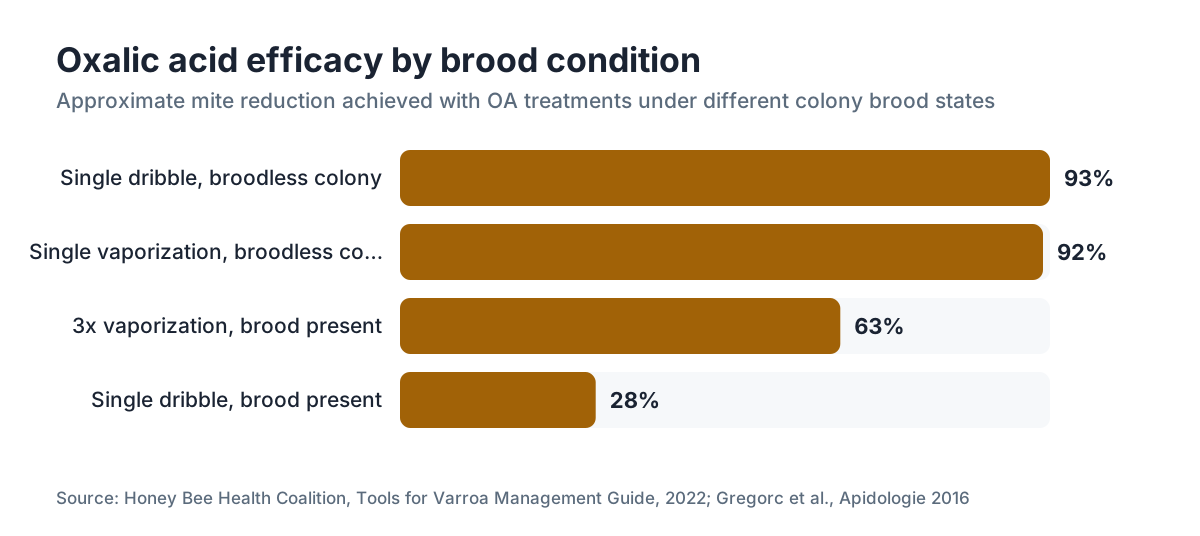
Brood condition at treatment time decides almost everything. In a truly broodless colony, a single OA dribble or vaporization hits 90% or higher mite mortality across multiple studies. That's the headline number worth remembering.
A University of Florida study cited in the Honey Bee Health Coalition guide found dribble treatment of broodless colonies cut mite loads by more than 90% in winter conditions. [2] That matches or beats a single round of Apivar (amitraz strips) or Apiguard (thymol gel).
In brood-present colonies, a single OA treatment is close to useless because 80 to 90% of mites can be sealed in cells during peak season. [8] Repeated vaporization (three treatments at 5-day intervals is the standard) cuts loads by roughly 50 to 75% with brood present. That's real, but it won't rescue a colony that's already deep in a mite crisis.
| Scenario | OA Efficacy (approx.) | Source |
|---|---|---|
| Single dribble, broodless colony | 90-97% mite reduction | HBHC Varroa Guide, 2022 |
| Single vaporization, broodless | 90-95% mite reduction | HBHC Varroa Guide, 2022 |
| 3x vaporization, brood present | 50-75% mite reduction | Gregorc et al., 2016 |
| Single dribble, brood present | 15-40% mite reduction | Multiple EU studies |
OA also has no known resistance in varroa, which is a genuine edge over amitraz (Apivar) and synthetic pyrethroids (Apistan, CheckMite). After nearly 30 years of European use, there are zero documented cases of OA-resistant varroa populations. [7] No guarantee it stays that way, but it's a solid reason to keep OA in your rotation.
If you run more than a few hives, tools that track mite loads and time your treatments earn their keep. VarroaVault's free mite management calculators can help you decide whether your pre-treatment counts justify an OA-only plan or whether you need a longer-residual synthetic.
Where OA fits, plainly: use it for your winter broodless treatment every single year, use repeated vaporization as a summer knock-down after a split or swarm, and pair it with a longer-residual treatment when brood is present and mites are already high.
Can you vaporize oxalic acid with a homemade or unregistered vaporizer?
Yes, legally. The EPA label regulates the product, not the vaporizer brand. So you can use any vaporizer, homemade included, as long as you're vaporizing a registered product (Api-Bioxal or OxaVar) exactly per the label. [3]
The problem with homemade rigs is temperature control. Oxalic acid needs a 350 to 400 degree F range to sublime cleanly. Homemade vaporizers vary wildly in how well they hit and hold that window. Run the pan too hot and OA breaks down into formic acid and other byproducts, so you're no longer applying what the label describes. Commercial units like the Varomor, ProVap, and various 12V battery models are built to hold the right range.
The other practical headache is sealing the hive. OA vapor escapes fast. Most protocols say seal the entrance for 10 minutes after application. A poorly fitted vaporizer bleeds vapor before it ever deposits on bees.
Respirator and eye protection apply no matter what equipment you use, because those rules come from the product label, not from the vaporizer. You don't want to breathe OA vapor year after year. Wear the respirator every time. No exceptions.
You can find vaporizers and other gear through reputable beekeeping supply companies that stock EPA-compliant products.
What are the legal requirements for using registered oxalic acid products?
Registered OA products for beekeeping are General Use Pesticides under FIFRA. That means you don't need a pesticide applicator's license to buy or apply them. Any beekeeper can legally buy and use Api-Bioxal or OxaVar without certification, unlike some restricted miticides. [5]
You are still legally bound to follow the label in full. The label is a federal legal document, not a suggestion sheet. Deviating from it, whether by using a stronger concentration, treating with supers on, or exceeding the number of treatments, puts you in violation under FIFRA Section 12.
The requirements beekeepers miss most often:
- Wear the required PPE. The label mandates it. Skipping gloves or eye protection is a label violation, more than a bad idea.
- Keep the original container and label. You can't move OA into an unlabeled container and legally apply it.
- Dispose of containers per label directions. Empty Api-Bioxal bags go in regular trash in most states, but check your state's pesticide disposal rules.
- Record keeping isn't federally required for general-use pesticides, but many state apiary programs and some export certifications want treatment records. Build the habit: product name, EPA reg number, date, colony ID, method.
Some states require their own registration for pesticides sold inside state lines. A product with a valid EPA registration can still be restricted in a given state until that state registers it. Check with your state department of agriculture if you're unsure whether a specific OA product is legal where you live.
How do you mix and apply Api-Bioxal correctly for dribble treatment?
Dribble is the simplest OA method and the one with the longest research record. Here's the Api-Bioxal label protocol.
Mix 35 grams of Api-Bioxal powder into 1 liter of 1:1 sugar syrup (equal parts sugar and water by weight). That gives you a 3.5% oxalic acid solution, the labeled concentration. Don't go stronger. Higher concentrations damage bees without killing proportionally more mites. [3]
Apply 5 mL per occupied bee space (seam of bees), up to 50 mL per colony. A standard deep frame with bees on both sides is about two seams. You're dosing roughly a teaspoon per frame of bees. Too much liquid harms the colony and doesn't raise mite kill. Use a syringe or a squeeze bottle with a narrow tip so you control the volume.
The label allows one dribble treatment per year. If you think you need multiple rounds, you're probably treating outside the broodless window, where results will be poor anyway, and you should switch to vaporization instead.
Temperature matters a lot. Don't dribble when cluster temps drop below about 40 degrees F, because bees can't move to spread the OA among themselves. Don't dribble above roughly 70 degrees F either, because a loose cluster gives poor coverage. For most US climates, January through February is the window, when clusters are tight and brood is minimal to absent.
Mix only what you'll use in one session. The solution holds up for about a week refrigerated, but fresh is better because it degrades faster as it warms and ages.
How do you do repeated oxalic acid vaporization for a brood-present colony?
Repeated vaporization is the method most beekeepers now use in the active season, especially after splits or caught swarms when a colony may be briefly queenless or in a short broodless window. It's also the standard for extended summer treatment when you want to press on mites without waiting for a natural broodless gap.
Most university extension guides call for three vaporization treatments, spaced 5 to 7 days apart. [9] The logic is simple. Mites sealed in cells on day 1 emerge over the next 5 to 7 days, become phoretic, and meet the next treatment. Three rounds covers mites across roughly one brood cycle.
For Api-Bioxal vaporization, measure 1 gram of powder per brood box. A two-box colony gets 2 grams total. Seal the entrance and any big cracks before you start. Standard method: slide the vaporizer wand through the bottom entrance, activate it, wait out the heating cycle (usually 2 to 3 minutes for 12V battery units), then keep the entrance sealed for another 10 minutes after you pull the vaporizer. [3]
Let the hive air out before you open it. Don't stand in the drift of bees leaving right after treatment, because some vapor rides out with them.
A straight answer on limits: even with three rounds, you won't get the mite kill in a brood-present colony that you'd get broodless. If your alcohol wash reads above 2% infestation in summer, three rounds of vaporization alone may not be enough, and a longer-residual treatment like Apivar may fit better. OA vaporization is excellent maintenance and excellent for broodless periods. As a rescue for an established infestation, it works only in narrow cases.
If you want help matching a protocol to your current mite count and brood situation, VarroaVault's protocol planning tools are free.
Are there any risks or downsides to oxalic acid treatments beekeepers should know about?
Yes. OA isn't a perfect solution, and here's the honest list.
Queen effects. Some beekeepers report queen losses after dribble treatment, mostly in small colonies or when they treat at temperatures where bees can't cluster well. The evidence is mixed. European studies generally find little queen mortality when protocols are followed, but anecdotal US reports suggest real risk in certain setups. Colonies with fewer than four frames of bees seem more vulnerable. [10]
Bee mortality with overdose. Exceed the labeled rate, especially with dribble, and you kill bees outright. OA is toxic to bees above certain concentrations, and the label rate balances mite kill against bee safety. Don't chase efficacy by doubling the dose.
No systemic activity. Amitraz gets picked up and spread among bees to some degree. OA is purely contact-based. Bees in parts of the hive the vapor or liquid never reached get no treatment at all. That's why sealing the hive during vaporization matters.
Repeat treatments wear colonies down. There's evidence that very frequent vaporization (more than three rounds) in a short window stresses colonies measurably. The label limits exist partly for that reason. Stick to the labeled intervals and counts.
Humidity and weather. OA dribble in cold, wet weather can chill a cluster. Check the forecast. A calm day above 45 degrees F is the target for late-winter broodless dribble across most US regions.
Human exposure. The occupational risk is real. NIOSH classifies oxalic acid as a respiratory and skin irritant. [6] Use the respirator. Treat dozens of hives and vaporization exposure stacks up fast without proper PPE.
How does oxalic acid fit into a full-year varroa management plan?
OA on its own isn't a full varroa plan. But it fills one role no other registered treatment covers as cleanly: the broodless-period knock-down.
Here's how experienced beekeepers slot OA into the year. In late fall, after supers come off and brood winds down, run an alcohol wash to confirm mite levels. If mites sit at or above 2% heading into winter, treat with OA dribble or vaporization during the true broodless period (roughly December through February across most of the continental US, depending on latitude). Timed right, this single winter treatment can cut mite populations by more than 90% and hand your colonies a clean start in spring. [2]
In spring, monitor with alcohol washes every 4 to 6 weeks once brood builds up. If mites stay below threshold (around 2% in spring, maybe 1 to 1.5% in late summer depending on whose numbers you trust), you can manage with OA vaporization rounds after splits. If mites spike mid-season, that's when a longer-residual treatment like Apivar becomes necessary, because OA alone won't get you there fast enough.
The Honey Bee Health Coalition's varroa guide, the closest thing US beekeeping has to a consensus protocol, recommends OA for winter broodless treatment and as part of an integrated pest management rotation to slow resistance in other chemical classes. [2]
The rotation principle: if you use amitraz (Apivar) in fall, use OA in winter. If you use OA vaporization on summer splits, give amitraz a rest that year. Nobody has clean data on resistance timelines, but the precautionary logic holds, and it's cheap insurance since OA costs far less per treatment than the synthetics.
For sourcing treatments and gear, start with beekeeping supply companies that specialize in varroa tools.
Where can you buy EPA registered oxalic acid products and how much do they cost?
Api-Bioxal sells through most major US beekeeping distributors. As of 2024-2025, retail pricing runs roughly like this.
| Product | Typical Package | Approximate Price | Treatments per Package |
|---|---|---|---|
| Api-Bioxal | 35g | $15-20 | 1 dribble treatment (10-20 colonies) OR ~10-15 vaporizations |
| Api-Bioxal | 175g | $50-65 | 5 dribble treatments or proportionally more vaporizations |
| OxaVar | 50g | $18-25 | Similar to Api-Bioxal 35g |
| Oxybee | 300mL | $25-35 | Variable based on colony count |
Prices swing by supplier and region. Online distributors, including some that run free shipping honey bee supply companies deals, can cut per-unit costs if you're buying for a bigger operation.
Oxalic acid is one of the cheapest effective varroa treatments you can buy. A single 35g package of Api-Bioxal can treat a hobbyist's whole apiary (say, 5 to 10 hives) for a winter broodless round at about $1.50 to $2.00 per colony. Apivar runs roughly $5 to $7 per colony per treatment and Apiguard around $4 to $6. OA's cost edge is hard to argue with.
Skip the unlabeled or foreign online sources. The savings per hive are trivial, and an unregistered product is illegal and potentially unsafe, because you can't verify its purity or concentration.
Frequently asked questions
Do I need a pesticide license to buy and use Api-Bioxal?
No. Api-Bioxal and other registered oxalic acid products for beekeeping are General Use Pesticides under FIFRA, so any adult beekeeper can buy and apply them without a certified applicator license. You still must follow the label exactly; the label is a federal legal document. Some states add registration steps for specific products, so confirm with your state department of agriculture if you're unsure.
Can I use raw oxalic acid powder from a hardware or woodworking supply store on my bees?
No, not legally. Raw oxalic acid sold for wood bleaching or industrial use is not EPA registered for honey bee colonies. Using it violates FIFRA no matter how pure or similar it is to Api-Bioxal's active ingredient. The registration process includes bee safety, residue, and worker exposure data that raw products never went through. Stick to Api-Bioxal or another registered product.
How many times can I treat with oxalic acid per year?
For dribble, the Api-Bioxal label allows one treatment per year. For vaporization, the label allows multiple treatments, usually read as three applications at 5-day intervals per treatment event. You can run more than one vaporization event per year if needed, though frequent application stresses colonies. Always read your current product label, since instructions can change when EPA reviews the registration.
Does oxalic acid kill mites in capped brood cells?
No. Oxalic acid is a contact miticide with no meaningful penetration through cell cappings. Mites sealed in brood cells survive OA treatment. This limitation shapes every OA protocol: dribble works best in truly broodless colonies, and vaporization has to be repeated over multiple rounds to catch mites as they emerge from cells and become phoretic on adult bees.
What PPE is required when applying oxalic acid by vaporization?
The Api-Bioxal label requires chemical-resistant gloves (nitrile works), protective eyewear, and at minimum an N95 respirator for dribble. For vaporization, a full-face respirator with an organic vapor and particulate cartridge (OV/P100) is strongly recommended and appears in many label interpretations. Repeated unprotected exposure to OA vapor ties to respiratory irritation and possible long-term lung effects. Don't cut corners here.
Can oxalic acid be used in a hive with honey supers on for harvest?
No. The Api-Bioxal label prohibits application when honey supers are present and intended for human consumption. Treat after supers come off in fall, or treat overwintering colonies before adding spring supers. European safety data suggests OA residues return to background levels fairly quickly, but the US label restriction stands and must be followed to stay legal.
What's the difference between Api-Bioxal and OxaVar?
Both are EPA-registered oxalic acid products for varroa, and both allow dribble and vaporization. Api-Bioxal (EPA reg. 84449-1) has the longer US registration history and the most published supporting data. OxaVar (EPA reg. 84449-2) is a competing product with essentially the same active ingredient and similar label requirements. For most beekeepers, pricing and availability through your preferred supplier is the real difference.
Is there varroa mite resistance to oxalic acid?
As of 2025, no documented cases of OA-resistant varroa exist anywhere, despite nearly 30 years of use in European apiaries. The physical, contact-based mechanism makes resistance less likely to evolve than with systemic chemicals. That said, resistance is never impossible under sustained selection pressure, which is one reason rotating chemical classes stays smart even with OA.
How long after a dribble treatment can I add honey supers?
The Api-Bioxal label lists no numeric pre-harvest interval. It says no supers during treatment. Once you've finished treatment and the supers you intend to harvest are not yet on the hive, you're in compliance. EU research suggests OA residues return to natural background within weeks to a few months in warm conditions. In practice, treating in late fall or midwinter means supers go on in spring well past any residue concern.
What temperature range is safe for oxalic acid dribble treatment?
Most guidance, including university extension recommendations, targets a cluster temperature where bees are tight enough for good coverage but not so cold they can't spread the treatment. Roughly 40 to 55 degrees F ambient is the practical sweet spot for most US winter treatments. Avoid below 40 degrees F (poor distribution, chilling risk) or above about 65 to 70 degrees F (loose cluster, likely brood, and dribble efficacy drops sharply).
Can I use oxalic acid on nucleus colonies or packages?
Yes. The Api-Bioxal label allows spray for packages and swarms not yet on drawn comb, and dribble or vaporization for nucleus colonies with drawn comb. Nucs and new packages are often broodless or nearly so, which makes them ideal OA candidates. A nuc that's broodless after a swarm or split can take a highly effective OA treatment with strong mite kill.
How do I know if my oxalic acid treatment worked?
The best check is an alcohol wash or sticky board count before and after. Run a baseline wash 3 to 7 days before treatment (at least 300 bees per sample), treat, then retest 5 to 7 days after the final round. A successful winter OA treatment in a broodless colony should drop phoretic mite load by 90% or more. If post-treatment counts stay high, check whether the colony had brood you missed, or whether coverage was inadequate.
What happens if I accidentally overdose a colony with oxalic acid?
Overdosing with dribble causes direct bee mortality. Bees hit with above-label OA concentrations show higher mortality, disorientation, and possible queen loss. If you over-applied, don't retreat. Give the colony time to recover, provide enough food, and monitor closely. There's no antidote. Prevent it by measuring carefully and holding strictly to the 5 mL per bee seam, 50 mL maximum rule. Overdosing doesn't kill more mites; it just harms bees.
Sources
- EPA, Pesticides program overview: Oxalic acid is a naturally occurring organic acid registered for varroa mite control in honey bee colonies
- Honey Bee Health Coalition, Tools for Varroa Management Guide (2022 edition): Broodless-period dribble treatment with OA achieves over 90% mite reduction; repeated vaporization in brood-present colonies reduces loads 50-75%; OA recommended as component of IPM rotation
- Api-Bioxal EPA Label, Registration No. 84449-1, Véto-pharma: Api-Bioxal label authorizes dribble (3.5% OA, 5 mL per seam, max 50 mL), spray for packages/swarms, and vaporization (1 gram per brood box); no supers present; PPE required
- EPA, Pesticide product and registration information: Oxybee uses a glycerine-based OA formulation registered for dribble application; OxaVar allows dribble and vaporization
- US EPA, Pesticide registration and FIFRA overview: Using an unregistered pesticide on honey bee colonies is a federal violation under FIFRA; Api-Bioxal and OxaVar are General Use Pesticides not requiring a pesticide applicator license
- NIOSH (CDC), occupational chemical safety documentation: Oxalic acid is classified as a respiratory and skin irritant with recommended respiratory protection during occupational exposure
- European Food Safety Authority (EFSA), scientific opinion on oxalic acid: OA treatments do not cause honey residues above naturally occurring background levels when used correctly; no OA-resistant varroa populations identified after decades of EU use
- Rosenkranz P, Aumeier P, Ziegelmann B. Biology and control of Varroa destructor. Journal of Invertebrate Pathology, 2010: During peak brood season, 80-90% of varroa mites are in sealed brood cells at any given time, limiting efficacy of contact-only treatments
- University of Florida IFAS Extension (EDIS), varroa mite management: Standard repeated vaporization protocol is three treatments at 5-7 day intervals to address mites across one brood emergence cycle
- Gregorc A, et al. Oxalic acid treatment efficacy studies. Apidologie, 2016: Repeated OA vaporization in brood-present colonies reduced mite loads approximately 50-75%; some queen loss risk reported in small colonies with overdose or cold-weather dribble application
- Penn State Extension, varroa mite treatment options: OA dribble in broodless colonies can achieve 90-97% mite reduction; protocol guidance for seasonal OA use in integrated varroa management
Last updated 2026-07-09