Oxalic acid treatment in February: what actually works
TL;DR
- February is often the best window for oxalic acid because many colonies in temperate climates run brood-free or nearly so, which lets a single application kill more than 90 percent of varroa.
- Dribble or vaporize by the EPA-registered label.
- One treatment per brood-free period is the rule.
- Check the cluster, not the calendar.
Why is February a good time to treat bees with oxalic acid?
Oxalic acid kills varroa riding on adult bees. It cannot reach mites reproducing under capped brood. That one biological fact makes timing everything.
In most of the United States and Canada, colonies hit their annual brood minimum somewhere between late December and late February, depending on latitude and that winter's weather. A colony that has stopped or nearly stopped rearing brood is a closed system of exposed mites, and a well-timed oxalic acid treatment knocks out most of them in one shot.
The Honey Bee Health Coalition's Tools for Varroa Management guide puts it plainly: oxalic acid is "most effective when applied during broodless periods." [1] When researchers test a single treatment on genuinely broodless colonies, kill rates above 90 percent are common. When brood is present, even a heavy treatment misses the mites locked inside cells, and populations rebound within weeks.
February sits in that sweet spot for most keepers in USDA hardiness zones 5 through 8. It's cold enough that the queen has often been off-lay for weeks, but the colony is alive and still has enough adult bees to treat. Further south, the broodless window may pass in January or never open at all. Further north, it may run into March. Check your hive, not your calendar.
How do you know if your colony is broodless enough to treat?
You don't need a perfectly broodless colony to benefit, but get as close as you can. The direct test is an inspection on a day warm enough to crack the lid without chilling the cluster. Look for capped cells with the slight dome of worker brood. A solid patch the size of your palm or larger means enough mite-sheltering cells that one treatment leaves a real mite population behind.
For the dead of winter, use temperature and population as stand-ins. If daytime highs have stayed below 50 degrees Fahrenheit (10 degrees Celsius) for three or more weeks, a typical colony in a single-story overwintering setup has probably been broodless or near-broodless for most of that stretch. It's not a guarantee. It's reasonable inference when opening the hive would do more harm than good.
Some keepers run a sugar roll or alcohol wash on a 300-bee sample before treating, to confirm mites are actually there. If your pre-winter count was high (above 2 mites per 100 bees) and you didn't treat well in fall, February treatment isn't optional. It's the difference between a colony that builds strong in spring and one that dies in April, right when you're counting on it. For background on the pest itself, see our piece on the varroa mite.
There's one place you genuinely can't get a broodless window: the deep South and parts of California, where strong colonies may never stop laying. In those climates you need extended oxalic acid methods (a slow-release approach is under active research) or multiple vapor applications timed to the brood cycle. Ask your local extension apiarist about regional protocols.
What are the EPA-registered methods for applying oxalic acid to bees?
As of 2025, the EPA registers oxalic acid dihydrate for three application methods in honey bee colonies: dribble (trickle), vaporization (sublimation), and sponge/extended-release. The first two are what most hobbyists and sideliners use. Each has a registered product label you must follow. Using oxalic acid in any way the label doesn't describe is a federal pesticide violation under FIFRA. [2]
The most widely used registered product in the U.S. is Api-Bioxal (Veto-Pharma). The label specifies:
- Dribble: 50 mL of a 3.5% oxalic acid solution (dissolve 35 g of Api-Bioxal in 1 liter of 1:1 sugar syrup by weight) applied directly onto bees, 5 mL per occupied seam, maximum 50 mL per colony, once per treatment period. [3]
- Vaporization: 1 gram of Api-Bioxal crystals per brood box, vaporized with a registered device, maximum 3 treatments per year at minimum 5-day intervals. [3]
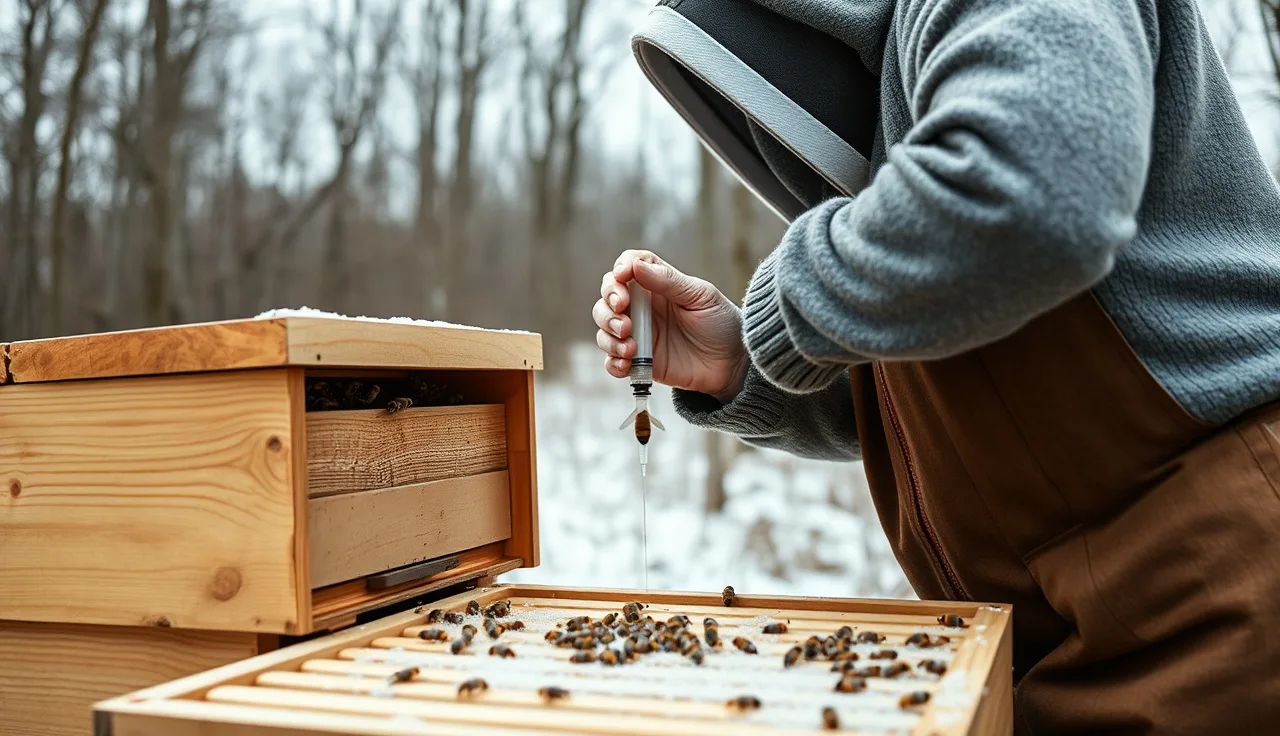
For a broodless February colony, the dribble is simple and cheap and needs nothing beyond a syringe. Vaporization reaches bees the dribble misses in corners and clusters, and you don't have to open the hive to do it. That's a real edge in cold weather.
Here's how to vaporize: insert the wand through the entrance or a small hole in the bottom board, add the measured Api-Bioxal dose to the pan, seal entrances and gaps with foam to hold the vapor for 1 to 2 minutes, then wait 10 minutes before reopening. Wear an N95 or P100 respirator, safety glasses, and gloves. The vapor irritates mucous membranes. Take it seriously. [3]
For the dribble, warm the solution to room temperature first. Cold syrup doesn't flow well and chills the cluster. Trickle it along the seams between frames where the bees actually sit, never on empty frames. A 300-bee cluster in February might occupy only 3 or 4 seams. Treat those and leave the rest.
Dribble vs. vaporization in February: which method is better?
Honest answer: vaporization edges out dribbling for February specifically. Three reasons.
Vapor gets into the cluster without opening the hive. Opening a hive in February, even briefly, drops cluster temperature and forces bees to burn energy rebuilding warmth they need to reach spring. The dribble requires at least a partial opening to find and reach the occupied seams.
Vapor also reaches bees on the edge of the cluster that a dribble skips. A February cluster can be a tight ball wedged in one corner. The dribble only touches bees it physically lands on. Vapor circulates through the whole cluster space.
And the efficacy is a wash. A 2017 University of Florida study found no statistically significant difference in mite drop between dribble and vaporization on broodless colonies, but temperature management during treatment mattered a lot. [4] Since cluster disturbance is the winter problem, that tips the practical advantage to vapor.
Dribble still has real strengths. It costs almost nothing beyond a syringe and the solution. No $150 to $300 vaporizer required. If you run one or two hives and cost matters, a careful dribble on a mild February day (above 40 degrees Fahrenheit, ideally above 45) is a legitimate choice. See beekeeping supplies if you're pricing equipment for a small operation.
Run ten or more hives and the vaporizer pays for itself in time within a single season, and the lighter colony disturbance makes it the clear call for February.
What is the correct oxalic acid dose for February treatment?
Dose is where label compliance really earns its keep, because both directions hurt. Under-dose and mites live. Over-dose and you harm bees, especially queens.
Api-Bioxal dribble: 5 mL of 3.5% solution per occupied seam, not per frame. Maximum 50 mL per colony, any size. A standard 10-frame Langstroth overwintering in February usually occupies 3 to 6 seams, so you'll rarely touch the 50 mL cap. [3]
Api-Bioxal vaporization: 1 gram per brood box present. A single deep gets 1 gram. Two deeps get 2 grams. Don't exceed the label. Higher concentrations don't kill more mites, and they do measurably kill more bees at elevated exposure. [3]
You can buy the 3.5% dribble solution pre-mixed, but many keepers mix their own from food-grade oxalic acid dihydrate (Api-Bioxal) and 1:1 sugar syrup by weight. Get the ratio right: 35 grams of Api-Bioxal per liter of syrup. A kitchen scale accurate to 1 gram does the job.
Worth flagging: old forum advice and non-label protocols still float around suggesting higher concentrations or more frequent doses. Those aren't EPA-registered uses, and they carry a real risk of queen loss. The label is the law, and the label dose is the one the safety and efficacy data were built on.
How many times can you treat with oxalic acid in February?
For a genuinely broodless colony, once. Adding treatments in the same broodless window buys almost nothing and adds stress.
The Api-Bioxal label allows up to 3 vaporization treatments per colony per year, at least 5 days apart. For dribble, the label says once per broodless period. The logic behind the single dribble is simple: with no brood, one treatment reaches nearly every mite. No reservoir hides in capped cells to justify a follow-up.
If you're vaporizing and you're not sure the colony is fully broodless, two treatments 5 days apart can be justified. A small patch of brood capped on day 1 will have emerged by day 5 to 7, exposing the mites that were inside. Some extension apiarists suggest this for early February when broodlessness isn't certain. By treatment 3, you're deep into diminishing returns.
After February, plan an alcohol wash or sticky board count in April as the colony starts building. If mites climb above 2 per 100 bees before your planned summer treatment, act early. One winter treatment resets the counter. It doesn't zero the game for the season.
Is oxalic acid safe to use in February when bees are clustered?
Yes, with reasonable precautions. Oxalic acid is organic and breaks down fast. Residue in honey stays low and sits near the oxalic acid honey already contains naturally. [5] The EPA's registration of Api-Bioxal rests on safety and efficacy data that includes winter treatment.
For the bees, the main February risk is chilling the cluster. If you dribble, keep the hive open under 2 minutes and work on a calm day above 40 degrees Fahrenheit. If you vaporize, you never open the hive, which removes most of the chilling risk.
For you, the vapor is the hazard. The Occupational Safety and Health Administration lists oxalic acid as an irritant to the respiratory tract, eyes, and skin. [6] Wear a fitted N95 or P100 half-mask respirator, not a simple dust mask. Add goggles and nitrile gloves for the minimum kit. Don't vaporize in a sealed space like a closed barn. Work with ventilation behind you so the vapor doesn't blow back into your face.
Queen safety comes up constantly in forums and rarely gets resolved. Some keepers report queen loss after treatment, but controlled studies haven't consistently shown higher queen mortality at label doses versus untreated controls. Over-dosing does correlate with queen problems. Stick to the label.
The Honey Bee Health Coalition's guide describes oxalic acid as having "low toxicity to bees when used as directed" and notes it's approved for organic operations. [1]
What equipment do you need to treat bees with oxalic acid in February?
For the dribble, very little: Api-Bioxal or a pre-mixed 3.5% solution, a 60 mL or 100 mL syringe or squeeze bottle for controlled application, a kitchen scale accurate to 1 gram if you mix your own, and basic PPE (gloves, eye protection). Equipment beyond the product itself usually runs under $15.
For vaporization, the key piece is a registered OAV device. Simple electrically heated wand vaporizers run about $30 to $60. Battery-powered commercial units built for treating many hives fast run $150 to $300 and up. The Varrox, ProVap, and various 12V wand vaporizers are common, and all must be used per the Api-Bioxal label. You'll also want foam or rags to seal the entrance during treatment, plus the respirator and goggles.
For mixing, use glass or stainless steel. Oxalic acid corrodes some metals over time. Label the container clearly and keep it away from food.
Starting out and pricing your first season? These tools belong in the budget alongside hive gear. Beekeeping supply companies can help you compare sources and prices. VarroaVault's free varroa management tools also track mite counts and treatment windows so you're not guessing when February rolls around.
One piece of gear that costs nothing: a notebook or spreadsheet to log treatment dates, colony size, estimated brood status, and post-treatment mite counts. Keepers who track this make better decisions year over year.
What mite infestation level justifies February treatment?
Treated well in late summer or fall, and your pre-winter count was below 1 mite per 100 bees? February treatment is reasonable insurance, not an emergency. Fall count above 2 per 100 bees and you're not sure the treatment worked? February treatment is urgent.
The Honey Bee Health Coalition recommends an action threshold of 2 mites per 100 bees (2 percent infestation) during brood rearing, and roughly the same threshold applies heading into winter. [1][10] A colony that enters winter above that level often doesn't make it to April, and if it does, the mite population explodes on the spring brood flush before you can respond.
Nobody has clean data on how mite populations shift through a typical North American winter, because it hinges on how much brood the colony raises. The closest read from published work: in a truly broodless colony, mite numbers don't grow over winter but they don't fall much either. You're preserving whatever load walked in with the bees in November. Treating in February drops that load before spring amplification starts.
Skipped the fall count? Many first-year keepers do. Assume the colony needs treatment and treat. Treating a low-mite colony costs you almost nothing. Skipping a high-mite colony costs you the colony.
Oxalic acid efficacy: what do the numbers actually show?
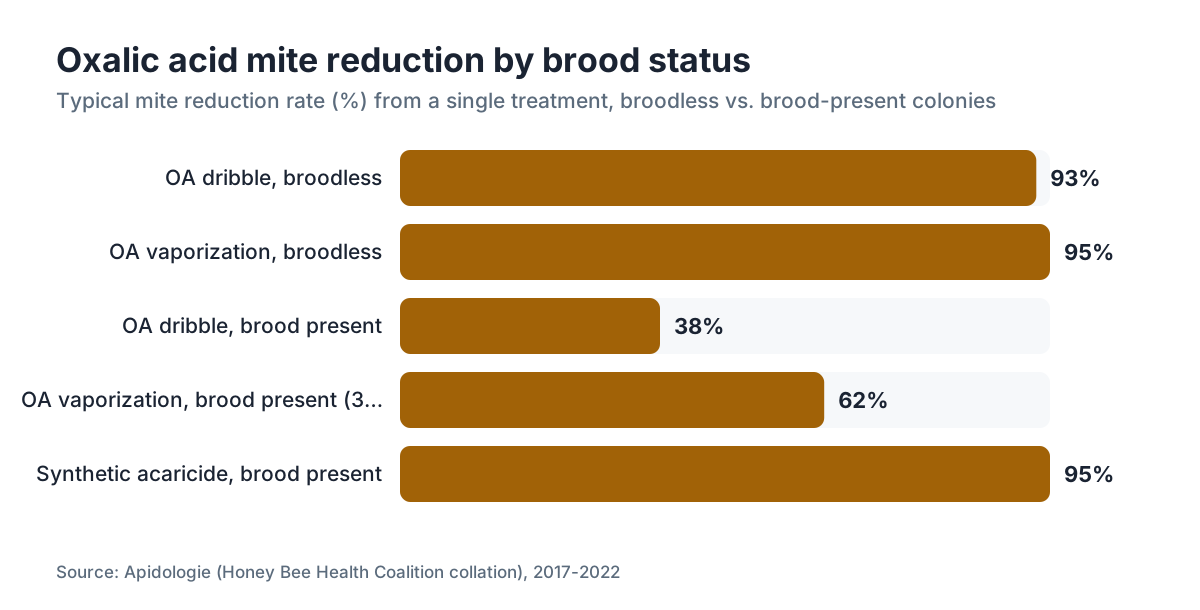
The data on oxalic acid in broodless colonies is among the strongest in varroa management. Peer-reviewed studies show 90 to 97 percent mite reduction when colonies are genuinely broodless at treatment. [4][7]
Add brood and efficacy falls off a cliff. A study in Apidologie found a single oxalic acid dribble cut mite infestation about 90 percent in broodless colonies but only 30 to 40 percent with substantial brood present. [7] That gap is the whole reason February timing matters.
Vaporization and dribble land close in broodless conditions, as noted. The real variable is execution: right dose, right seams, hive sealed properly for vapor. Sloppy technique bleeds efficacy fast.
Some resistance concern has surfaced in European mite populations, but as of 2024 there's no documented resistance to oxalic acid in North American Varroa destructor. The mechanism (oxalic acid disrupts the mite's cuticle function) differs enough from synthetic acaricides that cross-resistance looks unlikely, though monitoring continues. [8]
The table pulls together comparative efficacy from the literature and label.
| Method | Brood present | Typical mite reduction | Treatments needed |
|---|---|---|---|
| OA dribble | No | 90-97% | 1 |
| OA dribble | Yes (some) | 30-50% | Multiple needed |
| OA vaporization | No | 90-97% | 1-2 |
| OA vaporization | Yes (some) | 50-70% | 3 (label max) |
| Synthetic acaricide (e.g. Apivar) | Yes | 90-99% | Per label (6-8 weeks) |
Sources: Honey Bee Health Coalition [1], Apidologie [7], Api-Bioxal label [3].
What happens if you miss the February broodless window?
Missing the window doesn't cost you the year. It shifts your strategy.
If queens resume laying in late February or March and you've got capped brood, a single dribble or vaporization kills the phoretic mites and leaves the reproductive ones in the cells. Two options from there: accept the reduced efficacy of a single oxalic acid treatment and plan a harder spring intervention, or switch to an extended-treatment acaricide that reaches into brood cells, like Apivar (amitraz strips) or Formic Pro (formic acid).
Apivar is often the right call for a spring colony carrying brood and a high mite load. It's a 6 to 8 week treatment, works with brood present, and it's well studied. The catch: you can't use it during a honey flow because of residue, so you have to plan around your local nectar flow start date.
Staying with organic acids through spring is possible. Multiple oxalic acid vapor treatments timed to the brood cycle (3 treatments 5 days apart, repeated after capped brood emerges) can work, but it takes active management and careful attention to the label's annual limits.
What you can't do is ignore it. A colony heading into spring above 2 percent hits peak brood in April or May, and mite numbers can double every few weeks on that brood. By June you have a failing colony, and a failing colony gets robbed, which spreads mites to your other hives. For the full-season picture, VarroaVault's protocol builder maps out integrated management by region and hive count.
Does February oxalic acid treatment affect honey production?
For practical purposes, no. Oxalic acid is already in honey at low levels (roughly 8 to 9 mg/kg in European honeys, per European Food Safety Authority data [5]), and Api-Bioxal residues in treated colonies return to baseline within weeks.
Treating in February puts months between the treatment and your main honey flow, which usually starts April to June depending on region. The EPA registration specifically allows use in honey bee colonies, and the USDA National Organic Program allows oxalic acid in organic honey operations when used per label. [9]
The bigger effect on honey is indirect and positive. Colonies with controlled mites in February build stronger in spring, produce more bees for the early-season population peak, and carry healthier fat body reserves in the forager population. Mite-stressed colonies with heavy deformed wing virus loads raise smaller, shorter-lived bees that forage poorly. February treatment is part of how you set up a productive summer.
One caveat on the dribble: sugar syrup can theoretically contaminate honey supers if any are on the hive. You almost certainly don't have supers on in February in most climates, but it's worth saying. Remove supers before treating, always.
Frequently asked questions
Can I use oxalic acid in February if my bees still have some brood?
You can, but efficacy drops hard. A single treatment on a colony with capped brood might cut mites only 30 to 50 percent, because mites inside cells stay untouched. If the brood patch is small (a few hundred cells), treat anyway and plan a vaporization follow-up in 5 days. With substantial brood, switch to a longer-acting treatment like Apivar that works regardless of brood.
What temperature is too cold to treat bees with oxalic acid?
For dribble, stay above 40 degrees Fahrenheit (4 degrees Celsius) to avoid chilling the cluster and to keep the syrup fluid. For vaporization, temperature matters less since you don't open the hive. Some keepers vaporize successfully well below freezing, though extreme cold can slow vapor distribution inside. Mild, calm days with no wind are ideal for either method.
How long does it take for oxalic acid to kill varroa mites?
Mite drop starts within hours and peaks over the first 24 to 72 hours. A sticky board under the hive during and after treatment shows the drop, a useful confirmation the treatment reached the cluster. Full kill of phoretic mites takes roughly 3 to 5 days. Mites sealed in brood cells at treatment are unaffected and emerge later with the adult bee.
Do I need a prescription or license to buy oxalic acid for bees?
In the United States, Api-Bioxal is an EPA-registered pesticide sold without a prescription for use in honey bee colonies. You must follow the label, which is legally binding. Some states have extra pesticide rules, so check with your state department of agriculture. Canada registers it under the Pest Control Products Act with requirements that differ by province. No veterinary prescription is required in the U.S. as of 2025.
How do I mix oxalic acid solution for the dribble method?
Dissolve 35 grams of Api-Bioxal in 1 liter of warm 1:1 sugar syrup (equal weights of sugar and water). Stir until fully dissolved. That gives you a 3.5 percent oxalic acid solution, the labeled concentration. Use a kitchen scale accurate to 1 gram. Mix fresh for each use and discard leftovers; don't store mixed solution for weeks. Label the container and keep it away from children.
Can oxalic acid vaporization harm the beekeeper?
Yes, without proper PPE. The vapor irritates the respiratory tract, eyes, and mucous membranes. OSHA lists oxalic acid as a hazardous substance. Always wear a fitted N95 or P100 half-mask respirator (not a dust mask), chemical splash goggles, and nitrile gloves. Never vaporize in an enclosed space without ventilation, and stand upwind of the hive entrance. Read the Api-Bioxal label safety section before your first treatment.
Is one February oxalic acid treatment enough for the whole year?
No. February treatment resets your mite load heading into spring, but varroa rebuild on spring and summer brood. Most keepers need at least one summer treatment, typically late July or August when drone brood drops, and possibly another in early fall before overwintering bees are raised. A February-only plan leaves summer colonies exposed during peak mite reproduction. Monitor mite levels monthly from April on.
Does oxalic acid work on varroa mites in drone brood?
No. Oxalic acid doesn't penetrate any capped cell, drone brood included. Varroa prefer drone cells, which stay capped 14 days versus 12 for worker cells, giving mites more time to complete reproduction. Some keepers use drone brood removal as a companion tactic in season, but that's a separate strategy. In February, drone brood is usually absent, which is one more reason the timing works.
What is the shelf life of Api-Bioxal after opening?
Unopened Api-Bioxal lasts as stated on the packaging, typically 2 to 3 years from manufacture. Once opened, store the dry crystals in a sealed container away from moisture, since oxalic acid draws water from the air. Don't store mixed solution; prepare only what you'll use in one session. Check the label for current storage guidance, as formulations vary slightly between production batches.
Can I treat nucleus colonies or small packages with oxalic acid in February?
Yes. Nucs overwinter on fewer frames, so the dose just gets smaller: treat only the seams the bees actually occupy. A 4-frame nuc cluster on 2 to 3 seams might take 10 to 15 mL total by dribble, well under the 50 mL cap. For vaporization, scale the dose to the single-box size (1 gram per box) and seal all gaps carefully, since nuc boxes often leak more air than full-size equipment.
Will oxalic acid treatment disturb a winter cluster significantly?
Dribble causes some disturbance because you open the hive. Vaporization causes very little, since the hive stays closed. Either way, bees usually resettle within 20 to 30 minutes. The bigger winter stressor is prolonged cold from an open hive, so work fast with the dribble and pick a calm, mild day. Vaporizing on a cold day with the hive sealed is genuinely less disruptive than most winter tasks.
Should I combine February oxalic acid treatment with winter feeding?
They're compatible but don't have to happen together. If you're feeding candy boards or fondant, you can still treat on the same day; just apply any dribble to bees, not to the candy board. Some keepers treat first, then add feed. Avoid dribbling over an open candy board that could absorb the solution and dilute the dose. With vaporization, the winter feeding setup has no real interaction.
How do I confirm my February oxalic acid treatment worked?
Place a sticky board or a sheet of paper coated in vegetable shortening on the bottom board before treatment. Check it 24 to 72 hours later for mite drop. You should see a clear spike in dead mites compared to baseline. A high drop confirms the treatment reached the colony. If the drop is low despite a known high mite load, the colony likely had brood sheltering mites, and you'll need a follow-up.
Sources
- Honey Bee Health Coalition, Tools for Varroa Management Guide: Oxalic acid is most effective when applied during broodless periods; described as having low toxicity to bees when used as directed and approved for organic operations.
- EPA, Federal Insecticide Fungicide and Rodenticide Act (FIFRA): Using a pesticide in a manner inconsistent with its labeling is a federal violation under FIFRA.
- EPA, Api-Bioxal (Oxalic Acid) Pesticide Registration Label: Api-Bioxal label specifies 5 mL per seam, max 50 mL per colony for dribble; 1 gram per brood box for vaporization; maximum 3 vaporization treatments per year at 5-day minimum intervals.
- University of Florida IFAS Extension, Oxalic Acid for Varroa Control: 2017 University of Florida study found no statistically significant difference in mite drop between dribble and vaporization on broodless colonies; temperature management during treatment mattered significantly.
- European Food Safety Authority, Scientific Opinion on Oxalic Acid in Beeswax and Honey: Oxalic acid naturally occurs in honey at approximately 8 to 9 mg/kg; Api-Bioxal residues in treated colonies return to background levels within weeks of treatment.
- OSHA, Oxalic Acid Hazard Summary: OSHA lists oxalic acid as an irritant to the respiratory tract, eyes, and skin; recommends appropriate respiratory protection.
- Apidologie, Oxalic Acid Efficacy in Broodless vs. Brood-Present Colonies: Single oxalic acid dribble reduced mite infestation by approximately 90 percent in broodless colonies and only 30 to 40 percent in colonies with substantial brood.
- USDA Agricultural Research Service, Varroa Mite Research: As of 2024, no documented resistance to oxalic acid in North American Varroa destructor populations; mechanism differs from synthetic acaricides making cross-resistance unlikely.
- USDA National Organic Program, Allowed Materials for Organic Beekeeping: The USDA National Organic Program allows oxalic acid in certified organic honey bee operations when used according to label directions.
- Pennsylvania State University Extension, Varroa Management in Honey Bees: Action threshold of 2 mites per 100 bees (2 percent infestation rate) recommended during brood-rearing season and as an indicator for pre-winter treatment need.
Last updated 2026-07-09