Formic acid pads for bees: how they work and when to use them
TL;DR
- Formic acid pads (sold as Mite Away Quick Strips or MAQS) are EPA-registered gel pads that release formic acid vapor inside the hive and kill varroa mites, including mites hiding under capped brood.
- They work between 50°F and 85°F, need no honey super removal, and finish in 7 days.
- The main risks are queen loss and bee kill in heat.
What are formic acid pads and how do they work against varroa?
Formic acid pads are gel-matrix strips you lay directly on the top bars of a brood box. The gel releases formic acid as a vapor over about 7 days. That vapor slips into capped brood cells, and that is the whole reason formic acid stands apart from most other varroa treatments. It reaches phoretic mites riding on adult bees AND reproductive mites sealed inside brood cells. Oxalic acid, by contrast, barely touches mites under cappings.
The active ingredient is formic acid, the same organic acid that shows up naturally in honey at low levels. The EPA registers Mite Away Quick Strips (MAQS), made by NOD Apiary Products, as the main commercial pad product for U.S. beekeepers. The label lists the active ingredient at 68.2% formic acid by weight [1].
Vapor concentration inside the hive does the killing. Acid volatilizes off the gel surface and diffuses down through the frames. Mites are more sensitive to that vapor than bees are, so a correct dose knocks down a big share of the mite population without taking the colony with it. No single treatment hits 100%, and MAQS is no exception.
For why varroa is the central threat to colony survival, see our overview on the varroa mite.
What is the difference between MAQS and other formic acid strips for bees?
In the U.S. market, MAQS (Mite Away Quick Strips) and Formic Pro are the two registered formic acid pad products. Both come from NOD Apiary Products and both use a gel matrix. They differ in how you apply them.
MAQS is a 7-day single treatment with two strips applied at once. Formic Pro runs longer and cooler: two 14-day treatments with a 7-day break between them, or a single 14-day treatment in cooler conditions. That slower release is gentler on bees and queens, especially in jumpy spring or fall weather, because the peak vapor on any given day is lower.
Here is a quick comparison:
| Feature | MAQS | Formic Pro |
|---|---|---|
| Application time | 7 days | 14 days (single) or 14+14 days |
| Strips per treatment | 2 simultaneously | 1 strip, then 2nd strip later (protocol varies) |
| Temperature window | 50 to 85°F | 50 to 79°F (single strip phase) |
| Honey super allowed? | Yes | Yes |
| Queen risk | Moderate (higher in heat) | Lower |
| Registered for U.S.? | Yes (EPA Reg. No. 83923-1) | Yes |
Both products need a valid EPA registration and must be used to the label. Under FIFRA, the label is the law [2].
Outside the U.S., formic acid gel products carry different brand names in Canada and Europe, and the concentration or matrix may differ. If you're ordering, start by finding a beekeeping supply companies source that stocks the registered product for your country.
When should you use formic acid for bees?
Timing comes down to temperature, mite load, and your treatment calendar. The MAQS label sets an ambient range of 50°F to 85°F (10°C to 29°C) for the full 7-day run. Below 50°F the acid barely volatilizes, so it doesn't work. Above 85°F the vapor spikes and can kill brood, trigger emergency supersedure, or kill the queen outright [1].
That leaves two windows in most North American climates. Early spring, before the main nectar flow, works if temperatures hold reliably above 50°F. Late summer or early fall, after the honey harvest and while some brood is still around, is the other. Most beekeepers lean on the fall window. Mite loads peak in late summer as the colony population starts to shrink, and pushing counts down before the colony raises its winter bees is probably the single highest-payoff move on the whole calendar.
Don't trust the calendar alone. Test first. An alcohol wash or sugar roll showing 2 mites per 100 bees (2%) is the common threshold where most extension programs say treat. The Honey Bee Health Coalition suggests treating at 2 mites per 100 bees during the brood-rearing season and at 1 per 100 heading into winter [3]. If your count sits below threshold in good formic acid weather, you can wait. If it's 5% or higher in August, treat now, no matter what else is going on.
The Honey Bee Health Coalition's Varroa Management guidance puts it plainly: mite control late in the season protects "the bees that must survive the winter," which is why the late-summer window matters so much [3].
How do you use formic acid strips for bees, step by step?
Read the whole label before you open the package. That isn't filler advice. The MAQS and Formic Pro labels carry specific instructions that differ from older application guidance floating around online, and following the label is a legal requirement.
For MAQS (7-day protocol), here is the basic process:
- Check ambient temperature. It must sit between 50°F and 85°F for the full 7-day period. If a heat wave is in the forecast, wait.
- Put on chemical-resistant gloves and a respirator. Formic acid vapor irritates the airways. Nitrile gloves are not enough. Use thick rubber or neoprene.
- Open the outer wrap on site, never inside a vehicle or a closed room.
- Lay both strips flat on the top bars of the lowest brood box, spaced so they span the brood area. Rough side down, gel side up.
- Keep the entrance at its normal opening or a touch wider for ventilation. Restricting airflow concentrates the vapor and raises toxicity to bees.
- Don't open the hive during the 7-day treatment.
- After 7 days, remove and dispose of any leftover strip material per the label. The gel is usually mostly gone by then, but the cardboard backing stays behind.
For Formic Pro, the protocol uses a staged approach that allows cooler peak temperatures in the single-strip phase. Follow the exact label timing.
One practical note. Don't put full-dose strips on nucleus colonies or packages without cutting the dose as the label directs. A full 2-strip MAQS application on a 3-frame nuc can kill the colony.
What is the efficacy of formic acid pads compared to other varroa treatments?
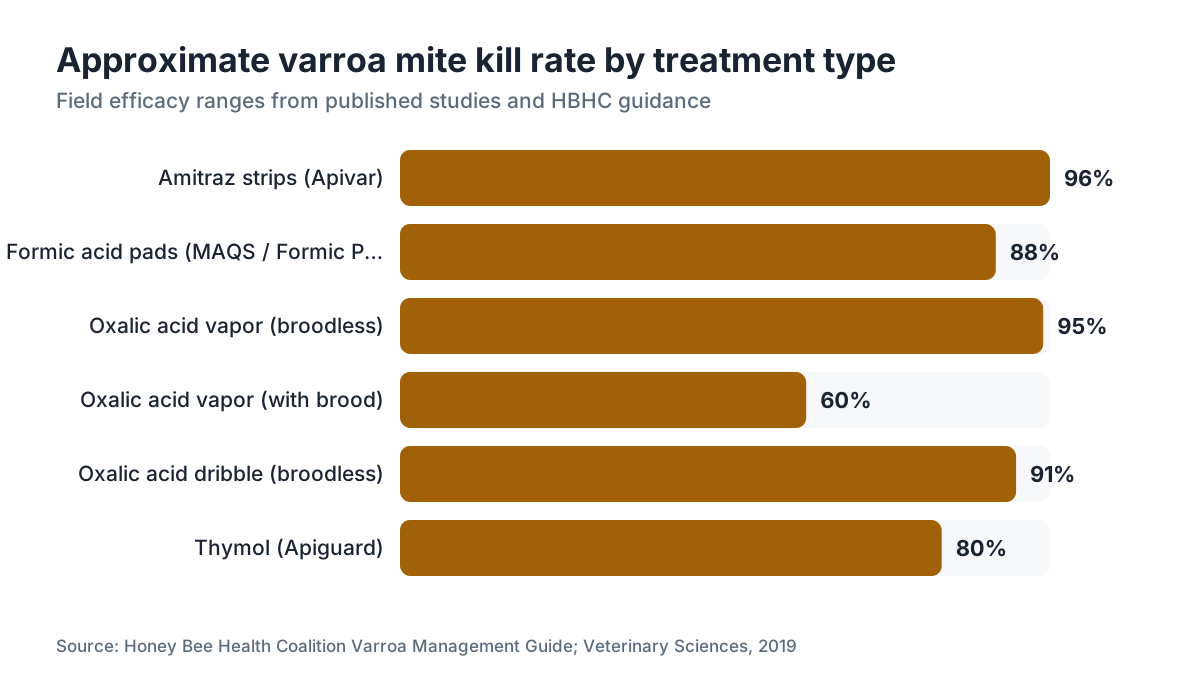
Efficacy shifts with the study, the hive, and the temperature during treatment. A 2019 review in the journal Veterinary Sciences reported MAQS mite kill in the 80 to 95% range under field conditions when temperatures held inside the label window [4]. That runs close to synthetic miticides like amitraz (Apivar), which typically shows 93 to 99% in field studies. Formic acid's edge is reaching mites under capped brood, something oxalic acid alone can't match in certain windows.
The Honey Bee Health Coalition's treatment comparison lists formic acid as one of only two organic acid options that hit both phoretic and reproductive mites [3]. The other is oxalic acid vapor, but OAV penetrates capped cells far less than formic acid vapor does.
A few honest caveats. High temperatures during treatment cut efficacy and raise bee mortality at the same time, so a heat spike mid-treatment is a real problem. Trials showing 90%-plus kill often run under controlled conditions, and real-world numbers in messy weather tend to land lower. And there is no documented resistance to formic acid in varroa populations, which matters a lot given the resistance beekeepers have seen with synthetics like fluvalinate [5].
Nobody has clean data on how efficacy tracks with colony strength. The working consensus among practitioners is that stronger colonies ride out the treatment stress better and finish with lower mite loads relative to their size.
What are the risks of formic acid treatments, and how do you reduce them?
Queen loss is the risk beekeepers fear most. Studies put queen loss with MAQS at roughly 5 to 15% depending on conditions, with the high end showing up in warm weather or small colonies [6]. The queen isn't uniquely sensitive to formic acid. She just sits in a spot with high vapor concentration, and brood stress near her can trigger supersedure. If you're treating a queen you can't afford to lose, use Formic Pro's gentler schedule or pick a window with steady temperatures in the 60s°F.
Higher-than-normal bee mortality is another known effect. Some beekeepers see a jump in dead bees at the entrance during the first 2 to 3 days. That's usually short-lived and the colony recovers. If it looks catastrophic (piles of bees, cluster collapse), pull the strips right away.
Brood kill can happen when it gets hot. If the hive interior spikes, formic acid can damage open and capped brood. Good ventilation and a screened bottom board help hold that down.
Protect yourself. Formic acid vapor at hive concentrations can cause eye and airway irritation or chemical burns on skin. The NIOSH permissible exposure limit for formic acid is 5 ppm over an 8-hour workday [7]. A dust mask gives you nothing here. You need an organic vapor respirator cartridge.
Don't leave opened packages in your car. The residual vapor turns the interior acrid within minutes and the acid corrodes metal.
Can you use formic acid with honey supers on?
Yes. That's one of the big draws of formic acid pads over synthetic treatments. Both MAQS and Formic Pro are registered for use with honey supers in place, because formic acid already occurs in honey and treatment doesn't push honey formic acid levels meaningfully above that natural background [1].
Data submitted for registration showed no meaningful rise in formic acid levels in harvested honey from treated colonies compared with untreated controls when applications followed label directions. The EPA accepted that data as part of the product registration.
Still, most experienced beekeepers treat after pulling honey supers for the year anyway, because late summer or fall lines up with the right mite-control timing. The no-super-removal allowance matters most for spring treatments during a flow, or for production colonies where pulling supers mid-season costs real money.
How do you know if the formic acid treatment worked?
You test. Run an alcohol wash or sugar roll 3 to 5 days after you pull the strips, or read a sticky board mite drop count. A sticky board under a screened bottom board for 24 hours during and right after treatment should show a big spike in mite drop over your pre-treatment baseline. That drop tells you the treatment is working. It does not tell you the final efficacy.
A real post-treatment count with an alcohol wash, done 7 to 10 days after treatment ends (so any remaining capped brood emerges and exposes its mites), gives you the number that matters: mites per 100 bees. If that count still sits at or above 2%, you either had a treatment failure (usually temperature-related), a very high starting infestation, or reinfestation from neighboring colonies.
Reinfestation is real and underrated. A colony can pull in hundreds of mites over a few weeks from drifting or from robbing a collapsing hive nearby. If your post-treatment count rebounds fast, look at what's happening across your apiary and at any feral colonies within a mile or two.
VarroaVault has a free mite tracking worksheet in its varroa tools section to log pre- and post-treatment counts and spot reinfestation trends across colonies.
How does temperature affect formic acid strip performance?
Temperature is the biggest lever in formic acid treatment, more than with any other common varroa product. The relationship isn't linear. Efficacy and bee toxicity both climb with heat, so the sweet spot is a narrow band where vapor runs high enough to kill mites but not so high that it harms bees and queens.
Below 50°F, the gel has low vapor pressure and volatilizes slowly. You get poor penetration and poor mite kill. Above 85°F, vapor pressure spikes and the hive interior can hit concentrations toxic to bees and lethal to queens, especially in cramped spaces or dark equipment that soaks up sun.
Here's the classic bind. You check the forecast, see 7 days of 70s, apply the strips, and day 4 hits 90°F. What now? Remove the strips. A partial treatment beats a dead colony. You can retreat once temperatures settle.
Formic Pro's staged application was built partly to handle exactly this. The first strip at a lower label limit (around 50°F for some phases) works better in cool spring or fall. Read the current label carefully, because these protocols have changed since first registration.
Hive color matters too. A black-painted brood box in afternoon sun can run 10 to 15°F above ambient air temperature. If your hives sit in full sun, your effective safe maximum is lower than the label's 85°F ceiling.
What do you do if a queen dies after a formic acid treatment?
First, confirm she's actually dead or gone. Check for eggs, young larvae, and the queen herself within 3 to 5 days after pulling the strips. If you find a fresh queen cell or a newly emerged queen, the colony may be handling supersedure on its own. A lot of apparent queen losses after formic acid are emergency supersedures that resolve without you lifting a finger.
If the colony is genuinely queenless with no viable cells, you have options. Introduce a mated queen from a backup colony or a purchase. Give the colony a frame of young larvae from another hive and let them raise an emergency queen. Or, late in the season, combine the queenless colony with a healthy queenright one over a newspaper layer.
Late-season queen loss is the scenario that worries beekeepers most. Raising or introducing a queen in September or October up north is hard, and the colony may not have time to build up before winter. That's one reason some beekeepers reach for oxalic acid dribble or vapor for fall treatments on fragile colonies, accepting the trade-off of no under-brood kill.
There's no solid data on what share of post-treatment supersedures succeed versus fail. Anecdotally, colonies seem to manage it fine in warm months and poorly in cool fall conditions, when drones for mating flights are scarce.
Are formic acid pads safe for bees at all colony sizes?
Colony size matters a lot. The standard 2-strip MAQS dose is set for a full colony: a double brood box, or a single deep with a strong population covering at least 8 frames. Put a full dose on a nucleus colony, a split, or a weak package and you can cause heavy bee and brood mortality.
The MAQS label does include a reduced-dose protocol for smaller colonies. It splits the two strips and applies one at a time with a gap between. Read the current label for the exact steps, because instructions have changed. Don't assume the single-strip dose is half as risky. Ventilation dynamics in a small colony mean vapor concentration per bee can still run higher.
Packages without established brood are especially vulnerable. Formic acid has nowhere to "go" in a broodless package and the vapor concentrates around the cluster. Most experienced beekeepers wait until a package has 3 to 4 frames of capped brood before any formic acid treatment.
Nucs built from splits can be treated, but pick Formic Pro over MAQS for those, and watch the entrance closely for the first 48 hours.
How does formic acid fit into a full-year varroa treatment protocol?
Formic acid pads work best inside a planned annual cycle, not as a fire extinguisher for a mite crisis. Here's how most university extension programs and the Honey Bee Health Coalition fold it in:
Spring: If mite counts hit threshold before the main nectar flow, a formic acid treatment in cool spring weather (55 to 70°F daytime highs) lets you treat without pulling supers or gutting the flow.
Summer: Skip formic acid when daytime temperatures regularly clear 85°F. This is where amitraz (Apivar strips) is often more practical, since it carries no temperature-ceiling risk.
Late summer or early fall: The primary window for most U.S. beekeepers. After harvest, before temperatures drop consistently below 50°F, with some brood still present to expose under-capped mites. Penn State Extension recommends treating in August and September across most mid-Atlantic and northeastern states [8].
Winter: Formic acid does nothing at typical winter temperatures. Oxalic acid by dribble or vaporization is the standard winter tool, best during a broodless stretch.
For hobbyists running a few hives, keeping your beekeeping supplies stocked ahead of the treatment window, protective gear and test kit included, is the difference between acting on time and scrambling when the count spikes.
VarroaVault's treatment protocol tools let you log counts by colony and build a treatment calendar for your climate zone, which takes some of the guesswork out of timing.
Frequently asked questions
How long do formic acid strips stay in the hive?
The MAQS 7-day protocol requires removing any leftover strip material after 7 days. In warm, humid conditions the gel often fully dissolves before day 7, but the cardboard backing remains and needs to come out. Formic Pro uses a 14-day single-treatment window or two 14-day phases. Never leave strips longer than the label says; the acid keeps releasing and can harm bees.
Can you use 65% formic acid liquid instead of commercial pads?
In the U.S., using bulk formic acid solutions as a hive pesticide without an EPA-registered label is illegal under FIFRA. Some beekeepers abroad use shop-grade formic acid with homemade pads, but dosing is very hard to control and the risks of queen loss and bee kill run higher. Stick with registered products that have tested, calibrated release matrices.
Do formic acid treatments leave residues in honey or wax?
Formic acid occurs naturally in honey. Treated colonies show no meaningful rise above natural background when label directions are followed, which is why both MAQS and Formic Pro are approved for use with honey supers present. Wax residue isn't a documented concern with formic acid, unlike synthetics such as fluvalinate, which can build up in beeswax over years.
What is the mite kill rate of formic acid pads?
Field studies report 80 to 95% mite kill with MAQS inside the label temperature window. A 2019 review in Veterinary Sciences found efficacy in this range across multiple field trials. Efficacy drops outside the window, especially above 85°F, and varies with colony size and starting infestation. A post-treatment alcohol wash is the only reliable way to confirm your own result.
Can formic acid pads kill a queen bee?
Yes, queen loss is a documented risk. Studies estimate 5 to 15% queen loss with MAQS, higher in hot weather or small colonies. The queen is often lost through emergency supersedure triggered by brood stress rather than direct toxicity. Formic Pro's slower release carries a lower documented queen loss rate. Checking for eggs 5 to 7 days after strip removal tells you whether she survived.
How many formic acid strips do you use per hive?
MAQS uses 2 strips applied at once per full-sized colony. A reduced single-strip dose is specified on the label for smaller colonies. Formic Pro uses a different staged protocol; check the current label for exact strip count and timing. Never double the dose thinking it improves efficacy. Higher doses raise queen and brood loss without proportionally better mite kill.
What personal protective equipment do you need to apply formic acid strips?
You need an organic vapor respirator (OV cartridge, not a dust mask), chemical-resistant rubber or neoprene gloves (nitrile isn't enough), and eye protection. Formic acid vapor irritates the airways and mucous membranes. NIOSH sets the permissible exposure limit at 5 ppm over 8 hours. Apply outdoors, open the package with your face turned away, and never apply in an enclosed space.
When is it too hot to use formic acid strips?
The MAQS label sets an 85°F upper limit for ambient temperature across the full 7-day treatment. Formic Pro's single-strip phase uses a lower limit around 79°F for certain protocols. If temperatures pass the limit mid-treatment, remove the strips right away. Dark-painted hives in direct sun can run 10 to 15°F above ambient, so your practical safe maximum air temperature may sit several degrees below the label limit.
Can you use formic acid strips on a nucleus colony or package?
The full 2-strip MAQS dose is too strong for most nucleus colonies and should never go on a fresh package without established brood. The MAQS label includes a reduced-dose protocol for smaller colonies. For nucs, Formic Pro's gentler release is preferable. Packages without capped brood shouldn't be treated with formic acid; wait until 3 to 4 frames of sealed brood are present.
Does varroa develop resistance to formic acid?
No resistance to formic acid has been documented in varroa populations in the published literature to date. That contrasts with synthetics like fluvalinate and coumaphos, where resistance is widespread across many U.S. populations. Formic acid's mode of action, disrupting cellular metabolism through a simple organic acid, appears much harder for mites to adapt to than synthetic neurotoxins.
Where do you place formic acid strips in the hive?
Lay both strips flat on the top bars of the lowest brood box, centered over the brood area, gel side up. With a double brood box, some updated label protocols let you place one strip on each box's top bars. Check your specific product label for placement, since instructions have been revised since the original registration.
How soon can you add a honey super after a formic acid treatment?
Formic acid pads are registered for use with honey supers already in place, so there's technically no required waiting period. If you removed supers for treatment, most beekeepers wait 24 hours after strip removal to let residual vapor dissipate before adding supers, though the labels don't require it. Formic acid doesn't accumulate in honey at harmful levels when used as directed.
How do you dispose of used formic acid strip materials?
Dispose of used MAQS cardboard backings and any leftover gel as directed on the product label. In most cases, household trash is permitted because the residual acid content is very low after the 7-day period. Don't compost them. Wear gloves when handling used strips; residual gel can still irritate skin.
Can you use formic acid in winter?
No. Formic acid pads need ambient temperatures of at least 50°F for effective volatilization. In most winter climates the cluster stays warm, but ambient air runs below the functional threshold and the acid won't disperse properly through the hive. Winter mite treatment calls for oxalic acid, by dribble on the cluster or by vaporization, ideally during a broodless period.
Sources
- EPA, Mite Away Quick Strips (MAQS) Product Label, EPA Reg. No. 83923-1: MAQS contains 68.2% formic acid by weight; label specifies 50 to 85°F application window; approved for use with honey supers in place
- EPA, Federal Insecticide, Fungicide, and Rodenticide Act (FIFRA) overview: Pesticide labels are legally binding under FIFRA; using a product inconsistently with its label is a federal violation
- Honey Bee Health Coalition, Varroa Management Guide: Treatment threshold of 2 mites per 100 bees during brood season; timing guidance for late summer/fall to protect winter bees; formic acid listed as effective against both phoretic and reproductive mites
- Veterinary Sciences (MDPI), 2019, review of formic acid efficacy against Varroa destructor: MAQS achieved 80 to 95% mite kill rates in field trials conducted within label temperature parameters
- Milani, N., Apidologie, 1999, 'The resistance of Varroa jacobsoni Oud. to acaricides': Fluvalinate resistance documented in varroa populations; no resistance documented for formic acid
- Underwood, R. and Currie, R., Apidologie, 2004, on temperature and dose effects of formic acid on queen survival and mite mortality: Queen loss rates of 5 to 15% associated with formic acid treatments, increasing at higher temperatures
- NIOSH Pocket Guide to Chemical Hazards: Formic Acid: NIOSH permissible exposure limit for formic acid is 5 ppm as an 8-hour time-weighted average
- Penn State Extension, honey bee and varroa mite management resources: August, September recommended as primary formic acid treatment window for mid-Atlantic and northeastern U.S. states
- University of Minnesota Extension, honey bee and varroa management resources: Alcohol wash threshold of 2 mites per 100 bees triggers treatment during the brood season
- NOD Apiary Products, Formic Pro product information: Formic Pro uses 14-day extended release schedule with lower peak temperature limit than MAQS; reduced queen loss compared to 7-day protocol
- USDA AMS National Organic Program, Allowed and Prohibited Substances: Formic acid is listed as an allowed substance for use in organic livestock production when applied per the product label
- Imdorf, A. et al., use of organic acids for varroa control (organic acid vapor research): Formic acid vapor penetrates capped brood cells; formic acid naturally present in honey at low concentrations; treatments at label doses do not significantly raise honey formic acid levels
Last updated 2026-07-09