How many bees are in a half cup? The mite wash number explained
TL;DR
- A standard half-cup sample for a varroa mite wash holds about 300 adult worker bees.
- That number is the baseline for figuring infestation as mites per 100 bees.
- Sample fewer bees and your percentage reads high.
- Sample more and it reads low.
- The Honey Bee Health Coalition's Varroa Management Guide and most university extension protocols all use the 300-bee half-cup standard.
How many bees are actually in a half cup?
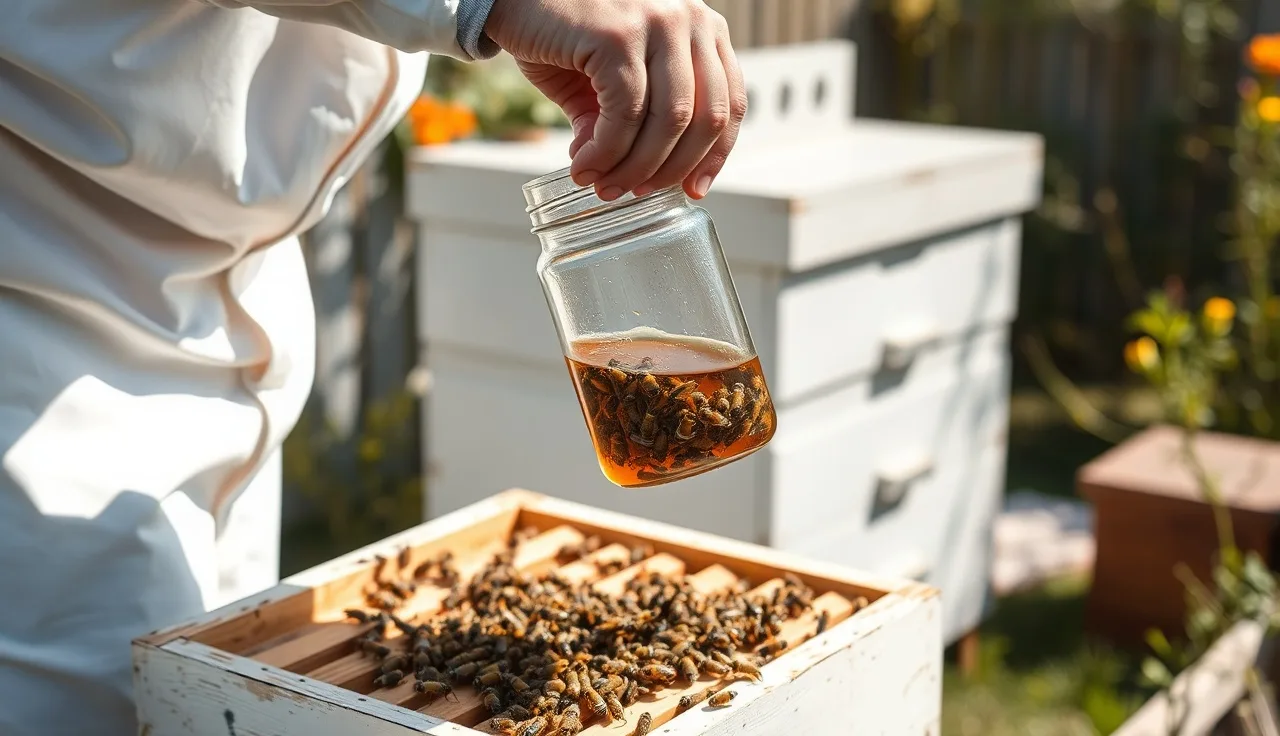
Roughly 300 worker bees. That figure comes from physical counts done during the development of standardized varroa monitoring, and the Honey Bee Health Coalition's Varroa Management Guide cites it as the accepted sample size for an alcohol wash or sugar roll [1]. Some sources say 200 to 300. Some say 300 to 350. The spread is real, because bee body size shifts with season, genetics, and how tightly the bees pack into the cup when you scoop.
The Bee Informed Partnership and several extension programs settled on half a cup (about 118 ml by volume) precisely because it captures close enough to 300 bees to keep the math clean [2]. You divide the mite count by 3 to get mites per 100 bees. That's the number that matters. Simple arithmetic, and it works only because the sample is standardized.
If you're measuring, use a standard US half-cup dry measuring cup. Purpose-built wash jars with mesh lids are sized to match that volume. Any given scoop lands somewhere between 250 and 350 bees in practice. That's fine.
What kills your accuracy is eyeballing a "small jar" or a "big scoop" without knowing the volume. A quarter cup of bees gives you a different number, and your mite percentage comes out wrong.
Why does the sample size matter so much for mite counts?
Because varroa infestation is expressed as mites per 100 bees, and that unit only works if your denominator is right. Published treatment thresholds are built around that same denominator [3]. Wash 150 bees, find 5 mites, and you calculate 3.3 per 100. Wash 300 bees at the same infestation density and you'd find about 10 mites and calculate the same 3.3. The rate matches. But only when your bee count is correct.
Here's the real-life failure. Beekeepers scoop, wash, count mites, and divide by 3 assuming they got 300. If they actually got 200, they divided by the wrong number and their rate looks lower than it is. That's how you miss a building infestation and walk into fall with a collapsing colony.
A half-cup scoop is also large enough to be statistically meaningful. Smaller samples swing more. Sample only 100 bees and one extra mite moves your rate a full percentage point. At 300 bees, each mite changes the rate by just 0.33 per 100. The bigger sample smooths out the noise [4].
The threshold most cited in the US is 2 to 3 mites per 100 bees during summer brood-rearing, and 1 mite per 100 in late summer before winter bees are raised [1]. Those numbers were calibrated against the 300-bee standard. Change your sample size without adjusting the math, and the thresholds stop applying cleanly.
What's the difference between an alcohol wash and a sugar roll for counting bees?
Both use the same half-cup sample. They differ in accuracy and in whether the bees survive. An alcohol wash kills all 300 bees and knocks mites loose very well. The Honey Bee Health Coalition reports alcohol wash detection at roughly 80 to 95 percent of the true mite load compared to dissection counts, which is why it's the reference method for monitoring [1].
A sugar roll coats the bees in powdered sugar so mites lose their grip and drop into a tray. The bees go back in the hive alive. The catch: sugar rolls undercount. They often detect only 60 to 70 percent of the mites an alcohol wash finds [5]. If sugar roll is your main method, drop your threshold, or switch to alcohol for any count that drives a treatment decision.
Feel bad about killing 300 bees? Those bees are about 0.1 percent of a healthy 10-frame colony. Losing them beats losing the whole colony to varroa. Call it the cost of knowing where you stand.
Soapy water is a middle option. It's gentler than isopropyl and still dislodges mites well. The USDA Beltsville Bee Lab and several extension services accept it as a valid field method [2]. Whatever liquid you pour in, the sample stays the same: half a cup, about 300 bees.
How do you collect a half-cup sample without counting individual bees?
You don't count them. That would take forever and rile up the hive. You use volume as a stand-in for count.
Here's the field method. Find a frame of open brood covered in nurse bees. Nurses carry the highest share of phoretic mites, the ones riding on adult bees instead of hiding in sealed cells, so a nurse sample reads your true load most accurately [6]. Shake or brush the bees off that frame into a tub. Scoop a level half cup from the pile that lands in the bottom. Dump the scoop into your wash jar and go.
A few things to avoid. Don't scoop from a cluster that has the queen in it. Check quickly before you shake so she doesn't end up in the jar. Skip frames with no brood too, because those pull older foragers with lower mite loads and your count reads artificially clean [6].
Building your own wash jar takes three things: a jar with a tight mesh screen lid (8-mesh hardware cloth works), a half-cup measuring cup, and isopropyl alcohol at 70 percent or higher. Grab a kit from most beekeeping supply companies or piece it together yourself. The varroa mite monitoring page here runs through what a complete wash kit needs.
Does the time of year change how many bees are in a half cup?
Not in raw count per volume, no. But it changes which bees end up in your sample, and that changes what your number means.
Spring colonies are smaller. You may struggle to fill a half cup with nurse bees off one frame without risking the queen. Use two frames if you have to, but still scoop just one half cup from the combined pile. Spring rates run low because varroa builds alongside the bee population coming out of winter. A spring count is a baseline, not a final verdict.
Late summer is where the stakes peak. This is when colonies raise their winter bees, and those bees need to be nearly mite-free to carry the colony through to spring. University of Minnesota Extension recommends treating before September 1 in northern states if your count tops 1 mite per 100 bees [7]. That's tighter than the summer number, and it's tighter because of winter-bee biology.
Late fall and winter, most brood is gone. Nearly all mites are phoretic, riding adult bees. A wash in this window can look alarming because nothing is hidden in cells, but it also gives you an unusually honest read of the adult-bee mite burden. Some beekeepers run a winter cluster wash to check whether an oxalic acid treatment did its job [3].
How do you calculate your mite infestation rate from the wash?
Shake the jar hard with your wash liquid, then pour the liquid through a white tray or into a white-bottomed container where mites show up easily. Count every small reddish-brown oval. Those are your mites. Dead bees stay behind the mesh screen.
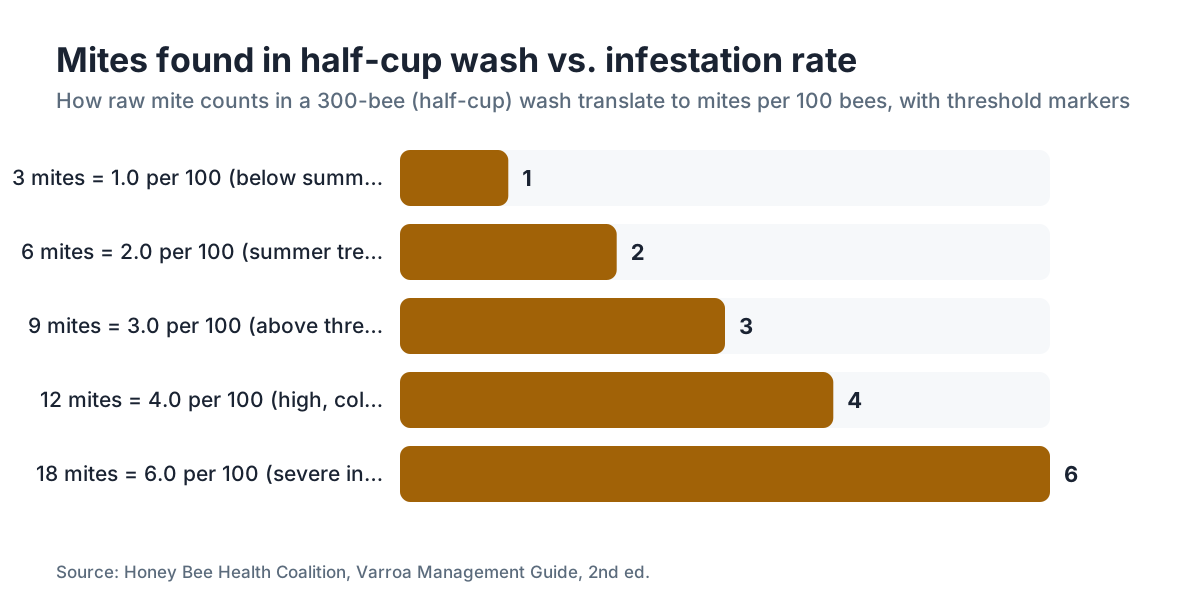
Divide the mite count by 3. That's your mites per 100 bees, assuming a standard half-cup sample of about 300 bees.
| Mites found in half-cup wash | Mites per 100 bees | Threshold status (summer) |
|---|---|---|
| 3 | 1.0 | Below treatment threshold |
| 6 | 2.0 | At treatment threshold |
| 9 | 3.0 | Above treatment threshold |
| 12 | 4.0 | High: treat immediately |
| 18 | 6.0 | Severe: colony at risk |
The summer threshold most US extension programs use is 2 mites per 100 bees, which is 6 mites in a half-cup wash [1][7]. Some researchers push for 2, some for 3. The Honey Bee Health Coalition guide puts it plainly: "Most experts recommend treating when mite levels reach 2 percent" in summer [1]. Draw your line there.
Late summer, the line tightens to about 1 mite per 100, or 3 mites in your wash, for the winter-bee reason above.
What can go wrong with a half-cup mite wash?
Plenty. Here are the failure modes worth knowing.
You scoop frames full of foragers. Foragers spend the day outside and carry fewer phoretic mites. Your count reads low, you skip treatment, and the mites keep breeding under the cappings. Target nurse bees on open-brood frames every time.
You don't shake long enough. Alcohol works fast, but you still need 30 to 60 seconds of hard shaking to pull mites out from between the abdominal plates where they wedge in. A short shake can leave 20 to 30 percent of mites clinging to the bees [5].
You water down your alcohol. Isopropyl at 70 percent is the floor. Weaker solutions don't kill bees fast enough to stop them grooming mites back on, and they don't dislodge as well. Skip witch hazel. Skip pre-diluted rubbing alcohol.
You sample during a dearth or right after treating. A recent oxalic or formic acid treatment has already knocked down the phoretic mites. Wash within a few weeks of that, and you're measuring the treatment's success, not your true baseline.
You forget to write down the date and result. One wash is a snapshot. Monitoring is a time series. Keep a log. The free mite tracking tools at VarroaVault flag trends across sampling dates so you're not doing the math by hand.
How often should you do a mite wash?
Every 30 days through the active season. That's the Honey Bee Health Coalition's recommendation, and it's a floor, not a ceiling [1]. If a colony ran close to threshold last month, sample it every two weeks.
A practical calendar for temperate northern US climates:
- Late March to April: first wash of the season, set your baseline
- May to June: monthly washes through the main nectar flow
- July to August: the tight window, sample every 3 to 4 weeks and lower your trigger
- Late August to early September: final pre-winter decision point
- January (broodless): optional wash to check oxalic acid worked
A lot of hobbyists skip monthly washes because it takes time and kills bees. But the Bee Informed Partnership's annual loss surveys keep showing that colonies under regular monitoring lose fewer bees over winter than colonies run on calendar treatment alone [2]. The data isn't airtight, since BIP surveys are self-reported, but the pattern holds across years.
Each wash runs maybe 15 minutes once you've done a few. Scoop, shake, count. That's a cheap trade against a $200 nucleus replacement.
Can you use a half-cup sample to test for varroa in a package or nuc?
Yes, and you should. Packages and nucs can show up with mite loads that aren't visible and don't get disclosed by the seller. A wash in the first week after installation tells you what you actually bought.
A brand-new package has no drawn comb yet, so you can't hunt for nurse bees on brood frames. Shake a representative sample from the cluster into your scooping tub and take your half cup from that. You lose the nurse-bee edge, but you still get a useful estimate.
Treat a nuc like any established colony. Find the brood frames, scoop your half cup from the nurse bees. New nucs sometimes read surprisingly high because the parent colony had been building mite pressure all spring.
Same logic for a captured swarm. Swarms often run lower than the parent hive because they're mostly phoretic mites with little brood, but "often lower" is not "always safe." Wash a sample. The half-cup method works no matter where the colony came from.
Are there situations where a half cup isn't enough bees to sample?
Only when the colony is too small to spare 300 bees. A brand-new package on day one. A queenless split with a handful of frames. A late-winter cluster that hasn't expanded. In those cases, sample what you can, count the mites, and do the math right.
Collect a quarter cup (about 150 bees) and divide your mite count by 1.5 for mites per 100, not by 3. The formula never changes: (mites found / bees sampled) x 100. The divide-by-3 shortcut only holds when you actually have a half cup.
For very small colonies, some extension programs suggest the sticky board drop count instead. You slide a screened bottom board insert underneath and count natural mite drop over 24 to 72 hours. The conversion thresholds differ from the wash method, so don't mix and match thresholds between the two [3]. A sticky board drop of 10 mites per day gets cited as a rough problem signal, but that figure swings hard with colony size and season, and it's less reliable than a wash.
For keeping equipment costs down, the free shipping honey bee supply companies article covers vendors that stock wash kits and sticky boards.
What do researchers say about sample size accuracy?
The 300-bee standard didn't come out of nowhere. The Bee Informed Partnership's methodology documentation describes the half-cup as the operationally validated standard that balances statistical power against what's practical in the field [2]. The Honey Bee Health Coalition's Varroa Management Guide, now in its second edition, cites the same standard and notes it produces a detectable difference from the true rate of roughly plus or minus 1 mite per 100 bees at typical field loads [1].
Work published in Apidologie found that alcohol wash on a 300-bee sample detected a mean of 93.5 percent of the true phoretic mite load, as measured against dissection of the entire colony [4]. Not perfect. Far better than any method that spares the bees.
Field monitoring is always an estimate. You're sampling a sliver of a colony that may hold 40,000 to 60,000 bees. The half-cup method is the best-validated compromise between accuracy and practicality anyone has for field use. Nobody has published a rigorous comparison showing a meaningfully better field protocol. Researchers tried 100-bee samples and found the noise unacceptable. Samples above 300 buy marginal accuracy while being harder to collect without scooping the queen.
Frequently asked questions
Exactly how many bees are in a half cup?
Roughly 300 worker bees, though any given scoop lands between 250 and 350 depending on bee size, season, and how tightly they pack. The half-cup standard was chosen because it reliably approximates 300 bees across most conditions, which keeps the divide-by-3 mite-rate calculation consistent and comparable to published treatment thresholds.
What is a mite wash and how does it work?
A mite wash is a monitoring method. You put a half-cup sample of worker bees into a jar of alcohol or soapy water, shake hard for 30 to 60 seconds to knock mites loose, then pour the liquid through a screen into a white tray and count the mites. Dividing the count by 3 gives you mites per 100 bees, the standard infestation rate.
How do I know if my varroa level is too high from a mite wash?
The widely accepted summer threshold is 2 mites per 100 bees, which is 6 mites in a standard half-cup (300-bee) wash. In late summer before winter bees are raised, the line tightens to 1 mite per 100, or 3 mites in your wash. The Honey Bee Health Coalition's Varroa Management Guide uses these as the reference thresholds.
Can I do a mite wash without killing the bees?
A sugar roll uses powdered sugar instead of alcohol and lets you return the bees to the hive afterward. The tradeoff: sugar rolls detect only about 60 to 70 percent of the true mite load compared to alcohol washes. If you make treatment decisions off sugar roll results, factor in that undercount and treat at a lower observed threshold than you would with an alcohol wash.
Why do you need nurse bees specifically for the mite wash?
Nurse bees on open-brood frames carry the highest concentration of phoretic mites, because mites prefer young bees and the warm microclimate near brood. Forager bees spend hours away from the hive each day and tend to carry fewer mites. Sampling foragers instead of nurses makes your colony look cleaner than it is.
How often should I do an alcohol wash?
The Honey Bee Health Coalition recommends every 30 days during the active season. The tightest window is late summer, roughly July through early September in temperate US climates, when varroa peaks and winter bees are being raised. Colonies close to threshold in that window warrant sampling every two weeks.
What kind of alcohol do I use for a mite wash?
Isopropyl alcohol at 70 percent or higher is the standard. Most beekeepers use 70 percent isopropyl rubbing alcohol from a pharmacy because it's cheap and it works. Lower concentrations may not kill bees fast enough to stop grooming behavior, and diluted formulas can give you slightly lower mite counts.
What if my colony is too small to take a half-cup sample?
Take whatever you can safely collect without stressing the colony into queen loss, then adjust your math. The formula is always (mites found divided by bees sampled) times 100. If you collected about 150 bees, divide your mite count by 1.5 instead of 3. For very small colonies, a sticky board drop count is less invasive, though less precise.
Does it matter what time of day I do the mite wash?
Yes, a little. Mid-morning to midday is usually best because foragers are out of the hive, leaving a higher share of nurse bees on the brood frames. Late afternoon brings foragers back, mixing the age groups. Early morning works but has more foragers present. The difference isn't dramatic, but consistent timing helps when you compare samples across months.
Can I reuse the alcohol from a mite wash?
You can, but accuracy drops as the solution gets diluted with bee body fluids over multiple uses. If you're washing several hives in one session, use fresh alcohol per hive to avoid cross-contamination and keep the mite-dislodging effectiveness up. A liter of 70 percent isopropyl costs under two dollars at most pharmacies, so fresh alcohol per hive is easy.
How is a mite wash different from a sticky board count?
A mite wash gives you a direct mites-per-100-bees rate from a standardized sample. A sticky board counts mites that fall naturally from bees over 24 to 72 hours. Sticky boards are passive and non-lethal but less accurate, with high variability by colony size and season. Wash counts are the method recommended for treatment-decision thresholds. Sticky boards work better as a rough trend indicator.
Should I test every hive in my apiary separately?
Yes. Mite loads vary a lot from hive to hive even in the same apiary. A strong mite-resistant colony next to a heavily infested one reads very differently on a wash. Testing only your worst-looking hive, or sampling one colony and applying the result to all of them, is a common mistake that leads to undertreating your highest-burden hives.
What equipment do I need to do a mite wash at home?
At minimum: a half-cup dry measuring cup, a wide-mouth jar with a tight mesh screen lid (8-mesh hardware cloth works), isopropyl alcohol at 70 percent, and a white plastic tray for counting mites. Commercial wash jar kits from beekeeping retailers combine the jar and mesh lid into one unit, which is convenient but not required.
How do I interpret a mite wash result in fall or winter?
In fall and winter broodless periods, nearly all mites ride on adult bees rather than hiding in sealed cells, so a wash gives you a very clean read of total mite burden. A count below 1 mite per 100 bees after an oxalic acid treatment in a broodless colony means the treatment worked well. Counts above 2 per 100 in late fall warrant concern going into winter.
Sources
- Honey Bee Health Coalition, Varroa Management Guide (2nd edition): Half-cup (approximately 300 bees) is the standard sample size for alcohol wash; summer treatment threshold is 2 percent mites per 100 bees. The guide states: 'Most experts recommend treating when mite levels reach 2 percent.'
- Bee Informed Partnership, Monitoring Methods Documentation: Half-cup alcohol wash validated as operationally standard sample size; self-reported monitoring correlated with lower overwinter colony loss rates in BIP annual surveys.
- USDA Agricultural Research Service, Bee Research Laboratory (Beltsville): Soapy-water wash accepted as valid field monitoring method; sticky board threshold of 10 mites per day cited as rough indicator; oxalic acid effectiveness verified by broodless-period wash.
- Apidologie (journal), colony-level sampling accuracy of alcohol wash: Alcohol wash on 300-bee samples detected a mean of 93.5 percent of true phoretic mite load compared to whole-colony dissection counts.
- Journal of Economic Entomology, comparison of varroa monitoring methods: Sugar roll detects approximately 60 to 70 percent of mites compared to alcohol wash; insufficient shake time reduces alcohol wash accuracy by 20 to 30 percent.
- University of Minnesota Extension, Varroa Mite Monitoring and Management: Nurse bees on open-brood frames carry the highest phoretic mite loads; forager sampling underestimates true infestation rate.
- University of Minnesota Extension, Varroa Mite Treatment Thresholds: Late-summer threshold of 1 mite per 100 bees before September 1 in northern states; winter bee biology drives the tighter threshold.
- Penn State Extension, Varroa Mite Monitoring and Management in Honey Bee Colonies: Monthly monitoring during active season recommended; alcohol wash described as the most accurate field-practical method for detecting phoretic mites.
- EPA, Pesticides (registration and product labels): Registered varroa treatment labels reference mite-per-100-bees thresholds consistent with the 300-bee half-cup sampling standard.
- NC State Extension, Entomology and Plant Pathology (Apiculture): Half-cup sample from nurse-bee population on open brood described as protocol standard; 70 percent isopropyl alcohol specified as minimum effective concentration.
Last updated 2026-07-09