Homemade oxalic acid vaporizer safety concerns every beekeeper should know
TL;DR
- Homemade oxalic acid vaporizers are genuinely dangerous.
- The vapor destroys lung tissue at concentrations you cannot see or smell coming, and the Api-Bioxal label requires a registered device.
- DIY builds skip the thermal controls and sealing that keep exposure below the OSHA ceiling of 1 mg/m³.
- Use a commercially approved vaporizer with a full respirator, every single time.
Why are homemade oxalic acid vaporizers considered dangerous?
Oxalic acid vapor destroys lung tissue, and you get almost no warning before the damage is done. That is the short answer.
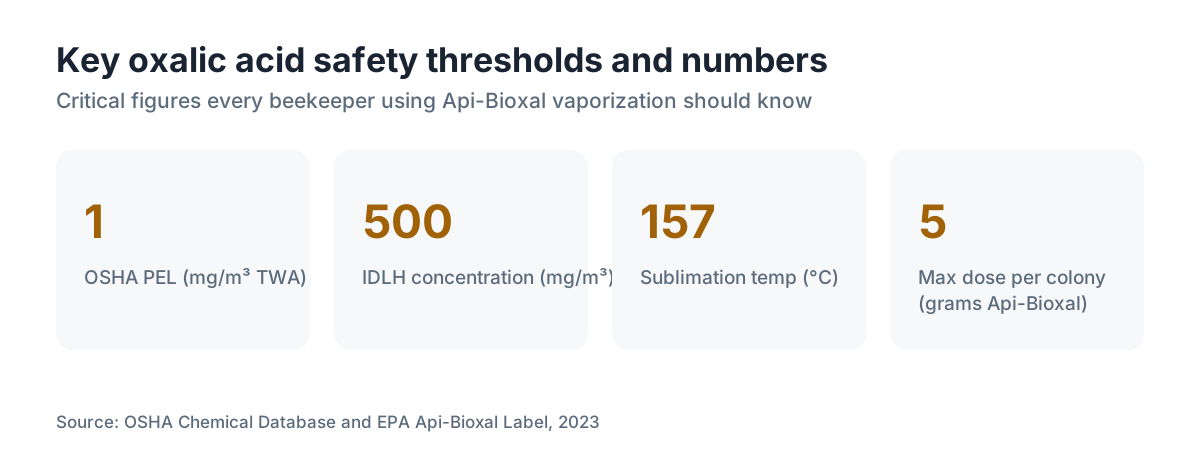
Oxalic acid (OA) is an organic acid that sublimates at around 157°C (315°F). When it vaporizes and you breathe it in, it reacts with moisture in your airways and forms a corrosive film across the mucous membranes of your nose, throat, and lungs. OSHA sets the permissible exposure limit for oxalic acid dust and vapor at 1 mg/m³ over an eight-hour shift [1]. That ceiling is very low. A poorly sealed vaporizer plate inside a hive can push the air a few feet from the entrance well past it.
Here is the specific problem with homemade builds. They have no validated thermal cutoff, no tested seal between the heating element and the hive entrance, and usually no way to know whether the plate is reaching sublimation temperature or blowing right past it. Overheat oxalic acid and it breaks down into carbon monoxide and formic acid, both of which pile their own toxicity on top of the OA [2].
Commercial vaporizers go through design testing and hold a set temperature range, so you get clean sublimation without decomposition. A wok burner, a 12-volt heating element pulled from a car seat, or a soldering iron rewired in a garage has none of that. The people selling these plans online are not toxicologists, and they are not the ones sitting in the emergency room when it goes wrong.
Before you pick any delivery method, it helps to understand what varroa mites are and why beekeepers reach for OA in the first place.
What does the EPA actually require for oxalic acid vaporizers?
The EPA registered oxalic acid dihydrate for beehive use as Api-Bioxal (EPA Reg. No. 84673-1) [3]. The label is a federal document with the force of law under FIFRA. Use OA in a way that contradicts the label, including running an unregistered device for the vaporization method, and you are breaking federal law.
The Api-Bioxal label directs that the product be applied "only with equipment designed and intended for this use" [3]. In practice that has meant commercially manufactured vaporizers built for the job, not something welded together in a shop.
That matters for two practical reasons. If you use a DIY vaporizer and something goes sideways, your homeowner's or farm insurance may deny the claim because you used an unlabeled method. And if you sell honey and a state inspector asks how you treat for varroa, an off-label method becomes a paperwork problem that can touch your sales license.
States layer on their own rules. Some require a pesticide applicator's license to use any OA method at all. Check your state extension service before you buy anything. The Honey Bee Health Coalition's Varroa Management Guide flags this state-by-state variability directly [4].
To find equipment that meets the label, the beekeeping supply companies page lists vendors who stock compliant vaporizers.
What are the specific health risks of OA vapor exposure?
Acute high-dose exposure to oxalic acid vapor burns the upper respiratory tract, floods the lungs with fluid (pulmonary edema), and in severe cases kills [2]. That is the extreme end. The more realistic risk for beekeepers is repeated low-level exposure across a season or several years.
Chronic low-level inhalation is tied to nasal and sinus irritation, chronic bronchitis, and kidney damage, because the kidneys clear absorbed oxalate from the blood [1]. Oxalate crystals can settle in the renal tubules and feed kidney stone formation over repeated exposures.
The eyes take a hit too. Vapor at sublimation temperatures causes severe conjunctival irritation, and a splash during mixing can burn the cornea. OSHA lists both the respiratory and ocular routes as primary exposure concerns [1].
One number puts the rest in perspective. The immediately dangerous to life and health (IDLH) concentration for oxalic acid is 500 mg/m³ [1]. That looks like a mountain of headroom above the 1 mg/m³ PEL. It isn't. IDLH is the point where a single exposure could kill you or leave permanent damage, and the PEL sits so low precisely because the gap between "a little" and "too much" collapses fast in confined spaces: truck beds, sheds, or anywhere you work hive after hive in quick succession.
The vapor is invisible. You cannot see it. You cannot reliably smell it at dangerous levels. By the time your eyes or throat sting, the exposure has already happened.
How do commercial vaporizers reduce the risks that DIY builds create?
Good commercial vaporizers (the Varomor, ProVap 110, and similar units) hold the plate inside the sublimation window instead of overshooting it. They also carry physical features that cut vapor leakback: a flange or gasket that seals to the hive entrance, a wand long enough to keep the heat source away from your face, and on some models an auto-shutoff that kills power once the OA charge has fully sublimated.
None of that is magic. It just reflects engineering by someone who tested the device again and again and measured actual vapor production and containment. A homebuilt rig made from a steel spoon and a battery charger skips every bit of it.
Temperature control is the biggest variable. Oxalic acid sublimates cleanly starting around 157°C. Above roughly 180°C, decomposition products start forming [10]. A commercial unit with a thermal regulator stays in range. A DIY resistive heater on a car battery rides on whatever resistance the builder picked, plus ambient temperature and battery charge state, all of which shove the real plate temperature around in ways you cannot see.
The Honey Bee Health Coalition's guide recommends a commercially available vaporizer plus a respirator rated for acid vapors as the minimum standard [4]. That recommendation exists for a reason.
What personal protective equipment do you need when vaporizing OA?
At absolute minimum: a NIOSH-approved half-face respirator with OV/P100 combination cartridges (organic vapor plus particulate filtration), chemical splash goggles (real goggles with an indirect vent, not safety glasses), and nitrile gloves [1][3].
The respirator is the piece people skip most. "I'll just hold my breath" and "I only do two hives" do not hold up against invisible acid vapor. The OV/P100 cartridge handles both the vapor and any particulate acid aerosol. Dust masks and surgical masks do nothing against oxalic acid vapor [2].
Work upwind of the entrance when you can, and stand to the side rather than straight in front of it during and after treatment. Vapor rides out with the bees and with the air pressure equalizing inside the box. A treated hive keeps off-gassing for several minutes after you pull the vaporizer.
Never vaporize inside an enclosed space. Not a garage, not a shed, not a polytunnel. Work outdoors with natural ventilation. Treating a long row of hives? Give yourself time to walk away between them instead of hovering over each one.
One more thing gets missed: mixing the solution or handling the crystals before you ever plug anything in. The crystals are dusty and carry the same lung hazard. Put the respirator on the moment you open the bag.
Are there legal consequences for using a DIY vaporizer?
Yes, and they are not trivial.
FIFRA (the Federal Insecticide, Fungicide, and Rodenticide Act) makes it a federal misdemeanor to use a registered pesticide in a manner inconsistent with its labeling [5]. The Api-Bioxal label calls for equipment designed for this use. A device that has never been evaluated or approved against that standard puts you in violation on every single treatment.
State law can pile on. Many states run their own pesticide use laws that mirror FIFRA or go further. Some require a licensed pesticide applicator for any OA vaporization, whatever the device. A hobbyist who injures themselves or a neighbor while using an off-label rig has very little legal standing.
Insurance is the quiet risk. Liability policies and workers' compensation coverage (if you have employees on a sideliner operation) typically exclude illegal acts and off-label pesticide use. You could end up personally liable for medical costs if a bystander, an employee, or you get hurt.
The odds of getting caught are admittedly low if you keep bees on your own land and treat your own hives. But "unlikely to be enforced" is not the same as "legal," and it is a long way from "safe." The health risk stands whether or not a regulator ever shows up.
What temperatures and conditions make vaporization more hazardous?
Two temperatures matter: the plate and the air around you.
Warmer air in late spring and summer means vapor disperses slowly in still conditions close to the ground, which is exactly where you are bent over the hives. Cold-weather treatments (common because OA hits hardest on broodless winter colonies) tend to disperse vapor better, but the cold also pushes beekeepers to rush and skip PPE steps because standing still is miserable.
Hive configuration matters too. A single deep on a screened bottom board bleeds vapor fast from several openings, which lowers efficacy but also thins the cloud at the entrance. A tower of three deeps on a solid bottom with a tight entrance seal holds vapor longer and builds a bigger exit pulse. What escapes escapes in a more concentrated burst.
Wind helps you while you treat and turns on you the second it pushes vapor back toward your face. Check the direction before you light anything. Skip calm, still days in enclosed apiary setups if you can.
The Honey Bee Health Coalition's guide notes that broodless colonies in late fall and early winter give the best efficacy window for OA vaporization, because the mites have nowhere to hide in capped brood [4]. That timing lands squarely in cold weather, when PPE discipline slips. Do not let the cold talk you out of the respirator.
How does DIY vaporizer risk compare to a commercial vaporizer, practically?
Here is an honest comparison. Neither method is zero-risk. Both need PPE. But the risk profiles are not the same.
| Factor | Commercial vaporizer | DIY vaporizer |
|---|---|---|
| Temperature control | Regulated, tested range | Unknown, varies with battery/element |
| Seal quality | Designed to limit vapor leakback | Depends on builder skill |
| Decomposition risk | Low at correct temperature | Higher if element overshoots |
| EPA label compliance | Yes (when used as directed) | No |
| Repeatable dose to bees | Yes | Variable |
| Cost | $90 to $250 for a quality unit | $10 to $50 in materials |
| Liability if something goes wrong | Covered under product liability and label compliance | Personal |
The cost gap is real. A decent commercial vaporizer runs $90 to $250 depending on the model and whether it is a wand style or a drop-in pan [6]. A DIY build comes together for $10 to $50 in hardware. Keeping two or three hives on a tight budget, that gap feels big.
Put it another way. One emergency room visit from an OA vapor exposure costs more than a commercial vaporizer, and that is before lost work time or any lasting lung damage. The cheap option carries real hidden costs.
VarroaVault's free varroa management tools include a treatment timing calculator that squeezes more efficacy out of each application, so you run fewer treatments and cut your cumulative exposure no matter which vaporizer you use.
What should you do if you are exposed to OA vapor?
Move to fresh air immediately. Do not wait to see if you feel better in a minute.
For eye exposure: flush with clean water for at least 15 to 20 minutes, holding the eyelid open. Take out contact lenses first if you can do it fast. After flushing, get a medical evaluation even if the irritation seems to fade, because corneal damage can worsen over hours [2].
For inhalation: fresh air is the first step. If you get chest tightness, trouble breathing, a cough that won't stop, or any sign of respiratory distress, call 911 or head to an emergency room. Pulmonary edema from acid vapor can build over several hours, meaning you might feel fine right after and then crash. That delayed onset is one of the reasons these injuries are so dangerous [2].
For skin contact with crystals or concentrated solution: brush off any dry material, then flush with water for 15 minutes. OA absorbs through skin and adds to systemic oxalate load, though this route moves slower than inhalation.
Keep the Poison Control number (1-800-222-1222 in the United States) posted wherever you store your OA, and give them the product name and formulation when you call [7]. They can tell you whether the exposure warrants an ER trip or can be handled at home.
What is the safest way to use oxalic acid for varroa if you are concerned about vaporization risks?
If vaporization feels like too much to manage safely, Api-Bioxal has two other EPA-registered delivery methods: dribble (trickle) application and sponge application (extended release) [3].
The dribble method mixes OA crystals into sugar syrup and trickles the solution between frames over the bees. Inhalation risk drops to near zero because no vapor forms, though splash and skin contact still call for gloves and eye protection. The catch: dribble is meaningfully weaker than vaporization, especially in multi-box colonies, and it only delivers real mite reduction on broodless colonies [4].
The sponge (extended-release) method, added to the Api-Bioxal label in 2022, places an OA-saturated cellulose sponge inside the hive. This is the lowest-exposure option for the beekeeper, because once the sponge is in and the hive is closed, your contact with OA is basically done. Efficacy data is still accumulating, but early results look promising for colonies with brood present, which beats dribble on that front [8].
If you do vaporize, use a commercial device, wear full PPE every time with no exceptions, work outdoors, and treat from the side of the entrance rather than straight in front of it. The beekeeping supplies page lists current approved commercial vaporizers if you are shopping for the first time.
How do you store oxalic acid safely between treatments?
Api-Bioxal in its registered form is a white crystalline powder sold in 35-gram and 275-gram packets. Store it in the original container with the lid sealed tight, in a cool dry spot away from children, pets, and any food storage [3].
Oxalic acid is hygroscopic, meaning it pulls moisture out of the air. Wet or clumped crystals behave differently on the plate, sometimes sputtering or spattering instead of subliming cleanly, which raises the odds of hot particles firing toward your face. Keep it dry.
Do not stash opened OA in your vehicle for the season. Temperature swings in a truck or car through summer degrade the product and create a moisture problem. Bring what you need for each treatment and keep the rest in a stable indoor location.
Dispose of unused OA and empty containers per the label: the Api-Bioxal label directs rinsing and then recycling or landfilling the container according to local rules [3]. Do not pour concentrated OA solution down drains or into waterways. Oxalic acid is acutely toxic to aquatic life at low concentrations.
Frequently asked questions
Is it illegal to use a homemade oxalic acid vaporizer in the US?
Yes, under FIFRA. The Api-Bioxal label carries federal legal force and specifies equipment designed and intended for this use. Homemade devices do not meet that standard, so a DIY vaporizer is an off-label pesticide application and a federal misdemeanor. State pesticide laws can add penalties. Enforcement on a small scale is unlikely, but the violation is real regardless.
Can OA vapor from treating bees seriously hurt you?
Yes. Oxalic acid vapor burns the respiratory tract above the OSHA PEL of 1 mg/m³, which the air near a vaporizing hive can reach fast. Pulmonary edema, the most severe outcome, can develop hours after exposure and is potentially fatal. Chronic lower-level exposure is tied to bronchitis and kidney damage. These risks are documented in occupational health literature, not theoretical.
What respirator do I need for oxalic acid vaporization?
A NIOSH-approved half-face or full-face respirator fitted with OV/P100 combination cartridges. OV means organic vapor, P100 is particulate filtration. Dust masks, surgical masks, and N95 respirators give no protection against acid vapor. The respirator must seal to your face; beards prevent that seal. Replace cartridges on the manufacturer's schedule or the moment you smell anything inside the mask.
How long should I stay away from the hive after vaporizing?
At least 10 to 15 minutes after you pull the vaporizer and close the entrance. Vapor keeps exiting with bee traffic for several minutes past the end of treatment. Working a long row? Move to the far end and work back rather than lingering at treated hives. Stay upwind and to the side of the entrance during the whole waiting period.
Why do some beekeepers build their own vaporizers if they are so dangerous?
Cost drives it. A working commercial vaporizer runs $90 to $250, and some beekeepers, especially newcomers, balk at that. Forum threads and YouTube tutorials make DIY builds look simple. The trouble is that the people sharing them rarely have occupational health backgrounds, and the risks of thermal inconsistency and vapor leakback stay hidden until something goes wrong. The savings are real, but so is the hazard.
Does the dribble method work as well as vaporization for varroa?
No. On broodless colonies with low mite loads, dribble can work well enough, but studies and the Honey Bee Health Coalition's summary both show vaporization achieves higher mite knockdown across the colony, especially in multi-box hives where dribbled solution never reaches every cluster. If mite pressure is high or the colony has any sealed brood, vaporization wins by a wide margin.
Can I use any brand of oxalic acid other than Api-Bioxal?
No, not legally for in-hive use. Api-Bioxal (EPA Reg. No. 84673-1) is the only oxalic acid product the EPA has registered for beehive use in the United States. Pool-grade or technical-grade oxalic acid is not registered for this purpose, so using it is an unregistered pesticide application and a FIFRA violation. Other countries have their own registered products; check your local regulations.
What is the OSHA permissible exposure limit for oxalic acid?
OSHA sets the PEL for oxalic acid at 1 mg/m³ as an eight-hour time-weighted average. The immediately dangerous to life and health (IDLH) concentration is 500 mg/m³. The gap between the working limit and the IDLH looks large, but the air near an active vaporizer in calm conditions can top the PEL quickly, and you get no reliable sensory warning until irritation has already started.
How many grams of oxalic acid should I use per hive treatment?
The Api-Bioxal label specifies 1 gram of Api-Bioxal per brood box for vaporization, up to a maximum of 5 grams per colony no matter how many boxes. That refers to the registered formulation, not pure oxalic acid dihydrate. Follow label rates exactly; more does not kill more mites and it raises bee exposure and residue risk. Read the current label before each treatment season in case it changed.
Is oxalic acid safe for honey that is already in the hive?
The EPA and the Api-Bioxal label direct that you not treat while honey supers meant for human consumption are on the hive. Pull the supers first. Oxalic acid does occur naturally in honey at low levels, but treating with supers on pushes residues above background and breaks the label. Treat in late fall or early spring before supers go on, or after harvest.
Does vaporizing OA hurt the bees?
At label rates and with proper application, OA vaporization has low bee toxicity. Some studies note minor mortality bumps at very high doses, but at 1 gram per brood box the effect on adult bees is minimal. The bigger risk from a DIY vaporizer is temperature inconsistency: a plate that overheats produces decomposition products including formic acid and carbon monoxide, which are more toxic to bees than OA itself.
Can I build a safer DIY vaporizer with better temperature control?
In theory, a well-built device with a PID controller, a sealed entrance flange, and a calibrated thermocouple could cut some risks. It still would not be EPA label-compliant, so the legal problem stays. And the engineering to do it right (real temperature validation, tested sealing, repeatable dosing) creeps into the cost range of commercial units. At that point the case for building instead of buying gets very thin.
What are signs that someone has had a significant OA vapor exposure?
Immediate signs include burning or stinging in the nose, throat, or eyes, heavy tearing, and coughing. These can show up at sub-IDLH concentrations. More serious signs are chest tightness, shortness of breath, and a feeling of pressure in the lungs. Delayed pulmonary edema, developing two to four hours after exposure, is the most dangerous outcome. Any respiratory symptoms after vaporizing warrant medical evaluation, not a wait-and-see approach.
Where can I find a current list of approved commercial OA vaporizers?
The EPA does not maintain a specific approved-vaporizer list, but major beekeeping supply retailers stock commercially designed units that meet the label's equipment requirement. University extension services and the Honey Bee Health Coalition's Varroa Management Guide (free download from honeybeehealthcoalition.org) include guidance on appropriate equipment. Buying from an established beekeeping supplier rather than a hardware or electronics vendor is the practical starting point.
Sources
- OSHA, Occupational Chemical Database: Oxalic Acid: OSHA PEL for oxalic acid is 1 mg/m³ TWA; IDLH is 500 mg/m³; primary exposure routes are inhalation and ocular contact
- CDC/NIOSH, Pocket Guide to Chemical Hazards: Oxalic Acid: Oxalic acid vapor causes chemical burns to respiratory tract, potential pulmonary edema, and delayed-onset lung damage; OV/P100 respirator required
- EPA, Pesticide Registration and Api-Bioxal Product Label (EPA Reg. No. 84673-1): Api-Bioxal is the only EPA-registered OA product for beehive use; vaporization must use equipment designed for this use; 1 gram per brood box up to 5 grams per colony; do not use when honey supers are on
- Honey Bee Health Coalition, Varroa Management Guide: HBHC recommends commercially available vaporizers and a respirator rated for acid vapors; broodless colonies in late fall represent optimal OA vaporization timing; regulatory variability by state noted
- EPA, Federal Insecticide, Fungicide, and Rodenticide Act (FIFRA) Overview: FIFRA makes it unlawful to use a registered pesticide in a manner inconsistent with its labeling
- Penn State Extension, Varroa Mite Management: Commercial OA vaporizers range from approximately $90 to $250 depending on model and features
- Poison Control, National Poison Control Center Hotline: Poison Control Center national number is 1-800-222-1222 for chemical exposure guidance
- University of Florida IFAS Extension, Oxalic Acid Treatments for Varroa: Extended-release OA sponge method added to Api-Bioxal label in 2022; early efficacy data promising for colonies with brood present
- USDA AMS National Organic Program: Oxalic acid is permitted in certified organic beekeeping operations when used according to the registered label
- Cornell University, Cornell Pollinator Network: OA sublimation temperature is approximately 157°C; decomposition products including CO and formic acid form above roughly 180°C
Last updated 2026-07-09