How many varroa mites is too many: thresholds explained
TL;DR
- Most beekeeping authorities set the treatment threshold at 2% mite infestation on adult bees (2 mites per 100 bees) during the summer brood-rearing season, dropping to 1-2% before winter buildup.
- Above 3% at any time of year, colony survival odds fall sharply.
- Measuring first matters more than any rule of thumb.
What is a varroa mite threshold and why does the number matter?
A varroa threshold is the mite load at which harm to a colony outweighs the cost and risk of treatment. Below the threshold, a healthy colony tolerates the pressure. Above it, you treat. Simple in theory. Harder in the bee yard.
The number that gets repeated most often is 2%. That means 2 mites for every 100 adult bees sampled. The Honey Bee Health Coalition's Tools for Varroa Management guide calls this the standard action threshold for the summer brood-rearing season, roughly May through August in most of the continental U.S. [1] The USDA backs essentially the same figure in its bee health guidance. [2]
But 2% is not a magic cliff. It's a statistical midpoint where, averaged across many studies and many colonies, harm accelerates. Some colonies at 2.5% limp through a mild winter. Others at 1.8% crash in October because the mite load was climbing fast and the beekeeper happened to measure on a lucky day. The number earns its keep by forcing you to measure instead of guess, not because it's a biological absolute.
For a deeper look at the parasite itself, the biology section of our varroa mite guide explains how mites reproduce inside capped brood cells and why a 2% reading on adults understates the total colony infestation.
What are the official varroa treatment threshold levels by season?
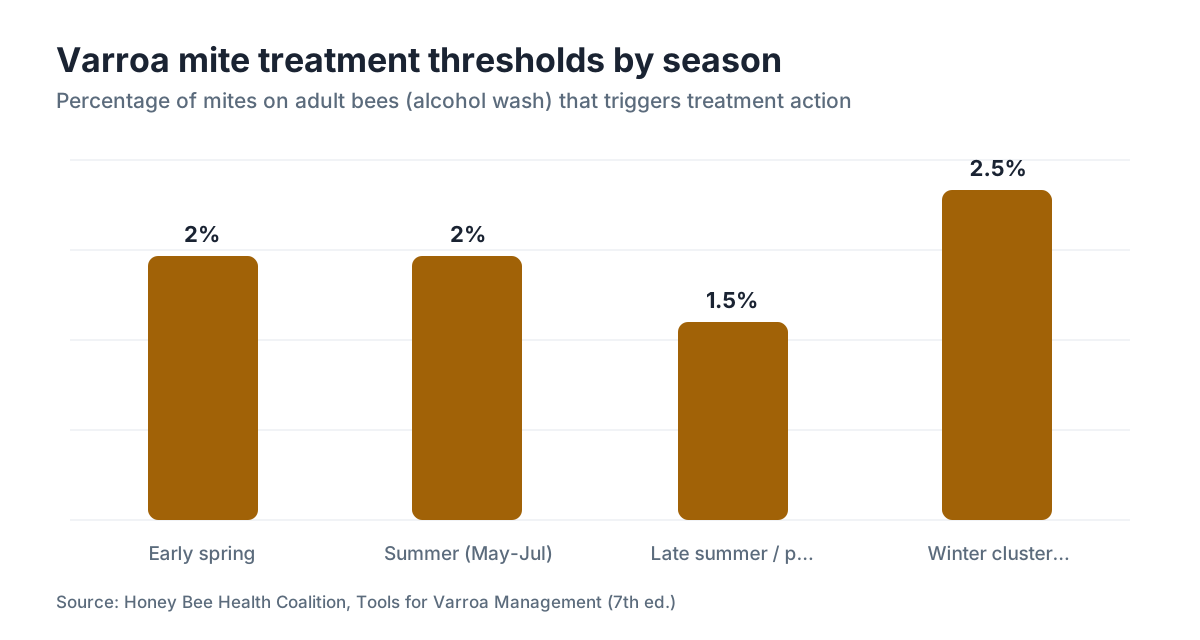
Thresholds shift with the calendar because the risk from mites changes as colonies move through the year. Here are the numbers most widely cited by U.S. university extension programs and the Honey Bee Health Coalition. [1][3]
| Season | Threshold (% mites on adult bees) | Why it changes |
|---|---|---|
| Early spring (brood just starting) | 2% | Colony is small; mites are mostly on adults |
| Summer (active brood rearing) | 2% | Standard threshold; brood amplifies mite growth |
| Late summer/pre-winter prep (Aug-Sep) | 1-2% | Winter bees being raised now; damage is irreversible |
| Winter cluster (little/no brood) | 2-3% | Mites are on adults only; growth is slow but colony is fragile |
The late summer window kills the most colonies. From roughly August 1 through mid-September, the bees your colony is raising will be the ones clustering through winter. Varroa feeding on those pupae inject viruses, particularly Deformed Wing Virus (DWV), that shorten adult bee lifespan and damage fat body reserves. [4] A winter bee with compromised fat bodies won't survive a normal northern winter. You can hit 2% in mid-August and watch the colony die in January without ever understanding why.
Extension apiculturists at Penn State put it plainly: even a 1% mite load in August warrants treatment if the colony will overwinter, because the population dynamics mean you are almost certainly heading toward 3% or more by September. [3]
For winter clusters with no brood, the threshold technically rises to around 2-3% because mite reproduction stops. Treating a broodless cluster is also more effective, since every mite is exposed on adult bees rather than hidden in capped cells. Oxalic acid vaporization, for example, gets 90-95% efficacy against phoretic mites but does almost nothing against mites in sealed brood. [5]
How do you actually measure your mite load?
You have three practical choices: alcohol wash, sugar roll, or a sticky board count. Alcohol wash is the most accurate and is what the Honey Bee Health Coalition recommends as the standard. [1] Sugar roll is gentler (the bees live) but typically underestimates mite loads by 20-30% compared to alcohol wash, which matters a lot when you're deciding between 1.8% and 2.2%. [6]
For an alcohol wash, you collect roughly 300 adult bees (about half a cup) from a brood frame, not the frame with the queen. Submerge them in 70% isopropyl alcohol in a mason jar with a mesh lid, shake for 30-60 seconds, and count the mites that wash out. Divide mites by bees, multiply by 100. That's your percentage.
A sticky board count gives you mites per day (natural mite fall) rather than a percentage, and the correlation between daily drop and actual infestation is loose enough that I wouldn't stake a treatment decision on it. The USDA has published conversion tables, but the variance is high. Use it to spot trends over time, not to set a hard threshold.
Sample from the right place. The brood nest is where mites concentrate. Sampling foragers at the entrance or bees from a honey super gives you a falsely low reading. Pull from a frame with open brood, take bees from several frames if the colony is large, and sample before 10 a.m. while foragers are still home.
Sample frequency matters as much as threshold math. The Honey Bee Health Coalition recommends sampling every 4-6 weeks during the brood season. [1] Mite populations can double in 3-4 weeks under favorable conditions. A 1.5% reading in July can become 4% by mid-August if left unchecked.
At what mite percentage does a colony usually die?
Colonies rarely die the moment mite loads cross a single threshold. The damage stacks up quietly, and the collapse shows up weeks or months after the population peak.
Studies tracking untreated colonies consistently find that winter mortality spikes when late-summer mite loads exceed 3%. Research published in PLOS ONE found that colonies entering winter with mite infestation rates above 3% on adult bees had significantly higher overwinter mortality than those kept below 2%. [7] A reasonable working rule: above 3% at any point during brood season, you're on borrowed time regardless of what other colony health signs tell you.
Above 5%, collapse typically hits within weeks during active brood-rearing. The virus load on adult bees reaches a point where bee lifespan drops from the normal 5-6 weeks to 2-3 weeks. Bee turnover can't keep pace with colony demand, and the adult population caves. Brood starvation follows. You'll see a sudden population crash that looks like pesticide poisoning to an inexperienced eye.
Beekeepers often catch the classic symptoms too late: spotty brood (from mite-killed pupae), bees with shriveled or missing wings from DWV, crawling bees near the entrance. By the time you see those signs consistently across the colony, the mite load is almost always already above 3-4% and the colony is in serious trouble. Test first. Don't wait for symptoms.
When is it too late to treat for varroa mites?
This is the question that keeps beekeepers up at night, and the honest answer is: rarely truly too late, but timing decides what you can save.
If it's August or early September and you're above threshold, treat immediately. You can still save the winter bees being raised over the next 4-6 weeks if you knock the mite load down now. The cutoff in most northern U.S. states is roughly September 15. After that date, most of the bees that form your winter cluster are already adults. Treatment stops further viral damage and reduces the mite load going into winter, but it won't undo harm already done to adult bees that emerged with compromised fat bodies.
Even so, treating a colony with a 4% mite load in October beats not treating. At minimum you're stopping the mite population from growing and giving the cluster a better numerical chance. Oxalic acid vaporization during a broodless period in late fall or early winter (when colonies naturally carry minimal brood) is one of the most effective treatment windows there is, with high efficacy against all phoretic mites. [5] Many northern beekeepers treat once in November or December specifically because it works so well.
The genuinely late scenario is a colony already collapsing in September or October. If the adult population has crashed, there are bees crawling outside the entrance, and the cluster has shrunk below 3-4 frames of bees, the colony may not survive regardless of treatment. Now you're making a judgment call: treat and hope, or break down the colony to keep mite-carrying bees from drifting into healthier hives nearby. Letting a collapsing colony sit untreated spreads mites to adjacent hives through robbing and drift. That's a real risk worth weighing.
For spring colonies, there's essentially no "too late" in the same sense. Measure above threshold in April, May, or June, and you treat. The bees are raising new generations continuously and the colony can recover fully if you act promptly.
Does a high mite count always mean you should treat right now?
Mostly yes, with one caveat: verify your sample before committing to a treatment that has temperature limits or costs real money.
If you get a 3% reading and it's the first time you've tested this colony, test again within a few days from a different brood frame. User error, sampling bias, and unlucky timing can push a reading 0.5-1% above the true average. Still, if you're above 2% in peak season, the right default is to treat rather than wait. The cost of a false negative (real infestation, no treatment) dwarfs the cost of a false positive (treating a colony that was marginally under threshold).
The exception is late fall or winter with an established testing routine. A 2.5% reading in December on a cluster you've tracked, where you saw 1.8% in October and the colony has otherwise held steady, is a different situation than a surprise 2.5% in August. Context matters. But most hobbyist beekeepers are under-testing, not over-testing, so when in doubt, treat.
VarroaVault's free monitoring log tool helps you track readings across colonies and seasons so you're deciding on trends rather than single data points. That's genuinely the line between good mite management and lucky guessing.
Which varroa treatments work at different infestation levels?
The treatment you pick should match the mite load, the season, and whether brood is present. Higher mite loads during active brood season need treatments that penetrate capped cells. A broodless winter cluster opens the door to simpler, highly effective options.
| Treatment | Active Ingredient | Brood Present? | Temp Range | Efficacy vs Phoretic Mites | Efficacy in Brood |
|---|---|---|---|---|---|
| Oxalic acid vapor | Oxalic acid | Best without brood | Above 50°F | 90-95% | Low |
| Oxalic acid dribble | Oxalic acid | No brood only | Above 40°F | 85-90% | Very low |
| Mite Away Quick Strips (MAQS) | Formic acid | Yes (brood present) | 50-85°F | 90%+ | 60-70% |
| ApiLifeVar / Thymovar | Thymol | Yes | 59-68°F | 90%+ | Moderate |
| Apivar | Amitraz | Yes | Above 50°F | 93%+ | Moderate-high |
| HopGuard 3 | Hop beta acids | Best without brood | Wide range | 80-90% | Low |
For very high mite loads (above 4%) during active brood season, Apivar (amitraz strips) or a formic acid product like MAQS gives you the most complete knockdown because both reach some way into capped cells. [8] You won't get 100% efficacy, but you can realistically drop from 4% below 1% within 6-8 weeks with Apivar if you use it correctly.
Oxalic acid vaporization during a broodless period is the gold standard for winter treatment and for breaking the brood cycle mid-season during a split or any other broodless stretch. The EPA-registered label for Apivar requires a minimum 6-week strip exposure; pulling strips early cuts efficacy. [9]
Always read the current EPA-registered label before applying any miticide. Labels are the law, and the application rates, temperature requirements, and re-entry intervals on them are not suggestions. [9] University extension programs, including those at Penn State and North Carolina State, publish product guides updated every year that are worth bookmarking. [3][10]
Can mite-resistant bees change what threshold you use?
Yes, though the data is still coming in. Colonies with proven hygienic behavior or Varroa-Sensitive Hygiene (VSH) traits suppress mite populations more effectively than standard stock, which means a 2% reading on a VSH colony may be less dangerous than 2% on standard Italian bees. Some researchers and breeders argue the threshold for VSH colonies should sit closer to 3%. Nobody has solid consensus on this yet.
The practical problem for most hobbyist beekeepers is you usually don't know exactly what genetics your colony carries unless you bought from a breeder who tests and certifies VSH traits. Local survivor colonies or packages from unknown sources might have some mite tolerance or might have none. Testing your mite levels stays essential either way.
If you're running standard commercial stock, stick to the 2% threshold. If you've invested in certified VSH or Pol-Line queens from a reputable breeder, ask the breeder directly what threshold they recommend for that line and track your colony's natural mite growth rate over several seasons. That beats any general rule.
How does a high mite load affect the rest of your apiary?
One collapsing colony is more than a one-hive problem. When mites overwhelm a colony in late summer or fall, healthy colonies from surrounding hives rob it out. Those robber bees carry mites home. If you have five hives within 300 feet and one is collapsing with a 6% mite load, all five are now at elevated risk.
Drifting is a parallel problem. Bees don't navigate perfectly, and a meaningful share of foragers end up in neighboring hives. High-mite colonies export mites through drift continuously, even before they collapse. University of Maryland research has described this "mite bomb" dynamic as one of the main reasons beekeepers who treat their own hives still see mite spikes: the mite source is a nearby beekeeper who isn't testing. [11]
If you're in a neighborhood with other hobbyist beekeepers within a mile, this is worth a direct conversation. Nobody's varroa management is fully independent. Your threshold decisions affect your neighbors' colonies and vice versa.
Breaking down a collapsing high-mite colony promptly, rather than hoping it recovers, is sometimes the responsible call. Freeze any brood frames that might harbor mites before storing or donating equipment. That's basic biosecurity that protects your other colonies and your neighbors'.
What monitoring schedule should you follow to stay ahead of thresholds?
The Honey Bee Health Coalition recommends testing every 4-6 weeks during the brood season as the baseline. [1] That sounds like a lot, but an alcohol wash on a single hive takes about 15 minutes once you've done it a few times. Five hives is a morning of work every month.
Three dates matter more than any others in most of the continental U.S. Test in late May or early June to catch late-spring buildup before the summer honey flow. Test again in late July, your last comfortable window to treat before the winter-bee-rearing period begins. Test a third time in mid-August, the decision point for winter prep: above 2% now, treat immediately.
Write down every reading with the date and colony ID. That record shows whether a colony's mite population is stable, declining, or accelerating. A colony at 1.8% in June that's at 1.9% in July is probably fine. A colony at 1.2% in June that's at 2.4% in July is telling you something is wrong, and treatment before August is smart.
For tracking multiple colonies across seasons without reinventing the spreadsheet wheel, VarroaVault's free protocol tools let you log washes, flag threshold crossings, and schedule your next test date. Use whatever tracking system you'll actually stick to. A paper notebook in the bee yard beats a sophisticated app you open twice a year.
Is there a varroa mite count that is definitely too high to save a colony?
No fixed number automatically means a colony is unrecoverable. But there are situations where the math is very bad.
A colony with a 7-8% mite load in September, a shrinking adult population, and visible DWV symptoms throughout the cluster is in serious trouble. You could treat with oxalic acid vaporization, come back in 10 days, treat again, and maybe arrest the collapse. Some beekeepers do save colonies from spots like this. But the time investment is high, the odds of success are lower than you'd like, and the risk of the collapsing colony turning into a mite bomb for your other hives is real.
In late fall (October in the northern U.S.), a colony above 5% mites with an already small cluster (fewer than 4 seams of bees) has poor survival odds even with treatment. I'd treat anyway to reduce mite spread to healthy colonies, but I wouldn't count it as a colony that makes it to spring.
Early in the season, even a 6% reading is recoverable with prompt, correctly applied treatment. Colonies rebound quickly if the queen is healthy and brood replacement outpaces viral damage. The season you're in matters as much as the number itself.
Frequently asked questions
When is it too late to treat for varroa mites?
Treating in September or even October is rarely truly too late, but the window where treatment protects winter bees closes around mid-September in most northern states. Winter bees raised after that point are exposed to fewer mite-transmitted viruses. Treating a collapsing October colony still makes sense to stop mite spread to other hives, even if colony survival is uncertain. There is no single calendar date after which treatment is pointless.
What is the standard varroa treatment threshold for beekeepers?
The Honey Bee Health Coalition and most U.S. university extension programs set the standard treatment threshold at 2% during the summer brood-rearing season, meaning 2 mites per 100 adult bees sampled by alcohol wash. The threshold drops to 1-2% in late summer (August onward) because mites infecting winter bees cause irreversible damage to fat body reserves and shorten bee lifespan in ways that won't show up until January or February.
How do I know if my mite count is too high without professional testing?
An alcohol wash is the standard self-test. Collect about 300 adult bees from a brood frame into a jar of 70% isopropyl alcohol, shake for 30-60 seconds, and count the mites on the mesh lid. Divide mites by bees and multiply by 100. If you get above 2% during summer, treat. The materials cost under $5 and the test takes 15 minutes once you have the method down.
Can a colony survive a 3% mite load?
Some colonies do survive with 3% mite loads, especially in spring or early summer when the colony is large and strong. Survival odds drop sharply if the 3% reading comes in August or September, when mites are infecting the winter bees being raised right now. PLOS ONE research found significantly higher overwinter mortality in colonies entering winter above 3%. Treating at 3% is the right call regardless of season.
What does a 2% varroa infestation rate actually mean?
It means 2 mites for every 100 adult bees in your alcohol wash sample. Because mites also hide inside capped brood cells at a ratio of roughly 7-10 times the phoretic count, a 2% reading on adults likely means your total colony mite population is considerably higher. The 2% figure is a practical sampling proxy, not a complete census. That's why it's used as a trigger threshold rather than a comfort line.
Is it too late to treat for varroa in October?
No. If your colony is in a broodless or near-broodless state, October is actually an ideal time to treat with oxalic acid vaporization because all mites are exposed on adult bees rather than protected inside capped cells. Efficacy in broodless colonies reaches 90-95%. The treatment won't undo viral damage already done to adult bees, but it will prevent continued mite reproduction and reduce the load going into winter cluster formation.
How fast can varroa mites multiply in a colony?
Under favorable summer conditions, a varroa population can double in roughly 3-4 weeks inside an active brood-rearing colony. A 1% reading in early July can realistically become 4% or higher by late August without treatment. This doubling rate is why monthly monitoring during the brood season is the minimum sensible schedule, and why a borderline reading in July deserves a treatment decision rather than a wait-and-see approach.
Should I treat for varroa mites in winter?
Yes, if you're above threshold. The broodless or near-broodless winter period is when oxalic acid vaporization is most effective because all mites are phoretic (on adult bees). A winter treatment in November or December, when colonies naturally have minimal brood in northern states, can achieve 90-95% mite knockdown. This is one of the most cost-effective treatment windows of the year and is especially useful if you skipped or delayed a fall treatment.
What mite level should I treat at before overwintering?
Go into winter below 1-2% at most. Many extension programs, including Penn State's apiculture extension, recommend treating in August if you're at or above 1% in late summer, because the mite population will almost certainly climb further during the remaining brood-rearing weeks before winter. Entering winter at 3% or above is a major risk factor for colony loss, regardless of how strong the cluster looks in October.
Why do some colonies die in January if mites were low in October?
Because the damage happened earlier. Mites feeding on pupae from August through September inject Deformed Wing Virus and other pathogens that damage fat body reserves and immune function in the adult bees being raised right then. Those bees look normal in October but die earlier than healthy bees, so the cluster shrinks faster than expected in December and January. By the time collapse happens, the bees the colony needed most are already gone.
Does sugar roll underestimate varroa mite counts compared to alcohol wash?
Yes. Multiple field comparisons have found that sugar roll typically underestimates mite loads by 20-30% relative to alcohol wash. The mites don't reliably separate from bees with sugar shaking the way they do when killed in alcohol. If you use sugar roll and get 1.8%, your true infestation is likely above the 2% treatment threshold. The Honey Bee Health Coalition recommends alcohol wash as the standard for this reason.
How many mites per day on a sticky board means I should treat?
Natural mite drop on sticky boards is a rough indicator, not a precise threshold tool. A commonly cited rule of thumb is more than 50-60 mites per day in summer warrants treatment, but the correlation between daily drop and actual infestation percentage is loose enough that an alcohol wash is far more reliable. Use sticky boards to notice sudden increases between formal tests, but don't make treatment decisions based on drop counts alone.
What happens to bees when the varroa mite load is very high?
At very high loads, Deformed Wing Virus becomes widespread in the colony. Adult bees emerge with shriveled wings and shortened lifespans. The colony's population turnover outpaces its ability to raise replacement bees, the brood nest becomes spotty as mite-killed pupae die in their cells, and the adult bee population crashes over a period of weeks. This cascade can happen fast enough that a colony looks strong in late September and is in full collapse by November.
Sources
- Honey Bee Health Coalition, Tools for Varroa Management Guide (7th edition): Standard treatment threshold of 2% mite infestation on adult bees during summer brood-rearing season; recommend sampling every 4-6 weeks
- USDA Agricultural Research Service, Bee Research Laboratory: USDA bee health guidance supporting 2% threshold for varroa management decisions
- Penn State Extension, Varroa Mite Management for Honey Bees: Even a 1% mite load in August warrants treatment if the colony will overwinter; updated product and threshold guidance
- Nazzi F et al., PLOS Pathogens (2012): Synergistic Parasite-Pathogen Interactions Mediated by Host Immunity Can Drive the Collapse of Honeybee Colonies: Varroa feeding on pupae injects Deformed Wing Virus, shortening adult bee lifespan and damaging fat body reserves
- EPA, Oxalic Acid Pesticide Registration (Reg. No. 3125-34), Api-Bioxal product label: Oxalic acid vaporization achieves 90-95% efficacy against phoretic mites; very low efficacy against mites in sealed brood
- Calderone NW, Cornell University: Evaluation of sampling methods for Varroa mites: Sugar roll underestimates mite loads by approximately 20-30% compared to alcohol wash
- Genersch E et al., PLOS ONE (2010): The German bee monitoring project: a long term study to understand periodically high winter losses of honey bee colonies: Colonies entering winter with mite infestation rates above 3% showed significantly higher overwinter mortality
- North Carolina State Extension, Varroa mite treatment product guidance: Amitraz and formic acid products penetrate capped brood cells better than contact-only treatments; knockdown from above 4% to below 1% achievable over 6-8 weeks
- EPA, Apivar (amitraz) EPA Reg. No. 86104-1 label requirements: EPA-registered label for Apivar requires minimum 6-week strip exposure; early removal reduces efficacy
- North Carolina State Extension, annually updated honey bee miticide product guide: University extension programs publish product guides updated each year covering label rates and temperature ranges
- Seeley TD and Smith ML, University of Maryland / Cornell research on mite movement between colonies: Robbing and drifting from collapsing high-mite colonies spread mites to neighboring hives; described as mite bomb dynamic
Last updated 2026-07-09