How often do varroa mites reproduce inside a honey bee hive
TL;DR
- A varroa mite finishes one reproductive cycle in about 10-11 days inside capped worker brood, producing 1-2 fertile daughters each time.
- One mite entering a colony in spring can become thousands by late summer.
- Mite populations double roughly every 4 weeks in warm brood season, which is why early detection is the only reliable defense.
What is the varroa mite life cycle from start to finish?
Varroa destructor lives in two phases: a phoretic phase spent riding adult bees, and a reproductive phase spent inside capped brood cells. Learn both and you understand why mite populations grow so fast and why certain treatments only work at certain times.
The phoretic phase is the mite's travel mode. A foundress mite clings to a nurse or worker bee, feeds on the bee's fat body through the soft cuticle between abdominal segments, and waits for a chance to enter a cell just before capping. During warm brood-rearing season, phoretic mites stay on adult bees for 4-11 days before finding a cell [1]. In winter, with no brood, mites can survive on adult bees for weeks or months, though survival drops the longer brood stays absent [2].
The reproductive phase begins the moment the foundress slips into a larval cell, usually about 20 hours before the cell is capped. She hides in the brood food at the bottom of the cell. Once the cell is sealed, she feeds on the developing pupa and lays her first egg, which is always male (unfertilized, producing a haploid son via arrhenotoky). The eggs that follow are female, laid about every 30 hours [3]. Inside a worker cell, capped for roughly 12 days, the foundress usually produces one mature, mated female daughter. Inside a drone cell, capped for about 14.5 days, she has time for two [1][3].
Mating happens inside the cell. The single son mates with each daughter as she reaches adulthood. Then the daughter (or daughters) and the foundress ride out on the emerging bee, and the cycle restarts. The son dies in the cell. Every time a cell is capped, the clock resets.
How many offspring does one varroa mite produce per cycle?
One foundress in a worker cell lays about 4-6 eggs total, but not all of them survive to become breeding females. The first egg is the male. Females follow. In a 12-day worker cell, only about 1.0 to 1.45 new fertile females emerge on average, because the last female laid often runs out of time to mature and mate before the bee emerges [3][4].
Drone cells change the math. Their longer capping period (roughly 14.5 days versus 12 for workers) lets 2 to 2.6 fertile females reach maturity [3]. That is why mite loads in drone brood run 8-10 times higher than in worker brood, and why drone comb trapping is a real management tool.
So a single worker cell gives a low reproductive yield. Compound it across hundreds of infested cells over a season and the picture flips. A colony holding 5,000 capped worker cells at any moment, at even a 5% infestation rate, has 250 reproductive events running at once. Each one throws off a new fertile female every 10-11 days.
The net reproductive rate (Ro) for varroa in worker brood usually lands between 1.3 and 1.6 daughters per foundress per cycle, depending on brood supply and foundress success [4]. In drone brood, Ro climbs to 2.6-3.0. Those are averages pulled from multiple studies. Real colonies vary a lot.
How fast does a varroa population double in a real colony?
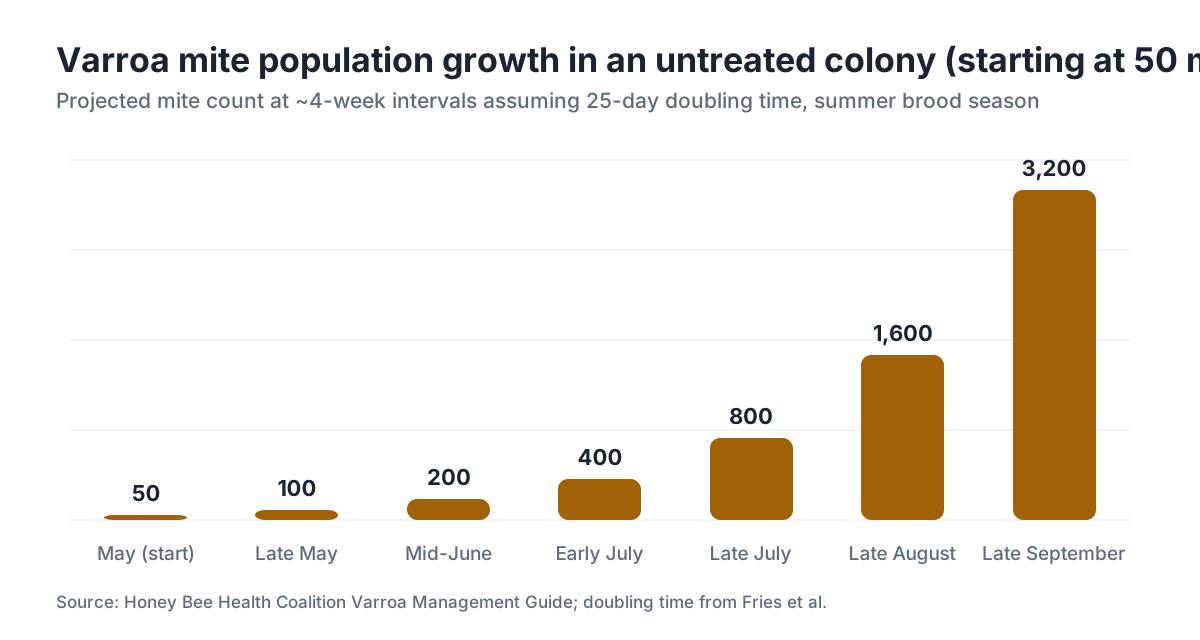
Doubling time depends on brood supply, the ratio of drone to worker brood, and how many mites are actively breeding versus sitting phoretic. Field observations and modeling both land on a doubling time of roughly 23-29 days under summer brood-rearing conditions [1][5].
The Honey Bee Health Coalition's Varroa Management Guide states that mite populations "can increase 8- to 12-fold" over one honey bee season if left untreated [2]. Start with 50 mites in May, and a colony can carry 400-600 mites by late July and more than 3,000 by late September. That climb is exactly why threshold-based monitoring beats calendar treatments.
Some things speed doubling: plenty of drone brood (longer capping, more daughters per cycle), warm weather that keeps brood rearing going, and big strong colonies that hand mites more cells to occupy. Some things slow it: broodless stretches (zero reproduction), hygienic genetics that uncap infested cells, and plain reproductive failure (the foundress dies before laying, or her offspring never mate).
Nobody has clean population-growth data across real apiaries at scale. The closest controlled work is Fries et al., which tracked mite populations in colonies with known starting infestations over a full season and found exponential growth that matches those doubling estimates [5]. Later modeling confirms the broad shape, though exact rates shift with geography and bee genetics.
Here is the practical frame. The economic threshold that triggers action is roughly 2% mites per adult bee (about 1 mite per 50 bees) in summer, or 2-3 mites per 100 bees in spring [2]. Once you cross that line, the doubling clock runs fast enough that every week of delay shows up as a worse outcome by the time treatment takes hold.
Why do mites prefer drone brood so strongly?
Varroa foundresses enter drone cells at 8-10 times the rate of worker cells on a per-cell basis [3]. The pull is partly chemical, partly a matter of timing.
Drone larvae give off a different blend of brood pheromones than worker larvae. Mites read the difference and steer toward drone cells. Researchers have pinned down specific compounds in drone brood volatiles that draw foundresses, though the full signaling path is still being worked out [6].
Timing matters just as much. Drone cells stay capped about 14.5 days versus 12 for workers. Those extra 2.5 days give the foundress room to raise a second fully mated daughter. A mite that lands in drone brood roughly doubles its payoff per cycle.
You can turn that biology against the mite. Drone comb trapping (you let bees build drone comb in a frame, then freeze it before the drones emerge) pulls a real chunk of the mite population out of circulation. It won't stand in for chemical treatment once loads are high, but it works as mechanical suppression during spring buildup. For more on the parasite itself, the varroa mite article covers its biology and host relationship in detail.
What happens to varroa reproduction during a broodless period?
Broodless means zero reproduction. No brood cells to enter, no breeding. Every mite in the colony is stuck in the phoretic phase, and phoretic mites do not reproduce.
This is one of the most useful facts in varroa management. A broodless period, whether natural (winter in cold climates, a summer dearth swarm) or forced (caging the queen, splitting, artificial swarm), opens a window where every mite sits exposed on adult bees and vulnerable to treatment. Oxalic acid vaporization, for one, hits phoretic mites far harder than mites sealed in brood [7].
In late fall across the northern US and Canada, colonies wind down and then stop brood rearing as the cluster forms. That is why oxalic acid treatments in early winter (after brood is mostly gone, typically late November through December in most of the US) rank among the most effective single treatments you can apply [7][8]. The dose hits mites when the whole population is out in the open.
During a mid-season broodless period made by splitting, any treatment applied in the 7-10 day window when the split holds no capped brood (eggs to capping runs about 9 days in worker cells) catches far more of the mite population than the same treatment applied with brood present. The logic is simple. Sealed cells shelter mites from most topical and fumigant treatments.
How does varroa reproductive success vary by bee genetics?
Plenty of mites fail. Somewhere between 10% and 40% of foundresses, depending on the bee population, produce no viable offspring even after entering a cell [4][9]. This is non-reproduction, or reproductive failure, and bee genetics drive a lot of it.
Hygienic behavior is one mechanism. Bees with strong hygienic genetics sense something wrong in infested cells, uncap them, and pull out the pupae along with the mite and her offspring. That breaks the reproductive cycle mid-stream and clears both the foundress and her brood. Colonies bred for Varroa Sensitive Hygiene (VSH) uncap infested cells at rates that sharply slow mite population growth [9].
A second mechanism is plain mite failure, even in non-VSH stock. Some foundresses die before laying. Some sons never mate their sisters. Some daughters stall out before maturing. Across a big bee population, those misfires add up. Breeders chasing mite-resistant lines try to push that natural non-reproduction rate higher through selection.
The Honey Bee Health Coalition names bee genetics as one part of an integrated approach [2]. VSH-selected and mite-tolerant stock won't erase the need to monitor or treat in most managed operations, but they can slow mite doubling. The effect is real. The size of it swings widely across individual colonies and regional stock.
How do mite infestation rates translate to colony damage thresholds?
Mite counts alone don't kill colonies. The viruses they carry do. Varroa is the main vector for Deformed Wing Virus (DWV), and colonies with high mite loads carry exponentially higher DWV titers [1][2]. The damage stacks. Each mite feeding on a developing pupa injects virus straight into the hemolymph, producing bees with shorter lives, weaker learning, and in bad cases the crumpled wings or crawling bees you see out front.
Most university extension programs and the HBHC set the treatment threshold at 2% mites on adult bees (2 mites per 100 bees) during the brood-rearing season [2][8]. Some split it by season: 2% in summer, 2-3% in early spring before the main nectar flow, and around 1% heading into late summer when the long-lived winter bees are being reared. Those winter bees have to be healthy to carry the colony through winter. Mite-damaged winter bees die early, and the colony collapses.
That seasonal idea gets missed constantly. A 2% count in July is not the same risk as a 2% count in August. In August, every mite-damaged bee coming up is one of your winter bees. Whether the colony sees February depends on the bees raised in late August and September. This is why August is often called the most important treatment window of the year.
| Month | Recommended action threshold | Notes |
|---|---|---|
| March-April | 2-3% (2-3 per 100 bees) | Pre-flow, populations low |
| May-June | 2% (2 per 100 bees) | Population building |
| July | 2% (2 per 100 bees) | Monitor frequently |
| August | 1-2% | Winter bee rearing begins |
| September-October | 1% | Treat before winter cluster |
| November-December | Broodless window | Best for oxalic acid |
The thresholds above come from HBHC Varroa Management Guide recommendations [2]. Local extension programs may nudge them based on regional climate.
What monitoring methods actually measure mite reproduction rates?
No method you'll use as a hobbyist measures mite reproduction rate in real time. Monitoring gives you a snapshot of current infestation level, and from that snapshot you can estimate where the population is headed.
Alcohol wash is the most accurate method for hobbyists, and it reliably reads higher than a sugar roll on the same colony [2][8]. You pull about 300 adult bees (roughly half a cup) from the brood nest, wash them in isopropyl alcohol, and count the mites that drop. Divide mites by bees, multiply by 100, and you have your percentage. University of Maryland Extension recommends a minimum of 300 bees per sample for statistical reliability [8].
Sugar roll is gentler and gives similar counts, but its accuracy runs a bit lower than alcohol wash because some mites hold onto the live bees. If you're making treatment decisions, alcohol wash is the call you can defend.
Sticky boards measure mite fall over 24-48 hours. They show trend over time but won't give you an accurate infestation percentage without heavy assumptions about colony size and phoretic rate. Use them to read direction (rising, falling, holding), not to make hit-the-threshold decisions.
How often to monitor is simpler than people make it. Once a month from March through October, minimum. Every two weeks in July and August, when doubling is fastest and delay costs the most. VarroaVault's free monitoring tools log counts over time so you catch the trend before it becomes a crisis.
How long can varroa mites live, and how does lifespan affect reproduction?
A foundress can live 5-7 months in winter on adult bees, though most studies put average phoretic survival well below that during active brood season [1][3]. During brood season she runs multiple reproductive cycles, each one inside a fresh cell. A single mite can produce offspring across 3-7 brood cycles in her life if conditions hold.
That multi-cycle capacity is part of what makes population modeling messy. You're not tracking a population with tidy individual lifespans. You're tracking a continuously overlapping series of foundresses at different stages. Some are on their first cycle, some on their fourth. A broodless period resets the reproductive clock for all of them at once, which is exactly why the strategy hits so hard.
Male mites are short-lived. They die in the cell after mating their sisters. They pass on genes but add no ongoing population burden.
Daughter mites emerge already mated and ready to enter a new cell immediately. There's essentially no juvenile non-reproductive gap after a fertile female emerges. She's ready to start another cycle within days of leaving the cell.
How does varroa reproduction compare in Apis mellifera versus other bee species?
Varroa destructor evolved as a parasite of Apis cerana, the Asian honey bee, where its reproductive success runs much lower than in Apis mellifera. In A. cerana, mite infestation stays low enough that bee and parasite coexist without collapse [1]. Varroa breeds less successfully there partly because of the bee's stronger grooming and its shorter drone-brood capping times.
When varroa jumped to A. mellifera, the western honey bee behind most of the world's managed hives, it found a host with no co-evolved defense. The mite's reproductive biology barely changed, but the bee's response to infested cells was too weak to hold mite numbers below lethal levels.
African honey bees (Apis mellifera scutellata) and their africanized honey bee descendants across the Americas tolerate mites much better than European A. mellifera, mostly through more active hygienic behavior, more frequent swarming (which builds in natural broodless periods), and smaller brood nests. This is live research territory. The mechanisms are well documented, but getting the genetics into commercially manageable bees is still a work in progress.
No other common beekeeping species managed in North America uses Varroa destructor as a natural host. Bumble bees, mason bees, and other solitary bees are not affected by varroa.
How do registered varroa treatments disrupt the mite's reproductive cycle?
Different treatments hit different phases of the mite's life cycle. Knowing which is which lets you pick the right tool at the right time.
Oxalic acid works by direct contact with mites on adult bees. It does not penetrate capped cells in any meaningful way [7]. So it crushes phoretic mites and does almost nothing to mites breeding in sealed cells. That is why broodless timing is everything for oxalic acid. The EPA-approved Oxalic Acid Dihydrate products (Api-Bioxal is the most widely used in the US) spell this out on the label [7].
Amitraz (Apivar strips) works over a long stretch, releasing active ingredient that kills mites on contact for 6-8 weeks. Because brood keeps cycling during that window, it catches mites as they leave cells and turn phoretic. It works with brood present, which makes it the workhorse mid-season treatment when you can't or won't force a broodless period. The label requires a minimum of 42 days of contact [10].
Formic acid (Mite Away Quick Strips, FormicPro) has an unusual trait: it penetrates capped cells to a degree, so it reaches reproducing mites inside sealed brood [11]. That comes with temperature limits (MAQS shouldn't run below 50 degrees F or above 85 degrees F) and some risk of queen loss, but reaching mites in brood is genuinely useful during peak brood rearing.
Thymol-based treatments (Apilife VAR, Apiguard) evaporate into the hive air and kill mites on contact, with partial cell penetration. They need temperatures above 60-65 degrees F and kill more slowly than amitraz or formic acid [12].
The principle across all of them: if you know where the mites are (phoretic or in brood), you can match the treatment. Mite reproductive biology is the map. For sourcing, beekeeping supply companies that carry EPA-registered products are your most reliable option.
What does the research say about varroa resistance to treatments?
Amitraz resistance is the live concern right now. Resistance in US varroa populations was first confirmed around 2017-2019 in some apiaries, with field studies from several states showing reduced Apivar efficacy where amitraz had been used repeatedly without rotation [13]. The mechanism involves mutations in varroa's octopamine receptor gene.
The fix is rotation. Reaching for amitraz every single cycle in the same apiary selects for the survivors, and their offspring take over the next mite generation. Rotating amitraz, formic acid, and oxalic acid across successive cycles slows resistance.
Coumaphos (CheckMite+) resistance in varroa goes back much further, to the early 2000s in some European and US populations. That history is one reason coumaphos sees far less use as a primary treatment today.
Oxalic acid resistance has not been clearly documented in field populations in the current literature, though the mechanism is theoretically possible. Most extension programs and the HBHC say to treat it as a precious tool and not overuse it into tolerance [2][8].
Nobody has solid standardized resistance surveillance data at the national level in the US. The closest ongoing work runs through the USDA National Honey Bee Disease Survey and some university apiculture labs. If your treatments are failing, send mite samples to a lab that screens for resistance mutations.
Frequently asked questions
How many eggs does a varroa mite lay per brood cycle?
A foundress lays about 4-6 eggs per brood cell, but only 1-2 develop into fertile females that actually exit the cell. The first egg is always male and dies in the cell after mating. In worker cells (capped 12 days), typically one daughter matures. In drone cells (capped 14.5 days), typically two mature. Raw egg count overstates real reproductive output by a wide margin.
How quickly can varroa mites destroy a colony?
A colony that starts spring with a modest infestation around 1-2% can collapse by late fall if untreated. Mite populations double roughly every 23-29 days during active brood rearing. A colony carrying 50 mites in May can carry 3,000 or more by September. Collapse usually comes from virus load, especially Deformed Wing Virus, not direct mite feeding. Late summer and fall are the highest-risk window.
Can varroa mites reproduce on adult bees outside of brood cells?
No. Varroa can only reproduce inside capped brood cells. Adult bees serve feeding and transport (the phoretic phase), but no reproduction happens on them. This is why a broodless period stops mite population growth completely and ranks among the most powerful tools available. Any mite on an adult bee sits in a non-reproductive holding pattern until a capped cell opens up.
How long does the varroa mite reproductive cycle take in a drone cell versus a worker cell?
In a worker cell, the cycle takes about 12 days (the worker capping period) and usually produces one fertile daughter. In a drone cell, capped for roughly 14.5 days, the foundress has time for two. That gap in capping time explains why varroa infests drone brood at 8-10 times the rate of worker brood on a per-cell basis.
What percentage of varroa mites fail to reproduce successfully?
Between 10% and 40% of foundress mites produce no viable offspring, depending on bee genetics and brood cell conditions. In colonies bred for Varroa Sensitive Hygiene (VSH), the failure rate runs much higher because bees detect and uncap infested cells. In standard European honey bee stock, non-reproduction rates of 15-25% show up commonly in research, though exact numbers vary widely by colony.
How do I know if my varroa mite population is doubling too fast?
Monthly alcohol wash monitoring is the most direct read. Take a 300-bee sample from the brood nest and count mites. If your count has doubled within 4 weeks during summer, the population is on a normal exponential track and you're past the point where monitoring alone helps. The Honey Bee Health Coalition threshold of 2% during brood season is the standard trigger for immediate treatment.
Does splitting a colony reduce varroa reproduction?
Yes, in two ways. Splitting cuts colony population, so the total mite count splits across two units. It also builds in a natural broodless period: the original colony has a gap while a new queen is raised, and the split holds no capped brood for 7-10 days. Treating during that broodless window with oxalic acid is highly effective.
At what time of year does varroa reproduce most rapidly?
Varroa breeds fastest during peak brood rearing, typically June through August across most of North America. Warm temperatures, abundant worker brood, and natural drone comb all push reproductive rates to their peak. Population doubling can run as fast as 23 days in this stretch. This is exactly when mite loads often look manageable but are accelerating toward a fall crisis.
Why is varroa more of a problem now than it was 30 years ago?
Varroa destructor arrived in the US around 1987 and spread fast through wild and managed colonies. Before it showed up, honey bees faced a different disease picture. The parasite carries no co-evolved suppression in western honey bees (Apis mellifera), so mite numbers can grow unchecked. Resistance to older chemicals (coumaphos, fluvalinate) built over decades, and the newer replacements carry their own limits.
Can I use broodless periods in winter to stop varroa reproduction completely?
Yes, and this is one of the most effective strategies going. In cold climates where colonies stop brood rearing in November and December, the entire mite population is phoretic. A single oxalic acid dribble or vaporization during this broodless window reaches nearly every mite. Studies show efficacy above 90% for oxalic acid applied during a complete broodless period. The key is confirming brood is actually absent before treating.
How many reproductive cycles can one varroa mite complete in her lifetime?
A foundress can complete 3-7 reproductive cycles in her life during active brood season, depending on how many successful cell entries she makes. Each cycle runs 10-11 days inside a worker cell. In winter, with no brood, her reproductive activity halts entirely. Lifespan ranges from a few weeks in summer to 5-7 months on winter bees, but most of that winter stretch is non-reproductive.
Do all varroa mites in a colony reproduce at the same time?
No. At any moment, mites in a colony sit at different stages: some phoretic on adult bees waiting for a cell, some in early reproductive stages in recently capped cells, some laying eggs, some near the end of a cycle with nearly mature daughters. This asynchrony is why extended treatments like Apivar strips, which work over 6-8 weeks, are needed to catch mites across multiple cycles.
Is it possible for varroa mite populations to decline on their own?
Temporarily, yes. A natural swarm creates a broodless period in the original colony and sends the swarm into a new location with a lower mite-to-bee ratio. Strong hygienic genetics can slow growth noticeably. But in standard Apis mellifera colonies without treatment, natural decline to below-threshold levels is rare and short-lived. Most untreated colonies in North America collapse within 1-3 years of initial infestation.
Sources
- Honey Bee Health Coalition - Varroa Management Guide (latest edition): Mite populations can increase 8-12 fold over a season if untreated; treatment threshold 2% mites per adult bee; VSH genetics and integrated management recommendations
- Ifantidis MD (1983) Ontogenesis of the mite Varroa jacobsoni in worker and drone honeybee brood cells - Journal of Apicultural Research: Drone cells capped 14.5 days produce 2-2.6 fertile female daughters; worker cells produce approximately 1-1.45 fertile daughters; male is always first egg
- Fries I, Camazine S (2001) Implications of horizontal and vertical pathogen transmission for honey bee epidemiology - Apidologie: Net reproductive rate Ro for varroa in worker brood estimated 1.3-1.6; natural non-reproduction rate 10-40% depending on bee genetics
- Fries I, Huazhen W, Wei S, Chungshyan L (1996) Grooming behavior and damaged mites (Varroa jacobsoni) in Apis cerana cerana and Apis mellifera ligustica - Apidologie: Population doubling time approximately 23-29 days under summer brood-rearing conditions; exponential growth documented in colonies with known starting infestations
- Trouiller J, Arnold G, Le Conte Y et al. (1992) Temporal pheromonal and kairomonal secretion in the brood of honeybees - Naturwissenschaften: Drone larvae produce different brood pheromone blends that attract varroa foundresses preferentially; chemical basis of drone brood preference
- EPA - Pesticide Registration (Api-Bioxal / Oxalic Acid Dihydrate product label): Oxalic acid does not penetrate capped cells; most effective during broodless period; approved for use in the US for varroa control in honey bee colonies
- University of Maryland Extension - Varroa Mite Management: Minimum 300 bees per alcohol wash sample recommended for accuracy; treatment threshold 2% during brood season; lower threshold August-September for winter bee rearing
- Harbo JR, Harris JW (2005) Suppressed mite reproduction explained by the behavior of adult bees - Journal of Apicultural Research: Varroa Sensitive Hygiene (VSH) bees uncap infested cells at rates that dramatically suppress mite population growth; mite non-reproduction rate much higher in VSH colonies
- EPA - Pesticide Registration (Apivar / Amitraz label and registration documents): Apivar strips require minimum 42 days contact time; amitraz resistance confirmed in some US varroa populations 2017-2019; label specifies application protocol
- Giovenazzo P, Dubreuil P (2011) Evaluation of autumn treatments against Varroa destructor in honey bee colonies in eastern Canada - Experimental and Applied Acarology: Formic acid (MAQS/FormicPro) has partial penetration into capped cells, giving efficacy against reproducing mites not accessible to contact-only treatments
- Penn State Extension - Varroa Mite Treatment Options: Thymol-based treatments (Apiguard, Apilife VAR) require temperatures above 60-65F and have slower kill curves; partial cell penetration
- Huillet C, Tison A, Delbac F et al. (2020) Varroa resistance to tau-fluvalinate and amitraz in honey bee colonies - Experimental and Applied Acarology: Amitraz resistance in varroa involves mutations in octopamine receptor gene; resistance confirmed in US and European field populations; rotation strategies recommended
Last updated 2026-07-09