How to apply Apivar strips: step-by-step for real hives
TL;DR
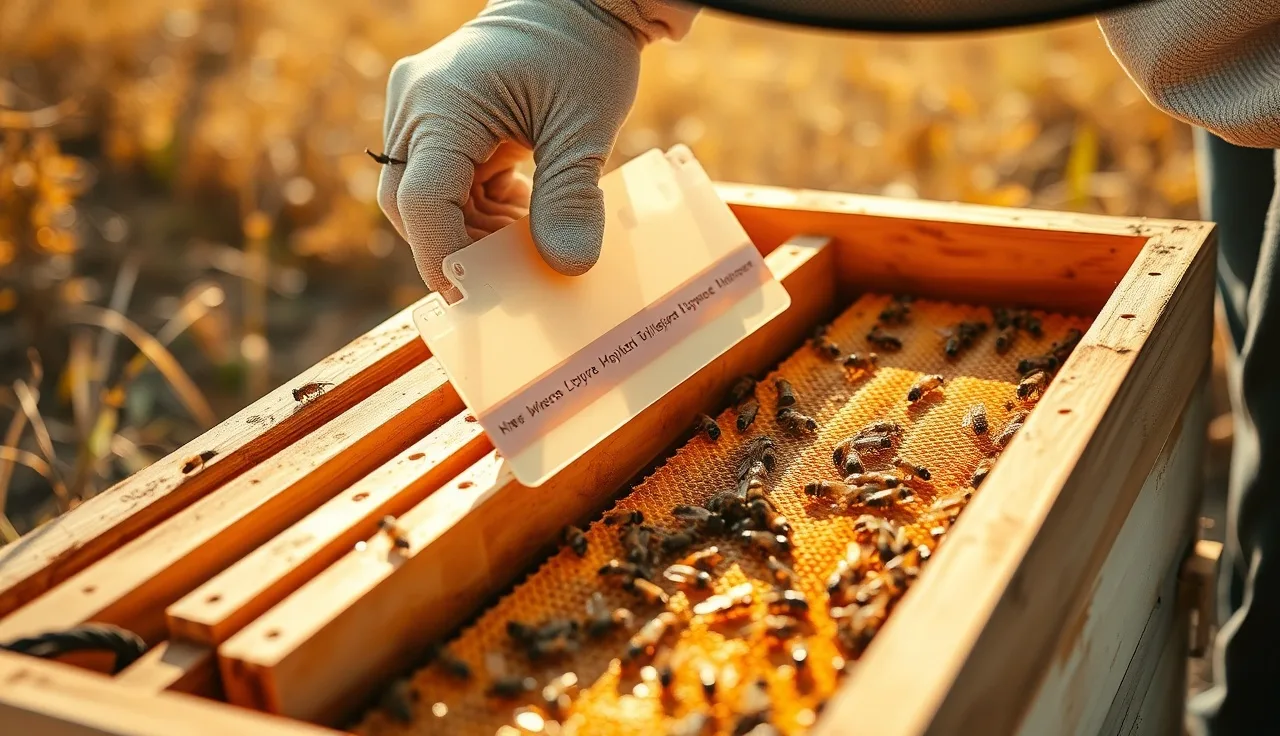
- Hang one Apivar strip per five frames of bees (two strips per standard colony) between brood frames, with strips touching the bee cluster.
- Leave them in for 6 to 8 weeks, then remove completely.
- Apply in fall after the honey harvest or in spring before the main nectar flow, when brood is present but honey supers are off.
What is Apivar and how does it kill varroa mites?
Apivar is an amitraz-based acaricide registered by the EPA (Registration No. 84639-1) for use in honey bee colonies to control Varroa destructor. Each plastic strip is impregnated with 3.33% amitraz, a compound that disrupts the nervous system of mites on contact. Bees walk across the strips and carry amitraz throughout the colony, coating brood-comb surfaces and adult bees in a thin residue that kills phoretic mites and mites emerging from capped cells.
Amitraz does not penetrate capped brood. That is why the 6-to-8-week treatment window matters so much: you need at least two full brood cycles (roughly 21 days each for worker brood) to expose the mites that were under cappings when you put the strips in. Shorten that window and you leave a surviving mite population behind.
Apivar is an over-the-counter product in all U.S. states, meaning you do not need a veterinary prescription to buy it. This sets it apart from some antibiotic treatments, though the FDA's Veterinary Feed Directive does not apply to acaricides. For a deeper background on the pest itself, see our guide on the varroa mite.
The Honey Bee Health Coalition's Tools for Varroa Management guide lists Apivar as one of the "soft chemical" options alongside oxalic acid and hop beta acids, and notes amitraz's effectiveness against both phoretic and reproducing mites when used across a full brood cycle. [1]
When should you apply Apivar strips?
Timing is the part most beekeepers get wrong. The EPA-registered label specifies two treatment windows: fall (after the last honey harvest) and spring (before honey supers go on). Both windows require that honey supers are completely removed before treatment begins. Amitraz can absorb into beeswax and honey at detectable levels, which is why the label prohibition on treating with supers present is a legal requirement, not a suggestion. [2]
Fall treatment matters more than spring for most beekeepers in temperate North America. The goal is to knock down the mite population before the colony raises its overwintering bees, the long-lived fat-body bees produced from roughly August through October depending on your latitude. Mite-damaged winter bees shorten colony lifespan dramatically. The University of Minnesota Extension recommends treating no later than early September in the Upper Midwest to protect that winter bee cohort. [3]
Spring treatment is a rescue option. Use it if you missed fall or if your mite count climbs above a threshold (typically 2 to 3% infestation on an alcohol wash) before supers go on. The catch is that amitraz residue can persist in wax for months, so repeated back-to-back treatments in the same equipment raise the theoretical risk of honey contamination during a later flow if supers go on too soon after strip removal.
Don't treat during a strong honey flow with supers on. If your colony is boiling with bees and you have supers stacked up, wait. Pull the supers, freeze or harvest those frames, then start treatment. A two-week delay to protect honey quality is worth it.
What mite count tells you it's time to treat?
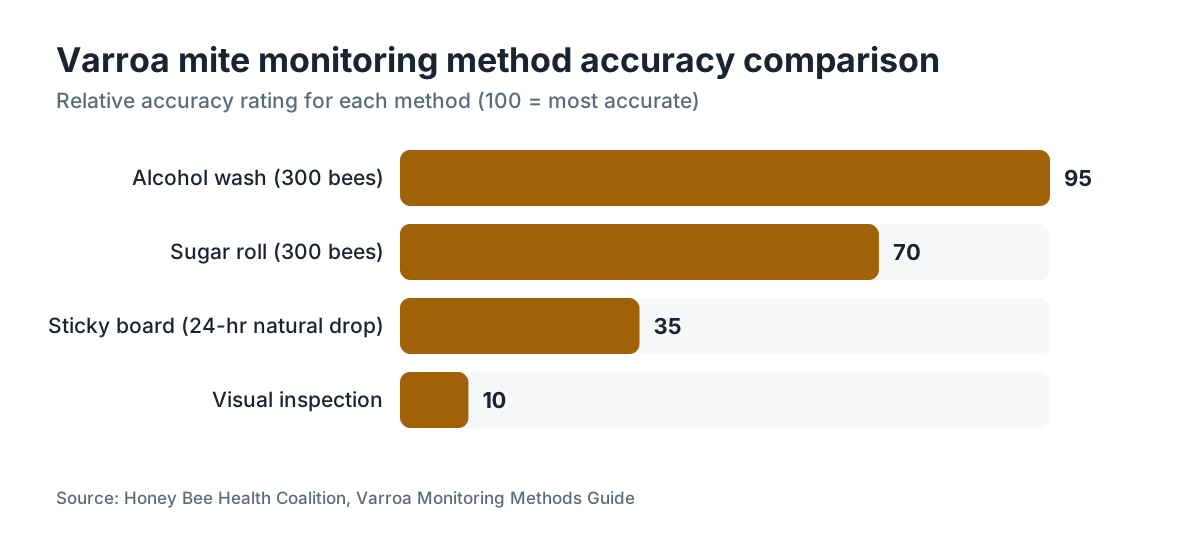
The Honey Bee Health Coalition recommends treating when an alcohol wash or sugar roll shows 2% or more mite infestation during the summer brood-rearing season (roughly 2 mites per 100 bees). In fall, before colony population drops, they suggest using 1 to 2% as the action threshold because the colony has less capacity to compensate. [1]
If you don't know your count, treat anyway in fall. Skipping the wash and treating prophylactically in September beats skipping treatment entirely. That said, post-treatment counts let you verify efficacy and catch resistance problems early, so washing bees about two weeks after strip removal is good practice.
A quick comparison of the main monitoring methods:
| Method | Accuracy | Equipment needed | Time to result |
|---|---|---|---|
| Alcohol wash | High (kills bees sampled) | Jar, rubbing alcohol | 10 minutes |
| Sugar roll | Moderate (does not kill bees) | Jar, powdered sugar | 10 minutes |
| Sticky board (natural drop) | Low (highly variable) | Sticky board, 24-48 hrs | 24-48 hours |
| Visual inspection | Very low | None | Immediate |
Alcohol wash on roughly 300 bees (half a cup) is the gold standard. The Honey Bee Health Coalition's guide walks through the exact procedure. [1]
How many Apivar strips do you use per hive?
The label dose is one strip per five frames of bees, with a minimum of two strips per colony and a maximum of four strips. [2] Most standard Langstroth colonies with a single or double brood box need exactly two strips. A very strong double-deep colony packed wall to wall might warrant three or even four.
Count frames of bees, not frames of comb. A frame of bees means both sides of the frame are covered with adult bees. If your colony occupies six frames of bees, two strips are correct. If it occupies twelve frames of bees (a heavy double-deep), go to three strips.
A package installed in spring with four or five frames of bees still gets two strips minimum. Don't go below two even for a small colony, because the minimum threshold reflects the treatment concentration needed to achieve full colony exposure.
Top-bar and Warré hive owners: the label was written for frame hives and the dosing guidance assumes standard Langstroth frames. Extension entomologists generally recommend scaling to roughly one strip per 5,000 to 6,000 bees, which maps to one strip per five well-covered frames regardless of frame size. When in doubt, contact your state apiarist for guidance on non-standard equipment.
How do you apply Apivar strips step by step?
Here is the full process, in order.
Before you open the hive:
Put on nitrile gloves. Amitraz is absorbed through skin and can cause drowsiness, headache, and lowered blood pressure in humans at sufficient exposure. The label requires gloves; wear them. [2] Have your smoker lit, your hive tool ready, and the Apivar package already open so you're not fumbling with packaging while bees are exposed.
Step 1: Remove honey supers. Every super, every time. There are no exceptions on the registered label. If you have a queen excluder, pull that too so the strips have full colony access.
Step 2: Find the brood nest. You don't have to spot the queen herself, but you need to know where the brood is concentrated. In a single deep, that's easy. In a double deep, the brood nest usually sits in the lower box or spans the seam between boxes. This is where your strips go.
Step 3: Position the strips in the brood nest. Hang one strip between two frames that have capped and open brood, near the center of the brood cluster. For two strips, place them symmetrically: one on each side of the brood nest center, roughly equidistant from the middle. In a double-deep hive, you can put one strip in the lower box and one in the upper box, each in the brood area.
The strips need contact with bees. Wedge each strip between two frames so the corrugated plastic hangs down into the frame space with its flat faces pressed lightly against the adjacent combs. There is a notch on one end of each strip: hook that notch over the top bar of a frame. The strip should hang roughly plumb. If the frames are too tight for the strip to touch both adjacent combs, nudge the frames slightly to create firm contact. [2]
Step 4: Record the date. Write it on the outside of the hive with a paint marker, or photograph the setup. You need to pull these strips in 6 to 8 weeks and it is easy to forget.
Step 5: Close the hive. Replace the inner and outer covers. You're done for now.
Where exactly should you place Apivar strips in the hive?
The placement goal is maximum bee traffic across the strip surfaces. Bees move most heavily through the brood nest, so that is where the strips belong. Strips in empty drawn comb, in honey storage areas, or in the corners of the hive get minimal traffic, which cuts efficacy sharply because fewer bees walk over them.
For a single brood box: place the two strips in the two inter-frame spaces on either side of the frame nearest the center of the brood pattern. If the colony is clustered on frames 4 through 7 (counting from one side), put the strips between frames 4-5 and between frames 6-7.
For a two-box setup: split the strips. One strip goes in the lower box in the heart of the lower brood area. The second strip goes in the upper box in the heart of the upper brood area. Bees move between boxes constantly and will contact both strips, but having strips in both boxes keeps exposure steady even if the cluster shifts during treatment.
Don't place strips directly adjacent to each other (back to back in the same inter-frame gap). Separate them so different bee traffic corridors carry amitraz to different parts of the colony.
One more thing: keep strips away from the hive entrance and outer walls. Temperature differences near the walls can reduce strip efficacy, and bee activity there runs lower than in the brood core.
How long do you leave Apivar strips in the hive?
The label requires a minimum of 6 weeks and a maximum of 8 weeks. [2] That range is not casual. Less than 6 weeks and you haven't covered two full worker brood cycles, so mites emerging from late-capped cells after treatment ends survive to reproduce. More than 8 weeks and you pile up excess amitraz residue in wax without meaningful added efficacy, and you push harder on resistance selection.
Six to eight weeks is the window. Most beekeepers aim for 7 weeks as a practical compromise.
The one exception: if you are treating a colony that has gone broodless (after a queen loss, a swarm, or an intentional brood break), shorter treatment works well because all mites are phoretic. The Honey Bee Health Coalition notes that combining a brood break with a miticide application is one of the most effective resistance management strategies available, and a broodless colony can be cleared with a much shorter chemical exposure. [1] Check the label and consult your state apiarist before deviating from the 6-to-8-week window, because the legal registered use specifies that range.
Weather affects strip performance. Amitraz volatility rises with temperature, so treatment during cool fall weather may run slightly less effective than mid-summer treatment. This is one reason fall treatment should start early enough that temperatures are still reasonable, rather than waiting until October in northern states when nights drop near freezing.
How do you remove Apivar strips and dispose of them?
Pull the strips out at 6 to 8 weeks. Use the same nitrile gloves you wore during application. The strips will be darkened and may be chewed or bent from bee activity. That is normal and a sign the bees have been working them.
Place used strips in a sealed plastic bag and dispose of them in household trash. Do not burn them: amitraz combustion products are toxic. Do not bury them in the garden. Do not leave used strips in the hive longer than 8 weeks. [2]
After removal, run an alcohol wash 2 to 3 weeks later to verify treatment success. A well-applied Apivar treatment should reach 90%+ mite reduction in a brood-rearing colony. If your post-treatment count is still above 2%, you have one of three problems: resistance (real but not yet widespread in most U.S. regions), strips that weren't in good bee contact, or treatment that was cut short. Amitraz resistance has been documented in some U.S. populations, and the Honey Bee Health Coalition recommends rotating active ingredients across treatment cycles to slow its spread. [1]
Can you use Apivar with honey supers on?
No. Full stop. The EPA-registered label explicitly prohibits applying Apivar while honey supers intended for human consumption are on the hive. [2] Amitraz and its breakdown products can absorb into beeswax and migrate into honey. The acceptable daily intake for amitraz residues in honey under U.S. standards is very low, and treating with supers present risks producing honey that fails residue testing for commercial sale, and more importantly, that you would not want to feed to your family.
The practical sequence is: harvest honey, pull all supers, treat for 6 to 8 weeks, remove strips, then let the colony build up two to four weeks before adding supers again for any late-season flow. In most of the northern U.S., there is no meaningful nectar flow after late August anyway, so fall treatment rarely conflicts with honey production once you harvest summer honey.
If you're in the Deep South or Pacific Coast and manage colonies through a fall or winter nectar flow, plan your treatment windows carefully and talk to your local extension apiculturist.
What are the most common mistakes people make applying Apivar?
Poor strip placement is the most common problem. Strips hanging in empty comb or honey storage get minimal bee contact and deliver a fraction of the amitraz dose. Always put strips in actively used brood comb.
Leaving strips in too long is the second most common error. Eight weeks maximum means eight weeks. Bees often chew strips apart after a while, and partially disintegrated strips left indefinitely add wax contamination without adding efficacy.
Not removing honey supers before treatment is a legal and food-safety violation. Don't do it.
Using the wrong number of strips. Underdosing (one strip for a 10-frame colony) leaves parts of the colony undertreated and selects for resistance. The label dose exists for a reason.
Treating late in fall when temperatures sit consistently below 50°F (10°C). Amitraz loses volatility and efficacy in cold conditions. If you're applying in October in Minnesota or Maine and temperatures are already cold, oxalic acid (which works regardless of temperature on broodless colonies) may be the better choice for that treatment window.
Finally, not verifying efficacy afterward. Many beekeepers treat and assume it worked. An alcohol wash 2 to 3 weeks after strip removal is the only way to confirm. If you're tracking colony health across the season, tools like those available at VarroaVault can help you log counts and spot patterns across multiple hives.
For beekeepers sourcing Apivar and other supplies, beekeeping supply companies that specialize in apiculture typically carry Apivar in packs of 10 strips (5 complete two-strip treatments).
Does Apivar work in all hive types including top-bar hives?
Apivar's label was written for frame hives, but it is used off-label in top-bar and other hive styles. The active ingredient works the same way regardless of hive design: bees carry amitraz through the colony via physical contact with the strips. The challenge in top-bar hives is that frames are not removable in the same way, and spacing may not let the strip hang correctly in the bee space.
For top-bar hives, many beekeepers lay the strips flat on the top bars in the brood area rather than hanging them vertically. This gives surface contact as bees walk over them. It's not the labeled application method but follows the same logic of maximizing bee-to-strip contact in the brood zone.
The real issue with non-Langstroth hives is dosing: how many strips for a top-bar colony that has 30 bars of brood? The 1-strip-per-5-frames logic is a reasonable starting point. When in doubt, contact your state apiarist's office, which in most states will advise on off-label hive-type applications.
Apivar is registered for European honey bee (Apis mellifera) colonies in the U.S. If you're keeping other bee species, that's a different conversation entirely. See our overview of beekeeping species for context on what applies where.
How does Apivar compare to other varroa treatments?
Each treatment has a specific use case. Apivar's advantage is that it works through brood cycles, so it kills mites in both the phoretic and reproductive stages over the full treatment window. Its downsides are the honey super prohibition, the wax residue concern with repeated use, and the emerging (though still limited) resistance issue.
| Treatment | Active ingredient | Honey super restriction | Broodless required? | Treatment duration |
|---|---|---|---|---|
| Apivar | Amitraz | Yes, remove supers | No | 6-8 weeks |
| Oxalic acid (dribble) | Oxalic acid | No (if no supers) | Yes (most effective) | Single treatment |
| Oxalic acid (vaporization) | Oxalic acid | No (if no supers) | Recommended | 3 treatments, 5 days apart |
| Mite Away Quick Strips | Formic acid | No if under 95°F | No | 7 days |
| ApiLife Var | Thymol blend | Yes, remove supers | No | 3 treatments, 1 week apart |
| HopGuard 3 | Hop beta acids | No | No | Varies by label |
Data from Honey Bee Health Coalition Tools for Varroa Management guide, 6th edition. [1]
For a fall treatment when colonies still have brood, Apivar and formic acid are the two main options that work through capped brood cycles without requiring a broodless state. For a broodless winter cluster, a single oxalic acid dribble or vaporization treatment is highly effective and has no wax residue concerns at the doses used.
The Honey Bee Health Coalition recommends rotating between chemical classes (amitraz, oxalic acid, formic acid) across treatment cycles to reduce the probability of resistance developing to any single active ingredient. [1] That is practical advice worth following.
Where can you buy Apivar and what does it cost?
Apivar is sold in packs of 10 strips. As of 2024 to 2025, retail pricing runs roughly $20 to $35 per pack of 10 depending on the supplier, which covers 5 complete two-strip treatments. Buying in larger quantities (50 or 100-strip packs) brings the per-treatment cost down noticeably.
Apivar is available through most major beekeeping supply retailers, local bee clubs sometimes organize group buys, and many state apiarists can point you to regional suppliers. Checking free shipping honey bee supply companies can save a few dollars on shipping when ordering online.
The strips have a limited shelf life once opened: the label says to store them sealed in a cool, dry location and use them within the labeled expiration period. Don't store open strips for a full season and expect them to work at full strength the following year.
Frequently asked questions
Can I apply Apivar with bees still on the frames?
Yes, and that's exactly how it works. You do not need to find or cage the queen, and you do not need to brush bees off frames before inserting strips. The bees need to be on and around the strips for the amitraz to spread through the colony. Light smoke at the entrance and a calm approach is enough. Heavy smoking can temporarily drive bees away from the brood nest and reduce early strip contact, so use smoke sparingly during application.
Do I need to remove Apivar strips before a nectar flow?
Yes. The EPA-registered label prohibits Apivar use with honey supers on the hive. If a nectar flow begins while strips are still in, you must pull the strips and wait before adding supers. The label does not specify a mandatory waiting period between strip removal and super addition, but most extension recommendations suggest at least two to four weeks to minimize any residue risk, and you should complete the minimum six-week treatment before pulling strips early for a flow.
Will Apivar harm the queen or brood?
At label doses, Apivar is generally considered safe for the queen and brood. Amitraz at the concentrations delivered by the strips is selectively toxic to the arachnid mite rather than the bee. Some beekeepers report occasional queen losses that they attribute to Apivar, though it's difficult to prove causation. If you're treating a colony with a newly mated queen or a small, stressed colony, watch closely after treatment and confirm the queen is still laying by day 10.
How do I know if Apivar worked?
Run an alcohol wash on 300 bees roughly two to three weeks after removing the strips. A successful treatment should reduce your mite infestation to well below 1% (ideally under 0.5 mites per 100 bees). If your count stays above 2% post-treatment, the strips may not have had good bee contact, the treatment may have been cut short, or you may be dealing with amitraz-tolerant mites. Report suspected resistance to your state apiarist.
Can I use Apivar twice in one season?
The label allows a spring treatment and a fall treatment in the same calendar year. Two treatments per year on the same hive is within the registered use. What you should avoid is back-to-back treatments without a break, since repeated amitraz exposure in the same wax accelerates residue accumulation and resistance selection. If you treat in fall, let the colony overwinter on that wax and plan a spring treatment only if monitoring shows it's needed.
What temperature range does Apivar need to work?
Amitraz is most effective at temperatures above 59°F (15°C). The compound's volatility and the bees' activity level both drop at lower temperatures, reducing contact between bees and strips. There is no hard cutoff in the label, but treating in late October in northern states when temperatures regularly drop below 50°F is a risk. If you're treating in cold conditions, consider oxalic acid vaporization for broodless or near-broodless clusters instead.
Can Apivar strips be reused?
No. Each strip is for a single treatment cycle only. After 6 to 8 weeks in the hive, the amitraz loading is substantially depleted and the strip's plastic matrix has been weathered and often chewed. Pull used strips, bag them, and dispose of them in household trash. Reusing depleted strips delivers inadequate amitraz doses, fails to control mites, and adds resistance selection pressure without the benefit of actual treatment.
Does Apivar work in a nuc or small split?
Yes. The label minimum is two strips per colony regardless of colony size. A nuc on five frames gets two strips just like a full-sized colony. Place them in the brood area, one on each side of the center brood frames. Small colonies still require the full 6-to-8-week treatment window. The only difference is that a very small cluster may cover the strips less thoroughly, so placement in the tightest part of the cluster matters even more.
Is there any resistance to Apivar in the U.S.?
Yes, amitraz resistance has been documented in some U.S. Varroa populations, though it is not yet widespread. A 2018 study in Scientific Reports documented reduced sensitivity to amitraz in varroa populations from Florida, Texas, and Maryland. This is why the Honey Bee Health Coalition recommends rotating active ingredients and monitoring post-treatment counts. If your mite load doesn't drop substantially after a properly applied Apivar treatment, resistance is a plausible explanation worth investigating.
Do I need a veterinary prescription to buy Apivar?
No. Apivar is an EPA-registered pesticide, not a drug subject to the FDA Veterinary Feed Directive. You can purchase it without a prescription at beekeeping supply retailers, online, or through your local bee club. This is different from oxytetracycline and other antibiotics used in beekeeping, which do require a veterinary-client-patient relationship. Always confirm current regulations with your state's department of agriculture since rules can change.
What should I do if I accidentally leave Apivar strips in longer than 8 weeks?
Pull them as soon as you realize the error and document when they went in and when you removed them. Leaving strips in longer than 8 weeks does not trigger an immediate disaster, but it does increase amitraz accumulation in wax and extends resistance selection pressure without adding meaningful mite control. If strips were in for 10 to 12 weeks, consider replacing the brood comb over the following season as part of normal comb rotation and rotate to a different active ingredient for your next treatment.
Can Apivar be used with screened bottom boards?
Yes. Screened bottom boards do not interfere with Apivar treatment. The amitraz is distributed via bee-to-bee and bee-to-surface contact within the cluster, not via gravity or fumigation, so whether the bottom board is solid or screened makes little practical difference to efficacy. Keep the sticky board out during treatment if you normally use one for monitoring, since counting mite drop during an active Apivar treatment doesn't give you a reliable baseline mite load.
Sources
- Honey Bee Health Coalition, Tools for Varroa Management Guide (6th ed.): Apivar listed as soft chemical option; 2% action threshold in summer; recommendation to rotate active ingredients to reduce resistance risk
- EPA, Apivar (amitraz) Pesticide Registration Label – Reg. No. 84639-1: Label specifies 1 strip per 5 frames of bees, minimum 2 strips, maximum 4 strips; 6-to-8-week treatment duration; prohibition on use with honey supers; glove requirement; disposal instructions
- University of Minnesota Extension, Varroa Mite Management: Recommendation to treat no later than early September in the Upper Midwest to protect winter bee cohort
- Penn State Extension, Varroa Mite Treatment Options for Honey Bees: Overview of amitraz treatment including temperature considerations and efficacy through brood cycles
- Scientific Reports (Nature), 'Population genetics of the Varroa destructor mite' – Reed et al. 2018: Documented reduced amitraz sensitivity in Varroa populations sampled from Florida, Texas, and Maryland
- USDA Agricultural Research Service, Varroa Destructor Management: Amitraz mode of action and absorption into wax at detectable levels under extended or improper treatment conditions
- Oregon Department of Agriculture, Varroa Mite Control in Honey Bee Colonies: State-level guidance on registered varroa treatments including Apivar and prescription status of acaricides vs antibiotics
- North Carolina State University Apiculture Extension, Managing Varroa Mites: Alcohol wash methodology and 300-bee sample size as gold standard for mite infestation monitoring
- Ohio State University Extension, Varroa Mite Treatment Timing: Fall treatment timing relative to winter bee production and colony survival rates
- Honey Bee Health Coalition, Varroa Monitoring Methods: Comparison of alcohol wash, sugar roll, and sticky board monitoring accuracy; brood-break combined treatment strategy
- Virginia Cooperative Extension, Honey Bee Pest Management: 1 to 2% fall action threshold recommendation; post-treatment monitoring timeline of 2-3 weeks after strip removal
Last updated 2026-07-09