How to measure 300 bees for an alcohol wash (step by step)
TL;DR
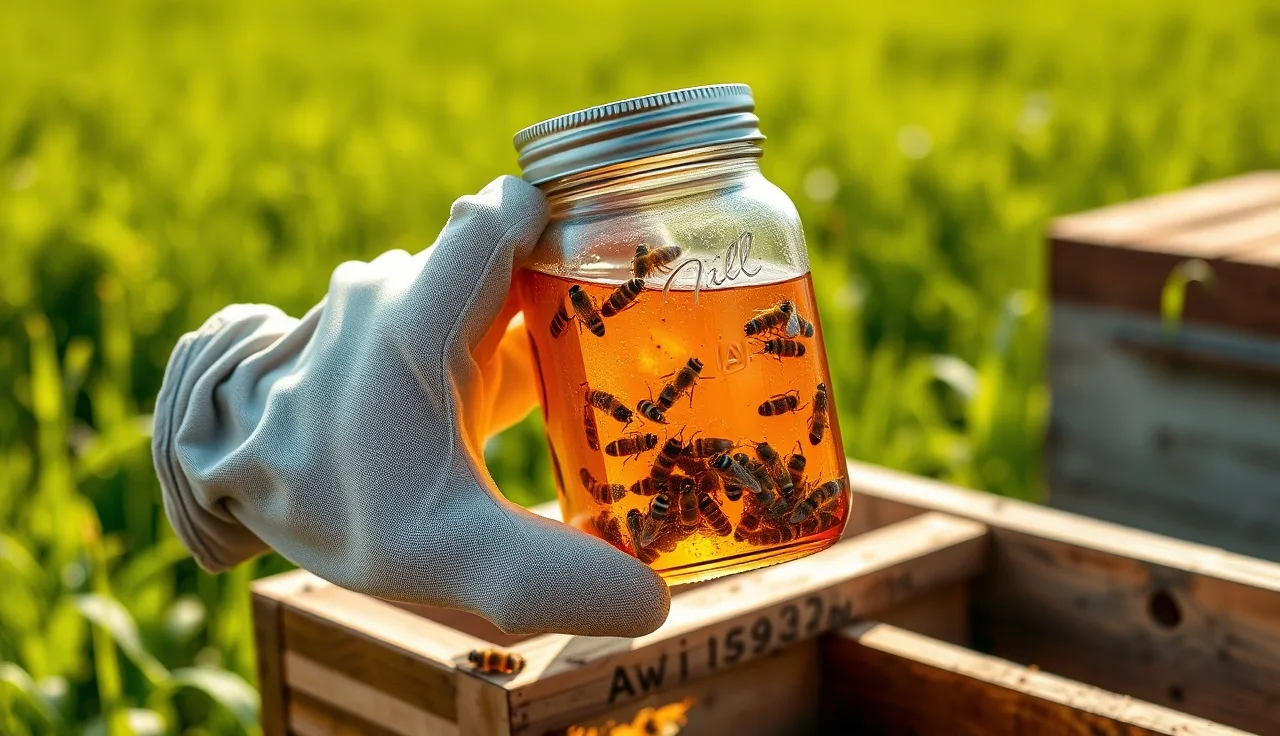
- A half-cup (roughly 120 mL) of bees scooped from a brood frame holds about 300 adult worker bees, which is the standard sample size for an alcohol wash varroa test.
- Shake bees into a wide-mouth jar, fill to the half-cup mark with 70% isopropyl alcohol, agitate for 60 seconds, and count the mites that fall out.
Why does the 300-bee sample size matter?
Three hundred bees is the number the Honey Bee Health Coalition's Varroa Management Guide recommends for an alcohol wash. It gives you a reliable mites-per-100-bees (MPH) figure without killing so many bees that you dent the colony [1]. Pull fewer and your count gets noisy. Pull more and you're spending bees for nothing.
Here's the math. Pull 150 bees, count 3 mites, and your MPH is 2.0. Pull 300 bees, count 6 mites, still 2.0. The larger sample smooths out the random variation that comes from bees spreading themselves unevenly across frames. That smoothing is what you're paying for when you decide whether to treat.
Most extension services set the economic threshold at 2 mites per 100 bees during the honey flow and 1 to 2 per 100 bees going into winter [2]. A sloppy sample can shove you over or under that line by accident. Get the sample size right and the rest of the math is trivial.
One more reason 300 wins: it's small enough to collect in under a minute from a single frame, so you're less likely to accidentally scoop the queen.
What equipment do you need before you start?
You don't need much. Having the right gear in hand before you crack the hive keeps things fast and clean.
The core setup:
- Two wide-mouth mason jars (one for collecting, one for counting), quart size works fine
- A jar lid drilled with 1/8-inch hardware cloth or window screen, or a commercial alcohol wash kit
- 70% isopropyl alcohol, at least 250 to 300 mL (rubbing alcohol from any drugstore works)
- A measuring cup, or a jar marked at the half-cup (120 mL) line
- A white or light-colored tray or bowl to pour the wash into for counting
- A permanent marker to draw your volume line if the jar isn't pre-marked
Skip the 91% or 99% isopropyl if you can. It works, but 70% is cheaper, and the higher water content actually helps knock mites off the bees a little better because the solution is slightly denser. The mechanism: water helps the alcohol get through the waxy surface of the mite [3]. In practice the difference is small. If 70% is on the shelf, grab it.
A powdered sugar roll is the no-kill option, but it consistently undercounts mites next to the alcohol wash. The University of Minnesota Bee Lab treats the alcohol wash as the most accurate field method a beekeeper can run [4]. I'd reach for powdered sugar only when I truly need every bee alive, and I'd read that count as a low estimate.
For the physical kit that makes this easier, the beekeeping supplies and beekeeping supply companies pages here are a decent starting point for mesh lids and wash kits.
How do you measure exactly 300 bees using volume?
The volume trick is what makes alcohol washing practical. You don't count bees one at a time. You use the fact that 300 worker bees fill roughly half a cup (about 120 mL) when shaken into a jar.
That relationship comes from repeated weighing and counting. A single adult worker weighs about 0.10 to 0.12 grams [5], so 300 bees run around 30 to 36 grams. Volume is harder to pin to one number because it shifts with how settled the bees are, but the half-cup mark is steady enough for field work. The Honey Bee Health Coalition uses this exact half-cup standard in its instructions [1].
Here's how to hit that mark:
- Find a frame of open brood in the brood nest, ideally one crawling with nurse bees. Nurse bees carry the highest mite loads of any adult bees in the colony because they have the most contact with capped brood [6].
- Hold the jar steady and shake the frame sharply over it once or twice. Don't scrape or brush, just shake. You want bees to fall in freely.
- Stop and check the volume. Bees pile loosely in the bottom. Find the half-cup (120 mL) line.
- Short? Shake a second quick burst over the jar.
- Over by a little? Fine. A few extra bees don't move your MPH result.
The main mistake is collecting the wrong bees. Field bees returning to the entrance carry almost no mites because they've been away from capped brood. Always collect from inside the brood nest.
Mark a permanent line on a mason jar at home before you head out. Pour exactly 120 mL (half a cup) of water in, mark the waterline, let it dry. Thirty seconds, and the guesswork disappears at the hive.
What if you're worried about scooping the queen?
This is the fear that stops new beekeepers from washing at all, and it's fair. Killing the queen by accident is a real cost.
Four habits protect her:
First, set the queen aside. Before you shake, find her on the frame. If she's there, lean that frame against the hive stand and collect from a different brood frame. Queens are almost never on more than one frame.
Second, shake, don't scrape. One sharp downward shake dislodges nurse bees. Queens grip harder and hold on longer, so a quick shake is less likely to drop her in than scraping bees off the comb.
Third, work in good light. You'll spot her before you shake if you can see the frame clearly.
Fourth, check the jar before you add alcohol. Queens are noticeably bigger than workers. See one in the jar, tip it gently against the open hive, and let her walk back out before you seal the lid and add the wash.
Nobody has clean data on how often queens die during alcohol washing in the field. The practice is common enough that it's clearly not a routine colony killer. Being careful costs nothing.
How do you actually run the alcohol wash once bees are in the jar?
With about 300 bees in the jar, the wash itself takes maybe two minutes.
Step 1: Add alcohol. Pour in enough 70% isopropyl to fully submerge the bees, usually 150 to 200 mL. You want them swimming, more than damp.
Step 2: Seal the jar. Screw on the mesh lid, the one with the screen insert that keeps bees in but lets the wash pour through.
Step 3: Agitate. Swirl and shake hard for about 60 seconds. Some sources say 30 seconds is enough. Sixty is more thorough, and the difference in mite recovery shows up when studies compare the two [3].
Step 4: Pour into the white tray. Invert the jar over your white bowl and let the alcohol drain through the screen. Bees stay in the jar, mites and alcohol end up in the tray.
Step 5: Rinse again. Add another splash of alcohol to the same jar, swirl 15 seconds, pour that into the tray too. This second rinse catches mites still clinging to the dead bees and pushes recovery up.
Step 6: Count. Mites are reddish-brown ovals about 1.5 mm long. They stand out against white. Count every one. If the tray is crowded, tilt it gently to spread them out.
Step 7: Calculate. (Mites counted / bees collected) x 100 = mites per 100 bees. Count exactly 300 bees by volume and find 6 mites, and your MPH is 2.0.
Download a tracking sheet from VarroaVault's free tools to log your washes by hive and date. It makes trends obvious well before a colony hits the treatment threshold.
How accurate is the half-cup volume method for hitting 300 bees?
Honest answer: pretty accurate, not exact. The half-cup standard is a field approximation, and it works because the ratio, not the raw count, is what matters.
The variability comes from bee size and how compressed the bees are in the jar. Fall bees run larger and heavier than spring bees. Bees that fall in loosely take up more room than bees shaken in fast and packed tight. Worker weights sit around 0.10 to 0.12 grams each [5], so a 30-gram sample (half a cup under typical settling) could be anywhere from 250 to 350 bees.
Does that range matter? Barely. Have 250 bees and 5 mites, your MPH is 2.0. Have 350 bees and 7 mites, also 2.0. The threshold doesn't move and the ratio holds, as long as you're pulling from the same population of nurse bees.
The bigger error isn't the volume method. It's collecting the wrong bees. Sample field bees from the entrance and your mite load looks artificially low. Go to the brood nest.
Want to verify your jar's mark once? Weigh a sample on a kitchen scale. Aim for 28 to 35 grams. That range maps reliably to 250 to 350 bees.
The table below shows how MPH shifts with sample size and mite count. It's why roughly 300 bees is enough even when you're not perfect.
When during the season should you do alcohol washes?
Test four times a year at minimum: early spring (before the first big flow), early summer (during the flow), late summer (after the flow, before any treatment), and late fall (to confirm winter prep) [8]. Beekeepers with more than a few hives often test monthly through the active season.
The late-summer test carries the most weight. Mite populations spike then because the colony is rearing fewer bees, so each bee carries a higher share of the mite load. The window to treat before winter bees are reared is narrow, usually mid-August to mid-September across most of North America [8]. Miss it and you rear winter bees loaded with mites, which shortens their lives and stacks the odds toward collapse by February.
For new colonies, packages and nucs included, run your first test 4 to 6 weeks after install. Packages start with almost zero mites, but whatever rode in with the bees establishes fast once brood rearing kicks off. A single infested queen introduced with a package can seed a mite population that clears the treatment threshold by late summer.
The varroa mite overview here walks through the mite's reproductive cycle, which explains why the late-summer window is so tight.
Testing at least monthly from July through September is not overkill. It's cheap in time (15 minutes per hive once you're practiced) and the information is worth far more than the bees it costs.
What do your mite count results actually mean?
You have your MPH number. Now you decide what to do with it.
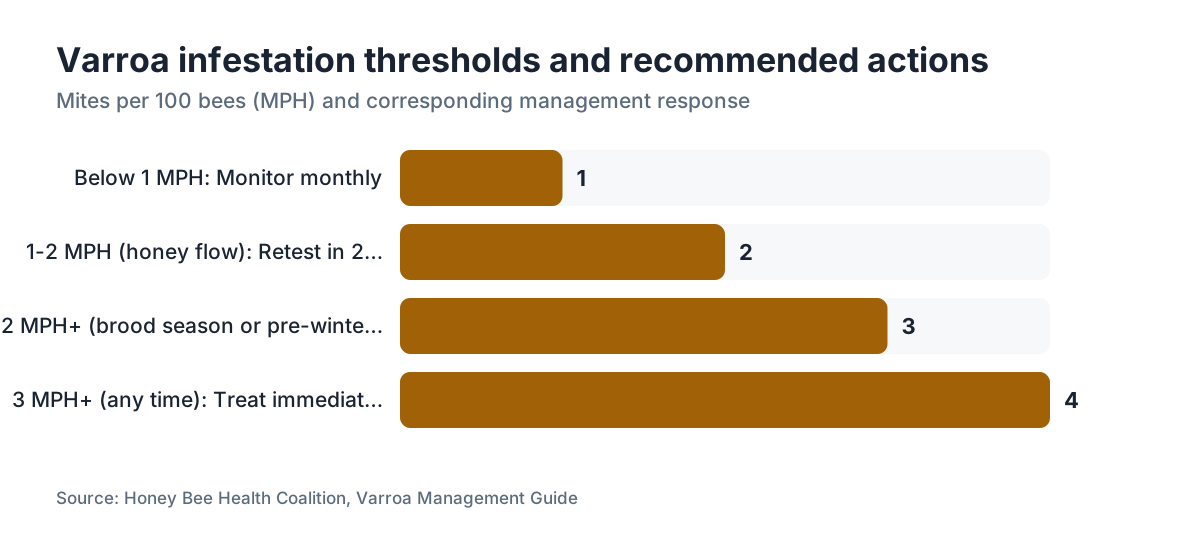
The Honey Bee Health Coalition's Varroa Management Guide [1] lays out these thresholds as general guidance:
- Below 1 MPH: Low infestation. Monitor monthly.
- 1 to 2 MPH during honey flow: Borderline. Test again in 2 to 4 weeks.
- 2 MPH or above during honey flow or before winter buildup: Treat now.
- 3 MPH or above at any time: Treat immediately, regardless of season.
A few caveats. These thresholds aren't law. They're practical benchmarks pulled from research on colony health outcomes. Beekeepers in areas with heavy mite pressure sometimes treat at 1 MPH going into fall. Others in isolated apiaries with low reinfestation risk hold off until 3 MPH during the flow. Your local conditions and your own loss history should shape how hard you read the numbers.
The EPA-registered treatments for varroa include oxalic acid (dribble, vaporization, or extended-release), formic acid (Mite-Away Quick Strips and others), amitraz (Apivar strips), and several more [7]. Each carries label rules about temperature range, brood conditions, and honey supers. Read the label. It's a federal document, and using a pesticide off-label is illegal.
Tracking multiple hives? Log every wash with date, hive ID, and bee count. Patterns across colonies tell you whether you have a reinfestation problem (mites drifting from a neighbor) or a treatment that failed.
One clean fact worth quoting: the Honey Bee Health Coalition states that "an infestation level of 2% (2 mites per 100 bees) or more warrants treatment" during the brood rearing season [1].
How often should you test each hive and how many hives in your apiary?
Test every hive individually. Mite loads aren't uniform across colonies even in one apiary. A hive that read clean in June can sit at 4 MPH in August. Spot-testing one or two hives and assuming the rest are fine is how people lose colonies they thought were healthy.
A small hobbyist apiary of 2 to 4 hives takes maybe an hour to test through. Sideliner operations of 15 to 50 hives need a system. One approach: test every hive in spring and fall, then test any hive showing behavioral warning signs (deformed wings, unusual crawling, a population that's too small for the season) whenever you spot them.
Reinfestation is real. If neighbors within a few miles keep bees and don't test or treat, your treated colonies can pick up mites from their collapsing hives through robbing and drift. There's no full defense against that, but knowing your own counts monthly means you catch it before it turns into a crisis.
Scaling up? VarroaVault's free varroa management tools include a hive-by-hive tracking sheet that shows your rolling average MPH by colony over time.
What mistakes do beekeepers commonly make when doing an alcohol wash?
A handful of errors show up over and over. All of them are fixable.
Collecting from the wrong frame. Grab bees off a honey frame or the top bars where older bees rest and your count comes back artificially low. Nurse bees on open brood are the target. They carry the highest mite loads because phoretic mites seek out nurse bees to reach the cells [6][10].
Using too little alcohol. The bees need to be fully submerged and agitated. A splash that just wets them won't dislodge mites reliably. Use at least 150 mL per wash.
Skipping the second rinse. A single pour-through leaves mites on the bees. A second small rinse combined with the first wash in your counting tray gives a more complete count [9]. Nobody has a clean published figure for exactly how many extra mites the rinse catches, but multiple extension programs agree you should do it [4].
Counting against a dark surface. Mites are small and reddish-brown. Against a dark tray or the ground, you'll lose some. Pour into a white bowl or pan. A disposable aluminum pie pan works and costs pennies.
Not recording the result. Skip the date, hive ID, and MPH and the test is half as useful. Memory fails across a season, every season.
Is there a less lethal alternative to alcohol wash for measuring varroa?
Yes, and it comes with a real accuracy cost.
The powdered sugar roll uses the same 300-bee sample and volume method. Instead of alcohol, you add about two tablespoons of powdered sugar to the jar, roll the bees to coat them, then shake the sugar and any dislodged mites through the screen onto a white surface with a little water to dissolve the sugar.
The bees go back in the hive alive. The catch is accuracy. Studies comparing sugar rolls to alcohol washes consistently find the sugar roll undercounts mites by 40 to 60% [4]. That's a big enough gap to hand you false confidence at borderline thresholds. A colony reading 1.0 MPH by sugar roll could easily sit at 1.5 to 2.0 MPH by alcohol wash.
Some beekeepers use it anyway because they can't stomach sacrificing 300 bees. In practice, 300 bees is under 1% of a healthy colony, and the information is worth it. But if the sugar roll is what gets you testing consistently instead of not testing at all, it beats nothing.
Sticky boards are another option. You slide them under the screened bottom board for 24 to 72 hours and count natural mite drop. The problem is that natural drop rates don't track infestation levels reliably across seasons and colony sizes, so converting a drop count to an MPH figure is guesswork. Sticky boards are good for confirming a treatment is working (mites spike, then drop after you treat) but weak for setting treatment thresholds.
The alcohol wash stays the field standard [1][4].
Frequently asked questions
Can I use any alcohol for an alcohol wash, or does it have to be isopropyl?
70% isopropyl rubbing alcohol is the standard and the easiest to source. Ethanol (grain alcohol) at similar concentrations also works. Avoid methanol, which is toxic and not sold as a consumer product in most places. High-proof vodka (40% ethanol) is too dilute and won't reliably knock mites off bees. Stick with 70% isopropyl from a drugstore. It costs about $2 per bottle and one bottle does multiple washes.
How long does an alcohol wash take from start to finish?
Once you're practiced, about 10 to 15 minutes per hive including opening the hive, collecting the sample, running the wash, and counting the mites. The first few times take longer because you're checking your volume marks and counting carefully. Build in 20 to 25 minutes per hive for your first season. The actual agitation and pour takes under 3 minutes. Most of the time goes to opening frames and finding the right bees.
Does collecting 300 bees hurt the colony?
Not meaningfully. A healthy colony holds 30,000 to 60,000 adult workers. Removing 300 is roughly 0.5 to 1.0% of the population. The colony makes it up within hours through normal hive activity. The information you get is worth far more to colony survival than 300 bees. The only time to hesitate is with a very small swarm or package in the first two weeks, before the colony has built up.
What's the difference between mites per 100 bees and a total mite count?
Mites per 100 bees (MPH) is a percentage, not a raw number. It lets you compare colonies of different sizes fairly. A raw count of 6 mites means very different things in a 20,000-bee colony versus a 50,000-bee colony. MPH normalizes that. Since your alcohol wash samples roughly 300 bees, you divide your mite count by 3 to get MPH, or divide by your actual bee count and multiply by 100.
Can I reuse the alcohol from an alcohol wash?
Technically yes, the mites are dead and filtered out, but the alcohol picks up wax, propolis, and proteins from the bees that make later washes harder to read. Fresh alcohol gives a cleaner wash where mites stand out against the white tray. If cost worries you, 70% isopropyl is cheap enough that reuse isn't worth the reduced accuracy. Use fresh alcohol for each wash.
How do I know if I collected from the right spot on the frame?
Look for open brood (uncapped larvae and eggs) and nurse bees hovering over or in cells. Nurse bees are younger, interior bees that haven't started foraging yet. They tend to have their heads in cells or cluster tightly over brood. Frames near the center of the brood nest are the best source. Avoid the outer honey frames, the frames at the edges of the cluster, and the top bars where older bees rest.
What if I can't see the mites clearly in my counting tray?
Try a white plastic or aluminum tray in bright sunlight. Mites are reddish-brown ovals about 1.5 mm long, visible to the naked eye but easy to miss in dim light or against a dark surface. Adding a little water to the tray after pouring the wash helps mites float and spread out. A hand lens or reading glasses help if your close-up vision isn't sharp. Take a phone photo and zoom in if you're unsure.
Do I need to test brood cells separately to get an accurate varroa reading?
For a standard monitoring test, no. The alcohol wash on adult bees is the accepted field method and the basis for treatment thresholds. Testing inside brood cells (by uncapping capped drone or worker brood and looking for mites) is a useful supplemental check to confirm reproduction is happening, but it doesn't give you a percentage figure you can compare to thresholds. The adult bee wash is the standard. Some researchers run a combined brood and adult sample, but that's not practical for hobbyist monitoring.
What mite count is too high to delay treatment?
At 3 mites per 100 bees or above, treat without delay regardless of season or whether supers are on. At 2 MPH or above during brood rearing season or before winter buildup, treat now. These are the Honey Bee Health Coalition's guidelines based on research into colony health outcomes. Below 1 MPH is generally considered low, but even a reading of 1 MPH in late July warrants another test in 2 to 3 weeks because populations can double quickly.
Can I do an alcohol wash without a mesh lid?
Yes, with a workaround. Put a piece of window screen or 1/8-inch hardware cloth over the mouth of the jar and hold it with a rubber band. Then invert the jar into your counting tray and let the alcohol drain through the screen while the bees stay in the jar. A proper mesh lid makes this easier and cleaner, but a rubber-banded screen works in a pinch. Commercial alcohol wash kits with built-in screen lids cost $10 to $20 from most beekeeping suppliers.
Should I test all my hives or just a random sample?
Test every hive. Mite loads vary dramatically between colonies even in the same apiary. Sampling only some hives and assuming the rest match is a common cause of unexpected winter loss. The time cost of testing a few extra hives is small. The cost of losing a colony to an untested high-mite hive is large, both in bees and in reinfestation pressure on your other colonies from a collapsing neighbor hive.
How does temperature affect an alcohol wash?
The alcohol itself works at any normal outdoor temperature you'd be opening a hive. What temperature changes is hive behavior: cold bees cluster tighter, so frame removal and collection go slower. Below about 50 F (10 C), bees are lethargic enough that you might accidentally collect field bees or cluster-surface bees instead of nurse bees on brood. Do alcohol washes on mild days above 60 F, when the colony is actively working brood frames.
How is the alcohol wash different from a sticky board reading?
An alcohol wash gives you mites per 100 bees, a percentage that maps directly to treatment thresholds. A sticky board gives you a raw daily mite drop count that doesn't reliably convert to a percentage because natural drop rates vary with colony size, season, and temperature. Sticky boards are best for confirming a treatment is working, not for deciding whether to treat. For threshold decisions, the alcohol wash is the right tool.
Sources
- Honey Bee Health Coalition, Varroa Management Guide: Half-cup sample (~300 bees) is the standard for alcohol wash; treatment threshold is 2 mites per 100 bees during brood rearing season
- University of Minnesota Bee Lab: Treatment thresholds of 1-2 mites per 100 bees before winter buildup; late summer timing window for treatment
- Journal of Economic Entomology (Oxford Academic): 60-second agitation improves mite recovery compared to 30 seconds; 70% isopropyl alcohol mechanism for mite detachment
- University of Minnesota Bee Lab, Varroa monitoring resources: Alcohol wash is the most accurate field method; powdered sugar roll undercounts mites; second rinse recommended for completeness
- USDA Agricultural Research Service, Bee Research: Adult worker honey bee weighs approximately 0.10-0.12 grams
- Rosenkranz, P., Aumeier, P., & Ziegelmann, B. (2010). Biology and control of Varroa destructor. Journal of Invertebrate Pathology, 103, S96-S119.: Phoretic mites preferentially associate with nurse bees to gain access to brood cells; nurse bees carry the highest phoretic mite loads
- U.S. EPA, Pollinator Protection: EPA-registered treatments for varroa include oxalic acid, formic acid, amitraz, and others with specific label requirements
- Penn State Extension, Beekeeping: Test four times per year minimum; late summer test is most consequential for winter colony survival
- Oregon State University Extension: Standard alcohol wash procedure: collect half-cup of nurse bees from brood frame, wash with 70% isopropyl, second rinse recommended
- Virginia Cooperative Extension: Collecting from the entrance or honey frames gives artificially low mite counts; brood nest nurse bee collection required for accurate results
Last updated 2026-07-09