How to monitor varroa in a new package hive
TL;DR
- New package hives can carry varroa mites from day one, but the broodless stretch in the first two to four weeks makes this the best window you'll ever get for an honest alcohol wash count.
- Start monitoring within the first week.
- Treat if your count hits two mites per hundred bees or higher.
- Recheck every two to four weeks through build-up.
Do new package bees already have varroa mites?
Yes. Most packages do. Commercial producers shake bees from established colonies that almost certainly carry some mite load, and the shaking and caging process does nothing to strip mites off. Varroa lives in the majority of managed U.S. colonies, and packaged bees are not exempt [8].
Here's the upside. The mite population in a fresh package is usually low, because the colony has been broodless for days in transit. Varroa reproduce inside capped brood cells. No brood means no reproduction cycle. Every mite you find in a new package is phoretic, riding on adult bees, exposed, and countable. That makes the first two to four weeks after installation the single best window you'll ever get for an honest mite count on that colony.
Don't assume your source tested or treated before shipping. Some do. Most don't. And even the ones that treat can ship bees with a surviving mite population. Verify it yourself.
When should you do the first varroa test on a new package?
Test within the first week after installation, before the queen lays in earnest. You want the colony while it's still mostly broodless. Once capped brood appears, usually around day seven to ten after the queen is released, mites start moving off adult bees and into cells, and your wash count stops reflecting the true load [2].
A schedule that works: test on day three to five for a clean baseline, then again at week four when the first brood has capped and you can read the trend. After that, test every two to four weeks through spring build-up. Mite populations can double every four to six weeks once brood is established [7].
Don't skip the early test because you think the package was clean. An alcohol wash costs about five minutes and roughly three hundred bees. Missing a growing mite problem costs you the colony, usually by late summer or early fall.
Which monitoring method works best for a new package hive?
Alcohol wash is the most accurate method, and the Honey Bee Health Coalition calls it the standard [1]. On a broodless package it gives you a direct count of every phoretic mite on the sampled bees. No guesswork.
Here's how to do it:
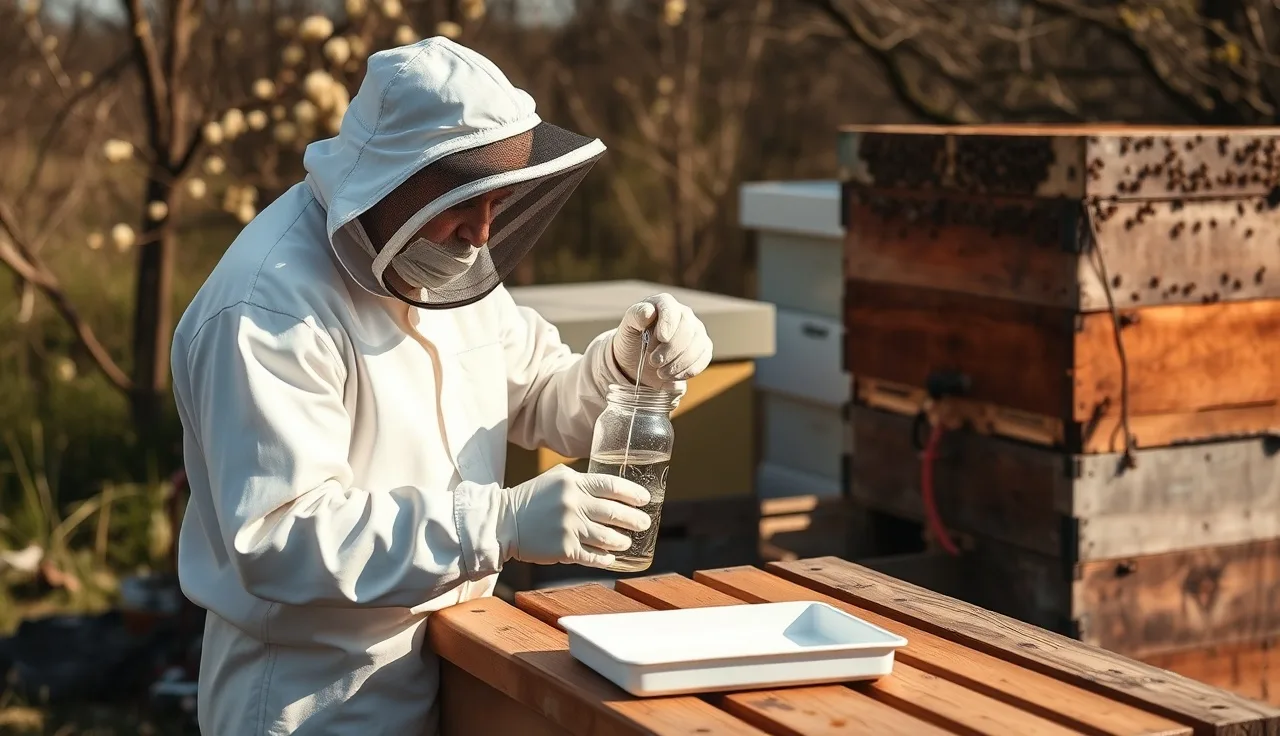
- Shake or brush about three hundred adult bees from a frame into a wide-mouth jar. Skip the queen frame. Use a frame covered in nurse bees.
- Add about one cup (240 mL) of isopropyl alcohol at 70 percent, or use windshield washer fluid as a cheaper stand-in.
- Seal the jar and shake hard for sixty seconds.
- Pour the wash through a mesh screen into a second container, catching the liquid.
- Count the mites in the liquid and count the dead bees.
- Divide mites by bees, multiply by one hundred. That's your mites per hundred bees.
Sugar roll is the no-kill alternative, and it's consistently less accurate. Research in the Journal of Economic Entomology found sugar roll undercounts mites against alcohol wash, partly because the sugar only shakes loose the phoretic mites that are already holding on lightly [3]. If you refuse to sacrifice bees, sugar roll beats nothing, but read those numbers conservatively.
Sticky boards are not a reliable count for a new package. They measure mite fall, not mite load, and the link between natural drop and actual infestation is too loose to stake treatment on, especially in a small colony that's still finding its feet [2].
What mite count is too high in a new package hive?
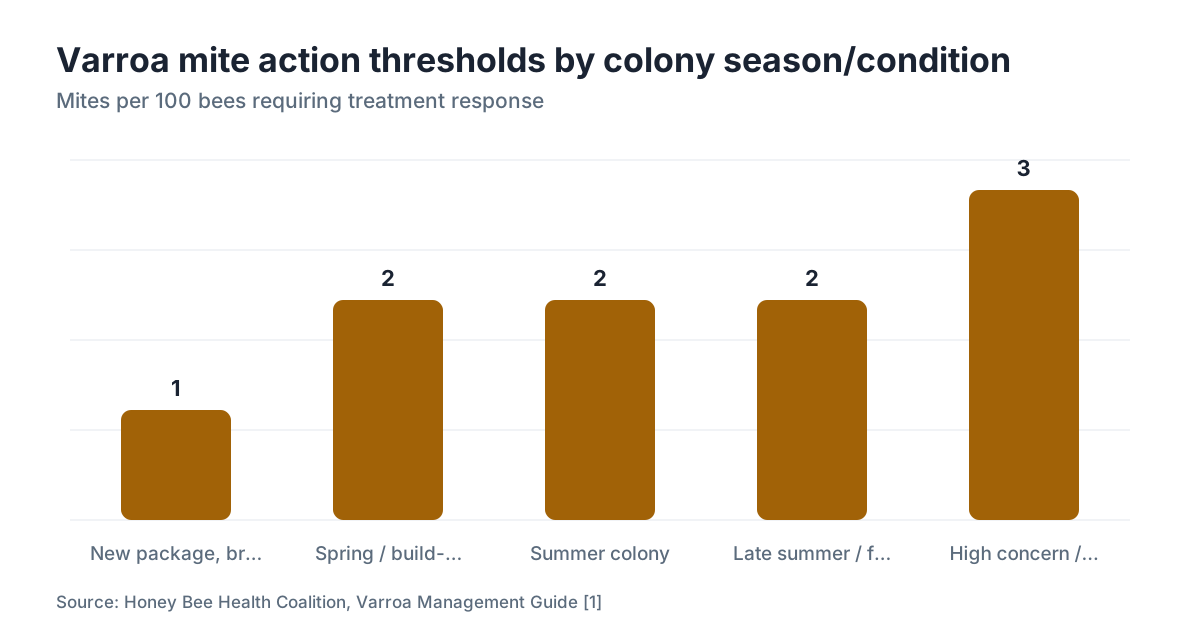
The Honey Bee Health Coalition's Varroa Management Guide puts the treatment threshold at two mites per hundred bees (2%) for spring colonies that are building [1]. That threshold applies to new packages too.
For a broodless or near-broodless package, some experienced beekeepers push earlier, closer to one mite per hundred bees. The logic: every mite you see now is phoretic, and the moment brood starts capping, the effective load jumps as mites vanish into cells and hide from your wash. It's a judgment call. Nobody has rock-solid data on the exact number for the broodless-package window, but the reasoning holds up.
Quick reference, based on HBHC guidelines:
| Mites per 100 bees | Situation | Recommended action |
|---|---|---|
| 0 to 1 | Low, broodless package | Retest in two to three weeks |
| 1 to 2 | Low-moderate, spring/building colony | Monitor closely, retest in two weeks |
| 2 or higher | At or above threshold, any season | Treat promptly |
| 3 or higher | High, summer through fall | Treat immediately, retest after treatment |
Source: Honey Bee Health Coalition, Varroa Management Guide [1]
How do you do an alcohol wash step by step on a small new colony?
A new package often has only two to four frames of bees, so pick your sample frame carefully. Pull a frame from the center of the cluster, ideally one with nurse bees but no capped brood yet. If the queen is marked and easy to spot, grab a different frame.
You want 300 bees for the standard count, roughly half a cup by volume. The Honey Bee Health Coalition's guide shows a half-cup measuring cup dipped into loose bees, which lands you around 300 [1]. Once you have the sample:
- Pour the bees into your wash jar right away so none fly off.
- Add alcohol or windshield washer fluid, enough to cover the bees completely.
- Seal tight and shake hard for sixty seconds. The agitation is what breaks mites loose.
- Pour through a fine mesh (hardware cloth at 8 mesh works) into a white tray or second container.
- Rinse the jar through the screen with a second splash of fluid to catch mites clinging to the glass.
- Count mites against the white background. A magnifying glass helps.
Say you count five mites in 300 bees. That's 5/300 x 100 = 1.67 mites per hundred bees. Below threshold, but worth a retest in ten to fourteen days.
Record every result. One count tells you where you are. A series tells you whether you're winning or losing. This is where a simple tracking sheet, or a tool like the free protocol builder at VarroaVault, saves you from trusting memory at the end of a long season.
Can you treat a new package for varroa, and if so, when?
Yes, you can treat a new package, and if your count warrants it, you should. The broodless window is an ideal time to treat, because products like oxalic acid work almost entirely on phoretic mites. With no sealed brood, every mite in the colony sits out in the open [4].
Oxalic acid by dribble or vaporization is legal in the United States when brood is absent and the colony fits a single hive body, per the EPA-registered product label (for example, Api-Bioxal by Véto-Pharma, EPA Reg. No. 86004-1) [4]. The label is the law. Follow it exactly.
A few timing notes:
- Wait until the queen is fully released and laying before treating. Stress a colony before the queen is accepted and you risk the whole installation.
- If you treat during the broodless window, retest four to five weeks later anyway. Once brood builds and mites resume reproducing, the population can climb back fast even after a clean early treatment.
- Oxalic acid dribble at the standard rate (about 5 mL of 3.5% solution per seam of bees) works well and costs little. Vaporization (OAV) reaches slightly more bees but needs equipment and respiratory protection [4].
For colonies over threshold later in the season with brood present, you'll need a different product class: formic acid (Mite Away Quick Strips, Formic Pro) or a synthetic miticide (Apivar, Apistan). Each has its own label rules, temperature windows, and honey super restrictions [5].
What supplies do you need to monitor varroa in a new package?
The barrier here is genuinely low. Short list:
- A wide-mouth jar with a mesh lid (sold as varroa wash kits from most beekeeping supply companies, or build your own with a mason jar and hardware cloth)
- Isopropyl alcohol (70%) or windshield washer fluid
- A half-cup measuring scoop
- A white plastic tray or a white sheet of paper
- A notepad or a phone for recording results
A basic DIY setup runs under ten dollars. Commercial varroa wash kits cost fifteen to thirty dollars and are a bit easier to use, but no more accurate.
You don't need a microscope, a sticky board, or any pricey gadget to get a reliable count. The Honey Bee Health Coalition's free Varroa Management Guide has printable counting sheets you can download and bring to the hive [1].
For supplies beyond the test kit, most beekeeping supply companies carry monitoring and treatment gear in one order. If shipping cost stings, some retailers offer free shipping on honey bee supply orders above a minimum, which makes buying alcohol wash supplies and oxalic acid together in one shipment worth it.
How often should you monitor varroa as the new package grows into an established colony?
The frequency that actually protects a colony is every two to four weeks during the active season. Most beekeepers test too rarely, and varroa can go from manageable to catastrophic in six weeks or less once brood rearing hits full swing [7].
A realistic calendar for a package installed in spring:
- Week one: baseline alcohol wash
- Week four: first post-brood test (queen has laid for two to three weeks, brood is capping)
- Week seven to eight: retest, compare the trend
- Every three to four weeks through summer
If any count sits at or above two percent, treat, then retest three to four weeks after treatment ends to confirm it worked. A post-treatment count above two percent means one of three things: the product failed (check label compliance), the colony is picking up re-infestation from nearby hives, or resistance is building in your local mites [2].
The Honey Bee Health Coalition recommends at minimum three to four mite counts per colony per season [1]. That's a floor, not a ceiling. High-pressure areas or apiaries packed near other colonies need more.
Why is the broodless window in a new package so important for mite monitoring?
The math is simple and worth knowing. In a colony with capped brood, roughly 70 to 80 percent of all varroa mites hide inside sealed cells at any given moment [2]. Wash a brooded colony and you're sampling only the 20 to 30 percent riding on adult bees. Your count underestimates the true load by a factor of three to five.
In a new package with no capped brood, that ratio flips. Nearly every mite is phoretic and countable. A count of two percent in a broodless package is a true two percent. A count of two percent in a heavily brooded summer colony could be an actual six percent or worse.
This is why the HBHC guide singles out the broodless period as an ideal monitoring window [1]. It's also why early summer counts from established colonies aren't directly comparable to broodless-package counts. Same number on paper. Very different biology underneath.
The varroa mite life cycle is what makes this click. A mite slips into a cell just before capping, lays one or two reproductive females, and the offspring emerge fully mature with the adult bee. A three-week brood cycle produces a new mite generation every three weeks. That exponential curve is what turns a manageable spring population into a colony-killing fall infestation.
What should you do if your new package mite count is zero?
Celebrate briefly, then retest. A zero count on a new package is plausible and genuinely good news, but it's no reason to stop monitoring.
Zero from a broodless sample in week one means your mite load sits below detectable levels right now. Once brood builds, the mites that survived shaking and packaging will reproduce, and foragers keep hauling in new ones by robbing other hives or drifting from neighboring apiaries. The Honey Bee Health Coalition's guide says it plainly: a zero count early in the season does not mean a colony stays at zero [1].
Retest at week four to six regardless of that first result. Get zero again and you're either lucky or your source ran an unusually clean operation. Keep testing every three to four weeks. The beekeepers who lose colonies to varroa in fall are almost never the ones who tested too often.
Does monitoring new packages differ if you are in a high-mite-pressure area?
Yes, and the difference matters. If your area has plenty of feral colonies, other managed hives within two miles, or a track record of fall losses in your apiary, your risk of fast re-infestation after treatment climbs. Mites move between colonies through drifting drones, robbing, and swarms [2].
In high-pressure areas, the practical moves:
- Test at week one and week three (not four) to catch buildup before it compounds.
- If you treat with oxalic acid during the broodless window and hit two percent again at week six, suspect re-infestation before you blame treatment failure.
- Consider reduced entrances in the first four to six weeks to cut down robbing, one of the fastest routes for mites to jump between colonies.
Nobody has clean published data on exactly how much re-infestation rates swing with apiary density, but research on drone drift and robbing confirms mites transfer this way, and extension services in mite-heavy states like California and Florida keep flagging it as a management concern [6][10].
How do you record and interpret varroa monitoring results over time?
A single count is a snapshot. A series of counts is a trend, and the trend is what actually guides decisions.
Keep a simple log per hive: date, method, number of bees sampled, mite count, mites per hundred bees, and any treatment applied. Notebook, spreadsheet, or a dedicated tool, your call. Midseason, when you're juggling multiple colonies and trying to recall which hive you treated six weeks back, that log earns its keep.
What the trend tells you:
- A flat or falling count after a broodless-window treatment is good. The treatment worked and re-infestation is low.
- A count that doubles over four weeks is alarming and calls for immediate treatment regardless of the absolute number.
- A post-treatment count still at or above threshold points to label non-compliance, resistance, or active re-infestation from outside.
The HBHC guide includes a worksheet format for exactly this [1]. VarroaVault also offers a free protocol tracker built around these decision points, so you can flag when a retest is due and compare counts across hives side by side.
Running more than five or six colonies? Standardize the log format across all of them. It saves time and makes it far easier to spot which colonies consistently run high and deserve a closer look at brood pattern, queen age, or local mite pressure.
Frequently asked questions
Should I test for varroa before installing a new package?
You can't test a caged package reliably. The bees are too compressed and stressed to sample safely. Install first, let the colony settle for two to three days, then run your baseline alcohol wash. The first test after installation, while the colony is still broodless, gives you the truest picture of what mite load arrived with your package.
How many bees do I need to sample for a reliable varroa count?
The standard sample is 300 bees, roughly half a cup by volume. That's the sample size the Honey Bee Health Coalition recommends because it gives statistically reliable results while sacrificing only a small fraction of the colony. Smaller samples raise error. Don't sample fewer than 200 bees if you can help it, and never pull from the queen's frame.
Is sugar roll accurate enough to use on a new package?
It's acceptable, but consistently less accurate than alcohol wash. Studies in the Journal of Economic Entomology found sugar roll undercounts mites against alcohol wash. For a new package where you want a true baseline and every mite is phoretic and countable, alcohol wash earns the small number of bees it costs. Use sugar roll only if you have a strong preference for a no-kill method.
Can I treat a new package with oxalic acid right away?
Yes, but wait until the queen is fully released and laying before you treat. Oxalic acid by dribble or vaporization works best when the colony is broodless, which describes most new packages. The EPA-registered label for Api-Bioxal allows use in broodless colonies. Follow label directions exactly, including dosage and protective equipment requirements.
What if my new package queen has not been released yet when I want to test?
Wait. Disturbing the hive during queen release is risky. Give the colony four to five days after installation for natural release, then run your first test. The broodless window stays open for another week or two after that, so you have time. A slightly delayed first test beats losing your queen to unnecessary hive disruption.
How do varroa mite counts change as a new package colony grows?
In the first two to four weeks, while the colony is broodless or barely brooded, your wash count reflects nearly all mites. Once capping begins, 70 to 80 percent of mites move into cells and off adult bees, so the same count number now represents a much bigger true population. This is why early season counts aren't directly comparable to mid-summer counts from the same hive.
Can a new package hive die from varroa in its first season?
Yes. A package installed in spring with even a modest mite load can reach collapse levels by late summer or early fall. Varroa populations can double every four to six weeks once brood is established. A colony that looks strong in July can be a dead shell by October. Early monitoring and prompt treatment during the broodless window is your best prevention.
Do I need a sticky board in addition to alcohol wash for a new package?
No. Sticky boards measure mite drop over time, not mite load, and the link between drop rate and actual infestation is too loose for reliable treatment decisions, especially in a small new colony. Alcohol wash gives you the data you need. A sticky board can help later for broad trends, but it shouldn't replace quantitative sampling.
How do I know if my varroa treatment on a new package worked?
Retest three to four weeks after the treatment period ends. For oxalic acid applied during the broodless window, retest once the first brood is emerging, around week four to five post-treatment. A count below two mites per hundred bees suggests success. At or above two percent means something failed or re-infestation already hit, and you need to act again.
Where can I find the official varroa treatment thresholds and monitoring guides?
The Honey Bee Health Coalition's Varroa Management Guide is the most widely cited U.S. reference and is free at honeybeehealthcoalition.org. University cooperative extension programs (Penn State, University of Minnesota, UC Davis) publish state-specific threshold guidance. EPA product labels for registered miticides are legally binding and available through EPA's pesticide registration pages.
Is it normal to find zero mites in a new package?
It happens, especially with packages from operations that treat before shipping. But it isn't the norm. Don't read a zero count as a permanent clean bill of health. Retest at week four to six. Mite populations can grow from undetectable to above threshold within a few brood cycles, particularly if drifting bees or robbers from mite-heavy colonies keep introducing new mites.
What is the best time of year to install a package if I want to minimize varroa risk?
Early spring installation gives the colony the most time to build population before the late-summer mite surge. It also opens multiple monitoring and treatment windows before the fall build-up of winter bees. Late spring or early summer packages have less runway to establish before mite populations peak. Earlier is generally better for mite management, though local nectar flow timing matters too.
Sources
- Honey Bee Health Coalition, Varroa Management Guide (current edition): Treatment threshold of two mites per hundred bees for spring colonies; broodless period as ideal monitoring window; minimum three to four mite counts per colony per season recommended
- Penn State Extension, Varroa Mite Management: Approximately 70 to 80 percent of varroa mites are in capped brood at any time; sticky boards not recommended as sole quantitative monitoring method; mite spread through robbing and drifting
- Journal of Economic Entomology, comparison of varroa sampling methods: Sugar roll undercounts varroa mites compared to alcohol wash; alcohol wash identified as most accurate phoretic mite sampling method
- EPA, Api-Bioxal (oxalic acid) pesticide registration, Reg. No. 86004-1: Oxalic acid (Api-Bioxal) is EPA-registered for varroa control in broodless colonies; label specifies dosage and application method requirements
- EPA, registered miticides for varroa in honey bees: Formic acid products (Mite Away Quick Strips, Formic Pro) and synthetic miticides (Apivar, Apistan) are EPA-registered for varroa treatment with varying temperature and honey super restrictions
- University of California Cooperative Extension, Honey Bee Varroa Management: High apiary density and nearby feral colonies increase risk of re-infestation via drone drift and robbing behavior
- University of Minnesota Bee Lab, Varroa Mite Monitoring and Management: Varroa populations can double every four to six weeks under active brood-rearing conditions; early season detection is most cost-effective intervention point
- USDA Agricultural Research Service, Honey Bee Research: Varroa destructor present in the majority of managed U.S. honey bee colonies; colony losses correlated strongly with high mite loads
- Florida Department of Agriculture and Consumer Services, Apiary Inspection Program: High mite pressure documented in Florida apiaries due to year-round brood rearing and high colony density; more frequent monitoring intervals recommended in southern states
Last updated 2026-07-09