How to prevent varroa mites in your hive (and when you can't)
TL;DR
- You can't make a colony permanently varroa-free.
- You can keep mite loads under the damage threshold of about 2% infestation (2 mites per 100 bees on an alcohol wash).
- The toolkit: drone brood removal, brood breaks, screened bottom boards, mite-tolerant stock, and timed oxalic or formic acid treatments before mite numbers explode each season.
Can you actually prevent varroa mites, or just manage them?
Honest answer first. You cannot stop Varroa destructor from getting into a colony. The mite reached North America in the mid-1980s and now lives in nearly every region that keeps Western honey bees [1]. Feral colonies carry it. Your neighbor's hives carry it. Drifting bees and swarms move it around. Prevention in the strict sense is off the table.
What you can prevent is the mite population climbing to the level that kills a colony. The Honey Bee Health Coalition sets the action threshold for most of the year at 2 mites per 100 adult bees (2%), and drops it to 1% in late summer when winter bees are being raised [2]. Below those numbers, a well-fed colony tolerates the load. Above them, collapse speeds up.
So the real question is how you keep the mite-to-bee ratio from crossing that line. The answer combines cultural practices that slow mite reproduction, monitoring so you know where you stand, and well-timed treatments when the curve starts bending the wrong way. None of it is hard. All of it takes consistency.
What monitoring method actually tells you your mite load?
Monitoring is the foundation. You can't prevent a mite explosion you never saw coming, and no set of prevention practices holds the line if you're guessing at your numbers.
The alcohol wash is the most accurate field method for adult bee mite loads. Collect roughly 300 adult bees (about half a cup) from a brood frame, submerge them in isopropyl alcohol or windshield washer fluid, shake for 60 seconds, and count the mites that drop through a screen. Divide mites by bees, multiply by 100, and you have a percentage [2]. A sugar roll is less reliable because mites don't always release cleanly, but it's a fair option if you'd rather not kill the sample bees.
Sticky boards give you a mite drop count over 24 to 72 hours. Turning that drop into an infestation percentage needs conversion tables that shift with colony size and season. The Honey Bee Health Coalition's Varroa guide recommends alcohol wash or sugar roll over sticky boards for threshold decisions [2].
How often should you sample? Monthly from early spring through the end of the summer nectar flow, then every two weeks in August and September. That's the window where mite loads routinely double in two to three weeks as bee populations shrink [3]. Missing a late-summer spike is the most common reason colonies die in October or November.
Keep a log. A single count tells you less than a trend. Two readings at 1.5% heading into August is a warning even though neither one crossed 2% yet.
How does removing drone brood slow varroa reproduction?
Varroa mites prefer drone brood at roughly eight times the rate they prefer worker brood [4]. A single mite entering a drone cell can produce two to three reproductive offspring before that drone emerges. Drone brood is both an attractant and an amplifier.
Trapping uses this against the mite. You hang a frame with drone-sized foundation, or a frame with a partial gap the bees will draw into drone comb, right in the brood nest. Bees draw it, the queen lays drone eggs, mites pile in, and you pull and freeze the frame just before the drone pupae are about to open (around day 21 to 24 after laying, capped but not emerged). Then you scrape it out, refreeze or discard, and let the bees draw fresh drone comb to run the cycle again.
Done every 21 to 24 days from early spring through midsummer, drone brood removal cuts mite loads 30 to 40% against untreated colonies in some trials [4]. That's real, but it isn't enough on its own where mite pressure runs high. Treat it as a free tool that buys you time before a chemical treatment, not a replacement for monitoring and treatment.
One practical note. This works best in spring and early summer when the colony is drawing new comb. By August most colonies lose interest in drawing drone comb, and your window narrows.
Does a brood break actually reduce varroa populations significantly?
Yes, and it's one of the most underused tools a hobbyist has. Varroa mites reproduce only inside capped brood cells. Remove all capped brood and reproducing mites have nowhere to go. Every mite is suddenly phoretic (riding on adult bees) and exposed to any topical treatment you apply.
A brood break happens naturally when you requeen and there's a laying gap, or you can force one by caging the queen for 24 to 27 days (a full worker brood cycle). Once all existing brood has emerged and no new capped brood is present, treat with oxalic acid. Oxalic works roughly three to four times better in that broodless state because the acid can't reach through cappings to the mites sealed inside [5].
Swarm season creates natural brood breaks in the parent colony after a swarm leaves, and sharp beekeepers use that window. If a colony throws queen cells, let the old queen go with the swarm, wait for the new queen to begin laying, then treat with oxalic acid in that broodless gap before her brood caps.
The research is solid. A 2015 PLOS ONE study found a single oxalic acid dribble during a broodless period cut mite loads over 90%, against 50 to 60% efficacy for the same treatment with brood present [5].
What is a screened bottom board and does it actually prevent varroa buildup?
A screened bottom board swaps the solid hive floor for wire mesh, usually 8 mesh per inch. Mites that fall off bees during grooming or treatment drop through the screen and can't climb back up. The claim is that this passively lowers mite loads.
The evidence is weak, and I'll say so plainly. University of Minnesota work and several reviews put the mite reduction from screened bottom boards alone at roughly 10 to 15% against solid floors [3]. That's detectable but close to meaningless when mite populations double every four to six weeks in summer. You'd need 90% or better to replace real treatment.
Where screened bottom boards earn their keep is as a platform for sticky board monitoring, and as ventilation that cuts winter condensation. Most experienced beekeepers run them for those reasons, not for mite control. On monitoring convenience alone they're worth buying. Our overview of beekeeping supplies covers the hive equipment actually worth the money.
Use a screened bottom board. Just don't let it change your treatment math.
Which varroa-resistant bee stocks actually help with prevention?
This is where long-term prevention really lives. Some honey bee populations carry heritable traits that suppress mite reproduction or step up mite removal. The three best documented:
VSH (Varroa Sensitive Hygiene): These bees detect and pull out mite-infested capped brood. In lines with strong VSH expression, as few as 10 to 20% of infested cells produce reproductive mites, against 80 to 90% in standard colonies [6]. The USDA Baton Rouge lab developed this stock and it's sold commercially, though expression fades after a few open-mating generations.
Mite Biter / Minnesota Hygienic: Similar idea, with weight on grooming behavior that scrapes mites off adult bees. University of Minnesota data show colonies with strong hygienic behavior holding lower mite loads through summer without any chemical treatment in some trials, though researchers warn the results depend on the setting [3].
Gotland and Arnot Forest survivor populations: Feral or semi-feral survivors studied as examples of natural selection toward mite tolerance. They aren't available commercially at scale. Treat them as proof that tolerance can evolve, not as a practical buy for most beekeepers today.
If you're buying packages or queens, ask suppliers straight out whether their stock was selected for VSH or hygienic behavior, and ask for mite count data on their breeding colonies. Our breakdown of beekeeping species covers the bee races and their traits if you're still choosing.
The catch: even the best resistant stock on the market still needs monitoring. VSH queens open-mated in a mite-saturated area drift back toward average susceptibility within a generation or two. Resistant stock buys a longer runway, not permanent immunity.
What are the EPA-approved varroa treatments and when do you use them for prevention?
The point of prevention is to treat before mite loads cross the threshold, not after. That timing is everything. Here's what's registered in the United States and what the data shows:
| Treatment | Active ingredient | Brood present? | Temp range (F) | Efficacy | Honey supers? |
|---|---|---|---|---|---|
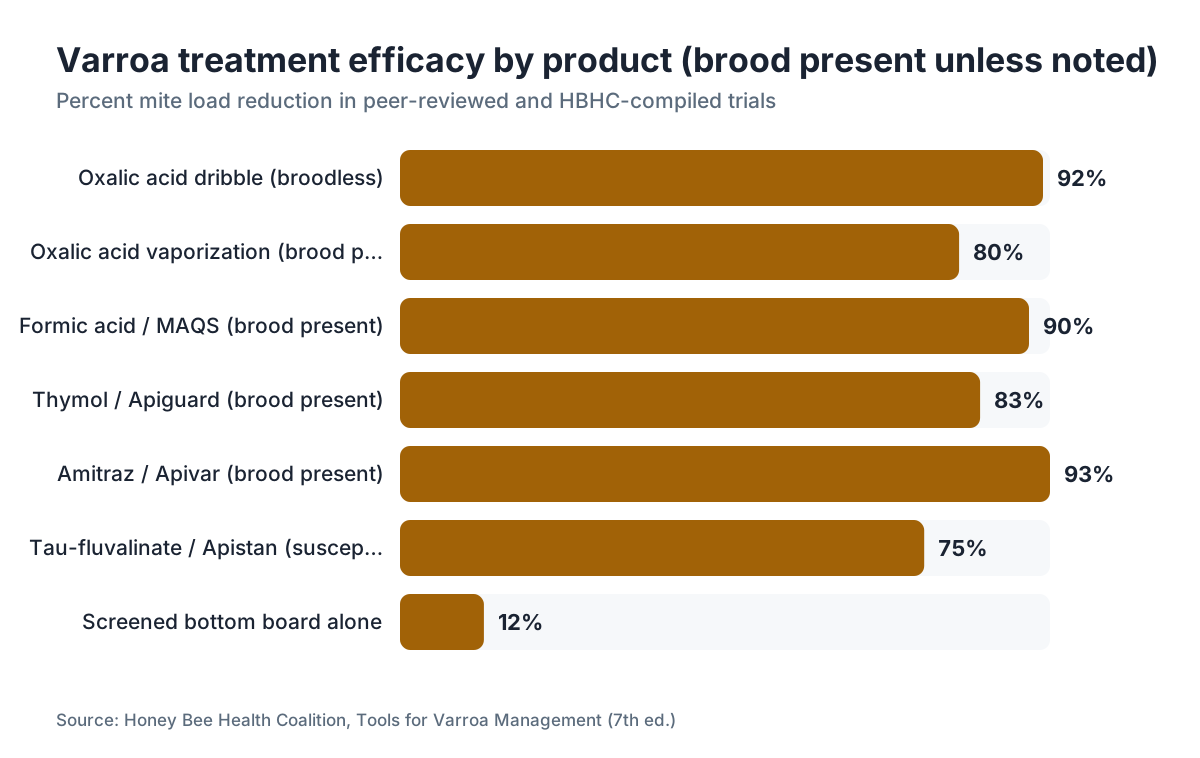
| Oxalic acid dribble | Oxalic acid | Broodless only | Above 50 | 90-95% broodless [5] | Remove |
| Oxalic acid vaporization | Oxalic acid | Yes (reduced efficacy) | Above 50 | 70-90% [5] | Remove |
| Mite Away Quick Strips (MAQS) | Formic acid | Yes | 50-85 | 85-95% [7] | Can stay on |
| Apiguard / ApiLife VAR | Thymol | Yes | 60-105 | 74-93% [7] | Remove |
| Apistan | Tau-fluvalinate | Yes | Above 50 | Variable, resistance common | Remove |
| Apivar | Amitraz | Yes | Above 50 | 90-97% [7] | Remove |
For prevention, the best practice is a late-summer (August) treatment to knock the load down before winter bees are raised, then a late-fall or winter oxalic acid treatment on a broodless or near-broodless colony. Cornell Cooperative Extension recommends this two-treatment cadence as the minimum annual protocol for colonies that overwintered successfully [8].
Formic acid (MAQS or Formic Pro) has one trait the others lack: it penetrates capped brood and kills mites inside sealed cells. That makes it the pick when you can't get a brood break but need fast, real reduction. Follow the label on temperature. MAQS applied above 85F can kill queens.
All oxalic acid products require label compliance. The EPA oxalic acid registration requires honey supers off during application [9]. That's a legal requirement, not a suggestion.
What's the prevention calendar by season?
Varroa prevention isn't a single event. It's a repeating annual cycle, and the timing shifts with climate. This is a general framework for temperate North American beekeeping:
Late winter / early spring (February-March): Set a sticky board or run your first alcohol wash of the season as soon as it's warm enough to open hives. Overwintered mite loads can already sit near threshold if fall treatment was missed or failed. Above 1%, treat before the mite curve steepens.
Spring buildup (April-May): Sample monthly. If you're using drone comb trapping, start now. Remove and freeze capped drone comb every 24 days. Most colonies run well below threshold in this stretch, but don't skip sampling because you assume it's fine.
Nectar flow (May-July): Mite loads often plateau or dip in percentage terms as bee populations boom. Keep sampling. The absolute mite count keeps growing even while the percentage looks flat.
Critical window (late July through August): This is where colonies live or die. Bee numbers start dropping as the flow ends. Mite numbers don't. The percentage can jump from 1% to 3% in three weeks. Treat when you hit threshold, not when you get around to it. Late July is the single most important treatment window of the year.
Early fall (September): Do a follow-up wash two weeks after your August treatment to confirm it worked. Still above 1%? Retreat. Winter bees are being raised now, and a damaged winter cohort means spring loss.
Winter (November-February): When the colony is broodless or nearly so, treat with oxalic acid vaporization or dribble. Even colonies that left summer below threshold gain from this insurance treatment. It's cheap, low-risk, and lifts overwintering odds.
How do varroa mites spread between hives and can you reduce that risk?
Mites move between colonies mainly three ways: robbing bees, drifting bees, and swarms. A heavily infested dying colony is basically a mite bomb. As it collapses and its foragers drift into or rob other hives, they carry mites along. Research tracking mite spread in apiaries found colonies within 2 km of a collapsing mite-saturated hive show measurable mite increases within weeks [10].
You can't control your neighbors' colonies, but you can cut your own exposure. Keep your colonies below threshold first. A low-mite colony that takes on drifting mites handles the load far better than one already sitting at 2%. Reduce hive entrances during dearth and don't leave exposed comb or open feeders out, which cuts robbing. And when you bring in new packages, nucs, or queens, sample for mites before they go into your apiary. A package from a supplier with sloppy mite management can seed a problem in an otherwise clean operation. Our piece on varroa mite biology covers how the mite finds new hosts.
Buying quality bees matters here too. Look for beekeeping supply companies and suppliers who publish mite count data on their colonies before sale.
If you keep bees where feral colony density is high or many neighbors keep hives, your re-infestation rate after treatment runs above average. That's no reason to quit treating. It's a reason to sample more often and hold tighter thresholds.
What free tools and resources exist to build a varroa prevention protocol?
The Honey Bee Health Coalition's "Tools for Varroa Management" guide is the most complete public reference there is. It's free, peer-reviewed, and covers every registered treatment with efficacy data, timing, and resistance guidance [2]. Download it before you build any treatment calendar.
For a structured year-round plan with monitoring calendars and treatment decision trees, VarroaVault offers free downloadable tools built around the HBHC thresholds and the two-treatment annual minimum. Bookmark it as a practical companion to the primary research.
State apiculture programs at land-grant universities often run free mite testing and publish regional timing calendars. Cornell Cooperative Extension, University of Minnesota Extension, and Penn State Extension all publish free varroa resources tuned to their climate zones [3][8].
To track counts over time, a plain spreadsheet with date, colony ID, bees counted, and mites found is enough. Some beekeeping apps include a mite count log. The format matters less than the habit.
What common prevention mistakes cost colonies their lives?
The costliest mistake is treating once and calling it done. Mite populations rebound. A July oxalic acid vaporization that drops your load to 0.5% can climb back over 3% by late September if you skip fall monitoring and a second treatment. Roughly two-thirds of colony losses in North America are mite-related, per USDA survey data, and most trace to inadequate or badly timed treatment rather than treatment failure [11].
The second mistake is treating with a dead product. Tau-fluvalinate (Apistan) and coumaphos (CheckMite+) resistance has been documented in Varroa populations across North America and Europe for over a decade [7]. If you apply a pyrethroid strip and your follow-up count barely moves, you probably have resistant mites. Switch chemical classes.
Third: treating in the wrong temperature range. Thymol products need daytime highs above 60F to volatilize well. Apiguard in a cold snap loses much of its punch. MAQS caps out at 85F. Read the label for every product every time, even one you've used for years, because labels get updated.
Fourth: skipping the August window because the colony looks strong. A colony can look great and sit at 3% infestation. By the time you see deformed wing virus, crawling bees, or spotty brood, the damage to the winter bee cohort is already done.
Frequently asked questions
What is the action threshold for varroa mites before I need to treat?
The Honey Bee Health Coalition sets the threshold at 2 mites per 100 bees (2%) for most of the active season, measured by alcohol wash or sugar roll. In late summer, roughly July through September when winter bees are raised, that threshold drops to 1%. Treat at or before those numbers, not after visible symptoms show up in the colony.
Can you ever get rid of varroa mites completely?
No. Varroa destructor is endemic throughout North American beekeeping, and re-infestation from drifting bees, robbing, and swarms is constant. Even a perfect treatment that brings a colony to zero mites will see levels climbing again within weeks in most apiaries. The goal is suppression below the damage threshold, not eradication.
How often should I check for varroa mites?
Monthly from spring buildup through early July, then every two to three weeks through August and September. Late summer is when mite loads climb fastest, and a missed August sampling window is the single most common cause of fall colony loss. Do at least one more check two weeks after any treatment to confirm it worked.
Is oxalic acid safe to use when there's honey in the supers?
No. The EPA-registered oxalic acid label requires removal of honey supers during application. This applies to both dribble and vaporization methods. Oxalic acid occurs naturally in honey at low levels, but the label restriction is a legal requirement. Treat only in supers-off conditions, usually late summer after the flow ends or during the winter broodless period.
Do screened bottom boards prevent varroa mites from building up?
Only marginally. Research shows screened bottom boards cut mite loads by roughly 10 to 15% against solid floors, which isn't enough to stop population explosions on their own. They're most useful as a platform for sticky board monitoring and for hive ventilation. Use them, but don't change your treatment schedule because of them.
What bee breeds are most resistant to varroa mites?
VSH (Varroa Sensitive Hygiene) stock developed by the USDA and Minnesota Hygienic bees show the strongest documented resistance in managed colonies. VSH lines can drop successful mite reproduction to 10 to 20% of infested cells versus 80 to 90% in standard stock. Resistance weakens after open mating in high-mite areas, so you still need to monitor even with resistant queens.
When is the best time of year to treat for varroa mites?
Late July through mid-August is the single most important window. This is when bee populations start declining while mite populations keep climbing, and when winter bees begin to be raised. A treatment that protects those winter bees decides whether your colony survives to spring. A second treatment in late fall or early winter on a broodless colony with oxalic acid is a strong complement.
Can varroa mites spread from one hive to another in my apiary?
Yes. Mites move between colonies via drifting foragers, robbing behavior, and swarms. A collapsing mite-infested colony can spread mites to healthy neighbors within weeks. Keeping your own colonies below threshold, reducing hive entrances during dearth, and sampling any new packages or nucs before introduction all cut spread risk.
How do I do an alcohol wash to check for varroa mites?
Collect roughly 300 adult bees (about half a cup) from a brood frame, not the frame with the queen. Put them in a jar with isopropyl alcohol or windshield washer fluid. Shake for 60 seconds, then pour the liquid through a mesh screen into a white container. Count the mites in the liquid. Divide mites by bees counted and multiply by 100 for your percentage.
Does removing drone brood help control varroa mite populations?
Yes, it helps. Varroa mites prefer drone brood at roughly eight times the rate of worker brood and reproduce more successfully in drone cells. Removing capped drone frames every 24 days from spring through midsummer can cut mite loads by 30 to 40% in some trials. It's a free, chemical-free tool that buys time but doesn't replace monitoring and treatment.
What happens if I don't treat for varroa mites?
Without treatment, most standard European honey bee colonies in North America collapse within one to three years of establishment, usually in late fall or early spring when the reduced winter bee population can no longer offset mite-spread viruses, especially deformed wing virus. USDA surveys consistently find mite-related causes in roughly two-thirds of US colony losses annually.
Can formic acid treatments like MAQS kill varroa mites inside capped brood?
Yes, and this is formic acid's key advantage over oxalic acid and most other treatments. Formic acid vapor penetrates capped brood cells and kills mites inside, where they're otherwise protected. MAQS and Formic Pro reach 85 to 95% efficacy with brood present, but temperature limits are strict: they must not be used above 85 degrees F, or queen loss risk climbs sharply.
Is treatment resistance a problem with varroa mite treatments?
Yes, particularly with older synthetic treatments. Tau-fluvalinate (Apistan) and coumaphos (CheckMite+) resistance is documented across North America and Europe. If a follow-up mite count two weeks after a pyrethroid strip treatment shows little reduction, assume resistance and switch to a different chemical class. Rotate between modes of action across years to slow resistance.
Sources
- USDA Agricultural Research Service, Honey Bee Research: Varroa destructor arrived in North America in the mid-1980s and is now present in virtually all regions where Western honey bees are kept
- Honey Bee Health Coalition, Tools for Varroa Management Guide (7th edition): Action threshold of 2 mites per 100 bees during most of the season, dropping to 1% in late summer; alcohol wash recommended over sticky boards for threshold decisions
- University of Minnesota Bee Lab: Screened bottom boards reduce mite loads roughly 10-15%; mite loads can double in two to three weeks in late summer; hygienic stock holds lower mite loads in some trials
- Martin, S.J. (1994), Swarming of Varroa jacobsoni from cells of drone and worker honey bees, Bee World, Rothamsted Research: Varroa mites prefer drone brood at roughly eight times the rate of worker brood; drone brood trapping can reduce colony mite loads 30-40% compared to untreated controls
- Gregorc, A. et al. (2017), PLOS ONE, Oxalic acid treatment efficacy with and without brood: Single oxalic acid dribble during broodless period reduced mite loads over 90%; the same treatment with brood present achieved 50-60% efficacy
- USDA Agricultural Research Service, Honey Bee Breeding, Genetics and Physiology Research, Baton Rouge: VSH lines produce reproductive mites in as few as 10-20% of infested cells versus 80-90% in standard colonies; VSH stock developed by USDA Baton Rouge
- Honey Bee Health Coalition, Tools for Varroa Management Guide, treatment efficacy table: MAQS achieves 85-95% efficacy with brood present; Apiguard and ApiLife VAR achieve 74-93%; Apivar achieves 90-97%; tau-fluvalinate resistance documented across North America and Europe
- Cornell Cooperative Extension, New York State Integrated Pest Management, Honey Bee Varroa: Cornell recommends a minimum two-treatment annual protocol: late summer and late fall oxalic acid on broodless or near-broodless colony
- U.S. Environmental Protection Agency, Pollinator Protection: EPA-registered oxalic acid label requires honey supers to be removed during application; this is a legal label requirement
- Frey, E. and Rosenkranz, P. (2014), Autumn Invasion Rates of Varroa destructor, PLOS ONE: Colonies within 2 km of a collapsing mite-saturated hive show detectable mite increases within weeks due to drifting and robbing
- USDA National Agricultural Statistics Service, Bee and Honey Surveys: Roughly two-thirds of US colony losses are mite-related, primarily from inadequate or poorly timed treatment rather than treatment failure
Last updated 2026-07-09