How to prioritize treatments when multiple hive issues present at once
TL;DR
- When a colony shows several problems at once, treat varroa first in almost every case.
- Mite loads above 2-3% overwhelm everything else and make other treatments pointless.
- Confirm a live queen before any chemical treatment.
- Then work down the list by how fast each problem kills: starvation, disease, pests.
- Feed a starving colony before you do anything.
Why does treatment order matter so much in a struggling hive?
A struggling colony is worse than a colony with a list of problems. Its ability to recover from any single problem is already wrecked by the others. That's the trap: beekeepers treat each issue as if it stands alone, when the issues are feeding each other.
Take varroa. It suppresses the immune response of individual bees by feeding on fat bodies and vectoring RNA viruses like Deformed Wing Virus (DWV) and Sacbrood [1]. A colony carrying 4% mite infestation won't recover from a fungal infection, because the bees emerging to replace dead workers are compromised themselves. You can medicate for nosema all you want. If the mites stay, you lose the colony anyway.
Order matters because a weakened hive has finite resources. Bees burn metabolic energy detoxifying treatments, managing brood through thermal disruption, and holding the cluster together. Ask them to fight too many battles at once with badly sequenced interventions and you speed up the decline you're trying to stop.
The framework below isn't theoretical. It comes from extension guidance out of land-grant universities, the Honey Bee Health Coalition's Varroa management recommendations, and the plain reality of what kills colonies fastest [2][3].
What is the triage hierarchy for a colony with multiple problems?
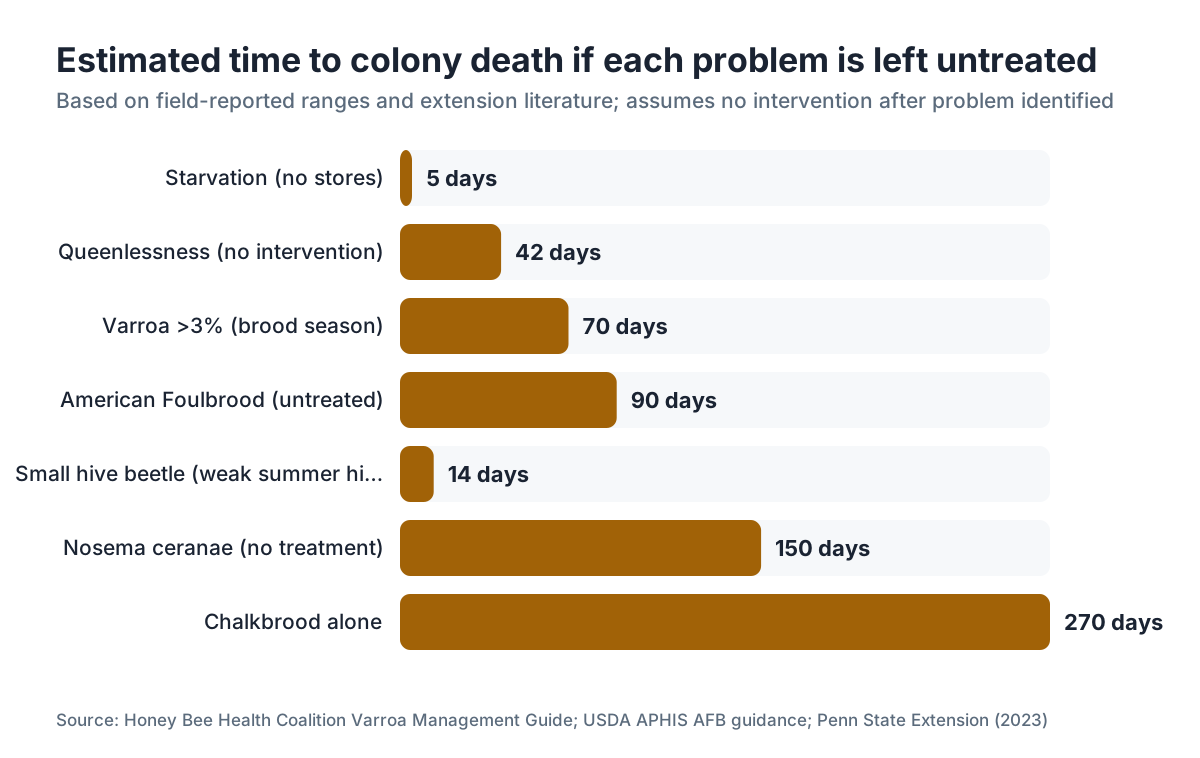
Rank the problems by speed of kill and by how much each one poisons everything else. That's the whole method. Starvation kills in days, so it goes first; chalkbrood rarely kills at all, so it goes last.
| Priority | Issue | Why this rank | Time to colony death if ignored |
|---|---|---|---|
| 1 | Starvation / no stores | Kills in days, no treatment works on dead bees | 3-7 days |
| 2 | Queenlessness (confirmed) | Laying stops, population collapse begins immediately | 4-6 weeks |
| 3 | Varroa above threshold | Amplifies every other problem, vectors viruses | 6-12 weeks |
| 4 | American Foulbrood (AFB) | Legally notifiable in most states, highly contagious | Weeks to months |
| 5 | Nosema ceranae | Debilitating but slower moving than varroa | Months |
| 6 | Small hive beetles (heavy infestation) | Can slime out a weak hive in summer | Days to weeks |
| 7 | Chalkbrood / Sacbrood | Stress indicators, rarely fatal alone | Months |
This isn't a rigid algorithm. It's a starting point. A 10% mite load in October in Minnesota kills faster than a hive without food in July in Florida, where forage is about to open. Context moves the numbers. But for a beekeeper standing at a troubled hive without much data, this stack points you at the right first action most of the time.
Starvation ranks first for a simple reason. No mite treatment, no queen introduction, nothing at all works on a colony that can't feed itself. Emergency feed. Then assess everything else [3].
When should you treat varroa before addressing anything else?
Unless the colony is literally starving (empty frames, bees fanning on bare comb), treat varroa first. It's the one problem that makes every other problem worse, so knocking it down usually clears part of the wreckage on its own.
The action threshold is a mite wash or sticky board reading at or above 2-3 mites per 100 bees (2-3%) during brood-rearing season [2]. The Honey Bee Health Coalition's Varroa Management Guide sets the economic injury threshold at 2% for most of the brood-rearing year and says to treat before you hit 3% [2]. Above that number, the colony is in active decline no matter what else you do.
Here's why varroa is almost always the right first move: it's causal, more than correlated. Varroa doesn't only stress bees. It builds the conditions for secondary infection by vectoring at least 17 known bee viruses, DWV being the worst [1]. A colony with visible nosema signs, ragged wings, or a pile of dead bees at the entrance very often has an untreated mite problem sitting underneath those symptoms. Fix the mites and some of those signs clear as healthier bees emerge.
The exception is American Foulbrood. If you see the classic ropiness on a toothpick, the sour smell, and sunken, perforated cappings, stop. AFB means immediate isolation, notification of your state apiarist in most states, and burning equipment in bad cases [4]. Treating varroa in a colony already doomed by AFB is wasted effort, and moving that equipment around spreads spores through your yard.
For mite testing protocols and treatment selection, the varroa mite article on this site walks through alcohol wash technique and treatment timing.
How do you handle queenlessness and varroa at the same time?
This one trips people up. The urge is to run out and buy a queen. But a queenless colony with a high mite load will chew through that queen's attendants and then the queen herself. You've spent $30-50 on a mated queen and fixed nothing.
The sequence that works: confirm mite load first, treat if it's above threshold, then introduce the queen 5-7 days into the treatment (or after it ends, depending on the product). Oxalic acid vapor is handy here, because a queenless colony often has no capped brood, and oxalic acid works best in broodless conditions [5]. The mite drop in a broodless, queenless hive after an oxalic treatment can be huge, often above 90% of phoretic mites [5].
If the colony is queenless but mites sit below 2%, introduce the queen first. Population decline from queenlessness moves faster than a mite load that's still subclinical. Be honest with yourself, though. A healthy colony that went queenless in summer almost always has a detectable varroa problem when you alcohol wash it. Check before you assume.
One more thing. Sometimes what looks like queenlessness is a laying worker colony: scattered eggs, several per cell, small worker-sized larvae in worker cells. That's much harder to rescue and it flips the priority order. A laying worker colony plus a high mite load is often not worth the rescue, especially late in the season. Know when to cut losses and combine.
Can you run two treatments at the same time without harming the colony?
Sometimes. But the safe combinations are narrower than most beekeepers think.
The honest answer is that co-application data for most pairings is thin. The closest thing to real guidance is the product label, which is legally enforceable in every U.S. state under FIFRA (Federal Insecticide, Fungicide, and Rodenticide Act) [6]. An EPA-registered label isn't a suggestion. It tells you approved temperatures, colony conditions, and rates. Apply two miticides together when a label says "do not use with other pesticides" and you've voided the label and probably hurt the colony.
Combinations generally considered safe, with careful label reading:
- Oxalic acid (dribble or vapor) alongside a hive beetle trap, or as an Apiguard (thymol) treatment is winding down, as long as the temperature windows don't clash.
- Supplemental feeding (sugar syrup, protein patty) alongside nearly any miticide. Bees need energy to process treatment stress.
- Fumagillin for nosema (where still available) and oxalic acid have no known negative interaction, but check current label status; fumagillin availability has shifted in the U.S. in recent years [7].
What to avoid: two organic acid miticides at once (say, oxalic acid and formic acid together). Their temperature sensitivities differ, vapor concentrations can climb into toxic territory for bees, and there's no evidence that stacking them beats a single treatment applied correctly.
Also avoid any queen introduction during a thymol treatment (Apiguard, ApiLifeVar). Thymol disrupts queen acceptance behavior, and the label for most thymol products advises removing queen cells or queens before application [8].
What do you do when the colony also has starvation plus varroa plus a failing queen?
This is the worst-case presentation, and it lands on beekeepers every fall when the monitoring slipped. Three acute problems stacked on top of each other. It's ugly, but there's a sequence that gives the colony its best shot.
- Feed immediately. A frame of honey from a disease-free source is best. Capped sugar syrup in a frame works. Fondant or a candy board for clusters already too tight to break. Don't wait. Starving bees can't thermoregulate, can't raise brood, can't survive a queen introduction, and take mite-vectored viruses harder.
- While feeding, run a quick mite wash if you can shake 100 bees off a brood frame. Five minutes. Above 3%, start oxalic acid vapor right away. A failing queen with a failing cluster usually means little or no capped brood, which is exactly when the broodless oxalic protocol shines [5].
- If the queen is failing but still laying (poor pattern, plenty of empty cells but some viable larvae), let her keep laying through the treatment. A few cells of brood beats none for cluster health.
- After treatment ends (typically 7-10 days for an oxalic vapor series), recheck. If the population is building on the emergency feed and the mite load is dropping, introduce a new queen or drop in a frame of young brood from a healthy colony so they have emergency queen-rearing material.
That's a lot of steps. It is. Colonies this far gone have maybe a 40-50% shot at survival even with correct intervention, going by my reading of the literature. Be ready for that. Don't compound the loss by buying queens for a colony that isn't going to make it.
How do you tell which problem is causing the symptoms you're seeing?
Symptoms in a struggling hive look alike. Spotty brood can mean varroa damage, AFB, EFB, chalkbrood, a pesticide kill, or a failing queen. You can't treat by symptom alone. You test.
The diagnostics that actually tell you what you're dealing with:
- Alcohol wash (or sugar roll): gives mite load as a percent. Run this first on any struggling hive [2].
- Toothpick test for AFB: insert a toothpick into a discolored larva and pull slowly. A brown, ropy string stretching 1-2 cm is pathognomonic for AFB [4].
- Smell test: AFB carries a distinctive sour, rotting odor. EFB smells sour too, more vinegary. Healthy brood smells like warm bread. Your nose is a real tool.
- Frame held to sunlight: backlight shows capped cells clearly. Sunken or perforated cappings point to AFB or EFB. Dark, greasy sealed cells with a tiny pinhole point to varroa-related PMS (Parasitic Mite Syndrome).
- Microscopy or PCR for nosema: you can't diagnose nosema by eye with any reliability. Crushed bees under a microscope can show spores, but PCR testing (through a lab like the USDA Beltsville lab or a state lab) is the only way to tell N. apis from N. ceranae [7].
When you can't test right now and the colony is crashing, fall back on the triage hierarchy above. Treat the most likely fast-kill cause first, then test as soon as you get the tools.
Does the time of year change which treatment you should prioritize?
Yes, a lot. The season decides not only what's present but what you can actually treat with any effect. A February formic acid treatment is near worthless because it's too cold for the vapor to work.
Spring buildup (March-May in temperate climates): Mite loads are usually lowest after winter, but they multiply fast as brood ramps up. A colony building poorly in spring with chalkbrood or ragged wings almost certainly has a mite problem. Treat before the population explodes [3]. Oxalic acid dribble or vapor while brood is still minimal gives you a high-efficacy window. Check for nosema too; spring is when it shows up most.
Nectar flow (May-July): Avoid anything that contaminates honey supers. Formic acid (Mite Away Quick Strips, ForMite) and oxalic acid vapor aren't approved for use with honey supers in place under most label versions [9]. Pull supers before treating, or use a product with a no-residue-in-honey claim (some oxalic acid products allow application with supers at certain rates; read your specific label). Small hive beetles ramp up in summer. In the southeastern U.S., a weak hive faces beetle pressure that compounds mite pressure hard.
Post-flow, late summer (August-September): The most important varroa window of the year. Bees raised in late summer become the overwintering cohort, the fat bees that must survive 4-6 months. If those bees emerge from mite-infested cells, they go into winter already broken [2][3]. Treat hard in August.
Winter (cluster period): Limited options. Oxalic acid vapor or dribble on a broodless cluster. Nothing else registered works well. Check stores. That's about it.
The temperature window for formic acid (MAQS/ForMite) is 50-85°F [9]. Thymol products need sustained temperatures above 59°F [8]. Time a treatment to the wrong season and you get near-zero efficacy for your money.
What's the right protocol if you suspect American Foulbrood alongside other problems?
Stop everything else and deal with AFB first. It's the one problem that threatens the whole yard, more than one box.
AFB (Paenibacillus larvae) is regulated in all 50 U.S. states and most countries with managed bees [4]. Spores survive 70-plus years on equipment. A confirmed AFB hive sharing a yard with your other colonies is an existential threat to your apiary.
What to do:
- Do not move frames, supers, or equipment from the suspect hive anywhere.
- Contact your state department of agriculture or state apiarist. Every state has one. Many states require mandatory reporting of confirmed AFB under state apiary law [4].
- Do not medicate hoping to suppress it. Oxytetracycline (Terramycin) and tylosin (Tylan) can mask AFB symptoms but do not kill spores. A colony treated with antibiotics can look recovered, then crash when the drug clears. And antibiotic treatment is not a legal substitute for destruction in states that require it.
- Burn equipment if required. It's brutal. It's correct.
The real question is how confident you are in the diagnosis. If the toothpick test gave characteristic ropiness AND the smell is right, treat it as AFB until proven otherwise. Your state apiarist can confirm with a culture test and walk you through the legal requirements. The USDA Beltsville bee lab also offers diagnostic services [7].
If there's any chance of AFB, it supersedes the varroa priority. You cannot save a hive that's a spore reservoir, and trying will cost you the rest of your bees.
How do you use VarroaVault and other free tools to build a triage protocol for your apiary?
The decision tree for a multi-problem hive gets complicated fast, and it looks different for a 3-hive hobbyist than for a sideliner running 80 colonies. A written protocol built ahead of time is what keeps you from freezing at the hive.
VarroaVault's free protocol tools let you build a calendar-based treatment schedule tuned to your region, the season, and the treatments you're rotating for resistance management. When you're staring at a hive with four issues at once, a pre-built protocol tells you what the baseline should look like. That makes it far easier to spot what's genuinely abnormal and needs action versus what's normal seasonal variation.
The Honey Bee Health Coalition's Varroa Management Guide is the single most authoritative free resource for U.S. beekeepers [2]. Downloadable as a PDF. It covers thresholds, treatment options with temperature windows, and resistance management. Print it. Keep it in your bee bag.
For diagnosis support, several land-grant extension programs offer hive health help, and some run state apiary inspections that are free or low-cost [3]. Your state apiarist is an underused resource. They'd rather help you before an AFB outbreak than clean up after one.
When you're buying supplies, knowing what's actually stocked matters. Not every miticide is carried by every reliable beekeeping supply company, and running out of oxalic acid in August is a problem worth preventing months ahead.
How do you prevent the multi-problem scenario from developing in the first place?
Monitoring. That's almost the entire answer.
The Honey Bee Health Coalition recommends monthly mite washes during brood-rearing season as the minimum standard for responsible beekeeping [2]. Most hobbyists who end up with four simultaneous problems haven't tested in two months. The colony didn't acquire four problems overnight. It picked them up one at a time while nobody was looking.
A simple monitoring calendar: alcohol wash every 4 weeks, April through October. Check stores every inspection. Note queen status at least monthly. Read the brood pattern instead of glancing past it. If you spot ragged wings or shiny, hairless bees on the bottom board or in front of the hive, run a mite wash that day, whenever the last one was.
Resistance management matters too. Rotate between miticide classes (organic acids, synthetic acaricides, thymol) so your local varroa population can't adapt to a single treatment. A treatment that stops working is itself a multi-problem scenario, and a nasty one [2][3].
Requeen proactively with locally adapted, hygienic queens where you can. Varroa Sensitive Hygiene (VSH) and hygienic-behavior queens don't erase varroa, but they measurably suppress mite reproduction, so you start each treatment season from a lower baseline [2]. Lower baselines mean you almost never end up in the spot where everything is wrong at once.
For a full picture of what a varroa mite infestation looks like at each stage and how to catch it early, keep that reference next to your monitoring calendar.
Frequently asked questions
If I can only do one thing for a struggling hive today, what should it be?
Do an alcohol wash. Five minutes and a $3 kit. If mite load is above 2-3%, that's your first treatment regardless of other symptoms. If stores are critically low (empty frames, bees in a tight cluster on nothing), emergency feed first. Those are the only two situations where you act before you know the full picture.
Can I introduce a queen into a high-mite-load colony?
You can, but it's risky. High mite loads produce virus-damaged nurse bees, and they're worse at accepting and supporting a new queen. The better sequence: treat varroa first, wait 5-7 days, then introduce the queen. If the colony is completely broodless and queenless, oxalic acid vapor first is especially efficient because there's no capped brood shielding mites.
What's the mite threshold that should trigger immediate treatment?
The Honey Bee Health Coalition recommends treating at 2% (2 mites per 100 bees) during brood-rearing season and no later than 3%. In late summer (August) some extension programs recommend a 1% threshold, because the bees raised then are your overwintering cohort. A colony that crosses winter with compromised fat bees rarely survives to spring.
Can small hive beetles cause as much damage as varroa?
In the southeastern U.S. in summer, a weak colony can be overwhelmed by small hive beetles in days. The beetles lay eggs, larvae slime the comb with fermented honey, and the colony absconds or collapses. But beetles are opportunists that prey on already-weak hives. Fix the underlying weakness (usually mites or a failing queen) and a reasonably strong colony handles beetle pressure on its own.
How do I know if my colony has nosema or just poor spring buildup from varroa?
You can't reliably tell by looking. Dysentery streaks on the hive front can suggest nosema, but varroa-damaged bees also build poorly. The only way to confirm nosema is microscopy or PCR lab testing. The USDA Beltsville Agricultural Research Center offers bee disease diagnosis. If varroa is above threshold, treat that first regardless; it's more likely to be the cause.
Is it safe to run a protein patty and an oxalic acid treatment at the same time?
Yes. Supplemental protein feeding during or after oxalic acid treatment is generally considered safe and may help bees recover from mite stress. There's no documented negative interaction between sugar or protein supplements and oxalic acid. Bees need energy to repair damage from high mite loads, so feeding supports the treatment rather than competing with it.
What's the difference between treating in fall versus spring for varroa?
Fall treatment (August-September) protects the overwintering generation. Those bees must survive 4-6 months in cluster, and they need to emerge from clean cells. Spring treatment reduces early-season buildup, but the pool of affected bees is smaller. Fall is the higher-stakes window. Miss August and a March treatment still helps, but you may have already lost bees you can't replace until forage opens.
Can I treat for nosema and varroa at the same time?
In principle yes, but U.S. nosema options are limited. Fumagillin was removed from commercial availability in the U.S. in 2011, though it remains available in some other countries [7]. There are no EPA-registered nosema treatments available in the U.S. as of this writing. Colony management (good ventilation, reduced stress, strong genetics) is the main tool. Treat varroa first; nosema often eases when mite pressure drops.
What do I do if I find AFB in one hive and varroa in another in the same yard?
Isolate the AFB hive immediately and contact your state apiarist before touching anything else. Don't share equipment or frames between hives. Then treat varroa in the other colonies on your standard protocol, using fresh protective gear changed between apiaries. AFB spores spread on equipment, hands, and through robbing. The varroa problem is real, but the AFB is the immediate contagion threat.
How long should I wait to assess if a treatment worked before trying something else?
For oxalic acid vapor, a sticky board check 48-72 hours after treatment shows the initial mite drop. A follow-up alcohol wash 3-4 weeks later tells you whether you got below threshold. For formic acid strips (MAQS/ForMite), the full treatment period is 7 days. Don't layer a second treatment on top before you know if the first one worked.
Does colony size change the priority order?
Yes. A small colony (3-4 frames of bees) with high mites and a failing queen may not be salvageable at all. Small populations collapse faster, thermoregulate poorly through treatment stress, and may not accept a new queen. At some point the better call is to combine the bees with a healthy colony (after treating for mites and confirming no AFB) rather than fighting for a hive that won't make it.
Are there natural or treatment-free options when multiple problems are present?
Honestly, not effective ones for acute multi-problem cases. Biotechnical methods like brood breaks and drone comb removal can suppress mite populations, but they take weeks and need the colony functional enough to execute them. A colony with 5% mites, a failing queen, and low stores needs intervention, not a brood break. Treatment-free approaches work in prevention, not in acute triage.
How do I keep records across multiple hives to catch multi-problem scenarios early?
A simple notebook or spreadsheet per hive with date, mite count, queen status, stores estimate, and any odd observations is enough. Consistency is the point. Monthly entries during the active season let you watch a mite load trend from 1% to 2% to 3% across three months instead of arriving at 5% with no warning. Free hive tracking apps exist, but a paper card on the hive works just as well.
Sources
- Honey Bee Health Coalition, Varroa Management Guide (honeybeehealthcoalition.org): HBHC recommends a 2% treatment threshold during brood-rearing season and no later than 3%; also recommends monthly mite washes and treatment rotation for resistance management
- Penn State Extension, Varroa Mite Management for Beekeepers (extension.psu.edu): Late summer (August-September) is the most critical treatment window because overwintering bees are raised then; also covers spring and fall monitoring protocols
- EPA, Pesticide Registration and Oxalic Acid Label (epa.gov): Oxalic acid vapor is most effective in broodless conditions; post-treatment mite drop can exceed 90% of phoretic mites in a broodless colony
- EPA, Federal Insecticide, Fungicide, and Rodenticide Act (FIFRA) (epa.gov): Under FIFRA, pesticide product labels are legally enforceable; application outside label directions is a federal violation
- Vita Bee Health, Apiguard product label and technical sheet (vita-europe.com): Thymol products require sustained temperatures above 59°F for efficacy and label guidance advises caution with queen introduction during treatment
- EPA, Pesticide Registration, Mite Away Quick Strips (ForMite) label (epa.gov): MAQS/ForMite approved temperature window is 50-85°F; label does not permit use with honey supers in place for most approved uses
- University of Minnesota Extension, Varroa mite management in honey bee colonies (extension.umn.edu): Covers alcohol wash protocol, seasonal treatment timing, and integrated mite management for temperate climates
- North Carolina State University Apiculture Program, Honey Bee Health (cals.ncsu.edu): Covers small hive beetle pressure in the southeastern U.S. and colony strength thresholds for managing beetle infestations
Last updated 2026-07-09