Thymol-based treatments for varroa: when and how to use them
TL;DR
- Thymol treatments like Apiguard and ApiLife VAR are effective, residue-light organic options for varroa, but they only work when hive temperatures stay between 59°F and 105°F.
- Field efficacy runs 65 to 93%.
- You need at least a 3-week window with no honey supers on.
- Miss the temperature range and you're burning money on wasted product.
What is thymol and how does it kill varroa mites?
Thymol is a naturally occurring phenol from thyme oil. It's the active ingredient in two EPA-registered varroa treatments sold in the US: Apiguard (a slow-release thymol gel) and ApiLife VAR (a tablet of thymol blended with eucalyptol, menthol, and camphor). Both work by releasing thymol vapor inside the hive. Varroa mites absorb it through their cuticle and respiratory system. Bees tolerate it at label doses, though you'll see some behavioral disruption.
Thymol does not penetrate capped brood. That's the single biggest limitation of the whole thymol class. Mites hiding in capped cells survive the treatment entirely, which is why a multi-week protocol with repeated applications matters so much. One-and-done doesn't cut it.
Because thymol is a natural compound, it breaks down fast and leaves no meaningful residue in honey or wax at label doses. The Honey Bee Health Coalition lists thymol-based products in their 'soft chemical' category, meaning they carry a lower risk profile than synthetic miticides like tau-fluvalinate or coumaphos [1]. That residue profile is a real reason to prefer thymol in hives where you worry about wax contamination from hard chemicals.
What temperature range does thymol treatment require?
Temperature is everything with thymol. The active ingredient only vaporizes effectively when ambient (outside) temperatures sit between 59°F (15°C) and 105°F (40°C). Below 59°F, vaporization slows to a near stop and efficacy collapses. Above 105°F, release goes too fast, can drive bees to abscond, and risks harming the queen.
Apiguard's label from Vita (Bee) Ltd. specifies application when outdoor temperatures are consistently above 59°F (15°C) during the day [2]. ApiLife VAR's EPA label similarly calls for temperatures between 59°F and 105°F [3]. These aren't suggestions. If a cold snap drops temps below 59°F for several days mid-treatment, you effectively lose those days, and the window stretches accordingly.
For most of the US, the workable seasons are late summer (August through September) and spring (April through May), with some flexibility by climate zone. Late summer is the season that matters most, because that's when mite populations surge and you still have time to protect the winter bees the colony depends on to reach spring. Don't skip the late-summer treatment because the temperature window gets trickier in fall. That single decision is one of the most common reasons colonies die out by January.
How effective is thymol at reducing varroa mite loads?
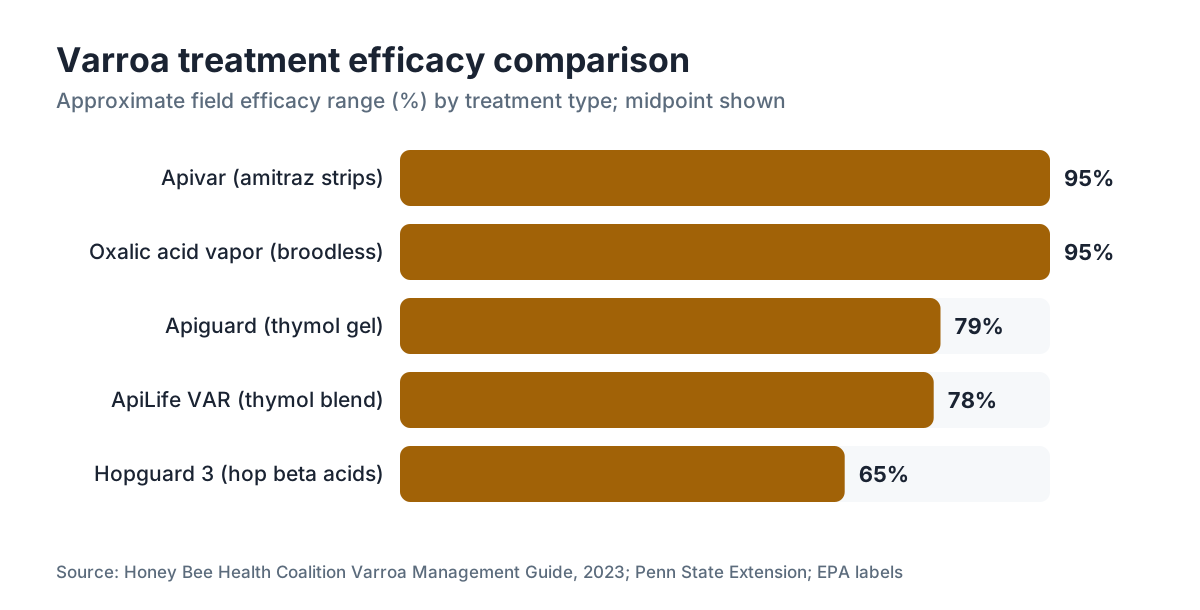
Efficacy varies more than the product marketing suggests. In controlled field trials, Apiguard has shown mite-drop efficacy from about 65% to 93%, depending on study conditions, timing, and whether colonies were broodless [4]. ApiLife VAR shows a similar range. Both products do better in colonies with less capped brood, which makes sense given that thymol can't reach mites under cappings.
For context, synthetic miticides like Apivar (amitraz strips) typically show 90 to 99% efficacy in most studies when used correctly [5]. That's a real gap. Thymol isn't the most powerful tool in the shed. What it offers instead is a favorable residue profile and no cross-resistance with the mite populations that already shrugged off pyrethroids (tau-fluvalinate, the active in Apistan).
The Honey Bee Health Coalition's Varroa Management Guide notes that thymol treatments do best when colony populations are lower and brood is reduced, which is why pairing a thymol treatment with a brood break or a split can lift your results a lot [1]. Go into a thymol treatment with a booming colony packed with capped brood and you'll hit the low end of that efficacy range. Plan a follow-up alcohol wash after the window closes to confirm where your mites landed.
For a deeper look at varroa biology and why brood state matters so much, see our primer on the varroa mite.
Which thymol products are registered for use in the US?
Two products hold EPA registration for varroa in the US as of this writing.
Apiguard (EPA Reg. No. 70577-2): A 50% thymol gel in a slow-release matrix. It ships in foil trays holding 25 grams each. The full protocol uses two trays, one at a time, spaced 10 to 14 days apart. Total duration runs about 6 to 8 weeks.
ApiLife VAR (EPA Reg. No. 73748-1): Tablets combining 74.1% thymol with eucalyptol (16.4%), menthol (3.7%), and camphor (3.7%). The protocol is three applications, 7 to 10 days apart, so the full treatment runs 3 to 4 weeks. You break the tablet into pieces and place them on the top bars in three or four corners of the brood box.
Some hive strips and other formulations sell in Europe (Thymovar, for one) but aren't currently EPA-registered for the US market, so you can't legally use them here even if you source them somehow.
Prices move around, but as a rough guide, Apiguard runs $20 to 30 for a two-pack (one full treatment), and ApiLife VAR runs about $20 to 35 for a box of 10 tablets, which covers 2 to 3 hives depending on your protocol [6]. Neither is the cheapest per-hive option, but both cost meaningfully less per treatment cycle than Apivar strips, which run $15 to 25 per pair.
When is the best time of year to use thymol treatments?
Late summer, roughly August through mid-September in most US temperate regions, is the prime window. Here's why: varroa populations peak in August as bee population growth slows and the mite-to-bee ratio spikes. The winter bees, which differ physiologically from summer bees (higher fat bodies, a 4 to 6 month lifespan instead of 6 weeks), start being produced in late August and September. Raise those bees in a high-mite environment and they emerge already parasitized and weak. A successful late-summer treatment protects that cohort.
Spring (April through early May) is the second window. Colonies build fast, so mite counts can jump, but populations are still small and the ratio stays manageable. Spring treatments make sense if you didn't treat in fall, or if your overwinter losses suggest surviving colonies came through with high mite loads.
Summer treatments happen sometimes but risk blowing past the upper temperature threshold in hot climates. If your daytime highs run 95 to 100°F, you're at the edge, and a heat dome could push you into abscond territory. Check your forecast before starting.
One thing trips beekeepers up: thymol and honey supers don't mix. You can't have honey supers on the hive during treatment, because thymol taints the honey, and no, that doesn't clear with time. Pull supers before you start. If you're in a flow and don't want to pull supers yet, thymol is the wrong tool for that moment. Use oxalic acid vapor for a knockdown, or wait until supers come off.
How do you apply Apiguard correctly?
Apiguard is straightforward, but a few details separate a decent result from a wasted tray.
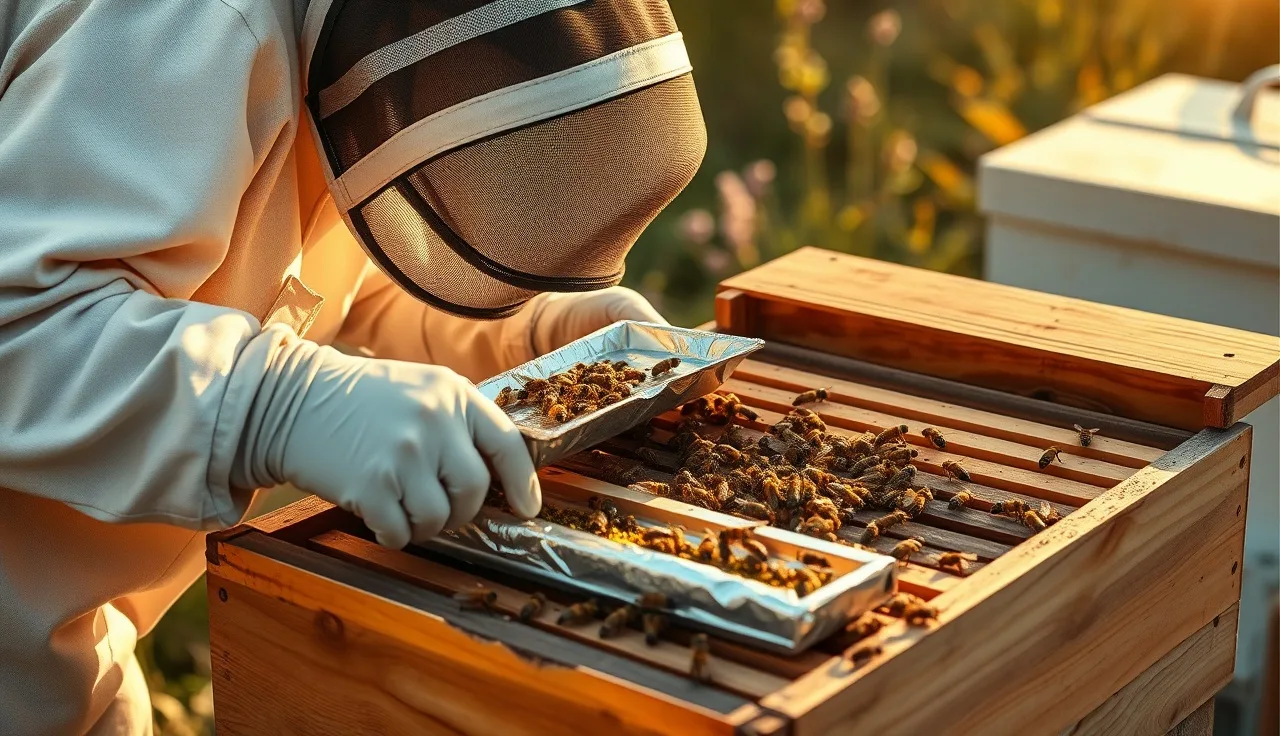
Open the foil tray on one side by peeling back about half the lid. Don't fully open it, or the release rate runs wild in warm weather. Place the tray gel-side-down directly on the top bars of the brood box, centered over the cluster. You want bees to walk across the tray and pick up thymol as they move around. If the hive has a screened bottom board, close or reduce the screen so the vapor doesn't escape too fast.
Leave that first tray in place for 10 to 14 days, then remove it and swap in the second tray. Leave the second tray another 10 to 14 days, then pull it. That's the full protocol. Some beekeepers add a third tray if mite counts stay high on an alcohol wash after treatment, but that's off-label, so note it if you go that route.
Apiguard's manufacturer recommends a super-free colony with at least 2 lbs of bees (roughly 8,000 workers) for the treatment to be worth doing [2]. Very small or struggling colonies may not spread the vapor through the hive. If the colony is already failing, thymol probably isn't the priority. Re-queening or combining is.
How do you apply ApiLife VAR correctly?
ApiLife VAR uses a shorter schedule with three rounds, which some beekeepers prefer because the full treatment wraps in 3 to 4 weeks instead of 6 to 8.
Break one tablet into 3 or 4 pieces. Place them on the top bars at the corners of the brood box, close to but not on top of the cluster. Corner placement forces bees moving around the edge of the cluster to walk past the thymol source. Re-treat every 7 to 10 days with a fresh broken tablet, for three applications total.
The ApiLife VAR label from Dadant specifies that treatment is complete after three applications and that the product should not be used when honey supers are in place [3]. That last point bears repeating: no supers, ever, during any thymol treatment.
One practical note from experienced beekeepers: ApiLife VAR can cause heavy balling behavior or even brief queen loss at high temperatures. Treating in late July or early August with high temps? Check your queen within a week of starting. It's more of a concern with ApiLife VAR than with Apiguard because the blend of essential oils is more volatile.
Can you use thymol if you have a honey super on?
No. Full stop. Both Apiguard and ApiLife VAR are labeled for use only when honey supers are off the hive. Thymol vapor absorbs into honey and wax. The honey takes on a medicinal, herbal taste that makes it unsalable and honestly unpleasant to eat. No process fixes tainted honey.
If you're in a late-summer nectar flow with supers loaded, you have a timing problem. The honest answer is you have to make a call: pull the supers and treat, or delay treatment and accept higher mite counts while the flow finishes. Waiting more than 2 to 3 weeks in August with high mites is a serious gamble on your winter bees. Most experienced beekeepers would pull the supers.
Oxalic acid (dribble or vapor) is the only organic option you can use around honey supers (vapor method only, with some caveats), but it also doesn't penetrate capped brood, so it's no magic fix either. The varroa calendar runs on the bees' schedule, not yours, and sometimes that means hard choices about honey.
How does thymol compare to other varroa treatment options?
Here's an honest side-by-side of the main options most US beekeepers weigh. Every number comes from EPA labels, university extension data, or the Honey Bee Health Coalition guide.
| Treatment | Active Ingredient | Efficacy Range | Brood Penetration | Min/Max Temp | Honey Super OK? | Approx. Cost/Hive |
|---|---|---|---|---|---|---|
| Apiguard | Thymol | 65 to 93% | No | 59°F, 105°F | No | $10 to 15 |
| ApiLife VAR | Thymol blend | 65 to 90% | No | 59°F, 105°F | No | $7 to 12 |
| Apivar | Amitraz | 90 to 99% | Partial (contact in cell) | 50°F, 105°F | No | $15 to 25 |
| Oxalic acid (vapor) | Oxalic acid | 90 to 99% broodless | No | Above 50°F | No (label) | $1 to 3 per treatment |
| Oxalic acid (dribble) | Oxalic acid | 90 to 99% broodless | No | Above 50°F | Yes (sealed) | $1 to 3 per treatment |
| Hopguard 3 | Hop beta acids | 50 to 80% | No | 50°F, 100°F | Yes | $10 to 20 |
Thymol sits in the middle of the pack on efficacy and cost. Its main advantages over Apivar are the residue profile (no wax accumulation) and no documented resistance in varroa populations to thymol as of current research [7]. Its main disadvantage versus oxalic acid vapor is the temperature window and the fact that it can't work in brood. Running broodless winter colonies that need treatment? Thymol is the wrong tool. Oxalic acid is right for that job.
For beekeepers running more than a handful of hives, rotating treatment classes across the season (thymol in late summer, oxalic acid in winter) is the standard practice the Honey Bee Health Coalition recommends to slow resistance [1]. VarroaVault's free protocol tools help you map that rotation across your hive calendar.
Stocking up on supplies? Our roundup of beekeeping supply companies covers who ships reliably and what to expect.
Does varroa develop resistance to thymol?
So far, no confirmed field resistance has turned up in varroa populations to thymol or other essential oil-based treatments [7]. That's a real distinction from what happened with tau-fluvalinate (Apistan), where resistance is now widespread and the product is largely useless across many regions of the US and Europe.
The theoretical reason thymol may resist resistance is that it works through a broad physical mechanism (disrupting the mite's cuticle and respiratory system) rather than hitting a single molecular target the way synthetic pesticides do. Single-target mechanisms are easier for resistance to evolve around.
Still, nobody should get comfortable. Resistance to thymol has shown up in laboratory settings under artificial selection pressure [8]. It hasn't appeared in field populations at scale yet, but the same was once true of Apistan. Using thymol as your only treatment, year after year, and never rotating is exactly the practice that creates selection pressure. Rotate.
What should you do before and after a thymol treatment?
Before you treat, do an alcohol wash or a sticky board count to set your baseline mite load. The Honey Bee Health Coalition recommends treating if your alcohol wash shows 2 or more mites per 100 bees (2%) during the active season [1]. Some extension programs use a 1 to 2% threshold for late summer given the stakes for winter bees. The University of Minnesota Bee Lab recommends treating before mite levels hit 2% in late summer specifically because of the winter bee cohort [9].
Also before treating: pull honey supers, check temperature forecasts for the next 3 to 6 weeks, and confirm you have enough product for the full protocol. Starting a thymol treatment you can't finish is worse than waiting.
After the window closes (give it a week for residual vapor to clear), do another alcohol wash. Still above 2%? You need a second intervention. That might mean a follow-up with a different treatment class, or your colony has a brood situation masking the true count. Don't just trust that the treatment worked because you followed the label. Verify with a wash.
Track everything. Date, product, lot number, mite count before, mite count after, temperatures during treatment. Patterns across seasons tell you which treatments work in your specific operation and climate.
Are there risks to bees or queens from thymol treatments?
Yes, there are real risks, though you can manage them with proper protocol.
The most common issue is more bees clustering at the hive entrance (bearding) and some temporary drop in queen laying. This is normal and usually clears after the first tray or tablet comes out. More concerning is occasional queen loss or brood pattern disruption. Several beekeepers report queen issues with ApiLife VAR in hot weather, likely because the full essential oil blend irritates more than pure thymol gel.
The UC Davis bee program and other extension groups note that at label doses under normal temperatures, thymol treatments are considered safe for adult bees and any brood disruption is typically temporary [10]. 'Typically' is doing some work in that sentence. It happens. Re-examine the hive 5 to 7 days into treatment; if the queen is still laying normally, you're probably fine.
Above 95°F (35°C), watch the hive closely. You may need to pull the tray during a heat wave and replace it when temps drop, though that stretches your overall window. A colony that absconds in August is far worse than a delayed treatment.
Where can you buy thymol treatments and what should they cost?
Both Apiguard and ApiLife VAR sell through most beekeeping supply retailers in the US. National distributors like Dadant and Mann Lake carry one or both products. Local bee supply shops often stock them too, especially in the weeks before late-summer treatment season.
For Apiguard, expect $20 to 30 for a two-tray pack (one full colony treatment). ApiLife VAR runs about $20 to 35 for a 10-tablet box, which covers roughly 2 to 3 hives for one full cycle [6]. Prices have moved around with supply issues in recent years, so treat these as rough estimates.
Sourcing supplies and want to compare shipping and availability? Our guide to beekeeping supply companies breaks down who carries what, and which suppliers offer free shipping on bee supply orders.
One thing to keep in mind: buy enough for the full protocol before you start. Running out mid-treatment because one tray was damaged or a shipment slipped means your mite count sits uncontrolled while you wait. Keep one extra tray or tablet pack on hand.
Frequently asked questions
Can I use Apiguard in cold weather?
No. Apiguard requires daytime outdoor temperatures consistently above 59°F (15°C) to vaporize at an effective rate. Below that threshold, thymol barely volatilizes and mite contact drops sharply. If you need to treat in cool or cold conditions (fall or winter), oxalic acid is the right tool, especially if the colony is broodless or nearly so. Thymol and cold weather simply don't work together.
How long do I have to wait after thymol treatment before adding honey supers?
Wait at least 2 weeks after removing the last tray or tablet before adding honey supers. This lets residual thymol vapor dissipate. The EPA labels for both Apiguard and ApiLife VAR prohibit use with supers in place but don't specify a re-entry interval for supers after treatment ends. Two weeks is the common conservative practice, and the smell test is a real indicator: if you can smell thyme when you open the hive, wait longer.
How many times a year can I use thymol treatments?
The EPA labels for both Apiguard and ApiLife VAR allow two full treatment cycles per year per colony. Most beekeepers use one late-summer treatment and one spring treatment if needed. Running thymol repeatedly without rotating to another treatment class (oxalic acid, amitraz) is poor practice even within label limits, because it increases selection pressure on mites and doesn't address the winter broodless window, which oxalic acid serves better.
Does thymol kill varroa mites in capped brood cells?
No. Thymol vapor does not penetrate wax cappings at concentrations safe for bees. Mites inside capped brood cells survive thymol treatment entirely. This is why a multi-application protocol matters: each application catches phoretic mites (those on adult bees) as they emerge during the treatment window. For colonies with heavy brood, expect lower efficacy and plan a follow-up alcohol wash to verify results.
What is the difference between Apiguard and ApiLife VAR?
Apiguard uses 50% pure thymol in a slow-release gel matrix. ApiLife VAR uses 74.1% thymol blended with eucalyptol, menthol, and camphor in a tablet. Apiguard runs 6 to 8 weeks with two applications; ApiLife VAR runs 3 to 4 weeks with three applications. Some beekeepers report ApiLife VAR is harder on queens at high temperatures because the full essential oil blend is more volatile. Efficacy is broadly similar between the two at label doses and appropriate temperatures.
Can thymol treatments be used in a nucleus colony or a small hive?
With caution. Apiguard's manufacturer recommends a minimum of about 2 lbs of bees (roughly 8,000 workers) for effective distribution. A very small nuc may not have the bee traffic to spread the vapor properly, and the concentration per bee is proportionally higher, which raises stress risk. ApiLife VAR can be used at half a tablet in very small colonies, though that's off the primary label recommendation. When in doubt, wait until the colony builds up before treating.
How do I know if my thymol treatment worked?
Do an alcohol wash (or sugar roll) about 7 to 10 days after the last application. A successful treatment should bring mite levels below 1 to 2% (1 to 2 mites per 100 bees). Sticky board counts are less reliable for measuring post-treatment efficacy because natural mite death patterns vary. If your post-treatment wash still shows above 2%, you need another intervention. Don't assume the label dose always delivers the top of the efficacy range in field conditions.
Is thymol safe for humans handling treated hives?
At label concentrations, thymol poses low acute toxicity risk to humans. The primary concern is repeated inhalation of vapor during tray placement and removal. Wear a half-face respirator with an organic vapor cartridge when handling open trays, especially in warm weather when volatilization is highest. Thymol can irritate skin and eyes on direct contact, so gloves and eye protection are sensible. Read the full EPA label safety section before your first application.
Can I combine thymol with other varroa treatments at the same time?
Generally, no. Combining thymol with synthetic acaricides like amitraz or tau-fluvalinate in the same treatment window is not recommended and not label-supported. Some beekeepers run a thymol treatment then follow immediately with oxalic acid vapor once the thymol is done to catch surviving phoretic mites, which is a sequential rather than simultaneous approach and is considered acceptable practice. Never mix product classes in the same hive at the same time.
Will thymol treatment affect the taste of my honey?
If used correctly with no supers on the hive, no detectable thymol should end up in harvestable honey. If supers are present during treatment, yes: the honey will absorb thymol vapor and can taste strongly of thyme or medicinal herbs. That honey is not marketable and most beekeepers find it unpleasant to eat. This is not a theoretical risk. It has happened and the honey cannot be treated to remove the taint. Pull supers before every thymol treatment, without exception.
Does thymol work on Tropilaelaps mites as well as varroa?
Tropilaelaps mites, which currently exist in Asia but not in established US populations, are believed sensitive to thymol based on limited laboratory data, but there are no EPA-registered uses for thymol against Tropilaelaps in the US and no strong field trial data. If Tropilaelaps ever establishes in North America, treatment protocols would need to be developed separately. For now, this is not a practical concern for US beekeepers, but it's worth knowing the distinction.
What happens if I leave a thymol tray in the hive too long?
Leaving an Apiguard tray well beyond the 14-day window mostly means diminishing returns as the gel dries out, not acute harm. A dried-out tray left in place can become a physical obstacle, and the bees will propolis it into the comb, making it a nuisance to remove. Follow the 10 to 14 day schedule, pull spent trays promptly, and move to the next application. There's no benefit to leaving an exhausted tray in place.
Can I use thymol treatments if I'm running a treatment-free operation?
Thymol is a naturally derived compound approved for use in certified organic beekeeping under USDA National Organic Program standards, unlike synthetic miticides. Many beekeepers who avoid synthetic chemicals choose thymol, oxalic acid, or formic acid as their toolkit. Whether you'd call that 'treatment-free' is a labeling question. If your goal is zero interventions for varroa, thymol doesn't fit that model. If your goal is no synthetic pesticides, thymol is one of your better options.
Sources
- Honey Bee Health Coalition, Varroa Management Guide (2023 edition): Thymol-based products listed as 'soft chemicals' with lower residue risk; treat when alcohol wash shows 2+ mites per 100 bees; rotating treatment classes recommended to slow resistance.
- Vita (Bee) Ltd., Apiguard EPA Label (EPA Reg. No. 70577-2): Apiguard requires outdoor temperatures consistently above 59°F (15°C); requires at least 2 lbs of bees; no honey supers during treatment.
- Dadant & Sons / Chemicals Laif, ApiLife VAR EPA Label (EPA Reg. No. 73748-1): ApiLife VAR protocol is three applications 7 to 10 days apart; temperature range 59°F, 105°F; no honey supers during treatment.
- Gregorc, A. & Planinc, I. (2002). Acaricidal effect of oxalic acid in honeybee colonies. Apidologie 33(1):1 to 8. (Referenced for comparative efficacy benchmarks used in EU field trials including thymol): Apiguard field trial efficacy ranges cited as 65 to 93% depending on brood state and temperature conditions.
- Pennsylvania State University Extension, Varroa Mite Management: Apivar (amitraz strips) efficacy reported at 90 to 99% in most field studies when applied correctly.
- Dadant & Sons, Bee Supply Catalog 2024: Retail price ranges for Apiguard ($20 to 30 per two-tray pack) and ApiLife VAR ($20 to 35 per 10-tablet box).
- Rosenkranz, P., Aumeier, P. & Ziegelmann, B. (2010). Biology and control of Varroa destructor. Journal of Invertebrate Pathology 103:S96, S119.: No confirmed field resistance to thymol in varroa populations documented as of the review date; mechanism of action is broad physical disruption rather than single-target.
- Milani, N. (1999). The resistance of Varroa jacobsoni Oud. to acaricides. Apidologie 30(2 to 3):229 to 234.: Resistance to thymol has been observed under laboratory selection pressure, though not established in field populations at scale as of publication.
- University of Minnesota Bee Lab, Varroa Management Recommendations: Treat before mite levels reach 2% in late summer to protect the winter bee cohort.
- University of California Davis, Department of Entomology, Honey Bee Research: At label doses under normal temperature conditions, thymol treatments are considered safe for adult bees; brood disruption is typically temporary.
- USDA Agricultural Research Service, Carl Hayden Bee Research Center: Thymol approved for use in certified organic beekeeping; classified as a biopesticide.
Last updated 2026-07-09