How to test wax for pesticide residue from treatments

TL;DR
- Beeswax is a fat-soluble sponge for varroa treatment chemicals.
- Testing means sending samples to an accredited agricultural or food-safety lab for LC-MS/MS or GC-MS analysis.
- Costs run $50-$200 per sample depending on the panel.
- The Honey Bee Health Coalition and several university extensions publish sampling protocols.
- Most hobbyists test when reusing old foundation or switching suppliers.
Why does beeswax accumulate pesticide residues in the first place?
Beeswax is roughly 70 percent long-chain esters and wax acids, all lipophilic. Fat-soluble compounds partition into it the same way they partition into body fat. Every time you apply an oil-based acaricide, a strip treatment, or even a miticide-laced oxalic acid drizzle, trace amounts bind to the wax in your comb.
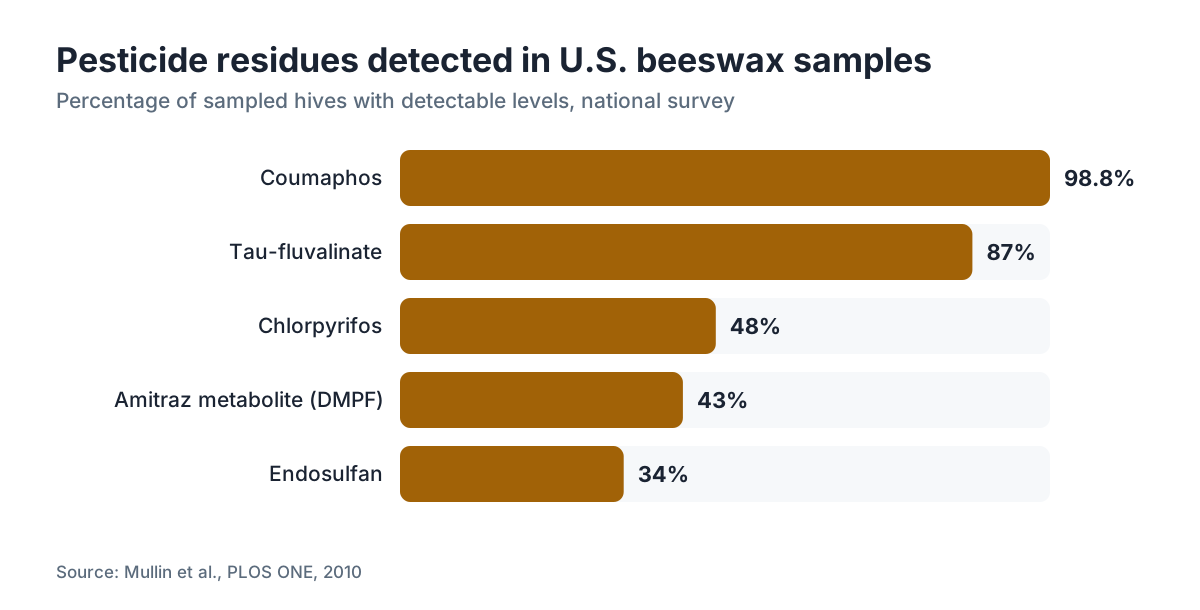
The residues that matter most in varroa management are coumaphos (CheckMite+), tau-fluvalinate (Apistan), and amitraz (Apivar, technically its metabolite DMPF). Coumaphos is particularly sticky. A 2010 study by Mullin et al. in PLOS ONE found coumaphos in 98.8 percent of wax samples collected across the U.S., with median concentrations of 94 ppb but highs well above 1,000 ppb in heavily treated apiaries [1]. Those numbers have aged but the chemistry has not: coumaphos has a log Kow of about 4.9, meaning it strongly prefers wax over water or hemolymph.
Tau-fluvalinate was the first synthetic pyrethroid used at scale in U.S. apiaries in the late 1980s and 1990s. Cumulative wax residues can exceed 1,000 ppb in comb that has never been replaced. At sub-lethal levels, fluvalinate and coumaphos in combination show synergistic toxicity to honey bee larvae, even when each compound alone sits below its individual NOEC [1]. That interaction is the main reason testing wax has real practical value, more than regulatory box-checking.
Amitraz breaks down quickly in biological tissue but its metabolite 2,4-dimethylaniline (DMPF) persists in wax at lower concentrations than coumaphos typically does. New data on amitraz residues in wax is thinner than coumaphos data, so lab detection is worth doing if your hives have used Apivar strips for multiple consecutive years.
What analytical methods do labs use to test wax for pesticides?
Two methods do almost all the work: gas chromatography with mass spectrometry (GC-MS or GC-MS/MS) and liquid chromatography with tandem mass spectrometry (LC-MS/MS). They are not interchangeable for every compound.
GC-MS handles volatile and semi-volatile compounds well. Tau-fluvalinate, coumaphos, chlorpyrifos, and most organophosphates are good GC-MS targets. The method involves solvent extraction (typically acetonitrile or hexane), a QuEChERS cleanup step to remove wax lipids, and then chromatographic separation before mass detection. Detection limits usually land in the low parts-per-billion range, often 1-10 ppb depending on the analyte and lab.
LC-MS/MS is better for compounds that are thermally labile or polar, including amitraz and many systemic pesticides like neonicotinoids (imidacloprid, clothianidin, thiamethoxam). Some labs run a combined panel on the same extracted sample using both instruments. If you're trying to check for pesticide drift from nearby agriculture as well as your own treatment residues, you need that combined panel.
The QuEChERS (Quick, Easy, Cheap, Effective, Rugged, Safe) extraction was adapted for honey and wax from vegetable-matrix methods and is now fairly standard in university extension and USDA labs [2]. It's not magic. Waxy matrices are difficult because lipids co-extract and can suppress ionization. Good labs run internal standards and matrix-matched calibration curves to correct for this. Always ask a lab whether they use matrix-matched standards for beeswax specifically, more than a generic pesticide screening.
A few labs also offer enzyme-linked immunosorbent assay (ELISA) screens for individual compounds, most often coumaphos. ELISA is cheaper (sometimes under $30 per analyte) and faster, but it's qualitative or semi-quantitative at best and gives false positives from related organophosphates. Use ELISA as a quick screen, then confirm with GC-MS or LC-MS/MS if you get a hit.
Which labs actually accept beeswax samples from beekeepers?
You have three realistic options: USDA-accredited agricultural labs, state department of agriculture labs, and private food-safety labs.
The USDA Agricultural Marketing Service runs the Pesticide Data Program (PDP), which tests honey and wax at federal scale, but that program does not accept beekeeper submissions [3]. It's surveillance, not a service.
State departments of agriculture run residue labs in many states, though access varies. California, Oregon, and several Midwest states have tested beeswax through their pesticide residue programs. Call your state ag department's pesticide bureau directly and ask whether they accept beekeeper samples. Fees and turnaround vary by state.
Private accredited labs are the most accessible route for most beekeepers. Labs that have published work in this space or are known in apiculture extension circles include:
- Pennsylvania State University's Pesticide Lab (Penn State Extension hosts beekeeper resources) [4]
- Eurofins (a large private network with multiple U.S. locations)
- Midwest Laboratories (Omaha, NE)
- Anatek Labs (Moscow, ID, known for honey and wax work)
None of these are free. A standard 25-30 compound acaricide and organophosphate panel at a private lab runs roughly $80-$150. A full 200-compound agricultural screen (useful if drift is a concern) runs $150-$300 or more. Turnaround is typically 5-15 business days [5].
The Honey Bee Health Coalition's Varroa Management Guide mentions wax contamination in its treatment resistance and colony health sections and points beekeepers toward university extension labs as a first contact [6]. That's still the best starting point if you're not sure who to call.
For a broader look at varroa mite biology and why comb management matters in the first place, the referenced article covers how mites cycle through comb in ways that interact with residue buildup.
How do you collect a wax sample correctly?
The lab can only work with what you send. Contaminated or sloppy samples produce results that mean nothing.
Use clean, unlined glass jars or lab-supplied sample tubes. Never use plastic bags or containers: most plasticizers are also lipophilic and will leach into your wax sample during storage, creating false positives on certain analytes. Glass jars with metal lids (PTFE-lined, not plastisol) are the standard.
For foundation or comb wax, cut 5-10 grams of comb (roughly a 3x3 inch piece of drawn comb, without honey or bees). If you're testing raw cappings wax from your extractor, pour melted but cooled wax directly into the glass jar. Keep it solidified for shipping.
Representative sampling matters. If your goal is to characterize an entire apiary's wax supply, take subsamples from multiple frames and multiple hives, then either submit composites (if the lab accepts them) or expect to pay for multiple individual tests. A single frame from one hive tells you about that comb, not your operation.
Label the sample with the date the comb was drawn (estimated is fine), which treatments have been applied in that hive over the last 3-5 years, and the number of brood cycles the comb has seen. This context helps the lab flag whether a detected level is expected or anomalous. Ship samples cold, with an ice pack, via overnight or two-day service. Wax is fairly stable but heat during shipping can degrade some analytes.
Store a portion of every sample you send. Labs occasionally lose samples or equipment fails mid-run. Keep 5g in your freezer at home until you get results.
What residue levels are considered harmful to bees or queen rearing?
There are no federally established regulatory thresholds for pesticide residues in beeswax the way there are tolerances in food crops. The EPA registers varroa treatment active ingredients for hive use, but the label does not set a maximum residue limit in wax [7]. So interpreting your results means leaning on research literature rather than a bright regulatory line.
The most-cited reference points come from the Mullin et al. 2010 PLOS ONE paper. That paper reported that coumaphos at concentrations above 100 ppb in wax comb reduced brood viability and had measurable sub-lethal effects on worker longevity. A combined coumaphos and fluvalinate load above 900 ppb total was associated with colony-level stress markers [1].
For queen rearing specifically, research out of North Carolina State University found that queens reared on foundation containing high coumaphos loads (above 100 ppb) had reduced sperm viability after their mating flights compared to queens reared on clean wax. That work, by Pettis and colleagues, is part of why most commercial queen producers now use only new or verified-clean foundation [4].
Here is the practical read. Many apiculture extension specialists treat 100 ppb coumaphos as a soft action threshold for wax destined for queen rearing. For regular worker brood rearing, the threshold is less clearly defined, but total acaricide loads above 1,000 ppb are worth acting on. Amitraz/DMPF thresholds have less data behind them. The closest guidance is the EU's maximum residue limit of 200 ppb in honey (not wax), which exists for food safety rather than bee health [8].
The honest answer is that nobody has published a clean, universally accepted bee-health threshold table for wax residues. The 100 ppb coumaphos figure is widely cited but comes from a single study design and may not generalize across different colony conditions.
What does pesticide residue testing actually cost?
Cost depends on how many analytes you want screened and which lab you use. Here's a realistic breakdown based on published lab fee schedules and extension guidance [5].
| Test type | Analytes covered | Typical price range |
|---|---|---|
| ELISA screen (single compound) | 1 (usually coumaphos) | $20-$40 |
| GC-MS acaricide panel | 15-30 compounds | $75-$130 |
| LC-MS/MS expanded panel | 50-100+ compounds | $120-$200 |
| Full agricultural screen (GC+LC) | 150-300 compounds | $175-$350 |
| Rush processing surcharge | varies | add $30-$80 |
For a hobbyist running 5-20 hives, the GC-MS acaricide panel is usually the right call. It covers the compounds you've likely used and the ones your foundation supplier may have used before you got the wax. The full agricultural screen makes sense if you're near row-crop agriculture and want to check for drift contamination on top of treatment residues.
Some state departments of agriculture run periodic free or reduced-cost programs for beekeepers, especially after large-scale bee kills or during colony collapse investigations. Ask your state apiarist's office whether such programs exist.
If cost is a barrier, consider pooling samples with other local beekeepers and submitting a composite from your shared apiary region. The result won't be hive-specific but it will give you a landscape-level read on whether your regional wax supply carries elevated background contamination.
How do you interpret lab results once you get them?
Your lab report will list detected analytes in parts per billion (ppb, equivalent to micrograms per kilogram) or parts per million (ppm). Most acaricide residues in beeswax show up in ppb.
Start with coumaphos. If you see anything above 100 ppb, treat that wax as unsuitable for queen rearing and note it as elevated for general brood rearing. If it's above 500 ppb, seriously consider rotating that comb out of your operation.
For tau-fluvalinate, the same 100 ppb soft threshold applies for queen rearing. Background fluvalinate is extremely common in older commercial foundation because it was used so widely in the 1990s. Finding 50-150 ppb fluvalinate in 10-year-old comb is not surprising.
For amitraz metabolites (DMPF), less than 200 ppb is the rough guidance extrapolated from the EU honey MRL, understanding that this is imperfect. Detect-but-low (10-50 ppb) is common in hives that used Apivar within the past 2-3 years.
If you see neonicotinoids (imidacloprid, clothianidin, thiamethoxam) at any significant level (say, above 10 ppb), that points to agricultural drift rather than your varroa treatments and warrants a different response, including reporting to your state department of agriculture.
Always ask the lab for their reporting limit and method detection limit for each analyte. A result of "not detected" is meaningless without knowing at what concentration they would have detected it. A lab with a 50 ppb detection limit for coumaphos cannot tell you whether your wax is clean at 40 ppb. That matters.
When should you actually bother testing your wax?
Routine testing of every frame every year is overkill for most hobbyists. Here's when testing genuinely earns its cost.
You're buying used equipment. Old comb from another beekeeper's operation has an unknown treatment history. Testing before you bring it into your apiary is the only way to know what you're getting. This is probably the single most common scenario where hobbyists benefit from testing.
You're starting a queen-rearing program. Clean wax matters more for queens than for anything else in beekeeping. If you're grafting or using cell cups on drawn comb, know what's in it.
Your colonies have unexplained reproductive problems. Poor brood viability, high DWV rates despite low mite counts, spotty brood without a clear pathogen cause. Any of these can overlap with high wax residue loads, though you shouldn't assume causation before ruling out other factors.
You want to sell or use your wax commercially. Cosmetic and food-grade beeswax buyers increasingly ask for residue documentation. Tested, low-residue wax commands a price premium.
You've relied heavily on one treatment for many years. Beekeepers who used only Apistan from the early 1990s through the 2000s, or who used CheckMite+ for small hive beetle management on top of mite control, are most likely to carry elevated loads. If that's your history, one baseline test is worthwhile.
You're planning to refresh your equipment anyway. Many experienced beekeepers rotate comb out on a 3-5 year cycle regardless of residue concerns, which naturally keeps background contamination lower. If you're already doing this, the math on testing shifts toward checking new foundation sources rather than your own old comb.
For managing mite loads that drive the pressure behind repeated treatment cycles, the varroa mite section covers monitoring thresholds and treatment timing in detail.
Can you reduce pesticide residues in wax without replacing all your comb?
Short answer: not really, and the methods that claim to work have serious limits.
Solvent washing or rendering won't pull lipophilic residues out of beeswax in any practical way. Residues that have partitioned into wax are bound there. Melting and filtering removes particulates but not dissolved chemical residues. Studies on commercial wax rendering confirm that coumaphos survives the standard beeswax rendering process at high temperatures [1].
Some beekeepers have tried diluting high-residue wax with large quantities of clean wax for foundation production. This lowers concentration mathematically but doesn't eliminate the contamination, and it spreads it further.
The only reliable approach is comb rotation: systematically removing old dark comb on a defined schedule and replacing it with foundation from a verified source. The standard recommendation from most university extensions is to cycle out combs after 3-5 years or after they have been through a known heavy treatment period [4]. New drawn-comb foundation from a source that can provide a certificate of analysis or test results is the cleanest starting point.
Buying certified low-residue foundation is possible but takes due diligence. Ask suppliers directly for residue test results. Reputable beekeeping supply companies that cater to natural and treatment-free beekeepers sometimes stock tested foundation, but "clean" is a marketing term without a legal standard behind it. Ask for actual numbers, not assurances.
If you're building your varroa management plan from scratch and want to track treatment history as a way to predict comb residue load over time, VarroaVault's free protocol tools include a hive history log built for this.
What does EPA product labeling say about wax residue risks?
EPA-registered varroa treatment labels require applicators to follow directions that include dosage, timing, and removal instructions. The labels for Apivar, Apistan, and CheckMite+ all specify strip removal deadlines and discourage treatment during active honey flows. The EPA's pesticide registration system requires tolerance assessments for honey as a food commodity, but beeswax is not a direct human food under FIFRA, so there is no federally established maximum residue level for pesticides in beeswax sold for non-food purposes [7].
The Apivar (amitraz) label notes that strips should be removed after 6-10 weeks and that leaving strips in longer than labeled increases residue risk in hive products. The CheckMite+ (coumaphos) label carries similar language. As the EPA label for CheckMite+ states: "Do not use in hives producing comb honey for sale or human consumption." That language exists precisely because coumaphos residues persist [7].
The practical implication is that label compliance keeps residues at expected background levels, but even perfect compliance accumulates residue over many treatment cycles. The label tells you the floor, not the ceiling of what to expect after years of use.
For beekeepers in states with active apiculture programs, the state apiarist's office is a good source for local guidance on residue testing resources. Several states, including California, run specific programs given their large commercial pollination sector.
Are there any DIY or on-farm tests for wax residues?
Mostly no. The detection limits you need for meaningful beeswax residue assessment require laboratory equipment. There are a couple of limited options.
ELISA test kits for specific pesticides, particularly coumaphos, are sold by agricultural supply companies. Abraxis and EnviroLogix make ELISA kits used in food-safety labs. These can give a semi-quantitative read (above or below a rough threshold) for a single analyte. Cost per test is $20-$40 for the kit components when bought in bulk. Individual kits run higher. The setup still needs basic liquid handling skills and a UV plate reader or at minimum a color comparator tube, so it's not as simple as a home pregnancy test.
Lateral flow immunoassay strips, similar to the ones used for rapid drug tests, exist for a handful of pesticides but not at the sensitivity needed for beeswax specifically. You'd get a meaningful result only for very high contamination.
Here's the practical call. If you're a hobbyist with fewer than 50 hives, send samples to a lab. The cost of getting a wrong result from an unreliable DIY test is higher than the $100-$150 lab fee. If you're a larger operation running your own queen program, partnering with a state extension lab for annual testing on a representative sample set makes more sense than one-off DIY screening.
The Penn State Pesticide Testing Laboratory and similar university extension labs sometimes offer educational testing programs at lower cost than commercial labs, especially for beekeepers who are willing to contribute their data to ongoing research [4].
How often should you test, and should you keep records?
There's no universal answer to frequency, but a practical framework works: test any new wax source before it enters your operation, test your oldest comb once as a baseline, and retest if you add a new treatment chemistry or if you observe unexplained queen or brood problems.
Record keeping is undervalued here. A simple log of which treatment was applied in which hive, in which year, with what dosage and duration, gives you a proxy for expected residue load before you ever send a sample. If you know a hive has had CheckMite+ every year for eight years, you already have a strong prior that its comb needs testing or rotation before reuse.
The Honey Bee Health Coalition's Best Management Practices for Honey Bees recommends keeping detailed treatment records as part of colony health management [6]. Those records do double duty: they support residue interpretation and they're legally required in some states for licensed apiarists.
For hobbyists running 5-10 hives, a simple paper log per hive is fine. Note the treatment name, active ingredient, number of strips or dose, date in, date out, and hive identifier. After a few years you'll have exactly what a lab needs as context for interpreting results.
VarroaVault's hive health tracker, part of the free varroa protocol tools, includes a treatment history field for each hive built for this longitudinal record. Having three to five years of treatment history mapped to specific comb frames is genuinely useful when you're deciding whether a set of combs warrants testing or rotation.
Frequently asked questions
How much wax do I need to send to a lab for residue testing?
Most labs require a minimum of 5-10 grams of beeswax per sample, about a 3x3 inch piece of drawn comb or a small block of rendered wax. Send more if you can, closer to 20-30 grams, so the lab has enough for repeat analysis if a run fails or a confirmation test is needed. Always use clean glass containers, not plastic.
Can I test honey instead of wax to check for pesticide residues from my varroa treatments?
Honey and wax tell different stories. Most fat-soluble acaricides like coumaphos and fluvalinate concentrate in wax, not honey, because of their lipophilic chemistry. Honey testing is more useful for water-soluble systemic pesticides like neonicotinoids. If you want to know whether your varroa treatments have loaded your hive wax, test the wax directly, not the honey.
Does oxalic acid leave residues in beeswax?
Oxalic acid occurs naturally in beeswax and honey at background levels. Studies have found that treatment-level oxalic acid applications do not significantly raise wax residue concentrations above natural background. The USDA has reviewed this in the context of the oxalic acid registration. Oxalic acid is not a concern in wax residue testing the way synthetic acaricides are.
What is the difference between ppb and ppm in wax residue reports, and which is more common?
Parts per billion (ppb) equals micrograms per kilogram (mcg/kg). Parts per million (ppm) equals milligrams per kilogram (mg/kg). One ppm equals 1,000 ppb. Most acaricide residues in beeswax are reported in ppb because concentrations usually fall in the low hundreds to low thousands of ppb range. If a lab reports in ppm, multiply by 1,000 to compare with published ppb thresholds.
Do varroa treatment residues in wax affect the taste or safety of harvested honey?
Because coumaphos and fluvalinate are strongly lipophilic, they concentrate in wax rather than honey. Honey residues from these compounds usually sit far below EU or U.S. tolerance levels when treatments are used correctly. The bigger practical concern for honey quality is neonicotinoid drift from agriculture, not acaricide strip treatments. That said, CheckMite+ labels explicitly warn against use in comb honey production.
Is there a national registry or database of beeswax residue test results I can reference?
There is no publicly searchable national registry. The closest public data comes from the USDA Pesticide Data Program surveillance reports, published annually, which test honey and occasionally wax at the national level. The Mullin et al. 2010 PLOS ONE paper remains the largest published dataset for U.S. beeswax residue levels across many apiaries. University extension labs sometimes publish regional summary data.
Can old foundation from a supplier have residues even if I never treated my hives?
Yes. Commercial beeswax foundation is pooled wax from many sources, including commercial operations with long treatment histories. The Mullin et al. 2010 study found widespread contamination even in wax purchased from commercial suppliers. Buying foundation labeled 'clean' or 'tested' and asking for actual certificate of analysis data is the only way to verify. Generic commercial foundation should be assumed to carry some background acaricide load.
How long do coumaphos residues persist in beeswax after treatment stops?
Coumaphos residues in beeswax are essentially permanent on any practical beekeeping timescale. Because coumaphos is strongly lipophilic, it does not biodegrade or evaporate out of wax under hive conditions. Studies have detected coumaphos in comb from hives where treatment stopped years earlier. The only way to reduce coumaphos load in a colony is to physically remove and replace the contaminated comb.
Does melting and filtering wax for candles or cosmetics remove pesticide residues?
No. Standard rendering, filtering, and bleaching processes for cosmetic beeswax do not remove lipophilic pesticide residues. Coumaphos and fluvalinate survive high-temperature rendering. If you're producing wax for commercial cosmetic or food-grade use and your buyers require residue testing, laboratory analysis is the only way to verify the final product. Marketing claims of 'triple filtered' wax do not address dissolved chemical residues.
Are there any organic or treatment-free wax sources that are guaranteed residue-free?
No beeswax source can be guaranteed residue-free, though certified organic operations follow stricter treatment restrictions. USDA organic certification prohibits synthetic acaricides, so certified organic wax should have far lower synthetic residue loads. Background contamination from neighboring non-organic operations via forager exposure is still possible. 'Treatment-free' is not a certified standard. Request test results, more than labels, from any supplier making purity claims.
What should I do if my wax tests come back with very high residue levels?
Act based on intended use. For general brood rearing, high residue comb (above roughly 500 ppb coumaphos total load) is worth rotating out on your next comb refresh cycle. For queen rearing, replace it immediately with tested clean foundation. Do not use heavily contaminated comb for cosmetic wax production without disclosure to buyers. Document the result and adjust your treatment rotation to reduce future buildup. Notify your local extension apiarist if levels are unusually extreme.
Do forager bees bring pesticide residues into the hive from outside, or do residues mostly come from in-hive treatments?
Both pathways contribute, but they produce different residue profiles. In-hive varroa treatments (coumaphos, fluvalinate, amitraz strips) are the primary source of acaricide residues in beeswax. Agricultural pesticide drift or contaminated pollen contributes mostly to residues in honey and pollen stores. Beeswax, because it is lipophilic, preferentially accumulates fat-soluble acaricides from direct hive contact far more than water-soluble agricultural fungicides or herbicides.
Sources
- Mullin et al., PLOS ONE 2010, 'High Levels of Miticides and Agrochemicals in North American Apiaries': Coumaphos detected in 98.8% of U.S. wax samples; median 94 ppb; synergistic toxicity between coumaphos and fluvalinate in beeswax at sub-lethal individual concentrations
- USDA Agricultural Research Service, QuEChERS extraction method documentation: QuEChERS extraction method adapted for honey and wax matrices in pesticide residue analysis
- USDA Agricultural Marketing Service, Pesticide Data Program: USDA Pesticide Data Program tests honey and wax at national scale as surveillance; does not accept beekeeper sample submissions
- Penn State Extension, Bee Health and Pesticides resources: Penn State Pesticide Testing Laboratory accepts beekeeper samples; research on queen rearing and wax coumaphos contamination above 100 ppb linked to reduced sperm viability
- Anatek Labs, pesticide residue testing services for beeswax: Private lab fee schedules for beeswax pesticide panels range approximately $75-$200 depending on compound panel size; turnaround 5-15 business days
- Honey Bee Health Coalition, Varroa Management Guide (Best Management Practices for Honey Bees): HBHC Varroa Management Guide addresses wax contamination and recommends treatment record keeping as part of colony health management
- U.S. EPA, pesticide registration and label database (CheckMite+ and Apivar labels): CheckMite+ label states: 'Do not use in hives producing comb honey for sale or human consumption'; EPA does not establish MRLs for pesticides in beeswax under FIFRA
- European Food Safety Authority, maximum residue levels for amitraz in honey (EU Regulation 396/2005): EU MRL for amitraz in honey is 200 ppb (mcg/kg); this is a food safety standard for honey, not a bee-health threshold for wax
- University of California Cooperative Extension, Bee Health Program: University extension programs in California provide beekeeper guidance on wax residue testing resources and state pesticide reporting
- USDA ARS Bee Research Laboratory, oxalic acid residue studies in honey and beeswax: Oxalic acid treatment applications do not significantly elevate wax residue concentrations above natural background levels; basis for EPA registration
Last updated 2026-07-10