How to track mite counts across multiple hives
TL;DR
- Run an alcohol wash or sugar roll on every colony every 3-4 weeks during the active season, log each result in one consistent spreadsheet or notebook, and flag any hive at 2% or higher.
- A written record per hive over time is the only way to catch a rising colony before it crashes your whole yard.
- Track individual hives, never a yard average.
Why does tracking mite counts across multiple hives matter?
A single count tells you where one colony stands right now. A record of counts across every hive, tracked over weeks, tells you the useful stuff: which colonies are climbing fast, which treatments actually worked, and which hive is quietly turning into a mite bomb that will re-infest the rest of your yard.
Variation between hives is bigger than most hobbyists expect. Research published in PLOS ONE (Seeley and Smith, 2015) found mite loads within a single apiary can differ by a factor of ten between colonies in the same week [1]. A yard average hides the one hive about to crash. You need individual numbers.
Re-infestation is a real pressure, and only collective tracking makes it visible. The Honey Bee Health Coalition's "Tools for Varroa Management" guide notes that mite loads can rebound within weeks of treatment if neighboring colonies or your own untreated hives keep producing drifting, mite-loaded bees [2]. Without a timeline across all your hives, you can't tell whether rising counts mean treatment failure, re-infestation from one bad actor, or normal seasonal buildup.
Here's the practical upshot. Even with four hives, run this like a small operation and keep written records. Five minutes of logging per inspection saves you a colony.
What monitoring methods work best for multi-hive tracking?
Three methods matter: alcohol wash, sugar roll, and sticky board counts. The Honey Bee Health Coalition rates alcohol wash as the most accurate because it kills the sampled bees and releases the mites clinging to them, giving a true count instead of an estimate [2]. Sugar roll spares the bees but undercounts. North Carolina State University's apiculture program reports sugar roll consistently reads lower than alcohol wash in published comparisons [10]. Sticky boards are passive and easy, but they measure only mite fall, an indirect proxy that shifts with season and colony behavior.
For multi-hive tracking where you want comparable numbers, alcohol wash is the standard. The short version of the method:
- Collect roughly 300 adult bees (about half a cup) from a brood frame. Not the frame the queen is on.
- Drop them into a jar with 70% isopropyl alcohol or windshield washer fluid.
- Shake for 30 to 60 seconds, then pour through a mesh screen into a white tray.
- Count the mites in the tray.
- Count the bees in the screen, or estimate from the known volume.
- Divide mites by bees, multiply by 100. That's your percentage.
A 300-bee sample from a full-strength colony gives a statistically reliable read. The University of Minnesota Extension puts the minimum at 200 to 300 bees [3]. Smaller samples inflate your uncertainty badly, especially at low mite levels.
Pick one method and stick with it across every hive all season. Mixing alcohol wash from hive 1 with sticky board data from hive 2 gives you numbers you can't honestly compare. Consistency beats method perfection.
See varroa mite for why sample timing and bee age affect your count.
What mite count thresholds should trigger treatment?
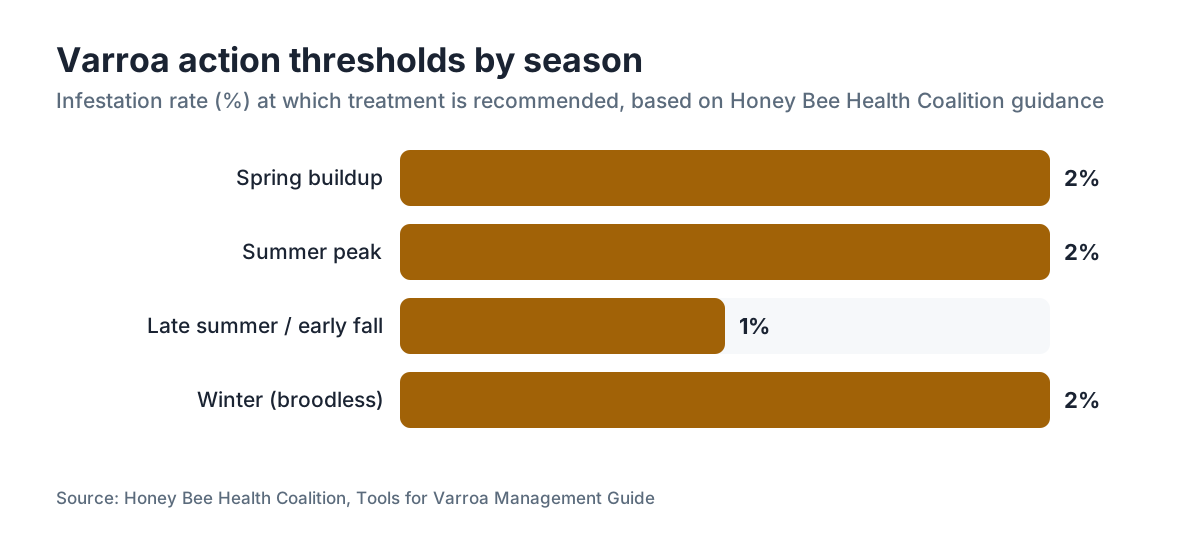
Treat at 2% or higher during the summer brood season. That's the Honey Bee Health Coalition's action threshold: 2 mites per 100 bees [2]. Some beekeepers wait until 3%, but the research basis for waiting is thin, and by the time you read 3% the real population is already higher because a large share of mites sit in capped brood and never reach the wash.
The threshold shifts by season. Through late summer and fall, as the colony builds its winter cluster, many experienced beekeepers drop to 1% or lower. The bees being made now are the ones overwintering, and Varroa-damaged winter bees don't live long enough to carry the colony to spring. The Honey Bee Health Coalition identifies late summer as the highest-risk period for mite-related winter losses [9].
| Season | Common action threshold | Rationale |
|---|---|---|
| Spring buildup | 2% | Brood expansion dilutes mite proportion temporarily |
| Summer peak | 2% | Standard benchmark; colony still has time to recover |
| Late summer / early fall | 1-2% | Winter bees being produced; damage is permanent |
| Winter (broodless) | 2-3% | Mites on adult bees only; counts read higher naturally |
These numbers apply to adult bee samples. They aren't arbitrary. They're set where prompt, effective treatment gives the colony a fair chance of dropping back below 1% before peak mite-reproduction windows.
Every hive gets its own threshold check. A yard-wide average of 1.5% means nothing if one hive sits at 4%.
How do you build a simple mite tracking system for multiple hives?
You don't need software. A printed or digital spreadsheet with the right columns does the job. Track these fields for each hive on each count date:
- Hive ID (number, name, or location)
- Date of count
- Method used (alcohol wash, sticky board, etc.)
- Number of mites counted
- Number of bees in sample
- Infestation percentage (mites / bees x 100)
- Any treatment applied and the date
- Notes (queen status, colony strength, recent splits)
One row per count per hive. That's it. Color-code the percentage column so anything at 2% or higher turns red automatically. Open the file before an inspection and you see at a glance which hives are climbing.
Paper works too. Some beekeepers keep a clipboard notebook with a grid drawn in marker. The discipline that matters: fill it in the same day you count, not two weeks later from memory.
VarroaVault offers free mite tracking tools built for multi-hive logging, including a template that tracks counts against treatment history, so you skip building a system from scratch.
Schedule counts as a recurring event, not something you do only when you suspect trouble. Ties to your normal inspection calendar mean you catch rising loads early, when one treatment fixes things, instead of late, when the colony is already in distress.
How often should you sample each hive?
Once a month minimum during the active season. Every 3 to 4 weeks is the standard from most state extension programs and the Honey Bee Health Coalition [2]. More often is better when you have time, especially in late summer, when a mite population can double in three weeks under good brood conditions.
After any treatment, run a follow-up count 3 to 4 weeks later to confirm it worked. If the post-treatment count doesn't drop below 1%, either the treatment failed (application problem, resistance, bad timing) or re-infestation is already underway. Skip that follow-up count and you're flying blind.
In winter, count once before the colony goes broodless and once more in late winter or early spring before brood buildup starts. Mites live entirely on adult bees during a broodless stretch, so counts read differently than during brood season. A 2% count on a broodless colony doesn't mean the same thing as 2% in July, because there's no brood reservoir hiding extra mites.
For a yard of 10 hives, budget 10 to 15 minutes per colony including setup and cleanup, so roughly 2 hours to monitor the whole yard. Build that into your inspection calendar and it stops feeling optional.
What's the fastest way to sample many hives in one visit?
Speed comes from prep and a fixed routine. Pre-stage everything: labeled mason jars with lids, a bottle of 70% isopropyl alcohol, a mesh screen insert or paint strainer, a white tray, and your logbook. Label each jar with its hive number before you leave the truck.
Move hive to hive in order. Collect your sample from each into the labeled jar, cap it, set it aside. Don't count in the field. Shake all the jars at once after you've sampled every hive, then pour, count, and log while you pack up.
Batching this way cuts total time because you skip full setup and cleanup between each hive. It also lets you count in shade at a table instead of squinting into a white tray in direct sun.
One note: keep bee samples cool and out of the sun while you move between hives. Heat degrades the count. And always sample from the brood nest, never honey supers, where mite concentrations are far lower and readings undercount the real infestation.
Buying supplies for multi-hive sampling? A kit approach with identical gear for each hive saves real time. Check beekeeping supply companies for multi-jar kits and mesh lids built for this workflow.
How do you identify which hive is driving up mite levels across the apiary?
When yard counts jump between rounds and you've treated recently, hunt for the outlier, the hive whose count sits well above the rest. That colony may have had a treatment failure, missed a count cycle, or lost its queen during treatment and raised a replacement unnoticed, which breaks the broodless window that was supposed to make the treatment work.
The USDA Agricultural Research Service Bee Research Laboratory has documented that colonies with high mite loads contribute disproportionately to apiary-wide re-infestation through robbing and drift [4]. Bees from heavily infested colonies carry mites into neighbors, and mites use drifting workers as transport. One missed high-count hive can drag your whole apiary up.
Read your count history to find the culprit. If hive 3 has been at or above 3% for two straight counts while the others sit under 1%, hive 3 is your priority, and probably your source of yard-wide pressure. Treat it immediately and re-count the yard two weeks later.
Sometimes the high hive is also your best honey producer, which breeds real reluctance to hit it hard. That reluctance costs you. A colony carrying 5% mites into August will lose so many winter bees it may not survive to make honey next year.
How do you record and use mite data after you collect it?
Raw counts in a notebook help. Counts plotted over time are where the value lives. Once you have three or four data points per hive, watch the trend more than the current number. A hive at 1.8% that read 0.4% six weeks ago and 1.0% three weeks ago is climbing steeply and needs attention even though it sits below 2%. A hive at 2.1% that read 4.0% three weeks ago is responding to treatment and probably fine.
Graphing counts over time also reveals your yard's seasonal pattern. Most yards in temperate climates show mite loads rising from June through September with a late-summer peak. Knowing your typical pattern lets you anticipate the high-risk window instead of reacting after the fact.
Share data with local beekeepers if you can. Some state bee inspector programs and clubs aggregate counts across apiaries, which can flag a geographic re-infestation event, say a nearby abandoned hive or feral colony acting as a mite reservoir and pushing everyone's counts up within a half mile. Nobody has clean data on how common this is. The closest estimates from extension researchers put the sharp drop-off in re-infestation pressure beyond 300 to 500 meters from an infested source colony [5].
At season's end, review the year before you file it away. Which hives ran low all year? Which needed multiple treatments? That history shapes next spring's decisions, including whether a persistently high-mite colony deserves requeening with more hygienic stock.
What are the biggest mistakes beekeepers make when tracking mite counts?
The most common mistake is counting only when you suspect a problem. By the time a colony looks like it's struggling, mite loads often run above 5% and the damage, especially deformed wing virus, is already done. Scheduled routine counts are the only way to catch the rise before it matters.
The second mistake is inconsistent sampling. Count from honey supers one month and brood frames the next and your numbers can't be compared. Sample from the brood nest, always, and use the same method every time.
Third: too few bees. A 100-bee sample carries so much variance that a zero count doesn't confirm a clean hive. At 300 bees, a zero means something. At 100, you may have gotten lucky. Virginia Cooperative Extension's apiculture program found in a training audit that many hobbyist beekeepers routinely sampled under 150 bees and misread the results as negative [6].
Fourth: skipping hives. It's tempting to pass on the one that's "always been fine." The always-fine hive is exactly the one that surprises you.
Fifth: treating without a follow-up count. Treatments fail more often than labels suggest under real conditions (temperature out of range, incomplete coverage, resistant mites). A post-treatment count is your only proof of success.
Building out your monitoring gear? beekeeping supplies covers the core equipment for alcohol wash work.
How does mite tracking change for sideliner operations with 25-plus hives?
At 25 hives or more, sampling every colony every month turns into a real time commitment. Some operations move to statistical sampling: monitor a representative subset each round and rotate which hives get sampled. This cuts labor but opens blind spots. If you go this route, always include any colony that ran elevated last round and any that got a new queen or a split since the last count.
The Honey Bee Health Coalition acknowledges that 100% monitoring every cycle isn't always practical at larger operations, but insists any sampling strategy still needs action thresholds applied yard-wide when a subset shows elevated counts, because you can't assume the un-sampled hives are clean [2].
Some sideliners run sticky boards for passive monitoring between active rounds. Board counts expressed as mites per day are less precise than alcohol wash, but they catch direction. A board showing 2 mites a day six weeks ago and 30 a day now is telling you something loud even without an exact percentage.
At this scale, a simple database or spreadsheet with sortable columns earns its setup time. You want to sort by last count date, by percentage, and by yard location. Anything that helps you triage fast on a busy day pays off.
VarroaVault's tracking tools scale to multi-yard operations with location tagging and per-hive treatment history, which matters when you're running hives across more than one property and the load of remembering which hive got what treatment when starts to pile up.
What do university extensions and major authorities say about mite monitoring?
The Honey Bee Health Coalition's "Tools for Varroa Management" is the most cited resource on this topic in the US, and it doesn't hedge: "Monitoring is the foundation of Varroa management." The guide recommends a 2% action threshold during the brood season and monthly or more frequent sampling [2].
The University of Minnesota Bee Lab, one of the leading US apiculture research programs, publishes detailed alcohol wash protocols and reports that beekeepers who monitor regularly and keep written records show lower winter loss rates than those who treat on a calendar schedule without counting [3].
Penn State Extension's apiculture program also recommends alcohol wash as the primary tool and documents a 3% threshold as a common alternative among Pennsylvania beekeepers, noting research supports both 2% and 3% depending on time of year and colony condition [7].
The EPA regulates varroa miticides under FIFRA, and product labels carry the force of law. Apivar (amitraz strips), Apiguard and Api-Life VAR (thymol), and Mite Away Quick Strips (formic acid) each have label-specific temperature ranges and application windows that govern when you can even treat [8]. Knowing your count is high only helps if you also know which treatment is label-legal in your current weather. That's another reason to monitor continuously instead of scrambling to count only when you decide to treat, because you might count during a temperature window where your preferred product can't be applied.
The USDA Agricultural Research Service Bee Research Laboratory in Beltsville, Maryland, has published extensively on varroa biology and the population dynamics that make late-summer counts so consequential [4].
Frequently asked questions
How many bees do I need for an accurate mite count?
At least 200 bees, and 300 is better. The University of Minnesota Extension recommends a 300-bee sample (roughly half a cup) for reliable alcohol wash results. Fewer than 200 bees carries enough statistical variance that a zero count doesn't confirm a clean colony, and a low count may reflect sample size rather than the actual mite load.
Can I use sticky boards instead of alcohol wash across all my hives?
Sticky boards are easier but much less accurate. They measure mite fall rate, an indirect proxy affected by colony size, season, and grooming behavior. The Honey Bee Health Coalition rates alcohol wash as the most accurate method. Sticky boards are fine for spotting directional trends between active counts, but they shouldn't be your primary threshold measurement.
What is a normal mite count for a healthy hive?
Below 1% (1 mite per 100 bees) counts as low-risk during summer. Below 2% is the Honey Bee Health Coalition's target threshold. In any area where varroa is established there is no truly zero-mite colony; even well-managed hives carry some load. What matters is the trend and whether counts stay below the action threshold for the current season.
How do I compare mite counts between hives if I sampled different numbers of bees?
Always convert to a percentage: mites counted divided by bees sampled, times 100. That normalizes across different sample sizes. Six mites from 200 bees (3%) is more concerning than 8 mites from 400 bees (2%), even though the raw number is lower. Record both the raw count and the calculated percentage in your log.
How soon after treatment should I recount mites?
Wait 3 to 4 weeks after a completed treatment course before counting. Some treatments like oxalic acid dribble show results faster, but counting too soon can mislead you because mites are still dying. The Honey Bee Health Coalition treats a post-treatment count as a required confirmation step, not optional. If the count hasn't dropped below 1%, investigate your conditions and consider a second treatment or a different product.
Is it worth buying a refractometer or special kit for mite counting?
No special equipment needed. A half-cup mason jar with a mesh lid or a paint strainer bag, a bottle of 70% isopropyl alcohol, and a white tray are enough. Several extension programs describe DIY kits for under $10 in materials. Purpose-made varroa wash kits from beekeeping supply companies are convenient but not functionally better than the DIY setup.
Can I track mite counts using a phone app?
Yes, several apps exist for logging counts, and a plain spreadsheet works just as well. The format matters less than the habit. Whatever you'll actually open and fill in on count day is the right tool. Log hive ID, date, method, mite count, bee count, percentage, and treatment history. Paper notebooks with a consistent layout work equally well and never need charging at the hive.
Do mite counts from one hive predict what neighboring hives have?
Loosely, but not reliably. Research shows mite loads within one apiary can vary by a factor of ten between neighboring colonies. One high-mite hive can re-infest nearby hives through robbing and drift, so a high count in one is a signal to count them all promptly. You cannot skip individual counts based on what nearby hives showed.
Should I count mites in winter when there's no brood?
Yes, but read the results differently. A broodless colony carries all its mites on adult bees, so counts run higher than during brood season at the same actual population level, because no capped cells are hiding mites. A late-winter count before spring buildup helps you set a baseline and decide whether to treat before the first brood cycle.
What's the difference between mite infestation rate and mite fall count?
Infestation rate is a percentage: mites per 100 bees from an alcohol wash or sugar roll. It measures the bee-to-mite ratio directly. Mite fall count is the number of mites dropping onto a sticky board over 24 to 72 hours. Infestation rate is more accurate and maps directly to published thresholds. Mite fall spots trends but can't be translated cleanly into a threshold percentage without calibration.
How do I know if mites are re-infesting my hives from outside my apiary?
Hard to confirm without genetic testing of mite populations, which isn't practical for most beekeepers. The indicators: counts that climb back to pre-treatment levels within 4 to 6 weeks of a verified effective treatment, especially during late-summer robbing season. Your count records show the timing. Coordinating monitoring and treatment with neighboring beekeepers within half a mile cuts the pressure a lot.
How do I prioritize which hive to treat first when multiple are above threshold?
Treat the highest-count hive first, but plan to treat every above-threshold hive within the same short window, ideally within a week. The highest-count hive produces the most mites and poses the biggest re-infestation risk. Treat one and wait on the rest, and drifting bees from the untreated colonies can restock the treated hive within weeks. Synchronized treatment beats sequential treatment.
Sources
- PLOS ONE, Seeley & Smith 2015, "Crowding honeybee colonies in apiaries can increase their vulnerability to the deadly ectoparasite Varroa destructor": Mite loads within the same apiary can differ by a factor of ten or more between colonies in the same week
- Honey Bee Health Coalition, Tools for Varroa Management Guide: 2% infestation rate is the action threshold during summer; monthly monitoring recommended; monitoring is the foundation of Varroa management
- University of Minnesota Extension, Bee Lab, Varroa monitoring protocols: 200-300 bees minimum sample size for reliable alcohol wash results
- USDA Agricultural Research Service Bee Research Laboratory, Beltsville MD: Colonies with high mite loads disproportionately contribute to apiary-wide re-infestation through robbing and drift
- University of Maryland Extension, Varroa mite management resources: Re-infestation pressure from a source colony drops sharply beyond 300-500 meters
- Virginia Cooperative Extension, Apiculture Program, Varroa monitoring training audit findings: Many hobbyist beekeepers routinely sampled fewer than 150 bees and misread results as negative
- Penn State Extension, Apiculture Program, Varroa management guidelines: 3% threshold common among Pennsylvania beekeepers; research supports both 2% and 3% depending on time of year
- US EPA, FIFRA pesticide labels: Apivar, Apiguard, Api-Life VAR, Mite Away Quick Strips: Varroa miticide products regulated under FIFRA have label-specific temperature ranges and application windows that are legal requirements
- Honey Bee Health Coalition, Tools for Varroa Management Guide, late summer risk section: Late summer is the highest-risk period for mite-related winter losses because winter bees are being produced
- North Carolina State University Apiculture Program, Varroa sampling methods comparison: Sugar roll consistently undercounts mite loads compared to alcohol wash in published comparisons
Last updated 2026-07-09