How to use screened bottom boards for varroa monitoring
TL;DR
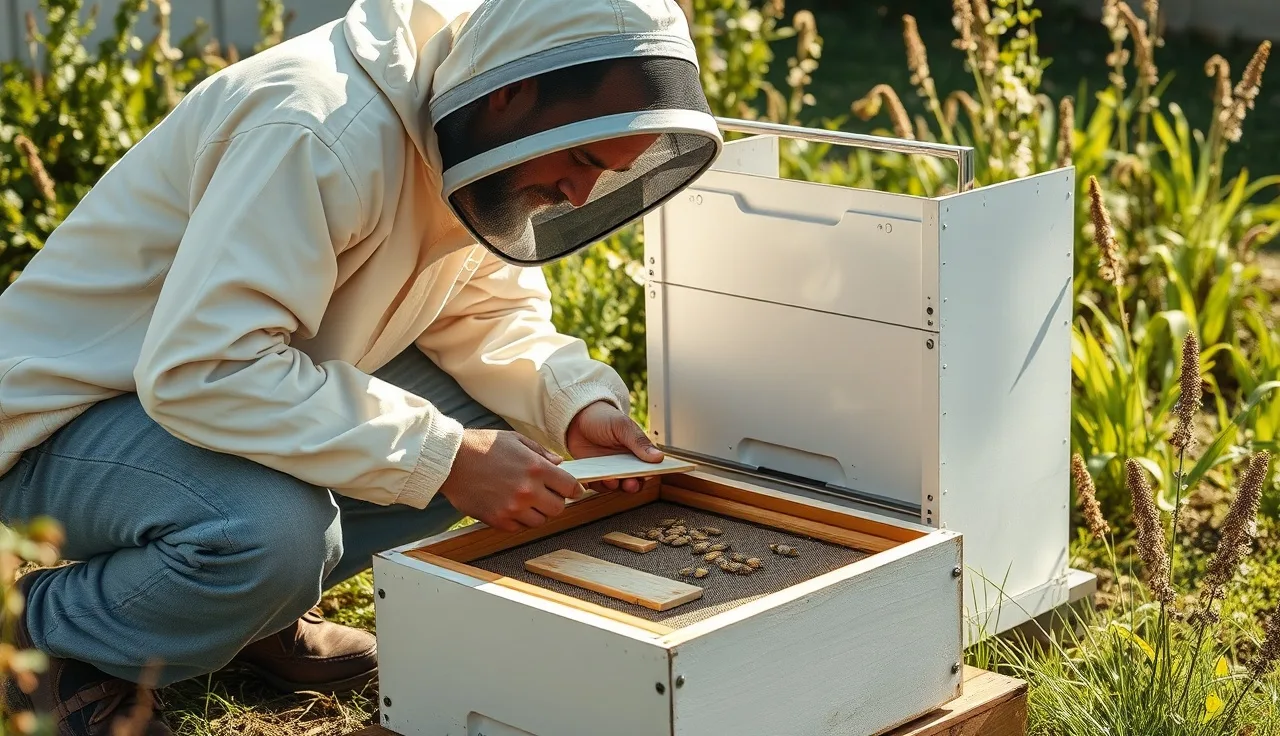
- A screened bottom board lets you count mites that fall from the colony onto a sticky tray below the mesh.
- Insert a coated white tray for 24, 48, or 72 hours, count the mites, divide by days, and compare that daily drop to seasonal action thresholds.
- Treat it as a trigger for an alcohol wash, not a stand-in for one.
What is a screened bottom board and how does it work?
A screened bottom board swaps the solid floor of a Langstroth (or similar) hive for a wire mesh screen, usually 8-mesh hardware cloth with roughly 3mm openings. Mites that drop off bees or comb fall through the screen and land on a removable tray. The screen sits between the colony and the tray, so fallen mites can't climb back up and house bees can't clean them away.
The number you pull off that tray is the "natural mite drop," also called a sticky board count. It reflects mites that fell on their own, not mites you knocked loose by washing or rolling. That difference shapes everything about how you read the result.
Screened boards got popular in the late 1990s and early 2000s partly because researchers hoped the open floor would drop mites out of the colony fast enough to matter. It mostly didn't. A 2001 study in Apidologie found screened boards cut mite populations by only about 9 to 14 percent versus solid boards, which won't manage an infestation on its own. [1] The boards still earn their keep as a passive monitor and for ventilation in hot weather.
The tray gets a coat of petroleum jelly, vegetable shortening, or a commercial sticky substance so mites stay put until you count. White or light-colored trays make them easier to spot.
How do you set up a screened bottom board correctly?
The setup is simple, but a few details trip people up.
Start by coating your monitoring tray (sometimes called an IPM board or insert board) in a thin, even layer of petroleum jelly or white vegetable shortening. Too thick and debris clumps over the mites. Too thin and mites walk off before you count. A foam brush or a credit-card squeegee spreads it clean. Some beekeepers spray a diluted dish-soap solution instead, though petroleum jelly holds mites more reliably.
Slide the tray into the channel under the screen so it covers the full footprint of the box above. Seat it flat. A gap on one side lets mites roll off the edge, and you undercount.
Write down the date and time you inserted the tray. You need the exact hours to calculate a daily drop rate. Most beekeepers leave the tray in for 24, 48, or 72 hours. Longer windows average out daily swings but pile up debris, which slows counting. I run 48 hours in spring and fall when colonies are medium-strength, and 24 hours in summer when mite numbers move fast and I want frequent snapshots.
Keep a log card taped to the hive or use a notebook. Colony ID, insertion date and time, removal date and time. That's the whole record. Past two or three hives, a tracking sheet or an app saves you from mixing up trays.
One more thing. Pull the tray when you aren't actively monitoring. A tray left in permanently turns into a moisture trap and a small hive beetle nursery in wet climates.
How long should you leave the sticky board in?
Leave it in 24 to 72 hours. Most university extension programs and the Honey Bee Health Coalition point to 72 hours as a baseline because it smooths out day-to-day swings. [2] Mite drop isn't steady. It rises and falls with brood nest temperature, bee activity, time of day, and how many brood cells are getting uncapped.
For a fast field check, 24 hours is plenty. For a steadier population read, 72 hours wins. The math never changes: total mites counted divided by the number of days the tray was in.
Here's the catch. If you pull the tray after 72 hours in August and it's buried under pollen, wax flakes, and dead bees, the count got harder, not more reliable. In heavy debris seasons I take three back-to-back 24-hour counts and average them.
Don't monitor during or right after a treatment. Oxalic acid, formic acid, and amitraz all knock mites off bees, so your drop count spikes for reasons that have nothing to do with baseline pressure. Wait at least two weeks after treatment before you trust sticky board data as a population read.
How do you count the mites on the sticky board?
Pull the tray slowly so it doesn't tip, and bring it into good light. A loupe or a 10x hand lens helps, though you won't need it once you've seen a few hundred mites.
Varroa destructor mites are reddish-brown, oval, and flat. They look like tiny crabs. An adult female runs about 1.1 mm long and 1.6 mm wide, big enough to see with the naked eye but easy to lose against pollen or propolis. [3]
The cleanest method: mark a grid on the underside of the tray before you coat it, then count each section and add them up. A 5x5 grid gives you 25 sections on a standard Langstroth tray. A sheet of clear acetate ruled in squares works too, laid right over the tray.
When debris is heavy, some beekeepers pour the tray contents through a coarse sieve (around 4mm) to lose the big chunks, then spread what's left on a white sheet. You miss a few mites this way, but it beats squinting through a wax pile.
Record your raw count and your duration. Then: mites per day equals total mites divided by number of days. That daily number is what you hold up against the thresholds.
What do the mite drop numbers actually mean?
This is where beekeepers get burned. Natural mite drop tracks with total mite load, but not tightly enough to stand alone as your main assessment.
The Honey Bee Health Coalition's Varroa Management Guide states that a daily drop of 2 or fewer mites generally points to a low infestation, while 8 or more per day in summer means the colony is at or above the economic threshold. [2] Those numbers assume a full-sized colony with normal brood. A small colony with little brood drops fewer mites even when the infestation rate (mites per 100 bees) is dangerously high.
The correlation between natural drop and true infestation shifts with season, colony size, and brood volume. A 2002 paper in the Journal of Economic Entomology found the correlation between sticky-board counts and alcohol-wash results ran from 0.5 to 0.7 depending on season, meaning sticky boards explain somewhere around 25 to 50 percent of the variance in real mite loads. [4] Useful. Also full of blind spots.
So use the sticky board count as a trigger, not a verdict. Seeing 5 or more mites per day? Run an alcohol wash or sugar roll to get an infestation rate as a percentage. That percentage is what you weigh against the treatment threshold of roughly 2 percent (2 mites per 100 bees) that most extension programs use. [5]
What are the action thresholds for natural mite drop?
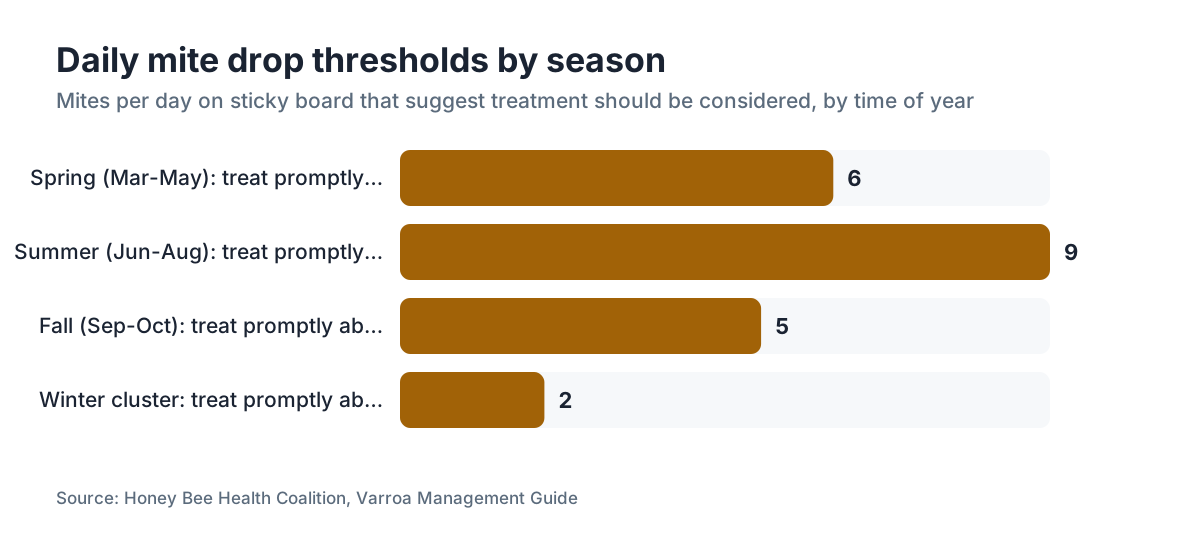
Thresholds move with the season and with whichever authority you follow, and there's no single agreed-on number. The table below pulls the most commonly cited guidelines from U.S. extension programs and the Honey Bee Health Coalition.
| Season | Daily mite drop (low concern) | Daily mite drop (consider action) | Daily mite drop (treat promptly) |
|---|---|---|---|
| Spring (Mar-May) | 0-1 | 2-5 | 6+ |
| Summer (Jun-Aug) | 0-2 | 3-8 | 9+ |
| Fall (Sep-Oct) | 0-1 | 2-4 | 5+ |
| Winter cluster | 0-1 | N/A | 2+ |
Fall is the window that decides winter. Colonies going into winter above 2 percent (roughly a daily drop of 5 or more in many colonies) face real odds of collapse by January or February. The Honey Bee Health Coalition flags August through October as the stretch when mite management does the most for winter survival. [2]
Let me be blunt. These thresholds are guidelines, not laws of physics. A colony showing 4 mites per day in September with a strong laying queen sits in a different place than a late split showing 4 per day with a patchy brood pattern. Numbers give you context. Your eyes on the bees do the rest.
How accurate is a screened bottom board compared to an alcohol wash?
The alcohol wash (or oxalic-acid wash) is the gold standard for varroa monitoring, full stop. You take about 300 bees (roughly half a cup), wash them in alcohol, filter the liquid, and count mites. The result is mites per 100 bees, a direct infestation rate. [5]
A sticky board can't give you an infestation rate. It gives you a count of mites that happened to fall during your window. The ratio of phoretic (on-bee) mites to reproductive (in-cell) mites shifts constantly with the brood cycle, and drop rates swing with temperature and colony behavior, so the sticky board number carries more noise than a wash.
Sticky boards still have real strengths. They're passive. They kill no bees. They work when you don't have time to crack the hive open. And they show you trend over time if you monitor on a schedule.
Run both. Do sticky board checks every two to four weeks as routine. When the count climbs or crosses a trigger, confirm with an alcohol wash before you commit to treatment. North Carolina State University Extension lays out this two-step approach for that exact reason. [9]
For the full range of monitoring methods and where to source them, the varroa mite and beekeeping supplies pages here break things down by method and supplier.
Does a screened bottom board reduce varroa on its own?
No. Not by enough to matter.
The pitch for screened boards as control was that mites falling off bees would drop through the mesh and die below instead of getting groomed back onto a bee. Sound theory. Weak result. That 2001 Apidologie study found only a 9 to 14 percent reduction in mite levels, far under any treatment-level impact. [1]
You still need a real treatment: oxalic acid, formic acid, amitraz, or another EPA-registered product applied correctly. [8] The screened board helps you know when to treat and whether the treatment landed. It treats nothing.
There is one side benefit. In warm climates and hot summers, screened bottom boards move more air through the hive, which cuts heat stress and lets bees fan less and forage more. That's worth having. Just not as a varroa strategy.
When should you monitor with a sticky board during the year?
The Honey Bee Health Coalition recommends checking mite levels at least once a month during the active season, plus before and after every treatment. [10] Sticky boards slot into a monthly rhythm cleanly. Insert a tray at the start of the month, pull it 72 hours later, log the count, and forget it for three weeks.
Here's how I space it out.
Early spring (March, before the first big flow) sets your post-winter baseline. A colony that survived but carries a high mite load into spring will crash before summer. Catch it now.
Late spring into early summer (May through June), once a month, tracks the curve as brood expands. Mite populations grow roughly 25 to 30 percent per month while queens are laying hard. [6]
Midsummer (July through August) needs the tightest checks, especially in areas with a summer dearth when colonies rob each other and mites hitchhike between hives.
Early fall (September) is the most important monitoring window of the year. The bees you're raising now are the winter bees. Mite-damaged winter bees don't make it. A high September count means treat now, not later.
After any treatment, drop a board in about two weeks post-application to see what's still moving. Counts falling from 15 a day to 1 a day mean it worked. Fifteen down to 10 probably didn't.
What can affect your sticky board count besides mites?
Several things push your count around without any real change in infestation, and knowing them keeps you from chasing noise.
Brood cycle phase matters most. Mites reproduce in capped brood, and when a fresh generation emerges with young bees, the phoretic load jumps for a day or two. You might catch a big drop spike right after a major emergence. Those are real mites, but not a worsening trend.
Temperature drives bee movement. On cold days with a tight cluster, fewer mites fall. On warm active days full of moving, grooming bees, drop climbs. A 72-hour window that catches a cold front undercounts against a warm stable one.
Hive beetle larvae shred mites and muddy the count. Ants haul mites off the tray. In high humidity, mites sometimes curl or break down in ways that make ID harder.
Debris hides mites, plain and simple. In late summer when propolis is heavy, or in spring when pollen pours in, trays fill fast. More than about 5 to 6 mm of debris on the tray and your count is probably low.
None of this makes sticky boards useless. It means you read the trend across several checks instead of reacting to one reading.
How do you monitor mites in a hive without a screened bottom board?
With a solid bottom board, you can still get a rough natural drop by laying a sticky card right on the floor and cracking the entrance just wide enough for traffic. It's messier and less precise because bees reach the tray and shuffle mites around, but in a pinch it tells you something.
The better answer is an alcohol wash or a sugar roll. Neither needs any hive modification, and both give you the true infestation rate as a percentage. An alcohol wash of a 300-bee sample takes about 10 minutes per hive and is accurate enough that most extension programs standardized on it. [5]
For building a monitoring calendar across several hives, VarroaVault's free protocol tools let you set a schedule with threshold reminders.
The point holds: no screened bottom board is no excuse to skip monitoring. Varroa builds to collapse levels in an untreated colony within one to three years, and you often won't see obvious symptoms until it's too late. [6]
Is a screened bottom board worth buying if you don't already have one?
New beekeeper starting from scratch? Buy screened bottom boards. They're standard equipment now, most kits include them, and the premium over solid boards is small (usually $5 to $15 more per board from most suppliers). You lose nothing and gain a passive monitoring floor.
With existing hives on solid boards, the math changes. Retrofitting costs money and a full inspection to move the boxes over. Whether it pays off depends on how many hives you run and how much you lean on sticky-board monitoring versus washes.
If you're already doing monthly alcohol washes, you're pulling better data than any sticky board offers, and you don't need to retrofit a thing. The sticky board earns its spot inside a program that mixes passive and active checks, not as a replacement for the wash.
For sourcing, the beekeeping supply companies page lists vetted suppliers with current pricing, which beats any specific number I'd quote here.
Check one spec before you buy: the tray channel should hold 1 to 2 cm of clearance below the screen. Some budget boards leave almost none, and bees reach through the mesh to groom mites off the tray, which defeats the whole design.
Frequently asked questions
How many mites per day on a sticky board is too many?
A daily drop of 2 or fewer is generally low. In summer, 9 or more per day puts you at or above treatment threshold. In fall, even 5 or more per day calls for immediate action because the bees being raised now will overwinter. These are general guidelines from the Honey Bee Health Coalition, not hard cutoffs. Confirm with an alcohol wash before you treat.
Can you leave the sticky board in the hive permanently?
You shouldn't. A tray left in permanently traps moisture under the screen, invites mold, and gives small hive beetles a sheltered place to breed. Insert the tray only during active monitoring windows of 24 to 72 hours, then pull it. Many beekeepers store the clean tray under the stand between sessions so it's always within reach.
Do screened bottom boards help control varroa without treatment?
No, not to any useful degree. Research published in Apidologie in 2001 found screened bottom boards cut mite populations by only about 9 to 14 percent versus solid boards. That's far below what it takes to stop a growing infestation. Screened boards are monitoring tools. Control requires an EPA-registered treatment such as oxalic acid, formic acid, or amitraz.
What is the best time of year to use a screened bottom board for monitoring?
September is the most important stretch. The bees reared in late summer become winter bees, and mite-damaged winter bees don't survive. Monthly monitoring from April through October is the standard recommendation from most university extension programs. Insert a board two weeks after any treatment to check whether it worked.
How do you tell mites from debris on a sticky board?
Varroa destructor mites are reddish-brown, oval, and flat, about 1.1 mm long and 1.6 mm wide. They look like tiny crabs. Use a 10x hand lens in good light and compare against a reference photo. Pollen grains are spherical. Wax particles are irregular white or yellow flakes. Mites show eight legs and a shield shape once you've seen a few.
Should you coat the sticky board with petroleum jelly or something else?
Petroleum jelly (Vaseline) is the common pick and holds mites reliably. White vegetable shortening works too and spreads a little easier. Some people use a diluted dish-soap solution or a commercial sticky coating. Skip anything with a strong scent that might shift bee behavior. The goal is only to stop mites from moving once they land.
How do you count mites on a very dirty sticky board?
Draw a grid on the underside of the tray before coating it, then count section by section. If debris is very heavy, pour the tray contents through a coarse sieve (around 4mm mesh) to drop the large wax and bee parts, then spread the rest on a white surface under a light. You'll miss a few mites, but it beats counting through a thick layer of gunk.
Is the sticky board count more accurate in summer or winter?
Neither is highly accurate, but winter adds a wrinkle: a tight cluster barely moves, so mite drop falls even when infestation runs high. Summer counts track total mite load a bit better, though brood emergence events can throw short-term spikes. In both cases, use the sticky board as a screening tool, not a precise measurement.
How does screened bottom board monitoring compare to a sugar roll?
A sugar roll gives you mites per 100 bees, a direct infestation rate. A sticky board gives you mites per day, an indirect proxy. Sugar rolls and alcohol washes are more accurate and are what extension programs base treatment decisions on. Sticky boards work well for passive, ongoing trend monitoring between those sharper checks. Use both together when you can.
Can varroa mites climb back up through the screened bottom board?
Mites that fall through the screen can't climb back through the 3mm mesh to reach the colony. That's the whole point of the design. If a mite falls near the entrance before it reaches the tray, or lands on debris bridging the screen, it could theoretically get picked up by a bee coming home. In practice, mites that make it through the screen are gone from the colony.
How often should you monitor with a sticky board?
Monthly during the active season (April through October) is the baseline from the Honey Bee Health Coalition. More frequent checks every two weeks pay off during a summer dearth, when mite populations grow fastest and robbing can pull mites in from collapsing colonies nearby. Always run a post-treatment check two weeks after applying any varroa treatment.
What mesh size does a screened bottom board need to work for varroa monitoring?
The standard is 8-mesh hardware cloth, with openings around 3.2 mm. That's wide enough for mites to fall through freely but tight enough that bees can't pass and most debris stays on top. Some boards use slightly finer mesh. The key spec: openings must be larger than a mite (about 1.1 mm) and smaller than a bee.
Does using a screened bottom board affect winter cluster survival?
The evidence is mixed. Some beekeepers close the tray insert over winter to cut drafts through the colony, especially in cold climates. Others leave it open, figuring moisture escaping downward through the screen reduces condensation. Most extension programs suggest closing the insert below about 5 degrees Celsius (40 degrees Fahrenheit) if the hive sits exposed without a windbreak.
Do you need a screened bottom board to monitor varroa at all?
No. An alcohol wash or oxalic acid wash is more accurate than a sticky board count and works on any hive regardless of bottom board type. Screened bottom boards are handy for passive monitoring but not required. If you run solid bottom boards, put your effort into monthly alcohol washes instead of spending money to retrofit your equipment.
Sources
- Apidologie (peer-reviewed journal of bee research): screened bottom board efficacy studies, circa 2001: Screened bottom boards reduced mite populations by only about 9 to 14 percent compared to solid boards
- Honey Bee Health Coalition, Varroa Management Guide: Daily mite drop thresholds by season; August through October identified as highest-impact treatment window for winter survival
- USDA Agricultural Research Service, Varroa destructor biology and identification: Adult female Varroa destructor is approximately 1.1 mm long and 1.6 mm wide
- Journal of Economic Entomology (Oxford Academic): sticky board vs. alcohol wash correlation study, 2002: Correlation between sticky-board counts and alcohol-wash infestation rates ranged from 0.5 to 0.7 depending on season
- Penn State Extension, Varroa Mite Monitoring and Treatment: Alcohol wash of approximately 300 bees is the recommended primary monitoring method; 2 percent infestation rate is the general treatment threshold
- Oregon State University Extension, managing Varroa mites in honey bee colonies: Varroa populations grow roughly 25 to 30 percent per month in a laying colony; untreated colonies typically collapse within one to three years
- University of Minnesota Bee Lab, Varroa monitoring methods: Screened bottom boards as standard monitoring equipment; guidance on tray insertion duration of 24 to 72 hours
- U.S. Environmental Protection Agency, registered pesticide products for varroa control: Oxalic acid, formic acid, and amitraz are EPA-registered active ingredients for varroa treatment in honey bee colonies
- North Carolina State University Extension, Apiculture: monitoring Varroa: Two-step monitoring approach: sticky board screening followed by alcohol wash to confirm before treatment decision
- Honey Bee Health Coalition, Tools for Varroa Management (sampling instructions): Recommends monitoring mite levels at least monthly during active season and before and after every treatment
Last updated 2026-07-09