How to vaporize oxalic acid safely in winter
TL;DR
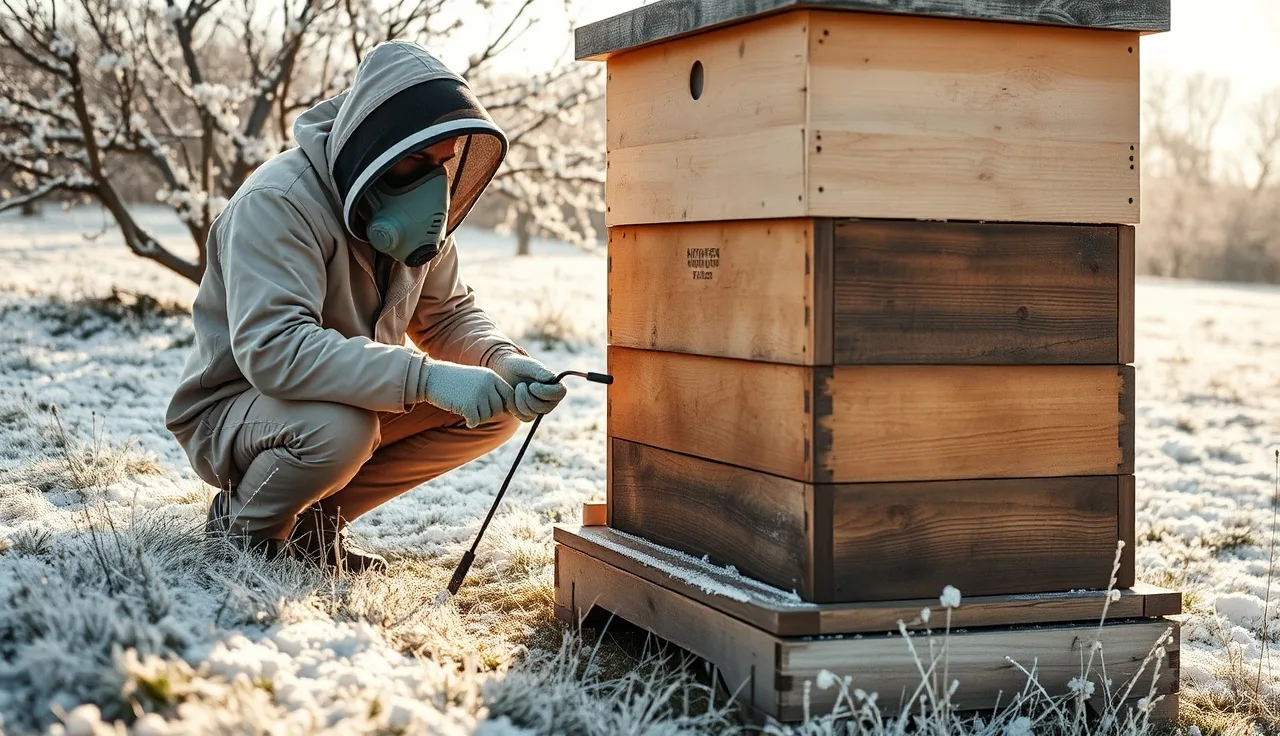
- In winter, vaporize 1 gram of oxalic acid dihydrate per broodless colony using an EPA-registered vaporizer and Api-Bioxal.
- Seal the entrance, stay upwind, and wear a half-face respirator with OV/P100 cartridges plus acid-resistant gloves.
- A broodless cluster in cold weather makes one treatment do the work of five, knocking mite loads down 90 percent or more.
Why is winter the best time to vaporize oxalic acid?
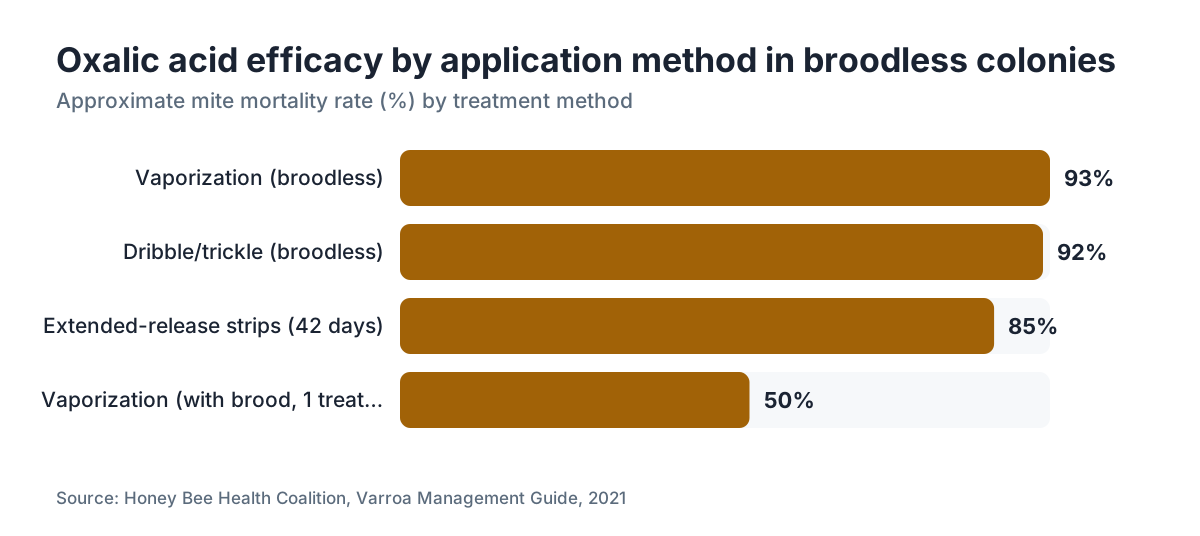
Winter is the sweet spot for oxalic acid vaporization, and the reason is brood. Varroa mites are most exposed when they have nowhere to hide. During a broodless stretch, every mite in the colony is phoretic, riding on adult bees instead of tucked inside capped cells where the vapor can't reach. One treatment during a solid broodless window can hit 90 to 95 percent mite mortality, according to research summarized by the Honey Bee Health Coalition [1].
Most temperate colonies go broodless from late November through January, though the window shifts with region, weather, and queen age. A Minnesota colony is likely broodless by Thanksgiving. A Georgia colony might not stop rearing brood until late December, if at all. Read your bees, not the calendar.
The other reason winter works is how the colony is packed. Bees cluster tight, usually in a single deep or two boxes, so the vapor spreads efficiently through the space where the bees actually are. You're not chasing them through four supers.
Then there's honey. The label for Api-Bioxal (the only oxalic acid product registered for hive use in the U.S.) prohibits application when honey supers are on the hive [2]. In winter the supers are off. One compliance headache gone.
What equipment do you need for oxalic acid vaporization?
You need three things: the vaporizer, the registered product, and personal protective equipment.
The vaporizer. Only EPA-registered vaporizers are legal in the U.S. The ProVap 110 and pan-style units sold by the major supply houses are among the common ones [3]. Homemade vaporizers carry real safety risks. Budget units that scorch the powder instead of subliming it cleanly can throw off decomposition products more harmful than the oxalic acid itself. Pay for consistent temperature control. A decent unit runs $150 to $300. That stings up front, but it pays for itself fast if you're treating more than a handful of hives.
The oxalic acid product. In the U.S., Api-Bioxal by Veto-pharma is the only EPA-registered oxalic acid product for honey bee colonies [2]. It comes as a dihydrate powder dosed at 1 gram per colony for vaporization. Do not use oxalic acid from a hardware store or pool supply. That material isn't pharmaceutical grade, isn't registered for this use, and putting it in a hive is a federal label violation.
PPE. This is where people cut corners, and it's a genuinely bad idea. Oxalic acid vapor is corrosive to your eyes, airway, and mucous membranes. The Api-Bioxal label requires [2]:
- A NIOSH-approved half-face respirator with combination organic vapor and P100 particulate cartridges
- Chemical-resistant gloves (nitrile is the floor; butyl rubber is better)
- Chemical splash goggles
- Long sleeves and closed-toe shoes
A dust mask is not a respirator. An N95 has no organic vapor cartridge, so it does nothing for the vapor phase. Get the right gear. MSA, 3M, and Honeywell all make half-face respirators in the $35 to $65 range, and cartridges run another $15 to $25 a pair.
You'll also want duct tape or an entrance reducer to seal the hive during and after treatment, plus a timer. Most protocols keep the hive sealed for at least 10 minutes after the cycle finishes, and some beekeepers go to 20. Check the current Api-Bioxal label for the exact wording, because EPA can revise it.
To track treatments across multiple hives, tools like those at VarroaVault let you log treatment dates and mite wash results in one place, so you know when to retreat.
What is the correct oxalic acid dose for winter vaporization?
The registered dose for Api-Bioxal vaporization is 1 gram of oxalic acid dihydrate per colony [2]. Per colony. Not per box, not per frame. One gram.
More is not better here. Higher doses don't kill meaningfully more mites, and they stress the bees. The 1-gram dose is what the efficacy studies submitted to EPA tested. Stick to it.
For a two-story colony or a nuc, the dose is still 1 gram. You're treating the colony, not the cubic volume. The vapor spreads where the bees are, and the bees themselves carry it through the cluster as they move.
Split a strong colony across a lower and upper deep with a solid board between them, and you may need to treat each chamber. This is rare in winter because bees cluster together, but if you left a top box on for insulation with bees still in it, treat each occupied space.
Weigh your doses. Don't eyeball it. A small digital scale that reads to 0.1 grams costs about $10 to $15 and removes the guesswork. Some Api-Bioxal packages come pre-measured, but confirm the dose before you load the cup.
How do you actually vaporize oxalic acid step by step?
Here's the full run, start to finish.
Before you leave for the apiary. Check the forecast. You want temperatures above about 0 degrees C (32 F), ideally between 5 and 10 degrees C (41 to 50 F). Bees should be clustered but not locked down by deep cold. Hard freezes make sealing harder and can leave vapor distribution uneven. Wind is your enemy for personal safety, so pick a calm morning.
Step 1: Gear up before you open anything. Respirator, goggles, and gloves go on before you touch the Api-Bioxal. The powder itself is irritating. Don't load the vaporizer inside a car with the windows up.
Step 2: Load the vaporizer. Measure 1 gram of powder on your scale and drop it into the vaporizer's cup or pan. Do this outside, respirator on.
Step 3: Seal the hive entrance. Reduce the entrance to closed or nearly closed with a foam plug, cloth, or the entrance reducer your hive came with. You want to trap the vapor so it has time to work through the cluster. Leave just enough gap for the vaporizer wand.
Step 4: Insert the vaporizer. Slide the wand through the entrance so the cup sits inside the hive. Some beekeepers insert it from the back through an open screened bottom board, which works fine. The goal is to get the vapor point inside the cavity.
Step 5: Power it and watch the clock. Connect to the power source (most run 12V DC off a car battery or lithium pack). The heating cycle usually takes 2 to 3 minutes to finish sublimation, but check your unit's instructions. Stay upwind the whole time. Do not stand in front of the entrance.
Step 6: Seal fully and wait. When the cycle ends, seal the entrance completely and leave the bees alone for 10 to 20 minutes. Longer contact means more mites exposed.
Step 7: Unseal and move on. Pull the plug, clean the cup, reload, and go to the next hive. Let the unit cool before reloading if it needs it.
After treatment. Log the date, ambient temperature, colony ID, and estimated mite load. Do a mite wash or sticky board count 3 to 5 days later to check efficacy. If loads are still high in a confirmed broodless colony, a second treatment 7 days later is within the label's allowed frequency. The current Api-Bioxal label permits up to three applications per treatment period [2].
What PPE is required and why does it actually matter?
Oxalic acid vapor is a corrosive acid in aerosol form, and it is not something to casually breathe. Heavy or repeated exposure can damage lung tissue. OSHA sets the permissible exposure limit for oxalic acid at 1 mg/m3 as an 8-hour time-weighted average [4]. Lean over a running vaporizer and the concentration right at the source can blow past that easily.
The required PPE from the Api-Bioxal label [2]:
| PPE item | Minimum spec | What it protects |
|---|---|---|
| Respirator | Half-face, NIOSH-approved, OV/P100 cartridges | Lungs and airway |
| Eye protection | Chemical splash goggles | Corneal damage |
| Gloves | Chemical-resistant (nitrile, neoprene, or butyl) | Skin contact |
| Clothing | Long-sleeve shirt, long pants | Skin contact |
| Footwear | Closed-toe shoes or boots | Foot protection |
The organic vapor cartridge matters because oxalic acid vapor has both particulate and vapor-phase parts. An N95 or dust mask catches particles and lets the vapor straight through. You need the combination cartridge.
Wear glasses instead of contacts on treatment days. Acid vapor and contact lenses are a bad match, even behind goggles.
Wash your hands and any exposed skin before eating or touching your face. Residue on skin isn't an emergency, but chronic contact is unpleasant and pointless.
Should a partner be there? Yes, especially your first few rounds. Not because the job is hard, but because if something goes sideways (an arced power connection, spilled powder, a slip near a hot vaporizer) it helps to have another set of hands.
What temperature is too cold (or too warm) to vaporize?
There's no hard lower limit on the Api-Bioxal label, but in practice treatment gets less reliable below about 0 degrees C (32 F). In deep cold, bees cluster so tightly that vapor can't work evenly through the ball. Extension guidance suggests treating when ambient temperatures are at least 3 to 5 degrees C (37 to 41 F) [5].
The warm end matters less for efficacy. If it's warm enough for bees to fly (above about 10 degrees C or 50 F), they may not be clustered, which actually improves contact with phoretic mites because the bees are spread out and moving. Mild winter days treat fine.
The thing to avoid is treating during a windy freeze, standing outside in dangerous cold, fumbling a vaporizer through thick gloves. Cold-weather treatment is a safety hazard for you as much as anything. Pick a calm, dry day in the 5 to 15 degrees C range when you can.
In very cold climates (northern Minnesota, Wisconsin, or the Canadian prairies), late October to early November is often the ideal window: colonies are likely broodless, temperatures are workable, and you still have daylight. Don't wait until January to treat at minus 15.
How many treatments do you need in a broodless colony?
For a truly broodless colony, one treatment often clears 90 percent or more of the mites [1]. The Honey Bee Health Coalition's Varroa management guide, drawing on multiple efficacy studies, reports single-treatment efficacy in broodless colonies at that level. It's the best single-shot efficacy of any approved method.
The Api-Bioxal label allows up to three applications per treatment period, no more than once per week [2]. Do one treatment on a confirmed broodless colony, then a mite wash 3 to 5 days later to check. If the count is still up, a second treatment a week out makes sense.
The trap is treating a colony you assume is broodless but isn't. Even a small patch of capped brood shelters a big share of the mites, fully protected from the vapor. You'll see an initial drop, then a rebound as emerging bees carry mites out of the cells. If your post-treatment count stays stubbornly high, open the box and look for brood before retreating.
Colonies that aren't broodless can still get some benefit, but you need repeats spaced to catch mites as they emerge. The standard protocol for colonies with brood is a treatment every 5 days for three to five rounds [6]. More work, more product, less punch than a single winter shot. That's exactly why the timing argument for winter is so strong.
Is vaporizing oxalic acid legal and what does the EPA label say?
In the United States, oxalic acid in honey bee colonies is legal only with the EPA-registered product Api-Bioxal, used exactly as the label directs. EPA registered Api-Bioxal (Registration No. 86150-1) in 2015 [2]. The Federal Insecticide, Fungicide, and Rodenticide Act (FIFRA) makes it a federal offense to use a pesticide in a manner inconsistent with its labeling.
The label requirements for vaporization:
- Use only EPA-registered vaporizers (named on the label or in the registrant's supplemental materials)
- Dose: 1 gram oxalic acid dihydrate per colony
- No application when honey supers intended for human consumption are on the hive
- Apply only to managed honey bee colonies
- Maximum three applications per treatment period, no more than one per week
The label is the law. Download the current version from EPA's Pesticide Product Label System or from the manufacturer before each treatment season, because labels get amended [3].
Canada runs its own registration. Health Canada's Pest Management Regulatory Agency (PMRA) has registered oxalic acid products for bee use, and Canadian beekeepers should check PMRA for current products and labels.
In the EU, oxalic acid for varroa has been approved since 2003 under various national authorizations, and the European Medicines Agency has issued guidance. EU beekeepers should consult their national veterinary authorities for currently registered products.
Do you need a pesticide applicator license to use Api-Bioxal? In most U.S. states, no, because it's a general-use pesticide. State rules vary, so check with your state department of agriculture [7].
What can go wrong and how do you handle it?
Oxalic acid exposure. Inhale a real dose of vapor and you move to fresh air immediately. Take the respirator off. If coughing, throat burning, or trouble breathing lasts more than a few minutes, call Poison Control at 1-800-222-1222 in the U.S. Flush eye splashes from powder with water for 15 to 20 minutes.
Vaporizer malfunctions. A unit that shorts, sparks, or heats unevenly is a fire and exposure risk. Don't run a damaged one. Most reputable vaporizers have inline fuses. Check them before the season.
Incomplete sublimation. Wet, liquid residue in the cup after the cycle means the vaporizer didn't get hot enough, usually a dead battery or a bad power connection. A 12V battery that sat all winter may not hold enough charge. Bring a freshly charged battery or a reliable DC supply.
Over-treating. More than 1 gram per colony doesn't help and can hurt the bees. Oxalic acid buildup in beeswax over years is a concern some researchers have raised. The Honey Bee Health Coalition notes that oxalic acid occurs naturally in honey and that residues from proper treatment stay within acceptable limits [1], which is one more reason to dose correctly, not less.
Treating the wrong time. Hitting a January colony with significant brood because you assumed it was broodless is the most common efficacy failure. Peek if temperatures allow, or lay a stethoscope against the box to gauge cluster location and size. A small tight cluster in one corner of the lower deep is a good sign of broodlessness.
How do you know if the treatment worked?
Do a mite wash 3 to 5 days after treatment and compare it to your pre-treatment count. In a broodless colony you should see a drop of 80 percent or more.
Or run a sticky board under a screened bottom for 24 to 48 hours before and after. The post-treatment fall spikes right away as mites die and drop off the bees. A big jump in natural mite fall in the first 48 hours is a good sign.
The Honey Bee Health Coalition recommends an action threshold of 2 to 3 mites per 100 bees by alcohol wash in winter [1]. If your post-treatment count is still above 2 percent, you either have remaining brood sheltering mites, the vapor didn't spread well, or the colony started with a load too heavy for a single shot. A second treatment a week later fits in that case.
University of Minnesota's Bee Lab has helped set these thresholds and cold-climate protocols. Their apiculture resources are worth bookmarking for protocol updates [6].
If you run several colonies, tracking wash data in a structured way pays off over the seasons. VarroaVault's free varroa management tools let you log wash results by hive and flag colonies that need retreatment. That kind of recordkeeping is often what separates the beekeepers who lose colonies in spring from the ones who don't.
How does winter vaporization compare to other oxalic acid methods?
There are three ways to put oxalic acid in a colony: vaporization, dribble (trickle), and extended-release. Here's how they stack up for winter.
| Method | Efficacy (broodless) | Efficacy (with brood) | Bee stress | Time per hive |
|---|---|---|---|---|
| Vaporization | 90-95% [1] | 40-60% without repeats | Low to moderate | 10-15 min |
| Dribble/trickle | 90-95% [1] | Not recommended | Moderate to high in cold | 5-10 min |
| Extended-release (glycerin strips) | 85-90% ongoing [8] | Effective with brood | Low | 5 min setup |
The dribble method dissolves oxalic acid in sugar syrup and applies it directly to bees between frames. It works in broodless colonies but stresses bees in cold weather, and wetting bees in winter is a real problem. Most winter applications now favor vaporization for that reason.
Extended-release products (glycerin-soaked strips or pads) are gaining ground because they work even with brood present. The Api-Bioxal label includes an extended-release method for glycerin-soaked pads. A 2020 study published in PLOS ONE by Jack and colleagues found extended-release oxalic acid reduced mite populations by roughly 85 percent over a 42-day period [8].
For a pure broodless winter treatment, vaporization is the most efficient single-shot option. Nothing else approved matches its mix of speed, efficacy, and low disruption in cold weather.
Where can you get oxalic acid supplies and who checks on this?
Api-Bioxal sells through beekeeping supply companies. In most states you need no prescription and no commercial applicator license to buy it, though age and state rules vary. A small package runs roughly $25 to $40 and covers multiple treatments depending on size. Check beekeeping supply companies or your local bee association for current pricing and stock, since supply can be regional and seasonal.
EPA enforces label compliance through state lead agency pesticide programs, and most enforcement is complaint-driven. Using unregistered oxalic acid (pool-grade or hardware-store) puts you outside legal cover and outside the documented safety data. If something goes wrong, the risk is entirely yours.
The Honey Bee Health Coalition's Varroa management guide is a free, peer-reviewed resource many state apiarists point to. When you're unsure about state-specific rules, your state apiarist's office is the right call. Most states have one, and they tend to be helpful [7].
For the vaporizer, buy a real unit from a reputable supplier. The gap between a $50 no-name and a $200 registered unit isn't cosmetic. Even, consistent heating decides whether you get clean sublimation or scorched product and weak vapor. It's one of those beekeeping supplies where the cheap option costs more in the end.
Frequently asked questions
Can I use oxalic acid from a hardware store or pool supply instead of Api-Bioxal?
No. In the U.S., only Api-Bioxal (EPA Reg. No. 86150-1) is registered for use in honey bee colonies. Hardware-store oxalic acid is not pharmaceutical grade, isn't tested for bee safety, and putting it in a hive is a federal FIFRA label violation. It may also carry impurities harmful to bees. The price gap between pool-grade and Api-Bioxal is small. Use the registered product.
Do I need to open the hive to vaporize oxalic acid in winter?
No, and you shouldn't. A key advantage of vaporization in winter is that you treat through the entrance without breaking the cluster. Slide the wand in through a reduced entrance, run the cycle, then seal the entrance for 10 to 20 minutes. The cluster stays intact. Opening a hive in cold weather chills the brood nest and stresses bees for no good reason.
How long does oxalic acid vapor stay inside the hive?
After you seal the entrance, effective concentrations usually persist for 10 to 30 minutes, depending on how well the hive is sealed and the temperature. Most protocols keep the entrance sealed at least 10 to 20 minutes after the vaporizer finishes. Bees in contact with the vapor during that window get their mites killed. After that, normal ventilation clears the remaining acid.
Will oxalic acid vaporization kill the queen or harm worker bees?
At the registered 1-gram dose, queen and worker losses from single winter treatments are generally low. Some studies report minor increases in bee mortality in the days after treatment. Queen loss is possible but uncommon at correct doses in cold weather. The bigger risk to the queen is rough handling or hive disruption, not the acid. Higher doses or more frequent applications raise the risk.
Can I vaporize oxalic acid if there is still some brood in the colony?
You can, but efficacy drops hard. Oxalic acid vapor doesn't penetrate capped brood, so mites inside sealed cells survive and emerge with the next generation of bees. For colonies with brood you need repeats every 5 days for three to five treatments to catch mites as they come out. A single winter treatment on a brooding colony gives temporary relief, not control.
How do I know if my colony is truly broodless before treating?
The most reliable way is a quick visual inspection on a day above about 10 degrees C (50 F). Look for capped brood. Alternatively, a stethoscope against the side of the lower box helps you locate the cluster by sound. In cold climates, colonies in established winter clusters past mid-December are often fully broodless, but queen age, genetics, and weather all affect it. If in doubt, inspect before treating.
What is the mite threshold that should trigger winter vaporization?
The Honey Bee Health Coalition recommends treating at 2 to 3 mites per 100 bees in late fall or winter, measured by alcohol wash. Many experienced beekeepers treat every colony in the broodless window regardless of count, since mite loads spike fast once brood returns in early spring and winter is your best chance at near-complete control with minimal disruption.
Can I vaporize with a homemade oxalic acid vaporizer?
Not legally in the U.S. The Api-Bioxal label requires an EPA-registered vaporizer. Homemade units also carry real safety risks: inconsistent heat can scorch oxalic acid and produce decomposition products more harmful than the vapor itself. For legal and safety reasons, use a commercially made, registered unit. Registered vaporizers run $150 to $300, a one-time cost spread over years of treatments.
How soon after vaporizing can I harvest honey?
The Api-Bioxal label prohibits treatment when honey supers intended for human consumption are on the hive. In winter this rarely comes up, since supers are off before cold weather. Oxalic acid occurs naturally in honey and beeswax. Studies submitted for EPA registration found proper vaporization doses don't raise oxalic acid residues in honey above background levels. Don't add supers until well after treatment is done.
What's the difference between oxalic acid vaporization and oxalic acid dribble?
Both work well in broodless colonies, around 90 to 95 percent efficacy. Vaporization is preferred in cold weather because it doesn't wet the bees, which can be dangerous in freezing temperatures. Dribble applies a sugar syrup solution directly on bees between frames. Vaporization is also faster per hive and doesn't require opening the colony. The tradeoff is the cost of a vaporizer and the need for proper respiratory PPE.
How do I safely store and dispose of oxalic acid and used vaporizer cups?
Store Api-Bioxal in its original container, away from heat, moisture, and children. It's a corrosive material. Rinse used vaporizer cups into a bucket of water (dilution neutralizes the acid), then dispose of the rinse water per local guidelines. Gloves and spent cartridges go in regular trash. Never pour concentrated oxalic acid solution down storm drains.
Does cold weather affect how well the vaporizer works?
Cold hits the power source harder than the vaporizer itself. A 12V lead-acid battery in freezing temperatures loses capacity and may not sustain the heating element long enough for full sublimation. Test your battery before heading out. Lithium power packs handle cold better than lead-acid. Some beekeepers run the battery inside a cooler with a hand warmer to hold output in very cold conditions.
Can I vaporize oxalic acid in a nucleus colony (nuc)?
Yes. The dose stays at 1 gram per colony regardless of size or box configuration. Nucs in winter are often broodless and respond very well to a single vaporization. Be careful with sealing, since nuc boxes are smaller and entrance gaps differ from standard equipment. The same PPE and label rules apply. A nuc carrying a heavy mite load into winter is a serious risk to itself and to neighboring hives.
Sources
- Honey Bee Health Coalition, Varroa Management Guide (2021 edition): Single oxalic acid vaporization treatment in broodless colonies achieves 90 to 95 percent mite mortality; action threshold of 2 to 3 mites per 100 bees in winter
- EPA Pesticide Product Label System, Api-Bioxal (Reg. No. 86150-1): Api-Bioxal is the only EPA-registered oxalic acid product for honey bee colonies; registered dose is 1 gram per colony for vaporization; maximum three applications per treatment period; no use with honey supers present; requires half-face respirator with OV/P100 cartridges
- EPA, Pollinator Protection: EPA registration history and information on registered vaporizer devices for oxalic acid application in honey bee colonies
- OSHA, Chemical Sampling Information (Oxalic Acid): OSHA permissible exposure limit for oxalic acid is 1 mg/m3 as an 8-hour time-weighted average
- Penn State Extension, Varroa Mite Management for Honey Bees: Recommendations for minimum ambient temperature of approximately 3 to 5 degrees Celsius for oxalic acid vaporization efficacy
- University of Minnesota Bee Lab, Varroa Management Resources: Repeat vaporization protocol for colonies with brood: treat every 5 days for three to five treatments; winter broodless treatment protocols
- PLOS ONE, Cameron Jack et al., extended-release oxalic acid efficacy study, 2020: Extended-release oxalic acid reduced varroa mite populations by approximately 85 percent over a 42-day treatment period
- Veto-pharma, Api-Bioxal Product Information: Api-Bioxal manufacturer specifications, registered formulation (oxalic acid dihydrate), and application dosing guidance
- NC State Extension, Apiculture Program: Extension guidance on winter vaporization timing, broodless colony confirmation, and post-treatment monitoring protocols
Last updated 2026-07-09