How to verify varroa treatment success with a follow-up wash
TL;DR
- Run an alcohol wash or sugar roll on at least 300 bees 72 hours after your varroa treatment ends.
- If the result is 2 mites per 100 bees or higher, your colony still has a problem.
- Below 2 per 100 in the brood-free season, or below 1 per 100 before a honey flow, most extension programs count the treatment a success worth monitoring.
Why does a follow-up wash matter after varroa treatment?
Treating a hive does not guarantee it's clean. You might have used the wrong temperature window for oxalic acid vaporization. The formic acid pads might have gassed off too fast in a heat wave. The colony might have carried more sealed brood than you expected, sheltering mites from any contact treatment. Any of these leaves a dangerous mite load even after you've done everything by the book.
The follow-up wash is the only honest answer to the question 'did it work?' A dead adult bee on the landing board proves nothing. Natural mite drop on a sticky board gives you a rough trend at best, and it's hard to read when brood is present [1]. An alcohol wash gives you an actual infestation rate you can hold up against a known threshold.
Colonies collapse from varroa even after treatment when the beekeeper assumes success and skips the check. One mid-season miss can mean a hive that looks fine in July is dead by October, because the bees emerging right now are the winter cluster. Confirmation is the closing step of the treatment protocol, not extra credit.
When should you do the follow-up wash after treatment?
Timing depends on the treatment you used, because each one works differently. Test while you still have time to act. If you wait until you've pulled everything out, a failed result puts you in a scramble.
For oxalic acid vaporization (Api-Bioxal and generic OA): if you treated a brood-free colony in a single application, wait 72 hours and wash. If you treated a colony with capped brood using multiple OA vaporizations over a 3 to 5 week period, run your wash one week after the final application, once those emerging bees have carried any surviving mites back into contact with the hive [2].
For Apivar (amitraz strips): the label calls for a 6 to 8 week exposure minimum [3]. Your follow-up wash should happen in the final week of the strip period, not after you pull them. Pull the strips first and then test, and you've already lost your window to extend treatment if the numbers come back bad.
For formic acid products (Mite-Away Quick Strips or Formic Pro): these hit both phoretic and capped mites, but formic efficacy swings with temperature. The Honey Bee Health Coalition recommends sampling again 2 to 4 weeks after the treatment is complete to confirm [1].
| Treatment | Earliest useful test window | Notes |
|---|---|---|
| OA vapor, brood-free single dose | 72 hours post-treatment | Most reliable scenario |
| OA vapor, brood-present multi-dose | 1 week after final vaporization | Wait for late-stage capped brood to emerge |
| Apivar strips | Final week of strip period (week 6-8) | Test before pulling strips |
| Formic Pro / MAQS | 2-4 weeks after removal | Temp fluctuations affect efficacy |
| Hopguard / oxalic dribble | 1-2 weeks post-treatment | Lower efficacy on capped brood; expect to re-treat |
What mite threshold means treatment succeeded?
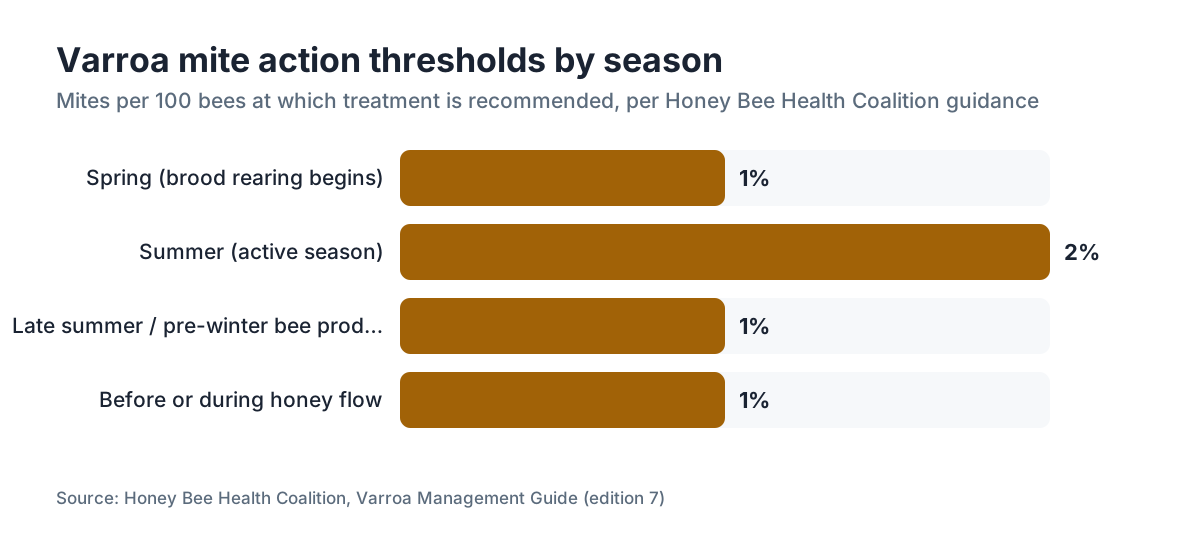
The Honey Bee Health Coalition's Varroa Management Guide sets an action threshold of 2 mites per 100 adult bees (2%) for most of the active season [1]. Come back below 2 per 100 and you've knocked the infestation down to a manageable level. Land at or above 2 per 100 and you have not succeeded, so you re-treat or switch strategies.
Thresholds shift by season. Before and during a major honey flow, many programs drop the trigger to 1 mite per 100 bees (1%), because a rising mite population during peak brood rearing can crash a colony fast [1]. In late summer and fall, before the winter cluster forms, even a 1 to 2% rate is a serious problem, because the bees being raised right now are the long-lived winter bees the colony leans on for 4 to 6 months.
Some state extension programs use slightly different numbers. Washington State University's apiary program treats 2% as the standard summer trigger but pushes late-season colonies closer to 1% before clustering [4]. The biology is the same across programs. The specific numbers drift only a little depending on regional brood-cycle timing.
A threshold is not a goal. The goal is always as few mites as possible. The threshold is the point where colony loss risk climbs sharply enough to demand action right now.
How do you run an alcohol wash correctly for a follow-up test?
An alcohol wash is the gold standard for accuracy. It kills 100% of mites on the sampled bees, which means you get a true count instead of a guess [1]. Here's how to do it cleanly.
Get a 32 oz (1 liter) wide-mouth mason jar with a mesh lid, or a commercial Varroa EasyCheck device. Fill it halfway with 70% isopropyl alcohol. Find a frame with open or uncapped brood and nurse bees clustered on it. Nurse bees carry the highest mite exposure, so they give you the most conservative (worst-case) read on the hive [1].
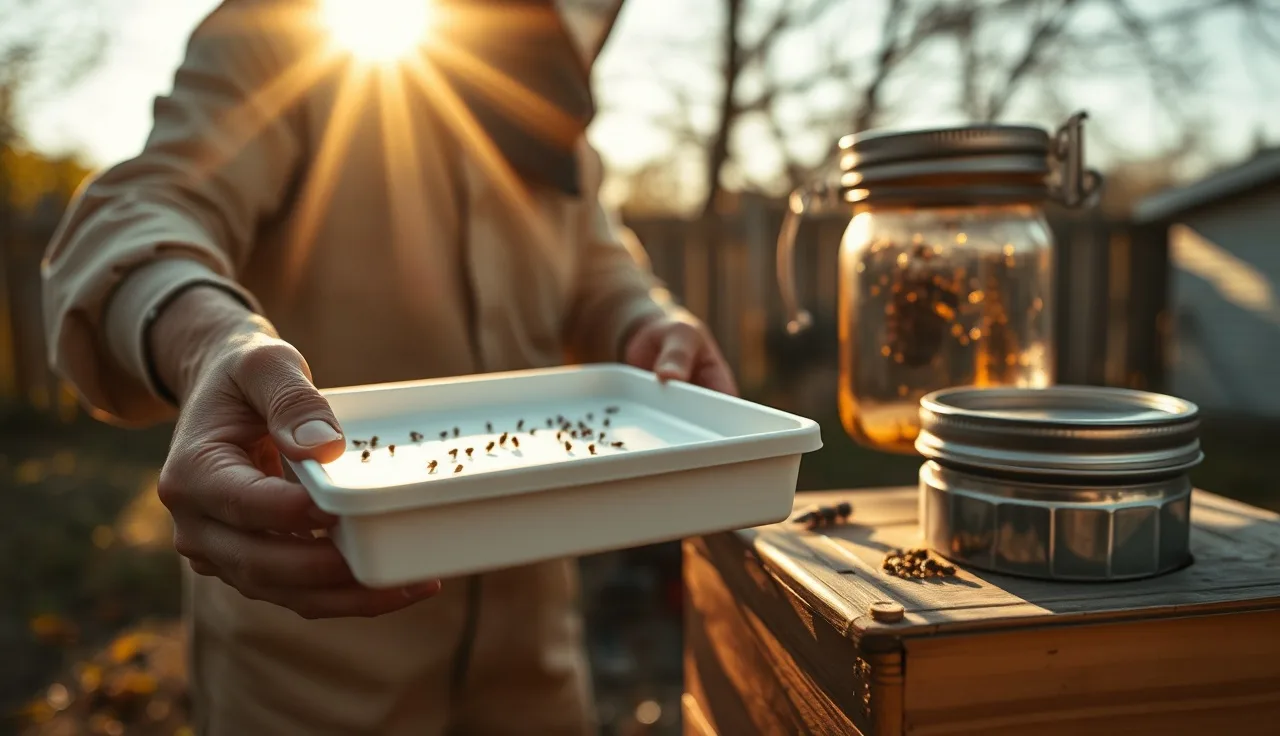
Shake or scrape roughly 300 bees (about half a cup by volume) into the jar. That's your minimum sample for a statistically reliable result. Fewer bees, more sampling error. Cap the jar, shake hard for 60 seconds, then shake again. Let it sit 1 to 2 minutes. Pour the liquid through a second mesh strainer into a white tray or a clear container with a white background. Count the mites floating in the liquid.
Divide mite count by bee count and multiply by 100. Collect 300 bees, find 4 mites, and that's 4/300 x 100 = 1.3%, below the 2% summer threshold. Find 10 mites in 300 bees and that's 3.3%, which demands action.
Estimating bee count is simple. A half-cup scoop is roughly 300 workers. Some beekeepers weigh instead: about 100 grams of bees runs near 300 workers, though this shifts with bee size and how much honey sits in their crops [5].
A few things to avoid. Don't sample bees near the entrance or frames of capped honey with no brood. Those bees undercount your load. Never sample the queen frame. If you're running a sugar roll instead, know that sugar rolls consistently underestimate infestation by roughly 20 to 40% against an alcohol wash in comparative studies [6].
Can you use a sticky board instead of a wash to check treatment results?
You can. But you probably shouldn't rely on it alone.
Natural mite drop on a sticky board (a 48 or 72 hour count) gives you a trend, not a percentage. The Honey Bee Health Coalition warns that sticky board counts are 'difficult to interpret' and should serve trend monitoring rather than diagnosis [1]. Mite drop rate rides on brood area, colony population, time of year, and temperature, so the same drop number can mean very different infestation rates in two different colonies.
After treatment, sticky board counts spike as killed mites fall, and watching that spike is satisfying. It still doesn't tell you how many survived. A colony that drops 500 mites in 48 hours might have 300 more alive in capped brood. The board alone can't say.
Use the sticky board as a secondary signal if you like. A post-treatment drop that quickly returns to near-zero is a good sign. Confirm with an alcohol wash or sugar roll before you call it done.
What do you do if the follow-up wash shows treatment failed?
First, confirm the result is real. Sample again from a second frame to rule out a bad bee sample. If both come back at or above 2%, you have a genuine treatment failure.
Then figure out why. The common reasons:
Breakdown in application. OA vapor at too low a temperature. Formic pads installed during a cold snap. Apivar strips that never touched the bee traffic paths.
Reinfestation from neighbors. If your apiary sits near other hives or feral colonies, mites drift in constantly on robber bees and drifting drones. One clean treatment can't overcome steady re-exposure when the source hives are loaded [4].
Resistance. Amitraz resistance in varroa has been documented in the U.S. and Europe [7]. If Apivar has failed twice in a row on the same apiary, switch to a different mode of action (an organic acid or thymol) and call your state apiarist.
Timing mismatch. Hopguard and OA dribble have poor efficacy on capped brood. Treat a colony in full brood mode with a contact-only method, and the mites in sealed cells simply wait you out.
Your next move after a confirmed failure is to re-treat, ideally with a different product category than the one that failed. If you used OA vapor on a brood-present colony, consider splitting the hive to force a brood break, then treating the broodless unit. That's one of the strongest rescue strategies a hobbyist can run without commercial gear [1].
For tracking these results across your hives over time, the free protocol tools at VarroaVault log wash results by colony, date, and treatment history, so you can catch patterns like chronic reinfestation or product failure before they turn into dead hives.
How accurate is the alcohol wash compared to other testing methods?
Accuracy across testing methods has been studied, and the results line up well enough to trust.
Alcohol wash is the reference standard. Paired testing (alcohol wash against full dissection of combs) shows alcohol washes capture close to 100% of phoretic mites on the sampled bees [6]. It's as accurate as field work gets.
Sugar roll is live and non-destructive but less accurate. A 2010 study by Calderone in the Journal of Economic Entomology found sugar rolls recovered significantly fewer mites than alcohol washes on the same bee samples [6]. The convenience is real. The precision isn't.
Drone brood uncapping (biotechnical sampling) is highly specific for mites in capped brood. It's a useful supplement when brood is present, but it only reports on the reproductive phase of mites, not the phoretic load on adult bees. You'd miss what's riding around on the workers.
Sticky board has the lowest precision of any method. It's fine for trend watching between wash cycles, useless for threshold decisions.
The practical take: use an alcohol wash for follow-up verification. Fall back to a sugar roll only when you genuinely can't destroy 300 bees (package bees, a very small colony, rare genetics). In that case, treat your result as maybe 20 to 40% low and read it accordingly.
For gear, the alcohol wash jar kits and Varroa EasyCheck devices most beekeeping supply companies carry work well. A plain mason jar with hardware cloth hot-glued over the lid also does the job for a few dollars.
How many bees do you need to sample for a reliable result?
Three hundred bees is the standard. The Honey Bee Health Coalition specifies this as the minimum sample for a statistically valid result [1]. With 300 bees, even a low count of 1 to 2 mites carries meaning. With only 100 bees, the confidence interval runs wide enough that you can miss an infestation sitting right at threshold.
In practice, 300 bees is roughly half a cup by volume. Most beekeepers collect by shaking a frame of nurse bees into a tub. You don't count bees one at a time. The half-cup measure is a calibrated estimate that most extension programs and the Honey Bee Health Coalition endorse as practical [1].
Small colonies (after a split, or in early spring) sometimes don't have 300 spare bees to give up without stress. Take what you can get, note the actual count, and stay conservative in your read. A count of 200 bees showing 3 mites is 1.5%, nominally under threshold but worth another check in two weeks given the shorter sample.
Never sample a colony with fewer than about 4 to 5 frames of bees. Losing 300 workers from a very small colony is a real hit to its population.
How often should you retest after treatment to monitor ongoing mite levels?
After you confirm a successful treatment, you're not done. Mites rebound fast once brood rearing resumes and forager traffic brings in re-infesting mites from outside your apiary.
The schedule most extension programs recommend: sample every 30 days during the active brood season [1] [9]. That's roughly once a month from March through September across most of North America. In late summer (August and September), tighten it to every 2 to 3 weeks, because that's the window where a mite surge does the most damage to winter bees [9].
After a treatment and a passing follow-up wash, your next test is in 30 days. If it comes back clean, hold the monthly rhythm. If it climbs back above threshold, that's reinfestation, not treatment failure, and you go hunting for the source.
Keep written records. A single number without context is almost useless. A run of numbers across months shows you whether a colony is stable, slowly building, or spiking, and that pattern tells you when to act before you hit emergency conditions. A notebook, a spreadsheet, or a varroa tracking app all work.
Does the time of year change how you interpret follow-up wash results?
Yes, a lot. The same mite count means different things in June and September.
Summer (June through early August): 2% is the standard trigger. A post-treatment result of 1.5% passes, but it's a borderline pass worth rechecking in three weeks.
Late summer and early fall (mid-August through October): the bees being raised now form your winter cluster. These are the longest-lived bees of the year, and varroa-linked virus transmission (particularly Deformed Wing Virus, tied to high mite loads) during their larval and pupal stages shortens their lifespan and weakens their immune function [8]. Plenty of experienced beekeepers treat the fall threshold as 1% rather than 2% for exactly this reason, and the HBHC guide backs the more conservative approach for pre-winter prep [1].
Winter (cluster broodless): varroa can't reproduce without brood. A wash during a broodless stretch captures phoretic mites only. This is the ideal window for OA treatment, because efficacy runs above 95% when no capped brood is shielding mites [2]. A post-treatment winter wash showing 0 to 1 mites per 100 bees is a strong signal heading into spring.
Spring (February through April): colonies are small and brood rearing is ramping. A 1 to 2% result in early spring compounds fast as brood area expands. Treat early rather than waiting for the population to explode.
What records should you keep from your follow-up wash tests?
At minimum, record these five things for every wash:
- Date of the wash
- Colony ID
- Number of bees in the sample
- Number of mites counted
- Calculated percentage
Also note the treatment used, application dates, and any observations about the colony (queen status, brood pattern, population estimate). Two minutes of writing gives you a history that pays off when you're trying to figure out why a colony died or why one always seems to run hot on mites.
Over a season or two, your records will tell you which colonies are mite magnets (often weak mite-resistant genetics, or a spot near a feral reinfestation source), which colonies reliably stay clean, and whether your treatment protocols hold up across the whole apiary.
If you want a structured place to do this, VarroaVault's free varroa tracking tools let you log results, set calendar reminders for follow-up washes, and see mite trends across multiple hives over time.
For beekeepers supplying local queens or selling nucs, wash records also show due diligence on mite management, which more buyers ask for after getting burned by an infested colony.
Are there situations where a follow-up wash is hard to interpret?
A few edge cases where your results need extra skepticism.
High drone production periods: workers carrying phoretic mites look like any other worker in a wash. But during drone-heavy stretches, if you inadvertently scoop frames with lots of emerging drones, results can skew, because mites prefer drone brood. Uncapping a few drone cells on the sampled frame before washing gives you a second data point.
Mid-split aftermath: split a colony and both halves show lower counts than the original, because the mite population divides along with the bees. Your 1.0% result from a fresh split might represent a higher real load in the parent colony's terms. Re-test both units three weeks later once populations settle.
After emergency queen introduction: colonies queenless for more than 2 to 3 weeks have gone through a brood break, which temporarily crashes mite reproduction. A wash during that window undercounts the real threat, because once the new queen starts laying, mite reproduction accelerates. Test again 4 to 5 weeks after she's laying consistently.
These situations are genuinely tricky. The honest answer is that no single data point is definitive. When in doubt, test twice, note the conditions, and weight your read conservatively.
Frequently asked questions
How long after oxalic acid treatment should I do a follow-up wash?
For a brood-free colony treated with a single OA vaporization, 72 hours is enough. For a colony with capped brood that received multiple OA treatments over several weeks, wait at least one week after the final application. This gives late-stage capped brood time to emerge and expose mites that were sheltered during treatment.
What mite count per 100 bees means my treatment worked?
Below 2 mites per 100 bees (2%) is the widely used summer success threshold from the Honey Bee Health Coalition. In late summer and fall, before winter bees are raised, most programs treat 1% or below as the safer target. If your post-treatment wash sits at or above 2%, the treatment didn't reduce the infestation enough and re-treatment is needed.
Can I use a sugar roll instead of an alcohol wash to check treatment success?
You can, but expect it to undercount. Studies show sugar rolls recover 20 to 40% fewer mites than alcohol washes on the same bee samples. If a sugar roll gives you a borderline result near 1.5 to 2%, treat the real number as higher. Sugar roll is acceptable for live colonies where you want to avoid killing bees, but it's not the gold standard for confirming success.
How many bees should I sample in a follow-up wash?
At least 300 bees, which is roughly half a cup by volume. The Honey Bee Health Coalition specifies 300 as the minimum for a statistically reliable result. Fewer bees means wide uncertainty in your percentage. If your colony is too small to spare 300 workers without stress, take what you can, record the actual number, and read the result conservatively.
My follow-up wash failed. Can I re-treat with the same product immediately?
Yes, in most cases. If the original treatment ran correctly and the product label allows repeat applications, you can re-treat. If the same product has failed twice in a row, switch to a different treatment category. Amitraz resistance has been documented in the U.S., so two Apivar failures on the same apiary warrant switching to an organic acid or thymol-based product.
Is a sticky board count reliable enough to confirm varroa treatment success?
No. The Honey Bee Health Coalition states that sticky board counts are difficult to interpret and should be used for trend monitoring, not threshold decisions. Mite drop rates depend on colony size, brood area, and temperature, so the same drop count can reflect very different infestation rates in different hives. Confirm treatment success with an alcohol wash.
Do I need to test every hive in my apiary or just a sample?
Every hive, if you can. Mite loads vary widely between colonies in the same apiary. A hive two feet from a clean one can be at 4% infestation. Testing only a subset means you'll miss high-load colonies that become mite bombs re-infesting neighbors. If you can't test all hives, prioritize colonies that seemed weak, had high pre-treatment counts, or received a split recently.
How do I know if high post-treatment mite counts mean reinfestation rather than treatment failure?
Timing is the clue. If your wash passes right after treatment but a wash 30 days later shows counts back above 2%, that pattern points to reinfestation rather than original treatment failure. True treatment failure shows up in the immediate post-treatment wash. Reinfestation from neighboring feral colonies or apiaries typically builds over 3 to 6 weeks after a successful treatment.
What should I do if my follow-up wash shows zero mites?
A zero result from a properly sized sample (300 bees) is a very good sign. Phoretic mite load is negligible. Still, hold your regular monthly monitoring schedule, because zero today doesn't mean zero in 30 days. Mites rebound quickly as brood rearing continues and foragers bring in new mites from outside your apiary.
Does the follow-up wash method change for different varroa treatment types?
The wash method itself is the same regardless of treatment. What changes is the timing. Apivar should be tested during the final week while strips are still in. OA vaporization on brood-present colonies needs a week after the final dose for emerged brood to stabilize. Formic acid products need 2 to 4 weeks after removal. The threshold you compare against (2% summer, 1% pre-winter) stays consistent across product types.
Can I test for varroa mites without killing bees?
Yes, with a sugar roll or a CO2-based method. The sugar roll gently coats bees in powdered sugar, causing mites to lose their grip, then you sift the mites into water and count. It's less accurate than an alcohol wash, missing up to 40% of mites in some studies. CO2 devices like the Varroa EasyCheck can also work without killing bees, with similar accuracy trade-offs to the sugar roll.
How do I track mite wash results across multiple hives over a season?
A simple spreadsheet with columns for date, colony ID, sample size, mite count, and percentage works well. Record your pre-treatment, mid-treatment (where applicable), and post-treatment numbers together so you can see treatment impact clearly. Over multiple seasons, this record tells you which colonies chronically struggle, which treatments work best in your conditions, and when to intervene before a crisis.
At what time of year is the follow-up wash most important?
Late summer, August through early September, is the highest-stakes window. The bees raised in this period become the winter cluster, and varroa-transmitted viruses picked up during their development shorten their lives and hurt winter survival. A failed treatment that goes undetected in August can mean a dead colony by January. The late-summer follow-up wash is arguably the single most important test of the year.
Does brood presence affect how I should interpret a follow-up wash result?
Yes. When brood is present, some mites always hide in capped cells and won't show in a wash of adult bees. Your wash result reflects phoretic mites only. A 1.5% result with heavy brood present could represent a higher total colony infestation than the same percentage in a brood-free colony. Factor in brood area when deciding how close to the threshold you're comfortable being before re-treating.
Sources
- Honey Bee Health Coalition, Varroa Management Guide (edition 7): Alcohol wash is the reference standard for mite sampling; 300-bee minimum sample; 2% summer action threshold; sticky board counts are difficult to interpret; monthly sampling schedule during active season recommended.
- USDA ARS, Bee Research Laboratory (oxalic acid for varroa control): OA vaporization on brood-free colonies achieves near 95%+ efficacy; recommended timing for single-dose treatment is the brood-free period.
- EPA, Pesticide Registration (Apivar amitraz product label): Apivar label specifies minimum 6-8 week strip exposure for efficacy.
- Washington State University, Department of Entomology (Apiculture / varroa management): 2% summer trigger threshold; 1% pre-winter target; reinfestation from neighboring colonies documented as cause of post-treatment mite rebound.
- Pennsylvania State University Extension (varroa mite sampling): Half-cup volume approximates 300 adult worker bees; weight estimate approximately 100 grams per 300 workers.
- Calderone, N.W. (2010), Evaluation of sampling methods for detection of Varroa destructor. Journal of Economic Entomology: Alcohol wash captures significantly more mites than sugar roll on the same bee samples; sugar roll underestimates infestation by roughly 20-40%.
- Posada-Florez, F. et al. (2021), Amitraz resistance in Varroa destructor. Scientific Reports: Amitraz (Apivar) resistance documented in Varroa destructor populations in the United States and Europe.
- Genersch, E. et al. (2010), Deformed Wing Virus and Varroa destructor. Journal of Invertebrate Pathology: Varroa mite infestation during larval and pupal development transmits Deformed Wing Virus, shortening adult bee lifespan and compromising immune function.
- University of Minnesota Extension (varroa mite management in honey bee colonies): Monthly sampling recommended during brood season; late summer sampling every 2-3 weeks given risk to winter bees.
- Oregon Department of Agriculture (apiary program, varroa monitoring): Alcohol wash method described as standard for regulatory and beekeeper use in Oregon apiary program guidance.
- Honey Bee Health Coalition, Tools for Varroa Management: The HBHC guide states that natural mite drop on sticky boards is 'difficult to interpret' and recommends alcohol wash for definitive threshold decisions.
Last updated 2026-07-09