How to interpret alcohol wash results for treatment decisions
TL;DR
- An alcohol wash above 2 mites per 100 bees (2%) is the accepted treatment threshold during brood-rearing season.
- Below 2%, keep monitoring every 30 days.
- Above 2%, treat now.
- In late summer and fall the threshold drops to 1%, because winter bees raised under mite pressure enter cluster already damaged.
- Context matters alongside the raw number.
What is an alcohol wash and why does the number matter?
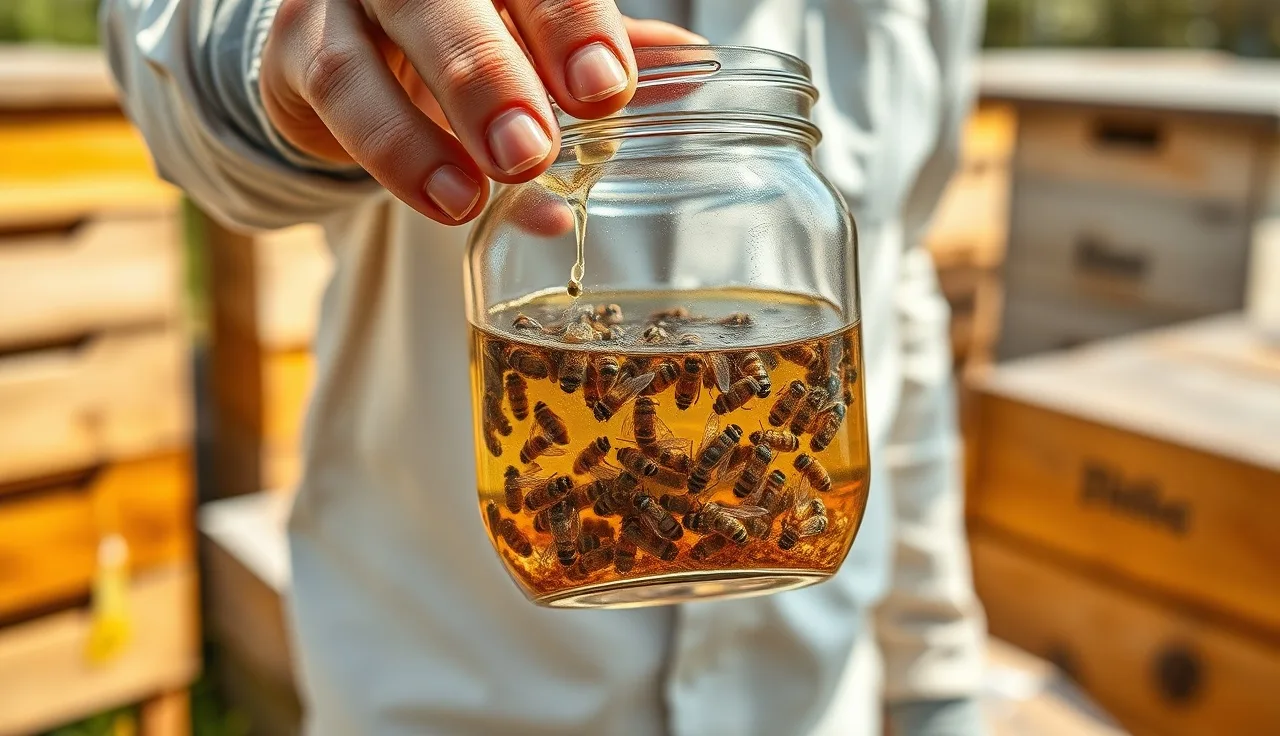
An alcohol wash is a kill-sample method that gives you a mite-per-bee ratio from a measured cup of adult bees. You collect roughly 300 bees (about half a cup by volume) from a brood frame, drop them into isopropyl alcohol or windshield washer fluid, shake for 30 to 60 seconds, and count the mites that fall off. The result is mites per 100 bees, which is the same thing as a percentage infestation rate. [1]
That percentage drives every treatment decision worth making. A raw mite count with no denominator tells you almost nothing. A colony with 40,000 bees and 400 mites sits in a very different spot than one with 10,000 bees and 400 mites. The wash gives you the ratio, and the ratio is what counts.
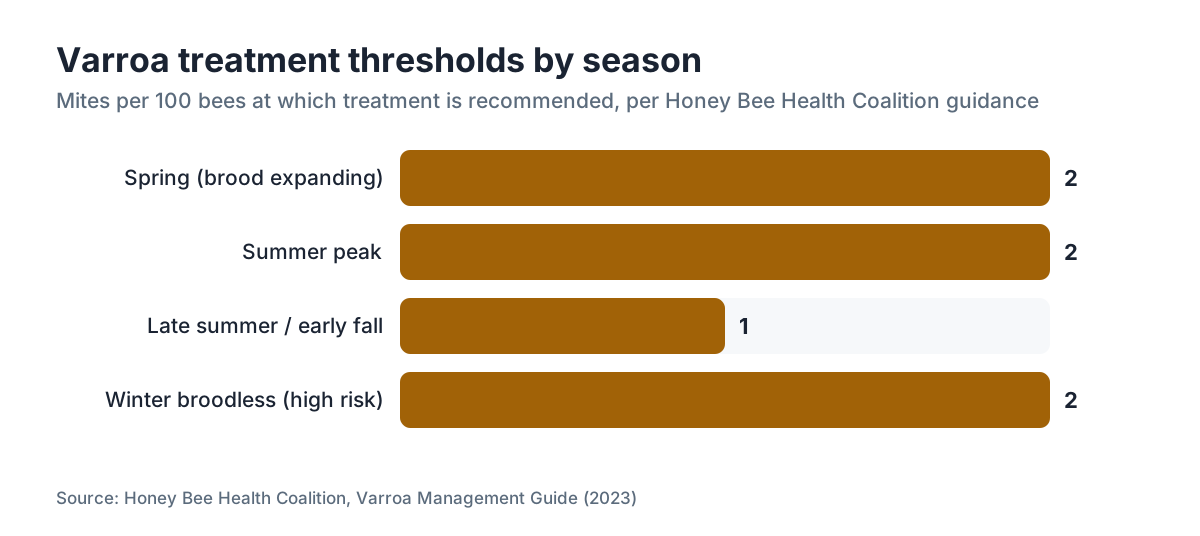
The Honey Bee Health Coalition's Varroa management guide sets the action threshold at 2 mites per 100 bees during brood-rearing season and 1 mite per 100 bees in late summer or early fall before the winter cluster forms. [1] Those two numbers are the backbone of every interpretation you'll do.
Alcohol washes beat sugar rolls on accuracy. A 2019 comparison in the Journal of Economic Entomology found sugar rolls detected fewer mites than alcohol washes from the same colonies, which means a sugar roll can leave you thinking you're safe when you're already over threshold. [2] For a decision this important, use the wash.
How do you calculate mite infestation rate from your wash?
The math is simple. Divide the mites you counted by the bees in your sample, then multiply by 100.
(mites counted ÷ bees in sample) × 100 = mites per 100 bees
Count 6 mites in a 300-bee sample: (6 ÷ 300) × 100 = 2.0%. That's exactly the action threshold.
Sample size matters more than most beekeepers think. If you eyeball "about half a cup," your count swings from 250 to 350 bees, and that moves the calculated rate by 15 to 20 percent. On a borderline result of 5 or 6 mites, that error is enough to turn a true 2.2% into an apparent 1.7%. Close calls earn a recount.
The Honey Bee Health Coalition publishes a downloadable data sheet, and its guide walks through standardizing sample size. [1] For a fast cross-check, the free tools at VarroaVault include a mite wash calculator: enter your mite count and bee count, and it returns the rate with the threshold flagged.
| Mites counted | Bees in sample | Rate (%) | Decision |
|---|---|---|---|
| 2 | 300 | 0.67 | Monitor, retest in 30 days |
| 4 | 300 | 1.33 | Monitor closely, retest in 2 weeks |
| 6 | 300 | 2.00 | At threshold, treat now |
| 8 | 300 | 2.67 | Above threshold, treat now |
| 12 | 300 | 4.00 | High infestation, treat urgently |
| 6 | 200 | 3.00 | Above threshold, treat now |
| 6 | 400 | 1.50 | Below threshold, monitor closely |
What does a result below 2% actually mean?
Below 2% means you don't need to treat right now. It does not mean you're done for the season.
A 0.5% result in June, with capped brood in the hive, hides most of your mites under the cappings, where they're reproducing. The wash only samples phoretic mites riding on adult bees, and that's typically 20 to 30 percent of the total mite population during peak brood rearing. [1] So a June reading of 1% can sit on top of a total colony load that would alarm you if you could see all of it.
Here's the practical version. Below 2% means monitor on a 30-day schedule during active brood rearing, and tighten to every 2 weeks in late summer (July through September across most of North America), when populations climb fast ahead of winter bee production. Miss the late-August window and you've found one of the most common ways colonies die over winter. They go into cluster already overwhelmed.
Below 1% in September or October, after brood rearing winds down, is real good news. Winter bees are long-lived and mite reproduction slows hard with less brood. If you're under 1% then, you can likely hold off and retest in late winter or early spring.
When does a result above 2% require immediate treatment?
Above 2% during brood season: treat. Not next weekend. Now. This isn't a "watch it two more weeks" situation.
The Honey Bee Health Coalition puts it plainly: 2% during brood-rearing season is the point where mite populations grow faster than bees can offset the damage. [1] Deformed wing virus transmission speeds up, winter bee quality drops, and forager lifespan shortens. Every week you wait above 2% adds to the bill.
Above 4% is an emergency. At that level you're probably already seeing population decline and brood with deformed wing virus. Treatment still helps, but weigh whether the colony has enough population left to recover.
Above 6% in early fall puts you in triage. Some beekeepers treat hard and feed to help the colony rebuild. Others combine the hive with an untreated or freshly treated neighbor. That call depends on your goals and how much season is left. The wash number tells you what's true. It doesn't tell you what to do next.
One honest caveat. The 2% threshold comes from research summarized by the Honey Bee Health Coalition and has wide support, but no single gold-standard trial pinned the exact number. The closest published basis is population modeling and colony survival data. Nobody has run a randomized trial at 1.9% versus 2.1% across 200 colonies. Treat 2% as a well-backed guideline with real biology behind it, not a precise toxicological cutoff. [1]
How does the season change how you read the result?
The same number means different things in different months. New beekeepers miss this constantly.
A 1.5% result in late April is fairly calming. Brood rearing is just ramping up, mite populations are low, and you have time. A 1.5% result in late August is close to a treat-now signal in many regions, because that population will grow quickly during the weeks when bees are raising the winter cluster. By the time your long-lived winter bees get capped, you want the mite load already down.
The Honey Bee Health Coalition recommends the tighter 1% threshold in late summer and fall exactly because the stakes are higher. [1] Winter bees live 4 to 6 months. A bee raised under high mite pressure during that window goes into winter already immunocompromised. Treatment after October in cold climates often works less well, because broodless or low-brood conditions change which products even function.
| Season | Recommended treatment threshold | Monitoring frequency |
|---|---|---|
| Spring (brood expanding) | 2% (2 mites per 100) | Every 30 days |
| Summer peak | 2% | Every 30 days |
| Late summer / early fall | 1% (1 mite per 100) | Every 2 weeks |
| Winter (broodless) | 2-3% (colony at risk) | Once in late winter |
Test spring colonies as soon as they have enough bees to sample, roughly 5 frames of bees. A colony that overwintered with low mites can still pick them up fast through robbing and drifting from nearby collapsing hives.
What sample location gives you the most accurate reading?
Where you take your bees from matters. A lot.
Sample from a brood frame every time, ideally the frame with the most open brood and young nurse bees. Nurse bees carry the highest phoretic mite loads, because young bees are the mites' preferred hosts. Sample from the entrance, a honey super, or a knot of older foragers and you'll undercount mites and walk away with a falsely low number. [3]
The Honey Bee Health Coalition guide says to sample from a frame with open brood and shake the bees straight into your jar without using a brush. [1] A brush skews the sample toward nurse bees and can knock mites loose. Shaking gives you a more natural cross-section.
Don't sample right after an oxalic acid or formic acid treatment. Those drop phoretic counts sharply within days, so a result taken 3 days post-treatment tells you about the treatment's knockdown, not the colony's true baseline. Wait 3 to 4 weeks after any miticide before you draw conclusions about baseline infestation.
For the biology behind why the brood frame matters so much, see our article on the varroa mite.
How do you account for sampling error and borderline results?
Borderline results (1.5% to 2.5%) earn a second wash, ideally from a different brood frame in the same hive.
Wash results carry real sampling variance. Even a careful 300-bee sample has a confidence interval around the true population rate. A systematic analysis of varroa sampling methods found standard monitoring protocols work well, but that sample size is the dominant factor in precision. [2] Samples under 200 bees produce meaningfully wider confidence intervals.
Here's the protocol for a borderline read. Run a second wash within the same inspection, from a different frame in the same hive. Both above threshold: treat. One above, one below: you're near the line, so make the conservative call and either treat or retest within two weeks.
Don't average two washes and call it a precise population estimate. Averaging gives you a better estimate. The variance doesn't disappear.
Colony size changes how seriously you take a given rate. A 60,000-bee colony at 2.5% carries far more total mites than a nuc at 2.5%, and it may be shedding mites into neighboring hives through robbing. Same rate. Different risk.
What treatment options are available once you decide to treat?
Treatment choice flows from infestation level, season, temperature, and whether honey supers are on. Your wash number gets you to "treat now." The count itself doesn't pick your product.
EPA-registered miticides in the US include oxalic acid (dribble, vaporization, and extended-release glycerin formulations), formic acid (gel strips and pads), amitraz (plastic strips), and thymol-based products. [4] [5] Each has temperature limits and honey super rules. Oxalic acid vaporization works great when the colony is broodless or near-broodless, and its efficacy drops when brood is present, because mites under cappings are protected. Formic acid reaches mites under cappings but has a usable window of roughly 50 to 85°F. Amitraz strips (Apivar) work through the full brood cycle but need 6 to 8 weeks of contact time. [5]
At 2 to 3%, most US beekeepers reach for oxalic acid vapor or Apivar depending on season. At 4%+ during summer, Apivar is a strong pick because it works no matter what the brood is doing. At 4%+ in a broodless fall colony, oxalic acid vapor is highly efficient and usually drops mites by 90%+ in that condition. [4]
For suppliers who carry the labeled products you'll need, see our roundup of beekeeping supply companies. You can also find treatment gear through free shipping honey bee supply companies if you're ordering vaporizer equipment.
Read and follow the full EPA label. "The label is the law" isn't a slogan. Violating label directions on a miticide is a federal offense under FIFRA, and some restrictions (like pulling honey supers before treatment) protect both your bees and your honey. [6]
How do you track results over time to spot a growing problem?
A single wash is a snapshot. A series of them is a story.
Keep a log, paper or digital, with date, hive ID, mite count, bees in sample, calculated rate, and any treatments applied. This isn't paperwork for its own sake. It's how you catch that hive #3 runs 30% higher than its neighbors (possible genetic susceptibility, possible reinfestation from a collapsed colony down the road), or that your August numbers have topped 2% three years running despite spring treatments.
Seeing patterns across seasons is where experienced beekeepers pull ahead. They know their apiary's typical mite curve, and they treat ahead of the late-summer spike instead of scrambling after it.
VarroaVault's free monitoring log tool is built for this. Enter your wash results by hive across the season and it flags trend lines, more than single-point threshold crossings. Worth a bookmark for the season.
The Honey Bee Health Coalition's 2023 revised guide includes a monitoring log template in the appendix that works fine on paper if that's your style. [1] The logging habit matters more than the tool you use.
What are the most common mistakes when interpreting alcohol wash results?
Sampling from the wrong spot is the single biggest source of false negatives. Bees from honey supers, entrance boards, or old forager populations carry fewer phoretic mites. You think you're fine. You aren't.
Testing too rarely in late summer is next. A colony at 0.8% in early August can cross 2% by early September with nothing checked in between. A lot of winter losses trace back to that gap. The Honey Bee Health Coalition is explicit about raising monitoring frequency in late summer. [1]
Waiting for symptoms is another one. By the time you spot deformed wings, shortened abdomens, or a shrinking population, the infestation has run high for weeks. The wash exists to warn you before clinical signs show up.
And some beekeepers read a too-soon post-treatment wash as proof the mites are gone. Sticky-board drop counts, or a wash done within days of oxalic acid, show miticide activity, not true baseline infestation. Wait a full brood cycle (roughly 21 days) after treatment before you judge whether it worked and what's left behind.
How does the 2% threshold compare to thresholds used in other countries?
The 2% (2 mites per 100 bees) brood-season threshold is the US standard, mostly popularized through the Honey Bee Health Coalition. Other countries use similar numbers, though not always identical ones.
The UK's National Bee Unit recommends treatment at roughly 1 mite per 100 adult bees during summer, a more conservative trigger. [7] Some German associations historically counted natural mite fall rather than wash percentages, which makes direct comparison messy. The European and Mediterranean Plant Protection Organization sets a summer threshold around 3%, higher than the US number. [8]
Those differences reflect different climates, different registered treatment options (the EU registration landscape varies country to country), and different beekeeper risk tolerances. The honest answer: none of these thresholds came from one definitive experiment. They're evidence-informed practices pulled from population modeling, colony survival data, and years of practitioner experience.
For US hobbyist and sideliner beekeepers, the HBHC's 2% summer and 1% late-summer standard has the most evidence behind it and gets cited most often. Stick with it unless you have a specific reason to deviate.
What do you do after treating? When should you retest?
Treat, wait, test again. That's the full cycle.
After a full Apivar treatment (8 weeks), run a wash to confirm it worked. The Honey Bee Health Coalition recommends a post-treatment wash to verify efficacy. [1] Amitraz resistance exists in some varroa populations, and oxalic acid applied during high-brood conditions may have left protected mites behind. You need the data to know.
Post-treatment, you want results well below 1%, ideally under 0.5%. If your wash comes back at 1.5% or higher after a full treatment cycle, you have a real problem: incomplete treatment, resistance, or fast reinfestation from neighboring colonies. Each one has a different fix.
Reinfestation is common in apiaries under high regional mite pressure, especially within 1 to 3 km of abandoned or unmanaged colonies. A study in Apidologie found reinfestation from neighboring colonies can re-elevate mite loads within weeks of treatment. [9] If your post-treatment numbers keep bouncing back up, the source may be outside your hive, not a treatment failure.
Once you get a clean result, go back to the regular schedule: every 30 days in active season, every 2 weeks in late summer.
Frequently asked questions
What is the treatment threshold for varroa mites based on an alcohol wash?
The Honey Bee Health Coalition recommends treating when your alcohol wash shows 2 or more mites per 100 bees during the brood-rearing season (spring through summer). In late summer and early fall, the threshold tightens to 1 mite per 100 bees, because winter bees raised under mite pressure have shorter lifespans and colonies are more vulnerable heading into cluster.
How many bees do I need in my alcohol wash sample to get an accurate result?
The standard sample is about 300 adult bees, roughly half a cup by volume. Samples under 200 bees produce wider confidence intervals and less reliable results. For borderline results near the 2% threshold, run a second sample from a different brood frame in the same hive before you make a treatment decision. The extra five minutes is cheap insurance.
Is a 1% varroa mite count bad enough to treat?
During spring and summer, 1% sits below the 2% threshold, so treatment isn't required yet. Monitor every 30 days. In late summer and early fall (roughly August through October across most of North America), 1% is at or near the action threshold, and the Honey Bee Health Coalition recommends treating at that level to protect long-lived winter bees from mite-associated virus damage.
How accurate is an alcohol wash compared to a sugar roll?
Alcohol washes are notably more accurate. A 2019 study in the Journal of Economic Entomology found sugar rolls consistently undercount mites compared to alcohol washes from the same colonies. That undercount matters, because it can make an infested colony look below threshold when it isn't. If you're deciding whether to treat, use an alcohol wash.
Where in the hive should I collect bees for the most accurate mite wash?
Always sample from a frame with open brood and the nurse bees on it. Nurse bees carry the highest phoretic mite loads and give you the most accurate colony-wide estimate. Avoid honey supers, the entrance, and frames of older foragers. All of those carry fewer mites and will undercount your true infestation.
Can I use windshield washer fluid instead of isopropyl alcohol for the wash?
Yes. Blue windshield washer fluid (methanol-based, usually the -20°F rated kind) works well, and it's cheap and easy to find. It separates mites from bees just as well as isopropyl alcohol, and some beekeepers prefer it for the visual contrast when counting. Pick a version without heavy additives that cloud the liquid.
How often should I do alcohol washes to monitor varroa levels?
At minimum, every 30 days during active brood-rearing season. Tighten to every 2 weeks in late summer (July through September across most of North America), when mite populations climb fast and winter bees are being raised. Test after any treatment to confirm efficacy, waiting 3 to 4 weeks post-treatment before drawing conclusions about baseline infestation.
What does a very high mite wash result (4% or more) mean for my colony?
A result of 4% or higher means you're well past the threshold and the colony is under serious stress. You're likely already seeing deformed wing virus effects even if they aren't obvious. Treat immediately with a miticide suited to the season and temperature. At 6% or above, assess whether the colony has enough population to recover, and consider combining it with a healthy hive.
How long after treatment should I wait before doing a post-treatment alcohol wash?
Wait at least 21 days after a short-duration treatment like oxalic acid vapor or formic acid pads, so a full brood cycle passes and protected mites emerge and get exposed. For Apivar strips, run the full 8-week treatment before testing. A wash done within days of treatment shows knockdown, not your true residual infestation level.
Do I need to treat if my colony has no symptoms of varroa damage?
Yes. If your alcohol wash tops the threshold, treat regardless of visible symptoms. By the time deformed wings, shortened abdomens, or colony decline appear, the infestation has run high for weeks and the damage to winter bee quality may already be done. The wash is an early-warning tool so you can act before symptoms show, not after.
Can reinfestation from neighboring colonies cause a high mite count right after treatment?
Yes. Research in Apidologie found varroa reinfestation from neighboring colonies, through robbing and bee drifting, can re-elevate mite loads within weeks of a successful treatment. If your post-treatment wash bounces back above 1% quickly, consider external reinfestation and evaluate how close your apiary sits to unmanaged or abandoned colonies.
What is the difference between phoretic mites and total mite population, and why does it matter for wash results?
Phoretic mites ride on adult bees, and that's what the wash counts. During active brood rearing, roughly 70 to 80% of mites sit under capped brood where the wash can't reach them. A 1% phoretic rate during peak brood season can reflect a total colony load well above 1%. That's why thresholds are set conservatively and why late-summer timing matters so much.
Is it possible to have too many mites in the hive but still test below the threshold?
Yes, especially during peak brood season when most mites hide under cappings. The phoretic fraction can look low even when total mite load is high. Sampling from foragers instead of nurse bees makes it worse. That's why the late-summer threshold is tighter (1%, not 2%) and why sampling location on the brood nest is so important for an accurate picture.
Sources
- Honey Bee Health Coalition, Varroa Management Guide (2023 edition): 2 mites per 100 bees treatment threshold during brood season; 1 mite per 100 bees in late summer/fall; guidance to sample from brood frames with nurse bees; recommendation to increase monitoring frequency in late summer
- Journal of Economic Entomology, Comparison of varroa sampling methods (2019): Sugar rolls detect significantly fewer mites than alcohol washes from the same colonies; sample size is the dominant factor in precision for alcohol wash results
- Penn State Extension, Varroa Mite Monitoring and Management: Nurse bees on brood frames carry the highest phoretic mite loads; sampling from honey supers or forager populations underestimates infestation
- EPA, Oxalic Acid for Varroa Mite Control (Pesticide Registration): Oxalic acid is EPA-registered for varroa control in the US; vaporization is highly effective in broodless or near-broodless conditions with mite kill rates of 90%+
- EPA, Apivar (Amitraz) Label and Registration: Apivar (amitraz) requires 6 to 8 weeks of contact strip time and works through the full brood cycle; honey super restrictions apply
- US EPA, Federal Insecticide, Fungicide, and Rodenticide Act (FIFRA): Violating pesticide label directions is a federal offense under FIFRA; label instructions are legally binding
- UK National Bee Unit (Animal and Plant Health Agency), Managing Varroa: UK NBU recommends treatment at approximately 1 mite per 100 adult bees during summer, a more conservative threshold than the US 2% standard
- EPPO (European and Mediterranean Plant Protection Organization), Guidelines for Varroa Management: EPPO guidelines reference a summer treatment threshold of approximately 3% infestation, higher than the US standard
- Apidologie, Varroa reinfestation from neighboring colonies (peer-reviewed): Reinfestation rates from neighboring colonies can significantly re-elevate mite loads within weeks of treatment in high-density or high-regional-pressure apiaries
- University of Minnesota Extension, Varroa Mite Management for Honey Bees: Late summer is a critical monitoring window; colonies that head into winter with elevated mite loads show significantly higher winter mortality rates
- Virginia Cooperative Extension, Alcohol Wash Protocol for Varroa Monitoring: Standard alcohol wash protocol uses approximately 300 bees (half cup) from brood frame; windshield washer fluid is an acceptable substitute for isopropyl alcohol
Last updated 2026-07-09