How to write a yearly varroa management plan that actually works
TL;DR
- A yearly varroa management plan maps out when you'll monitor mite loads (every 4-6 weeks), what threshold triggers treatment (2% alcohol wash in brood season), which treatments fit each season, and how you'll verify they worked.
- Write it before the season starts so you decide on data, not panic.
Why do you need a written varroa plan in the first place?
Most colony losses from varroa aren't caused by ignorance. Beekeepers know mites exist. They lose colonies because decisions get made reactively: you peek into a hive in late August, notice the bees look rough, and grab the first treatment you can find. By then the mite population has already crashed the winter bee cohort. The colony is a dead hive walking.
A written plan forces you to think through the whole year in January, when nothing is urgent and your judgment is clear. It locks in your monitoring schedule, your action thresholds, your treatment windows, and your verification dates before a single stressful thing has happened. When a product label says "do not apply when honey supers are on," you've already accounted for that constraint instead of discovering it at 8 p.m. the night before a treatment window closes.
The Honey Bee Health Coalition puts it plainly in its Varroa Management Guide: the most effective programs treat before mite populations cause detectable harm to the colony, not after [1]. That sounds obvious. Writing the plan is how you actually do it.
There's a record-keeping payoff too. Keep bees more than a few years and you'll lose track of which colonies you treated, when, and with what. A written plan doubles as a treatment log that tells you whether a product is losing punch in your apiary.
What information do you need before you can write the plan?
You can't write a plan in the abstract. You need five pieces of real information about your specific situation.
Your location and climate zone. Varroa management looks nothing alike in Minnesota and Alabama. Treatment windows, honey flows, broodless periods, and overwintering timelines all depend on your local season. Know your last expected frost, your main nectar flow dates, and when your bees go broodless or nearly broodless. Your state's cooperative extension service usually publishes seasonal charts for managed pollinators. [2]
How many hives you manage. A two-hive hobbyist and a 150-hive sideliner have different labor constraints, different cost tolerances, and access to different tools. Oxalic acid vaporizers pay off faster at scale, for instance. Write a plan you can actually execute.
Which treatments are registered in your state. The EPA registers varroa treatments federally, but states can restrict use further. Oxalic acid products (Api-Bioxal), amitraz strips (Apivar), fluvalinate strips (Apistan), coumaphos strips (CheckMite+), and formic acid products (Formic Pro, MAQS) are the main options. Check your state department of agriculture's current list. It changes. [3]
Your honey production goals. If you pull honey, you cannot use most chemical treatments while supers are on, full stop. Your plan must park all synthetic acaricide use outside your honey-on frames and schedule organic acid treatments (oxalic acid, formic acid) only during the windows their labels allow. Product labels are legally binding under FIFRA. Violating them is a federal offense. [4]
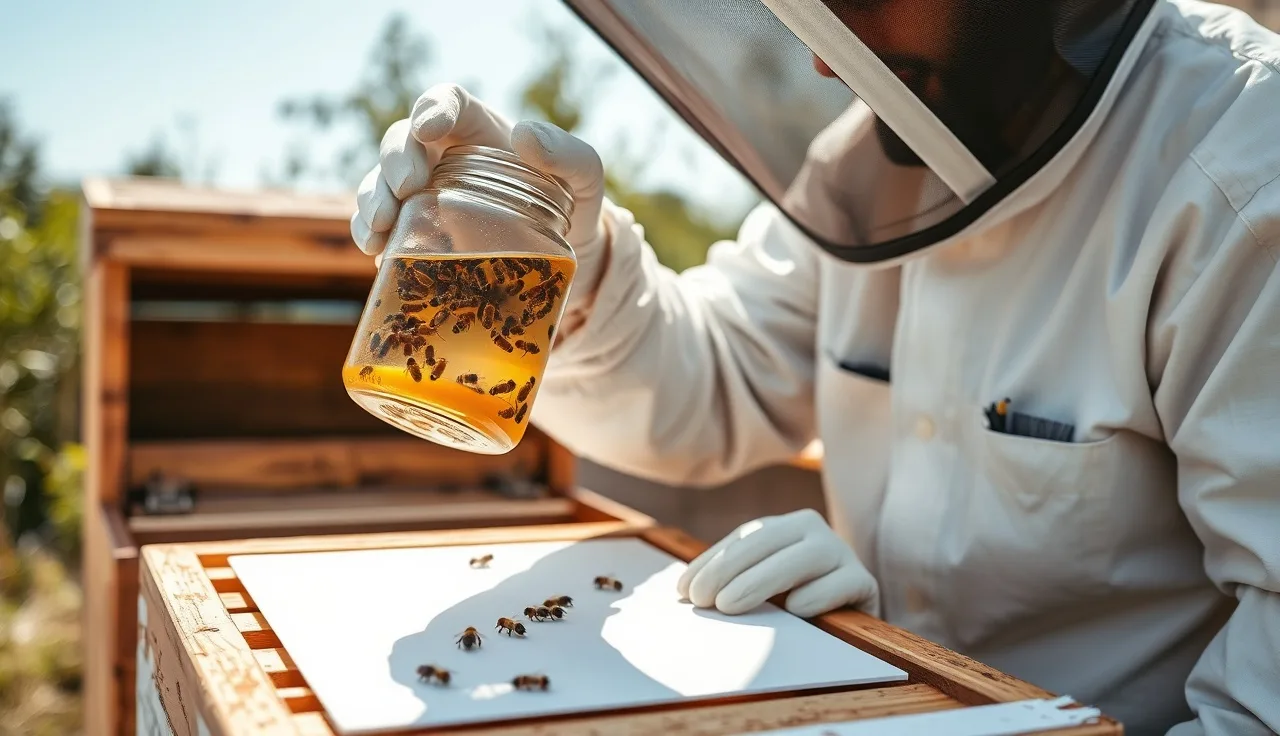
Your monitoring method. Alcohol wash and sugar roll are the two common methods. Alcohol wash is more accurate. If you don't own a mite-washing kit, put one on your supply list before anything else. A sticky board alone is not a reliable basis for treatment decisions. [1]
What are the right mite thresholds to put in your plan?
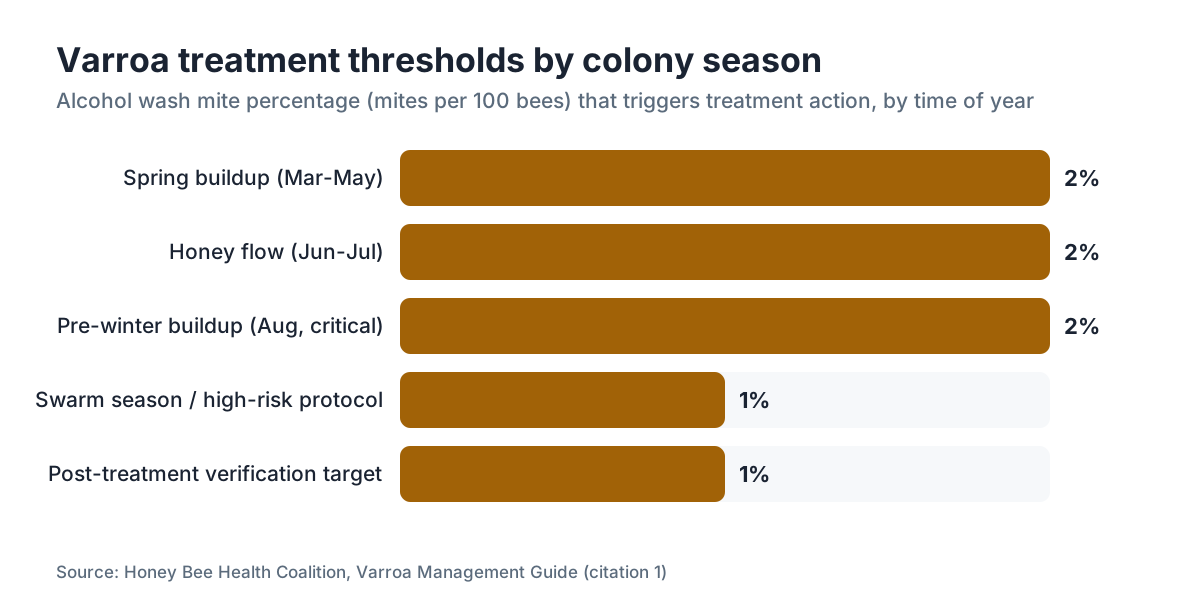
Thresholds exist because treating too early wastes money and adds chemical exposure, while treating too late means the damage is already done. The numbers below come from the Honey Bee Health Coalition's Varroa Management Guide, which pulls together the best available research through recent editions [1].
| Season / Colony State | Treatment Threshold (Alcohol Wash) |
|---|---|
| Expanding brood (spring/summer) | 2% (2 mites per 100 bees) |
| Honey production season | 2% |
| Pre-winter buildup (late summer) | 2% (act fast; winter bees being raised now) |
| Mite bomb risk / swarm season | 1% in some protocols |
| Broodless / winter cluster | Treat regardless if not treated in fall |
The 2% threshold is the most widely cited benchmark, but context changes the urgency. A colony at 1.8% in mid-August is in more danger than one at 2.5% in April, because the bees hatching in August will be the colony's entire winter population. Write that nuance into your plan. Don't just note "treat at 2%." Note "treat at 2% immediately in August even if close to but not over threshold."
Some beekeepers use 3% as their summer threshold. That's within the range of published guidance but leaves less margin. I'd rather treat once unnecessarily than lose a colony. An oxalic acid dribble on a summer hive isn't free, but it's cheap next to a package come spring.
How should you structure the 12-month monitoring schedule?
Monitoring every four to six weeks is the standard recommendation from extension apiculture programs [2]. For most beekeepers in temperate North America that means roughly eight to ten monitoring events per year per hive. Write them into a calendar with specific dates, more than "every month."
Here's a working template for a mid-Atlantic or Midwest beekeeper. Adjust the months for your climate.
January/February: If the cluster is accessible and weather permits above 50°F, do a quick visual check. No alcohol wash needed unless you see signs of distress. A cold-driven broodless period is a valid oxalic acid dribble or vaporization window. [5]
March: First alcohol wash of the year as brood ramps up. Record a baseline. If over 2%, treat before swarm season.
April/May: Wash again. Swarm season scrambles mite counts because splits and swarms redistribute mites unevenly. Wash every hive, including splits, within two weeks of the split.
June: Wash during the main honey flow. Most synthetics can't go in with supers, so if you hit threshold here, your options are formic acid (label-specific) or accepting risk until supers come off.
July: Wash. This is often the period of fastest mite population growth because brood is abundant and foragers import mites from nearby failing colonies.
August (critical): Wash in early August. Act immediately if at or near threshold. The bees reared from late August through October are your winter cluster. Mite-damaged winter bees are the direct cause of most spring dead-outs.
September: Verify treatment efficacy if you treated in August. Wash again two to four weeks after treatment end to confirm mite load dropped below 2%.
October/November: Final wash before clustering if your fall treatment window allowed it. Oxalic acid dribble or vaporization if brood is minimal or absent. [5]
December: Heft and external checks only in cold climates. No alcohol wash needed if you verified a clean count in October.
For each monitoring event, record the date, the sample size (300 bees minimum for alcohol wash), the mite count, the calculated percentage, and the action taken. A simple spreadsheet per hive works fine. The VarroaVault monitoring log tool, if you use it, keeps this in one place and flags when you're closing on threshold across your apiary.
Which treatments belong in which season?
Treatment selection isn't about picking your favorite product. It's about matching the product's effective window and legal requirements to the actual state of your colony at that moment. Here's how the main options fit into a yearly plan.
Oxalic acid (Api-Bioxal): Most effective when little or no capped brood is present, because oxalic acid does not penetrate cappings and can't kill mites in capped cells. In a broodless cluster (winter, or after a forced brood break), a single oxalic acid vaporization achieves over 90% mite knockdown in most studies [5]. During brood season, extended-release formulations (oxalic acid in glycerin-soaked shop towels or commercial pads) can suppress mites over several weeks, but the efficacy data is more variable. The registered product label controls what's legal. Follow it exactly. [4]
Formic acid (Formic Pro, MAQS): Penetrates cappings, so it kills mites in capped brood. That's a real advantage. It can be applied with honey supers on under specific label conditions (check your product's current label, because this has changed between formulations). Temperature constraints are real: most formic acid products should not be applied when daytime temperatures exceed 85 to 92°F depending on product and formulation. In hot climates, your summer window may be narrow. [3]
Amitraz (Apivar strips): Highly effective, 6 to 8 week treatment, no temperature constraints. Cannot be used with honey supers on. Resistance has been documented in some U.S. apiaries and is more common in parts of Europe. If you've run Apivar exclusively for years, consider rotating. [6]
Fluvalinate / Coumaphos (Apistan, CheckMite+): Widespread resistance in North American varroa populations makes these largely unreliable for most beekeepers. Most extension programs no longer recommend them as first-line treatments. They're in the plan as context only. I wouldn't build a program around either one. [1]
A reasonable basic framework: formic acid or Apivar in late summer (after honey supers off, targeting the August-September window), followed by an oxalic acid vaporization in the broodless or low-brood period of late fall or early winter. That two-treatment approach, timed correctly, is what most extension apiculturists recommend as a minimum effective program [10].
For detail on equipment and supplies for treatment application, see our guide to beekeeping supplies and our overview of the varroa mite biology that drives these timing decisions.
How do you account for swarms, splits, and new packages in your plan?
Swarms and splits create a temporary brood break, which looks like a great treatment opportunity, and it can be. But the resulting nuc or split also carries a disrupted mite load. Mites that were in capped brood at the time of the split emerge afterward and may push that small colony over threshold faster than you'd expect.
Build these events into your plan:
- Treat any swarm that moves into drawn comb within two to four weeks of establishment if you can assess the mite load. A swarm from a high-mite source colony arrives already loaded.
- Wash any split within two weeks. If over threshold, treat the small colony with oxalic acid, especially if you can induce or wait for a brief broodless period during queen introduction.
- Packages start with near-zero mites in most commercial operations, but their mite load can climb fast once brood starts. First wash at 4 to 6 weeks post-installation, then follow your regular schedule.
New beekeepers often feel like they shouldn't "stress" a new package with a mite wash. That's backwards. A low-mite package stays low-mite only if you monitor and catch any climb early.
What does a complete yearly varroa plan actually look like on paper?
Here's a condensed version of what a written plan includes. Adapt it to your situation. This isn't a one-size template, it's an illustration of the categories.
Apiary information: Location, number of colonies, hive IDs, your honey production calendar (when supers go on and come off).
Monitoring schedule: Specific dates or date ranges for each alcohol wash, the method (alcohol wash preferred), minimum sample size (300 bees), and the recording format you'll use.
Action thresholds: Clearly stated numbers for each season (e.g., "treat immediately at or above 2% from March through October; treat all colonies in October regardless of count if not treated in September").
Treatment inventory: What products you have on hand, their EPA registration numbers, expiration dates, and storage conditions. Products stored badly lose efficacy. Formic acid pads have a specific storage requirement. Check your label.
Treatment calendar: For each likely treatment window, which product you'll use and why. Include the alternative if conditions block the primary choice (e.g., "if temp above 85°F in August, use Apivar instead of Formic Pro").
Verification plan: Two to four weeks after each treatment course ends, you wash again. Write this date into the plan at the same moment you schedule the treatment. If you don't verify, you don't know if the treatment worked.
Resistance management notes: If you're rotating products, write down the rotation logic (e.g., "odd years: Apivar in August; even years: Formic Pro in August").
Emergency protocol: If a colony hits 5% or above in July (a genuine mite bomb), what do you do? Write the answer now. Most experienced beekeepers would pull supers, treat with the fastest-acting registered product, and consider whether the queen needs replacing.
If you want a pre-built structure, VarroaVault's free management tools include a fillable yearly protocol template that mirrors this format and adds automatic threshold flagging when you enter wash counts.
How do you verify that your treatments actually worked?
This step gets skipped constantly. You treat, you feel like you did something, and you move on. Then the colony crashes in February and you're confused.
Verification is a wash two to four weeks after the end of the treatment course. The Honey Bee Health Coalition's guidance holds that a post-treatment count below 1 to 2% confirms adequate efficacy [1]. If the count is still above 2% after a correctly applied treatment, you have one of three problems: the treatment went in wrong, the product has lost efficacy to resistance, or a collapsing neighbor colony is dumping mites back into your hive.
Document every verification wash in the same log as your monitoring washes. Over two or three seasons, you'll see whether a product is trending toward lower efficacy in your apiary. That's real, actionable data no industry publication can hand you for your specific bees in your specific location.
Reinfestation from nearby dying colonies is genuinely hard to control if you're in an area thick with feral colonies or beekeepers who don't manage mites. You can cut drift and robbing (the main transmission routes) by reducing entrance sizes in late summer and never breaking down weak colonies in the open where robbing bees scatter. That's not a substitute for your own management, but note it in your plan as a contextual risk.
How does your plan change for different colony types or local subspecies?
The core framework, monitor regularly, act at threshold, verify, applies everywhere. But some colony types need adjustments.
Colonies with VSH (Varroa Sensitive Hygiene) traits or other mite-resistant genetics may hold lower mite loads and need fewer interventions. If you're working with selected genetics from a breeding program, ask the breeder what monitoring intervals they recommend. Some VSH-selected colonies have shown significantly reduced mite population growth rates in controlled trials, though performance varies by environment and genetic purity [7]. Don't assume VSH queens mean zero varroa work. Monitor them just as often and let the data tell you if they're performing as advertised.
If you're in the southwestern U.S. working with Africanized honey bee genetics (see our piece on the africanized honey bee for background on that population), colony behavior and management rhythms differ, but varroa is still present and still needs monitoring. The mite biology is the same regardless of bee subspecies.
Top-bar hives, Warré hives, and other non-Langstroth formats complicate alcohol wash access and treatment application. The wash itself is the same, but getting a representative 300-bee sample from a top-bar colony takes more care. Oxalic acid vaporization works across hive types with the right equipment. Strips that rely on bees walking across them (Apivar, Apistan) are harder to place well in non-Langstroth formats.
If you keep multiple beekeeping species, note that Varroa destructor currently parasitizes only Apis mellifera and Apis cerana [11]. Keep bumble bees or mason bees alongside honey bees and varroa management stays a honey-bee-only concern.
What are the most common mistakes beekeepers make in their varroa plans?
Drawn from what actually shows up in colony loss data and what extension apiculturists report year after year:
Treating once and declaring victory. A single September treatment with no summer monitoring lets mite populations build unchecked through the critical August window. One-and-done doesn't work.
Skipping verification. Covered above, but it's the single most common and consequential omission in amateur plans.
Using threshold numbers as a ceiling instead of a signal. Two percent is not a safe level. It's the trigger for action. A colony consistently running 1.8% needs attention, not reassurance.
Ignoring temperature and honey-super constraints until the moment of treatment. Read your product labels in January. Know which windows are open and which are closed before you need them.
Not treating nucs and splits. Small colonies are not naturally lower-mite. They have a small bee population relative to their brood, which can push mite-to-bee ratios worse, not better.
Over-relying on one product class without watching for resistance. If you've used Apivar every year for six years and your post-treatment counts are still high, don't add a second strip. Switch product class and document it.
Planning for an average year. Your plan needs room for the early spring, the late summer dearth, the year the nectar flow runs three weeks long. Build in decision rules, more than fixed dates.
Where can you find reliable resources to build and refine your plan?
The Honey Bee Health Coalition's Varroa Management Guide is the single most useful free document available to North American beekeepers. It's updated periodically and covers monitoring methods, thresholds, treatment options, and resistance management in detail. Download the current edition and read it once a year [1].
Your state's cooperative extension apiculture program is the next most useful resource because it's geographically specific. The University of Minnesota Bee Lab and other land-grant programs publish state-adapted varroa management calendars [10]. Search your state's land-grant university extension site for varroa or apiculture [2].
The EPA's pesticide product database holds current registered labels for all varroa treatments. When a label changes, the EPA's site has the current version. Never rely on a label printed more than a year ago or one you grabbed from a third-party site [3].
For supplies and monitoring equipment, check our overview of beekeeping supply companies if you're comparing sources. Some regional suppliers also stock state-specific registered products that may not be available nationally.
The USDA Agricultural Research Service publishes peer-reviewed research on varroa biology and treatment efficacy through its bee research labs [5]. Beesource.com forums hold a lot of practitioner experience, but filter heavily and cross-reference with published extension guidance before you adopt forum protocols as if they were evidence-based.
Frequently asked questions
How often should I monitor for varroa mites throughout the year?
Every four to six weeks during the active season is the standard recommendation from extension apiculture programs. That typically means eight to ten monitoring events per year per hive in temperate North America. At minimum, wash in early spring, again before and after the honey flow, in early August (critical), in September, and in late fall before clustering.
What is the alcohol wash mite threshold that triggers treatment?
The Honey Bee Health Coalition sets the general threshold at 2% (2 mites per 100 bees) during brood season. Context matters: a count of 1.8% in early August, when winter bees are being raised, should prompt immediate action even though it technically falls below threshold. After treatments, a post-treatment count below 1 to 2% confirms the treatment worked adequately.
Can I use any varroa treatment when honey supers are on the hive?
Most registered varroa treatments cannot be applied while honey supers are present. Synthetic acaricides like Apivar and Apistan are completely prohibited with supers on. Some formic acid products (Formic Pro, MAQS) have label provisions for use with supers under specific temperature and colony conditions. Always read the current label for the exact product you have. Labels are legally binding under FIFRA.
When is the best time of year to treat varroa with oxalic acid?
Oxalic acid is most effective when brood is minimal or absent, because it cannot penetrate capped cells. The best window is a winter broodless period, typically December through February across most of the U.S. A single oxalic acid vaporization during a true broodless period achieves over 90% mite knockdown in most published studies. It also works in forced brood breaks or after late-fall counts confirm low brood levels.
What is resistance management and why does it belong in a varroa plan?
Resistance develops when a chemical treatment no longer kills as high a percentage of mites as it once did, because mites genetically tolerant of the treatment survive and reproduce. To slow it, rotate between product classes with different modes of action rather than reusing the same class every cycle. Resistance to fluvalinate and coumaphos is already widespread in North American varroa. Amitraz resistance has been documented in some U.S. apiaries.
How do I know if a varroa treatment actually worked?
Do an alcohol wash two to four weeks after the end of your treatment course. If the mite count dropped below 2% (ideally below 1%), the treatment worked adequately. If counts are still above 2%, the treatment may have gone in wrong, the product may face resistance in your apiary, or you're dealing with reinfestation from a neighboring collapsing colony. Always document the verification count in your records.
Do I need to include splits and swarms in my varroa management plan?
Yes. Splits redistribute mites unevenly across parent and daughter colonies. Mites in capped brood at the time of a split emerge afterward and can push a small colony over threshold quickly. Wash any split within two weeks. Swarms from high-mite source colonies arrive already carrying mites on adult bees. New packages should be washed four to six weeks after installation, since mite populations climb fast once brood ramps up.
How does climate and geography affect my varroa management schedule?
Significantly. Beekeepers in warm climates (Florida, southern Texas) may have year-round brood with no true broodless period, which shifts oxalic acid timing and keeps mite populations growing continuously. Northern beekeepers get a natural broodless window in winter that creates a reliable oxalic acid opportunity. Temperature constraints for formic acid also move the usable window considerably between northern and southern apiaries. Use your state extension service's calendar as the starting point.
How do I build a varroa plan if I only have one or two hives?
The same framework applies at any scale: regular alcohol washes, defined thresholds, and treatments matched to the season. The main difference is labor and cost efficiency. At one or two hives, an oxalic acid vaporizer may not be worth the upfront cost (vaporizers run $150 to $300 and up), and the dribble method with Api-Bioxal packets is cheaper per use. Formic Pro or Apivar strips scale down easily to small operations with no minimum quantity issue.
Should VSH or mite-resistant bee genetics change my monitoring schedule?
No. Keep monitoring at the same intervals. VSH and other mite-resistant genetics can substantially slow mite population growth, but they rarely eliminate it entirely, and genetic purity degrades over time through open mating. Let the wash data confirm whether your colonies actually hold low mite loads. If they consistently come in under 1% through the season without treatment, that's real evidence of working resistance traits. Don't assume it without the data.
What records should I keep as part of my yearly varroa plan?
At minimum: the date of each alcohol wash, the hive ID, the sample size, the raw mite count, the calculated percentage, the weather and colony notes, and any treatment applied with product name, lot number, date applied, and date removed. Then the verification wash result. Keep these per colony, per year. Two or three years of records will show colony-level trends and help you judge whether a product class is losing efficacy in your specific apiary.
How do I account for mite reinfestation from neighboring colonies in my plan?
You can't fully prevent reinfestation if nearby feral or unmanaged colonies are collapsing, because drifting and robbing bees carry mites across apiaries. You can cut the risk by keeping entrances reduced during late-summer robbing season, avoiding open-air breakdown of weak colonies, and keeping your own colonies strong enough to deter robbing. If your post-treatment counts climb quickly back above threshold with no obvious treatment failure, outside reinfestation is the most likely explanation.
Are there free tools to help me build and track a yearly varroa management plan?
Yes. The Honey Bee Health Coalition offers a downloadable Varroa Management Guide with protocol templates. Most state extension apiculture programs publish seasonal calendars. VarroaVault offers free management tools including a yearly protocol template and monitoring log that flags threshold breaches across your apiary. The EPA's pesticide database has current product labels. None of these cost anything, and together they cover most of what you need to build a solid plan.
Sources
- Honey Bee Health Coalition, Varroa Management Guide: Most effective management programs treat before mite populations cause detectable harm; treatment threshold is generally 2% in brood season; post-treatment efficacy target is below 1-2%
- EPA, Pesticide Product and Label System: Registered varroa treatments include oxalic acid (Api-Bioxal), amitraz (Apivar), fluvalinate (Apistan), coumaphos (CheckMite+), and formic acid products; state registrations may differ
- EPA, Federal Insecticide Fungicide and Rodenticide Act (FIFRA): Product labels are legally binding under FIFRA; using a pesticide in a manner inconsistent with its label is a federal violation
- USDA Agricultural Research Service, Bee Research Laboratory (Beltsville): A single oxalic acid vaporization treatment during a broodless period achieves over 90% mite knockdown in most studies
- USDA Agricultural Research Service, honey bee health research: Amitraz resistance has been documented in some U.S. apiaries; resistance to fluvalinate and coumaphos is widespread in North American varroa populations
- USDA Agricultural Research Service, Varroa Sensitive Hygiene (VSH) bee breeding research: VSH-selected colonies have shown significantly reduced mite population growth rates in controlled trials, though performance varies by environment and genetic purity
- EPA, Pollinator Protection: Federal guidance on pesticide use and label compliance to protect managed pollinators
- University of Minnesota Bee Lab: Monitoring every 4-6 weeks and two-treatment programs (late summer plus winter oxalic acid) are the recommended minimum for temperate-climate beekeepers
- National Academies of Sciences, Engineering, and Medicine, Status of Pollinators in North America: Varroa destructor parasitizes Apis mellifera and Apis cerana; does not parasitize non-Apis bee species
Last updated 2026-07-09