Integrated pest management plan for varroa: a hobbyist's guide
TL;DR
- A varroa IPM plan combines regular monitoring (alcohol wash or sugar roll), action thresholds (2-3% mite load usually triggers treatment), rotating chemical classes to stop resistance, and cultural practices like brood breaks.
- Most hobbyists should monitor every 3-4 weeks through the brood season and treat before mite loads crush the winter bee population.
- Skip the August count and you'll pay for it in January.
What is an integrated pest management plan for varroa, exactly?
An integrated pest management plan for varroa means you monitor, set a threshold, respond in proportion to what you find, and rotate your tools so you don't breed resistant mites. IPM is the opposite of grabbing a treatment every time you crack the lid. Four moving parts do the work: monitoring, thresholds, treatment selection, and cultural controls.
For a hobbyist running two to fifteen hives, this plan doesn't need to be complicated. It needs to be consistent. The Honey Bee Health Coalition says it flatly in their Tools for Varroa Management guide: "Monitoring is the cornerstone of any IPM program." [1] That's not marketing. Beekeepers who skip monitoring treat blind, either too late or for no reason, and both outcomes cost bees and money.
The plan you build should match your local climate, your management style, and your hive count. A single-hive keeper in Minnesota has a very different season than a sideliner in Georgia with twenty colonies. The logic holds across both. The calendar shifts. This article walks through every component so you can assemble a protocol that fits your actual operation.
Why does varroa IPM matter more than just treating on a schedule?
Treating on a fixed calendar feels safe and often isn't. Treat when mite loads are already low and you stress the bees with chemistry for nothing. Treat on schedule when loads have already crashed the winter bee cohort and you're closing the barn door late. A schedule can't see what a monitoring board can.
Resistance is the bigger threat. Varroa destructor develops tolerance to synthetic acaricides when the same products get used over and over without rotation. Tau-fluvalinate (Apistan) resistance turned up in the U.S. by the late 1990s, and coumaphos (CheckMite+) resistance followed [2]. A monitor-plus-threshold approach forces you to think about which chemical class you're reaching for and how often, which spaces out exposure and cuts selection pressure.
Then there's colony biology. Varroa populations grow on a roughly exponential curve through the brood season. A 1% load in June can hit 5-6% by September if nothing changes, because each reproducing female produces one to two viable daughters per brood cycle [3]. Catching that curve early, at or below the action threshold, beats trying to knock down a population that has already peaked. It's not close.
For varroa mite biology basics, that background matters because it decides where your monitoring windows need to be tightest.
How do you monitor varroa mite levels in a hobby apiary?
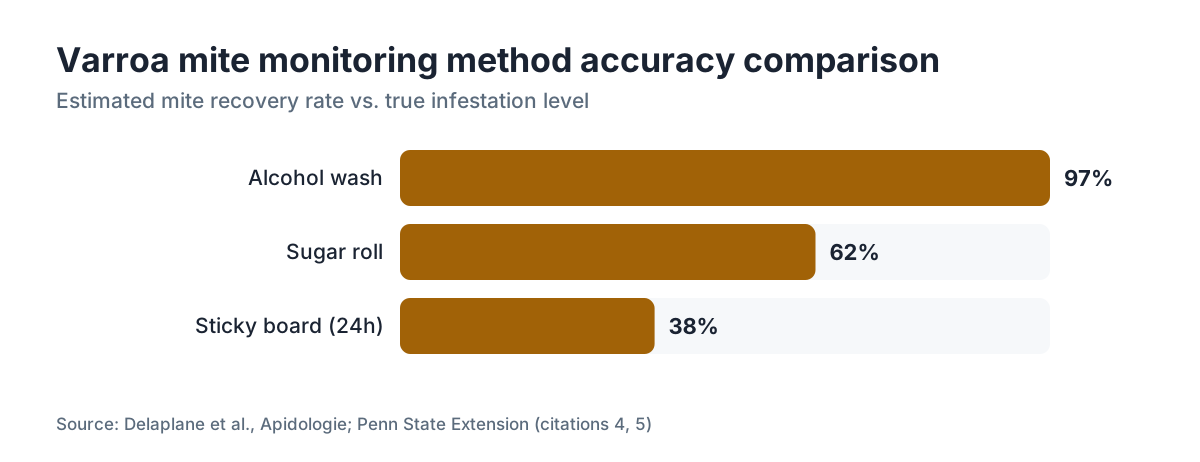
Three methods are practical for hobbyists: alcohol wash, sugar roll, and sticky board counts. The alcohol wash is the most accurate, and most extension programs call it the gold standard [4].
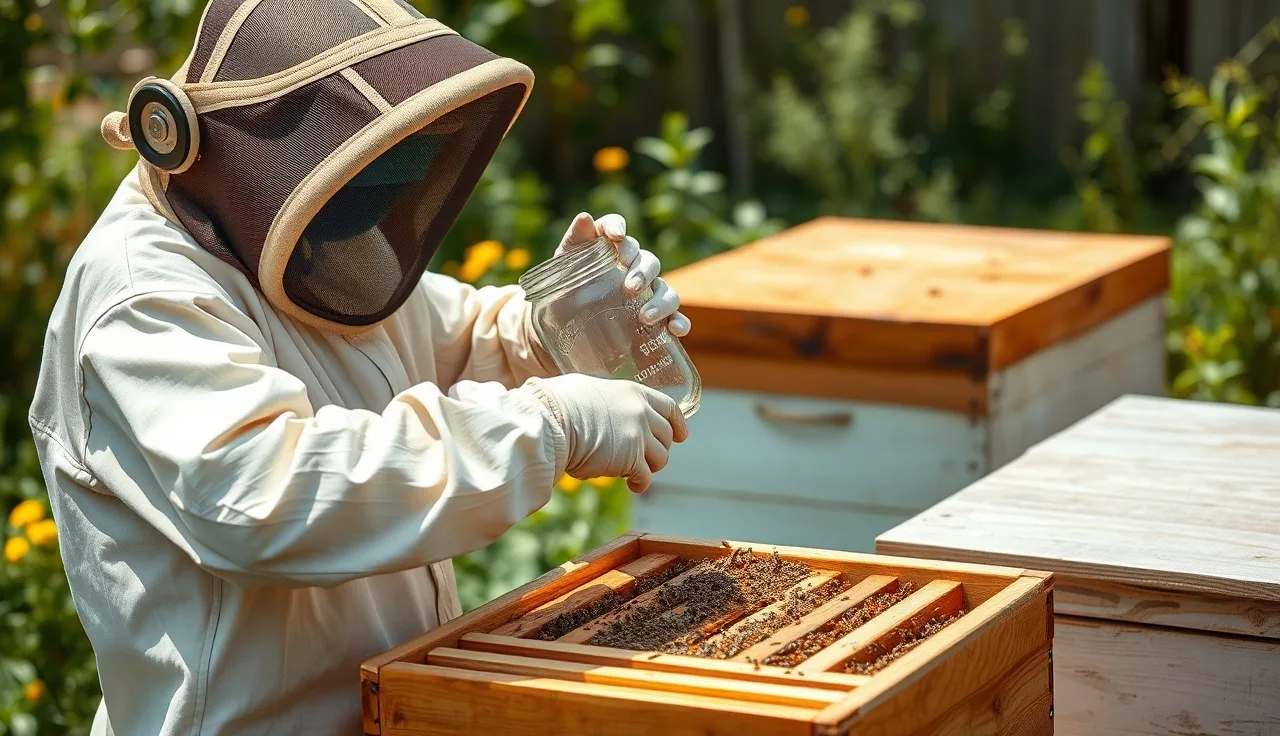
For an alcohol wash, you scoop about 300 bees (roughly half a cup) from a brood frame, drop them in a jar with isopropyl alcohol, shake for 30 to 60 seconds, and count the mites that wash out. Divide mites by total bees, multiply by 100. That's your percent infestation. It kills the sample, which some hobbyists hate, but the sample is tiny against a healthy colony and the number is reliable.
Sugar roll is gentler. The bees survive. But studies show it undercounts mites by 20-40% compared to an alcohol wash [5]. If you go the sugar roll route, shade your threshold downward to cover the gap. A sugar roll reading 1.5% might mean a true load of 2% or higher.
Sticky boards, slid under screened bottom boards for 24 to 72 hours, tell you mites are dropping but won't give you a trustworthy percent infestation without a separate formula that piles on variables. Use them for trends over time, not for a single go/no-go treatment call.
Sample from the busiest brood area, ideally a frame with young open brood where nurse bees cluster. Nurse bees carry the highest mite loads because they spend so much time against brood cells. Sample in the afternoon on a calm day for steadier results.
Monitor every 3-4 weeks during the active brood season, plus once before and once after your main treatment. Most U.S. extension services say start in late April or early May and run through October [4].
What mite level should trigger treatment?
The standard action threshold is 2% during the brood season (spring through early fall) and 1% or lower in late summer and fall, when the long-lived winter bees are being raised [1]. Waiting until loads hit 2% in September is too late in many northern climates. The damage is already baked into the winter cluster.
Here's the seasonal logic:
| Season | Action Threshold | Why It Shifts |
|---|---|---|
| Spring (brood expanding) | 2-3% | Population rising, natural drone brood purge helps |
| Summer peak | 2% | Brood nest full, mites reproducing fast |
| Late summer (July-Aug) | 1-2% | Winter bees start forming, damage is lasting |
| Fall (Sept-Oct) | 1% or any detectable | Protecting winter cluster cohort |
| Winter (broodless) | Any mites present | Ideal treatment window, high efficacy |
These thresholds come from Honey Bee Health Coalition guidance and Pennsylvania State University extension recommendations [1][4]. Some researchers argue 2% is conservative enough for most operations. The late-summer drop to 1% is where a lot of hobbyists lose colonies by waiting too long.
One rule to keep: if you miss a monitoring window and come back to a 4% or higher load, treat now, whatever the season says. At that level, decline is already underway.
Which varroa treatments are available to hobbyists?
Two broad categories exist: organic acids and essential oils (the "soft" treatments) and synthetic acaricides. Every treatment used in the U.S. must be EPA-registered for beehives, and you read the full label every time, because label requirements change [6].
Oxalic acid is the most-used organic option, and for good reason. It's effective, cheap, and has no documented field resistance. Applied as a dribble or as vapor, oxalic acid kills mites riding on adult bees but never touches capped brood. That's why broodless periods are ideal for vaporization: three vaporizations five days apart in winter can drop mite loads by 90% or more [7]. During the brood season, extended-release oxalic acid (approved in the U.S.) works over a longer window by staying in contact with bees as they hatch.
Formic acid (Mite Away Quick Strips or Formic Pro) works differently. It volatilizes and pushes through cappings, killing mites inside brood cells. That makes it useful in the brood season when other options can't reach. Temperature is the catch. Both products have efficacy windows tied to ambient temperature, generally 50-85 degrees F for MAQS and 50-79 degrees F for Formic Pro [6]. Treat outside those windows and you risk queen loss or weak mite kill.
Thymol-based products (Apiguard, ApiLifeVar) work by slow evaporation and need temperatures above 60-65 degrees F. Widely used in Europe and effective, they need four weeks of warm weather to finish a cycle, which squeezes their fall window in northern states.
Synthetic acaricides include amitraz (Apivar strips), tau-fluvalinate (Apistan), and coumaphos (CheckMite+). Apivar is the most reliably effective synthetic in the U.S. right now, with studies showing 93-99% efficacy when used correctly [2]. Apistan and CheckMite+ carry documented resistance in some populations, and many experienced beekeepers treat them as last-resort or resistance-testing tools rather than first choices.
Never apply anything without reading the current EPA label. Honey supers come off before most chemical treatments. Some oxalic acid vaporization labels allow supers on, but confirm the specific product's current label first [6].
How do you rotate treatments to prevent resistance?
Rotate by chemical class, not by brand. Apistan and other tau-fluvalinate products are the same class. Following Apistan with CheckMite+ isn't real rotation if the mites in your area already shrug off one pyrethroid or organophosphate.
A simple rotation most extension services support:
- Summer brood season: formic acid (penetrates brood) or amitraz (Apivar strips, 6-8 week contact)
- Fall, late season: extended-release oxalic acid or a second formic acid application
- Winter broodless window: oxalic acid vaporization (three rounds, 5 days apart)
Write down what you used, in which hive, and when. This sounds like overkill for a two-hive keeper. It isn't. A notebook page or a phone note does the whole job. Skip it and you'll eventually run the same product back to back without noticing.
Resistance to amitraz (the active in Apivar) shows up in some European and South American populations and in isolated U.S. sites [2]. It hasn't spread widely across North America yet. Using Apivar as your only treatment year after year is exactly how that changes. Rotate to organics for at least one treatment cycle per year.
VarroaVault's free protocol planner maps out a full-season rotation calendar if you want a structured starting point.
What cultural practices reduce varroa pressure without chemicals?
Cultural controls won't rescue a colony with a high mite load, but they're real tools that cut how often you treat and how hard you have to hit.
Brood breaks are the strongest cultural control a hobbyist has. A broodless colony forces mites onto adult bees, right where treatments like oxalic acid can reach them. Create a natural break by requeening (5-7 days between queen removal and the new queen laying) or by caging a queen for 21-25 days. Pair a brood break with an oxalic acid treatment and you get one of the most effective single moves available to a hobbyist [7].
Drone brood removal works because varroa prefers drone brood at roughly 8 times the rate of worker brood [3]. Install a frame of drone foundation, let the queen fill it, and pull it just before capping to physically haul out a big mite reservoir. This shines in spring and early summer when natural drone production runs high. It's labor and it doesn't scale past a handful of hives, but for a hobbyist it's a free tool that works.
Requeening with mite-resistant stock is a long game that compounds. Hygienic behavior, varroa sensitive hygiene (VSH), and Minnesota hygienic stock are all commercial traits that measurably lower mite reproduction [4]. VSH data in particular shows colonies holding lower mite loads under the same conditions as unselected stock. No silver bullet. Over a 3-5 year breeding program, it moves the baseline.
Screened bottom boards get mentioned a lot, but the evidence for them on their own is thin. Research estimates natural mite fall through a screen removes only about 10-15% of the population [10]. Use them for monitoring with a sticky board, not as a treatment.
What does a full-year varroa IPM calendar look like for a hobbyist?
This is a northern U.S. template (roughly zone 5-6). Shift it 4-6 weeks earlier for the deep South and later for Canada.
February-March (still clustered, broodless or minimal brood)
Run a sticky board for a baseline. If mites are present and the colony is fully broodless, this is your best oxalic acid vaporization window. Three treatments five days apart. Low stress for the bees, high efficacy.
April-May (brood expanding)
First alcohol wash of the season. Come out of winter without treating and early-spring loads can look deceptively low, then climb fast once brood ramps. Above 2%? Treat now, before the population accelerates.
June-July (peak season, heavy brood, supers possibly on)
Monitor monthly. With supers on, most synthetic treatments are off the table and formic acid label rules vary by product, so know your label. Drone brood removal works well here. If mites hit threshold with supers on, formic acid at a label-compliant temperature is often the best available option.
August (the window that decides your winter)
This is where most hobbyists lose the season. August into early September is when winter bees get raised. Any load above 1% here is a problem. Pull supers and treat. Apivar strips run 42-56 days [6], so a mid-August start finishes by late September or early October, which is right on time.
September-October (pre-winter)
Final alcohol wash of the season. If loads are still up after your summer treatment, a fall oxalic acid treatment (dribble for colonies with some brood, vapor if broodless) knocks them back before the cluster forms.
November-January (overwintering)
Colony is clustered. Watch dead-mite drop on a sticky board to gauge how winter is going. If the colony goes broodless and you missed the earlier windows, oxalic acid vaporization still works in mild weather above freezing.
How do you track your IPM results and know if your plan is working?
Records tell you whether your IPM plan actually works. Nothing else does. Here's the minimum useful data per hive, per inspection:
- Date
- Mite count and method
- Treatment applied (product, dose, dates started and ended)
- Queen status
- Colony strength (frames of bees, frames of brood)
No software required. A spiral notebook does it. But if you want to read patterns across seasons, a spreadsheet or a dedicated tool helps you catch things like which colonies keep running high (candidates for requeening) and whether your August treatment actually drops loads below threshold by October.
The real test of a plan is winter survival and spring buildup. Lose 20-30% of colonies over winter, which is about the national hobbyist average in recent USDA surveys [8], and varroa management is the first variable to check. That's not a scolding. It's just where the data points.
VarroaVault's free monitoring log and treatment tracker lets you log washes and treatments by hive and date, and it flags when you're overdue for your next monitoring window based on your last entry.
For monitoring tools, vaporizers, and treatment products, a full kit list from reputable beekeeping supply companies saves you time early in the season when things sell out fast. Start with the basics from your favorite beekeeping supplies source.
What are the most common varroa IPM mistakes hobbyists make?
Skipping the August monitoring window is the single most expensive mistake. Most beekeepers who lose hives over winter never got a mite count in late summer. By the time they find a dead colony in January, the collapse started back in September.
Treating without counting first is the next one. You spot a few bees with deformed wings, assume the worst, and dose. Maybe that's the right call. Maybe the load is 0.5% and the virus arrived by another route. Counting first costs ten minutes and makes you a sharper beekeeper.
Skipping the follow-up wash. Most hobbyists never do it, and they should. A post-treatment count 3-4 days after an Apivar strip comes out (or 3-7 days after an oxalic acid treatment) tells you whether the treatment worked. If the load barely moved, either the application was wrong or you have a resistance problem. You need that answer before winter.
Using the same product year after year. Covered in the rotation section, but worth repeating because it's so common. Apivar works. Running it every single treatment cycle for three years is a great way to help resistance along.
Waiting for symptoms. Deformed wing virus (DWV), the main virus varroa spreads, shows visible deformity only when the colony is already under heavy mite pressure. See crawling bees with crumpled wings and you're late. Monitor before symptoms, not after.
Are there resources or tools that can help you build your varroa IPM plan?
The Honey Bee Health Coalition's Tools for Varroa Management guide is the best free resource for a hobbyist building an IPM plan. It covers every approved treatment, dosing, timing, and temperature limits in plain language. Find it at honeybeehealthcoalition.org [1].
Pennsylvania State University's extension apiculture program has some of the clearest monitoring tutorials online, including video walkthroughs of the alcohol wash [4]. Michigan State University and the University of Minnesota publish solid extension resources for their own climates too.
The EPA's pesticide registration section is where you confirm a product is currently registered for honey bee colonies. Labels change. The legal label is the one on the EPA site, not the one printed on last season's package [6].
Want the biology side? The review by Rosenkranz, Aumeier, and Ziegelmann (2010) in the Journal of Invertebrate Pathology is the foundational scientific treatment of varroa biology and management, covering reproductive rates, host preferences, and resistance mechanisms [3].
State departments of agriculture often ask or require you to register your apiary, and some offer free inspections through their apiarist programs. Worth checking, because state apiarists usually know which treatments are losing efficacy in your region [9].
Frequently asked questions
How often should a hobbyist beekeeper monitor for varroa?
Every 3-4 weeks during the active brood season, which runs roughly April through October across most of the U.S. The two windows that matter most are late spring, before the summer buildup, and late summer (July through August), when winter bee production is on the line. An alcohol wash is the most accurate method for these counts, per Honey Bee Health Coalition guidance.
What is the 2% varroa threshold and is it right for every situation?
The 2% threshold (2 mites per 100 bees) is the standard action level during the summer brood season. In late summer and fall, most extension programs drop it to 1% because winter bees are being raised and mite damage then carries long-term consequences. The 2% figure assumes a reliable alcohol wash; sugar roll counts need adjustment because they undercount by 20-40%.
Can you treat varroa without using any chemicals at all?
Oxalic acid and formic acid are organic compounds many beekeepers accept, but strictly chemical-free varroa control is very hard to sustain. Drone brood removal, brood breaks, and mite-resistant genetics all help, yet none reliably hold mite populations below threshold on their own in most climates. Most experienced hobbyists use organic acids as part of their plan even when they prefer minimal intervention.
Is oxalic acid safe to use with honey supers on?
Some oxalic acid product labels allow application with honey supers on; others don't. The specific label for the product in your hands is the legal and practical guide. For example, the Api-Bioxal label (EPA Reg. No. 86797-3) has specific language about super use. Always read the current EPA-registered label, not last season's instructions, because label language gets updated.
How do you do an alcohol wash for varroa correctly?
Collect about 300 bees (roughly half a cup) from a brood frame, ideally including nurse bees. Add them to a jar of 70% isopropyl alcohol, seal, and shake hard for 30-60 seconds. Pour through a mesh screen and count the mites in the alcohol. Divide mite count by bee count and multiply by 100 for your percent infestation. Pennsylvania State University extension publishes a step-by-step video guide.
What is varroa-sensitive hygiene (VSH) and does it actually work?
VSH is a heritable trait where workers detect and remove mite-infested pupae before mite reproduction finishes. Research, including work from USDA ARS Baton Rouge, shows VSH colonies suppress varroa reproduction significantly compared to unselected stock. It's real and measurable. VSH genetics dilute within a season or two in open-mated populations, so ongoing requeening with selected stock is needed to hold the benefit.
How long should Apivar strips stay in the hive?
Apivar (amitraz) strips should stay in the hive at least 42 days and no more than 56, per the product label. Pull them early and efficacy drops; leave them too long and you raise the risk of residue in wax. Remove honey supers before inserting strips, and put supers back only after the strips come out and the label's waiting period passes.
What temperature do I need for a formic acid varroa treatment to work?
Mite Away Quick Strips (MAQS) need ambient temperatures of 50-85 degrees F during the 7-day treatment. Formic Pro has a similar window, roughly 50-79 degrees F. Go above the upper limit and you risk queen loss and bee mortality. Below the lower limit, the acid won't volatilize enough and mite kill suffers. Temperature is the most common reason formic acid treatments fall short.
How do I know if my varroa treatment worked?
Do a follow-up alcohol wash 3-7 days after treatment ends (timing varies by product). Compare loads before and after. A successful treatment should show at least a 90% reduction. If the drop is smaller, check your application method, confirm the treatment stayed in-hive for the full required duration, and consider whether resistance is a factor in your apiary.
Should I treat all my hives at the same time?
Yes. Treating every colony in the apiary at once prevents re-infestation. Mite spread through robbing and drifting between hives is well documented. Treat one hive but leave a high-mite neighbor untreated and mites move back into your treated colony within weeks. Synchronize your treatment dates across all colonies. If neighbors within flight range keep untreated hives, that's a source you can't fully control but should track.
Does a screened bottom board help control varroa?
Only marginally, and not enough to count as real control. Research estimates screened bottom boards cause a natural mite fall but remove only about 10-15% of the mite population. They're genuinely useful for monitoring (place a sticky board underneath for 24-72 hours), but don't substitute them for actual treatment when mite loads exceed threshold.
What's the difference between a varroa IPM plan and just treating twice a year?
Treating twice a year on a fixed calendar beats nothing, but it isn't IPM. True IPM means you monitor first, decide whether treatment is warranted from actual loads and colony context, pick the best treatment for that timing and temperature, rotate chemical classes on purpose, and verify it worked. Fixed-schedule treating leads to needless treatments at low loads or missed treatments when the schedule doesn't match a mite spike.
When is the best time of year to do a brood break for varroa control?
Late summer, roughly late July through August, is the highest-value window because it lines up with winter bee production. A brood break then, paired with oxalic acid vaporization, can sharply cut mite loads going into fall. Spring brood breaks help too, but summer carries the biggest long-term survival payoff. Requeening naturally creates a 3-4 week break you can pair with treatment.
Do I need to register my apiary with the state to use varroa treatments?
Registration rules vary by state. Some require apiary registration before you apply any EPA-registered pesticide on bees; others don't. Your state department of agriculture's apiarist or plant industry division is the right contact. Registration is often free or low-cost and sometimes comes with free inspections, which can be genuinely useful for a hobbyist who wants a second opinion on colony health.
Sources
- Honey Bee Health Coalition, Tools for Varroa Management Guide: Monitoring is the cornerstone of any IPM program; 2% action threshold during brood season
- Elzen PJ et al., Apidologie, Resistance to acaricides in Varroa destructor: Tau-fluvalinate and coumaphos resistance documented in U.S. varroa populations; Apivar showing 93-99% efficacy when used correctly
- Rosenkranz P, Aumeier P, Ziegelmann B, Journal of Invertebrate Pathology 2010: Varroa preferentially infests drone brood at roughly 8x worker brood rate; exponential population growth during brood season; one to two viable daughters per brood cycle
- Penn State Extension, Apiculture Program, Varroa Monitoring and Management: Alcohol wash recommended as gold standard monitoring method; monthly monitoring April through October; 1% fall threshold; VSH genetics measurably reduce mite reproduction
- Delaplane KS et al., Apidologie, Comparison of varroa sampling methods: Sugar roll undercounts mites by 20-40% compared to alcohol wash
- U.S. EPA, Pesticides program: EPA registers all treatments for use in beehives; label is the legal document; Apivar strips 42-56 day treatment window; MAQS temperature window 50-85F
- Gregorc A et al., Apidologie, Oxalic acid vaporization efficacy in broodless colonies: Three oxalic acid vaporizations 5 days apart in broodless colonies can reduce mite loads by 90% or more
- USDA NASS, Honey Bee Colonies report: National hobbyist winter colony loss rates averaging approximately 20-30% in recent annual surveys
- USDA ARS, Baton Rouge Honey Bee Lab, VSH Research Program: VSH colonies suppress varroa reproduction significantly compared to unselected stock
- University of Minnesota Bee Lab, Varroa Management Resources: Mite-resistant stock including Minnesota hygienic lines commercially available; screened bottom boards remove approximately 10-15% of mite population
Last updated 2026-07-09