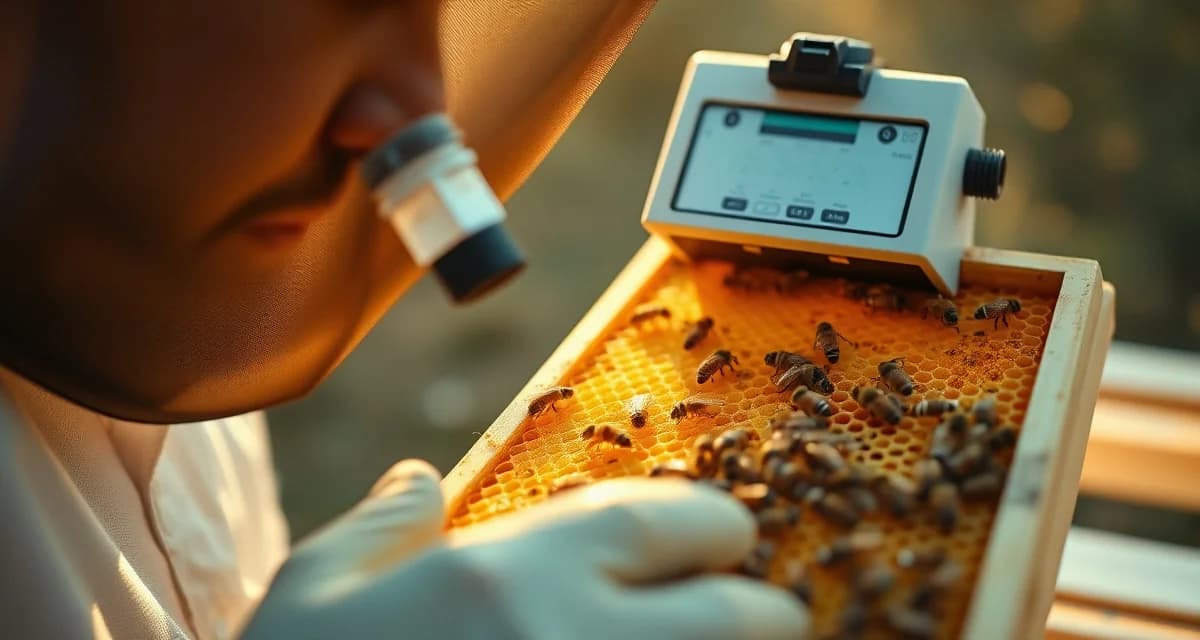
Integrated Pest Management for Bees: A Practical IPM Guide
Most beekeepers treat for varroa. Fewer actually manage varroa. The difference is integrated pest management for bees, a structured framework that replaces guesswork with data, and calendar spraying with threshold-based decisions.
IPM isn't new. It's been the gold standard in agriculture for decades. But in beekeeping, most hobbyists and even some commercial operators still treat on intuition or habit rather than measured need. IPM-based approaches reduce pesticide use by 50-80% while maintaining colony health equivalent to calendar-based programs. That's not just better for your bees. It's better for your honey, your wallet, and your resistance management.
This guide explains the IPM framework, how it applies specifically to varroa, and how to build a program around it.
TL;DR
- Integrated pest management (IPM) for varroa combines monitoring, threshold-based decisions, and treatment rotation
- Treating without a mite count is guessing; the count tells you whether you need to treat and how urgently
- IPM reduces overall chemical use by ensuring treatments happen when needed, not on a fixed calendar
- Treatment rotation prevents resistance buildup by alternating modes of action across cycles
- Post-treatment counts verify that treatment worked; lack of efficacy tracking is the most common IPM gap
- VarroaVault supports IPM by tracking pre/post counts, efficacy scores, and treatment rotation history
What Is Integrated Pest Management?
IPM is a decision-making framework, not a specific treatment or product. The core idea is that you manage pest populations using the most economical means possible, with the least disruption to the surrounding system, and only intervene when pest levels actually justify it.
In practice, that means four things:
- Monitor pest populations regularly
- Set thresholds that define when action is required
- Choose appropriate interventions based on the situation
- Evaluate outcomes and adjust
Applied to bees, the "pest" is varroa and the "surrounding system" is your colony. The framework keeps you from over-treating (which drives resistance and harms bees unnecessarily) and under-treating (which lets mite populations explode).
The Honey Bee Health Coalition's 4-Step Framework
The HBHC has codified bee IPM into a specific 4-step framework that VarroaVault is built around. It's practical, science-based, and designed for real beekeepers rather than researchers.
Step 1: Monitor
Testing is the foundation. You can't make a threshold decision without data. The HBHC recommends monitoring at least every 30 days during the active season, and before and after every treatment.
The preferred method is alcohol wash: a sample of 300 bees washed in 70% alcohol or windshield washer fluid. Count the mites, divide by bees, multiply by 100. That gives you a percentage infestation rate.
sugar roll is acceptable for beekeepers who don't want to sacrifice sample bees. It's slightly less accurate but still useful, especially for small hobby operations.
The important thing is consistency. Use the same method every time, take samples from the same part of the colony (nurse bee area near the bottom of the brood nest), and record your results.
Step 2: Set Thresholds
A treatment threshold is the mite infestation level at which treatment is economically and biologically justified. Below the threshold, the colony can sustain itself. Above it, the population trajectory becomes a problem.
The HBHC revised its thresholds in 2025. Current recommendations:
| Season | Treatment Threshold |
|---|---|
| Spring (March-May) | 2% infestation |
| Summer (June-Aug) | 2% (1% heading into flow) |
| Fall (Aug-Sept) | 1%, critical window for winter bees |
| Winter | Test broodless colonies before they cluster |
These aren't hard ceilings. They're decision points. A colony at 1.8% in August might still need treatment if it's your strongest honey producer with a lot of capped brood, because mite populations will spike fast.
Thresholds are also local. In high-density beekeeping areas with above-average reinfestation risk, some experienced beekeepers use tighter thresholds. Track your own data over time and you'll learn what the numbers actually mean for your colonies.
Step 3: Choose Interventions
When your mite count crosses the threshold, you act. The right intervention depends on several factors: time of year, brood status, temperature, whether honey supers are on, and your overall treatment rotation planning.
Key intervention options:
Oxalic acid vaporization: No brood penetration, so requires multiple treatments if brood is present. Zero PHI. Low resistance risk. Works any temperature. Best for fall/winter.
Formic acid (Formic Pro / MAQS): Penetrates capped brood. Zero PHI. Temperature-limited (50-85°F). Best for flow season and early fall.
Amitraz (Apivar): Penetrates brood. 14-day PHI. Resistance emerging in some areas. Easy to use, highly effective. Good for late season when temperature drops.
Mechanical interventions: Brood breaks, splits, trap combs, drone brood removal. These reduce mite loads without any chemical inputs, and they work well as part of an IPM program to extend intervals between chemical treatments.
Mechanical methods alone rarely provide sufficient control, especially in high-mite-pressure seasons. But combined with chemical treatment at the right time, they meaningfully reduce your overall treatment frequency.
Step 4: Evaluate
This is the step most beekeepers skip. You treat, and then you assume it worked. But treatment efficacy varies based on application technique, temperature, product age, and mite resistance.
Do a post-treatment count 2-3 weeks after treatment completion. If your mite level dropped by 90% or more, the treatment worked. If it dropped by 70%, something went wrong, whether bad application, resistance, or a major reinfestation event.
The data from your evaluation feeds back into the next monitoring cycle. That's what makes it a loop rather than a one-off event.
How IPM Differs From Calendar-Based Treatment
Calendar-based treatment means you apply a product in spring and fall regardless of your actual mite levels. It's simple, and it does provide some protection.
But it creates several problems. You may treat when mites are already below threshold, which wastes money and exposes your bees to unnecessary chemical stress. You may also treat with the same products in the same sequence year after year, accelerating resistance development.
IPM doesn't mean you never treat on a schedule. Fall treatment timing is specific enough (August-September, before winter bees are raised) that most IPM beekeepers do set a fall treatment date. But they verify the need first, and they verify the outcome after.
The practical difference is that an IPM beekeeper can look back at their records and see: "August mite count was 2.3%, I treated with OA vaporization on August 12, post-treatment count September 4 was 0.4%. Good result." A calendar beekeeper just knows they treated in August.
Building an IPM Program With VarroaVault
VarroaVault was designed from the ground up around the IPM framework. The IPM checklist inside the app mirrors the HBHC 4-step process, so each monitoring event, threshold decision, treatment choice, and post-treatment evaluation has a structured place to live.
Here's how the workflow maps:
Monitoring: Log mite counts directly from your phone in the apiary. The app calculates infestation rate automatically and flags any count that crosses your threshold.
Thresholds: Set seasonal thresholds in account settings. VarroaVault applies them automatically and sends alerts when a colony's count gets close to or exceeds your limit.
Treatment selection: When you log a treatment, the app records the product, active ingredient, application method, and date. It calculates your PHI deadline and posts a post-treatment reminder.
Evaluation: Post-treatment count fields are linked to the original treatment record, so you can see before/after data side by side and track treatment efficacy over time.
The complete varroa management guide covers each treatment option in detail, including current EPA registrations and label requirements. That content is designed to work alongside your VarroaVault records, not replace the reading you should be doing on your own.
Common Mistakes in Bee IPM
Testing at the wrong time of year. Many beekeepers test in June or July but skip the fall window. The August-September count is the most important one of the year.
Using raw mite counts instead of percentages. Ten mites in a strong 60,000-bee colony is fine. Ten mites in a weak spring colony with 15,000 bees is a crisis. Always calculate the percentage.
Not doing post-treatment counts. You can't manage resistance or evaluate products without before/after data.
Treating with the same product every cycle. Rotate active ingredients. At minimum, use two different classes per year.
Treating too late in fall. Colonies entering October without having completed fall treatment are high-risk. The winter bees are already being raised.
Related Articles
FAQ
What is integrated pest management for bees?
Integrated pest management for bees is a structured approach to varroa control that uses regular monitoring, threshold-based treatment decisions, appropriate treatment selection, and outcome evaluation. It's the framework recommended by the Honey Bee Health Coalition as the gold standard for varroa management. IPM doesn't mean avoiding treatments. It means using them strategically based on actual mite data rather than habit or calendar dates.
How does the IPM framework apply to varroa?
Varroa management under IPM means testing mite levels at least monthly during the active season, acting when counts exceed seasonal thresholds (2% spring/summer, 1% fall), choosing treatments appropriate for your conditions and brood status, and verifying treatment efficacy with a post-treatment count. The loop, monitor, decide, treat, evaluate, repeats throughout the season. The result is fewer unnecessary treatments and better outcomes because you're catching problems early and confirming your interventions actually worked.
Does VarroaVault support an IPM-based approach?
Yes. VarroaVault's entire design is organized around the HBHC 4-step IPM framework. The in-app checklist guides you through monitoring, threshold alerts trigger when counts approach your set limit, treatment logs track active ingredients for rotation management, and post-treatment reminders prompt you to do the evaluation count. If you follow the app's workflow, you're automatically running an IPM program.
How do I know if my varroa treatment is working?
Run a mite count 2-4 weeks after the treatment ends and compare it to your pre-treatment count. The efficacy formula is: ((pre-count - post-count) / pre-count) x 100. A result above 90% indicates effective treatment. Results below 80% should trigger investigation for possible resistance, application error, or reinfestation. Log both counts in VarroaVault to track efficacy trends across treatment cycles.
How often should I check mite levels in my hives?
At minimum, once per month (every 3-4 weeks) during the active season. Increase to every 2 weeks when counts are near threshold or after a treatment to verify it worked. In fall, monitoring frequency matters most because the window to treat before winter bees are raised is narrow. VarroaVault's monitoring reminders can be set to your preferred interval for each apiary.
What records should I keep for varroa management?
Each record should include: date of count or treatment, hive identifier, monitoring method used, number of bees sampled, mites counted, infestation percentage, treatment product name and EPA registration number, dose applied, treatment start and end dates, and PHI end date. State apiarists typically expect this level of detail during inspections. VarroaVault captures all of these fields in a single log entry.
What is Integrated Pest Management for Bees: A Practical IPM Guide?
Integrated Pest Management (IPM) for bees is a structured framework for controlling varroa mites that replaces guesswork with data-driven decisions. Rather than treating on a fixed calendar, IPM combines regular mite monitoring, threshold-based treatment triggers, and treatment rotation to reduce chemical use by 50-80% while maintaining colony health. This guide covers how to build a full IPM program specific to varroa management.
How much does Integrated Pest Management for Bees: A Practical IPM Guide cost?
This guide on Integrated Pest Management for bees is free to read on VarroaVault. The IPM strategies, monitoring protocols, and treatment frameworks described are educational resources available at no cost. Any treatments you implement based on the guide — such as oxalic acid or other approved miticides — will carry their own product costs, but the knowledge and framework itself is provided freely to help beekeepers manage varroa more effectively.
Sources
- American Beekeeping Federation (ABF)
- USDA ARS Bee Research Laboratory
- Honey Bee Health Coalition
- Penn State Extension Apiculture Program
- Project Apis m.
The Bottom Line
IPM for bees isn't complicated. It's disciplined. It requires that you test on a schedule, that you make decisions based on what the numbers say, and that you close the loop by verifying your treatments worked.
Most beekeeping losses from varroa aren't from lack of treatment options. They're from delayed monitoring, missed windows, and no follow-up. A structured IPM program closes all three of those gaps. The framework is there. The tools are there. You just have to use them.
Get Started with VarroaVault
The information in this guide is most useful when you have your own mite count data to apply it to. VarroaVault stores every count, flags threshold crossings automatically, and builds the treatment history you need for state inspections and effective management decisions. See pricing and free tools at varroavault.com.