Installing Apivar strips: the complete step-by-step guide
TL;DR
- Apivar strips hold 3.3% amitraz and hang between brood frames where bees walk across them.
- Use 1 strip per 5 frames of bees, minimum 2 and maximum 4 per colony.
- Leave them in 6 to 10 weeks, never longer.
- Wear nitrile gloves, keep strips off the bottom board, and count mites before and after to confirm it worked.
What is Apivar and how does it kill varroa mites?
Apivar is an amitraz-based acaricide the EPA registered for varroa control inside honey bee colonies. Each plastic strip carries 3.3% amitraz, a formamidine compound. It works as a monoamine oxidase inhibitor and an octopamine agonist in arthropods, which scrambles the mite's nervous system. Bees pick up residue as they walk across the strip, then carry it through the colony on their bodies, passing it to mites during grooming and cell-capping. [1]
Here is the catch. Amitraz does not reach mites hiding inside capped brood cells. Those mites sit under the wax caps, shielded from the chemical. That single fact drives everything about how you use the product. The label sets a six-week minimum exposure for exactly this reason: you need at least two full brood cycles to pass so emerging bees contact the strips after their cells open. Pulling strips at four weeks is one of the most damaging mistakes a beekeeper can make. [2]
Apivar is over-the-counter in the United States. No veterinarian's prescription, unlike some other bee medications. The EPA registration number is 67517-5, and Veto-Pharma makes it. [1]
When should you install Apivar strips?
Treat when adult bees are present, but timing changes both how well it works and how safe it is for the colony. Most extension programs point to two windows: late summer (July through August in the northern hemisphere) right after honey supers come off, and early spring before the colony builds up. [3]
Late summer is the window that matters most. By late July or early August the spring flow is done, supers are off, and mite counts climb fast as the bee population starts to shrink. Let mites run unchecked into September and October and they will infest the winter bees your colony depends on to survive. No treatment in November undoes that.
Spring treatment earns its place if your winter counts come back high, or if last fall's treatment fell short. Get strips out before the first real nectar flow so they are gone before supers go on. The label bans Apivar with honey supers in place because amitraz and its breakdown products can end up in honey. [1]
Skip treatment in full summer heat when daytime temperatures push past 105 degrees Fahrenheit (40 degrees Celsius). Amitraz volatilizes faster when it is hot, and queen loss appears to rise in extreme heat. Nobody has clean controlled-trial data on this. The pattern shows up in beekeeper reports and in cautionary language from several extension programs. [4]
How many Apivar strips do you need per hive?
The label is blunt: 1 strip per 5 frames of bees, minimum 2 strips per colony, maximum 4 strips per colony no matter how big the hive gets. Most standard 10-frame Langstroth colonies land at 2 strips. A genuinely strong double-deep covering 8 or more frames might warrant 4, and that is the ceiling. [1]
Do not eyeball it. Pull a few frames and count how many carry solid bee coverage. A frame covered on both sides counts as one. A frame with bees on one side counts as half. Guess high and you underdose; guess low and you waste money leaving residue in a thin hive.
Nucs and small colonies still get the 2-strip minimum, even if the cluster only covers 3 or 4 frames. You need enough contact surface spread through the cluster, and two strips is the floor.
Here is a simple reference table:
| Frames of bees | Strips needed | Notes |
|---|---|---|
| 1 to 5 | 2 (minimum) | Minimum per label regardless of size |
| 6 to 10 | 2 | Standard 10-frame Langstroth |
| 11 to 15 | 3 | Strong double-deep colony |
| 16 to 20 | 4 (maximum) | Do not exceed 4 per colony |
The Honey Bee Health Coalition's Varroa management guide gives the same dosing structure and tells you to count frames rather than guess. [3]
What equipment do you need before you open the hive?
Not much, but each item earns its spot. Nitrile gloves are required, not optional. Amitraz absorbs through skin and it is a pesticide. Some beekeepers wear a thin nitrile layer under their usual leather or rubber gloves. Wash your hands after handling strips even if you wore gloves the whole time. [1]
You will also need:
- A hive tool to move frames and set the right spacing
- A permanent marker or small adhesive label to note the installation date on the hive or the strip tab
- A container or zip-lock bag for used strips, because disposal matters
- Your normal gear: veil, jacket, smoker
Count mites right before you treat so you have a baseline. A quick alcohol wash or sugar roll before you open the package gives you a pre-treatment number to compare against a post-treatment count 48 hours after strip removal. The Honey Bee Health Coalition recommends this monitoring approach for confirming a treatment worked. [3] If you want a systematic way to track those counts against your treatment calendar, tools like those at VarroaVault make the record-keeping easier.
For the basic gear worth spending on, see our beekeeping supplies guide.
How do you actually install Apivar strips, step by step?
Step 1: Remove honey supers. Apivar cannot go on while supers are on. This is a label requirement, not a suggestion. If a super is still on, pull it first. [1]
Step 2: Open the package with gloves on. Each Apivar package holds 10 strips, enough for 5 standard colonies. The strips are plastic and pliable, with a small hole in the top tab for hanging.
Step 3: Find the brood nest. Strips go where bees are densest, which is in and around the brood frames. In a single deep, that is easy. In a double deep, put strips in the lower box if most brood is there, or split them if the brood nest spans both boxes.
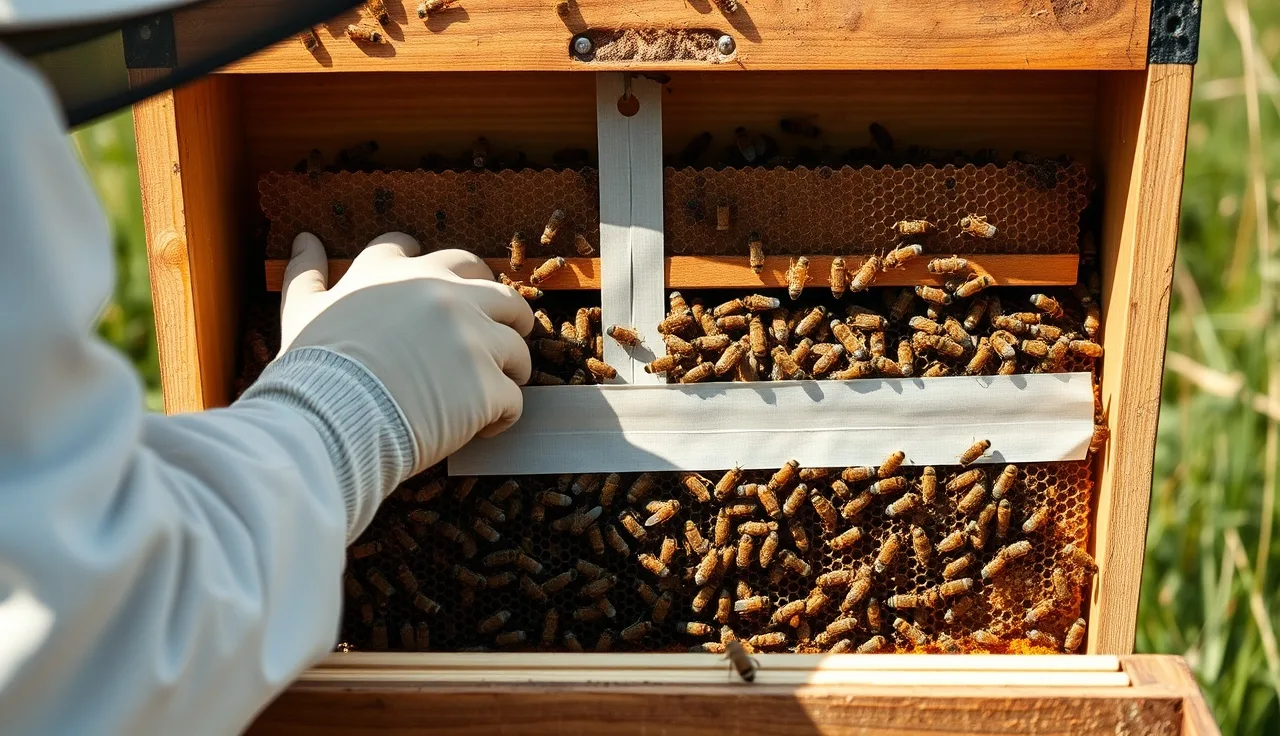
Step 4: Hang strips between frames, never flat on top. The strip drops down between two brood frames, with the notch at the top sitting over a top bar. One strip goes between frames 3 and 4, the other between frames 7 and 8 in a standard 10-frame box. That brackets the brood nest from both sides instead of clustering them in the center. [1]
Step 5: Do not crowd the frames so tight the strip cannot touch bees. You want the strip touching or nearly touching bees as they pass. If your frames are already bee-tight, that happens on its own. If empty frames are taking up space, pull them or nudge frames apart so bees concentrate near the strips.
Step 6: Mark the date. Write the installation date on the hive box or the strip tab. You have 6 to 10 weeks to pull them. A hive you neglect for a few weeks can slide past the 10-week maximum before you notice.
Step 7: Close the hive. Leave it alone for at least two weeks. The bees need that time to move the compound through the colony.
Where exactly in the hive should the strips be placed?
Placement sets contact time, and contact time sets efficacy. Strips need to hang in the busiest bee traffic, which is the brood frames. Park them at the outer edges where few bees walk and you waste the treatment. [2]
For a single 10-frame box, hang one strip between frames 3 and 4 and the second between frames 7 and 8. That brackets the brood nest on both sides.
In a two-box setup, the late-summer brood nest often spans part of both boxes. Put one strip in the lower box and one in the upper, both in the brood area rather than at the edges. Beekeepers with very strong double-deeps sometimes run 4 strips (2 per box), which stays inside the label maximum.
For a varroa mite infestation that survived prior treatments, keeping strips close to the center of the brood nest matters even more, because that is where mites reproduce.
Never lay strips flat on the bottom board. Never jam them under a frame. They hang, full stop. A strip pinned between frames with no bee contact does close to nothing.
How long do Apivar strips stay in the hive?
The label sets a minimum of 6 weeks and a maximum of 10 weeks. Both ends matter. [1]
Six weeks is the floor because varroa reproduce inside capped brood, and one worker brood cycle (roughly 21 days) is not enough to expose every mite. You need two full cycles. Six weeks covers that with a little margin.
Ten weeks is the ceiling because long exposure lets amitraz residue build up in wax, where it can linger. A 2010 review by Bogdanov reported amitraz and its metabolite DMPF in beeswax from treated hives, and the worry is that heavy residue from overly long treatments stresses colonies and drives sub-lethal effects on bees. The label's hard stop at 10 weeks reflects that. [8]
In practice, 6 to 8 weeks covers most late-summer windows. Treat in early August, pull strips mid-September to early October, and colonies get time to raise clean winter bees before cold sets in. Hitting that perfectly every year is hard. Aim for it anyway.
Forget and leave strips in 11 or 12 weeks? Do not panic. Pull them right away and write it down. Repeated over-exposure across seasons is the real problem, not a single two-week slip.
Can Apivar be used with a queen present, and what about queen loss?
Yes. Queens can stay in the hive during treatment, and under normal conditions they do fine. The label does not require removing the queen. [1]
Still, reports of queen loss during Apivar treatment exist, and they cluster around a few conditions: extreme summer heat, queens that were already marginal, and misplaced strips pressed against a queen in a small cluster. None of this is proven in a controlled trial that I know of. The pattern is steady enough to respect.
So here is what I do. Skip treatment in peak heat above 100 to 105 degrees Fahrenheit. Check the colony at the two-week mark to confirm the queen is still laying. Spot a laying gap or emergency queen cells, and investigate before you blame the treatment.
For a genuinely new and valuable queen, some beekeepers treat before reintroduction so the colony is clean when she arrives. That is a fair precaution.
How do you know if the Apivar treatment worked?
Count mites before and after. That is the only honest test. The Honey Bee Health Coalition recommends a post-treatment alcohol wash or sugar roll 48 hours to a week after strip removal, then comparing it to your pre-treatment baseline. [3]
A well-run Apivar treatment should knock mite levels down 90% or more in most colonies. If your pre-treatment wash showed 5 mites per 100 bees and the post-treatment wash shows 4, something failed: wrong dose, early removal, amitraz resistance, or reinvasion from a collapsing neighbor.
Amitraz resistance in varroa is real and documented, though it is less widespread than pyrethroid resistance, which is near-universal and why the old Apistan product has largely quit working. A 2021 paper in Scientific Reports found amitraz resistance mutations in US varroa populations, tied to changes in the octopamine receptor gene. [5] If your colonies keep running high after a correct treatment, call your state apiarist or switch to a non-amitraz product for one cycle.
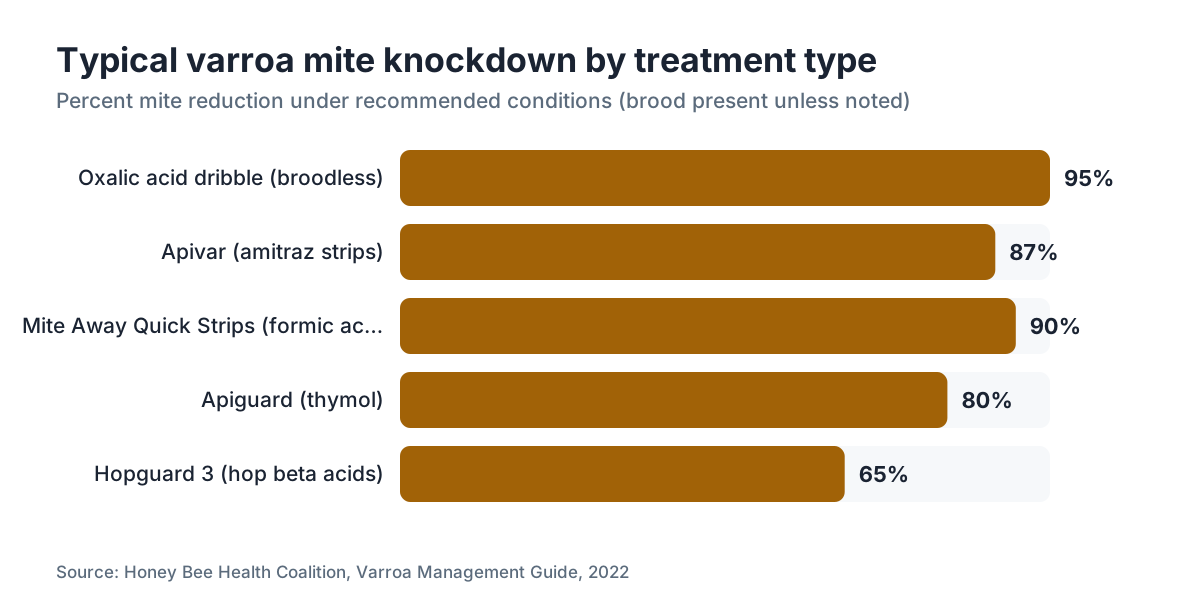
For most beekeepers treating correctly or rotating amitraz with oxalic acid, efficacy holds up. Expect roughly 90 to 95% knockdown in broodless or low-brood conditions, and 75 to 90% during full brood season.
How do you remove and dispose of used Apivar strips?
Gloves on again. Used strips still carry amitraz and should not go bare-handed. Pull each strip from between the frames, using your hive tool if propolis has glued the tabs in place after several weeks.
The label calls for disposal as solid waste in household trash. Do not compost them, do not burn them, and do not leave them in past the 10-week maximum. Some states run pesticide disposal programs that take agricultural chemicals, which is a cleaner route if one operates near you. [1]
Even strips that are not fully spent still carry amitraz. Do not reuse a strip in a second colony or hold one for a later treatment. The label covers a single use only.
After removal, run your mite count within one to two weeks and record it. That number tells you whether to follow up with a different product (oxalic acid is a common follow-up for residual mites) or wait for your next monitoring date.
What are the most common Apivar installation mistakes?
Pulling strips too early is the single most common error. Six weeks feels long, especially when you peek at week four and see a healthy-looking colony. The mites inside capped brood are still there. Leave the strips in. [2]
Using too few strips is a close second. Treat a strong double-deep with 2 strips instead of 4 and you cut your contact surface in half. Read the dosing table and follow it.
Leaving honey supers on is both a label violation and a food safety problem. Amitraz can taint honey. Pull the supers, treat, then put them back after strip removal if a fall flow is coming. [1]
Laying strips flat instead of hanging them. A strip on the bottom board touches almost no bees and does almost nothing. Hang them between frames.
Skipping the installation date. Sounds trivial. It is not. Beekeepers who never write down the date lose track and either pull early or run strips for 14 weeks.
Skipping the pre-treatment mite count leaves you blind on whether the treatment worked. Two minutes with an alcohol wash before you open the package gives you data that matters.
Is Apivar safe to use, and what are the human health precautions?
Amitraz is a pesticide and deserves respect, but the EPA registered it specifically for use in beehives at the concentrations in Apivar strips. Follow the label and the risk to you stays low. [1]
The main precautions are short. Wear nitrile gloves every time you handle strips. Wash your hands after. Do not eat or smoke while working with them. Amitraz can cause skin sensitization in some people with repeated exposure. Notice skin irritation or symptoms like dizziness or nausea after handling strips, take it seriously and see a physician.
Amitraz is toxic to dogs. Keep used strips and packaging where dogs cannot reach them. Veterinary cases of amitraz poisoning in dogs from Preventic tick collars (which also use amitraz) are documented, and the toxicity mechanism is the same. Keep this material away from pets.
For bees, Apivar has a well-established safety record at label rates when used correctly. Brood risk stays low because amitraz contact at these concentrations does not appear to cause meaningful larval death. Queen risk, as covered above, shows up mainly in high heat. [4]
How does Apivar compare to other varroa treatments?
Every varroa treatment has its own mechanism, efficacy window, and set of constraints. Here is an honest comparison:
| Treatment | Active ingredient | Brood penetration | Efficacy (typical) | Temperature limits | Honey super safe? |
|---|---|---|---|---|---|
| Apivar | Amitraz (3.3%) | No | 75-95% | Below ~105°F | No |
| Oxalic acid dribble | Oxalic acid | No | 90-99% (broodless) | Above ~40°F | Yes (no brood) |
| Mite Away Quick Strips | Formic acid | Yes (partial) | 85-95% | 50-85°F | No |
| Apiguard | Thymol | Minimal | 70-90% | Above 60°F | No |
| Hopguard 3 | Hop beta acids | Minimal | Variable | Wide | Yes (label allows) |
Apivar's strength is how simple and reliable it stays across a broad range of conditions. It does not need the precise temperature window that formic acid products demand, and it does not require a broodless stretch the way oxalic acid dribble does for peak efficacy. [3]
The downsides: a 6 to 10 week commitment (you cannot react fast), the ban during honey flow, and amitraz resistance that is emerging in some varroa populations even if it is not yet widespread. [5]
To find Apivar strips and alternative treatments, check our beekeeping supply companies guide for vendors with solid reputations.
Can you use Apivar in a nuc or small hive?
Yes, with the same label rules scaled down. The minimum is always 2 strips, even for a 4-frame nuc covering only 3 frames of bees. [1]
In a nuc, hang the 2 strips in the brood frames, which in a 5-frame nuc lands around frames 2 and 4. The same 6 to 10 week window applies. So does the ban on honey supers.
Small colonies can react harder to any treatment, so watch the queen more closely in a nuc during the treatment period. If you plan to move the nuc or combine it with another colony mid-treatment, pull the strips first, then treat the combined colony fresh with a correctly dosed new set.
One nuance. If you split a colony mid-treatment by pulling frames to make a nuc, remove the used strips from the donor, recalculate the dose for both the new nuc and the reduced original colony, and install fresh strips if each still needs coverage. Never split one dosed strip between two units.
Frequently asked questions
Can Apivar strips be used with honey supers on the hive?
No. The Apivar label explicitly prohibits use when honey supers are present. Amitraz can contaminate honey, which is both a food safety problem and a label violation. Remove all honey supers before installing strips. You can put supers back on after strip removal if a fall flow is expected and enough time has passed for any residual amitraz to dissipate.
How many Apivar strips go in a two-story (double-deep) Langstroth hive?
For most double-deep colonies, 2 to 4 strips depending on size. Use 1 strip per 5 frames of bees, minimum 2, maximum 4. A large double-deep covering 14 to 20 frames of bees needs 3 to 4 strips. Place them in the brood nest, ideally 1 to 2 in the lower box and 1 to 2 in the upper box if brood spans both.
What happens if you leave Apivar strips in longer than 10 weeks?
The label maximum is 10 weeks. Longer exposure raises amitraz and metabolite residue in beeswax, which can persist for years. It also risks selecting for amitraz-resistant mites by keeping sub-lethal chemical pressure on the population. Pull strips by the 10-week mark. A week or two over is not catastrophic, but do not make it a habit.
Do you need a prescription to buy Apivar in the United States?
No. Apivar is over-the-counter in the US, EPA registration number 67517-5. You do not need a veterinarian's prescription or extra authorization to buy or use it according to label directions, unlike some other veterinary medications. Buy it from beekeeping supply retailers or online vendors.
Can varroa mites become resistant to Apivar?
Yes. Amitraz resistance in Varroa destructor is documented and linked to mutations in the octopamine receptor gene. A 2021 study in Scientific Reports confirmed resistance alleles in US varroa populations. Resistance is not yet widespread, but it is real. Rotating treatments and confirming efficacy with post-treatment mite counts is the best way to catch resistance early in your apiary.
What should you do if the Apivar treatment does not bring mites down?
First confirm you used the correct number of strips, left them in at least 6 weeks, and placed them in the brood area. If all that checks out and counts are still high after treatment, consider amitraz resistance or reinvasion from a nearby collapsing colony. Contact your state apiarist for guidance and switch to a non-amitraz product (formic acid or oxalic acid) for the next cycle.
Can you install Apivar strips without removing the queen first?
Yes. The label does not require queen removal, and most treatments proceed without it. Queens generally tolerate the treatment fine. The exception is treating in extreme heat above 100 to 105 degrees Fahrenheit, where reports of queen loss are more common. Check the colony at the two-week mark to confirm the queen is still laying.
Can you use Apivar in a top-bar hive or Warré hive?
The label is written for Langstroth-style framed hives. Using it in a top-bar or Warré hive is technically off-label. The dosing logic (1 strip per 5 frames of bees) can be adapted, but you may struggle to hang strips correctly given the comb geometry. Consult your state extension apiculturist before applying in non-standard hive configurations.
Is it safe to harvest honey from a hive treated with Apivar earlier in the season?
The label requires strips to be removed and honey supers absent during treatment. After strip removal, honey produced in supers added during the following flow is considered safe by label guidelines. Amitraz residues can persist in beeswax, and some studies have found trace residues in honey from treated colonies. Following the label's timing requirements is the baseline for food safety compliance.
How do you store unused Apivar strips?
Store in the original sealed packaging at room temperature, away from heat and direct sunlight. The shelf life on the label is typically two years from manufacture date. Do not store near food or feed. Keep out of reach of children and pets, especially dogs, because amitraz is toxic to canines even at small doses.
Do you need to do anything special installing Apivar in very cold or very hot weather?
In cold weather below about 50 degrees Fahrenheit, bees cluster tight and may not contact strips placed outside the cluster. Wait for a mild day or time installation so strips sit in the heart of the cluster. In extreme heat above 100 to 105 degrees Fahrenheit, faster amitraz volatilization and reports of queen loss are concerns. Treat in the morning or evening when it is cooler.
How often can you treat with Apivar in a single year?
The label allows two treatments per year, typically one in late summer and one in early spring. Do not exceed two full courses annually. Back-to-back treatments without a break can raise selection pressure for amitraz resistance. Most integrated varroa management programs alternate Apivar with oxalic acid or formic acid to slow resistance.
Sources
- EPA / Veto-Pharma, Apivar EPA Label (Reg. No. 67517-5): Apivar contains 3.3% amitraz; label requires 1 strip per 5 frames of bees, minimum 2, maximum 4 per colony; 6 to 10 week treatment duration; prohibited with honey supers; disposal as household solid waste
- Penn State Extension, Varroa Mite Management: Amitraz does not penetrate capped brood cells; minimum 6-week treatment needed to cover two brood cycles; strips must hang between frames in brood area
- Honey Bee Health Coalition, Varroa Management Guide (2022): Recommended dosing structure for Apivar; pre- and post-treatment mite counting protocol; Apivar efficacy comparison with other treatments
- University of Florida IFAS Extension, Honey Bee Varroa Mite Management: Apivar use in extreme heat above 40 degrees Celsius associated with increased queen loss risk; timing recommendations for southern climates
- Scientific Reports (2021), Amitraz resistance in Varroa destructor: Amitraz resistance mutations in octopamine receptor gene confirmed in US Varroa destructor populations; resistance not yet widespread but documented
- USDA Agricultural Research Service, Honey Bee Research: Varroa mite reproductive biology, capped brood protection from acaricides, and treatment efficacy data
- Bogdanov S. (2010), Beeswax: quality issues today. Bee World: Amitraz and its metabolite DMPF found in beeswax samples from treated hives; residues persist in wax and informed 10-week label maximum
- Oregon Department of Agriculture, Apiary Program: Apivar is available without prescription in Oregon; state registration and label compliance requirements
- Michigan State University Extension, Varroa Management in Honey Bee Colonies: Late summer treatment timing for Apivar; importance of post-treatment mite monitoring; dosing for double-deep colonies
Last updated 2026-07-09