Langstroth vs top bar hive varroa treatment differences
TL;DR
- Most EPA-registered varroa treatments were designed and dosed for Langstroth equipment.
- Top bar hives have no standard volume, no removable bottom board, and curved comb that complicates oxalic acid vaporization, strips, and mite washes.
- Several treatments still work in a top bar hive, but doses, delivery, and monitoring all need adjustment.
- Here's exactly what changes and why.
Why does hive type change how you treat varroa at all?
EPA product registrations for varroa treatments specify application methods tied to Langstroth hardware. Doses get expressed in terms of "brood boxes," screened bottom boards, and wooden ware of known volume. A Langstroth deep super holds roughly 40 liters of interior space. A top bar hive's internal volume runs anywhere from about 30 to 100 liters depending on who built it, and nobody has tested how formic acid or amitraz vapors behave across that range of geometries. [1]
That gap matters because treatment concentration drives efficacy. Too little active ingredient and mites survive. Too much and you kill bees, kill the queen, or leave illegal residues in comb. The Honey Bee Health Coalition's Varroa management guide states plainly that "applicators must read and follow all label directions," and those labels assume specific equipment. [2] A top bar hive is not that equipment.
There's a structural problem too. Most TBHs have fixed sides, no interchangeable boxes, and comb attached to bars that you can't stack or rearrange the way you shuffle Langstroth boxes. You can't do a brood break by dropping in a queen excluder. You can't install Apivar strips in a standardized spot. You can't measure "two deep brood boxes" for a formic acid dose.
None of this makes you helpless. It means you have to understand why the defaults don't apply, then reason from what a treatment is actually doing.
How do you monitor varroa mites in a top bar hive?
Monitoring is the one place where TBH and Langstroth beekeepers stand on equal footing. The alcohol wash (300 bees, roughly half a cup, washed with 70% isopropyl) works the same in both hive types. The Honey Bee Health Coalition's guide sets an action threshold of 2% infestation for most of the season, which is 6 or more mites per 300-bee sample. [2] That threshold ignores hive type entirely.
The sugar roll is also hive-agnostic, though it undercounts mites compared to alcohol wash by roughly 30 to 40% in most comparative work, so I wouldn't lean on it if you're already borderline. [3]
The sticky board (natural mite drop count) is the hard one in a TBH, because most top bar designs have no removable screened bottom. Some builders install one, and if yours has it, run a 24-hour or 72-hour drop count. But plenty of TBHs have solid floors with entrance slots, and in that setup the sticky board tells you nothing useful. No screened bottom? Commit to alcohol washes every 2 to 3 weeks through the main season.
Sample nurse bees off a brood comb, never foragers at the entrance. In a TBH the brood nest usually sits in the center third of the hive. Open bars until you hit capped brood, then scoop the bees crawling on that comb. Sample the wrong comb and you undercount real infestation badly.
For the biology behind what you're counting, the varroa mite overview walks through the reproductive cycle that makes timing matter so much.
Does oxalic acid work in a top bar hive?
Yes, with real caveats. Oxalic acid is the most accessible treatment for TBH beekeepers because it comes in three delivery forms, and two of them work without standard Langstroth hardware. [4]
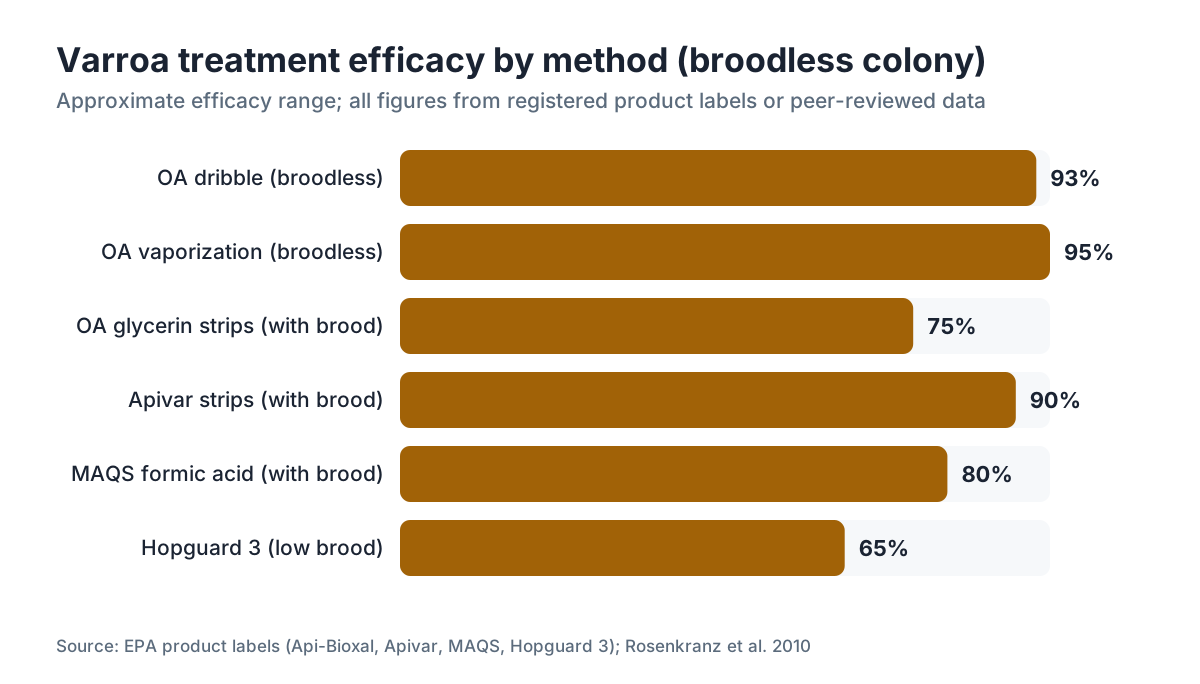
Oxalic acid dribble (trickle method): This works in a TBH and is probably your best move on a broodless hive in late fall or winter. Mix the registered solution (Api-Bioxal at 3.5 grams of oxalic acid dihydrate per 35 mL of 1:1 sugar syrup is the labeled concentration) and dribble 5 mL per occupied bar space over the bees. [4] In a Langstroth you apply 5 mL per seam, a "seam" being the gap between two frames. In a TBH you're dosing over individual bars, and the cluster sits as a sphere rather than in vertical seams. Practitioners who have written about this (University of Minnesota Extension has notes, though no formal TBH study exists) suggest treating every occupied bar rather than every inter-bar gap, still respecting the 50 mL total cap per application. On a truly broodless colony, dribble runs roughly 90 to 95% efficacy. [4]
Oxalic acid vaporization (sublimation): Here's where it gets awkward. The Api-Bioxal label calls for 2.05 grams of product per vaporizer load in Langstroth equipment, with instructions to seal entrances and vent after treatment. [4] In a TBH, sealing is a fight. The long entrance slot and the roof design both leak vapor, and the roof may not sit flush enough to hold it in. Vapor that escapes treats no mites and exposes you to a nasty acid. If you vaporize a TBH, spend real time sealing it first. Efficacy data for vaporization in non-standard equipment is essentially absent. The closest reference point: vaporization in Langstroth hits 90 to 99% per treatment on a broodless colony, and drops with brood present. [4]
Oxalic acid-impregnated glycerin strips (extended-release): The newest delivery method, and the only oxalic form that works with brood in the hive. The label calls for placement between brood combs. In a TBH with curved natural comb, you can hang or wedge a strip against a brood comb, but it won't sit the way it does between parallel Langstroth frames. Bees pick up the treatment by contact and spread it, so bad positioning cuts efficacy. Nobody has published efficacy numbers for strip placement in TBH geometry.
Can you use Apivar (amitraz) strips in a top bar hive?
Technically yes, but you'll fight the label the whole way. Apivar's label calls for two strips per brood box, placed between combs in the brood nest, hanging so bees contact them as they move through the cluster. [5] It's written for Langstroth frames of known width and spacing.
In a TBH the brood combs hang on individual bars with natural bee space between them. A standard Apivar strip (25 cm long) can be wedged between two combs or pinned to a bar with a push pin. Beekeepers do exactly this. The catch is that the label doesn't authorize the configuration, and a misplaced strip means lower efficacy plus the risk that bees avoid that section entirely and break up the cluster.
Apivar treatment runs 6 to 10 weeks. [5] The label says leave strips in for 6 to 8 weeks, then pull them completely. Leave them longer and you push amitraz resistance in your local mite population, which is already documented in parts of the US. Tracking resistance at the hobbyist level is genuinely hard, so treating for the labeled window and removing strips on time earns its keep.
One practical note. TBH colonies often run smaller than a double-deep Langstroth. If yours occupies fewer than 10 bars with limited brood, one strip instead of two may fit better. No formal guidance covers this, so it's a judgment call.
Amitraz also degrades faster in heat. If your TBH bakes in full sun and the interior tops 35 degrees Celsius (95 Fahrenheit) regularly, efficacy drops and residue concerns rise. Shade helps this treatment in any hive type.
What about formic acid treatments like Mite Away Quick Strips or Formic Pro?
Formic acid is a real option and the trickiest one in a TBH. Mite Away Quick Strips (MAQS) and Formic Pro are both labeled for Langstroth hives with specific ventilation requirements. MAQS calls for a screened bottom board or a propped lid so formic vapor vents properly. [6] Without that, the concentration inside spikes and you get brood kill, queen loss, and stressed bees.
Most TBHs offer limited or fixed ventilation. The long entrance slot gives some airflow, but it's no match for a Langstroth running a screened bottom and an open entrance. If your TBH ventilates reasonably and you treat in moderate temperatures (between 10 and 29 degrees Celsius, or 50 to 85 Fahrenheit, per the MAQS label), formic acid can do the job. [6]
Formic Pro has a two-strip setup for large colonies and a one-strip setup for small ones. The label puts the single pad at colonies with fewer than 5 Langstroth frames of bees. A modest TBH colony might match that, but converting a TBH population into "Langstroth frames of bees" is guesswork.
Formic acid's real edge is that it penetrates capped brood and kills mites inside brood cells, something dribble and vaporization can't touch. If you can't break the brood and your counts keep climbing, formic acid is one of the few tools that reaches reproductive-phase mites. That's worth a lot. But queen loss with MAQS runs 5 to 15% even under ideal Langstroth conditions, and that risk almost certainly climbs in a poorly ventilated TBH. [6]
How does the lack of a screened bottom board change your options?
The screened bottom board carries more weight than most beekeepers realize. For Langstroth users it's almost invisible, just a standard part. For TBH users it's often missing altogether.
Here's what you give up without it. Sticky board monitoring goes away. So does the ventilation formic acid needs, plus some of the airflow that helps vapor treatments spread evenly. You also lose the option to slide an oxalic acid vaporizer wand in under the cluster, which is the most common vaporization technique.
Some TBH builders add a screened section to the floor to solve exactly this. If you're building or commissioning a TBH and want maximum treatment flexibility, ask for a removable screened bottom board from the start. It's a meaningful structural difference and costs almost nothing during construction.
Got a solid-bottom TBH already? Your best monitor is the alcohol wash. Your best treatments are oxalic acid dribble on a broodless colony, oxalic acid extended-release strips when brood is present, and maybe formic acid if your hive ventilates well enough.
Langstroth vs top bar hive varroa treatment comparison
The table sums up the major registered varroa treatments and how they stack up across hive types. "Workable" means practitioners do it and can get reasonable efficacy with care. "Label mismatch" means the EPA label specifies Langstroth equipment and you're off-label in a TBH.
| Treatment | Langstroth | Top Bar Hive | Notes |
|---|---|---|---|
| Oxalic acid dribble | Yes, labeled | Workable (off-label geometry) | Best broodless; 90-95% efficacy [4] |
| Oxalic acid vaporization | Yes, labeled | Difficult (sealing issues) | Vapor escape reduces efficacy |
| OA glycerin strips | Yes, labeled | Workable (positioning harder) | Extended-release, needs brood contact |
| Apivar (amitraz strips) | Yes, labeled | Workable (wedge/pin method) | Label doesn't address TBH [5] |
| MAQS / Formic Pro | Yes, labeled | Risky (ventilation dependent) | Queen loss risk higher in TBH [6] |
| Hopguard 3 (hop beta acids) | Yes, labeled | Workable | Requires broodless or low-brood period |
| Alcohol wash monitoring | Yes | Yes | Threshold 2% (6 mites/300 bees) [2] |
| Sticky board monitoring | Yes | Only with screened bottom | Many TBHs lack screened bottom |
Hopguard 3 deserves a specific callout. Its label allows use in Langstroth and "natural" or non-Langstroth equipment, making it one of the few registered treatments that names alternative hive types outright. [7] Efficacy is lower than oxalic acid or amitraz, typically 50 to 80% depending on brood load, but that label compatibility is genuinely handy for TBH beekeepers.
What brood management and mechanical options work for top bar hives?
This is where TBH beekeepers actually gain an edge, because the management style lends itself to brood interruption.
A brood break forces varroa out of the protected capped-cell environment and into the phoretic phase, where oxalic acid dribble hits hardest. In a Langstroth you find and cage the queen for 21 to 24 days. In a TBH you do the same, but finding an unmarked queen in deep curved comb is harder. Practice finding and marking your queen before you need to do it under treatment pressure.
Drone comb removal works in a TBH too. Varroa reproduce in drone brood at roughly 8 to 10 times the rate they hit worker brood. [3] In a Langstroth you run drone comb foundation to concentrate the brood, then freeze and remove it. In a TBH bees build natural comb, and drone brood tends to show up at the edges of the brood nest where cells go irregular. You can cut sections of capped drone comb out with a knife, freeze them, and return the emptied comb or let bees rebuild. It's messier than pulling a frame. It still works, and every cycle pulls a real batch of mites out.
Some TBH beekeepers run an artificial swarm or split to create a broodless stretch in the parent colony, which is a management-based brood break. While the split raises a new queen (14 to 18 days to first emergence, then another 7 to 14 days to mating and laying), the parent colony sits largely broodless, and an oxalic acid dribble or vaporization in that window gives you near-maximum efficacy.
If you're building out a TBH management system, the beekeeping supplies section covers the hardware that makes these techniques easier.
Is varroa resistance worse in top bar hive colonies?
There's a persistent belief in natural beekeeping circles that TBH colonies, kept on natural comb with less intervention, build mite resistance faster. The honest answer: that claim runs mostly unsupported by peer-reviewed data at the hobbyist scale.
What the research does show is that varroa-sensitive hygiene (VSH), recapping behavior, and grooming can slow mite population growth in colonies selected for those traits, whatever the hive shape. [8] Hive geometry doesn't produce resistance. Bee genetics and selective pressure do.
What does happen in untreated TBH colonies is that mite populations sometimes crash alongside the colony. Survivorship in feral and minimally managed colonies is documented, but it usually rides on high colony turnover. The Honey Bee Health Coalition's position is blunt: letting colonies crash and hoping the survivors carry resistance isn't a management strategy, it's a gamble with a poor average outcome for the bees. [2]
Want to work toward treatment-reduced management? The better path is sourcing queens from breeders who select for VSH or mite-biting traits, then monitoring closely enough to intervene only when counts cross threshold. That works in Langstroth and TBH colonies alike.
What do extension services and the EPA actually say about alternative hive treatments?
Very little, which is itself useful to know. The EPA registers varroa treatments on efficacy and safety data submitted by manufacturers. Manufacturers test in Langstroth equipment because that's where the commercial market lives. No EPA registration pathway requires testing in alternative hive types, so the data gap is structural, not an oversight. [1]
The USDA Agricultural Research Service and several university extensions, Penn State Extension and the University of Minnesota Bee Lab among them, focus their published protocols on Langstroth management. [9] The Honey Bee Health Coalition's Varroa guide, the most thorough freely available document on the subject, touches TBH beekeeping only in passing. [2]
That leaves TBH beekeepers reasoning from principles. What matters is putting a therapeutic concentration of active ingredient in contact with bees long enough to kill mites without harming the colony. Once you hold that in your head, you can adapt labeled methods thoughtfully instead of ignoring the label or abandoning treatment.
VarroaVault's free protocol tools help you build a monitoring and treatment calendar around your hive type, your local mite pressure, and the treatments that are actually workable for your setup. They don't replace reading labels. They help you organize the decision logic.
The EPA's pesticide product information page is the authoritative source for what oxalic acid treatments are legally registered for, and reading the full Api-Bioxal label before any application is worth the time. [4]
What's the most practical treatment protocol for a top bar hive beekeeper?
Here's what I'd actually do, given the evidence and the constraints of TBH management.
Monitor by alcohol wash every 2 to 3 weeks from April through October. Pull 300 bees from a brood comb. Hit 2% (6 mites per 300 bees) and treat. Hit 3% or higher during peak summer buildup and treat immediately, then recheck in 3 weeks.
For main-season treatment with brood present, your best TBH options are Apivar strips (wedged between brood combs for 6 to 8 weeks, then removed) or oxalic acid glycerin strips if you can position them for good contact. Hopguard 3 is a lower-efficacy but more label-friendly choice. Formic acid works if your hive ventilates well and temperatures sit in range.
For fall treatment on a broodless colony, oxalic acid dribble is your best option, and this is the treatment that carries the most weight all year, because it protects the winter bees that carry your colony through to spring. Time it for when the colony has been broodless at least 10 to 14 days, usually November across most of the US and earlier up north. A single dribble on a confirmed-broodless colony with Api-Bioxal at labeled concentration gets you close to 95% efficacy. [4]
Do not skip the fall treatment. More colonies die from high mite loads entering winter than from almost any other single cause. [2]
Want to treat less over time? Source VSH or locally adapted queens, use brood breaks to open treatment windows, and keep monitoring as your constant baseline. A TBH doesn't exempt you from mite arithmetic. A colony that collapses from mites isn't a natural outcome, it's a preventable one.
For the full biology behind these decisions, the varroa mite resource covers the mite's reproductive cycle in the detail that shapes every management call you make.
Frequently asked questions
Can I use Api-Bioxal in a top bar hive legally?
The EPA registration for Api-Bioxal specifies Langstroth equipment in its application instructions. Using it in a TBH means applying a registered product off-label for the delivery method, which is legally gray. The chemical is registered; the hive type isn't addressed. You're not breaking a federal prohibition, but you're also not following label directions precisely. Read the full label and make an informed decision.
How do I do an alcohol wash in a top bar hive?
Open bars until you find capped brood. Scoop about 300 bees (roughly half a cup) off the comb surface with a wide-mouth jar. Add 70% isopropyl alcohol, seal, and shake for 60 seconds. Pour through a mesh into a white bowl and count mites. Divide the mite count by 300 and multiply by 100 for your percentage. Above 2% means treat. The technique is identical to Langstroth; only the bar access differs.
Do top bar hive bees have lower varroa loads naturally?
No solid evidence shows TBH colonies carry lower mite loads than Langstroth colonies when genetics match. Some TBH proponents point to smaller colony size or natural comb cell size as protective, but peer-reviewed studies haven't confirmed that consistently. What matters most is bee genetics (VSH, grooming) plus your monitoring and treatment discipline, none of which is set by hive shape.
What varroa treatment is safest for natural comb in a top bar hive?
Oxalic acid is the gentlest option for natural comb. It doesn't build up in beeswax at meaningful levels at registered doses, unlike synthetic miticides such as amitraz and fluvalinate, which can linger in comb for years. If you want chemical-free comb for any reason, oxalic acid dribble or vaporization on a broodless colony is your cleanest option and hits 90 to 95% efficacy in that window.
How do I create a brood break in a top bar hive to improve treatment efficacy?
Find your queen, cage her with a queen cage or clip, and suspend her in the hive between bars for 21 to 24 days. All brood emerges in that period, leaving a broodless colony where oxalic acid dribble or vaporization works best. Alternatively, do an artificial swarm: move the queen to a new hive with a few bars of bees and comb, and treat the broodless parent colony during the queenless window.
Can I use Hopguard 3 in a top bar hive?
Yes, and Hopguard 3 stands out because its label language accommodates non-Langstroth equipment better than most registered treatments. It uses hop beta acids as the active ingredient. Efficacy is lower than oxalic acid or amitraz, typically 50 to 80% depending on brood load, and it works best in broodless or low-brood conditions. It's a reasonable pick if you want a registered treatment with clearer label compatibility for your hive type.
How does hive volume affect oxalic acid vaporization dose in a top bar hive?
The Api-Bioxal vaporization label specifies 2.05 grams per vaporizer load per colony regardless of colony size, based on Langstroth testing. TBH interior volumes range from 30 to 100 liters depending on design. No published pharmacokinetic data exists for OA vapor in TBH geometry. Most practitioners use the standard labeled dose and focus instead on sealing the hive thoroughly so vapor doesn't escape before it reaches mites.
Is it harder to treat varroa in a top bar hive than a Langstroth?
Yes, in practice. Langstroth treatments are dose-tested, label-specific, and backed by extension protocols. TBH beekeepers adapt labeled methods to non-standard geometry, often without screened bottom boards, with variable hive volumes, and with limited ventilation for formic acid. Monitoring is equally straightforward in both. Treatment is genuinely more complicated in a TBH, and you need to understand why before choosing your tools.
What varroa threshold should I use for a top bar hive colony?
Use the same 2% threshold (6 mites per 300-bee alcohol wash sample) the Honey Bee Health Coalition recommends for all managed colonies. The threshold is built on mite-to-bee ratio and the damage mites do to developing bees, neither of which changes with hive style. Some beekeepers treat at 1% in late summer to protect winter bees, which is reasonable regardless of hive type.
Does Apivar work as well in a top bar hive as in a Langstroth?
It can, but strip placement is harder. Apivar strips rely on bee contact to spread amitraz through the colony. In a Langstroth, strips hang between parallel frames where bees constantly pass. In a TBH, you wedge or pin strips against curved natural comb and hope contact is enough. No published efficacy comparison exists for TBH Apivar placement, so you're extrapolating from Langstroth data and leaning on close monitoring to confirm it worked.
Can I split a top bar hive to control varroa?
Yes, and this is one of the genuinely practical advantages of TBH management. Moving the queen and a few bars of bees and comb to a new hive opens a broodless window in the parent colony of 14 to 21 days while the new colony raises a queen. Treat the parent colony with oxalic acid dribble during that window for near-maximum efficacy. The split also resets mite population dynamics in both resulting colonies.
What's the biggest mistake top bar hive beekeepers make with varroa?
Not monitoring. The second biggest is assuming natural comb, small cell size, or minimal intervention creates inherent resistance. Varroa populations can double roughly every 3 to 4 weeks in an untreated colony during summer buildup. By the time you see visible signs of colony decline, mite loads are usually already catastrophic. Alcohol wash monitoring every 2 to 3 weeks is the non-negotiable baseline.
Sources
- EPA, Pesticide Registration Overview: EPA product registrations specify application equipment and methods; labels written for Langstroth equipment do not address alternative hive types.
- Honey Bee Health Coalition, Varroa Management Guide (2023): Action threshold of 2% infestation (6 mites per 300-bee sample); applicators must follow all label directions; letting colonies crash is not a management strategy.
- Rosenkranz P, Aumeier P, Ziegelmann B, Biology and control of Varroa destructor, Journal of Invertebrate Pathology, 2010: Varroa preferentially reproduces in drone brood at roughly 8 to 10 times the rate in worker brood; sugar roll undercounts mites by approximately 30 to 40% vs alcohol wash.
- EPA, Pesticide Product and Label System (Api-Bioxal, EPA Reg. No. 87529-24): Dribble: 5 mL per seam, 50 mL max per colony, 3.5 g OAD per 35 mL 1:1 syrup; vaporization: 2.05 g per load; 90-95% efficacy on broodless colony.
- EPA, Pesticide Product and Label System (Apivar, EPA Reg. No. 92964-1): Two strips per brood box placed between combs; treatment duration 6 to 10 weeks; remove strips completely after treatment.
- EPA, Pesticide Product and Label System (Mite Away Quick Strips, EPA Reg. No. 83923-3): MAQS requires screened bottom board or propped lid for ventilation; temperature range 50 to 85 degrees Fahrenheit; queen loss 5 to 15% in ideal conditions.
- EPA, Pesticide Product and Label System (Hopguard 3, EPA Reg. No. 85290-3): Hopguard 3 label language accommodates non-Langstroth equipment; efficacy 50 to 80% depending on brood load.
- USDA Agricultural Research Service, Honey Bee Breeding, Genetics and Physiology Research (Baton Rouge): VSH trait reduces mite reproductive success; bee genetics, not hive type, determine resistance expression.
- Penn State Extension, Pollinators and Bees: Extension varroa protocols are written for Langstroth equipment; no formal TBH-specific treatment protocols published.
- University of Minnesota Bee Lab, Varroa Resources: University apiculture extension focuses published protocols on Langstroth management; TBH-specific treatment guidance is not available.
- Honey Bee Health Coalition, Colony Loss and Varroa: High mite loads entering winter are among the leading causes of colony loss; fall treatment is the most critical treatment of the year.
Last updated 2026-07-09