Living near untreated hives: the varroa reinfestation problem
TL;DR
- Untreated hives within roughly 1 to 3 miles of your apiary reinfest treated colonies through robbing bees, drifting foragers, and swarms.
- Research shows mite loads can climb back to damaging levels within 4 to 6 weeks of a good treatment.
- You can slow it with frequent monitoring, earlier retreatment, and entrance management.
- You cannot stop it while the source colonies keep breeding mites next door.
Why does living near untreated hives cause varroa reinfestation?
Treating your own bees is half the job. The other half lives next door, and mites don't respect property lines. Mite-carrying bees from collapsing or untreated colonies fly into your apiary and drop their passengers off.
The mechanism is well documented. A dying colony under heavy varroa pressure turns into a target for robber bees from healthier hives nearby. As those robbers strip the weak colony of honey, they pick up phoretic mites (mites riding on adult bees) and haul them home. One robbing event can move hundreds of mites in a single afternoon. Foragers also drift into neighboring hives on their own, especially when hives sit in long rows facing the same way. Drift isn't rare. A frequently cited study from the University of Guelph found drift rates of 10 to 40% of marked bees, depending on how the hives were arranged [1].
Swarms are the third pathway. A swarm from an untreated colony carries whatever mite load its mother hive had, and once it moves into a tree cavity or a neighbor's abandoned box, it usually stays untreated for good.
None of this is your fault. All of it is your problem.
How far away do untreated hives have to be to affect my colonies?
Honey bees forage reliably to about 2 miles and will fly up to 5 miles when forage is thin [2]. That range is your risk zone. Most robbing and drift happens closer than that, but a neighbor's hive a half-mile away is not safe just because it isn't in your yard.
The Honey Bee Health Coalition's Varroa Management Guide names robbing and drifting as "among the most significant causes of reinfestation after treatment," and the practical read is simple: any unmanaged colony within foraging range is a potential source [3].
If you keep bees in a suburb with other backyard beekeepers, or near farmland with feral colonies and neglected hobby hives, treat reinfestation as constant background pressure. Not a one-time event. Rural beekeepers surrounded by feral tree colonies face the same math. Feral bees in North America carry mites just like managed ones, and they answer to nobody.
How quickly can reinfestation happen after I treat my hives?
Faster than most people expect. A study in the journal Apidologie found colonies in high-density beekeeping areas rebuilt their mite populations substantially within 4 to 6 weeks of a successful treatment, driven mostly by mite immigration rather than surviving mites reproducing [4]. That's about one brood cycle. You knock the mites down, and before the next batch of bees even finishes emerging, outside mites are moving back in.
How fast depends on the mite load around you and how weak the nearest colony is. A colony in full collapse is a mite bomb. Swiss and German researchers tracking mite dispersal found single collapsing colonies can affect apiaries up to 1 kilometer away [5].
This is why one annual oxalic acid treatment in a broodless winter colony, effective as it is against the mites present that day, often won't hold across a full season under heavy pressure. You didn't fail. The treatment worked. The mites came back.
The timing makes more sense once you understand the varroa mite itself, its life cycle, and why the phoretic mites riding on adult bees are the ones crossing between hives.
What are the signs that my hive has been reinfested from outside?
The clearest signal is a mite count climbing faster than the colony's own brood and your treatment history can explain. Treat correctly, drop below 1 to 2 mites per 100 bees (the Honey Bee Health Coalition threshold), then find yourself at 3 to 4% four to six weeks later, and outside reinfestation is the likely answer [3].
Other signs:
- Robbing behavior at your entrances, especially in late summer and fall when nectar dries up
- A cluster of dead or crawling bees near a neighbor's colony that then goes quiet (a collapse in progress)
- Mite counts jumping in several hives at once, even hives that started with very different loads before treatment
Alcohol wash and sugar roll are the two accepted monitoring methods. Alcohol wash is slightly more accurate and is what most university extension programs recommend for a true count [6]. In a high-pressure area, run one every 2 to 4 weeks during the active season. That cadence is the only way to catch reinfestation while you can still act on it.
If you want a protocol that ties monitoring intervals to action thresholds, the free tools at VarroaVault help you build a season-long schedule around your own conditions.
Can I talk to my neighbor about treating their hives?
Yes, and it's worth trying. Most beekeepers who skip treatment either don't grasp the mite load their colonies carry, or they object to chemical treatments on principle. The conversation goes better than you'd guess when you frame it as sharing information rather than making demands.
Bring your data. Show the numbers from your alcohol washes and explain that your counts keep climbing. People respond better to "here's what I'm seeing" than to "your bees are hurting mine."
Offer resources. The Honey Bee Health Coalition's free Varroa Management Guide is genuinely good and reads as neutral, not preachy [3]. Extension programs from land-grant universities like Penn State or UC Davis publish free one-pagers on treatment options that sometimes land better coming from a university than from the guy over the fence [6][7].
A beekeeper who keeps bees on purpose and refuses to treat leaves you little legal recourse in most U.S. states. Beekeeping nuisance laws deal with aggressive bees and hive placement, not mite management. A few states require some mite management as part of registration, but enforcement is spotty. If the hives look abandoned, your state apiarist can sometimes inspect and require management or removal. Most states have one [8].
Feral colonies in tree cavities are a separate problem. Short of swarm trapping and trap-outs, which eat time and don't always work, you're managing your own response, not the source.
What treatment strategies actually help when reinfestation pressure is high?
No single treatment removes reinfestation risk. What works is staying ahead of it.
Monitor more often. A normal year, every 4 to 6 weeks during the active season is fine. Under heavy pressure, every 2 to 4 weeks. Catching a rising count at 2% beats chasing it at 5%.
Treat to a lower threshold. Most guidance sets the treatment trigger at 2 to 3% (2 to 3 mites per 100 bees) [3]. In a high-pressure zone where you know mites are coming, treating closer to 1 to 2% buys you a bigger buffer before the load reaches damage territory.
Use split treatments. Oxalic acid vaporization (OAV) done as three treatments 5 days apart across the brood cycle keeps killing phoretic mites over that window, which covers newly arriving mites better than a single dose [9]. The EPA-registered dribble method for oxalic acid is approved for broodless colonies only. Vaporization has a wider use window depending on the product, so read your specific label before treating with brood present [9].
Reduce entrances during robbing season. Late summer and fall, when nectar quits, is when robbing peaks and mite transfer runs hottest. A reduced entrance forces more contact at the gate and gives guard bees a real chance to stop robbers. Close off top entrances too. Together, these cut the robbing traffic that carries mites.
Set swarm traps. Bait hives (empty boxes with old comb and a few drops of lemongrass oil) around your property can catch swarms from untreated neighbors before they settle in nearby. You won't get them all, but it's free management and you gain colonies. Treat any caught swarm within a few weeks, because even a low starting load climbs fast.
Does the type of treatment matter when you're fighting constant reinfestation?
It does, mostly because treatments differ in how long they stay active and how they kill.
Oxalic acid has no residual activity once the treatment period ends. It kills phoretic mites on contact and does nothing to a mite that arrives the next day. Fine for a broodless winter knockdown, but the protection window between OAV rounds is basically zero.
Amitraz-based strips (Apivar) give you a 6 to 8 week window and kill mites as they touch the strip [10]. That continuous contact offers some passive cover against newly arriving phoretic mites while the strips are in, which is one argument for strips in high-pressure yards.
Formic acid (MAQS, Formic Pro) kills mites inside capped brood cells as well as phoretic mites, so it cuts the total population faster. The tradeoff is a shorter treatment window and tighter temperature limits [11].
None of these prevent reinfestation. They lower the mite load at the moment of treatment, full stop. In a high-pressure area, that means your treatment calendar needs more entries, not fancier ones.
Resistance is a second concern worth naming. Amitraz resistance in varroa has been documented in several countries and is a growing worry in the U.S., though solid prevalence data by region is still thin. Rotating treatment types, so you're not reaching for Apivar every cycle, is a sensible precaution [3].
If you're sourcing treatments for the first time, this overview of beekeeping supply companies helps you sort out where to buy what.
How does this compare to a "closed" apiary with no outside mite pressure?
The gap between isolated and high-pressure apiaries is big enough that researchers measured it directly.
In a study published in Apidologie, colonies in high-density beekeeping areas rebuilt mite populations much faster than isolated ones under the same treatment, with immigration doing most of the work [4]. That's not a rounding error. It means a beekeeper in a dense area may need to treat 2 to 3 times a season to hold the same control a beekeeper in an isolated spot gets from 1 to 2 treatments.
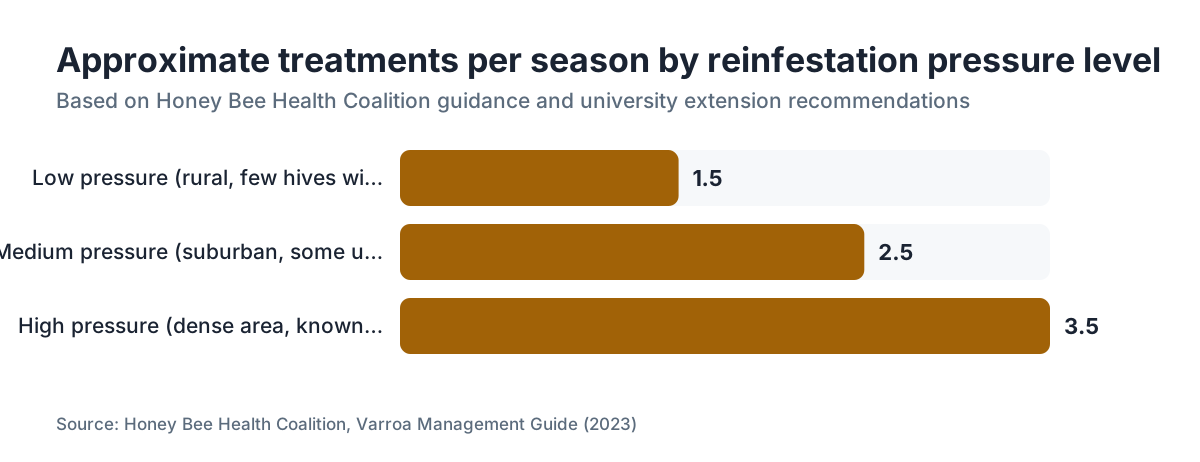
Here's a rough comparison of treatment frequency by surrounding pressure:
| Pressure level | Approximate surrounding context | Typical treatments per season |
|---|---|---|
| Low | Rural, few hives within 2 miles, no known feral colonies | 1-2 |
| Medium | Suburban, several backyard beekeepers nearby, some feral colonies | 2-3 |
| High | Urban/suburban density, known untreated or feral hives within 1 mile | 3-4+ |
These are estimates from Honey Bee Health Coalition guidance and university extension programs, not a controlled trial. Your real number comes from your monitoring, not a category label.
Here's the frustrating arithmetic of open apiaries: if you treat twice and your neighbor never treats, you're partly treating for both of you.
Are feral colonies the same problem as neighbor hives?
Feral colonies are arguably worse, because they sit entirely outside any management system. You can at least talk to a neighbor. A colony in a hollow oak three hundred yards away doesn't take meetings.
Feral honey bees in the continental U.S. carry varroa just like managed colonies. There was hope in the 1990s that feral bees might breed resistance through natural selection, and some European populations (the Gotland island bees in Sweden especially) did develop measurable hygienic behaviors after decades under pressure [12]. But across most of North America, feral colonies live an average of 1 to 3 years before varroa collapses them, which makes them a recurring mite source, not a stable neighbor [2].
With confirmed feral colonies nearby, swarm trapping is your best realistic move. You won't wipe out the feral population, but you can catch some swarms and turn them into managed, treated colonies. That beats stewing about it.
In the Southwest and parts of the South, feral identification gets more complicated. Africanized honey bees run feral in those regions, host varroa, and make a real reinfestation source. If you're in an affected area, the africanized honey bee identification question adds another wrinkle to your swarm decisions.
What's the honest long-term outlook for beekeepers in high-pressure areas?
Harder than it should be, not hopeless. Expect to monitor and treat more often than beekeepers in isolated spots, and expect to lose some colonies despite doing everything right. That's what an open biological system does.
The beekeeping community has no great answer at the landscape scale. Community-level varroa management, where every beekeeper in an area coordinates treatment timing to shrink the shared mite reservoir, has been studied in Europe and shows real promise [5]. The logic: if everyone treats at the same time in late summer, there's no collapsing colony to rob during the worst robbing window. Coordinating dozens of independent hobbyists in practice is the hard part.
Local beekeeping clubs are a place to start. A club that runs a "treat by" date each August moves the needle on area-wide mite transfer even when participation is patchy.
Selective breeding for varroa-sensitive hygiene (VSH) and other resistance traits is the longer lever. Colonies with strong hygienic behavior find and pull mite-infested brood, which suppresses mite reproduction. VSH queens are commercially available, though supply stays limited and the trait needs ongoing selection to hold [7]. VSH queens don't stop reinfestation. They slow the mite climb between treatments.
VarroaVault's free protocol tools are worth bookmarking for running the monitoring-to-treatment cycle through a high-pressure season. Record-keeping across several hives is where most hobbyists lose the plot, not in the treatments themselves.
What records should I keep to prove reinfestation is happening?
Good records do two jobs. They sharpen your management decisions, and they give you documentation if you ever sit down with a neighbor, a beekeeping club, or a state apiarist.
For each hive, log the date, the monitoring method (alcohol wash or sugar roll), the count as mites per 100 bees, any treatment applied and the product name, and the date treatment ended. Note any robbing you see, and any bees showing up from other colonies with different marking systems. Some beekeepers mark queens, and marked drifting workers are visible under close observation.
Consistent post-treatment spikes across several hives in the same 2 to 4 week window, with no sign of treatment failure (strips in place, temperatures in range for formic acid), point to external reinfestation rather than internal mite reproduction. The pattern itself is the evidence.
The records pay off for your own learning too. Comparing mite trajectories across seasons tells you whether local pressure is easing, worsening, or holding steady. Nobody else is collecting that data for you.
Frequently asked questions
How far can varroa mites travel between hives on their own?
Varroa mites can't fly. They move between hives only by riding on bees, so their effective range is whatever bees forage: roughly 1 to 2 miles routinely, up to 5 miles when forage runs short. Transfer is heaviest within a half-mile radius, where robbing and drift happen most, but any unmanaged colony within foraging range is a real reinfestation source.
Can I make my hive more resistant to robbing to reduce mite transfer?
Partly, yes. Entrance reducers during the late-summer robbing season are the most practical tool. Narrowing the entrance to one or two bee-widths forces robbers through a tighter gap and gives guard bees a better stand. Removing top entrances helps too. Strong colonies resist robbing better than weak ones, one more reason to keep mite loads low. No entrance management stops robbing outright, but it slows it.
Is there any legal way to force a neighbor to treat their bees?
In most U.S. states, no. Beekeeping rules cover hive placement, bee aggression, and registration, not treatment mandates. A handful of states tie registration to basic management standards, and state apiarists can sometimes require action on abandoned or severely diseased hives. If the hives look abandoned, contacting your state department of agriculture is worth trying. For hives someone keeps on purpose but won't treat, conversation is your only path, not regulation.
How do I tell if my mites are coming from outside versus reproducing inside my own hive?
No field test tells an imported mite from a locally raised one. The tell is the rate of increase. If your count climbs faster than the colony's brood and mite reproduction can account for, immigration is the likely driver. Rough rule: a treated colony with low counts that spikes past 3% within 4 to 6 weeks, with no treatment failure, points strongly to reinfestation from outside.
Do swarms from untreated hives carry varroa mites?
Yes. A swarm carries roughly the phoretic mite load its mother colony had at swarming. Because a swarm starts with no capped brood, the initial count often runs lower than the parent hive, but mite reproduction begins the moment the new colony raises brood. Untreated swarms usually reach damaging levels within one full season. Treat any swarm you catch from an unknown source within a few weeks.
What mite count threshold should I use if I'm in a high-reinfestation-pressure area?
The Honey Bee Health Coalition recommends treating at 2% (2 mites per 100 bees) during the brood-rearing season. In high-pressure areas, treating closer to 1 to 2% makes sense, because you're buying time against incoming mites more than managing internal reproduction. The lower you start before pressure peaks in late summer, the longer the colony stays safe. Monitoring every 2 to 3 weeks instead of 4 to 6 matters just as much.
Does treating more often lead to mite resistance to treatments?
More frequent treatments with the same chemical do raise resistance selection pressure. Rotating treatment types across seasons lowers that risk. For example, oxalic acid in winter, formic acid in spring, and amitraz-based strips in late summer spreads selection across different modes of action. Amitraz (Apivar) resistance has been documented in European and some U.S. populations, so leaning on one chemistry exclusively is a bad long-term bet.
Are community-wide treatment programs effective at reducing reinfestation?
European studies, especially from Switzerland and Germany, show that coordinated simultaneous treatment across apiaries in an area meaningfully cuts mite immigration compared to uncoordinated treatment. The effect is real but needs high participation. Even partial coordination, where 60 to 70% of area beekeepers treat in the same 2-week window, reduces collapsing colonies during peak robbing season. Local beekeeping clubs are the practical organizing unit.
Can I use a VSH or mite-resistant queen to reduce reinfestation impact?
VSH (varroa-sensitive hygiene) queens slow mite reproduction inside a colony by improving its ability to detect and remove infested brood. That helps, but it doesn't block phoretic mites arriving by robbing or drift. A VSH colony under heavy reinfestation pressure still picks up phoretic mites from outside. VSH slows the climb between treatments, which can mean fewer treatment cycles, but you still have to monitor.
What happens if I stop treating because I think my neighbor's bees are the real problem?
Your colony dies. The source of the mites doesn't change the load inside your hive, and untreated varroa typically kills a managed colony within 1 to 3 years, often faster. External pressure is real and maddening, but it argues for treating more carefully, not less. Your neighbor skipping treatment means you have to hold up both ends of the management equation.
Are there beekeeping practices that attract more robbing and therefore more mites?
Yes. Inspecting hives during nectar dearth (late summer, early fall) and leaving honey or wax exposed for even a few minutes draws robbers from surrounding colonies. Open feeders of syrup pull them in too. Working hives fast and clean, feeding inside the hive, and reducing entrances during dearth all cut how much robbing traffic your apiary generates and takes on.
Is mite reinfestation worse in urban areas than rural areas?
Usually yes, because colony density runs higher in urban and suburban areas. More hives per square mile means more mite sources and more forager overlap. Urban beekeeping has grown a lot in the last decade, concentrating hives in tight spaces. Rural beekeepers near feral populations face similar pressure but with more distance between sources. The worst cases are dense suburbs mixing managed and unmanaged hives.
How do I set up a swarm trap to intercept mites from neighboring colonies?
Use a 40-liter wooden box or nuc box with a 1.5-inch entrance hole, placed 10 to 15 feet off the ground in shade. Bait it with a piece of old brood comb and 5 to 10 drops of lemongrass oil on a cotton ball inside. Check every 1 to 2 weeks from late spring through early summer when swarming peaks. Treat any swarm you catch for varroa within 3 to 4 weeks after it starts raising brood.
Sources
- University of Guelph, School of Environmental Sciences, Honey Bee Research Centre: Drift rates of 10-40% of marked bees observed between neighboring hives depending on hive configuration and placement.
- USDA Agricultural Research Service, Bee Research Laboratory: Honey bees forage reliably up to 2 miles and can travel up to 5 miles; feral colonies in North America typically survive 1-3 years before collapsing from varroa.
- Honey Bee Health Coalition, Varroa Management Guide (2023 edition): Robbing and drifting are among the most significant causes of reinfestation after treatment; 2% mite threshold recommended for treatment during brood-rearing season.
- Frey E, Odoux JF, Requier F, et al., Apidologie (2011): Reinfestation of treated honey bee colonies by Varroa destructor in a high-density beekeeping area: Mite populations in high-density beekeeping areas recovered substantially within 4-6 weeks of treatment, driven primarily by mite immigration rather than residual mite reproduction.
- Frey E, Schnyder M, Odoux JF, et al., Apidologie (2011): Varroa destructor dispersal and mite immigration between Swiss apiaries: Single collapsing colonies can affect apiaries up to 1 kilometer away; coordinated community-level treatment reduces mite immigration events.
- Penn State Extension, Varroa Mite Monitoring and Management: Alcohol wash recommended as the most accurate monitoring method; monitoring every 2-4 weeks recommended in high-pressure conditions.
- UC Davis Department of Entomology and Nematology, Honey Bee Research: VSH (varroa-sensitive hygiene) queens commercially available and shown to reduce mite reproduction rates within colonies.
- EPA, Pesticide Registration: Oxalic Acid Product Labels (EPA Reg. No. 92054-1 and related): Oxalic acid vaporization series of 3 treatments 5 days apart approved for mite management; dribble method approved for broodless colonies only per label.
- EPA, Pesticide Registration: Apivar (Amitraz) Product Label: Amitraz strips provide 6-8 week treatment window with continuous contact kill of phoretic mites.
- EPA, Pesticide Registration: Formic Pro and MAQS Product Labels, NOD Apiary Products: Formic acid treatments kill mites in capped brood as well as phoretic mites and have temperature-range restrictions per label.
- Fries I, Imdorf A, Rosenkranz P, Apidologie (2006): Survival of mite infested honey bee colonies in a Nordic climate: Feral Swedish (Gotland) honey bee populations developed measurable hygienic behaviors after decades of selection pressure under varroa infestation.
Last updated 2026-07-10