How many hives before varroa management becomes overwhelming
TL;DR
- For most hobbyists, varroa management starts feeling unmanageable somewhere between 5 and 15 hives.
- The bottleneck is rarely the treatments.
- It's monitoring frequency, record-keeping, and timing multiple colonies through brood breaks or oxalic acid windows at once.
- Sideline operations running 25 to 50 hives need systems and dedicated time blocks, or mite loads get away from them fast.
Why does hive count matter so much for varroa control?
Varroa destructor doesn't care how many hives you have. It reproduces in capped brood at a fixed rate, roughly 1.3 to 1.6 female mites per foundress per brood cycle under normal conditions, and a colony can climb from a tolerable 2% infestation to a lethal 10%+ load in six to eight weeks during a summer buildup [1]. What changes with hive count is your ability to catch that trajectory before it kills bees.
With one or two hives, monitoring is a casual weekend task. You open each hive, run an alcohol wash or sugar roll, count mites, write it in a notebook. Takes an hour total. With twelve hives, that same protocol eats most of a Saturday. You keep separate records for each colony, track which ones are queenright, remember which ones finished a treatment three weeks back, and figure out which three are spiking while the other nine sit fine. The cognitive load alone trips people up.
The real problem isn't labor hours. It's synchronization. Oxalic acid vaporization works best when brood is absent or minimal, so its efficacy jumps from roughly 90-95% in broodless colonies down to around 42% in colonies with capped brood [2]. Say you're managing six hives, three brooding heavily and three fresh off a split. You can't treat them all the same way on the same day. Now you've got two treatment schedules running in parallel, and missing a window by ten days can be the difference between a clean knockdown and a reinfestation cascade.
What is the typical breaking point for hobbyist beekeepers?
Somewhere between 5 and 15 hives, with most people hitting the wall around 8 to 12. That range shows up again and again in beekeeper surveys and extension educator feedback, but I'll be straight with you: no rigorous peer-reviewed study pins down where burnout happens by colony count. The closest published data comes from loss surveys like the Bee Informed Partnership's annual reports, which show smaller operations (1 to 50 colonies) consistently reporting higher average colony loss than commercial outfits. That gap ran 39.7% annual loss for small-scale beekeepers in the 2022-2023 survey year [3]. It doesn't prove mismanagement, but it says small-scale operators, the folks with 5 to 50 hives, are struggling with something. Varroa is the leading identifiable cause of loss.
Why 8 to 12 specifically? At that count, informal mental tracking fails. You can't hold twelve colonies' mite histories in your head across a whole season. You need a spreadsheet or an app, and most hobbyists don't have one ready when they cross that number. The colonies also start to diverge. One rears brood year-round, another goes broodless naturally in December, a third has gone queenless without you noticing. Each exception demands its own treatment call.
Sideline beekeepers, usually defined as those running 25 to 150 hives alongside another job, hit a sharper version of this. At 50 hives, a single alcohol wash session for every colony is eight to ten hours of work if you're moving equipment and doing it right. Many sideline operators end up cutting corners on monitoring frequency. That's exactly when varroa gets ahead of them.
How much time does varroa monitoring actually take per hive?
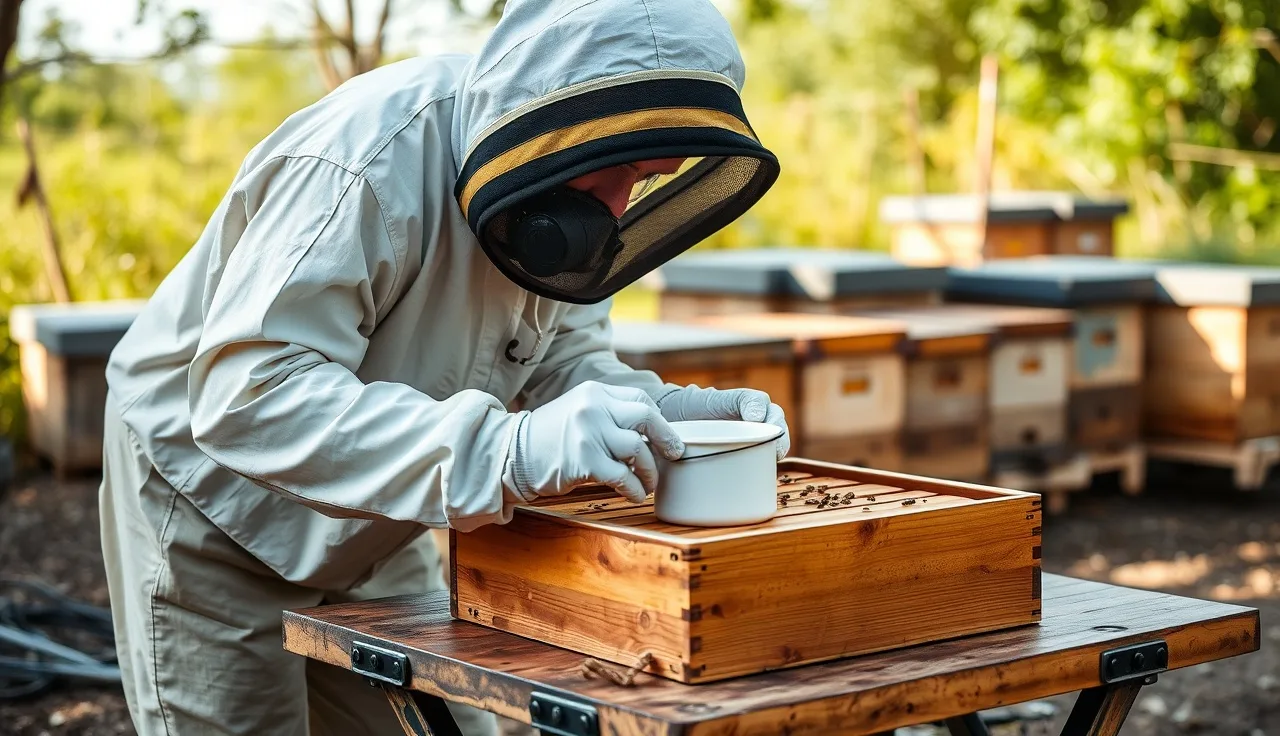
A proper alcohol wash on one hive takes about 10 to 15 minutes. You collect roughly 300 bees from the brood nest, add isopropyl alcohol, shake for 60 seconds, and count the mites that drop out [4]. Add travel between hive bodies, recording results, and cleaning your gear between hives to avoid cross-contamination, and you're at 15 to 20 minutes per colony in a real field setting.
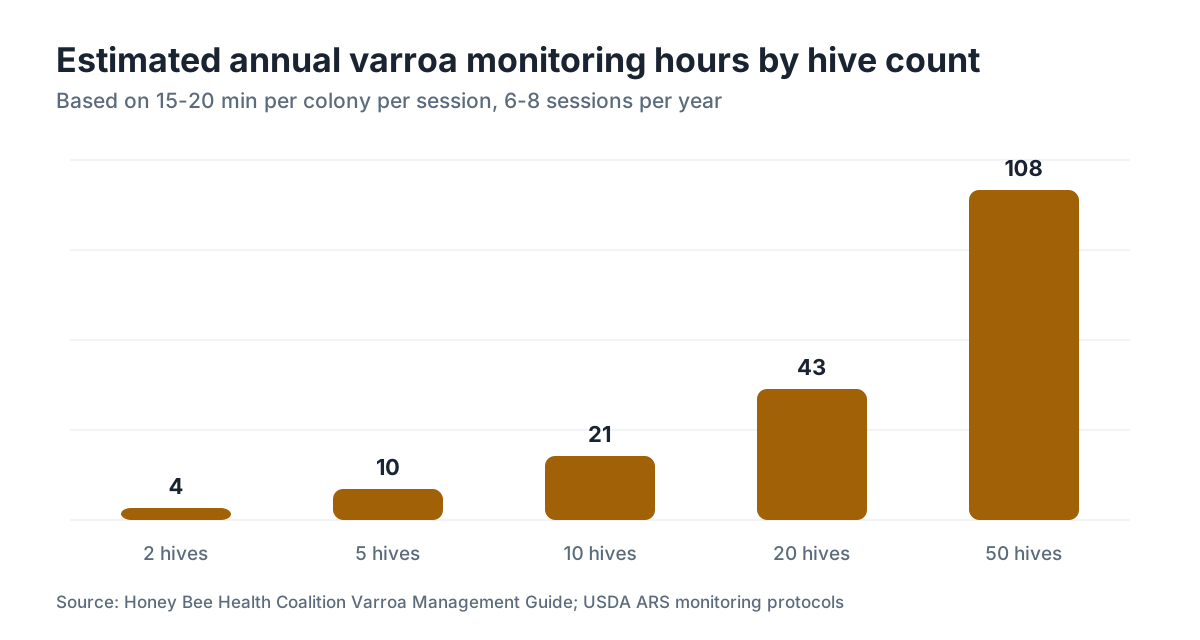
Here's what that looks like at scale:
| Hive count | Monitoring time per session | Sessions per year (recommended) | Total annual monitoring hours |
|---|---|---|---|
| 2 | 30-40 min | 6-8 | 3-5 hrs |
| 5 | 75-100 min | 6-8 | 7-13 hrs |
| 10 | 2.5-3.5 hrs | 6-8 | 15-28 hrs |
| 20 | 5-7 hrs | 6-8 | 30-56 hrs |
| 50 | 12-17 hrs | 6-8 | 75-140 hrs |
Those numbers are monitoring only. Treatments run separately. Oxalic acid vapor takes roughly 1 to 2 minutes of actual vaporizer-in-the-hive time per colony, but setup, hive sealing, and safety add another 5 to 10 minutes per hive [5]. A formic acid application (Formic Pro or MAQS) needs suited-up hive manipulation and label-compliant temperature checks, so it takes longer. Apivar strip insertion and removal go faster, but you still open every hive twice, 6 to 8 weeks apart.
The Honey Bee Health Coalition's Varroa Management Guide calls monitoring at least every four to six weeks during the active season the baseline, and more often if you've recently treated or you're near other apiaries [1]. At ten hives, doing that right is a real time commitment.
Does having more hives actually help or hurt your mite situation?
Both, depending on how you run the apiary.
More hives mean more chances for mite drift and robbing. When colonies at different mite loads share a yard, mites move between them. A low-mite colony sitting next to a collapsing high-mite colony is almost guaranteed to pick up mites through robbing bees, especially during a dearth. This is the reinfestation problem, and it's why treating one hive at a time instead of the whole apiary rarely holds up over a season [1].
More hives also give you more options. With ten or more colonies, you can make increases from low-mite stock, build brood breaks by splitting selectively, or requeen from your best performer into several colonies at once. You spread your loss risk too. Two hives and one dies over winter, you've lost half your operation. Twelve hives and one dies, you've lost a hive.
The deciding variable is whether you can track and treat all of them on schedule. A beekeeper who monitors every colony every six weeks and hits every treatment window with ten hives sits in a far better spot than one with twenty hives who only gets around to treating eight before the window closes. More hives help only if your management scales with them.
What systems do experienced beekeepers use to manage varroa at scale?
The ones who stay on top of it past 20 hives share the same habits. A written or digital record for every colony. A treatment calendar set at the start of the season. A commitment to treating the whole apiary on one schedule instead of reacting to individual colony crises.
Colony record-keeping doesn't need to be fancy. A paper card zip-tied to each hive works fine. What matters is that you write down the mite wash date, the count, the colony's brood status, and whatever treatment you applied. Skip that, and you're flying blind with eight colonies that all look the same from the outside.
Batch treating (treating every hive in a yard at once) is the single biggest efficiency gain for sideline operators. Instead of tracking twelve different start dates, you pick a trigger, say any colony in the yard hits 2% in August, and you treat everything. You give up a little nuance and gain certainty that no colony slipped through. The Honey Bee Health Coalition recommends this explicitly for operations where monitoring every colony individually isn't practical [1].
If you'd rather work from a structured protocol than build one from scratch, VarroaVault's free protocol tools let you build a seasonal treatment calendar by hive count and region. That saves a couple hours of planning per season for anyone juggling more than a handful of colonies.
Some sideline operators block one day a month for apiary work during the active season, right on the calendar next to their work meetings. That discipline, more than any tool or product, separates the beekeepers who stay ahead of varroa from those who don't.
At what hive count should you switch from monitoring every hive to sentinel hives?
Once an operation grows past 40 to 50 colonies in a single yard, monitoring every colony every four to six weeks stops being practical. That's the point where a sentinel approach makes sense. You pick 10 to 20% of your colonies, aiming for a representative mix of different strengths and ages, and monitor those hard. The bet is that mite pressure in the sentinels reflects the yard as a whole.
The tradeoff is real. A sentinel system misses outliers. A single colony with a highly reproductive mite population or a drone-layer can spike to dangerous levels while the sentinels read clean. University of Minnesota Extension recommends treating every colony in an apiary when any sampled colony crosses the 2% summer threshold [6]. That partly fixes the gap by making a sentinel's result a trigger for the whole yard rather than just that one hive.
For hobbyists under 20 hives, skip sentinel monitoring entirely and do the whole yard. The time you save isn't worth the blind spot. Sentinels start earning their keep somewhere around 30 to 50 hives, and even then, treating all colonies when one sentinel spikes is the safer play.
Which varroa treatments scale most practically with hive count?
It comes down to what you value: speed of application, brood penetration, or cost per colony.
Oxalic acid vapor is fast per hive once you're set up, roughly 1 to 2 minutes per colony, and it works extremely well in broodless conditions. For winter treatment of a broodless apiary, one beekeeper can treat 30 to 40 hives in a few hours. EPA-registered oxalic acid products carry specific application limits on the label, and the language varies by registrant, so read your specific product label before you plan a rotation [5]. Cost runs roughly $1 to $2 per treatment event at scale.
Apivar (amitraz strips) needs less timing precision because it works over 6 to 8 weeks regardless of brood presence. You pay for that convenience in cost (roughly $3 to $5 per colony per treatment) and in opening every hive twice [7]. Where brood-break timing is hard to control, Apivar is often the most reliable option even at the higher price.
Formic Pro (formic acid) kills mites under capped brood, which neither oxalic acid nor Apivar does as well. That makes it valuable when you can't get a full brood break. It also takes fewer application events than Apivar. The catch is temperature: the label requires 50-85 degrees F during the application period, which narrows your window in northern climates [8].
For a look at each treatment's mechanism and resistance patterns, our varroa mite guide is worth reading before you settle on a rotation.
| Treatment | Brood penetration | Applications per year (typical) | Approx. cost per colony | Time per hive |
|---|---|---|---|---|
| Oxalic acid vapor (broodless) | No | 1 (check label) | $1-2 | 2-5 min |
| Oxalic acid vapor (repeated) | No | Up to 3x in some products | $1-3 | 2-5 min |
| Apivar (amitraz strips) | Partial (contact) | 1-2 | $3-5 | 10-15 min |
| Formic Pro | Yes | 1-2 | $3-6 | 10-15 min |
| MAQS (formic acid pads) | Yes | 1-2 | $4-7 | 10-15 min |
How do you know if your varroa management is keeping up with your hive count?
Your mite counts tell you. If post-treatment counts stay below 1% and pre-treatment counts stay below 2% (the standard summer threshold) across your colonies, your system is working [1]. If you're routinely finding 4%, 6%, or higher in multiple colonies before treatment, your monitoring or your timing has a hole in it.
Beyond the numbers, watch for colony-level signs that varroa has gotten ahead of you. Spotty brood patterns that aren't explained by a laying issue. Bees with deformed or stubby wings, a sign of Deformed Wing Virus carried by varroa. Colonies that were strong in August and collapsed by October. Hives getting robbed out unusually fast. When Deformed Wing Virus shows up in a meaningful chunk of the adult population, that's a late-stage warning, not an early one [1].
At the operation level, a winter survival rate consistently below 70% means varroa is almost certainly a contributing factor, even if you think you're treating. The Bee Informed Partnership's 2022-2023 survey put average hobbyist winter loss at 37.4% [3], roughly double what most experienced beekeepers consider acceptable. If your own losses run above 20-25% winter over winter, the first place to look is whether your treatment timing actually covered the August-September mite peak.
What's the most common mistake beekeepers make as their hive count grows?
Treating by calendar instead of by mite count. Sounds backwards, right? Isn't a schedule a good thing? The problem is that a May schedule written in January can't account for an early spring buildup that pushed mite loads to 3% by April, or a late queen that delayed brood production and kept mite loads artificially low. Treating by calendar without monitoring is guessing, and varroa doesn't read your calendar.
The second most common mistake is stopping short. Plenty of beekeepers treat when they spot a problem and then call the job done. If you treated in August and counts dropped to 0.5%, great. But what happened in October? Did the population rebuild? Did that colony get reinfested from a neighboring collapse? Closing the loop with a post-treatment mite wash three to four weeks after treatment is how you confirm it actually worked. That's the step people skip most often as hive count climbs and time gets scarce.
The third issue is acquiring hives faster than management capacity grows. It's easy to accept a swarm, buy a nuc, or catch a cutout in May. Each new colony needs a mite check before it joins your yard, because a high-mite nuc from an unknown source can seed the whole apiary. That matters most when you're sourcing from supply companies or local sellers without knowing the mite history of the stock.
Can varroa-resistant bees reduce the workload as you scale?
Yes, meaningfully, though not to zero. Varroa-resistant stocks, particularly Varroa Sensitive Hygiene (VSH) bees and Minnesota Hygienic bees, have held lower mite levels than standard commercial stock without chemical intervention across multiple studies. A 2012 study in Apidologie found VSH colonies maintained significantly lower mite populations than control colonies over a full field season under similar conditions [9].
The practical reality is that the benefit degrades over time in most apiaries. Queens mate with local drones, diluting the resistance traits within a few generations unless you're rearing your own queens with resistant drones or buying consistently from a VSH breeder. Even VSH colonies can build to damaging mite levels under heavy reinfestation pressure, so monitoring never goes away.
Still, if you're managing 20 or more hives and sourcing VSH or hygienic-line queens, you can realistically stretch your treatment intervals and often cut the number of treatments per year compared to non-resistant stock. That translates straight into fewer hours and lower chemical costs. It's no substitute for monitoring, but it's a real lever worth pulling as you scale up.
What do sideline beekeepers wish they'd known before scaling past 20 hives?
Almost universally: equipment costs, record-keeping demands, and varroa logistics grow faster than the honey revenue they were counting on. Scaling from 10 to 30 hives isn't a 3x jump in work. It's closer to 5x once you add the extra monitoring rounds, split management, queen replacement, and the colony crisis that always seems to hit three hives at once.
A few points that come up again and again among sideline operators:
Get a dedicated vaporizer before you hit 20 hives, not after. Running twenty colonies through a single-use propolis lamp setup is slow and miserable. A purpose-built vaporizer with a reliable power source (a lithium battery pack or a direct 12V connection) changes how long a treatment round takes.
Treatment residues in wax matter at scale. Amitraz residues from Apivar can accumulate in comb over repeated treatments, and researchers are still working out whether that affects queen rearing in those combs. The current EPA label for Apivar prohibits use when honey supers are present [7]. Rotating treatments instead of leaning on the same chemistry every year is both a resistance strategy and a wax hygiene one.
Check what your state requires for hive registration and treatment records. Many states require registration of apiaries above a certain colony count, and some have specific documentation rules. Your state department of agriculture's website is the place to confirm this, not a beekeeping forum.
If you're planning gear for a scaling operation, look at what's available through beekeeping supply companies before you hit your limit. It saves a scramble later.
Frequently asked questions
How often should I be testing for varroa mites per hive?
The Honey Bee Health Coalition recommends testing every colony at least every four to six weeks during the active season (roughly March through October in most of North America) and before and after every treatment. That works out to six to eight monitoring sessions per year at minimum. In late summer, when mite populations peak and colonies raise winter bees, testing every three to four weeks is safer if you can manage it.
Is alcohol wash or sugar roll more accurate for varroa counts?
Alcohol wash is significantly more accurate. Studies comparing the two show alcohol wash recovers roughly 85-95% of mites on the sampled bees, while sugar roll recovers closer to 50-75%, so sugar roll can undercount your mite load by nearly half. The Honey Bee Health Coalition and most university extension programs recommend alcohol wash as the standard method. Sugar roll beats nothing, but don't base treatment decisions on it.
What mite count triggers a treatment?
The widely accepted threshold is 2% in summer (June through August), meaning 2 mites per 100 bees in an alcohol wash. In early fall (September through October), when colonies raise the winter bees that must survive several months, many extension programs drop that to 1% because mite damage to those long-lived bees is severe. In late fall or winter, treat if any mites show up in a broodless colony, since a single oxalic acid treatment then is highly effective.
Can I skip varroa treatment if my bees look healthy?
No. A colony can look perfectly healthy at a 3-4% mite load. Visual inspection of adult bees is unreliable because mites spend roughly 80% of their life cycle inside capped brood, invisible during a standard inspection. By the time you see deformed wing virus symptoms in adult bees, the colony is already severely infested. A mite wash is the only way to know what's actually happening.
How do you manage varroa across multiple apiaries in different locations?
Treat each apiary as a separate unit with its own monitoring schedule and treatment timing. Mite pressure varies by location based on nearby feral colony density, forage, and local beekeeper practices. A colony at your home yard might sit at 1% while an out-yard three miles away runs 4%. Keep separate records for each apiary. When you can't monitor every hive at an out-yard on the same frequency, batch-treating the whole yard at a lower trigger threshold is a practical tradeoff.
Does splitting colonies help control varroa mite levels?
Yes. A well-timed split creates a brood break in the queenless portion, which can cut mite loads significantly when paired with an oxalic acid treatment during the broodless window. Some beekeepers use walk-away splits specifically as a varroa tool in late spring or early summer. The queenless half can see mite loads drop 60-80% after a single OAV treatment during the brood break. It adds a management step but removes the need for a chemical treatment in some seasons.
What's the difference between Formic Pro and Apivar for someone managing 10+ hives?
Formic Pro penetrates capped brood and kills mites in both phoretic and reproductive stages, so it works without a brood break. Apivar (amitraz) works through prolonged contact over six to eight weeks and depends less on temperature, making it more predictable for fall treatment. Apivar costs slightly more per colony and needs two hive openings. Formic Pro applies faster but has a strict 50 to 85 degree F window. For 10+ hives, most beekeepers run one as primary and rotate to the other to manage resistance.
How do you prevent varroa mites from spreading between hives in the same yard?
Treat the entire apiary at the same time rather than individual colonies. Robbing and drift reinfest treated colonies from untreated ones within weeks. During a dearth, robbing intensifies, and a collapsing high-mite colony can spread thousands of mites to neighbors in a matter of days. Spacing hives with varied entrance orientations cuts drift somewhat, but the most effective prevention is keeping every colony in the yard below the mite threshold at the same time.
How long does a full varroa treatment take for 10 hives?
For oxalic acid vaporization in broodless colonies, figure 15 to 25 minutes of active treatment time for 10 hives, plus setup and teardown. For Apivar strip insertion, plan 20 to 30 minutes because you're opening each one more thoroughly. Add your monitoring round (2 to 3 hours for 10 hives done properly) and a single treatment day for 10 colonies is a 3 to 5 hour commitment. Plan for that before you add more colonies.
Are there any beekeeping apps or tools that help track varroa treatments across multiple hives?
Several apps exist, including Hive Tracks, ApiaryBook, and BeeKeepPal, and they all let you log mite counts, treatments, and inspection notes per colony. The feature to look for is the ability to set treatment reminders by colony and flag when a window is closing. Even a shared spreadsheet works fine for 10 to 20 hives. The tool matters less than the habit of recording every count and treatment the same day you do it.
At what point do hobbyist beekeepers typically hire help for varroa management?
Most hobbyists never hire help. They either cap their hive count or let the operation shrink through losses. Sideline operators with 30 to 50 hives sometimes bring in a part-time helper for treatment days, especially for oxalic acid vaporization where a second person sealing and unsealing hives speeds the process a lot. Very few operations below 100 hives have paid labor dedicated to varroa management specifically.
Does the time of year change how overwhelming varroa management is?
Absolutely. Late summer, roughly July through September depending on latitude, is the highest-pressure stretch. Mite populations peak just as colonies rear the winter bees that need to survive four to six months. Missing your August window by two to three weeks can have severe consequences. Winter itself is low-effort. One oxalic acid treatment in a broodless colony in December or January is often the single most effective intervention of the year and takes only minutes per hive.
Can I use the same varroa treatment every year, or do I need to rotate?
Rotate. Varroa mites have developed documented resistance to tau-fluvalinate (Apistan) across many North American populations, and there are emerging reports of reduced amitraz (Apivar) efficacy in some areas, though full resistance isn't yet widespread. Rotating between chemical classes, for example formic acid one year and amitraz the next, slows resistance. The Honey Bee Health Coalition's Varroa Management Guide covers resistance strategies in detail and is worth reading before you commit to one product for multiple seasons.
Sources
- Honey Bee Health Coalition, Varroa Management Guide (latest edition): Monitoring at least every four to six weeks during active season; batch treating all colonies in an apiary; 2% summer threshold; reinfestation through robbing; deformed wing virus as late-stage indicator
- Gregorc, A. et al., PLOS ONE 2017, Oxalic acid efficacy with and without brood: Oxalic acid vaporization efficacy is approximately 90-95% in broodless colonies versus roughly 42% in colonies with capped brood
- Bee Informed Partnership, National Colony Loss and Management Survey 2022-2023: Small-scale beekeepers reported 39.7% annual colony loss and 37.4% winter loss in the 2022-2023 survey year
- USDA Agricultural Research Service, Honey Bee and Varroa Research: Alcohol wash protocol: 300 bees from brood nest, 60-second shake with isopropyl alcohol, count mites released
- EPA, Pesticide Registration (Oxalic Acid Dihydrate product labels): Oxalic acid vaporization label specifies application limits and conditions; label language varies by registrant; always consult current product label
- University of Minnesota Bee Lab, Varroa Management: Treat all colonies in an apiary when any sampled colony exceeds the 2% summer threshold
- EPA, Pesticide Registration (Apivar amitraz product label): Apivar label specifies 6-8 week treatment period, cost approximately $3-5 per colony, and prohibits use when honey supers are present
- EPA, Pesticide Registration (Formic Pro product label): Formic Pro label requires ambient temperatures of 50-85 degrees F during the treatment period
- Delaplane, K.S. et al., Apidologie 2012, VSH honey bee stock field performance: VSH colonies maintained significantly lower varroa mite populations than control colonies over a full field season
- Penn State Extension, Varroa Mite Sampling and Control: Sugar roll accuracy is approximately 50-75% mite recovery versus 85-95% for alcohol wash; alcohol wash is the recommended standard monitoring method
- Oregon State University Extension, Managing Varroa Mites in Honey Bee Colonies: Fall treatment threshold lowered to 1% in September-October to protect winter bees; brood break splits as varroa management tool
Last updated 2026-07-09