Mite doubling time explained for hobbyist beekeepers
TL;DR
- Varroa populations double about every 4 to 6 weeks during peak brood season, when few bees dilute a growing mite load.
- Miss one monitoring window and your infestation can quadruple before you ever open a treatment.
- Doubling time turns vague worry into a schedule: count mites now, project where you'll be in six weeks, and act before the threshold hits.
What is mite doubling time and why does it matter?
Mite doubling time is how many days a varroa population needs to double inside one hive. It isn't a fixed biological constant like a half-life. It's a growth rate that rides on how much sealed brood is available, the time of year, and how many mites are already present. In a booming summer colony, that doubling can take as little as four weeks [1]. In a late-fall colony with almost no brood, growth slows to a crawl or stops.
Here's why it matters. Exponential growth fools people. Most beekeepers think in straight lines: 50 mites today, maybe 100 later. But "later" might be 30 days, which puts you at 200 by day 60 and 400 by day 90. A colony that looks fine in June can be collapsing in August, and the math tells you exactly why.
The Honey Bee Health Coalition says it plainly in their Tools for Varroa Management guide: a 2% infestation in August isn't a crisis if you treat right away, but that same 2% in early July, left alone for eight weeks, can push a colony past the point of no return before the fall bees are even raised [1]. That's the doubling-time problem in one sentence.
How fast do varroa mites actually reproduce?
A single female varroa slips into a brood cell just before it's capped. She favors drone cells, which stay capped longer. Once sealed in, she lays eggs: the first is unfertilized and becomes a male, the rest become females. Egg to mature female takes about 5.9 days, males about 6.1 days, under lab conditions [2]. Worker brood stays capped roughly 12 days, drone brood about 14 to 15, so a mite in a worker cell usually yields 1 to 2 viable offspring per cycle, while a drone cell can produce 2 to 3 [2].
At the colony level, researchers model growth using a reproductive rate, often written Rf, for female offspring per foundress per cycle. Work summarized by the USDA ARS Beltsville Bee Research Laboratory puts Rf for varroa in worker brood around 1.3 to 1.45 under typical conditions [3]. So for every mite that enters a cell, 1.3 to 1.45 new reproductive females eventually emerge. Small number. Enormous effect over a season.
Turning that into a doubling time takes more than the reproductive rate. You need the share of bees in sealed brood versus open stages, the colony size, and local conditions. University extension work lands on a familiar result: a colony with a healthy adult population and a normal brood nest in summer doubles its mites in roughly 4 to 6 weeks [1][4]. Smaller colonies or those with a weaker queen can double faster, because fewer bees dilute the mite load per bee even when total mite numbers grow more slowly.
What does an exponential mite growth curve look like in real numbers?
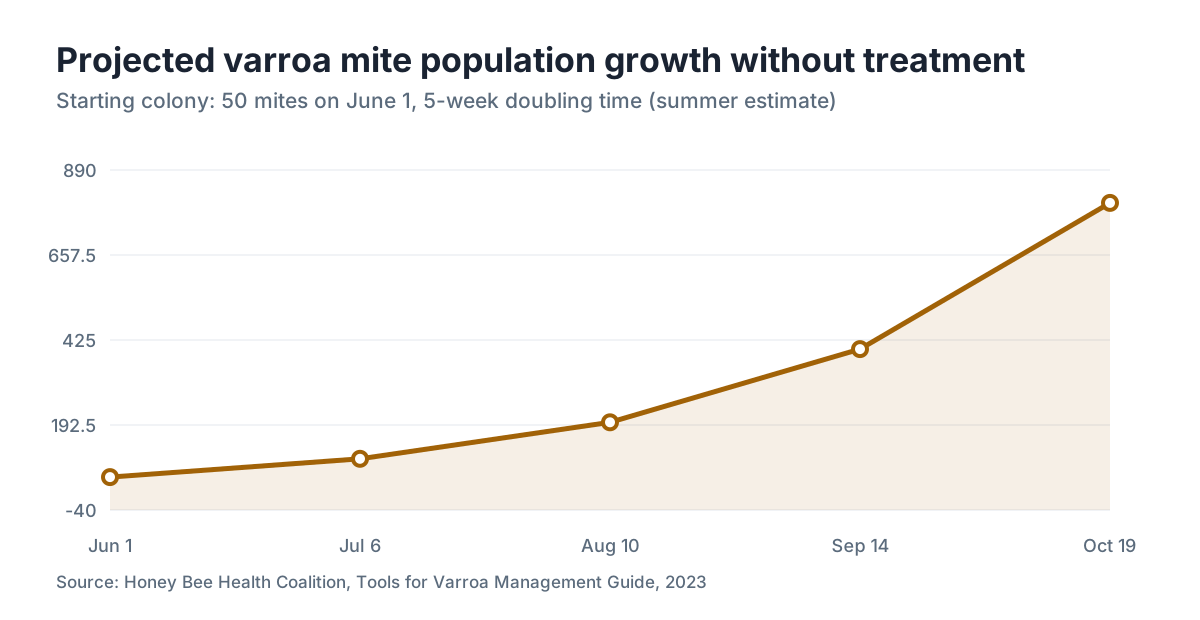
Start with 50 mites in a strong colony on June 1. Assume a five-week doubling time, a fair middle estimate for a healthy summer colony across most of the continental U.S. [1][4].
| Date | Estimated mite count | Approx. infestation rate (3 lb colony, ~40,000 bees) |
|------------|---------------------|-------------------------------------------------------|
| June 1 | 50 | ~0.1% |
| July 6 | 100 | ~0.25% |
| Aug 10 | 200 | ~0.5% |
| Sep 14 | 400 | ~1.0% |
| Oct 19 | 800 | ~2.0% |
That last number sounds fine. Two things make October mites far worse than June mites. The colony is shrinking in fall, so the same raw count is a bigger share of a smaller bee population. And October bees are the winter bees that need to live until March. Varroa-parasitized winter bees carry reduced fat body reserves and shorter lifespans [5], so a colony heading into winter at 2% is nothing like a colony entering summer at 2%.
The table also hides the mites in capped brood. An alcohol wash or sugar roll counts phoretic mites riding on adult bees, not the ones sealed in cells. The ratio shifts with brood levels, but a rough rule from Penn State Extension is that for every phoretic mite you wash off, roughly 2 to 3 more sit inside capped brood [4]. A 2% wash can mean a true colony load three times higher.
At what mite level should you be alarmed?
The Honey Bee Health Coalition's treatment thresholds are the most cited in the U.S. [1]. The numbers below come from the 2023 edition of their Tools for Varroa Management guide.
| Season | Treatment threshold (alcohol wash or sugar roll) |
|------------------------|--------------------------------------------------|
| January through March | 2% (2 mites per 100 bees) |
| April through June | 2% |
| July through August | 2% |
| September through November | 2% |
The HBHC recommends a single 2% threshold year-round, but crossing that line matters far more in late summer than in early spring, and doubling time is the reason. A 2.5% count in May gives you weeks to schedule treatment before the fall bee-raising window. A 2.5% count in August means you're already behind: the winter bees are being made right now, and those bees will carry varroa damage their whole lives.
Some extension programs use a 1% threshold in August specifically for this timing risk [4]. That's a defensible call. I'd treat at 1.5% in late July or August without a second thought, because waiting for 2% in that window costs you six to eight weeks of winter-bee quality you never get back.
How do you measure your actual mite level?
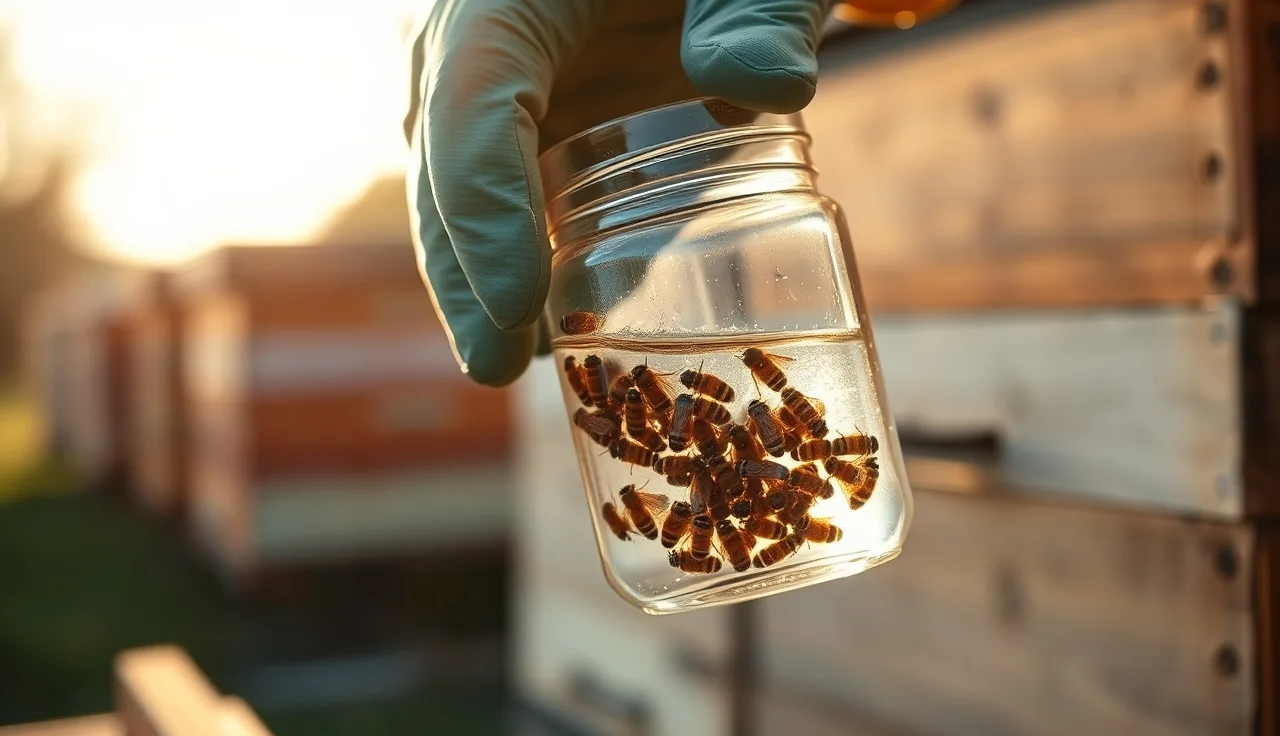
You need a count. Looking at a hive tells you almost nothing about mites. Bees that look healthy can carry a 3% infestation. The two accepted methods are the alcohol wash and the sugar roll, and the alcohol wash is more accurate because it kills and releases every phoretic mite in the sample [1].
For an alcohol wash: scoop roughly 300 bees (about half a cup by volume) off a brood frame, and keep the queen out of the sample. Add isopropyl alcohol, seal the container, shake 30 seconds, and pour the liquid through a mesh screen into a white tray. Count the mites. Divide by 3 for a 300-bee sample to get the percentage. The Honey Bee Health Coalition and Penn State Extension both publish step-by-step instructions and free worksheets [1][4].
A sugar roll uses the same sample but coats the bees in powdered sugar and rolls them, then shakes the mites onto a white surface. Sugar roll undercounts by 20 to 40% against alcohol wash in controlled tests [1], so a lot of beekeepers now treat it as the weaker option. If your sugar roll reads 1.5%, the real number may be 2% or higher.
Sticky boards under a screened bottom board give a mite drop count over 24 to 72 hours. They're less precise than a wash for setting thresholds, but they catch sudden spikes and help you check whether a treatment is working [4].
Sample every brood-active month during peak season. April, June, August, then again in September. If August reads above 1%, treat before September. That cadence catches doubling-time traps before they spring.
How does a brood break change the doubling time?
This is one of the most underrated facts in mite management. Varroa reproduces only inside capped brood. No brood, no reproduction. A brood break, from swarming, requeening, or caging the queen on purpose, forces every mite into the phoretic phase, riding adult bees but unable to breed [2].
During a natural swarm, the parent colony often sees a partial brood break while the new queen gets established. Studies have measured real mite-load drops after natural swarming, though the size of the effect varies [6]. A deliberate break by caging the queen for 24 to 28 days (a full worker brood cycle plus a few days) can cut infestation sharply and makes a follow-up oxalic acid treatment far more effective, because a broodless colony has nearly all its mites exposed on adult bees where oxalic acid reaches them.
Here's the math. If your colony has a five-week doubling time and you halt reproduction for four weeks, you've subtracted four weeks of growth from the population's future path. Pair that with oxalic acid vapor or dribble during the broodless window and you've got one of the cheapest interventions a small-scale keeper can run. It takes a queen cage and some oxalic acid.
Brood breaks do stress the colony. You lose some foraging capacity and buildup slows. For a hobbyist with a few hives, that trade is usually worth it, especially in late summer ahead of the winter bee rearing window.
Why does doubling time get worse in late summer?
Two things hit at once in late summer, and together they turn varroa dynamics ugly fast.
First, the colony starts shrinking as the queen slows egg-laying in August and September. Bee numbers slide from 50,000 to 60,000 down toward 20,000 to 30,000 by November. Mite numbers don't fall at the same pace. So your infestation percentage climbs even when total mite counts barely move. A colony with 500 mites and 50,000 bees sits at 1%. The same 500 mites in a 25,000-bee fall colony is 2%.
Second, drone brood mostly disappears. Drones get expelled or killed off as the colony trims down for fall. With drone brood gone (and mites strongly prefer it), mites crowd into worker brood at higher rates [2]. Worker cells still support reproduction, just at a slightly lower rate per cycle, but the concentration effect can actually speed up infestation in the remaining worker cells.
Put those together and the late-summer window becomes the single most important treatment timing of the year. The Honey Bee Health Coalition's guide flags August 1 as a target date for northern states, so winter bees get raised in a low-mite hive [1].
What treatments are approved and how do they interact with doubling time?
Every varroa treatment registered in the U.S. is regulated by the EPA and must be used according to its label, which is federal law [7]. Here are the main categories and how they map onto doubling time.
Oxalic acid (OA): Sold as dribble, vapor, or extended-release glycerin strips under various registrations. OA kills phoretic mites only and does not penetrate capped brood [7]. That makes it strong during broodless periods (winter or an induced break) and weak in a colony with normal brood. Doubling-time payoff: OA used right in a broodless colony can wipe out 90%+ of the mite population in one application, resetting the growth clock [1].
Formic acid (Formic Pro, MAQS): Penetrates capped brood to a degree, so it works year-round [8]. It carries temperature limits, generally 50 to 85 degrees F depending on product. Trials report roughly 70 to 90% mite kill when used correctly.
Amitraz (Apivar): A synthetic miticide applied as plastic strips for 6 to 8 weeks. Efficacy runs above 90% in research trials at full duration [9]. Resistance shows up in some populations. Poor results after a full Apivar course are a flag worth taking seriously.
Thymol (Apiguard, ApiLife Var): Temperature-dependent (best above 59 to 65 degrees F), slow-acting, usually two to four weeks. Efficacy varies but generally lands in the 75 to 90% range [1].
For planning against doubling time, ask one question: how much does my treatment cut the mite population, and how fast? A 90% knockdown drops a 2% infestation to 0.2%, which at a five-week doubling time buys about 11 weeks before you're back at 2%. That's your retreatment planning window.
You can track all of this in the free protocol tools at VarroaVault without building a spreadsheet from scratch.
How do you build a simple doubling-time treatment schedule?
You don't need a biology degree. You need three numbers: your current mite percentage, your estimated doubling time for the season, and your treatment threshold.
Here's a framework that works:
- Sample in early April. Under 1%, sample again in six weeks. At 1 to 2%, consider treating in May before buildup peaks.
- Sample in June. Any result above 1% should trigger a plan. At a five-week doubling time, 1% in June is 4% by mid-August if you do nothing.
- Sample in late July or early August. This is the highest-stakes count of the year. Treat immediately above 1 to 1.5%. The goal: mites below 1% through the August-September window when winter bees are raised.
- Sample in September after treatment. Confirm it worked. If you didn't get mites below 1%, plan a second treatment or a different product for winter.
- A late November or December oxalic acid dribble or vapor on a broodless colony is widely recommended as a clean-slate move into spring [1][4].
That's five sampling events and maybe two to three treatments across a year. For a hobbyist running five hives, a year of alcohol wash supplies runs under $30. Treatments range from about $2 to $3 per hive per application for oxalic acid up to $15 to $20 per hive for a set of Apivar strips beekeeping supply companies.
Write the dates on your hive lids in pencil. I mean it. The number of colonies lost because someone forgot to sample in August is not small.
Does mite doubling time differ between Africanized and European honey bees?
This one has a genuinely interesting answer. Africanized honey bees run measurably lower varroa infestation levels than European honey bees in several field studies, and researchers tie that partly to hygienic behavior and shorter brood-capping periods, both of which cut mite reproductive success [10].
A shorter capped period means fewer mites finish a successful cycle per cell. If the effective Rf drops below 1.0, meaning each foundress averages under one viable female offspring per cycle, the mite population declines on its own, no treatment needed. Some varroa-resistant lines of European bees bred for hygienic or mite-biting behavior get close to that line, but most commercial and hobbyist stock in the U.S. does not [3].
If you're in the continental U.S. running standard Italian, Carniolan, or Russian stock, don't assume any built-in resistance. Russian bees carry some documented mite-suppressive traits but still need monitoring [3]. VSH (Varroa Sensitive Hygiene) bees from USDA-linked breeders show the strongest research-backed resistance in European stock, with Rf values closer to Africanized populations under controlled conditions.
What's the biggest mistake hobbyists make about mite doubling time?
Treating once and calling it done.
A good August treatment that knocks mites from 2% to 0.2% is a real win. But 0.2% at a five-week doubling time puts you back near 2% by late November if you have any fall brood at all. Plenty of hobbyists treat in August, feel relieved, skip the fall count, and send the colony into winter with a mite load that's been climbing quietly since October.
The second mistake is misreading the alcohol wash number. You're counting phoretic mites. A 1.5% wash means there are mites in brood you never counted. The colony's real burden is higher than the wash shows [4]. Treating at 1.5% isn't overcorrection. It's accounting for the hidden population.
The third mistake is ignoring the neighbors. Robbing and drifting bees import mites from collapsing nearby colonies. If a neighbor's hive crashes in August and your bees rob it out, your mite load can spike in days, not weeks. No amount of doubling-time math protects you from that. One more reason to sample often instead of trusting a mental model of where you think you are.
To keep hive records, mite counts, and treatment dates in one place, the free tools at VarroaVault are built for exactly this kind of tracking across multiple hives over time.
What does the research actually say about mite population models?
The foundational work on varroa population dynamics comes from a few sources. Martin (1998) published a widely cited model that folded in brood cycle timing, mite reproductive rates, and colony size, producing doubling-time estimates that have held up reasonably well against later field work [6]. Fries and colleagues have published extensively on mite reproductive biology and resistance mechanisms [2].
The USDA ARS Beltsville Bee Research Laboratory runs ongoing varroa programs, and its data on Rf values and treatment efficacy feed into the Honey Bee Health Coalition's guidance [3]. Penn State Extension's Mite-A-Thon monitoring program has produced large real-world datasets on infestation across U.S. regions, showing that average August infestation in untreated or undertreated colonies regularly tops 3 to 4% in many states [4].
One honest caveat: field doubling times are messier than any model. Weather, queen events, robbing, colony strength, and local forage all add noise. The 4 to 6 week doubling time is a central estimate from models and field observation. Individual colonies range from 3 weeks (hot weather, heavy brood, small colony) to 8 or more (large colony, good genetics, some hygienic behavior). Nobody has real precision on this for a specific hive on a specific day, and anyone who claims they do is selling something.
The models are for planning, not for predicting your exact colony. Use them to set a monitoring cadence, not to replace monitoring.
Frequently asked questions
How often should I check mite levels to keep up with doubling time?
Sample at least every 4 to 6 weeks during active brood season, roughly April through October in most U.S. climates. The Honey Bee Health Coalition recommends monthly monitoring as a baseline. In late July and August, go every 3 to 4 weeks, because that's when a missed doubling cycle does the most damage to your winter bee crop. A late fall broodless-period check finishes the year.
Can I estimate mite doubling time for my own hive?
You can get a rough estimate by taking two alcohol wash samples 4 to 6 weeks apart without treating in between. If you went from 0.5% to 1.0%, your doubling time is about that interval. It won't be precise, because colony population is changing too, but it's a real data point. Most hobbyists in summer see doubling somewhere between 4 and 7 weeks in a healthy colony.
Does a screened bottom board reduce mite doubling time?
Screened bottom boards let some mites fall out of the colony, but research consistently shows a modest reduction, usually 10 to 15% fewer mites than solid bottom boards. That's not enough to stretch your doubling cycle or delay treatment. Use screened bottoms for ventilation if you like them, but don't count them as mite control. Sticky boards under screened bottoms are useful for monitoring mite drop, not reducing it.
What mite percentage kills a colony?
There's no single collapse threshold, but colonies above 3 to 4% in late summer show sharply higher winter mortality in research data. The Honey Bee Health Coalition's 2% threshold sits well before collapse risk climbs. Colonies sometimes survive winter at 3 to 4%, but they produce fewer bees, more virus load, and weaker spring starts. The damage compounds long before the colony visibly fails.
Is doubling time faster in small colonies than large ones?
Yes, in percentage terms. A small colony with fewer bees but the same absolute mite count has a higher infestation rate and fewer bees to suppress mites by grooming. Mites also cycle faster between brood and the phoretic phase when brood space is tight. Small colonies (packages, splits, nucs) need more frequent monitoring. A new package can hit the 2% threshold surprisingly fast in its first active brood season.
Does treating with oxalic acid once in winter reset the doubling time clock?
It resets the mite population to near zero in a broodless colony, which effectively resets the clock for the next season. Winter OA on a broodless colony can reach 90%+ mite kill per EPA label data and HBHC guidance. Start spring at 0.1% or less, and a five-week doubling time gives you until roughly mid-summer before crossing the 2% action threshold, assuming no mites drift in from other colonies.
Do drones affect how fast mites reproduce in a hive?
Yes, a lot. Varroa prefers drone brood because the longer capping period (14 to 15 days versus 12 for workers) gives mites more time to produce offspring per cycle. Drone brood can carry infestation rates 8 to 10 times higher than worker brood. A colony with heavy spring drone production can see faster overall mite growth. Some beekeepers use drone comb trapping as a supplemental control, though it won't replace chemical or biotechnical treatment.
What happens to mite doubling time during a swarm?
A swarm carries off some mites (the phoretic ones on the departing bees), while the parent colony gets a partial brood break during requeening. The brood gap slows mite reproduction for a while. But the parent's reduced bee population can push the mite percentage up even as absolute numbers drop. Both the swarm and the parent colony need monitoring and likely treatment if they were above threshold before the swarm.
How does mite doubling time compare in northern versus southern states?
Southern states with longer brood seasons and mild winters give mites more months of reproduction per year. A colony in Georgia or Florida may never fully stop brood, so mites breed year-round and winter oxalic acid applied during a broodless period is less reliably effective. Northern beekeepers get a natural broodless winter window, but their shorter season makes each summer doubling cycle count more. Always start with your state's extension recommendations.
Can good genetics slow mite doubling time enough to skip treatment?
In most North American hobbyist stock, no. VSH (Varroa Sensitive Hygiene) bees from USDA-linked breeders show the strongest documented mite suppression in European stock, but even VSH bees need monitoring and occasional treatment in most field conditions. Researchers treat genetics as a tool that reduces treatment frequency, not one that eliminates it. Monitor regardless of genetics, every season.
What's the difference between infestation rate and total mite count, and which matters more?
Infestation rate (mites per 100 bees) is what your alcohol wash measures and what thresholds are based on. Total mite count is the absolute number in the colony. For treatment decisions, infestation rate matters more, because it reflects the per-bee burden and virus transmission risk. Total count matters for understanding how many mites survive treatment and keep doubling, which is why larger colonies carry more buffer than small ones at the same percentage.
How do I know if my treatment actually worked against the mite doubling cycle?
Sample again 3 to 4 weeks after finishing treatment. If your infestation rate dropped 90% or more from pre-treatment levels, it worked. If you treated in August and re-sample in September to find you're still above 1%, either efficacy was poor (possible resistance, bad application, or timing against heavy brood) or mites came back in from neighboring colonies. A follow-up treatment with a different product class may be warranted.
Is there a free tool to track mite counts and predict when I'll hit the threshold?
Yes. The Honey Bee Health Coalition provides a free mite management guide with threshold tables and record-keeping worksheets at honeybeehealthcoalition.org. VarroaVault also offers free tracking tools built to log counts across multiple hives and flag when doubling-time projections suggest you're approaching the 2% threshold, so you can plan treatment timing instead of reacting to it.
Sources
- Honey Bee Health Coalition, Tools for Varroa Management Guide (2023 edition): Varroa populations can double every 4-6 weeks in summer; treatment threshold is 2% year-round; August 1 target date for northern-state treatment; OA in broodless colonies achieves 90%+ mite kill
- Fries, I. et al., Varroa destructor (Acari: Varroidae) parasitizes the adult bee, Experimental and Applied Acarology: Female mite egg-to-adult development takes approximately 5.9 days; drone brood capped 14-15 days; worker brood 12 days; mite preference for drone brood documented
- USDA ARS Beltsville Bee Research Laboratory: Reproductive rate (Rf) values for varroa in worker brood cluster around 1.3-1.45; Russian bee mite-suppressive traits documented
- Penn State Extension, Varroa Mite Management: For every phoretic mite on adult bees, roughly 2-3 additional mites are inside capped brood; sugar roll undercounts by 20-40% vs. alcohol wash; Mite-A-Thon field data show average August infestation above 3-4% in untreated colonies; alcohol wash step-by-step instructions
- Genersch, E. et al., The German bee monitoring project, Apidologie (2010): Varroa-parasitized winter bees have reduced fat body reserves and shorter lifespans, increasing winter mortality risk
- Martin, S.J. (1998), A population model for the ectoparasitic mite Varroa jacobsoni in honey bee colonies, Ecological Modelling: Foundational varroa population model incorporating brood cycle timing and mite reproductive rates; natural swarming events documented to produce measurable mite-load reductions
- U.S. EPA, Varroa Mite Control and the Honeybee: All varroa treatments in the U.S. are regulated by EPA; oxalic acid kills phoretic mites only and does not penetrate capped brood per label; use according to label is federal law
- Formic Pro EPA product label, NOD Apiary Products: Formic acid (Formic Pro) penetrates capped brood; temperature use range 50-85°F depending on product formulation
- Floris, I. et al., Efficacy of miticides against Varroa destructor, Apidologie (2004): Amitraz (Apivar) efficacy typically above 90% mite kill in research trials when used for full recommended duration
- Medina, L.M. and Martin, S.J., A comparative study of Varroa jacobsoni reproduction in Africanized and European honey bee brood, Experimental and Applied Acarology (1999): Africanized honey bees show measurably lower varroa infestation levels partly due to hygienic behavior and shorter brood-capping periods that reduce mite reproductive success
- University of Minnesota Extension, Varroa Mite Management: Monthly monitoring during brood season recommended; August treatment timing to protect winter bees
Last updated 2026-07-09