Varroa plus nosema: how dual pest stress destroys colonies faster
TL;DR
- Colonies carrying both varroa mites and Nosema ceranae suffer compounding immune suppression, gut damage, and faster bee loss than either pest causes alone.
- Dual-infected hives can collapse weeks earlier than single-pathogen colonies.
- Diagnosis decides everything.
- Treat varroa first in most seasons.
- Handle nosema with comb rotation and nutrition, not chemicals, unless a lab confirms high spore counts.
What actually happens when varroa and nosema hit the same colony?
Bad gets worse, fast. Varroa destructor feeds on honey bee fat body tissue, more than hemolymph as once believed, and that fat body is the bee's immune headquarters. A 2019 PNAS study by Ramsey et al. pinned down this feeding site, which helps explain why mite-parasitized bees fall apart so easily when a second pathogen shows up [1]. Nosema ceranae, the microsporidian that now dominates most of North America, chews up the midgut lining and drops the bee's ability to absorb nutrients, make vitellogenin, and run an immune response [2].
When both pathogens land in the same bee, you get a double knockout. Fat body damage from varroa weakens the same bees that are fighting gut destruction from nosema. Foragers die younger. Brood care goes patchy because nurse bees are physically broken. And since varroa also injects deformed wing virus (DWV) and other RNA viruses straight into developing pupae, the hive fills up with short-lived, immunosuppressed adults that can't eat properly and can't fight disease.
The Honey Bee Health Coalition's Varroa Management Guide calls varroa "the single most damaging pest of honey bee colonies worldwide," and notes that co-infections with viruses and other pathogens make outcomes far worse than mite parasitism alone [3]. Nosema is exactly that kind of co-infection pressure.
Seasonal timing sharpens the knife. In late summer, when colonies raise the long-lived winter bees that have to survive until spring, a double hit of high mite counts and high Nosema ceranae can gut the winter cluster before it forms. You pull the lid in April and find dead bees, honey still in the frames, and no obvious cause. Unless you tested, you never find out what killed them.
How do varroa and nosema interact biologically?
They attack the same defense system from two directions. The fat body and hemocyte network produce immune proteins like abaecin and defensin, and both pests knock that system down. A 2009 study by Antunez et al. in Environmental Microbiology found that N. ceranae infection significantly down-regulated immune gene expression in adult bees, including genes that help suppress viral replication [2]. Varroa does the same damage through a different route: direct tissue destruction plus salivary compounds that appear to blunt local immune signaling.
The result is additive immunosuppression. Each pest alone is survivable at moderate levels. Together they shove bees past the point where the colony can compensate by making more foragers or ramping up hygienic behavior.
Then there's the nutritional angle. Nosema ceranae cuts the bee's ability to digest pollen and absorb amino acids, which are the raw material the fat body needs to rebuild. Bees can't repair what varroa is destroying if their guts can't process the fuel. Colonies in poor forage, near monoculture farmland or stuck in a dearth, take the worst of it, because the nutritional deficit is already there before either pest gets a foothold. Pollen diversity and volume matter. See our page on beehive pollen for what good pollen intake actually looks like.
Viral load is the third leg. Varroa moves DWV, sacbrood virus, and others during feeding and reproduction. N. ceranae may itself change how those viruses replicate, though the direction of that effect is still being worked out. What's clear: high mite loads track with high DWV titers, and bees with immune function wrecked by nosema have less capacity to hold viral spread in check. The math isn't perfectly linear. The direction is not in doubt. More of one pest means worse outcomes when the other is present too.
How do you know if your hive has both varroa and nosema?
You usually can't tell by looking. That's the honest answer. Both infections get well established before clear clinical signs show up, and the symptoms overlap hard: weak spring buildup, thin forager populations, crawling bees, patchy brood, early winter collapse. Same picture, different causes.
For varroa, the field standard is the alcohol wash. The USDA Beltsville Bee Lab and most state extension services recommend washing 300 adult bees from the brood area and calculating mites per 100 bees. An action threshold of 2 mites per 100 (2%) is widely used during brood rearing, and some researchers argue for treating at 1% before the winter bee window in late summer [3][11]. The sugar roll works too, but it undercounts by roughly 20 to 30% compared to the wash. Factor that in if it's your method.
For nosema, you need a microscope or a lab. N. ceranae spores show up at 400x in a squashed-gut prep. The Honey Bee Health Coalition and several state labs accept samples for spore counts. Counts above 1 million spores per bee are generally called significant; above 10 million per bee is heavy infection [5]. Here's the problem: most hobbyist beekeepers never test for nosema at all, so dual infections stay invisible until the colony is already dying.
For varroa mite testing protocols and threshold guidance, you'll find step-by-step instructions for both the alcohol wash and sticky board methods.
A workable habit: run an alcohol wash every 30 days in the active season, and test for nosema at least once in early spring and once in fall. Find varroa above threshold, treat it. Find nosema above 1 million spores per bee on top of that, and you have a compounding problem that needs a layered response, not a single fix.
Which pest should you treat first?
Treat varroa first. Almost always. It's the more immediately lethal pest at most infestation levels, and knocking mite counts down removes the main driver of viral loading and immune suppression. Once varroa is under control, the colony has a real shot at managing nosema on its own through natural bee turnover and better nutrition.
Nosema treatment is harder than it used to be. Fumagillin, the one antibiotic that reliably worked against nosema, left the U.S. market around 2011 after its registration lapsed, and it's no longer legal for bee use here [6]. That leaves management instead of chemistry: replace old comb where spores build up, improve nutrition, keep ventilation good, and hold colonies strong through timely mite control. Canada and parts of Europe still have fumagillin in some form. U.S. beekeepers are working without it.
So the order goes: confirm mite load, treat varroa if you're at or above threshold, then reassess colony strength. If nosema is confirmed high and the colony still struggles after mite treatment, the best evidence-backed moves are comb replacement, adequate pollen or protein supplement, and splitting heavily infected colonies to force a brood break that disrupts nosema cycling.
One scheduling trap: some oxalic acid treatments need a broodless period to hit full effect. If you're heading into fall and want both problems handled before winter bee production peaks, the sequence is simple. Treat varroa aggressively while there's still time for the bees to raise healthy winter bees, then work on comb and nutrition to bring nosema pressure down.
What varroa treatments work and do any also help with nosema?
No registered varroa treatment does anything meaningful to Nosema ceranae. Two problems, two approaches. Here's the varroa treatment landscape for U.S. beekeepers, all EPA-registered options [7]:
| Treatment | Active ingredient | Effective temp range | Brood effect | Notes |
|---|---|---|---|---|
| Apivar | Amitraz strips | 50-105°F (10-40°C) | Works through capped brood cycle | 6-8 weeks contact required; resistance emerging in some regions |
| Mite Away Quick Strips (MAQS) | Formic acid | 50-85°F (10-29°C) | Penetrates capped brood | Can be used during honey flow; queen loss risk at high temps |
| Api-Life VAR | Thymol blend | 59-69°F (15-21°C) | Minimal brood penetration | Narrow temp window; good for spring/fall |
| Apiguard | Thymol gel | 59-85°F (15-29°C) | Limited brood penetration | 4-week treatment; effective in moderate temps |
| Oxalic acid (dribble/vaporize) | Oxalic acid dihydrate | Above 40°F for dribble | Kills phoretic mites only | Most effective when colony is broodless |
| Hopguard 3 | Hops beta acids | 50-100°F | Reduced efficacy in capped brood | Organic option; shorter treatment window |
For dual-stressed colonies, the real worry is how well these work under bad conditions. A colony weakened by nosema often thermoregulates poorly, which changes how fast thymol-based treatments volatilize. Oxalic acid vaporization is usually the most reliable choice in a compromised colony because it doesn't lean on the bees to spread the compound around.
On the nosema side, the only registered option in the U.S. right now is management. Cut the environmental spore load by replacing old dark comb, feed quality pollen or substitute to support nutrition, and keep stress off the colony during treatment windows. Thymol and probiotics have shown up in research, but no product carries EPA registration for nosema in the U.S. as of 2025.
Building a full seasonal protocol around these options is what VarroaVault's free protocol tools are for. Map out timing, temperature windows, and re-infestation checks without doing the scheduling math by hand.
How much does dual pest stress raise the risk of colony death?
Substantially, though the exact multiplier shifts with season, region, and nutrition. A few numbers frame it.
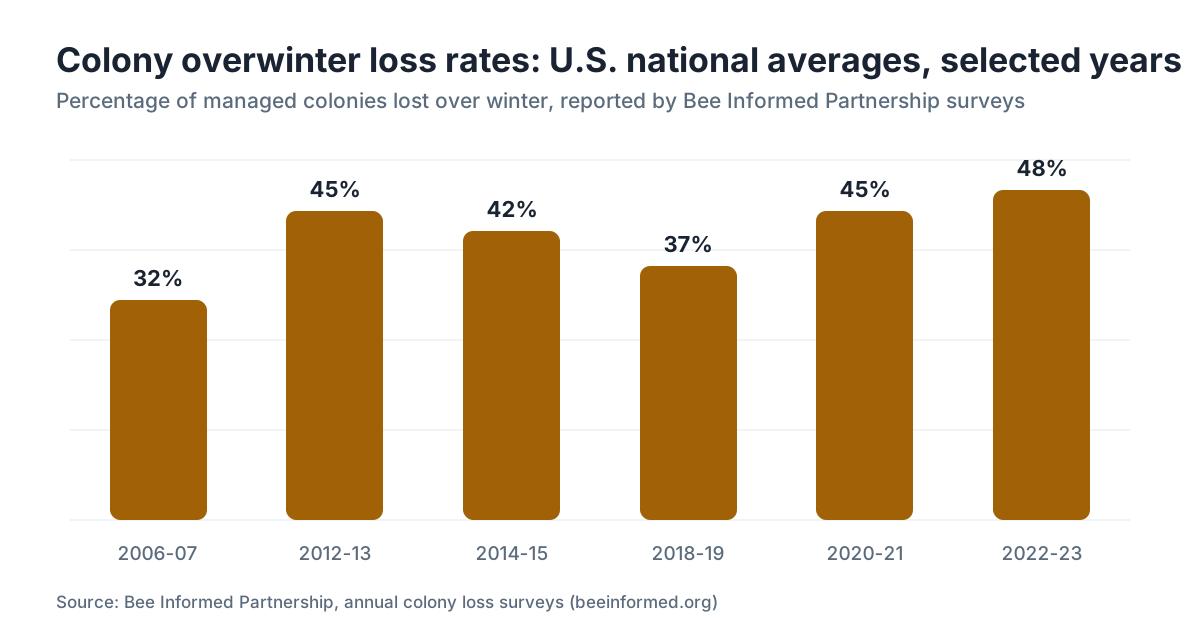
USDA and Bee Informed Partnership colony loss surveys have shown overwinter losses above 30% nationally in most years since 2006, with varroa and its associated viruses named as the leading driver [8]. Nosema shows up as a contributing factor in a meaningful share of submitted deadout diagnoses, but since most beekeepers never test for it, it's almost certainly undercounted.
A 2012 PLOS ONE paper by Dainat et al. found that colonies with high nosema loads in fall had significantly higher winter mortality than colonies with low loads, and mortality peaked when both nosema and varroa ran high [9]. Not perfectly additive in a mathematical sense, but the direction holds every time. Dual infection beats either alone into the ground.
Some extension services say it plainly. Penn State Extension recommends treating varroa before the critical fall period and monitoring nosema separately, warning that a colony entering winter with both faces compounding stressors that are hard to recover from [4].
Here's the practical read. A colony with a 3% mite wash in August has a real problem. That same colony at 3% with confirmed high nosema probably won't reach April without help. The window to act is shorter, and the margin for error is thinner.
Does poor nutrition make dual pest stress worse?
Yes, and it's the most underrated piece of the whole thing. Honey bees need pollen to build the fat body, and the fat body is the exact tissue varroa feeds on. A bee raised on diverse, high-protein pollen has a tougher fat body than one raised in a monoculture with thin amino acid variety. Studies have shown that bees with higher protein stores tolerate varroa and viral infections better, live longer, and hold onto more functional immune responses.
Nosema ceranae stacks right on top of this. It interferes with nutrient absorption, so even when good pollen is available, infected bees can't fully use it. You land in a downward spiral: the gut pathogen stops the bees from building the fat body reserves that would help them fight the gut pathogen and the mite both.
During dearth, especially midsummer in a lot of regions, dual-stressed colonies need supplemental feeding. A quality pollen substitute (look for at least 20% crude protein and a diverse amino acid profile) fed in patties before brood rearing stress peaks makes a real difference. It won't cure nosema. It softens how hard the gut infection hits the fat body.
Forage diversity and pollen availability are the base everything else sits on. For more on what pollen looks like inside a healthy hive, the beehive pollen resource covers identification and nutritional assessment.
Are some colonies or bee lines more resistant to dual pest stress?
Some are, and breeding for resistance is real, not marketing. Varroa-sensitive hygiene (VSH) bees and selected Russian honey bee lines show documented differences in mite population growth compared to unselected Italians or Carniolans [10]. The USDA Baton Rouge Bee Breeding Lab has maintained and distributed VSH genetics for decades, and the improvement is measurable. VSH bees interrupt mite reproduction in capped cells at much higher rates than unselected bees.
Whether high-VSH colonies also handle nosema better is less clear. There's a theoretical case: a stronger, longer-lived adult population should have more collective capacity against any pathogen. But strong experimental data on VSH colonies and nosema co-infection isn't there as of 2025. Nobody has good data on that specific interaction, and anyone who tells you otherwise is guessing.
For hobbyists and sideliners, the practical message is short. Buying packages or queens? Look for VSH or mite-resistant stock from reputable breeders. It won't end your need to monitor and treat, but it slows how fast mite populations rebuild between treatments, which buys time and shrinks the window when dual-stress vulnerability spikes.
Hygienic behavior, separate from VSH, matters for nosema too. Bees that pull diseased pupae faster tend to carry lower pathogen loads across the board. The two traits are partly correlated. They aren't the same thing.
What does a dual-stress management calendar actually look like?
Here's a working schedule for a temperate northern hemisphere beekeeper in USDA hardiness zones 5 to 7.
Early spring (March-April): Run an alcohol wash as soon as the colony is strong enough to sample 300 bees from the brood area. If nosema worries you, collect 30 to 60 bees per hive and send to a lab or check under a scope. Mite threshold is still 2 per 100 this time of year. Act if you're at or above it. Start protein supplement if natural pollen hasn't come in yet.
Late spring (May-June): Monthly alcohol washes. Both the colony and the mite population are growing now, so watch counts closely. Find nosema above 1 million spores per bee in spring, and plan comb rotation for that hive.
Midsummer (July-August): The highest-risk window. The August window for varroa treatment gets recommended everywhere because it's your last practical chance to bring mite counts down before winter bee rearing starts. Treat at 2% or higher. If counts are high, pair oxalic acid vaporization with a contact treatment. For nosema, cut out unnecessary manipulation and keep incoming pollen or supplement strong.
Fall (September-October): One final mite check 4 to 6 weeks after treatment to confirm it worked. Still elevated? Re-treat. Oxalic acid dribble or vapor works well on broodless or near-broodless fall colonies. Check protein needs for winter cluster formation.
Winter (November-February): Little to do once the cluster is tight. This is when the fall's dual-stress problems play out. Do the August through October work right, and most colonies make it. Skip it, and spring tells the story.
For scheduling help, threshold calculators, and treatment timing tools built around your region and hive count, VarroaVault's free management tools handle this kind of seasonal planning.
What should you do when a colony is already failing from dual stress?
Confirm the diagnosis first. A deadout with honey still in the frames and a small cluster, or no cluster, fits late-season collapse from dual stress. It also fits starvation, queen failure, or pesticide exposure. Pull frames and read the evidence. Adult bee bodies head-first in cells points to starvation. A shotgun brood pattern points to a laying worker or failing queen. Physical deformities on dead adults point to high DWV from varroa.
If the colony is alive but weak in late summer, the honest prognosis depends on how much time is left before cold weather shuts down brood rearing. A colony down to 3 frames of bees in September in Minnesota is probably not wintering. Combining it into a stronger hive after an oxalic acid treatment beats nursing it separately, where it likely dies anyway and possibly hands nosema spores and mites to a neighbor.
Still got season left? Treat varroa immediately with whatever suits your temperature and brood status. Feed protein supplement. Replace the oldest, darkest comb with foundation to shrink the nosema spore reservoir. If the queen is present and laying, ask whether her genetics are part of the problem. Some queens throw bees with notably weak hygienic behavior, and that produces recurring high-mite seasons.
One hard rule: don't harvest honey from hives you're treating with registered miticides unless the label allows it. Most amitraz and formic acid labels restrict harvest timing. Read the current EPA label for any product before you use it [7].
Don't do nothing and hope. Hope doesn't reduce mite counts.
Where can you find reliable resources and tools for managing varroa and nosema together?
The Honey Bee Health Coalition's Varroa Management Guide is the most practical free resource for U.S. beekeepers. It covers testing methods, thresholds, treatment options, and timing in plain language, and it's updated to reflect current registrations [3].
Penn State Extension's beekeeping pages, the University of Minnesota Bee Lab, and the USDA Bee Research Lab at Beltsville all publish free, peer-reviewed guidance on both varroa and nosema [4][11]. State departments of agriculture sometimes carry their own recommendations tuned to local climate and forage, so it's worth a look at your state's ag site.
For nosema specifically, the Beltsville lab accepts diagnostic samples from beekeepers, and the USDA APHIS site has current submission guidance. Some state apiarists also offer free or low-cost disease testing.
Shopping for treatment products? Confirm what you're buying is EPA-registered in your state. Registration varies by state, and using an unregistered product is both illegal and often useless. For a comparison of suppliers and what they carry, the beekeeping supply companies page is a fair starting point.
To track mite counts over time and line up treatment windows against your local calendar, VarroaVault's free tools let you log wash results, set threshold alerts, and generate treatment timing recommendations for your region.
Frequently asked questions
Can varroa and nosema infect the same individual bee at the same time?
Yes. A single adult bee can carry phoretic varroa mites on her body, host active Nosema ceranae spores in her midgut, and be infected with deformed wing virus vectored by varroa feeding, all at once. This triple burden is why dual-stressed colonies fall apart faster than single-pathogen hives. Fat body damage from varroa and gut damage from nosema both cut the immune capacity the bee needs to survive any of them.
Is Nosema ceranae worse than the original Nosema apis?
Most researchers think N. ceranae is more virulent, at least in temperate climates. Unlike N. apis, which tends to spike in spring and fade in summer, N. ceranae can hold high spore counts year-round and has been linked to summer collapses that N. apis rarely caused. N. ceranae has largely displaced N. apis across most of North America and Europe. Confirming which one you have takes microscopy, since the two look similar at low magnification.
Will treating varroa also reduce nosema loads?
Not directly. Varroa treatments have no registered efficacy against Nosema ceranae. But bringing mite counts down removes a major source of immune suppression, which lets bees mount better natural defenses against nosema. Colonies with well-controlled varroa tend to show better health across the board, including lower general pathogen burdens. So treating varroa helps nosema indirectly. It is not a substitute for nosema-specific management.
What happened to fumagillin and why can't I use it for nosema anymore?
Fumagillin (sold as Fumagilin-B in Canada) was the only antibiotic effective against nosema in honey bees. The U.S. supply lapsed around 2011 when the registration was not renewed, and it has not been legally available for bee use in the United States since. No equivalent replacement has EPA registration as of 2025. U.S. beekeepers rely on management instead: comb replacement, nutrition, and varroa control.
How often should I test for varroa if I also suspect nosema?
Test for varroa every 30 days during the brood-rearing season using an alcohol wash of 300 bees from the brood area. For nosema, test at least once in early spring and once in fall, ideally by sending 30 to 60 bees to a diagnostic lab. Overtesting for nosema is not the problem hobbyists have. Undertesting is, and most dual-stress collapses go undiagnosed because nosema is never confirmed.
Can I use oxalic acid when the colony has both varroa and nosema?
Yes. Oxalic acid is EPA-registered for varroa control and safe for bees at label doses. It does nothing to nosema, but it's often the best pick for a weakened, dual-stressed colony. It doesn't need high ambient temperatures (dribble works above 40°F), it doesn't hit the bees with volatile compounds, and it's highly effective against phoretic mites. Broodless application by vaporization gives the best mite kill.
Does Nosema ceranae cause the same spring dwindling that Nosema apis used to?
N. ceranae presents differently. The classic spring dwindling with crawling bees and dysentery was more typical of N. apis. N. ceranae infections can stay subclinical until the colony suddenly crashes, sometimes in midsummer when you'd expect strong foraging populations. That makes it harder to catch early without testing. Sudden unexplained population drops in otherwise healthy-looking hives are worth a nosema check.
What mite wash threshold should I use before the winter bee rearing period?
Most extension services set the action threshold at 2 mites per 100 bees (2%) during brood rearing. Some researchers push for treating at 1% in late summer (roughly August in northern states) before winter bee rearing begins, because those long-lived bees must survive 5 to 6 months and any fat body damage now is permanent. For dual-stressed colonies, leaning toward the 1% threshold in August is reasonable.
Are there bee breeds or genetic lines that handle both varroa and nosema better?
VSH (varroa-sensitive hygiene) bees and selected Russian lines have documented advantages against varroa through suppressed mite reproduction. Whether those genetics also give nosema resistance isn't well established experimentally. General hygienic behavior, meaning fast removal of diseased brood, may lower total pathogen loads including nosema spores, but specific data on VSH and nosema co-infection is thin. Using resistant stock is still worth doing.
Can a strong hive become re-infested with both varroa and nosema from weak neighbors?
Yes. Varroa re-infestation from collapsing nearby colonies is well documented and can push mite counts up fast in a previously treated, clean hive. Nosema spores spread through feces and get picked up by foragers robbing weakened hives. If you run several hives or have neighbors with bees, never assume a treated hive stays clean. Monthly mite washes and fall nosema checks still matter even in well-run apiaries.
Does supplemental feeding with pollen substitute actually help nosema-infected colonies?
It helps, but it doesn't cure the infection. Nosema ceranae impairs nutrient absorption, so infected bees can't fully use the protein they eat. Feeding quality pollen substitute still reduces the nutritional deficit and supports fat body recovery in bees that aren't heavily infected yet. The biggest payoff is for early-season colonies where natural pollen is scarce. It's supportive care, not treatment, and works best alongside varroa control.
How do I collect and send bees to a lab for nosema diagnosis?
Collect 30 to 60 adult forager bees (not nurse bees) from the hive entrance into a small vial of 70% isopropyl alcohol. Label the vial with hive ID, date, and your contact info. Most state apiarists and university diagnostic labs accept bee samples for nosema spore counts. Check your state ag department or a university extension lab like Penn State or the University of Minnesota for current submission instructions. Results usually come back within 1 to 2 weeks.
What's the difference between varroa-related colony collapse and nosema-related collapse?
Varroa collapse tends to show deformed, stunted bees, a declining adult population over weeks, and sometimes visible mites on adults. Nosema collapse is often more sudden, with apparently healthy adult numbers dropping fast, sometimes with dysentery on the front board (more common with N. apis), and without the DWV deformities. In practice, many collapses involve both, and the only way to separate contributing factors is to test.
Should I combine a dual-stressed failing colony with a healthy one?
Sometimes. Combining a failing colony into a strong one can save the bees and the genetics if you do it right. Combine only after treating for varroa first. Do not dump a high-mite load into a clean hive. For nosema, rotate out the oldest comb from the failing colony instead of bringing it all in, since comb is a major spore reservoir. The newspaper method works fine. Just treat before you combine.
Sources
- USDA ARS / Ramsey et al., PNAS 2019, 'Varroa destructor feeds primarily on honey bee fat body tissue': Varroa destructor feeds primarily on fat body tissue, the seat of bee immune function, not primarily on hemolymph as previously believed
- Antunez et al., Environmental Microbiology 2009, 'Immune suppression in the honey bee (Apis mellifera) following infection by Nosema ceranae': N. ceranae infection significantly down-regulates immune gene expression in adult bees, including genes that suppress viral replication
- Honey Bee Health Coalition, Varroa Management Guide (current edition): Varroa mites are the single most damaging pest of honey bee colonies worldwide; co-infections with viruses and other pathogens dramatically worsen outcomes
- Penn State Extension, Bee Health pages: Penn State recommends treating varroa before the critical fall period and monitoring for nosema separately; dual-stressed colonies entering winter face compounding stressors
- USDA ARS, Bee Research Laboratory, Beltsville, nosema spore count thresholds: Nosema spore counts above 1 million per bee are considered significant; counts above 10 million per bee indicate heavy infection
- EPA, Fumagilin-B registration status, pest management regulatory notes: Fumagillin is no longer legally available for honey bee use in the United States as of approximately 2011 due to non-renewal of registration
- EPA, registered pesticide product labels (Apivar, MAQS, Apiguard, Api-Life VAR, oxalic acid, Hopguard 3): Apivar, MAQS, Apiguard, Api-Life VAR, oxalic acid, and Hopguard 3 are EPA-registered varroa treatments with specific temperature and harvest restriction requirements per their labels
- USDA NASS and Bee Informed Partnership, annual colony loss surveys: Overwinter colony losses in the U.S. have consistently exceeded 30% nationally in most years since 2006, with varroa and associated viruses cited as the leading driver
- Dainat et al., PLOS ONE 2012, 'Predictive markers of honey bee colony collapse': Colonies with high nosema loads in fall had significantly higher winter mortality; when both nosema and varroa were high, mortality was highest
- USDA ARS Honey Bee Breeding, Genetics, and Physiology Research Unit, Baton Rouge, VSH bee program: VSH (varroa-sensitive hygiene) bees interrupt mite reproduction in capped cells at measurably higher rates than unselected bee lines
- University of Minnesota Bee Lab, varroa and colony health resources: Alcohol wash of 300 bees from the brood area is recommended as the gold standard field test for varroa; action threshold of 2 mites per 100 bees during brood-rearing season
Last updated 2026-07-09