Natural varroa mite treatments: what actually works in 2025
TL;DR
- The most effective natural varroa mite treatments are oxalic acid (vaporized or dribbled), formic acid (Formic Pro or MAQS), and thymol (ApiLife VAR or Apiguard).
- Oxalic acid vapor during a broodless period kills 90-97% of mites.
- No single method works in every situation.
- Your choice depends on brood status, ambient temperature, and how high your mite load already is.
What counts as a 'natural' varroa treatment?
The term gets thrown around loosely, so let's pin it down. In varroa management, 'natural' or 'soft' treatments are compounds derived from naturally occurring substances: organic acids (oxalic acid, formic acid) and plant-derived compounds (thymol, hop beta acids). They're the opposite of synthetic acaricides like Apivar (amitraz) or Apistan (tau-fluvalinate), which are lab-made molecules.
The EPA registers these products for use in the U.S., and most have full label approval from the agency. That matters because 'natural' doesn't mean unregulated. Using any varroa treatment in a way that breaks its label is illegal and, frankly, a bad idea for your bees.
Here's the part people miss. 'Natural' does not mean 'gentle on bees' or 'always safe'. Formic acid is corrosive. Oxalic acid can hurt bees if you misapply it. Thymol can kill colonies in hot weather. These are real chemicals with real dose-response curves. They work, and they can do harm. Treat them accordingly.
The Honey Bee Health Coalition's Varroa management guide covers this category thoroughly and is a good primary reference if you want to go deeper [1].
What is the best treatment for varroa mites among natural options?
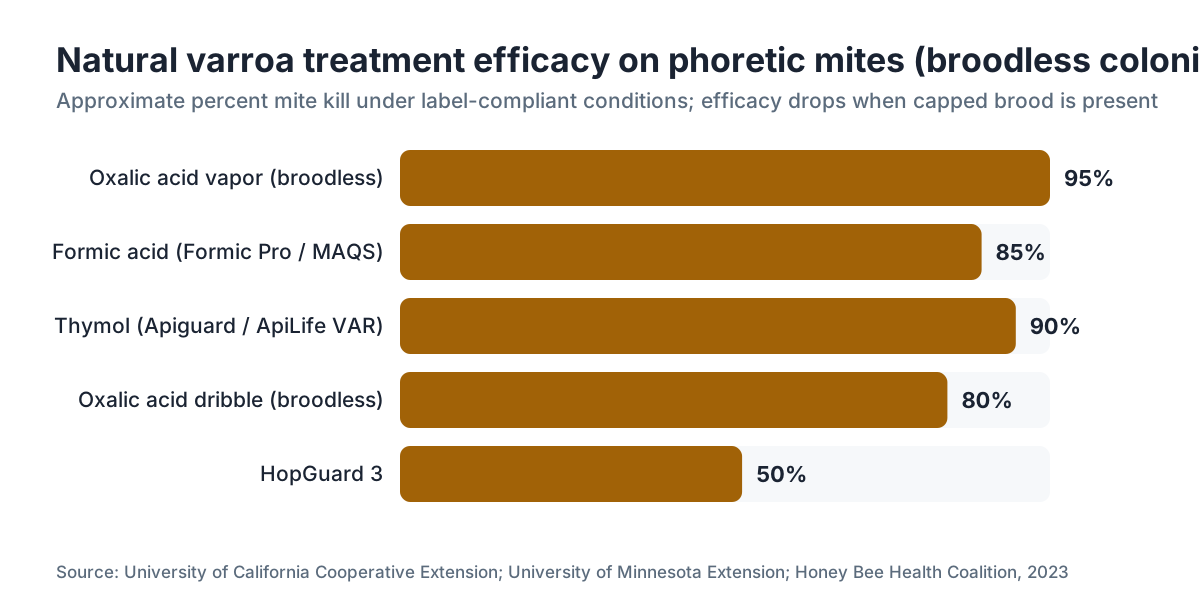
For pure mite-kill efficacy, nothing beats oxalic acid vapor during a completely broodless period. Studies cited by the University of California Cooperative Extension report 90-97% efficacy when colonies have zero capped brood [2]. That number falls into the 50-70% range once brood is present, because oxalic acid can't reach through cappings to the mites inside cells.
But 'best' depends on your situation.
| Treatment | Active Ingredient | Brood Penetration | Temp Window | EPA Registration |
|---|---|---|---|---|
| Oxalic acid vapor | Oxalic acid dihydrate | None | 0-100°F (vaporizer) | Yes (Api-Bioxal) |
| Oxalic acid dribble | Oxalic acid dihydrate | None | 40-60°F recommended | Yes (Api-Bioxal) |
| Formic Pro / MAQS | Formic acid | Yes (penetrates cappings) | 50-85°F | Yes |
| Apiguard | Thymol | Partial | 59-105°F | Yes |
| ApiLife VAR | Thymol blend | Partial | 59-95°F | Yes |
| Hopguard 3 | Hop beta acids | None | Any | Yes |
If your colony has brood and mite counts are high, formic acid is the only natural option that reliably kills mites inside capped cells. The University of Minnesota Extension notes that formic acid treatments kill both phoretic mites and a large share of reproductive mites under cappings [3].
Thymol products (Apiguard, ApiLife VAR) work well in the right temperature range and are popular in Europe, but they need two treatment strips with a 1-2 week gap, and efficacy drops sharply below 59°F or above 105°F.
HopGuard 3 is approved and has its place, mostly for mite management during honey flows when other treatments aren't allowed, but its efficacy data is thinner and generally lower than the other options [4].
My honest take. For most hobbyist beekeepers in North America, the practical answer is a late-fall or winter broodless oxalic acid vapor treatment paired with a midsummer formic acid treatment when mite counts climb above your threshold. Timed to your colony's brood cycle and your local climate, that two-treatment protocol covers the year better than any single product can.
How does oxalic acid work and what are the EPA-registered products?
Oxalic acid (OA) is a naturally occurring compound found in rhubarb, spinach, and other plants. Bees make trace amounts too. At the concentrations used against varroa, it kills mites on contact by disrupting their nervous and digestive systems, though the exact mechanism is still being studied.
In the U.S., Api-Bioxal is the only EPA-registered oxalic acid product for honey bees [5]. It comes as a crystalline powder, and you can apply it three ways:
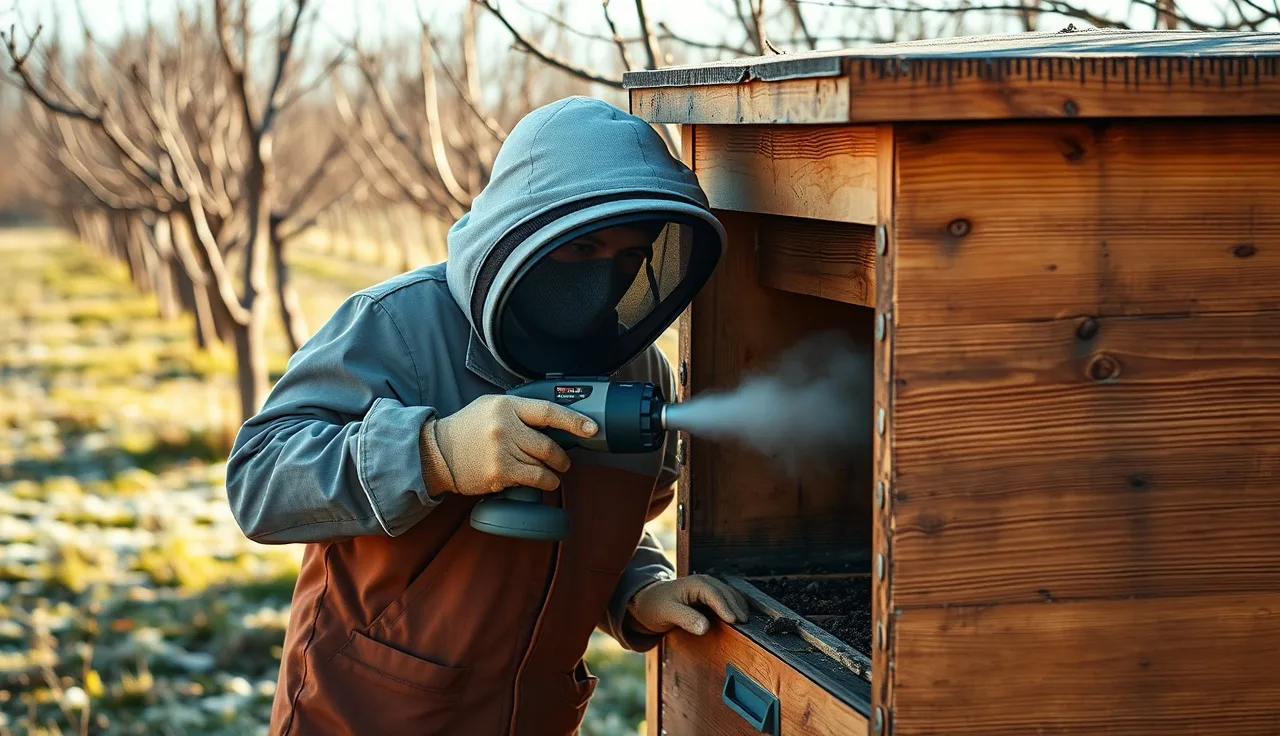
- Vaporization: OA crystals go in a vaporizer wand and sublimate into the hive. This is the most effective method and the one most hobbyists are moving toward. Efficacy on phoretic mites (the ones riding on adult bees) can hit 97% in broodless colonies [2]. Requires a respirator. Serious lung irritant.
- Dribble (trickling): A 3.5% oxalic acid solution in sugar syrup is dribbled directly onto bees between frames. Works best in late fall or winter when the cluster is tight and brood is minimal. Less equipment, slightly lower efficacy than vapor, and more stress on the bees.
- Extended-release strips: OA-impregnated glycerin strips (sold as Api-Bioxal extended-release strips) are newer to the U.S. market. They release OA slowly over weeks and can treat colonies with brood, though efficacy is lower than vapor during a broodless window. The label allows up to two strips per brood box.
One legal note worth memorizing. The Api-Bioxal label specifies 'no honey supers on during treatment' for vaporization and dribble applications. Leaving supers on is a label violation [5].
For beekeepers building out their kit, beekeeping supplies covers vaporizer options and protective gear worth having on hand.
When and how should you use formic acid for varroa?
Formic acid is the only natural varroa treatment that kills mites inside capped brood cells. That makes it uniquely useful during the main brood-rearing season, when mite populations grow fastest.
Two formic acid products are registered with the EPA for U.S. use: Formic Pro and MAQS (Mite Away Quick Strips) [6]. Both use the same active ingredient and deliver it through slow-release pads laid across the top bars of the brood frames.
Temperature is the constraint that makes or breaks this treatment. The label requires ambient temperatures between 50°F and 85°F. Below 50°F, the product doesn't volatilize enough to work. Above 85°F, formic acid releases too fast, and queen loss becomes a real risk. The University of Minnesota Extension puts queen loss from formic acid treatment at roughly 5-10% even under good conditions [3]. That's not a scare statistic. It's a known trade-off.
Formic Pro uses a two-pad, 14-day schedule or a one-pad, 10-day schedule depending on conditions. MAQS uses two pads at once for a 7-day treatment. Follow your product's label exactly, because the strip counts and timing differ.
Practical tips from beekeepers who use this regularly:
Remove all honey supers before treatment (label requirement). Open the entrance to the widest setting for ventilation. Check queens three weeks after treatment. Skip treatment during a nectar flow in hot weather if you can. And if temperatures are forecast to spike above 85°F mid-treatment, you have a choice: pull the strips and retreat, or accept the queen risk.
Formic acid also has a zero-day honey withholding period when used to label, which is a real advantage for summer management [6].
Does thymol work, and which thymol products are registered?
Thymol works. It's been the workhorse across much of Europe for decades. In warm enough conditions it can hit 90%+ efficacy [7]. The catch in North America is temperature. Thymol doesn't volatilize well below 59°F, and beekeepers in northern states and Canada often face fall conditions where thymol quits right when mite populations peak after the honey flow.
Two thymol-based products are registered in the U.S.:
Apiguard is a thymol-in-gel product. One 50g tray sits open on the top bars. The colony's heat evaporates the thymol slowly. A second tray goes in after two weeks. The full treatment takes four weeks and needs minimum ambient temperatures of 59°F.
ApiLife VAR is a tablet soaked with a blend of thymol, eucalyptus oil, menthol, and camphor. You make three applications one week apart.
Both products are labeled for use with no honey supers present. Both can cause some brood mortality above 105°F.
Thymol has real strengths. No resistance documented in mite populations. No residue worries in wax at normal use rates. And it's cheap. For beekeepers in the southeastern U.S. or other warm-fall climates, it's a genuinely good choice for summer and early fall.
If you follow varroa treatment research, thymol nanoformulations and slow-release delivery systems are active areas. A 2022 paper in the Journal of Pest Science found microencapsulated thymol showed better efficacy and lower bee toxicity than conventional formulations, though no commercial product based on it is registered in the U.S. yet [7].
What is HopGuard 3 and when does it make sense?
HopGuard 3 uses potassium salts of hop beta acids, a byproduct of the brewing industry, as its active ingredient. It's applied on cardboard strips coated with the hop extract, hung between brood frames.
The product has EPA registration and is one of the only treatments labeled for use during an active honey flow (with honey supers present, per current label guidance, though always verify the current label before you apply) [4]. That's a meaningful edge in a narrow set of situations.
The limitation is efficacy. HopGuard 3 can't reach mites in capped cells, and studies show it's generally weaker than oxalic acid or formic acid on phoretic mites too. Use it as a supplementary tool, say during a spring buildup or a honey flow when nothing else is legal, rather than as your primary annual treatment.
Some beekeepers who raise queens use it in mating nucs because of its relatively low toxicity to queen larvae at labeled rates.
Is there any new varroa mite treatment on the horizon?
Yes, and 2024-2025 brought real movement on a few fronts.
Oxalic acid extended-release strips (the glycerin-impregnated version of Api-Bioxal) got more widely available in the U.S. after label expansions, giving beekeepers a brood-compatible OA option that skips the vaporizer [5].
Lithium chloride is probably the most talked-about candidate in research circles right now. A 2018 study in Scientific Reports showed that feeding bees a lithium chloride solution produced very high mite mortality (greater than 90% in some trials) with apparently low bee toxicity at effective doses [8]. Follow-up work has been mixed on safety margins, and as of 2025 lithium chloride is not registered with the EPA for honey bee colonies. It is not legal to use. But it's watched closely.
RNA interference (RNAi) is a longer-term direction. The idea is feeding bees dsRNA molecules that silence specific varroa genes, killing the mites without harming bees. USDA ARS researchers have published proof-of-concept work, and at least one company has explored commercialization, but no RNAi product is registered for varroa control as of 2025 [9].
Genetically selected mite-resistant bees (VSH, hygienic behavior) stay the most underused tool in hobbyist beekeeping. The USDA Baton Rouge Bee Lab has bred Varroa Sensitive Hygiene (VSH) bees for decades, and colonies with high VSH traits genuinely suppress mite reproduction, cutting treatment frequency [9]. It isn't a chemical treatment, but it's a real part of integrated management.
For the latest, the Honey Bee Health Coalition updates its Varroa management guide as new products get registered [1].
What is the right mite threshold before you treat?
This is where a lot of hobbyist beekeepers either act too late or panic too early. The Honey Bee Health Coalition recommends treating when mite levels reach 2% (2 mites per 100 bees) in the brood season (roughly April through August) and 1-2% heading into fall [1].
Why the fall threshold is tighter: the bees produced in August and September are the winter bees that have to carry the colony through to spring. Mite-parasitized winter bees have suppressed immune systems and shortened lifespans. A 2% mite load in September can mean a dead colony by February.
The Bee Informed Partnership's national survey data consistently shows colonies with mite counts above 3% in August suffer substantially higher winter mortality than colonies kept below 2% [10].
How you count matters. Alcohol wash is the most accurate method for hobbyists. A sugar roll gives comparable results with less bee mortality, though some researchers argue the sugar roll undercounts by 15-25% in cold weather when mites grip tighter. A sticky board (counting mite drop over 24 hours) tells you mites are present but can't give you a reliable percentage without a separate bee count.
If you're building a monitoring routine, VarroaVault's free management tools include a mite calculator that converts your raw count to a percentage and flags your treatment window by season.
For more on the varroa mite itself, including its life cycle and why brood-phase timing matters so much, that article is a good companion read.
Can you use more than one natural treatment at a time, and how do you rotate?
You can combine some treatments but not others, and layering them carelessly can harm your bees.
Oxalic acid and formic acid should not run at the same time. The combined chemical stress is pointless, and the vapors together are harsh on bees. Same goes for thymol and formic acid: don't stack them.
What does work is sequential rotation. Many experienced beekeepers use a midsummer formic acid treatment (to knock down mites during brood rearing) followed by a broodless-period oxalic acid vapor treatment in late fall or winter. That two-treatment approach covers the two most vulnerable windows in the mite population's annual cycle.
Rotating active ingredients is standard integrated pest management advice for slowing resistance. Varroa hasn't developed documented resistance to oxalic acid or formic acid the way it has to some synthetic acaricides, but the principle of not leaning on one compound forever still holds.
A practical annual schedule for temperate North America:
June or July: Alcohol wash mite count. If above 2%, treat with formic acid (Formic Pro or MAQS) or oxalic acid vapor with a brood break (via queen caging).
August: Recount 30 days after treatment. Retreat if above 2%.
October or November (after brood ceases): Oxalic acid vapor treatment. Repeat once or twice more at 5-7 day intervals to catch stragglers.
This schedule matches the integrated approach the Honey Bee Health Coalition recommends [1].
Do natural treatments leave residues in honey and wax?
This is one of the most common questions, and the honest answer varies by product.
Oxalic acid occurs naturally in honey. Background levels in untreated honey run roughly 5-89 mg/kg depending on floral source [2]. Treatment nudges wax residue up slightly, but studies haven't found harmful increases in honey residues when the product is used to label (no supers during treatment). The label prohibition on supers is the key safeguard.
Formic acid is also a natural component of honey, present at 20-200 mg/kg in untreated samples. The MAQS and Formic Pro labels require super removal specifically because formic acid can push honey formic acid concentrations above background during treatment. With supers off and treatments used as labeled, residue concerns are low. The zero-day honey withholding period on the label reflects that [6].
Thymol can build up in wax and honey at low levels. European studies have found thymol residues in honey from treated colonies, though levels are generally below regulatory thresholds. Honey produced during or right after treatment shouldn't be harvested. The Apiguard and ApiLife VAR labels require supers off [7].
The wider point: natural treatments carry real residue risks if you ignore label instructions, but used correctly, residue levels in finished honey are either naturally occurring or within accepted limits. The label is the law and the protection.
What do beekeepers actually spend on natural varroa treatments?
Costs vary, but here's a realistic picture based on 2024-2025 retail pricing from major beekeeping supply companies.
Api-Bioxal powder (35g, enough for about 15-20 hive treatments by dribble, or 10-15 by vaporization depending on dose) runs $20-$30. The vaporizer is a separate buy: a basic battery-powered wand costs $60-$130, and a ProVap 110 or similar commercial unit runs $200-$400. If you have more than 3-4 hives, the vaporizer pays for itself in labor and efficacy fast.
Formic Pro (10 packs, treating 5 hives twice) runs about $35-$50. MAQS (10 strips, treating 5 hives) is roughly $30-$45.
Apiguard (10 trays) is approximately $30-$40. ApiLife VAR is similar.
HopGuard 3 strips are roughly $25-$40 for a 10-strip pack.
For hobbyists with 2-5 hives, annual natural treatment costs typically land at $50-$120 per year for one or two treatments, not counting equipment. That's a lot cheaper than repeated synthetic treatments plus the cost of replacing dead colonies, which the Bee Informed Partnership estimates at $150-$200 per package or nuc [10].
For product sourcing, beekeeping supply companies and free shipping honey bee supply companies are worth checking before you buy.
What about non-chemical natural methods, do they help?
Mechanical and cultural controls don't replace chemical treatment, but they genuinely lower mite loads and can cut how often you need to treat.
Brood breaks: Removing or caging the queen for 24-25 days (one full brood cycle) means mites in cells can't reproduce. Any OA or other phoretic-only treatment applied during that broodless window hits maximum efficacy. This is a real tool, especially for small-scale beekeepers willing to manage their queen.
Drone brood removal: Varroa prefers drone cells at a rate roughly 8-10x higher than worker cells. Pulling capped drone frames every 21 days can drop mite loads by 30-40% when done consistently as a supplement to other management [1]. It won't save a heavily infested colony on its own, but over a season it adds up.
Screened bottom boards: The theory is that mites falling off bees drop through the screen and can't reboard. In practice, research suggests screened bottom boards cut mite loads by only about 10-15% [3]. Worth having for ventilation, not worth trusting for mite control.
Mite-resistant genetics: As noted above, VSH and other hygienic traits genuinely suppress mite population growth. If you can source VSH-selected queens from reputable breeders, this is probably the best long-term return on any single management decision you make. The USDA Baton Rouge Bee Lab and several commercial breeders sell VSH-selected queens [9].
Small cell comb, essential oil feeding, and powdered sugar dusting have all been studied and have not shown meaningful, reproducible efficacy in controlled trials. They're not worth your time when effective registered products exist.
Frequently asked questions
What is the best varroa mite treatment, natural or synthetic?
For raw mite-kill efficacy, oxalic acid vapor in a broodless colony (90-97% kill rate) and amitraz strips (Apivar) are the most effective individual treatments. If you want to stay natural, the best protocol combines a midsummer formic acid treatment (which reaches mites under cappings) with a late-fall oxalic acid vapor treatment during the broodless period. Neither approach works well if you skip monitoring.
Can I treat for varroa mites without chemicals at all?
Not effectively for most beekeepers in most climates. Brood breaks, drone frame removal, screened bottom boards, and mite-resistant genetics all reduce mite loads, but none reliably holds counts below threshold on their own in standard Apis mellifera colonies. VSH-selected bees come closest to chemical-free management, but even those colonies usually need at least occasional treatment. An untreated colony will almost certainly collapse within 1-3 years.
Is oxalic acid safe for bees and honey?
Yes, when used as labeled. Oxalic acid occurs naturally in honey at 5-89 mg/kg. Api-Bioxal applied with no honey supers present does not produce detectable harmful residues in finished honey. The risk is to bees if you overdose or treat a colony with a lot of open brood, since OA can damage larvae. Follow the Api-Bioxal label strictly and wear a proper respirator during vaporization.
How many oxalic acid vaporizations do I need to treat varroa effectively?
For a truly broodless colony, one to three vaporizations spaced 5-7 days apart is the standard recommendation. Three treatments catch mites the first application missed. If any capped brood is present, OA vapor efficacy drops sharply and you may need to repeat treatments over several weeks as brood hatches, or run a formic acid treatment first to cut the in-cell mite population.
What temperature do I need for formic acid varroa treatment?
The Formic Pro and MAQS labels require ambient temperatures between 50°F and 85°F during treatment. Above 85°F the product volatilizes too fast, raising queen loss risk to potentially 10% or higher. Below 50°F it barely works. In practice, treatment windows are May through early June or late August through October for most temperate beekeepers.
Can I use natural varroa treatments while my honey supers are on?
Almost never. Api-Bioxal (oxalic acid), Formic Pro and MAQS (formic acid), Apiguard, and ApiLife VAR all require honey supers to be removed before treatment. HopGuard 3 is labeled for use with supers on in some situations, but verify the current label before relying on that. Treating with supers present is a federal label violation and can contaminate your honey.
How do I know if my varroa mite count is high enough to treat?
Do an alcohol wash or sugar roll with a sample of about 300 bees (roughly half a cup). The Honey Bee Health Coalition recommends treating if your count reaches 2% (2 mites per 100 bees) during the brood season, and 1-2% heading into fall. Never rely on a sticky board count alone for a treatment decision; it can't give you an accurate percentage without a separate bee population estimate.
Does varroa become resistant to natural treatments?
No documented field resistance to oxalic acid or formic acid has been reported as of 2025. Resistance to synthetic acaricides like tau-fluvalinate and coumaphos is well documented in many varroa populations. This is a real advantage of natural treatments: the way they kill mites makes resistance harder to develop. Thymol resistance hasn't been documented in the field either, though lab studies show mites can somewhat tolerate thymol exposure.
What natural varroa treatment works best in winter?
Oxalic acid dribble or vapor is the standard winter treatment. When colonies are broodless (or nearly so) in late fall and winter, OA reaches the entire phoretic mite population on adult bees. Vaporization works at temperatures as low as freezing (bees don't need to fly, just cluster). Avoid formic acid in winter, since it needs temperatures above 50°F to work.
Is there a new varroa mite treatment that will replace oxalic acid?
Nothing registered yet. Lithium chloride has shown impressive lab results (over 90% mite kill in some trials) but isn't EPA-registered and has unresolved bee safety questions. RNAi-based treatments are in research phases. Oxalic acid extended-release strips are the newest practical addition to the registered toolkit in the U.S. For now, oxalic acid and formic acid remain the most effective registered natural options.
How long after natural varroa treatment can I put honey supers back on?
For Api-Bioxal (OA) vaporization and dribble, the label allows super replacement right after treatment is complete, since OA doesn't build up in honey above background levels at labeled doses. For Formic Pro and MAQS, follow the label, which typically allows super return after the treatment strips are removed. For Apiguard and ApiLife VAR, wait until the treatment cycle is fully complete and the trays or tablets are removed.
Can I combine brood removal with natural treatments to improve efficacy?
Yes, and it's one of the smartest approaches available. A brood break created by caging or removing the queen for 24-25 days, followed by OA vaporization during the broodless window, can achieve mite reductions above 95%. It takes more management but cuts the number of treatment applications and maximizes the effect of every one. Many serious small-scale beekeepers use this method in summer when they want to avoid formic acid.
Do thymol varroa treatments affect the taste of honey?
They can. Thymol residues in honey, while generally below regulatory limits, can add a detectable medicinal or herby flavor at higher concentrations. The risk is highest if you treat while honey supers are present (which the label prohibits) or if the bees are actively curing nectar during treatment. With supers removed and treatment timed correctly, noticeable flavor impact in harvested honey is uncommon but not impossible.
Sources
- Honey Bee Health Coalition, Varroa Management Guide (2023 edition): Treatment threshold recommendations of 2% mite load during brood season and 1-2% heading into fall; integrated management combining cultural and chemical controls
- University of California Cooperative Extension, Bee Health: Oxalic Acid: Oxalic acid vapor achieves 90-97% efficacy on phoretic mites in broodless colonies; natural oxalic acid background in honey is 5-89 mg/kg
- University of Minnesota Extension, Varroa Mite Management: Formic acid kills phoretic and reproductive mites under cappings; queen loss risk from formic acid treatment roughly 5-10% even under good conditions; screened bottom boards reduce mite load by approximately 10-15%
- EPA, HopGuard 3 pesticide registration: HopGuard 3 (hop beta acids) is EPA-registered for use in honey bee colonies; labeled for use during active honey flows in certain situations
- EPA, Api-Bioxal (oxalic acid dihydrate) pesticide label: Api-Bioxal is the only EPA-registered oxalic acid product for honey bees in the U.S.; label prohibits honey supers during vaporization and dribble applications
- EPA, Formic Pro and MAQS pesticide labels: Formic acid products require ambient temperatures of 50-85°F; zero-day honey withholding period when used as labeled; super removal required before treatment
- Journal of Pest Science, Microencapsulated thymol for varroa control (2022): Microencapsulated thymol showed improved efficacy and reduced bee toxicity vs conventional formulations; thymol treatments can achieve 90%+ efficacy at optimal temperatures (59-105°F)
- Scientific Reports, Lithium chloride is highly effective in eliminating Varroa destructor (2018): Feeding bees lithium chloride solution resulted in greater than 90% varroa mite mortality in some trials with apparently low bee toxicity at effective doses; no EPA registration exists as of 2025
- USDA ARS Honey Bee Breeding, Genetics & Physiology Research Unit, Baton Rouge: USDA Baton Rouge Bee Lab breeds VSH (Varroa Sensitive Hygiene) bees; colonies with high VSH traits suppress mite reproduction; RNAi-based treatments are in research phases with no registered product as of 2025
- Bee Informed Partnership, National Honey Bee Colony Loss Survey: Colonies with mite counts above 3% in August have substantially higher winter mortality; package and nuc replacement costs estimated at $150-$200 per colony
Last updated 2026-07-09