Nurse bee sampling for mite wash is more accurate than forager sampling
TL;DR
- Nurse bees carry roughly 2 to 3 times more varroa mites than foragers in the same hive, because mites ride young bees near capped brood.
- Wash a 300-bee sample of nurse bees to get a true infestation number.
- Sampling foragers instead undercounts the mite load and can stall treatment until the colony is already failing.
Why does it matter which bees you sample for a mite wash?
A mite wash is only as good as the bees you put in the jar. Sample the wrong bees and you get a number that looks calm while your colony quietly crashes. This happens more than most beekeepers realize, and the cause is almost always the same: shaking foragers off the entrance cluster or the outer frames instead of reaching into the brood nest for nurse bees.
Varroa destructor does not spread itself evenly across a colony. It concentrates where it can reproduce, which means in or near capped brood, and on the young bees crawling over that brood all day. Those young bees are the nurse bees. Foragers spend most of their lives outside the hive and have aged past the brood-rearing stage. A mite riding a forager is a hitchhiker between hosts, not reproducing, and there are far fewer of them per bee.
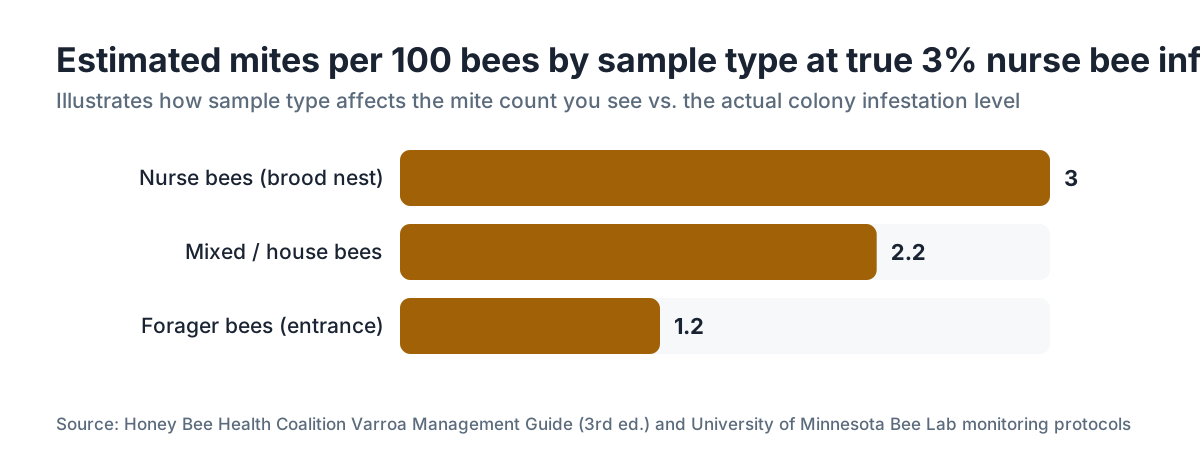
The consequence is easy to see. Say your colony sits at a true 3 mites per 100 bees in the nurse population. A forager wash from that same hive on that same day might come back at 0.5 to 1.5 per 100 bees [1]. You read that and think you have time. You do not.
What does the research actually say about forager vs. nurse bee mite levels?
Nurse bees consistently show higher mite loads than foragers, and samples from the brood area give the most reliable estimate of true colony infestation. That is the position of the Honey Bee Health Coalition's Varroa Management Guide and the field studies it draws on [1][2].
Work reviewed by the University of Minnesota Bee Lab found that phoretic mite loads on foragers ran roughly 30 to 60 percent of the load on nurse bees in paired samples from the same colonies [3]. The spread is wide because it depends on colony size, season, and how much capped brood is present. The direction never flips: foragers undercount.
The Honey Bee Health Coalition states it plainly: "Samples taken from nurse bees tending open brood will have higher mite loads than samples of forager or house bees and more accurately reflect the true infestation level." [2] That quote is from their guidance document, and it matches the consensus across United States university extension programs.
Nobody has clean population-level data pinning this to one universal multiplier. The honest answer is the ratio shifts by season. In spring and early summer, when brood rearing runs hot and mite reproduction accelerates, the gap between nurse and forager counts is widest. In late fall with little or no brood, the gap narrows, because mites have nowhere else to be and spread more evenly across the adult population [4].
Where exactly are nurse bees in the hive, and how do you collect them?
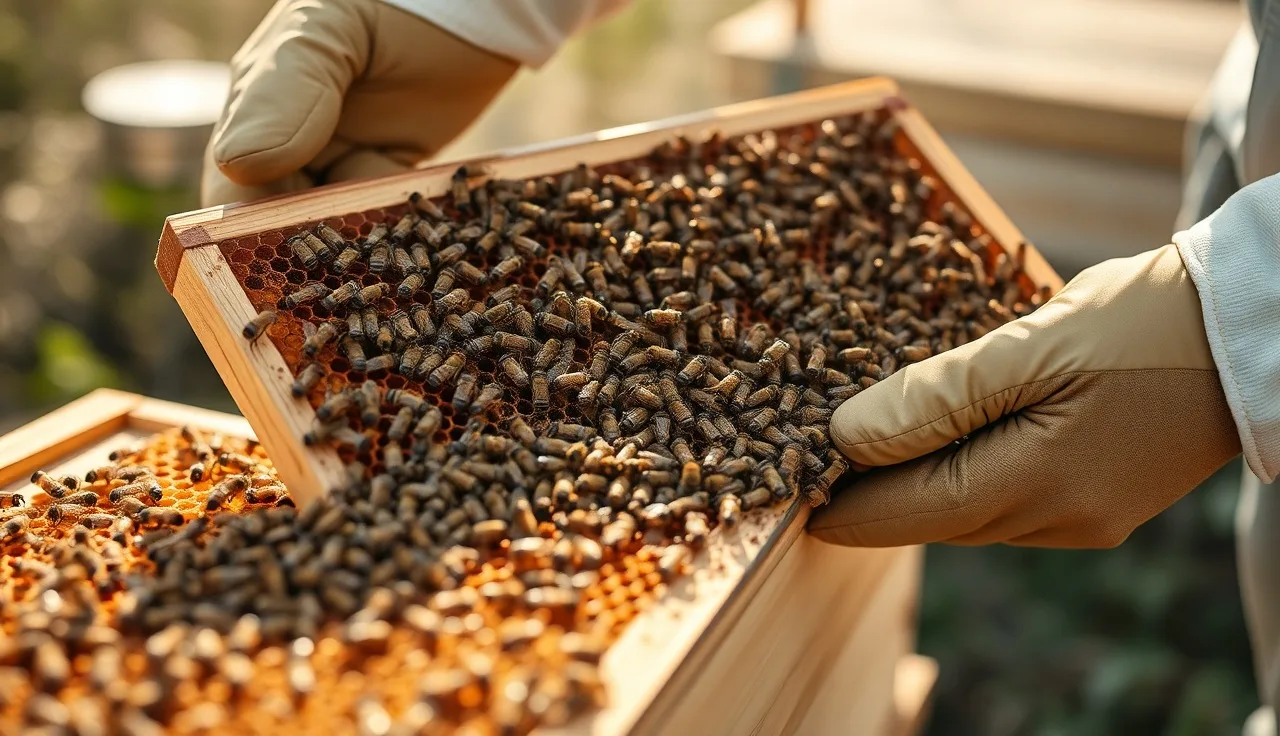
Nurse bees live on the frames with capped brood and open larvae, especially the frames near the center of the brood nest. They are the bees with their heads down in cells, or crawling slowly across brood comb rather than flying or clustering at the entrance. They tend to be younger, and they usually carry no pollen in their corbiculae.
To collect a sample, pull a frame of capped or mixed brood from the center of the nest. Hold it over your sample jar or a catch container and give it one sharp shake. The nurse bees drop off. The queen, if she is on that frame, is heavier and usually stays. Check before you shake. Washing the queen is a rough day for everyone. If you see her, set that frame aside and shake an adjacent one.
You want roughly 300 bees. That number is not arbitrary. The Honey Bee Health Coalition and most university extension programs recommend 300 bees because it gives statistically reliable counts at the thresholds that drive treatment decisions, and 300 bees is a small slice of a healthy workforce [2][5]. At 300 bees, 3 mites equals exactly 1 percent infestation, which keeps the math simple.
Do not top off the sample with bees from other frames or from the entrance. Keep it pure nurse bees from the brood nest. Mixing populations drags the count back toward the forager-biased average you were trying to escape.
How do you actually do the alcohol wash or sugar roll once you have the right bees?
The mechanics are the same no matter which bees you use. The only thing that changes is which bees go into the jar.
Alcohol wash: add your 300 bees to a jar with at least 70 percent isopropyl alcohol (soapy water works too, though alcohol detaches mites more reliably). Seal it, shake hard for about 60 seconds, then pour the liquid through a fine screen or a two-stack jar lid into a white basin. Count the mites. Divide the mite count by the number of bees and multiply by 100. That gives mites per 100 bees, the standard metric [2][5].
Sugar roll: same collection, but add about two tablespoons of powdered sugar instead of alcohol. Roll and shake for 60 seconds, then roll the mites out through the screen. Sugar rolls spare the bees but return counts about 20 to 30 percent lower than alcohol, because sugar does not knock off every mite [6]. If you make treatment calls off sugar roll numbers, know you are reading a conservative estimate and adjust for it.
The alcohol wash is the standard everyone measures against. State apiarist offices and the EPA product labels for oxalic acid and other treatments reference mite-per-hundred-bees thresholds built on alcohol wash data [7].
You can track results over time with the free monitoring log at VarroaVault, which lets you flag sample type (nurse vs. forager) so seasonal comparisons stay honest.
One more habit: count your bees after washing, not before. Estimate before, count after. Some beekeepers weigh instead of count (roughly 100 bees per 10 grams) [5]. Both work. Counting after is more accurate.
What mite count threshold should trigger treatment, and does sample type change the threshold?
The widely cited action threshold from the Honey Bee Health Coalition is 2 mites per 100 bees (2 percent) during brood-rearing season, and some extension programs drop it to 1 percent in late summer as the winter bee cohort forms [2][8]. These thresholds were built on nurse bee sampling from the brood nest. Read those numbers off a forager sample and you are comparing two different things.
A forager-derived count of 1 percent could easily match a true nurse bee infestation of 2 to 4 percent. That colony needs treatment today. But if you trust the standard threshold without knowing your sample was foragers, you wait, you re-test in two weeks, and you burn eight weeks of bees to mite-borne viruses before a forager count finally crosses 2 percent.
The threshold does not shift with sample type. The threshold assumes you sampled correctly. That is the whole trap. The guidelines are written for nurse bee samples, full stop.
Late summer timing matters most. August and September are when varroa populations spike relative to the adult bee population, because brood volume starts shrinking while mite reproduction from earlier weeks hits its peak. That is exactly when an accurate count counts, because the bees raised in late summer and fall become your winter cluster. Damaged winter bees mean dead colonies by February [4][8].
| Sample type | Typical mites/100 bees at true 3% infestation | Treatment indicated at 2% threshold? |
|---|---|---|
| Nurse bees (brood nest) | ~3.0 | Yes, clearly |
| House/mixed bees | ~2.0-2.5 | Borderline |
| Forager bees (entrance) | ~0.8-1.5 | Often missed |
Is there any situation where sampling foragers is acceptable or even useful?
One case, and it is honest: rapid triage. If you are screening many hives fast to rank-order them by likely infestation, and you plan to follow up any questionable result with a proper nurse bee wash, entrance sampling works as a rough first pass. Some commercial operations running hundreds of hives do exactly this.
For a hobbyist or sideliner making an actual treatment decision, forager sampling is not a method. The precision you lose is the precision you need. The point of a mite wash is a number you can act on with confidence, and a forager sample does not give you one.
There is a seasonal exception too. In late fall and winter with no brood present, the colony is essentially all adult bees in one cluster, and mites sit phoretically across the population with no brood to pull them together. A sample from a broodless cluster is a fair estimate of true infestation because there is no nurse cohort preferentially carrying mites. This is the one time the distinction mostly disappears [4][9].
Every other time of year, sample from the brood nest.
How does varroa mite biology explain why nurse bees carry more mites?
Varroa destructor reproduces only inside capped brood cells. A female mite slips into a cell just before capping, lays her eggs on the developing larva, and her offspring mate inside the sealed cell. When the adult bee chews out, it carries any mature mites that hitched along. Those mites then have to reach another cell before the next reproduction cycle, and they get there by crawling through the colony on the backs of nurse bees [10].
Nurse bees are the main transport inside the hive because they spend all their time in the brood nest, moving cell to cell, feeding larvae, capping brood. A mite on a nurse bee is one visit away from the next open cell. A mite that lands on a forager is stuck. It rode out of the hive and has to wait for that forager to return and re-enter the brood area before it can reproduce.
That is why the mite-to-bee ratio runs so much higher on nurse bees. It is not random. It is what the parasite's life cycle predicts. Every part of varroa biology points toward the brood nest, and nurse bees are the gatekeepers of that zone [10][11].
For a fuller look at the parasite itself, the varroa mite overview covers its life cycle and host interaction in detail.
Can you accidentally sample the queen, and what else can go wrong?
Yes, and it happens. The queen spends most of her time in the brood nest, on exactly the frames you want to shake. Check before every shake. Look for the long abdomen and the ring of attendants around her. If you spot her, set that frame face-down on the landing board or on top of the hive, shake a different frame, then return her frame when you are done.
Other common mistakes:
Shaking the wrong frames. Outer frames, honey frames, or frames from a super give you a mixed or forager-heavy sample. Go to the physical center of the brood nest.
Using too few bees. Samples under 200 bees swing wildly. Two mites out of 150 bees reads as 1.3 percent, but the confidence interval is so wide it is nearly useless. Three hundred bees is the minimum that means anything [5].
Not recording sample type. If you track counts across inspections without noting nurse versus forager, your trend data turns to noise. One forager sample dropped into a run of nurse bee samples looks like sudden improvement when it is just a methodology artifact.
Washing in sunlight or heat. Mites can die and grow fragile in hot conditions, which makes them harder to count or causes them to break apart. Work in the shade when you can.
Does sample location within the hive change results in a Langstroth vs. other hive types?
The biology is the same across hive designs. Sample from the warmest, most active part of the brood cluster every time. In a Langstroth, that is usually the middle frames of the bottom brood box, or the center of a single brood box if you run one. In a top-bar hive, it is the bars nearest the center of the cluster. In a Warré, it is the upper boxes where the cluster lives.
The catch with some alternative designs is physical access to the brood nest. If you cannot easily pull frames and shake bees into a jar, adapt the collection: hold the jar under a brood comb and brush bees in, for example. Brushing is slower and more disruptive, but it still gets you nurse bees when you brush the right frames.
What never works in any design: shaking bees from the entrance or from frames at the edges of the box. Those bees skew heavily toward foragers and older house bees, whether you run Langstroth, Warré, top-bar, or anything else.
How often should you be doing mite washes, and how do you track the results?
The Honey Bee Health Coalition recommends monitoring every 30 days during the active brood-rearing season, with extra attention in June through July (before the summer mite spike) and August through September (before treatment decisions that shape your overwintering bees) [2][8].
For new beekeepers, or anyone who has had a collapse, monthly monitoring is not overkill. Experienced beekeepers with a stable operation sometimes stretch to every six weeks in spring, then tighten back to monthly in late summer. The math is simple: mite populations can double roughly every four to six weeks under good brood conditions [10]. A colony that tests clean in June can blow past threshold by late July without one extra inspection.
Record keeping is the part most hobbyists skip, and it is the part that saves colonies. Write down date, hive ID, bees in sample, mites counted, calculated percentage, sample type (nurse or forager), and notes on colony strength or brood pattern. Over two or three seasons you start to see which hives trend high and which stay low, which tells you a lot about your breeding stock and local mite pressure.
VarroaVault's free monitoring log is built for this kind of longitudinal tracking, with a sample type field so you do not blend nurse and forager counts into one misleading trend line.
For reliable gear, see our guide to beekeeping supply companies for jars, screens, and wash kits.
What do state apiarists and extension programs recommend about sampling method?
State apiarist offices that publish monitoring guidance, including those in California, Florida, Minnesota, and Maryland, all specify brood nest sampling in their official protocols [8][12]. The University of Minnesota Bee Lab, one of the busiest varroa research centers in the country, explicitly recommends shaking nurse bees from brood frames rather than pulling bees off the entrance or outer frames [3].
The EPA does not regulate sampling methodology, but the product labels for treatments like Api-Bioxal (oxalic acid) and Apivar (amitraz) reference treatment thresholds grounded in brood-nest-derived mite counts [7]. Treating off a forager sample that reads below threshold, when a true nurse bee count would sit above it, means your treatment decision rests on a misleading input.
The Honey Bee Health Coalition's Varroa Management Guide, now in its third edition, is the most accessible synthesis of this guidance for hobbyist and sideliner beekeepers. It is free to download and covers sampling, thresholds, and treatment options by season [2]. If you have not read it, read it. It is the closest thing American beekeeping has to a shared clinical standard.
For completeness: USDA Agricultural Research Service (ARS) Bee Research Lab publications also back the nurse bee preference in their monitoring protocols, though their documentation runs more technical [13].
Frequently asked questions
Can I just shake bees off the entrance instead of opening the hive?
Not if you want a reliable count. Entrance bees are almost entirely foragers and older house bees. They carry far fewer mites than nurse bees in the brood nest. An entrance sample routinely reads 50 to 70 percent lower than a true nurse bee sample from the same hive on the same day. Use it for rough triage only, never for a treatment decision.
How do I know I'm actually collecting nurse bees and not random bees from a brood frame?
Nurse bees are the bees physically on the brood frames when you pull them from the center of the nest. They tend to be younger, their abdomens are not swollen with nectar, and they often do not fly off immediately when the frame is shaken. Foragers tend to fly rather than fall. Shaking hard over your container and collecting the bees that drop, rather than brushing, preferentially captures the less flight-ready nurse bees.
What is the correct mite threshold that should trigger treatment?
The Honey Bee Health Coalition recommends treating at 2 mites per 100 bees (2 percent) during brood-rearing season, and at 1 percent in late summer (August-September) when winter bees are being raised. These thresholds assume you sampled nurse bees from the brood nest. A forager sample reading 2 percent likely represents a true infestation well above that level.
Does it matter if I use alcohol wash versus sugar roll for nurse bees?
The sample population matters more than the wash method, but method affects accuracy too. Alcohol washes detach close to 100 percent of mites; sugar rolls typically recover 60 to 80 percent of mites present. If you use sugar rolls, treat your count as conservatively low and factor that in against the 2 percent threshold. Alcohol wash is the standard in most research and official protocols.
How many bees do I need in my sample for the count to be meaningful?
Three hundred bees is the standard from the Honey Bee Health Coalition and most university extension programs. At 300 bees the math is clean: each mite equals 0.33 percent, and 6 mites tells you clearly you are at 2 percent. Samples under 200 bees carry enough variance that borderline results are hard to read with confidence.
Can I sample nurse bees without risking the queen?
Yes, with one step: look for the queen before you shake any frame. She is most often in the center of the brood nest, exactly where you want to sample. If you see her, set that frame aside and shake an adjacent brood frame. She is heavier and tends to stay on the frame during shaking, but it is not guaranteed. A one-second visual check before each shake removes the risk.
If my colony has no brood (winter or post-swarm), which bees should I sample?
In a broodless colony the nurse-versus-forager distinction mostly disappears. All mites are phoretic on adult bees with nowhere to concentrate, so the distribution is more even. Sample any representative cluster of adult bees. The bigger point: treating a broodless colony with oxalic acid vapor is highly effective precisely because every mite is on a bee and exposed to the treatment.
How often should I do a mite wash on each hive?
Monthly during the brood-rearing season is the standard recommendation from the Honey Bee Health Coalition. Tighten to every three weeks in August and September when mite populations spike fastest against shrinking brood. Varroa populations can double in four to six weeks under good brood conditions, so leaving two months between summer checks means you may already be well past threshold when you finally look.
Does hive type (top-bar, Warré, Langstroth) change how I collect nurse bees?
The biology is the same across designs; you always want bees from the warmest, most active brood area. In Langstroth hives you shake frames into a jar. In top-bar or Warré hives where frames come out less easily, hold a container under the comb and brush bees in. Brushing is slower but still gives you nurse bees when you work the right part of the nest.
What diseases spread faster when mite levels are high, and why does undersampling matter for hive health?
Varroa is the main vector for Deformed Wing Virus (DWV) and several other bee viruses. A colony with an underestimated mite load that quietly crosses threshold will see virus levels rise fast in late summer. Bees emerging with deformed wings and short lifespans cannot form a viable winter cluster. The link between late-summer mite counts and winter survival is one of the strongest correlations in varroa research.
Is a sugar roll accurate enough to use instead of an alcohol wash for nurse bees?
Sugar rolls are non-lethal and useful for trend monitoring, but they undercount alcohol washes by roughly 20 to 30 percent. If you prefer sugar rolls for humane reasons, apply a correction factor or set your action threshold lower than 2 percent to compensate. Some beekeepers use 1.5 percent as their sugar-roll action threshold. Both methods are far more reliable on nurse bees than on foragers.
Do I need special equipment to do a nurse bee alcohol wash?
No expensive gear required. You need a two-jar wash kit (wide-mouth Mason jars work fine), a hardware cloth screen or mesh jar lid with small holes, isopropyl alcohol at 70 percent or higher, a white bowl or plate to count mites in, and a way to count bees (volume estimate or post-wash count). The full setup costs under $20, and you may already own most of it. See options at reputable beekeeping supply companies.
What should I do if my nurse bee mite wash comes back above the treatment threshold?
Treat promptly. Product choice depends on season, temperature, and brood status. Oxalic acid (Api-Bioxal) in vaporized form works with or without brood; extended-release formic acid (Formic Pro) and amitraz strips (Apivar) work best with brood present because they expose mites over multiple brood cycles. Always follow the EPA-approved product label for dosing and timing. Confirm efficacy with a follow-up wash 30 days after treatment.
Sources
- Honey Bee Health Coalition, Varroa Management Guide (3rd ed.): Adult mites are found on nurse bees at higher rates than on foragers; samples from the brood area give the most reliable infestation estimate.
- Honey Bee Health Coalition, Varroa Management Guide (3rd ed.), direct quote on nurse bee sampling: "Samples taken from nurse bees tending open brood will have higher mite loads than samples of forager or house bees and more accurately reflect the true infestation level."
- University of Minnesota Bee Lab, Varroa Monitoring Protocols: Phoretic mite loads on foragers average roughly 30 to 60 percent of loads found on nurse bees in paired samples from the same colonies.
- Apidologie, Fries et al., varroa population dynamics and seasonal distribution: The ratio of mites on nurse bees vs. foragers narrows in late fall with little or no brood; in spring and summer the gap is widest.
- Honey Bee Health Coalition, Varroa Management Guide, sampling methodology: 300-bee sample size recommended; approximately 100 honey bees weigh 10 grams; at 300 bees, 3 mites equals exactly 1 percent infestation.
- Calderone, N.W. (2011). Evaluation of drone-cell insert and other management practices for the control of Varroa destructor. Journal of Apicultural Research.: Sugar rolls typically recover 60 to 80 percent of mites present, returning counts 20 to 30 percent lower than alcohol washes.
- EPA, Api-Bioxal (oxalic acid) product label and registration: Treatment thresholds on EPA-approved oxalic acid and amitraz product labels are grounded in brood-nest-derived mite count data.
- University of California Agriculture and Natural Resources, Varroa Mite Management for Honey Bees: State extension programs recommend treating at 2 mites per 100 bees during brood season and 1 percent in late summer; all protocols specify brood-nest sampling.
- USDA Agricultural Research Service, Bee Research Laboratory publications: In broodless colonies, mites distribute phoretically across the adult population without brood-driven concentration; nurse-versus-forager distinction largely disappears.
- Rosenkranz, P., Aumeier, P., Ziegelmann, B. (2010). Biology and control of Varroa destructor. Journal of Invertebrate Pathology.: Varroa reproduces only inside capped brood cells; phoretic mites use nurse bees as primary transport to find new cells; varroa populations can double every four to six weeks under favorable brood conditions.
- Honey Bee Health Coalition, Tools for Varroa Management: Varroa mite concentration in the brood nest and on nurse bees is a direct consequence of the parasite's reproductive biology.
- Maryland Department of Agriculture, State Apiarist Varroa Monitoring Guidance: State apiarist offices specify brood-nest sampling in official monitoring protocols.
- USDA ARS Beltsville Bee Lab, Varroa Research Publications: USDA ARS monitoring protocols support nurse bee preference for accurate infestation assessment.
Last updated 2026-07-09