October oxalic acid treatment in northern climates: what actually works

TL;DR
- In northern climates, October is often your last real chance to treat with oxalic acid before the winter cluster forms and brood runs out.
- One dribble or vaporization on a broodless (or nearly broodless) colony can drop mite loads 90 percent or more.
- Timing beats method here.
- Miss the window and a lot of those colonies won't see spring.
Why does October matter so much for oxalic acid treatment up north?
October is where northern winters are won or lost. Colonies are winding down brood rearing. The last summer bees are dying off. And the bees that will actually carry the colony to spring, the long-lived winter bees, are being raised right now. Those are the exact bees varroa targets.
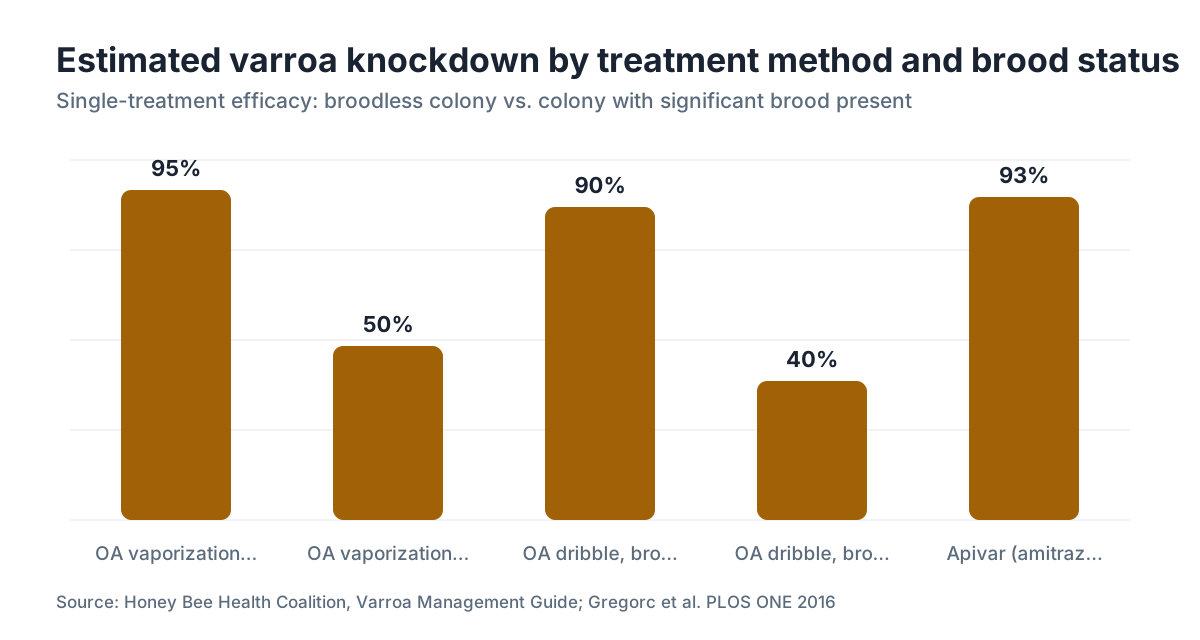
Oxalic acid (OA) is close to useless against mites tucked inside capped brood cells [1]. The acid can't cross the wax cap. Treat in July, when your colony has eight or ten frames of brood, and you hit maybe 10 to 20 percent of your mites because most of them are hiding inside cells. October flips that. Brood rearing is dropping fast, and once nighttime temps sit in the low 40s Fahrenheit, many northern colonies carry little or no capped brood. That's when a single OA treatment reaches 90 to 95 percent of mites, because almost all of them are phoretic and riding on adult bees [1][2].
Miss the window and you're gambling. Maybe you wait for November and the cluster is tight and you don't want to bother them. Maybe you tell yourself you'll treat in spring. Either way, the mites that ride those winter bees through the cold will explode the moment brood rearing restarts. Colonies going into winter above 2 to 3 percent (2 to 3 mites per 100 bees) die at much higher rates [10].
Here's the short version. Treat in October in the north and you're hitting a broodless colony with a product built for phoretic mites. That combination is about as good as varroa control gets.
When exactly in October should you treat, and how do you know it's the right time?
The trigger isn't a date. It's brood status. Treat when the colony has little to no capped brood.
In zone 4 to 5 country (Minnesota, Wisconsin, Michigan's Upper Peninsula, upstate New York, most of New England), that window usually opens between late September and mid-October, depending on the year [5]. A warm fall can drag brood rearing into late October. A cold snap can leave colonies broodless by September 20.
Here's how you check. Pull a couple of frames from the brood area. No capped brood, or maybe a patch or two, and you're in the window. Solid frames of capped brood mean wait a week and look again. Don't treat into heavy brood. You'll kill some bees, rile up the colony, and reach maybe 20 percent of the mites for your trouble.
A temperature rule of thumb: OA vaporization works down to around 50°F ambient, and the bees need to be clusterable, meaning cool enough to have started clustering but not locked up tight. Plenty of northern beekeepers treat between 45 and 55°F daytime highs, often early morning before the cluster breaks apart. Dribble works across a wider temperature range as long as the bees are on the frames and you can reach them.
One field signal: if your maples and oaks have dropped most of their leaves and you're getting light frosts at night, you're almost certainly in or near the window. Pair that with a frame check and you'll know.
Don't chase a perfectly broodless colony. A little capped brood won't wreck the treatment. You're trying to catch the colony when phoretic mite load peaks, which happens as brood drops off. The Honey Bee Health Coalition's Varroa Management Guide ranks fall broodless treatments among the most effective single-shot interventions a beekeeper has [3].
What are the approved methods: dribble, vaporization, or extended-release strips?
Three EPA-registered delivery methods for oxalic acid exist in the United States: dribble (also called trickle), vaporization, and extended-release towel or sponge products. Each earns its place in October.
Dribble (trickle) method
You mix OA into sugar syrup, typically 3.5 grams of OA dihydrate per 100 mL of 1:1 syrup, and trickle it straight onto the bees between frames [1]. The registered dose is about 5 mL per seam of bees, capped at 50 mL per colony. Bees groom the solution off each other, and the acid contacts the mites.
Dribble is simple. All you need is a syringe or squeeze bottle. The catch in October is access. You have to see and reach the bees, and a tight cluster deep in the hive makes even delivery hard. In a cold snap, the bees can bunch on frames where you can't find the seams.
Vaporization (sublimation)
You heat solid OA crystals until they sublimate into a vapor that fills the hive and coats the bees. Most northern beekeepers have moved this direction over the last several years. The Api-Bioxal label allows up to three vaporization treatments per colony per year [1]. A single vaporization on a broodless October colony typically drops mite loads 93 to 97 percent in efficacy trials [2].
You need an approved vaporizer, real personal protective equipment (a full-face respirator rated for organic vapor, not a dust mask), and a sealed entrance during treatment. Figure 2 to 3 minutes per hive.
The October advantage is that you never open the hive. Seal the entrance, insert the vaporizer, let the vapor spread. The cluster stays intact. That's why so many northern beekeepers reach for it.
Extended-release (Api-Bioxal glycerin towel method)
Api-Bioxal, the only FDA-cleared oxalic acid product for the US market [1], has a labeled extended-release use with glycerin-soaked shop towels laid across the top of the frames. It releases OA slowly over several weeks and keeps working even with some brood present, because it catches mites as they emerge from cells. Good option if you're unsure the colony is fully broodless, or you want a longer treatment window.
The downside: extended-release efficacy swings more in practice than vaporization, and you have to come back to pull the towel. Some beekeepers run it as a follow-up to a vaporization.
For most northern beekeepers treating one broodless or near-broodless October colony, a single vaporization is the cleanest, highest-efficacy move. No vaporizer? Dribble works. Unsure about brood? Extended-release buys you margin.
For the gear you'll need, the beekeeping supplies resource walks through protective equipment worth comparing before you buy.
What mite level should you treat at, and do you need to test before treating?
Test before you treat. Always. Treating blind is guesswork.
Without a mite count, you might waste a treatment on a clean colony. You might under-treat a hive that needs several rounds. And you'll have no baseline to judge whether the treatment even worked.
The two practical tests are the alcohol wash and the sugar roll [8]. The Honey Bee Health Coalition puts the action threshold at 3 percent infestation, the point where immediate treatment is warranted [3]. That's 3 mites per 100 bees in an alcohol wash. My own take: in October in the north, I'd treat at 2 percent, because any mite you leave will breed the moment February brood starts, and you won't get another cheap treatment window until the colony goes broodless again.
Above 2 percent in late September or October? Treat. Below 1 percent? I'd still treat in October, because the cost of one OA treatment on a clean colony is basically nothing (a few minutes and a couple dollars of product), while the cost of skipping it and being wrong is a dead colony.
Test again two to three weeks after treatment. A mite wash should show a steep drop. If it didn't, either brood shielded the mites or your application had a problem. Post-treatment count still above 2 percent means run a follow-up or figure out why the first one fell short.
How safe is oxalic acid for bees, and does it harm winter cluster survival?
At label rates, oxalic acid doesn't appear to hurt adult bee survival or break up the winter cluster [2]. That's one of its biggest edges over synthetic miticides. Bees make small amounts of oxalic acid on their own, and it shows up naturally in honey.
The question people raise is whether OA damages winter bees' fat bodies or shortens their lives. A few studies have looked. Gregorc and colleagues (2016) found no significant hit to winter bee physiology at labeled doses [2]. Push the dose well above label and you start seeing disruption. The lesson is plain: use the labeled dose and you're fine.
What does cause harm is treating a queenright colony loaded with brood. OA can kill open larvae. It's mostly inert to capped brood, but open larvae exposed to vapor or dribble die. That's another reason the October broodless window matters. Wait until brood rearing finishes and you skip the open-brood toxicity problem entirely.
OA also leaves no honey or wax residue at levels that raise food safety concerns when used as labeled [6]. It breaks down fast in the hive. Compare that to tau-fluvalinate or coumaphos, which build up in wax over time.
For you, the human, the real safety issue is exposure during vaporization. OA vapor at sublimation concentration harms eyes and lungs. Wear a NIOSH-approved respirator with organic vapor cartridges. Work upwind. Don't stand over the vaporizer. None of that is optional.
Can you treat in October if the colony still has some brood?
Yes, with adjustments. A little brood shouldn't stop you.
If the colony holds a modest amount of capped brood, say one or two frames, a single OA treatment still knocks down phoretic mites hard. You just won't hit the 90-plus percent you'd get from a fully broodless colony. Mites inside those capped cells survive and ride out with the next batch of bees.
The extended-release method (glycerin-soaked Api-Bioxal towels) fits this situation well, because slow release over several weeks catches emerging mites before they find fresh cells. Three vaporizations spaced 5 to 7 days apart is another approach some beekeepers use to catch multiple rounds of emergence [3].
If it's already late October and the colony still carries real brood, ask whether the queen is laying normally or unusually late. A late or odd laying pattern can point to a newly mated or recently requeened colony. Queens from late-season emergency cells sometimes push brood rearing deep into fall. Your treatment plan barely changes, but it's useful context.
Bottom line: imperfect brood conditions are no reason to skip October treatment. A treatment that hits 60 to 70 percent of mites in a partly broodless colony beats no treatment by a mile.
What does the research actually say about fall OA treatment efficacy?
Fall OA treatment is one of the best-supported moves in varroa management, backed by several independent studies.
A widely cited 2016 study in PLOS ONE by Gregorc, Sampson, and colleagues tested OA vaporization and reported 93 to 97 percent efficacy in broodless colonies [2]. The Honey Bee Health Coalition's Varroa Management Guide, which pulls together the current literature, also puts fall broodless OA treatment at the top of the efficacy list for single-application methods [3].
For comparison, amitraz strips (Apivar) run roughly 90 to 95 percent efficacy over a 6 to 8 week treatment. Coumaphos (CheckMite+) can reach similar numbers but carries heavier residue and resistance risk. OA in a broodless colony matches that efficacy with one short treatment and far fewer residue worries.
The Honey Bee Health Coalition's Varroa Management Guide states: "Oxalic acid is most effective when used during the broodless period in late fall or early winter, when essentially all mites are phoretic on adult bees" [3].
Where the data thins out is multi-year colony survival. We know fall OA drops mite loads. We know high mite loads track with winter death. The logic holds. But randomized studies tracking survival across multiple winters, treated versus untreated, are hard to find. The closest work comes from regional surveys. A 2018-2019 Bee Informed Partnership survey found colonies managed with oxalic acid inside an integrated program reported lower winter losses than untreated ones, though self-reported survey data has obvious limits [4].
To track your own outcomes season to season, the free mite load tracker at VarroaVault helps you build a real picture of what's working in your yard.
How do you actually apply oxalic acid vapor in October, step by step?
Here's the working rundown for a northern beekeeper running a fall vaporization.
Before you start
Confirm brood status with a quick inspection. Get your PPE on before you go near the vaporizer: full-face respirator with OV/P100 cartridges, nitrile or latex gloves, no exposed skin near the treatment. Gather your gear. Approved vaporizer (Varrox, ProVap, and similar are common; confirm yours is approved for use with Api-Bioxal). Api-Bioxal powder. A small scale to measure 1 to 2 grams per treatment. Foam plugs or tape to seal the entrance.
Application
Measure 1 gram of Api-Bioxal per brood box (the label sets dose by colony volume). Load the vaporizer cup. Seal the bottom entrance with foam or mesh screen. Insert the vaporizer through the entrance or a notch in the bottom board. Activate it. Wait 2 to 3 minutes for the OA to fully sublimate. Leave the entrance sealed another 5 to 10 minutes so the vapor spreads through the hive. Pull the vaporizer, unseal the entrance, move on.
After treatment
Wash your hands and face even if you wore PPE. Clean the vaporizer cup before the residue hardens. Record the date, temperature, estimated brood level, and colony ID. Schedule a follow-up mite wash in 2 to 3 weeks.
One thing that trips up beginners: make sure the entrance is actually sealed. OA vapor leaks through any gap, and you lose efficacy while dosing yourself for nothing. On older equipment or homemade hives, you may need to stuff small gaps.
Check your vaporizer's wattage against the Api-Bioxal label too. Underpowered vaporizers don't fully sublimate the crystals, leaving wet OA deposits that can harm bees. Wet residue on the bottom board instead of dry white powder means your vaporizer isn't getting hot enough.
What are the legal and label requirements for oxalic acid treatment in the US?
Api-Bioxal is the only EPA-registered oxalic acid product cleared for honey bee colonies in the United States as of this writing [1]. It got its original EPA registration in 2015.
The label is the law. Under FIFRA (the Federal Insecticide, Fungicide, and Rodenticide Act), you're legally required to follow the product label exactly [9]. The key restrictions for northern beekeepers:
- Treatment is allowed with or without honey supers present, but remove supers meant for human consumption unless your label version specifically permits treatment with supers on. Check your version.
- Up to three treatments per year by vaporization.
- One treatment per year by dribble, per the labeled instructions.
- The PPE listed on the label is mandatory, not a suggestion.
- You must use Api-Bioxal specifically. Generic OA from industrial suppliers isn't registered for in-hive use, and using it violates federal law.
Some state departments of agriculture pile on extra rules. California, for one, has had specific applicator requirements. Check with your state ag department if you're unsure.
For hobbyists: you don't need a pesticide applicator's license to use Api-Bioxal in your own hives. It's available over the counter. Sideline and commercial operators treating other people's hives may face licensing requirements depending on state law.
The EPA's pesticide registration portal carries the full label text and is worth reading [1].
How does October OA treatment fit into a full-year varroa management plan?
October OA isn't a full strategy. It's one piece of a year-round plan.
Line up the mite lifecycle against your colony calendar. In the north, a colony that overwinters well starts rearing brood in late January or February. By April the brood nest is expanding and mites are breeding fast [7]. Go into winter with a low mite load from your October treatment and you buy two or three months of low-mite beekeeping before the spring buildup takes off. Skip spring and early summer testing, though, and August will bury you.
A workable integrated varroa calendar for northern beekeepers runs like this:
- April-May: First alcohol wash of the season. Above 2 percent, treat.
- June-July: Monitor monthly. Mite populations grow fastest now. Consider a mid-summer treatment if loads climb past 2 to 3 percent.
- August: The window that matters most. Colonies are building winter bees. Test again. Treat if needed. Many beekeepers run Apivar (amitraz strips) here for a longer treatment.
- October: Final fall treatment. OA on a broodless or near-broodless colony. Your last real shot before winter.
- Winter: No treatment needed if October worked. Count natural mite drop on a sticky board if you want data.
The varroa mite overview goes deeper on the full lifecycle and why timing matters at each stage.
VarroaVault's free protocol builder maps out this kind of seasonal schedule for your climate zone and colony count, handy if you're running more than a handful of hives and need to track treatment timing across a season.
Resistance management deserves a thought too. Rotating between OA and amitraz across seasons cuts the odds of selecting for resistant mites. OA in fall, amitraz strips in summer, is a reasonable rotation. Avoid leaning on the same chemistry over and over in one season if you can help it [3].
What mistakes do northern beekeepers make with October OA treatment?
A few patterns show up over and over.
Treating too late. By mid to late November in zone 4 to 5, colonies are clustered tight and temps may be too low to distribute treatment well. Worse, the winter bees have already taken weeks of mite exposure. The damage stacks up. Treat in October, not whenever you get around to it.
Treating without testing first. You can't know a treatment worked if you never knew where you started. Testing takes 20 minutes. Do it.
Using non-registered OA. Industrial oxalic acid from woodworking or pool suppliers is chemically identical in active ingredient, but it isn't registered for in-hive use. Using it is a federal violation and opens you to liability [9]. Api-Bioxal costs more per gram, but you're using a few grams per colony. The cost difference is trivial.
Skipping PPE for vaporization. OA vapor at sublimation concentration genuinely hurts. Eye damage and lung irritation are real. A full-face respirator runs $30 to $60 and lasts years. Don't cut this corner.
Expecting one treatment to last forever. October OA doesn't protect the colony through spring buildup. Mite breeding restarts with brood. Be back testing by April.
Treating heavy-brood colonies and expecting full efficacy. Treat a colony with four frames of capped brood and a big chunk of your mites is shielded. Don't skip the treatment, but adjust expectations and plan a follow-up.
Frequently asked questions
Can I use oxalic acid when there's still honey in the supers in October?
Check your Api-Bioxal label version carefully. The current EPA label for vaporization allows treatment with supers present, but some older revisions had restrictions. As a practical matter, most northern beekeepers have supers off by October anyway. If honey supers for human consumption are on the hive, confirm your label version permits it before treating. When in doubt, pull the supers first.
How many OA vaporizations are allowed per year under the EPA label?
The Api-Bioxal label allows up to three vaporization treatments per colony per year. For dribble, it's one treatment per colony per year. Many beekeepers use all three vaporizations: one in the fall October broodless window, and one or two more in spring or early summer if mite loads call for it. Always follow the current label, since registered uses can change.
What temperature is too cold to vaporize oxalic acid in northern climates?
Vaporization itself works at any ambient temperature because you heat the OA externally. The practical lower limit is about bee behavior. Below roughly 40 to 45°F, the cluster may be too tight for vapor to spread through the colony. Most northern beekeepers aim for daytime temps of 45 to 55°F, often treating mid-morning when the cluster has loosened a little but hasn't fully broken.
Will oxalic acid treatment kill my queen in October?
At labeled doses, OA doesn't target queens differently than workers. Queen loss after OA treatment happens occasionally but is uncommon, and it's usually tied to hive disturbance rather than the OA itself. Vaporization disturbs the colony less than dribble, one reason northern beekeepers favor it for fall. If you're treating a colony with a new or recently mated queen, handle it gently to keep disruption low.
Is one October OA treatment enough, or do I need to do multiple treatments?
In a fully broodless colony, a single OA vaporization can hit 93 to 97 percent mite knockdown, usually enough to carry a colony through winter. If the colony still had brood at treatment, or your pre-treatment load was very high (above 5 percent), run a second vaporization 5 to 7 days later. Test three weeks after treatment to confirm the result.
How do I know if my colony is broodless without fully opening the hive?
Pull one or two frames from the center of the brood nest and hold them to the light, or use a flashlight. No capped cells with a slightly rounded look means no capped brood. Clusters of cells with flat or sunken caps are usually capped honey or pollen, not brood. A fully broodless fall colony typically has this look by mid to late October in zone 4 to 5.
Can I use the dribble method in October if I don't have a vaporizer?
Yes. Dribble works well in October as long as you can reach the bees and apply the solution to the seams between frames. Mix 3.5 grams of Api-Bioxal per 100 mL of 1:1 sugar syrup and apply about 5 mL per seam, up to 50 mL per colony. The main limit is that you have to open the hive and reach the cluster, which gets hard when temps are very low and the bees are packed tight.
What's the difference between Api-Bioxal and generic oxalic acid for bees?
Chemically, oxalic acid dihydrate is oxalic acid dihydrate. The difference is registration status. Api-Bioxal is EPA-registered under FIFRA for in-hive varroa treatment. Generic OA from hardware or pool supply stores isn't registered for this use in the US. Using non-registered product in a hive is a federal violation even if the active ingredient matches. The Api-Bioxal premium is real but small given how little you use per treatment.
How long does oxalic acid stay active in the hive after vaporization?
OA vapor disperses and settles on bees and hive surfaces within minutes of treatment. It doesn't linger as an active residue the way synthetic miticides do. Its effective window is basically the treatment period plus a short time as vapor. That's why timing against brood status matters so much: you can't treat now and expect protection three weeks later when brood mites emerge.
Should I combine weak colonies before doing October OA treatment?
If a colony is too weak to overwinter on its own, combining it with a stronger colony before treatment is often the right call. A combined colony is easier to treat, more likely to survive winter, and you avoid spending treatment on a unit that won't make it. Treat the combined colony once it's stable. Combine before mid-October in the north to give the merged colony time to settle.
Does OA treatment affect the beneficial microbiome in the hive?
Research here is limited. OA is mildly acidic, and there's some theoretical concern about effects on gut microbiome in bees that ingest the dribble solution. Studies so far haven't found clinically significant effects on colony health at labeled doses. The Honey Bee Health Coalition doesn't flag this as a primary concern for registered use. It's a real question worth watching as microbiome research grows, but not a reason to skip treatment.
What mite count after October treatment tells me I need to retreat?
Test two to three weeks after treatment. If your alcohol wash comes back above 2 percent (2 mites per 100 bees), run a follow-up before hard winter sets in. Above 3 percent after treatment signals either significant brood present during treatment or an application problem. Either way, act fast. Your options narrow quickly once temps sit in the 30s for weeks at a time.
Where can I buy Api-Bioxal and what does it cost?
Api-Bioxal sells through most major beekeeping supply companies. Price varies but typically runs $20 to $35 for a 35-gram packet, enough for roughly 17 to 35 vaporization treatments depending on colony volume. Some beekeeping supply companies sell it in larger quantities at a lower per-gram cost. It's widely available, so you shouldn't need to order far ahead for October use.
Sources
- EPA, Pesticide Registration (Api-Bioxal, Reg. No. 84318-1): Api-Bioxal is the only EPA-registered oxalic acid product for in-hive varroa treatment in the US; label allows up to three vaporization treatments per year; dribble dose is 5 mL per seam up to 50 mL per colony
- PLOS ONE, Gregorc et al. (2016), Oxalic acid vaporization efficacy in honey bee colonies: OA vaporization in broodless colonies achieved 93-97% varroa mite knockdown; no significant impact on winter bee physiology at labeled doses
- Honey Bee Health Coalition, Varroa Management Guide (current edition): Oxalic acid is most effective during the broodless period in late fall; 3% infestation threshold warrants immediate treatment; fall broodless treatments are among the most effective single-treatment interventions
- Bee Informed Partnership, National Management Survey 2018-2019: Colonies managed with oxalic acid as part of an integrated program had lower reported winter losses than untreated colonies in survey data
- University of Minnesota Extension, Honey Bee Health: Northern climate treatment timing guidance; October window for fall OA treatment in zone 4-5
- Penn State Extension, Honey Bees and Beekeeping: Oxalic acid does not accumulate in wax or honey at levels raising food safety concerns when used as labeled
- USDA Agricultural Research Service, Bee Research Laboratory: Varroa mite population dynamics and phoretic mite ratio relative to brood cycle stages
- Cornell University, Dyce Lab for Honey Bee Studies: Alcohol wash and sugar roll methodology for accurate mite infestation monitoring
- EPA, Summary of the Federal Insecticide, Fungicide, and Rodenticide Act (FIFRA): FIFRA requires pesticide use in strict accordance with the registered label; using non-registered product for an in-hive use is a federal violation
- Michigan State University Extension, Pollinators and Bees: Colonies entering winter with mite loads above 2-3% show dramatically higher winter mortality rates
Last updated 2026-07-09