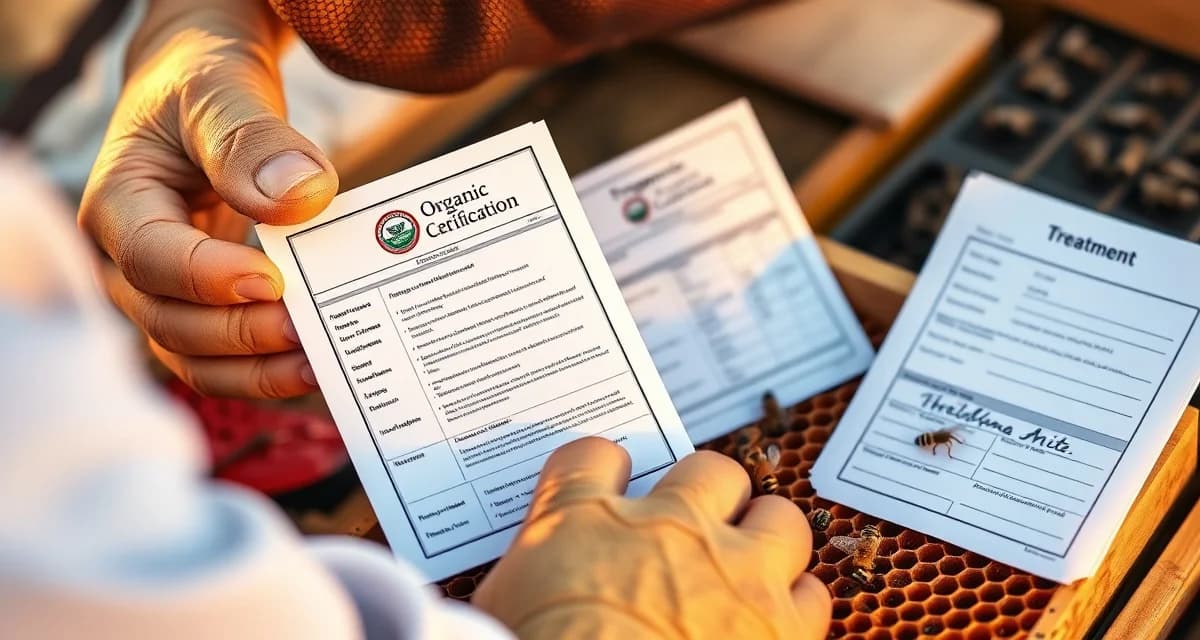
Organic Certification Compliance for Beekeeping: Varroa Treatment Guidelines
Organic honey production requires using only permitted inputs for pest and disease management. For varroa, that means organic acids and natural compounds, and documentation that synthetic chemicals weren't used.
Here's what's approved, what's prohibited, and how to keep records that satisfy your certifier.
TL;DR
- Organic-certified beekeeping permits only approved treatments: oxalic acid, formic acid, and thymol
- Amitraz (Apivar) and coumaphos are not permitted under USDA National Organic Program (NOP) standards
- Organic treatment records must document the specific approved product, batch number, application date, and rate
- Third-party certifiers may require annual treatment record submission as part of certification renewal
- VarroaVault's organic certification mode logs only approved treatments and flags any non-organic product entry
- Building a 3-year treatment history using only approved products strengthens certification applications
What Is and Isn't Approved for Organic Beekeeping
Permitted Treatments (Generally)
Oxalic acid (Api-Bioxal): Approved. Naturally occurring organic acid. Permitted by NOP (National Organic Program) for use in certified organic operations.
Formic acid (MAQS, Formic Pro): Permitted by most certifiers. Naturally occurring in honey. Check with your specific certifier for their current accepted products list.
Thymol (ApiLife Var, Apiguard): Permitted by many certifiers. Natural essential oil compound. Confirm with your certifier, not all certifiers approve all thymol products.
HopGuard III: OMRI-listed. Check with your certifier.
Prohibited Treatments
Amitraz (Apivar): Synthetic chemical. Not permitted in NOP-certified organic operations.
Coumaphos (CheckMite+): Synthetic organophosphate. Prohibited in organic operations.
Fluvalinate (Apistan): Synthetic pyrethroid. Prohibited.
Certifier Requirements Vary
"Organic" certification in beekeeping is not a single federal standard in the same way as crop certification. The USDA NOP provides a framework, but certifiers apply it with variation. Some certifiers:
- Approve formic acid but require specific products
- Accept thymol products only from certain manufacturers
- Have documentation requirements beyond what the product label specifies
Before your first organic beekeeping season, and annually when renewing certification, confirm with your certifier which varroa treatments they permit and what documentation they require.
Documentation Requirements for Organic Certification
Certifiers typically want to see:
Treatment records:
- Date of each treatment
- Product name, lot number, and manufacturer
- Hive or apiary identification
- Method of application
- Name of applicator
Source documentation:
- Product receipts or labels confirming organic-permitted status
- OMRI listing or equivalent for products that use it
Negative records:
- Some certifiers want documentation that prohibited treatments were not used, inspection records that simply don't include amitraz applications can serve this purpose
Mite monitoring records:
- Evidence that treatment decisions were based on actual monitoring (IPM approach) is increasingly requested
VarroaVault generates treatment history exports that include all the field data certifiers typically require: date, product, lot, hive ID, applicator. The mite count history alongside treatment records demonstrates an IPM-based approach.
Wax and Equipment Compliance
Organic certification for beekeeping extends to wax. Comb drawn on foundation previously treated with amitraz-containing wax is not compliant. If you're transitioning from conventional to organic, you may need to cycle out old comb over 2-3 seasons as colonies draw fresh comb on clean foundation.
Transition note: Certifiers typically require a full-season transition period during which all management practices comply with organic standards before certifying the operation and its honey as organic. Check with your certifier for the transition timeline required.
IPM Documentation for Organic Certification
Organic beekeeping under NOP is supposed to follow integrated pest management (IPM) principles, using preventive measures and then lowest-impact treatments, escalating only as needed.
For an organic certifier, this means:
- Regular mite monitoring (documented counts)
- Treatment decisions based on threshold data, not calendars
- Use of permitted treatments at label doses
- Documentation of efficacy and outcomes
VarroaVault's count-to-treatment-to-efficacy workflow maps directly onto IPM documentation requirements. Your count history, treatment records, and efficacy scores together form an IPM case file for each season.
Related Articles
FAQ
Can I use Apivar on organic-certified hives?
No. Apivar contains amitraz, a synthetic chemical that is prohibited in NOP-certified organic operations. Using Apivar on a certified organic operation and selling the resulting honey as organic is non-compliant and potentially fraudulent. Amitraz-free rotation programs (OA, formic acid, thymol) are the standard for organic beekeeping.
What happens if I accidentally used a prohibited treatment on organic hives?
Any use of a prohibited treatment typically requires disclosure to your certifier and typically results in loss of organic certification for the affected hives for at least the current season. Certifiers vary in how they handle inadvertent violations. Full disclosure is required, attempting to conceal treatment use is a more serious compliance issue than the use itself.
How do I document varroa management for my organic certifier?
Keep records of every mite count (date, method, result per hive), every treatment (product, lot number, date applied and removed, hive identification), and every post-treatment count (date and result). VarroaVault stores this data and generates exportable reports. Export your treatment history before each certifier audit.
How do I know if my varroa treatment is working?
Run a mite count 2-4 weeks after the treatment ends and compare it to your pre-treatment count. The efficacy formula is: ((pre-count - post-count) / pre-count) x 100. A result above 90% indicates effective treatment. Results below 80% should trigger investigation for possible resistance, application error, or reinfestation. Log both counts in VarroaVault to track efficacy trends across treatment cycles.
How often should I check mite levels in my hives?
At minimum, once per month (every 3-4 weeks) during the active season. Increase to every 2 weeks when counts are near threshold or after a treatment to verify it worked. In fall, monitoring frequency matters most because the window to treat before winter bees are raised is narrow. VarroaVault's monitoring reminders can be set to your preferred interval for each apiary.
What records should I keep for varroa management?
Each record should include: date of count or treatment, hive identifier, monitoring method used, number of bees sampled, mites counted, infestation percentage, treatment product name and EPA registration number, dose applied, treatment start and end dates, and PHI end date. State apiarists typically expect this level of detail during inspections. VarroaVault captures all of these fields in a single log entry.
What is Organic Certification Compliance for Beekeeping: Varroa Treatment Guidelines?
Organic Certification Compliance for Beekeeping: Varroa Treatment Guidelines is a framework governing which varroa treatments beekeepers may use while maintaining organic certification. Under USDA National Organic Program (NOP) standards, only naturally derived treatments—oxalic acid (Api-Bioxal), formic acid, and thymol—are permitted. Synthetic miticides like amitraz (Apivar) and coumaphos are prohibited. Compliance also requires detailed recordkeeping of every treatment application, including product name, batch number, date, and rate, to satisfy third-party certifier requirements.
How much does Organic Certification Compliance for Beekeeping: Varroa Treatment Guidelines cost?
Organic certification compliance for beekeeping has no single fixed cost—expenses vary by certifier, operation size, and state. Certification fees from accredited third-party certifiers typically range from a few hundred to over a thousand dollars annually. Approved organic treatments like oxalic acid are generally affordable, often less than synthetic alternatives. Additional costs include recordkeeping tools and potential inspection fees. Building a documented 3-year treatment history using only approved products is required before most certifiers will grant certification.
Sources
- American Beekeeping Federation (ABF)
- USDA ARS Bee Research Laboratory
- Honey Bee Health Coalition
- Penn State Extension Apiculture Program
- Project Apis m.
Keep Records That Protect Your Certification
Organic certification depends on complete, accurate records. VarroaVault maintains the treatment history and mite monitoring data your certifier needs. Export compliance reports on demand. Start your free trial and know your organic documentation is covered.
Get Started with VarroaVault
Organic-certified beekeeping means limiting your treatment options and maintaining documentation that your certifier can verify. VarroaVault's organic mode logs only approved treatments and generates certification-ready records. See pricing and free tools at varroavault.com.