Overwintering with high mite levels: what actually happens to your colony
TL;DR
- Colonies entering winter above 2 mites per 100 bees face sharply higher collapse risk, and most die between December and February.
- High mite loads in August and September damage bees at the larval stage, producing short-lived winter bees that cannot hold the cluster together.
- Treatment after October rarely saves a doomed colony.
What actually happens inside a hive that overwinters with too many mites?
The colony collapses from the inside out, and it usually looks fine until it doesn't.
Varroa destructor reproduces inside capped brood cells, preferring nurse-bee-aged larvae. Each mite that reproduces inside a cell injects viruses, mostly deformed wing virus (DWV), straight into the developing bee. In obvious cases the emerging bee has crumpled wings. More often it looks normal and emerges quietly damaged: reduced fat bodies, a shrunken hypopharyngeal gland, a shortened lifespan [1].
Here is why that matters for winter. The bees that carry a colony through four or five months of cold are not the bees flying in August. Winter bees, sometimes called diutinus bees, are built differently. They pack their fat bodies with vitellogenin, a protein that lets them live 4 to 6 months instead of the 4 to 6 weeks a summer bee gets [2]. These winter bees come from brood raised in August and September.
So if your mite load is high in August, the mites are breeding in the exact brood that is supposed to become your winter cluster. Those bees are born already compromised: lower vitellogenin, weaker immune function, a shorter clock. They cannot hold the cluster long enough. The colony dwindles through November and December, the cluster shrinks below the mass it needs to make heat, and by January or February the bees are gone [3].
Open that hive in March and you find a classic winter kill: a small knot of dead bees, honey still in the frames overhead, and a textbook varroa-virus fingerprint. The hive did not starve. It ran out of bees.
What mite level is too high going into winter?
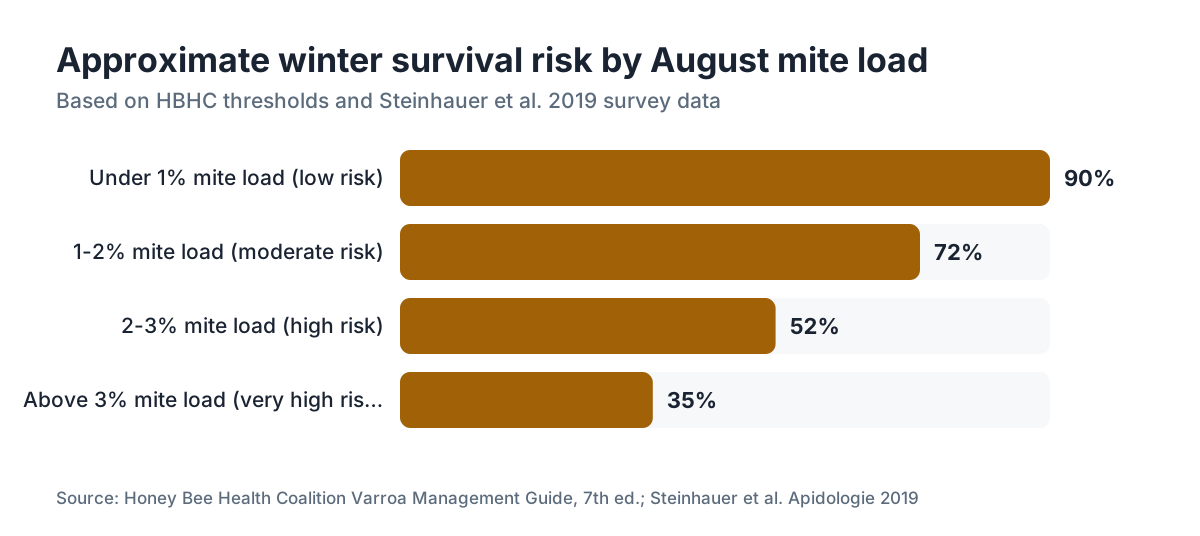
Two mites per 100 bees, tested in August. Above that, winter survival drops off a cliff. The Honey Bee Health Coalition sets the pre-winter treatment threshold at 2 mites per 100 bees (2%), measured by alcohol wash in August [4]. That number is not arbitrary. Studies matching fall mite loads to spring survival keep landing on the same range.
A 2019 national survey by Nathalie Steinhauer and colleagues found colonies with mite loads above 3% in late summer were roughly twice as likely to die over winter as colonies held below 1% [3]. The relationship is not perfectly linear, but the cliff is real.
| August mite level (alcohol wash) | Approximate winter survival risk |
|---|---|
| Under 1% (under 1 mite/100 bees) | Low risk |
| 1-2% (1-2 mites/100 bees) | Moderate risk, treat promptly |
| 2-3% (2-3 mites/100 bees) | High risk, treat immediately |
| Above 3% (3+ mites/100 bees) | Very high risk, winter outcome poor even with late treatment |
These thresholds assume an alcohol wash or sugar roll of a 300-bee sample pulled from the brood nest. Sticky board counts are shakier for threshold decisions because they track colony size and mite drop rate, not infestation percentage [4].
Sample every 4 weeks during the active season, and hit late July and mid-August specifically. Those two counts tell you whether your treatment window is open or already closing. If you haven't sampled and it's now September, sample today. A colony sitting at 4% in September is not going to fix itself.
When does the window for effective treatment close?
For most northern climates, the window where treatment can still protect your winter bees closes in early September, sometimes sooner. That is the uncomfortable answer, and it's the one that catches beekeepers off guard every fall.
Here is the mechanism. Oxalic acid, the best tool for broodless or low-brood colonies, kills mites riding on adult bees but does not reach inside capped cells. Mites tucked in capped brood during treatment survive. Once the queen slows or stops laying in October and the last capped brood emerges, an oxalic acid dribble or vaporization becomes highly effective [5]. But the bees emerging that late are not true winter bees. They missed the late-summer nutritional window that switches on fat body development.
Amitraz (Apivar strips) and formic acid (Mite Away Quick Strips or Formic Pro) do reach into capped cells to varying degrees and can still knock mites down in September. Timing is the trap. Apivar strips need 6 to 8 weeks of contact time [6]. Slide them in on September 15 and you finish in early November, long after your winter bees are already decided.
Formic acid moves faster, roughly 7 days for a short treatment or 14 to 28 days for an extended one, but it needs temperatures above 50 degrees Fahrenheit and below about 85 to apply safely [7]. In a warm September, it's your best remaining tool.
The calendar most extension apiarists push looks like this. Treat in late July or early August if your June and July counts are climbing. Treat by August 15 at the absolute latest if you want to protect the full winter bee cohort. A September treatment can still help but cannot fully undo August damage. An October treatment mostly cleans mites off the bees you already have and may ease spring buildup, but the winter colony is already cast.
What viruses spread when mite loads are high, and why does that matter?
Varroa vectors at least 16 honey bee viruses [1]. In a high-mite colony heading into winter, three earn special attention.
Deformed wing virus (DWV), especially DWV-A and the nastier DWV-B variant, is the one tied most directly to winter collapse. It replicates to enormous titers inside mite-parasitized bees. Work in PLOS Pathogens found DWV-B levels in symptomatic winter-kill colonies running orders of magnitude higher than in healthy overwintered colonies [8]. The colony does not need visible deformed wings for DWV to be killing it. Most of the damage is invisible, running through the fat body and nervous tissue.
Acute bee paralysis virus (ABPV) and sacbrood virus also spike under heavy mite pressure, though their part in winter mortality is less studied. ABPV can kill adult bees fast, which speeds up a population collapse that compromised winter bees already started.
Think of varroa less like an external parasite you can brush off and more like a syringe delivering a viral payload straight into developing brood. A load that looks manageable in summer, say 3%, can still be multiplying because varroa's reproductive cycle rides the honey bee brood cycle. One mite in a healthy summer colony becomes 3 to 4 by fall if left alone [1].
That is why "I'll treat in the fall" is not a plan. It's a bet that the viral damage won't already be baked in.
How fast do mite populations grow if you skip summer treatment?
Faster than most hobbyists expect. Under normal summer conditions with no treatment, varroa populations double roughly every 4 to 6 weeks [1]. A colony testing at 1% in June can hit 3-4% by late August. One at 2% in July can easily top 6% by September.
The math shifts in late summer because colonies start cutting back brood. Fewer brood cells means more mites forced onto adult bees instead of breeding inside cells. That is why alcohol wash counts sometimes jump in August and September even when the colony looks healthy. The mite population built quietly all summer, and now that there is less brood to hide in, the phoretic (hitchhiking) load on adult bees climbs fast.
For a sense of scale: a colony of roughly 50,000 summer bees at 3% carries about 1,500 mites. Each reproductive mite drops 1 to 2 daughters per brood cycle, so 1,500 becomes 3,000 to 4,500 in the next cycle. No amount of natural resistance in a typical colony keeps pace with that.
Missed your summer window and reading this in September? Sample now and act on what you find. The free calculator at VarroaVault can help you model how far your current count will run before the brood nest shuts down.
Can a colony with high mites in fall be saved before winter?
Sometimes. It comes down to two things: how high the count is, and whether there is still brood in the hive.
If your September count sits between 2-4% and the queen is still laying, formic acid gives you the best shot. Formic Pro or Mite Away Quick Strips reach into capped cells, killing mites inside brood along with the phoretic mites on adults. The EPA-registered label for Formic Pro allows treatment when temperatures are between 50 and 79 degrees Fahrenheit (with some leeway up to 85 for short-form strips) [7]. A single 14-day treatment in early September can cut mite loads by 70-90% in trials, though field results vary.
If your count is above 5% in September, the decision gets harder. Treatment is still worth doing, but understand the August winter bee cohort may already be compromised. Some beekeepers pair a September formic treatment with a late October or November oxalic acid vaporization after the colony goes broodless. That two-step hits both the in-cell and phoretic populations.
A colony at 6% or more in October, especially in the northern U.S. or Canada, is a coin flip at best. Treat anyway. It costs almost nothing, and a recovered colony come spring is worth a lot. But don't neglect your solid colonies to nurse the doomed one. Prioritize the ones that can make it.
For late-fall oxalic acid vaporization, the EPA label allows multiple vaporizations 5 to 7 days apart in broodless colonies [5]. Three vaporizations spaced a week apart, done after the colony is naturally broodless, consistently gets 95%-plus mite kill in studies from the Currie lab at the University of Manitoba.
What does a high-mite winter kill look like, and how do you tell it from starvation?
Starvation and varroa collapse are the two most common winter losses, and they leave different signatures. Read them right and you know whether to fix your feeding or your mite plan next year.
Starvation looks like this: a small cluster, dead bees head-first in cells reaching for honey that ran out, and empty frames right around the dead cluster. The bees ate everything within reach and froze.
Varroa collapse looks different. There is usually still honey in the hive, sometimes plenty. The cluster died small, but not from lack of food. You may find dead bees with deformed or stunted wings on the bottom board. Brood cells can show spotty or sunken cappings from secondary infections. Run an alcohol wash on dead or dying bees from a suspected varroa collapse in late fall and mite counts are often extremely high, well above 5 or 6% [3].
A third pattern is a colony that vanishes: few or no dead bees present, but the cluster is gone. That is tied to severe DWV infection. The adult population drops below cluster-forming mass and the bees die scattered rather than in a tight ball.
Open a dead colony in March and check these in order: honey stores present or absent, cluster size and position, dead mites or deformed bees on the bottom board, brood pattern on frames near the cluster. The diagnosis decides whether you blame your feed management or your mite management, and those need completely different fixes.
Does colony strength going into winter offset high mite levels?
Not meaningfully. This is a piece of beekeeper intuition that the data does not back up.
A big colony in October with a 4% mite load has more bees, sure. It also has more mites. Percentage drives per-bee viral exposure more than raw count does. A strong colony does buy time, because it takes longer to dwindle to a cluster too small to survive, but the winter bee quality problem is still there. Those bees are still hollowed out at the fat body level, still carrying high viral titers, still going to die early.
The Honey Bee Health Coalition's Varroa management guide puts it plainly: "Colony strength in fall does not compensate for high mite levels" [4]. The guide says treat regardless of apparent strength if the August count clears threshold.
What strength does change is your margin in a mild or short winter. In the Pacific Northwest or the southeastern U.S., where cold seasons are short, a strong colony at 3% might squeak through. In Minnesota, Wisconsin, or Ontario, it probably won't. Climate sets your risk tolerance. It does not rewrite the biology.
What are the consequences for neighboring colonies and the wider apiary?
A collapsing high-mite colony is more than a dead colony. It's a mite bomb for every hive within a kilometer or two.
As a varroa-heavy colony dwindles in late fall, it can slide into heavy drifting and get robbed out. Bees from weakened colonies drift into neighboring hives carrying phoretic mites. Bees from stronger colonies rob the collapsing hive's honey and fly home wearing mites that were living on the dying colony. Research in Apidologie has documented robbing that can double a healthy colony's mite load within a few weeks [9].
For sideliners running 15 to 50 hives, one unmanaged collapsing colony can pull the whole yard down. That's the real reason to treat a failing colony in fall even when you think it's doomed: you're protecting the rest of the yard, more than gambling on a long-shot rescue.
For hobbyists with two or three hives, the same logic holds. Your neighbor's unmanaged hives, feral colonies nearby, or your own second hive limping along can all send you mite-laden robber bees. Monitoring and treating in isolation never works perfectly, because this is a landscape-level problem. But controlling your own colonies' mite loads is the most effective move you actually have.
You can find monitoring and treatment supplies through established beekeeping supply companies that stock EPA-registered products.
How do you build a protocol that prevents this from happening next year?
Colonies that overwinter well are almost never the product of lucky treatment timing. They come from a calendar that refuses to leave fall mite management to chance.
Here is the framework extension apiarists keep recommending, drawn from the Honey Bee Health Coalition's Varroa management guide and Penn State Extension's bee health resources [4][10].
Sample every 4 weeks from April through October. Put it on your calendar now. Use an alcohol wash with a 300-bee sample from the brood nest for the most accurate count.
If your count hits 2% or above anytime between April and August, treat. Don't wait to confirm the trend. The trend is confirmed.
Build in a preventive treatment window in late July to mid-August regardless of count, using a product suited to the conditions. This is the most important treatment of the year for protecting winter bees. Formic acid works if temperatures cooperate. Amitraz strips work if you have 8 weeks to run them before the brood nest contracts.
If you use Apivar (amitraz), put strips in by August 1 to finish by late September. Don't slide them in during September and expect them to save your winter cluster.
Schedule a post-broodless oxalic acid treatment in November or December. This is your cleanup round, not your primary treatment. It catches mites that survived earlier treatment or drifted in from collapsing colonies nearby.
Document everything: count, date, product, dose, temperature, result. Beekeepers who keep records catch problems earlier and lose fewer colonies. VarroaVault's free protocol tools can walk you through building and tracking this schedule if you want the structure.
The mite problem is not going away. Varroa has been established in North American colonies since the late 1980s, and there is no treatment-free silver bullet for most hobbyists working non-VSH, non-selected stock. The beekeepers who keep colonies alive through winter are the ones who treated in August, not the ones who hoped.
Are there any naturally resistant bee stocks that change the calculus?
Yes, though it pays to be precise about what "resistant" means in the field.
Varroa Sensitive Hygiene (VSH) bees, developed by USDA-ARS researchers, are a genuinely different animal. VSH colonies detect and remove mite-infested pupae at a high rate, which suppresses mite reproduction hard. Field trials with high-VSH colonies have kept mite populations below threshold without treatment through a full season in some studies, though results swing widely by location and starting mite pressure [11].
Russian honey bees, another USDA-ARS program, show moderate tolerance through grooming and suppressed mite reproduction. They are not treatment-free the way marketing sometimes implies, but they tend to reach threshold later and respond better to treatment.
Hygienic behavior more broadly, selecting for bees that detect and remove diseased or parasitized brood, cuts mite reproductive success and slows virus spread. The University of Minnesota Bee Lab has done extensive work on this trait [12].
The honest caveat: most hobbyists are not running certified VSH or Russian stock. Local queen lines vary enormously. A colony that "seems resistant" may just have had a low-mite spring. Without alcohol wash counts, you cannot tell a resistant colony from a lucky one. Resistant stock is worth sourcing if you can find it, but it does not replace monitoring. Even VSH colonies should be sampled and treated when counts climb, because the trait is not 100% heritable and it degrades over generations in an open-mated apiary.
Frequently asked questions
What mite percentage is considered dangerous before winter?
The Honey Bee Health Coalition sets the pre-winter treatment threshold at 2 mites per 100 bees (2%), tested by alcohol wash in August. Above that level, winter survival drops significantly. Colonies above 3% in August are roughly twice as likely to die over winter as colonies kept below 1%, according to a 2019 national survey by Steinhauer and colleagues.
Will my colony definitely die if it goes into winter with a 4% mite load?
Not definitely, but the odds are bad. A 4% load in October means the August winter bee cohort almost certainly saw heavy mite parasitism and the viruses that ride along. Those bees are compromised at the fat body level. The colony might survive in a mild winter or a southern climate, but in cold northern climates a 4% fall load without treatment is high risk. Treat what you can and monitor closely.
Can I treat with oxalic acid in October and still save my winter bees?
Oxalic acid in October can cut your mite load and help the bees still alive, but it cannot restore the fat body reserves of winter bees damaged as larvae back in August and September. It is worth doing, especially as a vaporized treatment once the colony is broodless, but it's damage control at that point, not prevention. Your primary protection window was late July through mid-August.
How do I know if my colony died from varroa versus starvation?
Starvation leaves honey frames empty near the cluster, with bees head-first in cells. Varroa collapse leaves honey still present, a very small dead cluster, often deformed bees on the bottom board, and sometimes almost no dead bees if the colony dwindled to nothing before the cold set in. An alcohol wash on dead or dying bees confirms it: mite loads above 5% in late fall point strongly to varroa-driven collapse.
Does a big, strong colony survive winter better even with high mites?
No, not meaningfully. The Honey Bee Health Coalition states clearly that colony strength in fall does not compensate for high mite levels. A large colony with a 4% mite load has proportionally more mites, and the winter bees born from August brood are still compromised by DWV and reduced fat body reserves no matter how many of them there are. Colony size buys time, not survival.
How quickly can mite populations grow from June to fall?
Under typical summer conditions with no treatment, varroa populations double roughly every 4 to 6 weeks. A colony at 1% in June can reach 3-4% by late August. At 2% in July, a colony can top 5-6% by September. Growth accelerates in late summer as brood volume drops, forcing more mites onto adult bees where an alcohol wash counts them directly.
Can a collapsing high-mite colony spread mites to my other hives?
Yes, and it's one of the most underappreciated risks. Dwindling colonies trigger robbing from stronger hives. Robber bees fly home carrying phoretic mites from the collapsing colony. Research in Apidologie documents robbing events that can double a healthy colony's mite load within weeks. Treating all your colonies, more than the weakest one, protects the whole apiary.
What is the best treatment to use in September if I missed the August window?
Formic acid (Formic Pro or Mite Away Quick Strips) is the best September option because it penetrates capped cells and works faster than amitraz strips. It needs temperatures between 50 and 79 degrees Fahrenheit. Amitraz (Apivar) can still be used in September but requires 6-8 weeks of contact time, which pushes the end of treatment into November. A September formic treatment followed by a November oxalic acid vaporization is a reasonable two-step rescue.
Do VSH or Russian bees eliminate the need to treat before winter?
High-VSH colonies can suppress mite populations significantly and sometimes hold below-threshold counts without treatment, but results vary by location and starting mite pressure. Russian bees show moderate tolerance. Neither stock removes the need to monitor. Most hobbyists are not running certified resistant stock, and even those who are should sample and treat when counts climb. Resistant genetics reduce your risk; they don't erase it.
What does the winter cluster look like inside a varroa-damaged colony as it's dying?
The cluster shrinks steadily as compromised winter bees die ahead of schedule. By December or January it may be a softball-sized group instead of a basketball-sized one. The remaining bees cannot make enough heat to hold cluster temperature. Open the hive in January without disturbing them and you'd see a cold, tight cluster with little movement, honey within reach but bees too cold or too few to get to it.
How often should I sample mite levels to protect my winter bees?
Sample every 4 weeks during the active brood season, April through October. The two most important sampling dates for winter prep are late July and mid-August. Those results tell you whether your treatment window is still open. If you only sample twice a year, July and August are the non-negotiable dates. Use an alcohol wash with a 300-bee sample from the brood nest for accurate percentage counts.
Is oxalic acid vaporization safe and effective in late fall broodless colonies?
Yes. The EPA-registered label for oxalic acid vaporization allows multiple treatments spaced 5 to 7 days apart in broodless colonies. Research from the Currie lab at the University of Manitoba found that three vaporizations spaced about a week apart in broodless colonies consistently reached 95% or greater mite kill. Late October through December, when the queen has stopped or greatly reduced laying, is the ideal window.
Can I use Apivar strips in late September and still protect winter bees?
Apivar strips need 6 to 8 weeks of contact time per the EPA label. Installed September 15, they finish around mid-November. The mite reduction happens, but the August and early September winter bee cohort was already raised under high mite pressure. Apivar in late September cleans up your surviving population and sets you up for a lower-mite spring, but it cannot undo the developmental damage already done to your winter bees.
Sources
- Rosenkranz P, Aumeier P, Ziegelmann B. Biology and control of Varroa destructor. Journal of Invertebrate Pathology, 2010: Varroa destructor vectors at least 16 honey bee viruses; mite populations double approximately every 4-6 weeks under summer conditions
- Amdam GV, Omholt SW. The regulatory anatomy of honeybee lifespan. Journal of Theoretical Biology, 2002: Winter (diutinus) bees accumulate high vitellogenin fat body reserves and live 4 to 6 months versus 4 to 6 weeks for summer bees
- Steinhauer N et al. Drivers of colony losses. Apidologie, 2019: Colonies with mite loads above 3% in late summer were roughly twice as likely to die over winter compared to colonies held below 1%
- Honey Bee Health Coalition. Tools for Varroa Management Guide, 7th edition: Pre-winter economic threshold is 2 mites per 100 bees in August; colony strength in fall does not compensate for high mite levels
- EPA. Oxalic acid (Api-Bioxal) product registration and label information: EPA-registered label for oxalic acid vaporization allows multiple treatments 5-7 days apart in broodless honey bee colonies
- EPA. Amitraz (Apivar) product label: Apivar strips require 6 to 8 weeks of contact time per the EPA-registered label
- EPA. Formic acid (Formic Pro / Mite Away Quick Strips) product label: Formic acid treatments are registered for use when temperatures are between 50 and 79 degrees Fahrenheit; penetrates capped brood cells
- Ryabov EV et al. A virulent strain of deformed wing virus (DWV) of honey bees that has spread globally. PLOS Pathogens, 2014: DWV-B titers in mite-parasitized winter-kill colonies were orders of magnitude higher than in healthy overwintered colonies
- Frey E, Odemer R, Blum T, Rosenkranz P. Activation and interruption of the reproduction of Varroa destructor is triggered by host signals. Apidologie, 2013: Robbing behavior between colonies can transfer mites rapidly, potentially doubling a healthy colony's mite load within weeks
- Penn State Extension. Honey bee health and Varroa mite management resources: Recommended monitoring and treatment calendar for protecting winter bees, including 4-week sampling intervals
- USDA-ARS. Varroa Sensitive Hygiene (VSH) honey bee stock research, Baton Rouge Bee Lab: High-VSH colonies detect and remove mite-infested pupae, suppressing mite reproduction and holding populations below threshold in some field trials
- University of Minnesota Bee Lab. Hygienic behavior and mite-resistant stock research: Selection for hygienic behavior reduces mite reproductive success and slows virus spread
Last updated 2026-07-09