When to give up on a hive with extreme mite load
TL;DR
- If a hive's alcohol wash tops 3 percent (3 mites per 100 bees) and you also see collapsing brood, deformed wings, or a failing queen, treatment rarely reverses the decline before winter or swarm season.
- The bigger danger is that a crashing colony drifts its mites into your healthy hives.
- Here is how to make the call without lying to yourself about it.
What mite level is actually 'extreme,' and how do you know you're there?
Extreme starts at 5 percent (5 mites per 100 bees on an alcohol wash) during the brood-rearing season. That is the number most experienced beekeepers treat as the point of no easy return. Anything at 3 percent or higher in summer is already past the level a colony recovers from on its own.
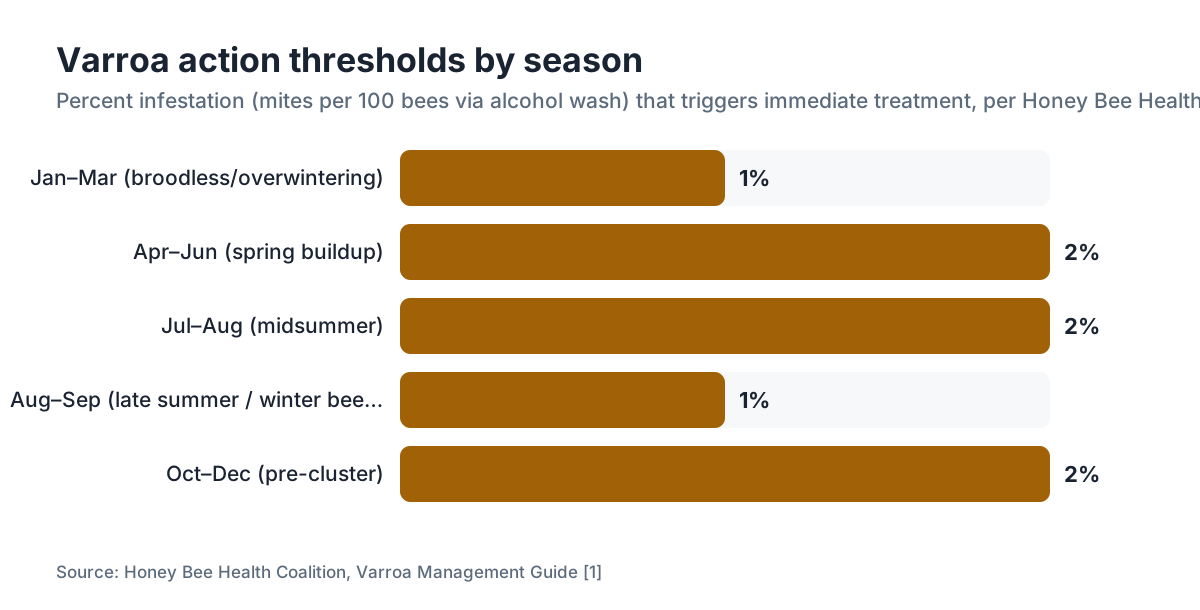
The Honey Bee Health Coalition's Varroa management guide sets the thresholds most of North American beekeeping runs on. For most of the active season the trigger is 2 percent, meaning 2 mites per 100 bees. In late summer and early fall the Coalition drops that to 1 percent, because the bees you raise then are the ones that have to survive winter [1].
The alcohol wash is the most reliable method for a hobbyist. Scoop roughly 300 bees from a brood frame (keep the queen out of the cup), cover them with 70 percent isopropyl alcohol, shake for 60 seconds, and pour the wash through a mesh into a white pan. Count the mites, divide by the number of bees, multiply by 100. That is your percent infestation [12]. Fifteen mites from 300 bees is 5 percent. That colony is in serious trouble.
Sticky boards and CO2 methods exist, but the alcohol wash tracks actual mite population most tightly in peer-reviewed testing. Sugar rolls undercount by 20 to 40 percent compared to alcohol washes [2]. So a 3 percent sugar roll probably means the real number is higher. Keep that in mind when the reading is about to decide whether a colony lives or dies.
What other signs tell you a colony is past the point of treatment?
A mite count is one number. The shape of the colony around that number tells you whether treatment can work fast enough to matter.
Deformed wing virus (DWV) is the clearest alarm. Varroa injects DWV while feeding on developing pupae, and the virus produces the crumpled, useless wings you see on newly emerged workers [3]. Five or more deformed-wing bees on a single inspection means the viral load is already severe. Treatment kills mites. It does nothing for bees already carrying DWV. Those bees die within days of emerging, and the workforce falls faster than new bees can replace it.
A scattered brood pattern with sunken or perforated cappings next to high mite counts often points to parasitic mite syndrome (PMS), where mites knock down larval immune response and let secondary bacterial infections move in. That is not a colony on the edge. That is a colony already going down.
A failing or freshly superseded queen stacked on top of high mites is a nasty combination. A new queen needs 5 to 6 weeks to rebuild a brood nest. During the broodless gap, mites pile onto the remaining nurse bees with nowhere to reproduce, then explode the moment capped brood returns. Treating during that broodless window can work well. But if the population is already too small to cover and warm a new brood nest, the arithmetic falls apart.
Population is the last factor, and often the deciding one. A colony shrunk below four or five frames of bees in spring or summer (outside a normal winter cluster) rarely survives a treatment cycle and rebuilds before the next hard season. Treatment takes time. A tiny colony has almost none left.
How fast does a high-mite colony actually crash?
Faster than most beekeepers believe. Varroa populations grow roughly 10 to 12 times as fast as a honey bee colony can grow [4]. A hive at 3 percent in early July can reach 8 to 10 percent by mid-August in a temperate climate with no treatment at all. Survey work led by Dennis vanEngelsdorp found that colonies hitting 6 percent or higher by August had very low overwintering survival, regardless of fall treatment [5].
The damage is quiet before it is obvious. Mite-fed nurse bees produce lower-quality royal jelly. Winter bees, which need to be physiologically fat and long-lived, come out undernourished from the start. The colony enters winter with structurally compromised bees rather than simply fewer bees. An October treatment might drop the mite count, but the quality of that winter cluster was decided back in August and September.
Here is the version worth taping to the wall: a colony that crosses 3 percent in August in a northern state has maybe six to eight weeks before the damage to its winter bees is locked in. That window is short. Miss it, and no amount of October treatment brings the colony back.
Varroa Mite biology is why the numbers compound like this. Each mite produces roughly 1.5 daughters per brood cycle, mostly in worker cells, and reproduction speeds up as brood density climbs and the colony gets stressed.
Does treating an extreme-mite hive actually work, or is it too late?
Sometimes it works. It depends almost entirely on timing and which treatment you reach for.
Oxalic acid (OA) vaporization acts fastest on adult mites. One vaporization session kills roughly 90 to 95 percent of phoretic mites, the ones riding on adult bees [6]. Phoretic is the word that matters. OA does not reach into capped cells, so any mite reproducing in brood is safe behind the cappings. If your colony has 16-plus frames of capped brood, a single OA treatment leaves most of the mite population untouched. You either run a series of treatments across three to four weeks to catch mites as they emerge, or you use an extended-release product like Apivar (amitraz strips) that stays active long enough to kill mites cycle after cycle.
Apivar strips are labeled for 42 to 56 days of in-hive contact [7]. That covers two full brood cycles and wipes out mites reproducing inside cells. For a colony at 4 or 5 percent with brood, Apivar is often the right call because it keeps working while you do nothing. The catch is temperature. Amitraz efficacy drops hard below 50 degrees Fahrenheit, so Apivar going in during late October in Minnesota does almost nothing.
Formic acid (Mite-Away Quick Strips or Formic Pro) penetrates cappings and kills mites inside brood cells. It is the only option that does that [8]. For a colony loaded with brood and mites, formic acid is often the fastest route to a real drop. The catch runs the other direction on temperature: the label restricts use above 85 to 93 degrees Fahrenheit, depending on formulation, to hold down bee kill [8].
The hard truth: a colony already showing DWV at scale and sitting below four frames of bees will die even after you knock the mites back. You would be spending time and money on bees that cannot rebuild their population fast enough to survive what comes next.
What is the risk to your other hives if you keep a dying colony alive?
This is the question that should drive the whole decision, and it is the one beekeepers ask too quietly. A single crashing hive can raise mite loads across your entire apiary.
A collapsing colony leaks mites through drifting and robbing. High DWV loads disorient foragers, so they drift into neighboring hives carrying mites with them. Once the colony weakens past the point where guard bees can hold the entrance, robber bees from your healthy hives pour in, strip the remaining honey, and fly home with mites aboard [9]. One collapsing hive can seed every other colony within roughly a mile, which covers most hobbyist apiaries end to end.
Work from Cornell and other groups shows that mite bombs, the field term for a crashing high-mite colony, can push neighboring hive mite loads up by one to two percentage points within two to four weeks [9]. Three healthy hives sitting at 1 percent can get shoved to 2 or 3 percent by a neighbor crashing at 8 percent, through drift and robbing alone, right before winter. That is how a beekeeper loses a whole apiary in one season.
Keeping a lost colony alive out of sentiment is one of the more expensive habits in beekeeping. The bees in it are dying anyway. The real question is whether they take your other colonies down with them.
What should you actually do when you decide to give up on a hive?
Act fast. Every day a collapsing colony sits in your apiary is another day it spreads mites. You have a few options, and the right one depends on what that dying colony still has to work with.
If there is still a decent amount of capped honey, the mite load is extreme, but the queen is alive and laying, some beekeepers do a terminal split: pull the frames with brood and bees, shake those bees into a strong established hive, and freeze or destroy the most mite-infested brood frames. Freezing brood for 24 to 48 hours at 0 degrees Fahrenheit kills mites and larvae both. Never drop heavily infested brood frames straight into a healthy colony without treating first.
If the colony is truly crashing (under two or three frames of bees, brood pattern wrecked, DWV everywhere), the clean move is to kill it and salvage the equipment. The standard method is a large plastic bag in the freezer overnight, or a soapy-water slurry. State rules on disposal of dead bees and wax vary, so check your state department of agriculture. Many states allow burial or composting of dead colonies.
The drawn comb and hive bodies still hold value. Freeze them 24 to 48 hours to kill remaining mites, wax moth eggs, and small hive beetle larvae. Once frozen and dried, they are safe for a new package or nuc. Honey frames free of brood can generally be fed back or stored. Do not stash wet drawn comb in a closed box without freezing it first, because wax moths will find it.
VarroaVault's free tools let you log wash counts next to colony population notes, so you see the full picture hive by hive instead of one number floating alone.
Need to restock after a loss, or just getting into monitoring? Beekeeping supply companies that carry refractometers, alcohol wash kits, and mite treatments are worth bookmarking for a fast rebuild.
Is there a point in the season when you should give up sooner rather than later?
Yes. The calendar matters as much as the count. The same 4 percent reading is a manageable spring problem and a death sentence in late fall.
Late summer, the six to eight weeks before your local drone-flight cutoff, is the highest-stakes window of the year. The bees raised now form the winter cluster. Anything above 2 percent in this window warrants immediate treatment under the HBHC guidelines [1]. A colony at 4 percent in mid-August in Ohio or Pennsylvania is in genuine danger. That same 4 percent in late October in the same yard is already past saving for that winter, because the winter bees are developed and their physiology is set.
In spring, a colony at 4 percent ahead of the main flow has room to recover. The brood cycle is expanding fast and there is plenty of season left. Aggressive spring treatment with formic acid or Apivar can rescue a colony that would be a lost cause in October.
States with year-round brood or mild winters (California, Florida, the Texas gulf coast) change the math. Mite populations compound all year without the brood break northern beekeepers sometimes get for free. In those climates a 3 percent reading in December is as urgent as one in August.
Summer splits and forced brood breaks are sometimes used specifically for mite management: instead of giving up, you split hard, create a broodless period, treat with OA, then reassemble or combine with a stronger colony. This can work at 3 to 4 percent if you catch it before DWV spreads. At 6 percent with visible DWV, the odds fall sharply.
Should you combine a high-mite colony with a healthy one?
Rarely, and only under narrow conditions. Combining a high-mite colony with a healthy one before treating is one of the fastest ways to wreck your best hive. Mite loads do not average out when you merge two colonies. Mites move to the frames with the most brood, which sit in the strong colony you just fed them into.
The one scenario where combining makes sense: the high-mite colony has already finished a full treatment cycle, its post-treatment wash is below 1 percent, and it simply lacks the population to rebuild alone. Then combining that treated remnant with a queenright strong colony (newspaper method) saves the bees and the drawn comb without importing a mite problem.
Never use a collapsing colony's queen to requeen a healthy one without a 30-day quarantine and a fresh mite test. Genetics from a colony that crashed under varroa pressure are almost always weak on hygienic behavior and grooming, which is part of why it crashed.
What does a good mite management calendar look like so you don't get here again?
Most hobbyists reach extreme mite loads because they tested rarely, not because they lacked treatments. The HBHC recommends testing at least monthly during the brood-rearing season and after every treatment [1]. That sounds like a lot. An alcohol wash takes about 10 minutes once the gear is in your hands.
A bare-minimum schedule for a temperate northern climate:
April or first inspection: baseline wash. This sets your starting point for the season.
June: mid-season check before any splits or swarm management.
Early August (the big one): the pre-winter bee window. Above 1 to 2 percent here, treat immediately.
Six to eight weeks after treatment ends: verify efficacy. Still above 2 percent after a full Apivar cycle and you may have a resistant population and need to switch mechanisms [7].
October in northern states: a final check before cluster formation. OA dribble or vaporization during a broodless period is the standard end-of-season treatment.
The Honey Bee Health Coalition's guide, free at honeybeehealthcoalition.org, includes a one-page calendar with thresholds by month and region [1]. Print it and tape it inside your hive tool box. The number of colonies that die because the beekeeper meant to test and never got around to it is genuinely depressing.
VarroaVault's free protocol builder turns this calendar into a custom schedule for your location and colony count, which helps once you run five or more hives and the testing dates start to blur.
Can a hive with extreme mites ever recover on its own without treatment?
In conventional Western honey bee stock (Apis mellifera ligustica, carnica, and most commercial lines), no. Not at 5 percent or above. The mite population outruns the colony's ability to compensate, and untreated North American colonies that start a season above 3 percent almost always collapse by fall or the following spring [4].
There is real research on varroa-resistant populations, especially colonies with strong hygienic behavior and recapping (VSH, varroa-sensitive hygiene). VSH colonies suppress mite reproduction by detecting and pulling infested pupae. USDA Baton Rouge work has shown VSH colonies holding mite loads below 2 percent without treatment [10]. But those are specially selected stocks, not the typical package or nuc from a commercial supplier. If you bought a package this spring from a standard source, assume it does not carry VSH genetics.
The Gotland Island feral population in Sweden did develop tolerance over many generations of natural selection under heavy mortality. Survivors showed shorter cappings, more hygienic behavior, and slower mite reproduction [11]. That process ran about 10 years and buried a lot of colonies along the way. It is not a management plan. It is natural selection at scale, and most hobbyists cannot absorb the losses it demands.
Frequently asked questions
What mite percentage means I should definitely give up on a hive?
No single cutoff holds across all seasons, but most experienced beekeepers treat 6 percent or above as extreme territory where recovery is unlikely without immediate action. During the late summer window (August through September), even 3 percent demands urgent treatment because those bees overwinter. Add visible DWV or a failing queen and the threshold drops further. The Honey Bee Health Coalition sets 2 percent as the summer action threshold and 1 percent in late summer [1].
Can I save a hive with a mite load of 5 percent or higher?
Sometimes, if it is before mid-August in a temperate climate and the colony still has enough bees. Formic acid (Formic Pro or MAQS) is the strongest tool because it kills mites inside capped brood, not only the phoretic ones. A colony at 5 percent in June with 8 frames of bees and a solid queen can recover with aggressive treatment. That same colony in September probably will not overwinter even with perfect treatment, because the winter bees being raised now are already damaged.
How do I know if deformed wing virus is already too advanced to treat?
Five or more bees with crumpled, vestigial wings on a single inspection means DWV is already widespread in that colony [3]. Treatment stops new mite reproduction and lowers future DWV transmission, but it does not cure bees already infected. Those bees die within days of emerging. If the population is still strong (6 or more frames of bees), treatment can still save the colony. Below 3 to 4 frames, there probably are not enough healthy bees left to rebuild.
What is the risk to nearby hives if I leave a collapsing colony in my apiary?
High, and underappreciated. As a colony collapses, disoriented foragers drift into neighboring hives carrying phoretic mites. Once the colony weakens and robbing starts, healthy colonies pour in to steal honey and leave with mites aboard. Research shows this can raise neighboring hive mite loads by one to two percentage points within a few weeks [9]. In a small apiary of two to five hives, one mite bomb can compromise every other colony.
Is it better to treat a dying hive or just kill it?
If the colony is below three to four frames of bees, shows widespread DWV, and has a failing or absent queen, the honest answer is to kill it and salvage the equipment. Treatment takes four to six weeks to work, and a colony that small and compromised cannot rebuild in that time. The bigger threat is what happens to your other colonies during those weeks while you wait to see if it turns around.
Can I move a high-mite hive away from my apiary to protect my other hives?
Moving a hive at least two to three miles away (the standard foraging radius) does protect your other colonies from direct drift and robbing. That buys you time to treat the moved hive without risking the apiary. But moving a weak, heavily infested colony without treating it first is not a long-term fix. It still collapses, and its bees still drift mites to whatever colonies are in range at the new spot. Treat it immediately after the move.
Should I combine a high-mite hive with a healthy one?
Only after a complete treatment cycle and a verified post-treatment wash below 1 percent. Combining an untreated or partly treated high-mite colony into a healthy one does not dilute the mite load. Mites move to frames with capped brood, usually in the stronger colony. You end up destroying your best hive. The newspaper-combination method is fine mechanically. The mite treatment has to come first.
Does time of year change when I should give up on a colony with high mites?
Dramatically. A colony at 4 percent in May has the whole brood season ahead of it and can recover with aggressive treatment. The same load in late August means the winter bees being raised right now are already parasitized and their physiology is already compromised. By October, even a successful treatment cannot fix bees damaged back in August. Season is arguably as important as the raw mite count.
What do I do with the equipment after a colony dies from varroa?
Freeze all frames, boxes, and drawn comb for at least 24 to 48 hours at 0 degrees Fahrenheit. That kills remaining mites, wax moth eggs, and small hive beetle larvae. After thawing and drying completely, the equipment is safe for a new package or nuc. Do not store wet drawn comb in a sealed box without freezing first, because wax moths will destroy it within weeks. Check your state department of agriculture for disposal requirements for dead bees.
How often should I test mite levels to avoid reaching extreme loads?
The Honey Bee Health Coalition recommends at minimum a monthly alcohol wash during the brood-rearing season, plus a mandatory test about six weeks after any treatment to verify it worked [1]. In practice, testing in April, June, early August, and October covers the critical windows for a northern temperate beekeeper. Most extreme mite loads trace back to infrequent testing, not a shortage of available treatments.
Can Africanized honey bees handle high mite loads better than European bees?
Africanized bees show somewhat stronger hygienic and grooming behavior than most standard European stock, which can slow mite population growth. Studies have found lower mite loads in Africanized colonies under similar conditions. But they are not immune. An africanized honey bee colony under enough mite pressure still collapses without management, and the aggression traits make them impractical for most hobbyists regardless of any mite tolerance.
What is the difference between alcohol wash and sugar roll for diagnosing extreme mite loads?
Alcohol wash kills the sample bees and dislodges mites reliably, giving the most accurate count. Sugar roll spares the bees, but mites cling tighter and release less completely, which produces systematic undercounting of 20 to 40 percent compared to alcohol wash [2]. For a high-stakes call about whether to give up on a colony, use alcohol wash. Reading a 6 percent load as 4 percent because you used a sugar roll is a costly mistake.
Do VSH or hygienic bee genetics make extreme mite loads less likely?
Yes. Colonies bred for varroa-sensitive hygiene (VSH) detect and remove mite-infested pupae before the mite reproduces, which suppresses mite population growth. USDA research from the Baton Rouge lab found high-VSH colonies holding mite loads below 2 percent without treatment under field conditions [10]. But most commercial packages and nucs are not high-VSH stock. Requeen from a reputable VSH or hygienic-bred queen source if you want real genetic resistance.
Sources
- Honey Bee Health Coalition, Varroa Management Guide (current edition): Action threshold of 2 percent during the season and 1 percent in late summer/early fall; monthly testing recommendation
- Journal of Apicultural Research, comparison of Varroa destructor sampling methods (alcohol wash vs sugar roll): Sugar rolls undercount mite infestation rates by 20 to 40 percent compared to alcohol wash
- USDA Agricultural Research Service: Varroa transmits deformed wing virus during feeding on pupae; visible deformed wing bees indicate high viral load in the colony
- Seeley, T.D. and Smith, M.L., Bee World, 'Crowding honeybee colonies in apiaries can increase their vulnerability to the deadly ectoparasite Varroa destructor': Varroa populations grow approximately 10 to 12 times faster than honey bee colony populations can grow
- vanEngelsdorp, D. et al., Journal of Apicultural Research, U.S. honey bee colony loss survey: Colonies reaching 6 percent or higher infestation by August had very low overwintering survival rates
- Oxalic Acid product information, EPA Pesticide Registration: A single oxalic acid vaporization kills roughly 90 to 95 percent of phoretic mites but does not penetrate capped brood
- Apivar (amitraz) label, EPA Pesticide Registration: Apivar strips are labeled for 42 to 56 days of in-hive contact; efficacy drops below 50 degrees Fahrenheit
- Formic Pro / MAQS label, EPA Pesticide Registration: Formic acid penetrates cappings and kills mites inside brood cells; label restricts use above 85 to 93 degrees Fahrenheit
- Seeley, T.D. et al., PLOS ONE, wild honey bee colonies and adaptation to Varroa destructor without treatment: Robbing and drifting from collapsing colonies can raise mite loads in neighboring hives by one to two percentage points within weeks
- USDA Agricultural Research Service, Baton Rouge Honey Bee Breeding lab, Varroa-sensitive hygiene research: High-VSH colonies can maintain mite loads below 2 percent without treatment under field conditions
- Fries, I. et al., Journal of Apicultural Research, 'Survival of mite-infested Apis mellifera colonies in a Nordic climate': Gotland Island feral bee population developed varroa tolerance over approximately 10 years of natural selection with high colony mortality
- Penn State Extension, Varroa Mite Management: Alcohol wash method and recommended bee sample size (approximately 300 bees from a brood frame) for accurate mite counts
Last updated 2026-07-10