Oxalic acid for bees: the only recipe guide you need
TL;DR
- The EPA-registered oxalic acid recipe for bees is 35 grams of Api-Bioxal dissolved per liter of 1:1 sugar syrup for dribble (a 3.5% solution), or 1 gram of powder per brood box for vaporization.
- Dribble and spray need brood-free colonies.
- Vaporization works year-round and can repeat.
- Always use Api-Bioxal, never bulk powder.
What exactly is oxalic acid and why do beekeepers use it on hives?
Oxalic acid is an organic acid that shows up in rhubarb, spinach, and dozens of other plants. At the right concentration it kills varroa mites on contact, and used correctly it leaves no residue that piles up dangerously in wax or honey. The EPA registered the commercial formulation Api-Bioxal (Véto-Pharma) for U.S. use in 2015, and that label sets the legal boundary for every treatment you run [1].
European beekeepers have used variants of oxalic acid since the 1990s. American beekeepers spent years watching them do it before registration finally landed here. The delay was regulatory, not scientific.
Here is the fact that shapes everything. Oxalic acid kills phoretic varroa, meaning mites riding on adult bees outside capped cells. It does not reach into capped brood. That single limitation drives every decision you make, from when you treat to how many rounds you run.
Want the biology first? Our varroa mite article walks through the life cycle and the damage in detail.
What is the correct oxalic acid recipe for bees, by application method?
There is no single universal recipe. Concentration and carrier change depending on whether you dribble, spray, or vaporize. All three methods sit on the Api-Bioxal label, and that label governs legal use in the U.S. [1].
Method 1: Dribble solution
Dissolve 35 grams of Api-Bioxal in 1 liter of 1:1 sugar syrup (500 g sucrose in 500 mL water). That gives you a 3.5% weight-per-volume solution. Apply 5 mL per occupied bee space between frames, capped at 50 mL per colony. The label is blunt about repeats: one dribble treatment, one time per colony per year [1].
Method 2: Spray solution
Same concentration: 35 g Api-Bioxal per liter of 1:1 syrup. Spray roughly 1 to 2 mL directly on the bees covering each frame. This one fits package bees and swarms, not established hives, because you cannot reach both sides of brood frames without soaking the nest.
Method 3: Vaporization
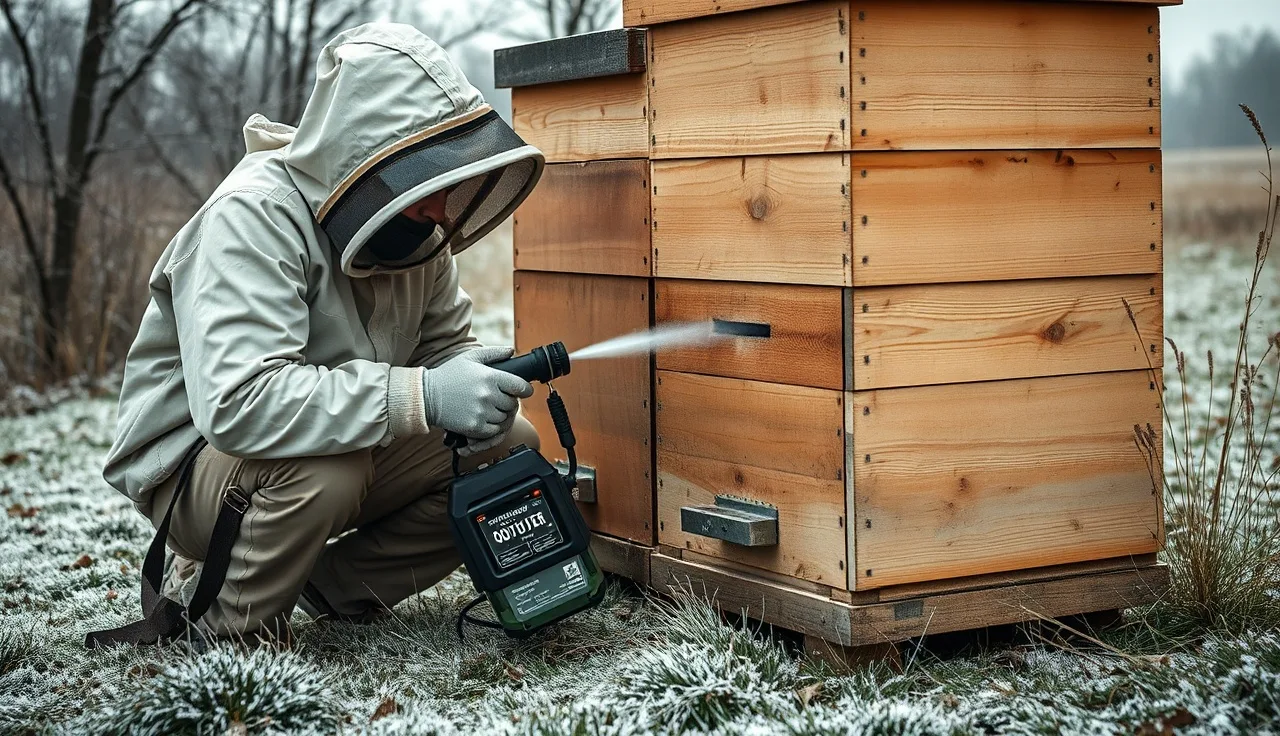
Vaporization uses Api-Bioxal powder straight, no mixing. The dose is 1 gram of Api-Bioxal per brood box. The U.S. label allows up to three treatments at 5-day intervals per treatment episode, and multiple episodes per year [1]. Most beekeepers default to this method now because it does not need a brood-free colony and you can repeat it.
A word on purity. The Api-Bioxal label calls for oxalic acid dihydrate at 99.2% minimum purity. Buying bulk oxalic acid from hardware or wood-bleaching suppliers and dosing hives with it breaks federal pesticide law (FIFRA), because it is not the registered product [2]. It is also riskier in practice, since purity and grind size are not controlled.
Does the oxalic acid recipe change depending on the season or temperature?
The concentration does not change with season or temperature. What changes hard is which method works and how well.
Dribble and spray both need a brood-free colony. Varroa hiding in capped cells sits completely protected. The best natural brood-free window across most of North America is mid-winter, usually December through January, when cold shuts the queen down. Below about 50°F (10°C) bees cluster tightly and take an even dribble without the cluster scattering, but treat on a day above 40°F (4.4°C) so you are not chilling them [3].
Vaporization is more forgiving on temperature. The unit heats the powder to sublimation (around 315°F / 157°C inside the pan), so ambient temperature affects the bees more than the chemistry. Most beekeepers vaporize when it is above 37°F (3°C), warm enough that bees are not comatose [9]. Treating on a cold day when bees cluster tight actually improves contact, because they cannot spread out and dodge the vapor.
Summer vaporization during a brood break (from splitting, caging the queen, or after swarm removal) is one of the strongest plays a beekeeper has. Three vapor treatments at 5-day intervals across a 14-day brood-free window can drop mite loads by 90% or more, according to a Penn State Extension review of field trials [4].
Heat is the other limit. Skip dribble or spray on days above about 90°F (32°C). The sugar solution can hurt bees that are already heat-stressed.
What equipment do you need to mix and apply an oxalic acid treatment?
Safety gear comes first, and it is not optional. Oxalic acid is a severe eye and mucous-membrane irritant. The Api-Bioxal label calls for nitrile gloves, splash-proof goggles, and at minimum an N95 respirator for vaporization (an FFP3 respirator or a half-face respirator with P100 cartridges is better) [1]. A disposable apron or dedicated clothing is worth adding.
For dribble you need a kitchen scale accurate to 1 gram, a mixing container, a syringe or dribble applicator marked in milliliters, and warm water to dissolve the sugar fully. Refrigerated, the solution stays good for several weeks, so you can mix one batch and carry it across apiaries.
Vaporization needs a vaporizer. Two categories exist. Heated-pan models you warm with a propane torch or a 12V battery connection, and electric models with a self-contained heating element. Battery-powered electric units in the Varrox or Sublimox style are the most popular for sideliners because they are faster and more consistent. Budget $150 to $350 for a reliable one [5]. Cheap units from unknown sellers sometimes never hit sublimation temperature, so you waste product and time.
You also need to seal the hive during treatment. Foam plugs, a folded towel, or a dedicated entrance block all work. Hold the seal at least 10 minutes after the powder finishes sublimating so the vapor reaches every bee in the cluster.
Stocking basic gear? Our page on beekeeping supplies has sourcing context.
How effective is oxalic acid at killing varroa mites, by method?
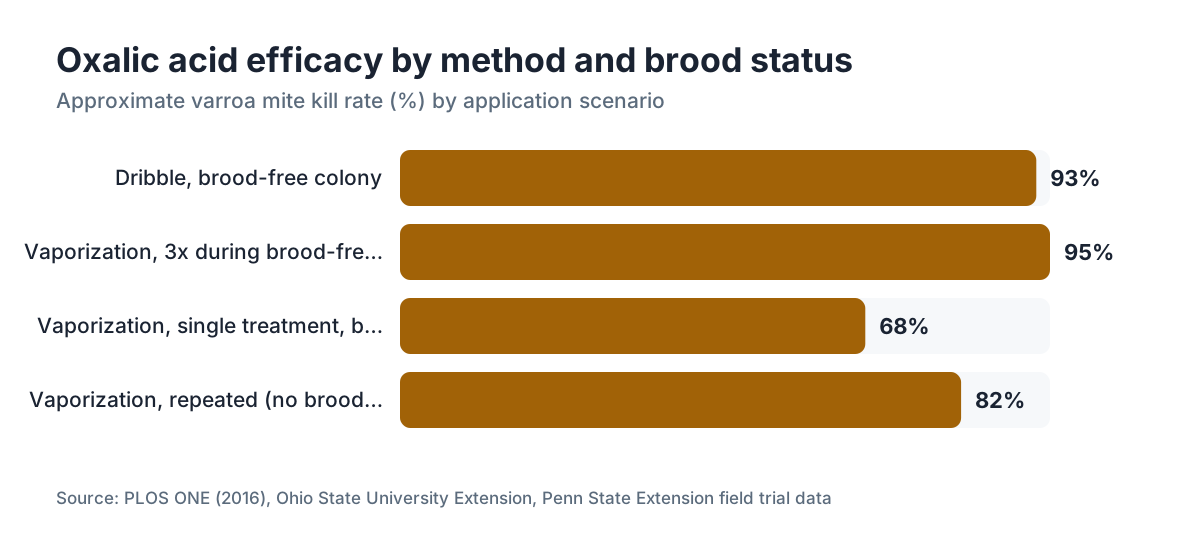
Effectiveness numbers swing a lot depending on brood status, technique, temperature, and how mite loads got measured before and after. A 2016 randomized trial in PLOS ONE found dribble application to brood-free colonies averaged 93.4% mite mortality [6]. Vaporization studies land anywhere from 85% to 99% efficacy, with repeated applications during brood-free windows at the top end [10].
The Honey Bee Health Coalition's Varroa Management Guide puts the logic plainly: "oxalic acid treatments performed when colonies are brood-free are most effective, as phoretic mites are fully exposed to the treatment" [3]. Every protocol builds on that one sentence.
A few honest caveats.
Single-treatment vaporization during active brood-rearing runs weaker, usually 60% to 75% mite kill in one pass, because mites in capped cells live [10]. You repeat treatments to catch the next batch as it emerges. The 5-day label interval maps to the varroa reproductive cycle: most capped cells hatch within 12 days, and hitting them at 5-day intervals catches each fresh wave of phoretic mites before it re-enters cells.
There is no confirmed varroa resistance to oxalic acid. The mechanism, direct acid contact, makes resistance far slower to develop than with synthetic miticides like amitraz or tau-fluvalinate, where resistance is well documented across many regions [8]. Nobody has good long-term resistance data yet, because oxalic acid at scale is still fairly new in the U.S., but slow resistance is considered a real advantage of the organic-acid class.
When should you treat, and how does brood status affect timing?
Timing beats everything else in an oxalic acid recipe, small measurement differences included. Get the timing wrong and the best mix on earth still fails.
For maximum single-treatment efficacy, treat a completely brood-free colony. Four reliable ways to open a brood-free window:
- Natural winter brood break. Across most of North America this runs late November through January. Exact timing depends on your latitude and the season. Check for brood first, because a mild fall can keep a queen laying into December.
- Caging the queen. Cage her inside the hive for 24 days. All open brood caps by day 12, which leaves 12 more brood-free days to run two or three vapor treatments.
- After swarming or during a split. A colony that swarms or a split you make often goes queenless for 10 to 21 days. That is a ready-made window.
- Removing the queen before treatment. Aggressive, but effective in a high-mite emergency.
For year-round management without touching brood, vaporization every 10 to 14 days suppresses but never clears mites during brood season. Treat it as a holding pattern between other treatments or while you wait for a natural break.
Monitoring before and after treatment is how you know any of this worked. Alcohol wash or sugar roll for a count per 100 bees. Most extension services set the action threshold at 2 to 3 mites per 100 bees during brood season, and 1 mite per 100 bees heading into winter [3].
VarroaVault's free mite tracking worksheet logs your wash counts and flags treatment timing without spreadsheet headaches.
Is homemade oxalic acid safe to use on bees, or do you have to buy Api-Bioxal?
You have to buy Api-Bioxal, or another EPA-registered formulation if one reaches the market. Dosing hives with bulk oxalic acid violates the Federal Insecticide, Fungicide, and Rodenticide Act (FIFRA), which bars applying a pesticide in a manner inconsistent with its labeling [2].
Plenty of experienced beekeepers did exactly this for years before 2015, mixing solutions from wood-bleaching grade powder. The argument was that it is the same molecule. Chemically, sure. Legally and practically, no. Api-Bioxal is tested for purity and particle size. Bulk powder is not, and wrong particle size in a vaporizer has real consequences: uneven vaporization and higher bee mortality when hot acid particles land on bees before they fully sublimate.
The cost is not the sticking point. A 35-gram packet (enough for one liter of dribble solution or 35 vaporization treatments) runs $10 to $20 at beekeeping suppliers [5]. A 275-gram container runs about $40 to $65. For a small operation, that is nothing against the value of healthy colonies.
For sourcing options, see our roundup of beekeeping supply companies.
What are the safety risks of oxalic acid for bees and for the beekeeper?
Oxalic acid is genuinely hazardous to people if you mishandle it. The safety data sheet and the Api-Bioxal label both flag severe irritation to eyes, skin, and the respiratory system. Inhaling the vapor or fine particles inflames the airways, and repeated exposure links to kidney damage because oxalic acid forms calcium oxalate crystals in the renal tubules [1].
Vaporization is the highest-risk moment for the beekeeper. The vapor is invisible and does not clear instantly. Stay upwind. Do not lean over the entrance after treatment. Seal the hive, walk away for 10 to 15 minutes, then pull the plug. Indoors or in a closed space, vaporizing without respiratory protection is dangerous, full stop.
For bees, oxalic acid at label doses is well tolerated. Studies show minimal bee mortality at recommended concentrations, though queens run a bit more sensitive than workers. Some beekeepers report queen loss after repeated dribble applications, which is part of why the label caps that method at one treatment a year.
Oxalic acid does leave trace residue in wax, but it stays well below any threshold of concern for honey safety. A 1997 study cited in European Food Safety Authority assessments found treated-hive honey held oxalic acid at concentrations lower than natural levels in most fruit juices, which run 150 to 900 mg/kg. Honey sits around 7 to 20 mg/kg naturally, and treatment does not move that figure in any meaningful way [7].
You can extract and use honey from treated hives the same season you treat. The Api-Bioxal label has no honey-super removal requirement, which is a real edge over synthetic miticides.
How does vaporization compare to dribble for most beekeepers?
These two methods do not compete. They fit different situations.
| Method | Brood-free required? | Treatments per year | Best season | Rough cost per treatment |
|---|---|---|---|---|
| Dribble | Yes | 1 (label limit) | Winter / brood break | ~$0.40 per colony |
| Spray | Yes | Multiple (swarms/packages) | Spring package installation | ~$0.40 per colony |
| Vaporization | No (but stronger without brood) | Multiple rounds, 3 per episode | Any season | ~$0.50-1.00 per colony |
Dribble is simpler, cheaper on gear, and effective when conditions line up. No vaporizer, no battery, no extension cord. Run 5 to 10 hives with a reliable winter brood break, and a single winter dribble makes sense inside a broader annual plan.
Vaporization is more flexible and increasingly the first choice, because you can repeat it, it works any season, and it does not force you to open the hive in the cold. For sideliners with 25 or more colonies, the speed of vaporization (2 to 3 minutes per hive once the gear is staged) beats dribbling frame by frame.
Honestly, the strongest plan for most hobbyists with access to a brood break combines both: a midsummer vaporization series during a caged-queen window, then a winter dribble if counts stay high. The Honey Bee Health Coalition's Varroa Management Guide lays out integrated timing in detail, and it is a free download [3].
What mistakes do beekeepers make when applying oxalic acid?
The most common mistake is treating during active brood-rearing with one dribble or one vapor pass and expecting 90-plus percent efficacy. It will not happen. A colony with 6 frames of capped brood has most of its mites protected. You knock down maybe half the phoretic mites, feel like the treatment failed, and the real problem was timing.
Second: not sealing the hive during vaporization. Vapor leaks, concentration inside drops below the effective threshold, and you treat the yard air instead of the colony. Foam plugs at every entrance, upper vents included.
Third: sloppy measuring. Five mL per bee space is a maximum, not a range. Under-treat and it does nothing. Over-treat and you risk queen loss and dead bees. Use a graduated syringe, not a guess.
Fourth: skipping PPE because it feels awkward. I will not pretend every beekeeper follows label safety to the letter. But oxalic acid vapor is the one place where an N95 or better is not optional for your own health.
Fifth: leaning on oxalic acid alone as a year-round fix for colonies carrying heavy brood. It works best as one tool in a rotation. Pair it with other approved treatments (amitraz strips, formic acid) and with integrated pest management like drone comb removal, and you get more durable mite control than any single product delivers.
Where can you find free tools to track your oxalic acid treatment protocol?
A treatment log is basic good practice, and it protects you legally if a neighbor claims you misused pesticides. Log the date, the product lot number, the method, the number of colonies treated, the mite wash count before and after, and the ambient temperature.
VarroaVault runs a free mite tracking and treatment protocol tool built for hobbyist and sideliner beekeepers managing varroa with oxalic acid and other registered products. You use it without buying anything.
The Honey Bee Health Coalition also publishes free regional treatment decision guides and a printable monitoring log inside its Varroa Management Guide [3]. The University of Minnesota Bee Lab and Penn State Extension both keep free online resources covering oxalic acid protocols for small operations [4][5].
For sourcing Api-Bioxal and vaporizers, especially if you want to compare prices across suppliers, our guide to beekeeping supply companies has practical notes on what to look for.
Frequently asked questions
Can I make my own oxalic acid solution for bees instead of buying Api-Bioxal?
No. Under FIFRA, the only legal oxalic acid treatment for U.S. honeybee hives is an EPA-registered product like Api-Bioxal. Using bulk oxalic acid powder from hardware or wood-finishing suppliers is an off-label pesticide application, which is illegal regardless of the concentration you mix. The registered product also guarantees the purity and particle size that make vaporization safe and consistent.
How many grams of oxalic acid do I mix per liter for the dribble method?
The Api-Bioxal label specifies 35 grams dissolved in 1 liter of 1:1 sucrose syrup (500 g sugar per 500 mL water). That produces a 3.5% weight-per-volume solution. Apply 5 mL per occupied bee space with a maximum of 50 mL per colony. Use a kitchen scale accurate to 1 gram and a graduated syringe for application.
How much Api-Bioxal do I use per hive in a vaporizer?
The label dose for vaporization is 1 gram of Api-Bioxal per brood box. A double-deep Langstroth hive with two brood boxes gets 2 grams. Measure with an accurate gram scale. You can treat up to three times at 5-day intervals per treatment episode, and you can run multiple episodes per year, unlike the dribble method, which is limited to once annually.
What temperature is too cold or too hot to do an oxalic acid vaporizer treatment for bees?
Most practitioners vaporize when ambient temperatures are above 37°F (3°C). Below that, bees may be dangerously chilled during hive sealing. The upper limit is looser, but avoid vaporization above 90°F (32°C) because heat-stressed bees tolerate treatment poorly. For dribble treatments, the functional range is about 40°F to 80°F (4°C to 27°C).
Does oxalic acid kill varroa mites inside capped brood cells?
No. Oxalic acid kills only phoretic mites riding on adult bees. Mites inside capped cells are completely protected because the acid cannot penetrate wax cappings. This is why brood-free timing matters so much: when no capped brood is present, all mites in the colony are phoretic and exposed. During active brood season, a large fraction of the mite population hides in cells and survives treatment.
How long do I need to seal my hive after oxalic acid vaporization?
Seal the hive entrance for a minimum of 10 minutes after the Api-Bioxal powder has fully sublimated inside the vaporizer pan. Some beekeepers extend this to 15 to 20 minutes in very cold weather when vapor disperses more slowly. Plug all openings, including upper entrances and screened bottom board gaps, to keep vapor concentration up throughout the brood box.
Can you use oxalic acid when honey supers are on the hive?
Yes. The Api-Bioxal label has no requirement to remove honey supers before treatment. This is one of the key practical advantages of oxalic acid over most synthetic miticides, which require super removal. Research confirms that oxalic acid does not raise honey residue above naturally occurring background levels, so treated-hive honey is safe to harvest and sell.
How many times a year can I treat with oxalic acid?
The dribble and spray methods are limited to one treatment per colony per year on the current U.S. label. Vaporization has no annual application limit; the label allows repeated episodes of up to three treatments at 5-day intervals each. In practice most beekeepers run one to three vaporization episodes per year depending on mite pressure and whether they can engineer brood-free windows.
Will oxalic acid treatment hurt my queen?
At label doses the risk is low but real. Queens run somewhat more sensitive to oxalic acid than workers, and some beekeepers report elevated queen loss after dribble treatment, particularly at the high end of the dose range. Vaporization is generally considered gentler on queens than dribble. Treating when temperatures sit in the moderate range (50°F to 70°F) and measuring doses carefully reduces queen risk.
What is the shelf life of a mixed oxalic acid dribble solution?
A properly mixed Api-Bioxal dribble solution (35 g per liter of 1:1 syrup) stored in a sealed container in the refrigerator stays stable for several weeks, generally up to 8 weeks before the sugar syrup ferments or crystallizes. Mixing a fresh batch per treatment season is the cleaner approach for small operations. Discard any solution that shows cloudiness, crystallization, or off odor.
Do I need to monitor mite counts before and after oxalic acid treatment?
Yes, and this is non-negotiable good practice. An alcohol wash or sugar roll before treatment tells you whether mite loads actually justify treatment and gives you a baseline. A wash 72 hours after treatment gives rough efficacy data. The standard action threshold during brood season is 2 to 3 mites per 100 adult bees. Going into winter, most extension services recommend treating if counts exceed 1 mite per 100 bees.
Is oxalic acid safe for bumblebees or other bee species if it drifts to nearby nests?
Api-Bioxal is registered and tested only for Apis mellifera (European honeybees). Research on oxalic acid toxicity to native bees and bumblebees is limited. Because vaporization produces visible acid vapor that exits the hive briefly before dissipating, treating near high densities of ground-nesting native bees warrants caution. Keep hive entrances pointed away from areas with known active native bee nesting when you can.
How do I dispose of leftover oxalic acid solution safely?
Neutralize leftover dribble solution by slowly adding baking soda (sodium bicarbonate) until the fizzing stops, which converts oxalic acid to sodium oxalate. Then dilute heavily with water before pouring down a sink drain, or follow your local hazardous waste guidelines. Never pour undiluted oxalic acid solution into storm drains or onto soil near waterways. Empty Api-Bioxal packaging can go in regular trash once fully emptied.
Sources
- EPA, Api-Bioxal Supplemental Label (Reg. No. 86203-1): Api-Bioxal label specifies 35 g per liter 1:1 syrup for dribble; 1 g per brood box for vaporization; one dribble treatment per year; up to three vapor treatments at 5-day intervals per episode
- Honey Bee Health Coalition, Varroa Management Guide (2023 edition): Oxalic acid treatments performed when colonies are brood-free are most effective, as phoretic mites are fully exposed; action threshold 2-3 mites per 100 bees during brood season, 1 per 100 going into winter
- Penn State Extension, Apiculture Program resources: Three vapor treatments at 5-day intervals during a 14-day brood-free window can reduce mite loads by 90% or more per Penn State field trial review (2015)
- University of Minnesota Bee Lab, Varroa Treatment Information: Reliable oxalic acid vaporizers cost approximately $150 to $350; Api-Bioxal 35-gram packets retail for $10 to $20 at beekeeping suppliers
- Gregorc A, et al., PLOS ONE (2016), oxalic acid treatment efficacy in honeybee colonies: Dribble application to brood-free colonies achieved 93.4% average mite mortality in randomized field trial
- European Food Safety Authority (EFSA), Oxalic Acid Scientific Opinion (2004): Natural oxalic acid in fruit juices is 150-900 mg/kg; background honey levels are 7-20 mg/kg; treatment does not meaningfully raise honey oxalic acid above natural background
- USDA ARS Bee Research Laboratory, varroa management resources: No confirmed varroa resistance to oxalic acid documented; direct acid contact mechanism makes resistance development slower than synthetic miticides
- UC Davis Apiaries and Bee Breeding Program, oxalic acid treatment guidelines: Vaporization during cold weather when bees are clustered improves contact exposure; minimum ambient temperature recommendation of 37°F for vaporization
- Ohio State University Extension, Varroa Mite Management in Honey Bee Colonies: Vaporization efficacy ranges 85-99% with repeated applications during brood-free windows; single in-brood-season application typically 60-75% mite kill
- Cornell University College of Agriculture and Life Sciences, Dyce Lab for Honey Bee Studies: Alcohol wash before and after treatment is standard monitoring method; 72-hour post-treatment wash gives rough efficacy data
Last updated 2026-07-09