Oxalic acid side effects on bees: what the research actually shows
TL;DR
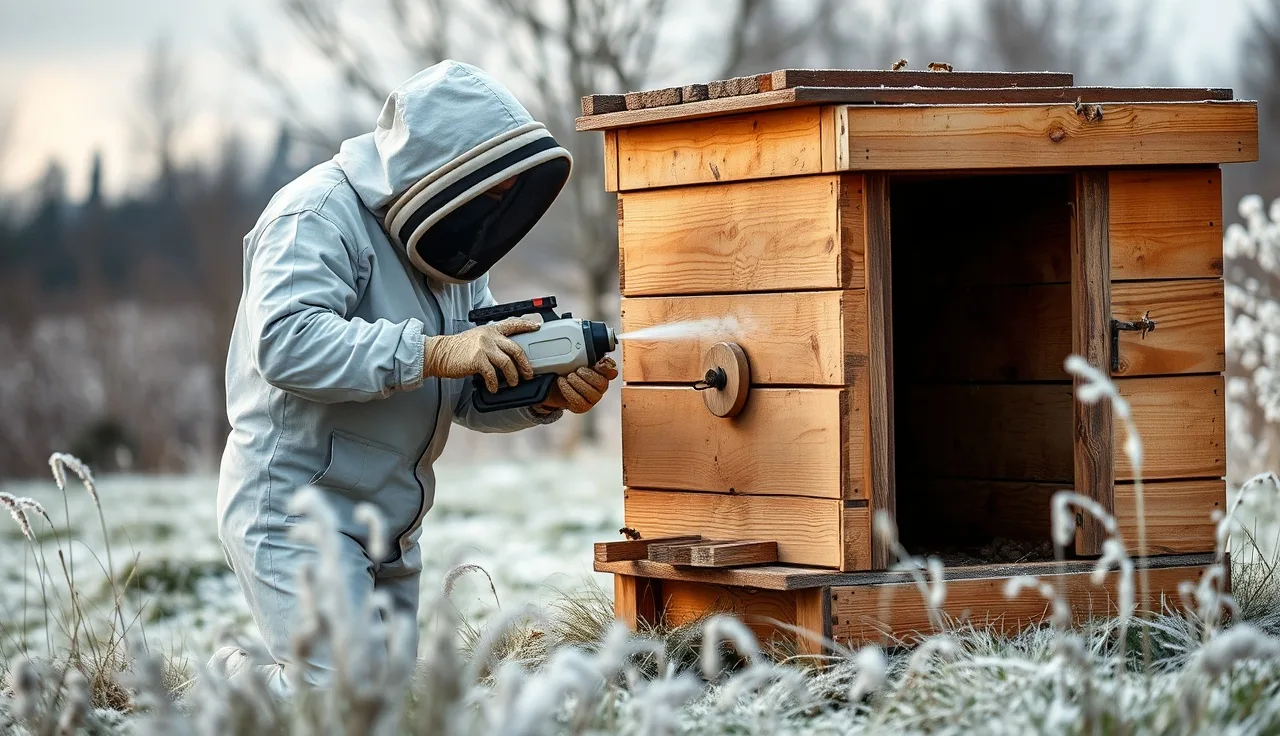
- Oxalic acid (OA) is one of the safest varroa treatments you can buy, but it isn't harmless.
- It kills open brood at high doses, shortens adult bee life when overapplied, and burns your airways if you skip a respirator.
- Used at label rates during a broodless period, the risk to bees is small and well-documented.
What is oxalic acid and why do beekeepers use it on hives?
Oxalic acid is a natural organic acid found in rhubarb, spinach, and honey itself. Honey typically holds 8 to 40 mg/kg of oxalic acid depending on floral source [1]. Beekeepers use concentrated OA solutions and vapors to kill Varroa destructor mites, the biggest single driver of colony loss in managed honey bees. The varroa mite is what makes any of this necessary.
The EPA registered oxalic acid dihydrate for use in bee colonies in the United States in 2015 [2]. The registered products here are Api-Bioxal (approved for dribble, vaporization, and extended-release sponge application) plus a handful of generic registrations that followed after 2020. The Honey Bee Health Coalition notes that OA "is approved for use in honey supers" when applied as a vapor or sponge, which sets it apart from most other varroa treatments [3].
The mechanism is contact-based. OA damages the mite's cuticle and interferes with its feeding. It does not build up in wax or honey at harmful levels when used at label rates. That's the core reason it caught on. It kills mites, and it leaves a residue profile that regulators and organic certifiers can live with.
Does oxalic acid hurt or kill adult bees?
At label rates, the effect on adult bees is small. The standard EPA-registered dribble dose is 3.5 grams of OA in 35 mL of 1:1 sugar syrup per seam of bees, capped at 50 mL per colony [2]. Studies reviewed by the European Food Safety Authority found no statistically significant drop in adult bee survival at those concentrations [4].
High doses tell a different story. A 2016 study in PLOS ONE by Gregorc et al. tested OA well above label rates and found dose-dependent jumps in bee mortality and oxidative stress markers [5]. The lesson isn't that OA is dangerous. It's that the margin matters. Doubling or tripling the dose to chase better mite kill isn't supported by the data, and it costs the colony.
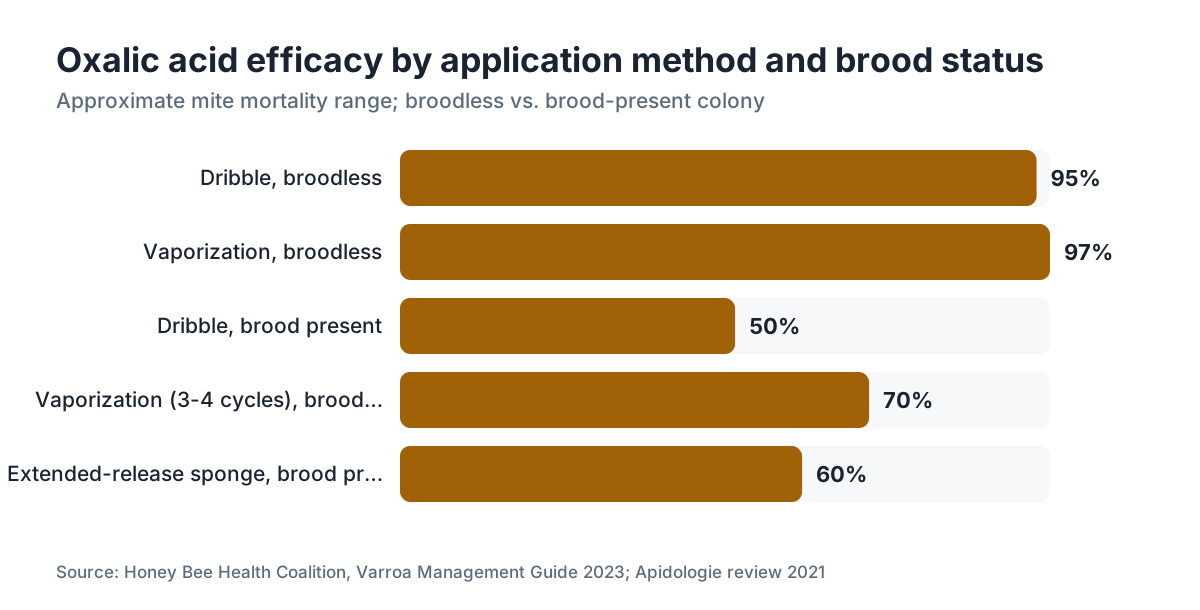
Vaporization is the most common method now, and the research on vapor exposure is mostly reassuring at label rates. A 2021 review in Apidologie concluded that repeated OA vaporization cycles (up to 3 to 4 treatments 5 days apart) within label guidance did not significantly reduce colony strength or worker longevity compared to untreated controls [6]. Some beekeepers do report clusters of dead bees right below the vaporizer entry point immediately after treatment. That's probably a local concentration spike at the moment of application, not systemic poisoning.
Healthy adult bees tolerate OA well at the right dose. Stress the colony first with starvation, disease, or poor ventilation during treatment, and you'll see worse outcomes that get pinned on the acid.
How does oxalic acid affect open brood?
This is the real limitation, and it deserves plain language. Oxalic acid is highly toxic to open (unsealed) brood at the concentrations used for mite control [4]. The dribble method deposits acid solution straight onto bees sitting over open cells. Larvae exposed to OA show abnormal development and higher mortality in lab studies.
That's why every label and extension guide tells you to treat during broodless periods. The University of Minnesota Extension recommends applying OA only when colonies are broodless or nearly broodless, usually mid-winter in northern climates [7]. Treat a colony carrying six frames of open brood in September and you'll damage that brood. Mite kill also collapses, because the mites hiding under capped cells are untouched by any OA method.
The sponge (extended-release) format handles part of this problem. Api-Bioxal glycerin sponge boards are labeled for colonies with brood present because the slow release keeps colony-level OA concentrations lower at any single moment [2]. Even so, dose integrity matters. Don't cut the sponge into a smaller piece to 'spread it out' and then add extra strips.
In most U.S. climates the broodless window falls between November and January. Time your OA treatment there and you sidestep almost all of the brood toxicity while getting far better mite kill, since every mite is now riding on an adult bee and fully exposed.
Can oxalic acid affect queen bees specifically?
Queen safety is one of the questions I hear most, and the honest answer is that the evidence is mixed but mostly reassuring at label rates.
Lab studies that applied OA directly to queens found reproductive effects at elevated doses, including reduced sperm viability in stored semen after exposure [8]. That sounds alarming. But those studies usually used concentrations or exposure times far outside what a colony queen sees during a normal treatment cycle.
Field reports of queen loss after OA treatment exist. Controlled studies haven't reliably reproduced queen-specific mortality above background loss rates. The Honey Bee Health Coalition's Varroa guide notes the open queen-safety questions but stops short of calling OA a proven queen-killer at label rates [3].
Here's what is clearly true. Dribbling liquid onto a cluster that just requeened with a young, unestablished queen in fall carries some risk from the mechanical stress alone. Vapor is gentler that way. If I had a new queen I was worried about, I'd pick vapor over dribble, and I'd wait until the cluster was well-established before treating.
What are the side effects of oxalic acid on beekeepers?
The effect on bees gets most of the attention. Your own safety is real and underdiscussed.
Oxalic acid vapor is corrosive to the respiratory tract. The EPA label for Api-Bioxal requires a NIOSH-approved respirator with an OV/P100 cartridge, chemical-resistant gloves, and protective eyewear during vaporization [2]. Inhaling OA vapor is not a minor irritation. Repeated exposure can damage the upper airways, and the vapor is invisible, so people badly underestimate their exposure without the right gear.
Skin contact with the crystal or the mixed solution causes irritation, and with prolonged contact, mild chemical burns. Eye contact is serious. OSHA's Hazard Communication guidance classifies oxalic acid as a Category 1 eye hazard [9].
The dribble method carries lower inhalation risk than vaporization, but you're still handling a corrosive acid solution. Wear nitrile gloves at a minimum.
Here's what actually happens. A beekeeper buys a vaporizer, uses it on a wrapped hive on a still day, skips the respirator because 'it's natural', and catches a face full of vapor when lifting the board to check. Once, and it's just unpleasant. Do it every treatment all season and you're stacking up airway damage. Skip that. A decent half-face respirator rated for organic vapors and acid gases costs about $30 to $50 see beekeeping supply companies.
Does oxalic acid leave residues in honey or wax?
Residue in honey is the question that made beekeepers nervous before the EPA registration, and the data is clear enough to settle it. Baseline honey already contains oxalic acid.
The European Food Safety Authority panel established in 2004 that residues after treatment do not meaningfully exceed the natural background range, so honey from treated colonies tests within the range of untreated colonies [4]. The U.S. EPA reached a similar conclusion when it set the residue standard at registration [2].
Wax is a little more complicated. OA does not bind into wax the way synthetic acaricides like coumaphos or tau-fluvalinate do. Studies show OA residues in wax stay low and don't accumulate across repeated seasonal treatments [10]. That's one of the genuine advantages OA holds over the older synthetics.
The label still bans dribble application while honey supers meant for harvest are on the hive, mostly as a conservative regulatory step for the sugar-syrup carrier, not because OA itself poses a contamination risk at those levels. The extended-release sponge and vaporization formats are labeled for use with supers present, which reflects the cleaner residue profile of those delivery methods [2].
If you sell honey and need clean treatment records, tools like VarroaVault's free protocol tracker let you log treatment dates and method, so you know exactly which supers sat on the hive during any application.
What does the research say about oxalic acid efficacy vs. side effects at different doses?
The dose-response curve is where this gets interesting. OA efficacy against mites in broodless colonies is high. Multiple studies report 90 to 99% mite mortality from a single well-timed treatment [3][6]. The side-effect profile at those doses is low.
Go above label rates and you flip the ratio. Gregorc et al. (2016) showed that at 2x the standard dose, worker bee mortality climbed measurably and colony stores consumption rose, a sign of metabolic stress [5]. Mite kill didn't improve in step. So you get more bee harm and no better mite control. There is no upside to overdosing.
The table below lays out the tradeoffs across the three EPA-registered application methods.
| Method | Brood safe? | Efficacy (broodless) | Efficacy (brood present) | Beekeeper exposure risk |
|---|---|---|---|---|
| Dribble (Api-Bioxal) | No | 90-99% [3] | 40-60% [3] | Low (gloves, care) |
| Vaporization (Api-Bioxal) | Mostly | 90-99% [6] | 60-80% [6] | High (respirator required) |
| Extended-release sponge | Yes (labeled) | Lower single-point | Moderate sustained | Low |
Nobody has clean head-to-head data on extended-release sponge efficacy across all colony sizes and seasons. The label-cited studies showed acceptable efficacy, but researchers note it swings with ambient temperature [2].
Most beekeepers who use OA regularly land on vaporization for winter broodless treatment. The mite kill is reliable, the residue profile is good, and the labor cost per colony drops once you own a vaporizer. The respirator requirement is non-negotiable.
How does temperature affect oxalic acid safety and effectiveness?
Temperature drives OA more than most beekeepers realize. Cold clusters are tight, and in a tight cluster the vapor spreads well before bees start moving away from it. Below about 50 degrees Fahrenheit (10 degrees Celsius), though, bees pack so tightly that vapor may not fully penetrate, efficacy can drop, and mite drop gets harder to read [7].
The sweet spot for winter OA vaporization is roughly 35 to 50 degrees F (2 to 10 degrees C). Cold enough that the colony is broodless, warm enough that some bee movement helps carry the treatment through. The University of Minnesota Extension puts the practical window in northern states at late November through January [7].
Heat brings a different problem. OA mixed with sugar syrup for dribble degrades faster when it's hot, and hive temperatures run past 95 degrees F in summer. Dribbling OA in hot weather onto a populated hive means more direct worker exposure to concentrated acid. That's another reason extension programs push the winter broodless window over summer applications, even though summer mite loads usually run higher.
For summer vaporization (treating brood-present colonies with several short cycles), stay inside label session limits and give colonies a full 5 days between treatments so the bees can recover from respiratory stress before the next round.
Is oxalic acid safe for package bees and newly hived swarms?
This question gets ignored too often, and the practical answer is yes, with caveats.
Package bees in a new hive are broodless for their first 1 to 2 weeks. That window is a good chance to treat if you know the package showed up carrying mites, which happens more often than anyone likes given the source colonies packages come from. A single OA dribble or vaporization during that broodless stretch can knock down the founding mite load hard.
The risk is stressing brand-new bees already juggling orientation, queen release, and comb building. A light OA vaporization in a strong package (at least 3 lbs of bees) is generally considered low-risk by extension apiculturists. Dribbling 50 mL of syrup onto a weak, stressed 2 lb cluster is a different calculation.
Wild-caught swarms are broodless at first too. They also tend to carry low mite loads, because they've already gone through a natural brood break. A mite wash before you decide to treat is worth 20 minutes. Under 1 mite per 100 bees, you may not need to treat at all. Over 3 per 100, treat while the broodless window is still open.
What are the signs that oxalic acid harmed a colony?
Knowing what post-treatment distress looks like matters, because some symptoms are normal and brief while others flag a real problem.
Normal after OA vaporization: bees run agitated and buzzy for 15 to 30 minutes. You may see heavier fanning at the entrance. Some bees cluster outside the hive for a while. A few dead bees at the entrance over the next 24 to 48 hours isn't alarming, especially if mite loads were high and you're also seeing dead mites on a sticky board.
Signs of over-treatment or error: large piles of dead bees (more than a fist-sized heap) in the days after treatment, a sharp rise in brood removal (damaged larvae being ejected), queen failure within 2 to 4 weeks, or a colony that just won't build up into spring. None of these prove OA harm on their own. Cross-check your dose, your method, and whether another stressor (starvation, pesticide drift, chalkbrood) could explain it.
One thing trips people up. A high mite-drop count on the sticky board after OA treatment is good news, not harm. Those are dead mites. Count them. If your pre-treatment wash ran 5 per 100 bees and you're seeing hundreds of mites on the board over the following week, the OA did its job.
If you want to track mite counts and treatment responses across seasons, the free tools at VarroaVault are built for exactly that, with protocol prompts that tie treatment timing to colony outcomes over time.
How does oxalic acid compare to other varroa treatments for bee safety?
Context matters. No varroa treatment is free of side effects. The real question is relative risk.
Amitraz (Apivar strips) has a documented residue-accumulation problem in wax and a queen-loss risk if strips stay in too long or if concentrations build up in small nucs [3]. Coumaphos (Checkmite+) is a synthetic organophosphate with strong wax persistence and concerns about sublethal effects on queen reproduction at accumulated residue levels [3]. Formic acid (MAQS, Formic Pro) carries a real heat-dependency risk and can cause queen loss and brood damage above 85 degrees F [3].
OA sits in as the option with the lightest residue footprint, the fewest documented queen-loss events at label rates, and no known resistance in Varroa mites in current research. The Honey Bee Health Coalition's 2023 Varroa guide rates OA as appropriate across all three main treatment windows (winter, spring, and fall) depending on format [3].
OA's one real limitation, open-brood toxicity, is shared by formic acid, and it's arguably worse with formic in warm weather. OA's weak spot is at least predictable and you can dodge it with timing.
For a full-season plan, look at beekeeping supplies that pair OA with a complementary treatment to cover the summer brood-present window where OA alone underperforms.
Are there any long-term effects of repeated oxalic acid treatments on colony health?
Here the honest answer is that data beyond a 3 to 4 year observation window is thin.
What we do have: a 2021 Apidologie review found no significant negative trend in colony strength, queen longevity, or honey production in colonies treated with OA vaporization for 3 straight years at label rates, compared to untreated controls [6]. Several European monitoring programs have tracked OA-treated colonies for five years and longer without flagging cumulative toxicity.
OA does not build up in wax the way synthetic acaricides do. That's a meaningful long-term edge. Wax from colonies treated with coumaphos for years carries residues that can hurt queen-rearing success even after the wax is melted and reprocessed [10].
There's also no documented resistance to OA in Varroa mites, and that's no small thing. Pyrethroid resistance in mites is now essentially universal in U.S. colonies, which is why tau-fluvalinate strips have lost most of their punch. Rotating modes of action (OA, formic acid, amitraz) is the standard way to keep resistance from building against any one class [3].
The practical takeaway: treating with OA every winter broodless window, for as long as you keep bees, looks safe on the current evidence. We don't have 20-year U.S. data because registration only dates to 2015, but the longer European record is reassuring.
Frequently asked questions
Can oxalic acid kill bees if you use too much?
Yes. At doses well above the label rate, OA causes measurable jumps in adult bee mortality and metabolic stress. A 2016 PLOS ONE study by Gregorc et al. found dose-dependent worker mortality at 2x the standard concentration. At label rates (3.5 g OA per application for dribble, or one Api-Bioxal vaporizer load per treatment per the EPA label), adult bee mortality isn't significantly different from untreated controls.
Does oxalic acid affect bee larvae and brood?
OA is toxic to open (unsealed) larvae at the concentrations used for mite control. That's why the dribble and standard vaporization methods are only recommended during broodless periods. Treating over heavy open brood damages larvae and cuts colony population. The extended-release sponge is labeled for use with brood present because slower release keeps peak concentrations lower, but efficacy per cycle is also lower.
Is oxalic acid safe to use when honey supers are on the hive?
For dribble application, no, per the EPA label: pull honey supers before dribbling. For vaporization and the extended-release sponge, the Api-Bioxal label does allow use with supers on. That reflects the EFSA (2004) finding that OA residues after treatment don't meaningfully exceed the natural OA background already in honey. Always read the current label before applying.
How long after oxalic acid treatment can I add honey supers?
The Api-Bioxal dribble label doesn't set a pre-super interval, but the product isn't labeled for use with supers on. Standard practice is to treat in the broodless winter period, well before spring nectar flow and super addition. Vaporization is labeled for use with supers present, so for spring or summer vapor treatments no waiting period applies. Check the label for your specific registered product.
Does oxalic acid hurt the queen bee?
At label rates, controlled field studies haven't shown queen loss above background rates. Lab studies at elevated doses found some reproductive effects, including reduced sperm viability, but they used concentrations beyond what a queen sees in a normal treatment. If you have a newly introduced, unestablished queen, use vaporization over dribble to cut the mechanical stress of liquid landing on the cluster.
Can you use oxalic acid on a hive with brood present?
You can use the extended-release sponge (Api-Bioxal glycerin board) in colonies with brood, since its slow-release profile is labeled for that. Standard dribble and single-dose vaporization are not recommended with significant open brood: OA is directly toxic to unsealed larvae, and mite efficacy tanks because mites under capped cells are unreachable. Winter broodless treatment stays the gold standard for OA efficacy and colony safety.
What PPE do beekeepers need when using oxalic acid?
The EPA label for Api-Bioxal requires a NIOSH-approved respirator with an OV/P100 cartridge, chemical-resistant gloves, protective eyewear, and long-sleeved clothing during vaporization. For dribble mixing and application, gloves and eye protection are the minimum. OA vapor is invisible and corrosive to airways, and repeated exposure without a proper respirator carries real long-term risk. A decent half-face respirator with the right cartridges costs $30 to $50.
How effective is oxalic acid against varroa mites?
In a broodless colony, a single well-timed OA treatment reaches 90 to 99% mite mortality, based on multiple studies cited in the Honey Bee Health Coalition's Varroa guide. Efficacy drops to 40 to 60% in colonies with significant open brood (dribble method) because mites under capped cells aren't reached. Multiple vaporization cycles (3 to 4 treatments 5 days apart) during brood-present periods help, but still don't match a winter broodless treatment.
Does oxalic acid leave residues in beeswax?
OA residues in beeswax after label-rate treatments are low and don't accumulate with repeated seasonal use, according to residue studies reviewed at registration. That compares favorably with synthetic acaricides like coumaphos and tau-fluvalinate, which bind into wax and build up over years. The European Food Safety Authority's 2004 assessment confirmed OA in both honey and wax stays within naturally occurring background ranges after treatment.
Can I use oxalic acid on package bees or swarms?
Yes, and the broodless window right after installation or capture is an ideal time to treat. Package bees and fresh swarms have no capped brood, so OA efficacy peaks and brood toxicity isn't a factor. Do a mite wash first on swarms, since natural loads can be low. For packages, a single vaporization during the first week (before the queen lays sealed brood) can drop founding mite pressure sharply.
Why does oxalic acid kill varroa mites but not bees at label doses?
Varroa mites have a thin, permeable cuticle and feed directly on bee fat body tissue. OA damages their cuticle integrity and feeding physiology at concentrations adult bees can tolerate, partly because bees buffer and excrete the acid through normal metabolism at low-to-moderate doses. The selectivity breaks down at very high doses or with rapid repeated cycles, which is why staying within label rates isn't optional.
Is oxalic acid safe for use in organic beekeeping?
Oxalic acid is approved for USDA certified organic operations when applied according to its EPA registration and the relevant National Organic Program standards. Because it occurs naturally in honey and many plants, it's among the very few varroa treatments compatible with organic certification. Confirm with your specific certifier before the treatment season, since NOP compliance depends on the complete operation record, more than the product.
How soon after oxalic acid treatment do mites die?
Most mite mortality happens within 24 to 72 hours, with the biggest sticky-board drop usually in the first 48 hours. You may see mite drop continue for up to a week as bees groom residual dead mites off each other. A high sticky-board count in the days after treatment is a good sign. If you see near-zero drop after a confirmed high infestation, recheck your application method and dose.
Sources
- EFSA Journal, Oxalic acid in honey baseline residue review (2004): Honey naturally contains 8 to 40 mg/kg of oxalic acid depending on floral source; treated-colony residues do not significantly exceed this background range.
- EPA, Api-Bioxal Pesticide Registration (Reg. No. 84538-12): Api-Bioxal is the EPA-registered oxalic acid dihydrate product; label specifies dose (3.5 g OA per seam, max 50 mL per colony for dribble), required PPE including NIOSH OV/P100 respirator, and super-on permission for vaporization and sponge formats.
- Honey Bee Health Coalition, Varroa Management Guide (2023 edition): OA achieves 90-99% mite mortality in broodless colonies; dribble efficacy drops to 40-60% with open brood; OA approved for use with honey supers in vapor/sponge format; comparison of treatment residue profiles across registered acaricides.
- European Food Safety Authority, Scientific Opinion on oxalic acid in bees (2004): OA is highly toxic to open brood at mite-control concentrations; residues in honey and wax after treatment do not significantly exceed natural background levels; no significant adult bee mortality at standard doses.
- Gregorc A. et al., PLOS ONE (2016): Toxicity of oxalic acid to honey bees: At 2x label concentration, OA caused dose-dependent increases in adult worker bee mortality and oxidative stress markers; mite kill did not improve proportionally to the increased dose.
- Apidologie, Review of oxalic acid vaporization efficacy and colony safety (2021): Repeated OA vaporization cycles (3 to 4 treatments, 5 days apart) at label rates did not significantly reduce colony strength or worker longevity vs. untreated controls; efficacy in broodless colonies 90-99%.
- University of Minnesota Extension, Oxalic Acid Treatment for Varroa Mites: OA recommended only when colonies are broodless or nearly broodless; practical treatment window in northern states is late November through January; temperature range for vaporization is 35-50 degrees F.
- Journal of Apicultural Research, OA effects on queen bee sperm viability (2019): Lab studies at elevated OA doses found reduced sperm viability in stored sperm after OA exposure; effects were dose-dependent and occurred at concentrations above normal treatment levels.
- OSHA, Hazard Communication Standard and chemical hazard classification: Oxalic acid is classified as a Category 1 eye hazard; skin and respiratory tract corrosive; requires appropriate PPE per SDS guidelines.
- USDA Agricultural Research Service, Acaricide residues in beeswax (multiple studies cited in Varroa management literature): Coumaphos and tau-fluvalinate bind into beeswax and accumulate with repeated seasonal use; OA residues in wax are low and do not accumulate across multiple treatment seasons.
- Penn State Extension, Varroa Mite Management: Oxalic Acid: Confirms broodless-period recommendation for OA dribble and vaporization; notes package bees and swarms as ideal OA treatment opportunities; describes mite-wash threshold guidance.
- USDA National Organic Program, Allowed Substances List (7 CFR Part 205): Oxalic acid is permitted for use in USDA certified organic honey bee operations when applied per NOP standards and EPA registration.
Last updated 2026-07-09