Oxalic acid for honey bees: the complete treatment guide
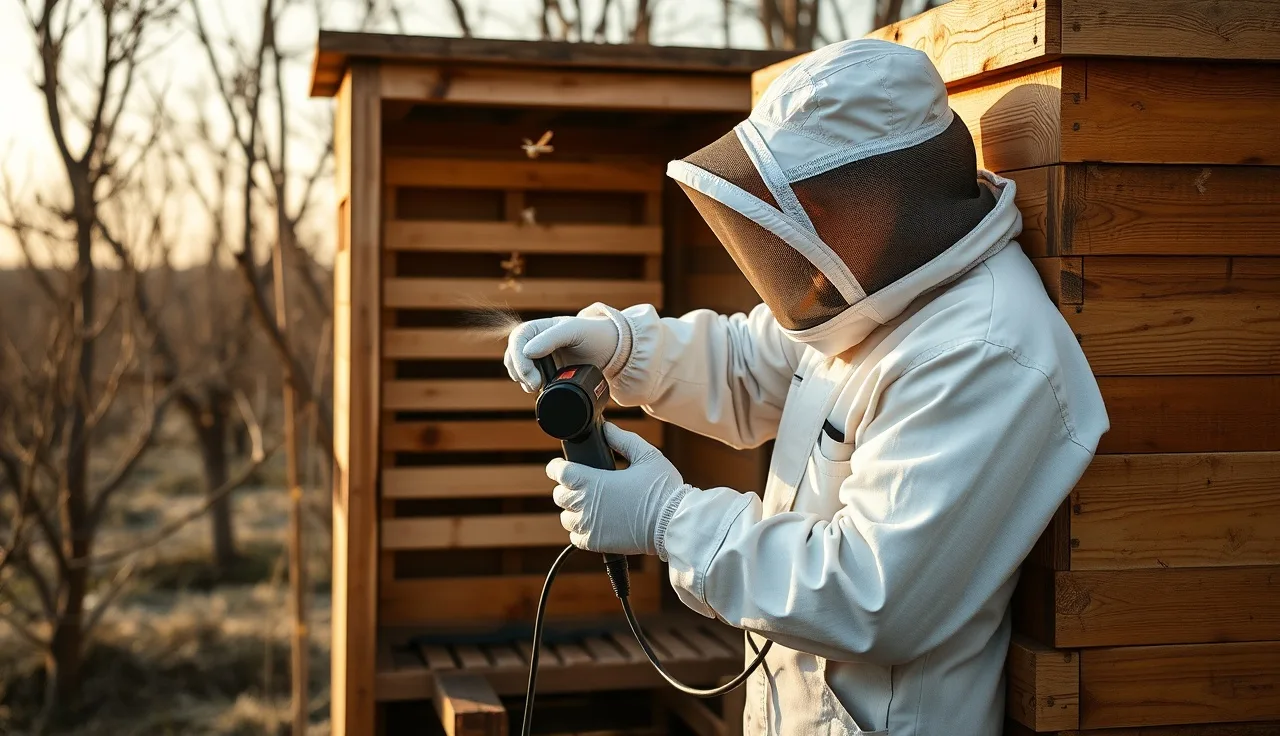
TL;DR
- Oxalic acid (OA) is an EPA-registered acid that kills phoretic varroa mites on adult bees.
- Dribble, vaporization, and extended-release glycerin strips are the three legal methods.
- A single broodless-winter dribble or vapor treatment reaches 90 to 99% mite efficacy.
- OA does not penetrate capped brood, so timing and method choice decide whether it works.
What is oxalic acid and why do beekeepers use it for varroa?
Oxalic acid (chemical formula C2H2O4) is a dicarboxylic acid that occurs naturally in rhubarb, spinach, and, at trace levels, in honey itself. Beekeepers reach for it because it kills Varroa destructor mites riding on adult bees, and at the concentrations the EPA allows it leaves no residue that changes honey quality [1].
The mite dies because oxalic acid damages its cuticle on contact. Adult bees shrug off the treatment at labeled doses. Push the concentration higher and bees start dying too, so precision matters more than most beginners expect.
The oxalic acid formula the EPA approved as Api-Bioxal is 3.2% oxalic acid dihydrate by weight, delivered in either a water-sugar solution (for dribble) or a glycerin-cellulose matrix (for extended-release strips). The vaporization method uses 1 gram of Api-Bioxal crystals per brood box. These are not interchangeable. Each application method has its own labeled dose, so read the current label before you treat [1].
Oxalic acid has been standard in European beekeeping since the 1990s. The EPA registered Api-Bioxal in the United States in 2015, and the USDA National Organic Program allows it in certified organic operations [2]. For a closer look at the pest itself, see our guide to the varroa mite.
What are the three legal methods for applying oxalic acid to honey bees?
The Api-Bioxal label describes three application methods, and that label is federal law. You cannot mix-and-match doses across them.
Dribble (trickle) method. You dissolve Api-Bioxal in a 1:1 sugar-water solution to hit the 3.2% concentration, then dribble 5 mL per seam of bees (up to 50 mL per colony, 10 seams maximum). It works best in broodless colonies because OA only touches phoretic mites. It leaves some residue on combs. The Honey Bee Health Coalition notes dribble suits winter cluster conditions, when bees can't be shaken off for vapor [3].
Vaporization (sublimation). You heat 1 gram of Api-Bioxal crystals per brood box until they sublimate into a fine aerosol that coats bees and hive surfaces. Vapor reaches bees where dribble can't. It does not penetrate capped cells. Because you can repeat every 5 days, multiple vapor rounds during a brood break catch mites as they emerge. Most research shows 2 to 3 vapor treatments spaced 5 to 7 days apart match or beat a single dribble [4].
Extended-release glycerin strips (Oxalic Acid Shop Towel method). The current Api-Bioxal label (revised by the EPA in 2023) allows an extended-release application using cellulose towels soaked in a glycerin-OA solution, placed between brood boxes. It works through the entire brood cycle (about 6 to 8 weeks of contact) and is the only OA method that reaches mites as they emerge from cells, which makes it useful when brood is present [1][5]. USDA-ARS research showed 90%+ mite reduction over a full brood cycle with this method [5].
A quick comparison:
| Method | Brood present? | Applications needed | Relative cost/hive | Key constraint |
|---|---|---|---|---|
| Dribble | No (best) | 1 | Low | Wets bees; comb residue |
| Vaporization | No (best) | 2 to 3 over 10 to 14 days | Low-medium | Requires vaporizer; PPE critical |
| Extended-release strips | Yes OK | 1 set, 6 to 8 weeks | Medium | Glycerin prep time; newer label |
For sourcing a vaporizer and other gear, the beekeeping supplies and beekeeping supply companies pages have practical options.
How effective is oxalic acid at killing varroa mites?
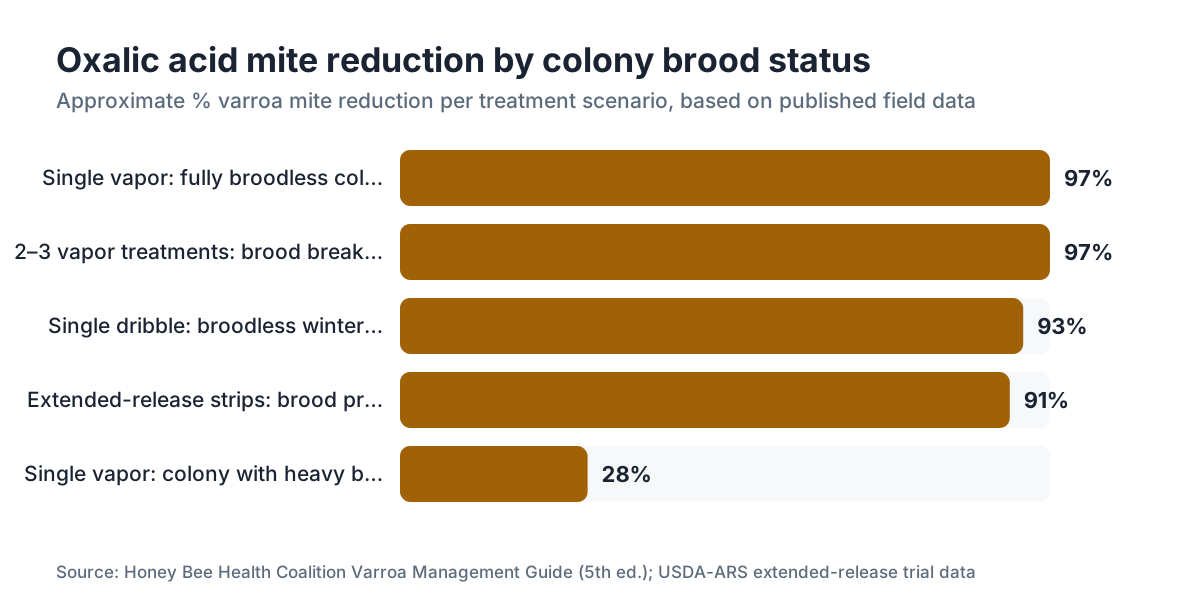
In broodless colonies, a properly applied dribble or vapor treatment reaches 90 to 99% reduction in phoretic mite loads, according to efficacy data submitted with the Api-Bioxal registration and confirmed by multiple university trials [4][6]. That number collapses when brood is present because OA cannot penetrate capped cells.
A 2017 Virginia Tech study found a single oxalic acid vapor treatment in a broodless winter colony reduced mite counts by 97.5% [4]. Three repeat vapor treatments during a natural or induced brood break approach the same ceiling.
The extended-release strip method behaves differently. It works slowly but keeps killing mites for weeks, which matters if the colony still has brood. USDA-ARS researchers reported over 90% mite reduction across a full brood cycle in field trials published in the Journal of Economic Entomology [5].
OA is not a standalone annual strategy for most operations in warmer climates. Treat in January and mite populations can explode again by July. Pair it with regular alcohol washes or sticky board counts every 30 days so you know when to act.
When is the best time to use oxalic acid on a hive?
The highest-return moment for oxalic acid is a natural winter brood break. Across most of the continental United States that window runs November through January, when the queen stops laying and every mite is phoretic (riding on adult bees, exposed to OA). Treat once during this window and you can start spring with a nearly clean colony [3].
Outside that window you have two good options. Cage the queen for 24 days to let all capped cells hatch, which exposes every mite, then treat. Or use the extended-release strip method, which doesn't need a broodless colony at all.
Never treat during a honey flow if supers holding honey for human consumption are on the hive. Dribble and vapor require supers off. The extended-release method has its own label guidance on super management, so read that section before you proceed [1].
Treat when daytime temperatures top 50°F for dribble (bees need to break cluster to spread the solution) and when it's warm enough to seal the hive for 10 to 20 minutes for vapor. Below about 40°F, vapor still works, but tightly clustered bees may not get fully coated.
How do you actually apply oxalic acid vapor (fogging honey bees with oxalic acid)?
"Fogging honey bees with oxalic acid" is common shorthand, though technically it's sublimation, not fogging. True fogging uses a carrier liquid and propellant. OA vapor heats dry crystals until they turn straight to gas, then recrystallize on hive surfaces.
Here's the step-by-step for vapor application:
- Remove honey supers. Seal all entrances and ventilation points except the main entrance where the vaporizer wand goes in.
- Weigh out exactly 1 gram of Api-Bioxal per brood box. A two-deep hive gets 2 grams. Do not eyeball this.
- Load the vaporizer pan, insert into the entrance, seal around the wand with foam or a towel.
- Power the vaporizer (electric models take about 2 to 3 minutes to fully sublimate the dose). Most beekeepers keep it in for 2.5 minutes, then leave it sealed for 10 minutes.
- Open the hive, remove the vaporizer, clear the entrance.
- Repeat every 5 to 7 days for 2 to 3 total treatments if you're targeting a brood-break window.
Safety is not optional here. Oxalic acid vapor tears at airways, eyes, and mucous membranes. The EPA label requires a NIOSH-approved respirator rated for acid gases (a dust mask does nothing), chemical splash goggles, and chemical-resistant gloves [1]. Work upwind. Do not inhale any visible vapor. The Oregon Department of Agriculture's pesticide safety page covers OA vapor risks and is worth reading before your first treatment [7].
Electric vaporizers run roughly $30 to $150 depending on brand and whether they're battery or cord-powered. Propane vaporizers exist but add burn risk. A good electric vaporizer is money well spent if you run more than 5 hives.
Formic acid vs oxalic acid for honey bees: which should you use?
This is the comparison most beekeepers eventually land on, and the honest answer is that they do different jobs.
Formic acid (the active ingredient in Mite-Away Quick Strips and Formic Pro) penetrates capped brood. Oxalic acid does not. If you have a colony in mid-summer with wall-to-wall brood and a climbing mite count, formic acid reaches mites in cells. OA can't. That's the main practical difference [3][6].
Here's how the key attributes stack up:
| Attribute | Oxalic acid | Formic acid |
|---|---|---|
| Penetrates capped brood | No | Yes |
| Works in broodless colony | Yes, very effective | Yes |
| Approved with honey supers on | No (standard methods) | MAQS: yes, with restrictions |
| Temperature sensitivity | Lower risk | High (above 85°F raises bee mortality risk) |
| Queen risk | Low at label dose | Moderate; queen loss reported at ~5 to 10% |
| Residue in honey/wax | Minimal at legal dose | Naturally present; minimal at label dose |
| Cost per treatment | Low ($1 to 3/hive for OA) | Higher ($5 to 12/hive for MAQS) |
| Application complexity | Low-medium | Low (strip placement) |
The formic acid formula in MAQS is 68.2% formic acid in a polymer matrix built for slow release. Formic Pro uses two pads at the same 68.2% concentration. Both demand temperature monitoring that OA does not.
My take: OA is the better choice for winter brood breaks and the backbone of a treatment plan. Formic acid is the right reach for mid-summer emergencies when brood is heavy and you can't or won't cage the queen. Most serious sideliners I know run OA in winter and formic or Apivar in summer, rotating to slow resistance. The Honey Bee Health Coalition's Varroa Management Guide recommends exactly this kind of rotation [3].
Does oxalic acid contaminate honey or wax?
This is a fair worry, and the research answers it well for normal use. Oxalic acid occurs naturally in honey at background levels of roughly 8 to 9 mg/kg [8]. Studies measuring residues after Api-Bioxal treatment found OA levels in honey stayed inside the natural background range and did not rise meaningfully above untreated controls when the product was used according to label directions [8].
The European Food Safety Authority set a maximum residue limit (MRL) for oxalic acid in honey at 50 mg/kg. Observed post-treatment levels in research sat far below that ceiling [8]. The EPA relied in part on this data when it registered Api-Bioxal.
Wax tells a different story. OA does deposit in beeswax, especially with dribble, but research indicates the amounts aren't a food safety problem at label rates. The practical rule beats the chemistry: never treat with harvest supers on. The label prohibits it for dribble and vapor, and that restriction earns its place.
Used correctly, oxalic acid is one of the lowest-residue varroa treatments available. That's a big reason it's allowed in organic production.
Is oxalic acid safe for bees and what are the risks of misuse?
At labeled concentrations, oxalic acid is remarkably gentle on adult honey bees. Brood is another matter. Dribble onto open brood kills larvae, because young brood is far more sensitive than adults. That's why the label tells you to apply only to the seams between frames where adult bees cluster, never onto open cells.
Overdosing is the main way beekeepers get burned. Doubling the vapor dose or cranking up the OA concentration in a dribble solution raises bee mortality. A 2020 study in PLOS ONE examined repeated vapor treatments and found colonies given 4 or more treatments in a broodless period showed measurable adult bee mortality compared to 2-to-3-treatment groups, though the colonies recovered [9]. The label's 2 to 3 treatment guidance reflects that balance.
Queen safety is generally good with OA. Unlike formic acid, oxalic acid at label rates rarely costs you a queen. Reports of queens vanishing after vapor treatment usually trace back to hive disturbance, not OA toxicity.
For the beekeeper, the risks are respiratory and skin/eye irritation. OA vapor at treatment concentrations in a sealed hive runs well above the OSHA permissible exposure limit for oxalic acid (1 mg/m3 as an 8-hour TWA) [10]. Wear the respirator. Every time. No exceptions for "just one hive."
How does oxalic acid compare to other varroa treatments (Apivar, HopGuard, Apiguard)?
OA fills a specific slot in the toolkit, and knowing where it sits next to other options helps you build a real protocol.
Apivar (amitraz) is a synthetic acaricide in strip form. It works through the entire brood cycle with no temperature restriction, which makes it the most reliable single treatment for heavily infested summer colonies. Its weakness is resistance: amitraz-resistant varroa populations have been confirmed in commercial apiaries in the US and Europe [3]. Rotate away from it periodically.
Apiguard (thymol gel) works above 60°F and penetrates brood well, though it's slower and more temperature-sensitive than formic acid. It's organic-approved.
HopGuard (hop beta acids) is newer and has thinner efficacy data than the others. The Honey Bee Health Coalition rates it lower on overall effectiveness [3].
Oxalic acid's advantages: lowest cost per treatment, strong safety margin for bees and honey, natural origin, no resistance documented to date, and it acts immediately. Its disadvantage is the brood barrier. A full protocol usually pairs OA in winter with a synthetic or formic treatment in summer.
VarroaVault's free protocol tools help you map a season-long plan using OA at its best timing windows, combined with whatever summer treatment fits your operation. Building a calendar matters more than finding the one perfect product.
What does the EPA registration for oxalic acid (Api-Bioxal) actually require?
Api-Bioxal holds EPA registration number 84922-3. The label is legally binding, and using OA in any way that deviates from it (different concentrations, different application methods, untested delivery devices) is a federal pesticide violation under FIFRA [1].
Key label requirements most beekeepers miss:
- You must use Api-Bioxal specifically, not generic oxalic acid from a hardware or grocery store. The generic product is not EPA-registered for use on bees, and using it is illegal, full stop.
- The label sets maximum treatments per year by method. Vapor: up to 3 treatments per year (spaced 5 to 7 days apart). Dribble: once per year in broodless conditions. Extended-release: one application per year.
- Supers meant for human consumption must be off during dribble and vapor.
- The label requires personal protective equipment. Requires, not recommends.
The EPA has a searchable pesticide registration database where you can pull the current Api-Bioxal label any time [1]. Label language changes. The version you downloaded two years ago may not match today's requirements. Check it every year before your winter treatment.
How do you monitor mite levels to know if your oxalic acid treatment worked?
Treatment without monitoring is guessing. An alcohol wash or sugar roll before and after treatment gives you real data on whether OA did its job.
The Honey Bee Health Coalition sets a threshold of 2% infestation (2 mites per 100 bees on an alcohol wash) as the trigger to treat across most US regions, though some researchers use a 1% threshold in late summer when the colony population is sliding into winter [3].
After a winter dribble or vapor series, run an alcohol wash 7 to 10 days after the last treatment. If you started at 5% and dropped to 0.5%, that's a win. Still at 3%? Something went wrong: brood you didn't account for, a bad dose, or a poorly sealed hive during vapor.
Sticky boards cost less but give you mite-fall counts (mites/day), not a percentage of the bee population. Handy for trending, harder to read than a wash. Most extension programs now point to alcohol wash as the primary monitoring method for its precision [6].
Keep records. Date of treatment, method, mite count before, mite count 10 days after. After two or three seasons that data tells you which hives run chronically high and whether your timing works.
Where can you buy oxalic acid (Api-Bioxal) and what does it cost?
Api-Bioxal sells through beekeeping supply companies and some farm supply stores. You won't find it in garden centers or hardware stores (and again, the non-registered generic version is not legal for bee treatment).
Pricing as of 2024 to 2025 runs roughly $15 to 25 for a 35-gram packet (enough for about 17 vapor treatments at 2g per two-box hive), and around $30 to 50 for a 300-gram container that covers a larger operation [11]. Many suppliers offer bulk pricing for sideliners.
For free-shipping and discount options from established suppliers, the free shipping honey bee supply companies page has a current list. Standard beekeeping supplies retailers like Mann Lake and Dadant carry Api-Bioxal. The beekeeping supply companies page covers a wider set of vendors.
A battery-powered electric vaporizer adds $30 to $100 to your startup cost but pays for itself fast if you're treating more than a handful of hives. Some local beekeeping clubs loan or rent vaporizers. Worth asking before you buy.
Frequently asked questions
Can I use hardware store oxalic acid on my bees instead of Api-Bioxal?
No. Only Api-Bioxal (EPA registration 84922-3) is legally registered for varroa treatment in US honey bee colonies. Using generic or industrial-grade oxalic acid on bees violates FIFRA regardless of chemical purity. It also carries unknown impurities that could harm your bees. Buy the registered product. A 35-gram packet treats roughly 17 single-box hives and costs about $15 to 25.
How many times can I treat with oxalic acid per year?
The Api-Bioxal label permits up to 3 vapor treatments per year (spaced 5 to 7 days apart in a series), 1 dribble treatment per year in broodless conditions, and 1 extended-release strip application per year. You cannot combine the annual limits freely. Each method has its own yearly maximum. Read the current label before planning your season.
Does oxalic acid kill varroa mites in capped cells?
No. Oxalic acid only kills phoretic mites riding on adult bees. It cannot penetrate capped brood cells. This is the most important limitation to understand about OA. In a colony with heavy brood, roughly 80 to 90% of mites sit protected in cells. Timing OA to a brood break, or using the extended-release method over the full brood cycle, is how you work around it.
What PPE do I actually need for oxalic acid vaporization?
The Api-Bioxal label requires a NIOSH-approved respirator rated for acid gases (minimum OV/P100 half-face), chemical splash goggles (not regular safety glasses), and chemical-resistant gloves. A standard bee suit covers skin. Do not use a dust mask. It does not filter acid vapor. Work upwind from the entrance when inserting and removing the vaporizer.
Will oxalic acid hurt my queen?
At label doses, OA carries low queen-loss risk. Unlike formic acid, which causes queen loss in roughly 5 to 10% of colonies in some studies, oxalic acid rarely kills queens directly. Any losses reported after OA treatment usually trace to hive disturbance during application. Still, hold off treating a freshly introduced queen until she has laid for at least 2 to 3 weeks.
What temperature do I need to apply oxalic acid dribble vs vapor?
For dribble, the colony needs to be in a cluster but able to move the solution through it. Most beekeepers dribble above 40°F. Below that, bees can't distribute it well. For vapor, there's no strict lower limit since you're sealing the hive, but above 50°F ensures bees spread across frames rather than sitting in a tight cluster that blocks vapor penetration.
How long after oxalic acid treatment can I add honey supers?
The Api-Bioxal label sets no mandatory waiting period between treatment and adding supers, but it prohibits treatment when supers holding honey for human consumption are already in place. Standard practice: finish your treatment series, then add supers. Since winter OA treatments happen months before honey flows, this rarely creates a conflict.
Is oxalic acid approved for organic beekeeping?
Yes. The USDA National Organic Program allows oxalic acid as a varroa treatment in certified organic operations. It must be the EPA-registered Api-Bioxal product, applied according to the label. This is one of a small number of synthetic-free options that also carry strong efficacy data, which is why it's popular among beekeepers managing colonies for organic honey certification.
What is the oxalic acid dribble formula and how do I mix it?
The Api-Bioxal dribble solution is 3.2% oxalic acid dihydrate by weight in a 1:1 (w/v) sucrose-water solution. The product comes pre-measured for this concentration. Follow the package instructions exactly. Do not mix your own formula from raw OA. Apply 5 mL per seam of bees, with a maximum of 50 mL (10 seams) per colony. One packet typically prepares about 175 mL of solution.
How soon after oxalic acid treatment should I see mite counts drop?
Mite kill from dribble or vapor is fast. OA acts by direct contact within minutes of exposure. Alcohol wash counts drop within 24 to 48 hours. Do your post-treatment wash 7 to 10 days after the final treatment in a series to give any remaining mites a few days of exposure and let dead mites clear. A successful broodless treatment typically drops infestation from above 2% to under 0.5%.
Can I use oxalic acid on a package of bees or a newly installed nuc?
Yes, and it's a good idea. A new package runs effectively broodless for the first 10 to 14 days after installation, an ideal window for a single dribble or vapor treatment. It sets the colony up with a near-zero mite load before the first brood emerges. Just confirm the queen is released and laying before you treat if you're using vapor, since the sealed hive procedure can disturb a new colony.
Why does my vapor treatment seem to not work as well in summer?
In summer, a healthy colony may keep 80 to 90% of its mites inside capped brood cells, completely protected from OA. A single vapor treatment with heavy brood present may only cut the overall mite population by 20 to 30%, not the 90%+ you'd see in a broodless colony. Summer OA vapor still knocks phoretic mites down, but for summer infestations you need a brood-penetrating option like formic acid or amitraz.
What is the difference between fogging and vaporizing oxalic acid?
Vaporization (sublimation) heats solid OA crystals to about 157°C, turning them straight to gas that recrystallizes on cool hive surfaces. True fogging uses a liquid solution propelled by air or heat. The Api-Bioxal label authorizes sublimation only, not water-based fogging with OA. Some non-registered OA foggers exist, but their use is not legal under the current US label.
How does the extended-release oxalic acid strip method work?
Extended-release OA uses cellulose shop towels soaked in a glycerin-oxalic acid solution, placed between brood boxes. Bees walk over the towels and carry OA through the colony over 6 to 8 weeks. That slow release means mites meet OA as they emerge from cells, giving the method efficacy even with brood present. USDA-ARS field trials showed over 90% mite reduction over a full brood cycle. The current Api-Bioxal label includes specific preparation and placement instructions.
Sources
- EPA, Api-Bioxal Pesticide Registration (Reg. No. 84922-3): Api-Bioxal is the only EPA-registered oxalic acid product for varroa in the US; label specifies doses, PPE requirements, and application limits
- USDA Agricultural Marketing Service, National Organic Program: USDA NOP allows oxalic acid as a varroa treatment in certified organic operations
- Honey Bee Health Coalition, Varroa Management Guide (5th ed.): HBHC recommends 2% infestation as treatment threshold; describes OA as most effective in broodless colonies; recommends rotational treatment strategies
- Rinkevich, F.D. et al., Virginia Tech / Journal of Economic Entomology, 2017: Single oxalic acid vapor treatment in broodless winter colonies reduced mite counts by 97.5% in field trials
- USDA ARS Bee Research Laboratory / Journal of Economic Entomology: Extended-release glycerin-OA strip method achieved over 90% mite reduction across a full brood cycle in USDA-ARS field trials
- Penn State Extension, Varroa Mite Management: Alcohol wash is recommended as the primary mite monitoring method for precision; OA efficacy data and treatment guidance referenced
- Oregon Department of Agriculture, Pesticide Program: State pesticide safety guidance covers oxalic acid vapor risks and required personal protective equipment
- European Food Safety Authority (EFSA), Oxalic Acid in Honey MRL assessment: EFSA set a 50 mg/kg MRL for OA in honey; natural background levels are approximately 8 to 9 mg/kg; post-treatment residues remain within natural range at label doses
- Gregorc, A. et al., PLOS ONE, 2020: Colonies receiving 4 or more OA vapor treatments in a broodless period showed measurable adult bee mortality compared to 2 to 3 treatment groups; colonies recovered
- OSHA, Occupational Chemical Data: Oxalic Acid: OSHA PEL for oxalic acid is 1 mg/m3 as an 8-hour TWA; hive vapor concentrations during treatment exceed this level
- Mann Lake Bee Supply, Api-Bioxal product listings: Api-Bioxal 35g packet retails for approximately $15 to 25; 300g container approximately $30 to 50 as of 2024 to 2025
- University of Minnesota Extension, Varroa Mite Management in Honey Bee Colonies: OA dribble and vapor are most effective in broodless colonies; extended release method extends efficacy through brood cycle; timing guidance for northern climates
Last updated 2026-07-09