Oxalic acid spray on bees: what actually works and what doesn't
TL;DR
- Spraying a 3.5% oxalic acid solution directly onto bees kills phoretic varroa on contact but does nothing to mites sealed under capped brood.
- It works best on package bees or swarms with no capped brood at all.
- For colonies with brood, dribble or vaporization gives better kill rates.
- Use an EPA-registered product and the exact label dilution.
What does oxalic acid actually do to varroa mites and bees?
Oxalic acid is an organic acid found in plants like rhubarb and spinach. As a beekeeping treatment it works on contact: touch a varroa mite's soft body with it and the acid wrecks the mite's cuticle and kills it. Bees shrug it off at the right concentration because their exoskeleton is harder and less permeable than a mite's.
The Honey Bee Health Coalition's Tools for Varroa Management guide says oxalic acid is most effective against phoretic mites, meaning mites riding on adult bees rather than mites sealed in capped brood cells [1]. That one fact explains almost every frustration beekeepers have with this treatment. If your colony has a lot of capped brood, a big chunk of the mite population is simply invisible to oxalic acid, no matter how you apply it.
At the concentrations in registered products (roughly 3.5% weight per volume in water or sugar syrup), oxalic acid does little harm to adult bees and doesn't leave worrying residues in honey. Studies measuring residues found treated honey stays within the range of natural background levels when you follow label directions [2]. It is corrosive to human mucous membranes, though, so PPE is not optional.
For a deeper look at the mite itself and its life cycle, the varroa mite overview explains why the brood-phase biology is the central problem every treatment method is trying to solve.
How does oxalic acid spray work, and when is it actually the right choice?
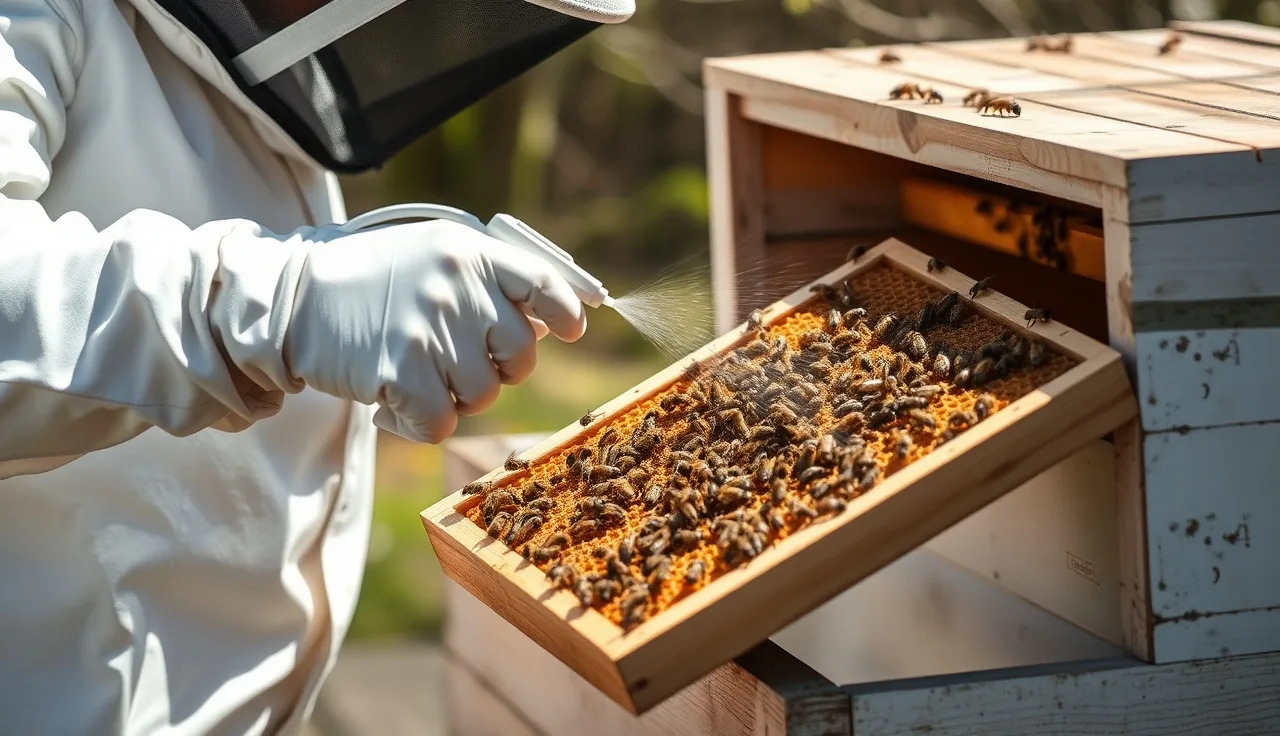
Spray means mixing an oxalic acid solution and applying it directly onto the bees, frame by frame, with a small hand sprayer or squeeze bottle. You mist the bees sitting on the comb, not the comb itself. The acid coats the bees and kills whatever mites are riding on them at that moment.
The EPA-registered label for Api-Bioxal (the most widely used oxalic acid product in the US) sets the dribble solution at 35 grams of oxalic acid dihydrate per liter of 1:1 sugar syrup. The spray method uses a different mix: 35 grams per liter of plain water, no syrup, applied at roughly 5 mL per frame side of bees [3]. Read your specific product label, because that is the legally binding document, not any third-party guide.
Spray is the right tool in three spots. Packages of bees with no drawn comb and no capped brood. Swarms just hived that haven't sealed any brood yet. And queen introductions where you want to knock down mites without hauling out other treatment gear. Outside those, I'd reach for vaporization first.
Spray is not approved for colonies with honey supers on for human consumption. Check the current Api-Bioxal label every season, because EPA registration details do change.
Getting the right equipment makes correct application easier. The beekeeping supply companies roundup covers where to source sprayers and PPE.
What is the correct mixing ratio and dose for oxalic acid spray?
The Api-Bioxal label (the only federally registered oxalic acid product in the US as of this writing) sets the spray solution at 35 g oxalic acid dihydrate dissolved in 1 liter of water [3]. That works out to about 3.5% w/v. No sugar for spray. Sugar is only for the dribble method.
Application rate is roughly 5 mL per frame side covered with bees. A standard Langstroth deep frame has two sides, so covering both means up to 10 mL per frame. Don't drench them. You want a light mist, not soaked bees. A trigger sprayer set to a fine mist beats a coarse spray every time.
Practical notes from the label and extension guidance:
- Wear nitrile gloves, eye protection, and a dust/mist respirator. Oxalic acid is corrosive to eyes and respiratory tissue [4].
- Mix fresh solution. Oxalic acid solutions degrade over time, faster in heat.
- Treat when bees are on the frames, generally above 50°F (10°C). Cold clustered bees are hard to reach evenly.
- One treatment per package or swarm is the labeled use. Repeated spray treatments on the same colony are not part of the registered protocol.
Concentration matters in both directions. Too weak and mite kill drops. Too strong and you risk bee deaths, especially in small colonies or nucs. Weigh your oxalic acid on a gram scale. Don't estimate by volume.
Can you spray liquid oxalic acid on bees vs. using the dribble method, and which works better?
Yes, you can spray liquid oxalic acid on bees, and it is an EPA-registered method. The real question is whether it beats dribbling, and for most colonies it doesn't.
Dribble (trickling solution along the seams between frames) is the older and more studied approach. Europe has used it for decades under various national registrations. Spray is valid under the US Api-Bioxal label but aimed at packages and swarms, not established colonies with ongoing brood rearing.
On contact, dribble reaches the cluster more reliably because it follows gravity down the seams where bees sit. Spray misses bees on the undersides of frames and in gaps a wand can't hit. Neither one touches mites under capped brood, and that's the hard ceiling on any contact oxalic acid treatment.
A study in Apidologie found oxalic acid efficacy against phoretic varroa ran roughly 90 to 99 percent in broodless colonies, then dropped sharply once capped brood was present [5]. That gap matters if you're treating in fall with brood still around versus midwinter when the colony is fully broodless.
For established colonies with brood, vaporization comes closest to making the brood-phase problem workable, because you can time repeat vapor treatments to catch mites as they emerge from cells. More on that next.
How does sublimation (vaporization) of oxalic acid compare to spray?
Sublimation means heating solid oxalic acid dihydrate crystals until they vaporize, then pushing that vapor through a hive entrance. The vapor condenses on surfaces and bees inside the hive and kills phoretic mites on contact. It does not reach capped brood cells, so it shares that ceiling with spray and dribble.
Where sublimation beats spray is reach and repeatability. One vaporization fills the whole hive cavity with treatment, under frames, into corners, and through a tight winter cluster where dribble might not get. And you can repeat it. The Api-Bioxal label allows up to three treatments at 5-to-7-day intervals for vaporization on colonies with brood present [3]. That schedule is built to catch mites as they emerge from cells between treatments.
The trade-offs are cost and exposure. A quality oxalic acid vaporizer runs $100 to $350 depending on type, and the human exposure risk during treatment is higher. You seal all hive openings, wait the full dwell time, and wear a proper respirator. The vapor is nastier to breathe than spray mist.
For broodless treatment, vaporization and dribble land at comparable kill rates in most studies, generally 90 percent or better [5]. For colonies with brood, the three-treatment vaporization schedule gives better season-long suppression than a single spray or dribble pass.
Short version: spray is for packages and swarms. Sublimation is for established colonies, especially those with brood.
What mite kill rate can you realistically expect from oxalic acid spray?
Your realistic kill rate hinges almost entirely on whether capped brood is present when you treat.
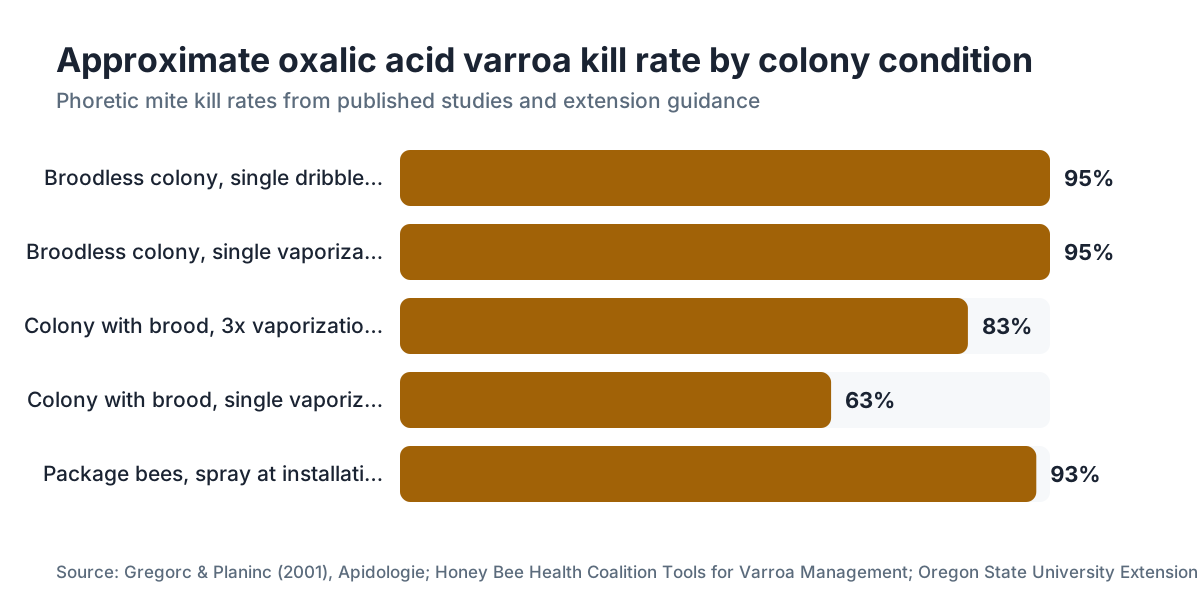
Broodless colony, single treatment: multiple studies and extension resources put efficacy at 90 to 99 percent kill of phoretic varroa [5][6]. That's genuinely good. A package or swarm treated once before any brood is capped can start life with its mite load nearly wiped out.
Colony with capped brood, single treatment: efficacy falls to somewhere around 50 to 80 percent of the total mite population, because the mites under capped cells go completely untouched. The exact number tracks how much brood is present. University of Minnesota Extension treats any application with capped brood present as a partial measure, not a standalone fix [6].
None of this makes spray useless. A 95 percent kill on a package arriving with 20 mites leaves you with about 1 mite instead of 20. That's a real head start heading into your first brood cycle. The mistake is spraying a mid-season colony packed with brood and thinking the job's done.
Always follow any treatment with an alcohol wash 3 to 4 weeks later to see your actual post-treatment mite load. The Honey Bee Health Coalition's alcohol wash protocol is the most widely used monitoring method for hobbyists [1].
| Treatment scenario | Approx. phoretic kill rate | Notes |
|---|---|---|
| Broodless colony, spray or dribble | 90-99% | Single treatment, well established [5] |
| Broodless colony, vaporization | 90-99% | Similar to dribble in most comparisons |
| Colony with brood, single vaporization | 50-75% overall | Mites in cells survive |
| Colony with brood, 3x vaporization | 75-90% overall | Interval treatments improve cumulative kill [3] |
| Package bees, spray at installation | 90-95% | No brood present, ideal scenario |
Is oxalic acid spray safe for bees, brood, and honey?
At registered concentrations and application rates, oxalic acid spray is safe for adult bees. The research is fairly consistent here: label-rate treatments don't meaningfully raise adult bee mortality and don't hurt queen laying in the days after [2].
Brood is a different story. Direct contact between concentrated oxalic acid and open brood (uncapped larvae) kills larvae. That's a big reason spray is aimed at packages and swarms, where no open brood exists yet, and why dribble goes along frame seams instead of straight onto larvae. Treating a colony with open brood means any accidental larval contact is a problem.
Honey: oxalic acid already sits in honey naturally at low levels. A residue study found oxalic acid in treated colonies stayed within the natural background range of untreated honey and didn't rise meaningfully above baseline [2]. The EPA label still bars treatment when honey supers are on, a standard precaution, but the residue concern is low next to synthetic miticides.
In humans, the vapor and mist are the real hazards. Inhalation can cause serious respiratory irritation and, with repeated exposure, lasting lung damage. A half-face respirator with organic vapor and particulate cartridges is the floor for vaporization. A dust/mist respirator covers spray and dribble. This is not negotiable.
What are the EPA rules and registration requirements for oxalic acid treatments?
In the US, oxalic acid treatments for varroa fall under FIFRA (the Federal Insecticide, Fungicide, and Rodenticide Act). You must use an EPA-registered product. Mixing your own solution from bulk hardware-store powder is technically illegal under federal law, even though plenty of beekeepers have done it for years [7].
Api-Bioxal (EPA Reg. No. 79671-3) is the primary registered product. It is labeled for dribble, spray, and vaporization on honey bee colonies. The label spells out allowable colony conditions, application rates, re-entry intervals, and restrictions on use with honey supers [3].
Some states add rules. California has required a licensed Pest Control Advisor for certain pesticide uses, though hobbyist beekeepers are often exempt under home-use provisions. Check your state department of agriculture's pesticide registration database for current requirements. The National Pesticide Information Center keeps state-level contact information [8].
Oxalic acid is listed as an acceptable material under the USDA National Organic Program when used as prescribed, which makes it one of the few varroa treatments compatible with certified organic honey production [7].
For most hobbyists and sideliners the bottom line is short: buy Api-Bioxal, follow the label, keep it in its original container, and don't mix it stronger than specified. That covers your legal and safety obligations.
When is the best time of year to use oxalic acid spray?
The best time is whenever your colony is broodless or nearly broodless, because that's when the treatment can reach the full mite population.
Across most of the northern US and Canada, that window falls late November through early January, when overwintering clusters have stopped rearing brood. A single oxalic acid treatment during this broodless stretch consistently produces the highest mite kill of any timing all year [6]. Oregon State University Extension points to the natural winter broodless period as the single most effective annual varroa treatment for hobbyist beekeepers [9].
Spring package installation is the second-best timing for spray, since packages by definition carry no capped brood. Treating packages on installation day is simple and it works.
Summer broodless windows exist if you do a walk-away split or cage your queen for brood removal, but engineering a broodless period mid-season is labor and disruption most hobbyists don't want. A better move for most people: a multi-treatment vaporization series in late summer (August through September) to knock down mites before winter bees are reared, then the single winter treatment for cleanup.
The worst timing for spray, and the most common mistake, is treating a mid-summer colony with several frames of capped brood and calling it done. You kill the phoretic mites, feel like you helped, and leave 50 to 75 percent of the mite population alive to breed through the fall.
Want a treatment calendar built around these windows? VarroaVault's free varroa protocol tools walk you through the decision points for your region and colony.
How do you actually apply oxalic acid spray step by step?
Here's a practical walkthrough for treating a package or broodless swarm with spray.
What you need: Api-Bioxal (or another registered oxalic acid product), a kitchen scale accurate to 1 gram, a 1-liter container, distilled or clean tap water, a small trigger sprayer with a fine-mist setting, nitrile gloves, eye protection, and a dust/mist respirator.
Step 1: Weigh out 35 grams of oxalic acid dihydrate crystals from your registered product.
Step 2: Dissolve the crystals fully in 1 liter of room-temperature water. The solution should run clear once dissolved. Label the container with the date and concentration.
Step 3: Put on all your PPE before opening the hive. Spray doesn't need smoke, but a light puff can help keep bees on the frames.
Step 4: Pull each frame and apply about 5 mL of solution per frame side covered with bees. Hold the sprayer 6 to 8 inches away and use a fine mist, not a stream. You want visible moisture on the bees without pooling.
Step 5: Replace frames and close up. Treatment works on contact, so there's no dwell period or entrance sealing like vaporization needs.
Step 6: Dispose of extra solution per your label. Don't pour large volumes down a drain or onto soil near water. Oxalic acid harms aquatic organisms at concentration [3].
Step 7: Check mite levels 3 to 4 weeks later with an alcohol wash to confirm it worked.
Total time to treat a package: about 10 minutes. One of the fastest varroa interventions there is.
What are the limitations of oxalic acid spray compared to other varroa treatments?
The honest limitations worth knowing:
Brood is a hard wall. No form of oxalic acid, spray, dribble, or vapor, kills mites inside capped cells. That's biology, not a formulation flaw. Mites sealed in with pupating bees are out of reach of any contact miticide. Systemic treatments like Apivar (amitraz strips) or Apistan (fluvalinate) do reach into brood cells because the active ingredient migrates through the wax. Oxalic acid doesn't [1].
Single-treatment window. Apivar works over a 6-to-8-week strip placement. A spray is a single moment in time. Miss the window, or hit it when brood is present, and you've wasted the treatment.
Resistance isn't a known issue, which is a real edge over some synthetics. As of the most recent Honey Bee Health Coalition assessment, no confirmed oxalic acid resistance has been documented in US varroa populations [1]. That matters, because fluvalinate resistance is documented in many varroa populations.
No residual action. The acid breaks down fast in the hive. Good for residue worries, but it means no protection against reinfestation from neighboring colonies. Treat a clean package, park it next to a heavily infested apiary, and mites will drift back in on foragers within weeks.
For sideliners running dozens of colonies, the per-hive time cost of spray is low, but the record-keeping to time broodless windows across many hives is real work. A summer vaporization series plus a single winter treatment is how most serious hobbyists and sideliners I know handle it. Gear matters here too. The free shipping honey bee supply companies list helps you source vaporizers and PPE without overpaying on shipping.
What PPE do you need for oxalic acid spray, and what are the health risks?
Oxalic acid is corrosive. The hazard scales with method: spray is the least dangerous, vaporization the most. Neither one gets approached carelessly.
For spray, the EPA label and OSHA guidance call for:
- Chemical-resistant gloves (nitrile at minimum, heavier gloves for repeated use)
- Chemical splash goggles or safety glasses with side shields
- A dust/mist respirator (N95 or equivalent) to avoid inhaling droplets
- Long sleeves and closed-toe shoes [4]
For vaporization, the standard jumps:
- A full-face respirator, or a half-face respirator with combined OV/P100 cartridges
- The same gloves and body coverage
- Bystanders and other people kept clear of the treatment area
The specific risks: acute eye and mucous membrane irritation, respiratory tract damage from inhaled vapor or mist, and skin irritation from prolonged contact. Serious lung damage from repeated unprotected vaporization exposure is documented in occupational settings. This is not hypothetical.
Get spray or solution in your eyes? Flush immediately with plenty of water for at least 15 minutes and get medical attention. The NPIC poison control line is 1-800-858-7378 for guidance after a significant exposure [8].
Store mixed solution away from children, pets, and food. Keep unused Api-Bioxal in its original sealed packaging per label directions, usually a cool, dry place.
Frequently asked questions
Can I spray oxalic acid directly on bees without harming them?
Yes, at the registered concentration of 3.5% (35 g oxalic acid dihydrate per liter of water) and the label rate of about 5 mL per frame side, spray does not meaningfully raise adult bee mortality. Direct contact with open brood is the real hazard, which is why spray is aimed at packages and swarms with no open larvae present.
How many times can you treat a hive with oxalic acid spray?
For spray specifically, the Api-Bioxal label authorizes one treatment per colony or package per labeled use. For vaporization, the label allows up to three treatments at 5-to-7-day intervals per application period. Repeated spray treatments on the same colony are not part of the registered protocol, which is one reason vaporization is more useful for colonies with active brood.
Does oxalic acid spray kill mites under capped brood?
No. Oxalic acid in any form, spray, dribble, or vapor, only kills varroa mites exposed on adult bees (phoretic mites). Mites sealed inside capped brood cells are fully protected. This is the fundamental limitation of all oxalic acid treatments, and the reason timing to broodless periods produces the highest kill rates.
What is the difference between oxalic acid dribble and oxalic acid spray?
Both deliver oxalic acid to bees on contact. Dribble applies solution into the seams between frames, letting gravity carry it through the cluster. Spray mists a finer solution onto exposed bees. Dribble is generally used on established colonies in winter clusters; spray is for packages and swarms. The dribble solution includes sugar syrup; the spray solution uses plain water.
Is it legal to make your own oxalic acid solution for treating bees?
Under FIFRA, applying any pesticide preparation not registered by the EPA is prohibited. Mixing bulk oxalic acid powder from hardware suppliers is not a registered use. Api-Bioxal (EPA Reg. No. 79671-3) is the registered product for this purpose in the US. The practical and legal answer is to buy the registered product and follow its label exactly.
When should I use sublimation (vaporization) instead of spray?
Use vaporization for established colonies, especially with capped brood, because you can repeat treatments at 5-to-7-day intervals to catch mites as they emerge from cells. Spray is limited to one treatment and works best with no brood present. For winter broodless colonies, spray, dribble, and vaporization all produce comparable high kill rates. Vaporization is the more versatile tool during active brood season.
Can you use oxalic acid spray when honey supers are on?
No. The Api-Bioxal label prohibits application when honey supers intended for human consumption are on the hive, regardless of method. Remove supers before treating. This is both a legal requirement under the product registration and a practical precaution, even though residue studies show oxalic acid in honey stays near natural background levels after treatment.
How soon after treating with oxalic acid spray can I inspect the hive?
For spray there is no labeled re-entry interval beyond letting the spray dry and wearing standard PPE during treatment. You can inspect the same day if needed. This differs from vaporization, which requires sealing the hive and waiting a specified dwell time before reopening. Check the current Api-Bioxal label for any updated re-entry language.
What mite level should trigger an oxalic acid spray treatment?
Most extension and Honey Bee Health Coalition guidelines recommend treating when varroa loads reach 2 percent or more of the adult bee population, measured by alcohol wash or sugar roll. That's roughly 2 mites per 100 bees. For packages or swarms you might treat preventively at installation regardless of measured load, since the broodless window is ideal and the treatment cost is low.
How do I measure whether the oxalic acid spray treatment actually worked?
Do an alcohol wash on about 300 bees (half a cup) 3 to 4 weeks after treatment. Count the mites, divide by the bee count, and multiply by 100 for your percent infestation. A successful treatment should bring a previously infested colony well below 2 percent. If mite levels are still high after a broodless treatment, look for reinfestation from neighboring hives.
Is oxalic acid spray safe for use in certified organic honey production?
Yes. Oxalic acid is listed as an allowed material under the USDA National Organic Program when used as directed. It's one of the very few varroa treatments compatible with organic certification. You still need to use the EPA-registered product (Api-Bioxal), follow the label, and document your applications for your certifier. Check with your specific certifying agency for their documentation requirements.
Can oxalic acid spray be used on nucleus colonies or splits?
It can, but only if the nuc or split is broodless or holds only a newly installed package. Most walk-away splits carry capped brood from the start, so spray efficacy is limited. Vaporization with repeat treatments is usually more practical for nucs with brood. Cage the queen until all brood hatches and you create an ideal window for a single high-efficacy spray or dribble treatment.
What temperature is too cold to spray oxalic acid on bees?
The practical floor is around 50°F (10°C). Below that, bees cluster tightly and you can't get even coverage. For winter treatments of clustered bees, dribble beats spray because you can target the cluster seams directly without needing bees spread across exposed frames. Most beekeepers use spray in warmer weather for packages and new swarms.
Sources
- Honey Bee Health Coalition, Tools for Varroa Management Guide (7th edition): Oxalic acid is most effective against phoretic mites and no confirmed oxalic acid resistance has been documented in US varroa populations
- Bogdanov, S. et al. (2002), Apidologie, 'Residues of para-dichlorobenzene and other compounds in beeswax and honey': Oxalic acid residues in honey after treatment remain within natural background range
- EPA, Api-Bioxal Product Label, Registration No. 79671-3: Api-Bioxal spray solution is 35 g oxalic acid dihydrate per liter water at 5 mL per frame side; vaporization allows up to 3 treatments at 5-7 day intervals
- EPA, Pesticide Worker Safety and PPE Guidance: Required PPE for oxalic acid spray includes chemical-resistant gloves, eye protection, and dust/mist respirator
- Gregorc, A. & Planinc, I. (2001), Apidologie, 'Acaricidal effect of oxalic acid in honeybee (Apis mellifera) colonies': Oxalic acid kill rate of phoretic varroa in broodless colonies ranges from roughly 90 to 99 percent; efficacy drops significantly with capped brood present
- University of Minnesota Extension, Varroa Mite Management: Treatment in the presence of capped brood should be considered a partial measure; broodless winter treatment produces the highest annual kill rates
- USDA National Organic Program, Allowed and Prohibited Substances: Oxalic acid is an allowed material under the National Organic Program when used as prescribed, and applying non-registered pesticide preparations is prohibited under FIFRA
- National Pesticide Information Center (NPIC), Oregon State University / EPA: NPIC poison control line 1-800-858-7378 for pesticide exposure guidance; state-level pesticide registration contacts
- Oregon State University Extension Service, Varroa Mite Control in Honey Bee Colonies: Single oxalic acid treatment during the natural winter broodless period is the single most effective annual varroa intervention for hobbyist beekeepers
- USDA Agricultural Research Service, Honey Bee Research: Background varroa mite biology and phoretic mite phase proportion in actively brood-rearing colonies
Last updated 2026-07-09