Parasitic mite varroa: what every beekeeper must know
TL;DR
- Varroa destructor is a parasitic mite that feeds on honey bee fat body tissue, breeds inside capped brood cells, and can kill an untreated colony within one to three years.
- It also carries at least seven bee viruses.
- Treatment thresholds start at 2 to 3 mites per 100 bees.
- Several EPA-registered options work, and matching them to the colony's brood cycle decides whether they succeed.
What exactly is Varroa destructor?
Varroa destructor is an external parasitic mite in the family Varroidae. It is reddish-brown, oval, and about 1.1 mm wide by 1.6 mm long, big enough that a trained eye can spot it on an adult bee without magnification, though only just [1]. The female is the only life stage you will ever see riding a bee. Males exist only inside capped cells and die there.
The mite came out of Asia, where it parasitized Apis cerana, the Asian honey bee. Apis cerana and its native mites shared a very long history, and those bees carry grooming and hygienic behaviors that hold mite numbers down. Varroa destructor, a close relative but a separate species, jumped to Apis mellifera, the European honey bee, sometime in the mid-twentieth century, most likely in East Asia. By the 1960s and 1970s it was riding shipments of bees and equipment around the planet [2]. It reached the United States in 1987 and now lives in every U.S. state except Hawaii, where some counties stay mite-free [8].
For more on the range of bee species beekeepers work with and why the host switch matters, see beekeeping species.
The name got settled in 2000. Researchers confirmed that what had been called Varroa jacobsoni attacking Apis mellifera was actually a separate species, and named it Varroa destructor [9]. The name is not subtle. It is accurate.
How does varroa actually feed and harm bees?
For decades the textbooks said Varroa fed on hemolymph, the insect version of blood. A 2019 study by Ramsey and colleagues in the Proceedings of the National Academy of Sciences turned that on its head. Varroa's preferred feeding site is the fat body, the organ bees use to store protein, break down pesticides, make vitellogenin, and run their immune system [3]. The mite opens a wound on the bee's abdomen and comes back to it again and again.
That detail matters for research. For your bee yard the outcome is the same: every mite is draining fat reserves a bee needs to overwinter, fight pathogens, and feed brood. A heavily parasitized bee emerges lighter, shorter-lived, and immune-compromised.
The viruses are what turn a serious problem into a colony killer. Varroa carries at least seven bee viruses, and Deformed Wing Virus (DWV) is the one that does the most damage [1]. DWV is close to harmless at low levels in a healthy colony. Varroa changes the math by working like a needle, pushing high concentrations of virus straight into developing pupae. You get adult bees with shriveled, useless wings, short lives, and neurological damage. As mite loads climb through summer, DWV levels in the colony rise fast, and by fall you can have a hive full of bees that cannot fly and will not survive winter. Researchers have found DWV in nearly every Varroa-infested colony they have tested [1].
Reading the biology is the first step toward calm, rational control. The mite is not magic. It is a parasite with a predictable life cycle, and that predictability is exactly what good treatments exploit.
What is the varroa life cycle inside the hive?
Varroa runs two phases. The phoretic phase is when the mite rides an adult bee. The reproductive phase is when it slips into a brood cell just before the workers cap it.
During the phoretic phase a mated female (called a foundress) clings to an adult bee, feeds on the fat body, and waits for a cue to enter a cell. That phoretic period runs roughly five to eleven days in a colony with open brood, but it stretches to weeks or months during broodless winter stretches [4]. That long broodless window is why late fall and early winter treatments hit so hard: nearly every mite is out on adult bees and fully exposed.
The foundress enters a brood cell, usually a worker cell one to two days before capping, and hides under the brood food. She favors drone brood at a rate roughly eight to ten times that of worker brood, because drone cells stay capped longer (24 days versus 12 for workers), which buys her more time to breed [4]. Once the cell is capped she feeds on the pupa and lays her first egg, which is male and unfertilized, then lays one female egg about every thirty hours. She can produce two to five daughters per cycle.
The male mite mates with his sisters inside the sealed cell. Only mated daughters survive to leave when the adult bee chews out. The foundress usually rides out with that new bee, ready to run the cycle again. Daughters that never mated die in the cell.
Here is the number that shapes everything else. In a typical colony, roughly 80 to 90 percent of Varroa mites are tucked inside capped brood at any given moment [4]. That is why alcohol washes and sugar rolls, which only sample phoretic mites, need a correction factor to estimate the real total. It is also why any treatment that cannot reach inside capped cells struggles during heavy brood seasons.
How fast does a varroa infestation grow and collapse a colony?
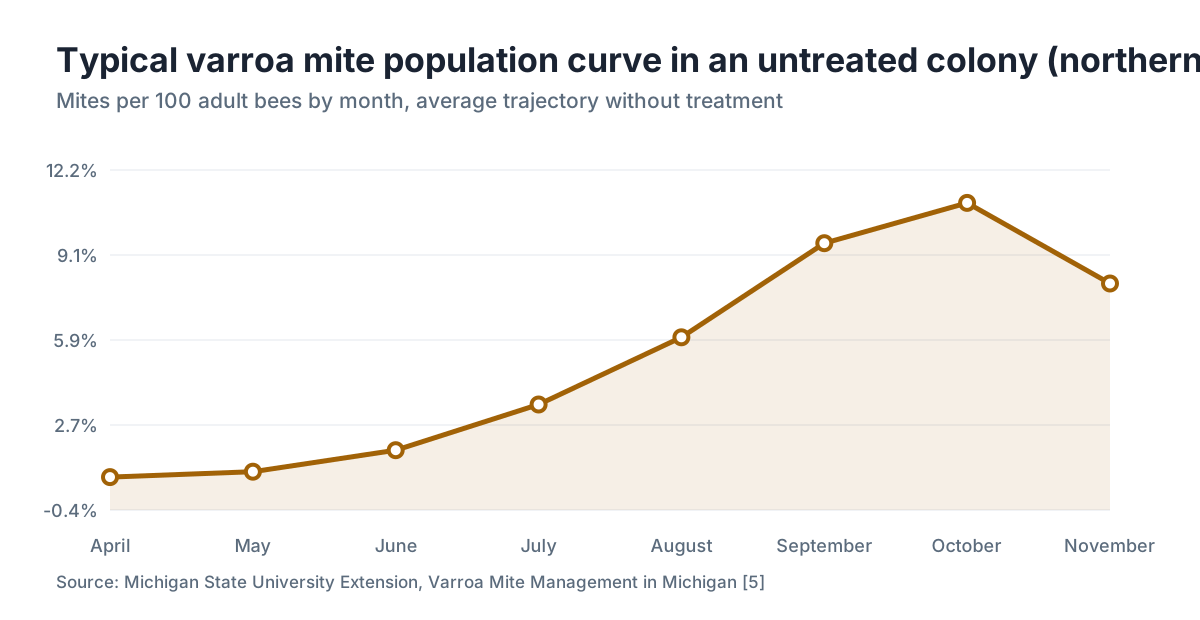
Varroa grows exponentially when nothing checks it. A colony that opens spring at 1 mite per 100 bees can hit 10 or more per 100 by August or September [5]. Doubling time is roughly one month during peak brood season, though it shifts with colony size, brood area, and climate.
The collapse follows a familiar arc. Spring and early summer stay quiet, because the bee population outpaces the mite population. Midsummer the balance flips. Foragers start dying young, and the workforce shrinks. Late summer and fall, as the colony winds down brood production, the ratio of mites to bees spikes. Winter bees, the long-lived bees that carry a colony through cold months, are raised parasitized and emerge with wrecked fat bodies. The colony either dies before winter ends or limps into spring as a tiny, sick cluster that never recovers.
Most U.S. colonies survive one to three years untreated if they started with a low mite load. Some researchers put the median near two years [5]. That window swings hard with location, nearby feral colony density, and whether the beekeeper keeps importing mites through new packages. A package from a heavily infested source can show up with a real mite load already on board.
The chart below traces an untreated mite population through a typical beekeeping year, using data from Michigan State University Extension.
If you are new to bees and weighing equipment choices, monitoring and treatment supplies cost almost nothing next to a dead colony. Beekeeping supplies is a useful place to start on gear.
How do you monitor varroa mite levels accurately?
You cannot manage what you do not measure. That sounds like a poster, but a large share of hobbyist colony deaths trace straight back to beekeepers who never sampled. Eyeballing adult bees does not cut it. Mite loads can be dangerously high while only a handful of mites show on the frame.
Two methods hold up for hobbyists: the alcohol wash and the sugar roll. Both sample about 300 adult bees (roughly half a cup) from the brood nest, ideally loaded with nurse bees. The alcohol wash is the more accurate of the two [6]. You shake the bees into rubbing alcohol (at least 70 percent), agitate hard for 60 seconds, and count the mites that rinse off through a mesh lid. The sugar roll swaps in powdered sugar and lets the bees live, but it consistently reads low, undercounting mites by 20 to 40 percent against an alcohol wash [6]. If you want your bees alive, learn the alcohol wash. Yes, you kill about 300 bees per test. That is a rounding error in a healthy colony, and the number you get back is worth it.
A sticky board (a screened bottom board with a sticky insert underneath) gives a rough read on mite fall over 24 or 72 hours. Without knowing colony size you cannot turn that into an infestation rate, and the conversion math is loose. Use it as a quick check between real washes, not as your main tool.
The Honey Bee Health Coalition recommends monitoring at least monthly during the active season, and more often when mite loads sit near threshold [6]. Their Tools for Varroa Management guide, now in its seventh edition, is the best free reference on monitoring protocols going. If you want a monitoring calendar shaped to your yard, VarroaVault's free protocol tools let you build one from your location and colony count.
How often should you test? At a bare minimum: mid-spring after the first brood buildup, midsummer (around July 4th in the northern U.S.), and late August or early September. That last test, right before the treatment window closes, is the most important one you run all year.
What is the varroa treatment threshold and when do you act?
A treatment threshold is the mite level where treating pays off, both for the colony and your wallet. For Varroa, the most-cited U.S. threshold is 2 mites per 100 bees (2 percent) during brood-rearing season, dropping to 1 mite per 100 bees (1 percent) in late summer and early fall while winter bees are being made [6].
The Honey Bee Health Coalition's Tools for Varroa Management guide states that "a threshold of 2 mites per 100 adult bees is recommended during brood-rearing months" [6]. Some state extension programs and the Beekeeper's Handbook use 3 percent as a general trigger, but the drift lately runs toward treating earlier, especially before and during winter bee production.
Here is the timing trap that catches so many people. The damage to winter bees happens in August and September, but those bees are not fully measurable until October. Wait until you see weak bees in fall and you have already lost the winter bees. Test in late July or early August, and if you are at or above 2 percent, treat now.
In a broodless winter cluster, even 1 percent can mean real trouble, because every one of those mites sits on a small, fragile adult population. Some researchers argue any detectable mites during a broodless stretch justify treatment.
One more thing about thresholds: they are guides, not laws. A colony at 1.8 percent in late August is worth treating. A colony at 2.1 percent in June during a strong buildup might earn a retest in two weeks, depending on what else is stressing it. Use your head, but lean toward treating over waiting.
What treatments are approved for varroa control in the U.S.?
Every Varroa treatment used in the U.S. has to be EPA-registered, and organic acids have to follow their registered label. Here is an honest overview of what you can buy, with real notes on how well each one works and where it falls short.
| Treatment | Active Ingredient | Efficacy (approx.) | Brood Penetration | Temperature Window | Notes |
|---|---|---|---|---|---|
| Apivar | Amitraz (strips) | 90-95% | Yes (slow) | 50-105°F | 6-8 week contact; resistance documented in some populations |
| Apistan | Tau-fluvalinate (strips) | Variable | Yes (slow) | 50-105°F | Widespread resistance in many regions; test efficacy |
| Api-Bioxal | Oxalic acid (vaporize or dribble) | 90-99% phoretic | No | Above 50°F for vapor | Best broodless; multiple rounds needed with brood present [7] |
| Mite-Away Quick Strips | Formic acid | 90-95% | Yes | 50-85°F | Temperature-sensitive; can harm queen and brood if too hot |
| Apiguard / ApiLife VAR | Thymol | 80-95% | Limited | 59-105°F | Needs ventilation; two treatments required |
| HopGuard 3 | Hop beta acids | ~50-70% | No | Broad | Lower efficacy; useful broodless or in rotation |
Oxalic acid (Api-Bioxal) is the treatment everyone is talking about, and for good reason. Applied by vaporization during a natural or induced broodless period, it reliably kills 95 to 99 percent of phoretic mites [7]. The EPA label for Api-Bioxal allows vaporization, dribble, and extended-release in sponge form. Read the label. It is the legal document, and following it protects your bees and you [7].
Amitraz (Apivar) is the most dependable option when brood is present, because the slow release means emerging mites keep bumping into it as they leave cells. Resistance to amitraz shows up in Europe and in parts of the U.S. [2]. Rotating modes of action across years is smart practice.
Formic acid (MAQS) is the one treatment that reaches inside capped brood. It works, but it needs a temperature window of 50 to 85°F. Above that, the off-gassing turns toxic to bees and queens [10]. Follow the label to the letter.
Thymol products (Apiguard, ApiLife VAR) do well above 59°F, which in much of the northern U.S. squeezes their useful window into late summer [10].
Resistance to synthetic miticides is real, not theoretical. If you run the same strip product year after year with no rotation, do a mite wash before and after to confirm it still works. A post-treatment count that drops less than 60 percent from baseline points to reduced susceptibility.
What is oxalic acid treatment and does it actually work?
Oxalic acid (OA) is a natural organic acid found in plenty of plants, including rhubarb. Against Varroa it kills on contact while the mites are in the phoretic phase, out on adult bees rather than sealed inside cells. It does not get through cappings.
Api-Bioxal is the only EPA-registered oxalic acid product for bees in the U.S. [7]. You can apply it three ways: dribble (syrup dripped over the bees between frames), vaporization (a purpose-built vaporizer sublimates OA crystals into the hive), and extended-release through sponges or glycerin-soaked shop towels, an approach that has drawn a lot of research attention for treating colonies with brood present.
For broodless treatment by vaporization, the data is excellent. A University of Florida study found greater than 95 percent reduction in mite loads from a single OA vapor treatment during broodlessness [4]. With brood present, one treatment only kills the phoretic fraction, roughly 10 to 20 percent of the total. Multiple treatments spaced 5 to 7 days apart across a full brood cycle can bring good control, but it is a lot of work.
Vaporization needs a proper vaporizer, real protective gear (the label requires a NIOSH-approved respirator rated for acid vapors), and care to seal the hive entrance during treatment. OA vapor damages human lungs. That is not safety theater. It is on the EPA label for a reason [7].
The extended-release glycerin-OA method (people call them OA sponges) has shown efficacy in brood-on colonies in university trials. As of mid-2025 this method is permitted under the Api-Bioxal label through an EPA section 3 amendment. Check the current label at the EPA before using any application method [7].
How does varroa spread between colonies and apiaries?
Varroa moves three main ways, and knowing them changes how you think about risk across a whole apiary.
Drifting and robbing lead the pack. Foragers from infested colonies wander into neighboring hives carrying phoretic mites. A heavily infested colony near yours will export mites into your boxes all season long. That is why treating in a vacuum sometimes fails: your neighbor's untreated hives, or the local feral colonies, keep reseeding your bees [5].
Swarms carry whatever the parent colony had. A high-mite swarm can look fine for months, then fall apart the next year. If you catch swarms or buy packages, test them in the first few weeks.
Beekeepers are major vectors themselves. Moving frames, splits, packages, and queens between colonies or yards hands mites around directly. Buying bees from far-off sources without testing is a common way a high-mite population lands in a new area.
Feral colonies are a mixed story. In some regions feral Apis mellifera are crashing fast from Varroa and do not hold a big reinfestation reservoir. Where feral colonies are stable (warmer climates, or pockets of genetically resistant feral bees), they can pour steady mite pressure onto managed apiaries.
For beekeepers who want more on varroa mite identification and sampling, that companion article goes deeper into field methods.
Are there varroa-resistant bees, and do they actually work?
Yes, and the research has grown more hopeful over the last decade, with a few honest catches.
The best-studied resistance traits are Varroa-sensitive hygiene (VSH) and suppressed mite reproduction (SMR). VSH bees detect and pull mite-infested pupae out of capped cells, cutting the mite's breeding success. SMR describes colonies where a high share of foundress mites fail to make viable offspring, for reasons that include but reach beyond hygienic removal. Some researchers now use "low Varroa reproduction" (LVR) as a wider label [2].
The USDA Honey Bee Breeding, Genetics, and Physiology Laboratory in Baton Rouge has bred and distributes VSH breeder queens. Russian honey bees, originally from Primorsky Krai in Russia where Apis mellifera had a longer run with Varroa, also show raised resistance behaviors. VSH and Russian queens are real, and you can buy them.
Here is the catch. Resistance traits in a managed yard need ongoing selection pressure to hold. Drop resistant queens into a population that drifts heavily or mates with local drones, and the trait dilutes out within a few generations. For hobbyists in mixed beekeeping areas, resistant stock lowers mite pressure but rarely ends the need to monitor. Several studies and beekeeper groups (the Elgon and COLOSS projects in Europe among them) document colonies surviving years without treatment, but those are selected populations under controlled breeding.
The practical read: buying VSH or low-mite-reproduction queens from a reputable breeder is a sound long-term move. It probably will not free you from monitoring in the short term, but it tilts the baseline your way.
What does a year-round varroa management protocol actually look like?
No single protocol works everywhere. Climate, management style (single box versus multi-box, production focus, local flora), and local mite pressure all move the right answer. Here is a reasonable template for northern U.S. beekeepers (USDA Hardiness Zones 4 to 6).
Early spring (March-April): Test as soon as you have steady brood. If the colony overwintered carrying mites, deal with it. OA dribble or vapor works if the colony is still small and brood is thin.
Late spring (May-June): Test again once the colony hits full expansion. Below 2 percent, monitor monthly. Above 2 percent, consider amitraz or formic acid, especially with drone brood coming in.
Midsummer (July): This is the fork in the road. Test around July 4th. At or above 2 percent means treat before August. Below 2 percent means test again in three to four weeks.
Late summer (August-September): Protect winter bee production. This is the most important treatment window of the year. At or above 1 to 2 percent, treat. Extended-release amitraz strips or multiple OA vapor treatments (in a nucleus-style artificial broodless period if you can pull it off) both work. Formic acid works if the temperatures cooperate.
Fall (October-November): Once the colony is broodless or nearly so, OA vapor or dribble is very effective and cheap. Treat this as cleanup, knocking down any mites that rode out the summer.
Winter (December-February): In a broodless cluster, a single OA treatment is effective and reasonable if you skipped late fall. Inside-cluster temperature needs to run above roughly 40°F so the bees cluster loosely enough for the treatment to reach them.
VarroaVault's free protocol builder maps this kind of seasonal plan to your region and colony count, which keeps a monitoring window from slipping through the cracks during a busy season.
For hive setup and equipment that makes monitoring and treatment access easier, see beekeeping supplies.
What do hobbyist beekeepers most often get wrong about varroa?
The list is shorter than you would think, because most mistakes are a few patterns repeating.
Skipping monitoring between treatments is the big one. Beekeepers treat in fall, feel good, and do not test again until the next fall. By then summer mite buildup has already gutted the winter bees, and the colony is in trouble. Monitoring monthly, or at minimum every six weeks from April through September, is not overkill. It is the floor for catching problems before they cascade.
Treating too late in fall is the close cousin. August is the window for protecting winter bees, not October. An October treatment can still help, but the damage done to winter bees raised in August and September, while mite loads ran high, is already baked in.
Running one product forever with no rotation builds resistance pressure. If you have used Apivar strips five years straight, run an efficacy check. Amitraz resistance is documented and growing in some U.S. populations [2]. Rotating to OA vapor for a season, or reaching for formic acid when conditions allow, is sound management.
Ignoring reinfestation from nearby hives is a strategic miss. You can treat flawlessly and still find high counts three weeks later if your bees are robbing out a heavily infested neighbor. Cutting down robbing, keeping entrance reducers in during dearth, and talking to nearby beekeepers all matter.
Last, misreading the problem. Not every dying colony is a Varroa crash. Queenlessness, pesticide hits, American foulbrood, and poor nutrition all drive decline too. Test your mite loads before you blame Varroa, and ask whether something else is piling on.
Frequently asked questions
How long does varroa take to kill a colony?
An untreated colony with an average starting mite load usually declines and dies within one to three years, with a median near two years in northern U.S. climates. The timeline hinges on local mite pressure, reinfestation from other hives, and the colony's genetic resistance. Colonies often look healthy deep into year two before collapsing fast in late summer or fall.
Can you see varroa mites without a microscope?
Yes. Adult female Varroa mites are about 1.1 mm wide and reddish-brown, and you can spot them on adult bees with careful naked-eye inspection, especially on light-colored abdomens. But visual inspection is not a reliable monitoring method. Loads can run dangerously high (above 5 percent) while only a few mites show on the bees you look at. Use an alcohol wash for real counts.
What is the difference between Varroa destructor and Varroa jacobsoni?
Both are mite species in the genus Varroa that parasitize bees. Varroa jacobsoni parasitizes Apis cerana in Southeast Asia and poses little threat to Apis mellifera. Varroa destructor is the species behind global bee losses; it also started as an Apis cerana parasite but adapted to Apis mellifera in the mid-twentieth century. The two were formally separated in 2000 by Anderson and Trueman.
Does powdered sugar really remove varroa mites?
No. Rolling bees in powdered sugar does not meaningfully reduce mite loads. Early studies suggested it might trigger grooming, but controlled trials found no statistically significant drop in infestation rates. The sugar roll, where powdered sugar shakes mites off bees for counting, is a monitoring tool, not a treatment. Powdered sugar dusting as mite control is not supported by current evidence.
Can varroa mites infest other species of bees besides honey bees?
Varroa destructor is essentially specific to Apis mellifera and Apis cerana. It does not reproduce on bumble bees, mason bees, or other native bees, though mites turn up occasionally on non-Apis species that enter hives. Varroa jacobsoni parasitizes some other Apis species in Southeast Asia. For practical purposes, Varroa is a managed honey bee problem, not a general pollinator threat.
Is oxalic acid safe for honey bee brood?
Oxalic acid applied by vaporization or dribble can harm open larvae at elevated doses. The Api-Bioxal label advises against dribble treatment when brood is present because of larval mortality risk. Vaporization involves less brood contact but still works best and safest during broodless periods. Extended-release OA preparations show lower brood toxicity in research settings. Always follow the current EPA-registered label.
How do I know if my varroa treatment worked?
Do a mite wash 48 to 72 hours after a short-contact treatment (like OA dribble or formic acid), or two to three weeks after removing strips. Compare the post-treatment count to your pre-treatment baseline. A good treatment should cut phoretic mites by at least 90 percent. If your counts fall less than 60 percent, suspect product resistance or a reinfestation event and dig into it before retreating with the same product.
At what temperature can you apply oxalic acid vaporization?
The Api-Bioxal label and most practitioners point to vaporization working when outside temperatures run above roughly 40 to 45°F, so bees cluster loosely and vapor can reach them. Colder is not necessarily harmful to bees, but the cluster tightens and vapor contact drops. In warm climates with year-round brood, OA vapor works less well because only phoretic mites die.
Why do varroa mites prefer drone brood?
Drone brood cells stay capped about 24 days, versus 12 days for worker brood. The longer capping period gives a foundress more time to finish her reproductive cycle and raise more viable daughters. Research also suggests mites key in on the pheromone profile of pre-capped drone larvae. Beekeepers sometimes remove drone brood as a supplemental mite control, though it does not replace chemical treatment.
What viruses does varroa transmit to honey bees?
Varroa carries at least seven bee viruses. Deformed Wing Virus (DWV) is the most damaging and shows up in nearly every infested colony. Others include Acute Bee Paralysis Virus, Sacbrood Virus, Black Queen Cell Virus, Varroa destructor virus-1, and Israeli Acute Paralysis Virus. The mite injects high-titer virus straight into developing pupae, which does far more harm than simple surface contact transmission.
Can varroa mites survive without bees?
No. Varroa mites are obligate parasites; they cannot complete their life cycle or survive long without a honey bee host. Off the bee, phoretic mites die within one to several days depending on temperature and humidity. You cannot clear an infestation by leaving equipment empty. Treatment means hitting the mites while they are attached to the bees or in the brood.
Should I treat a new package of bees for varroa right away?
Not necessarily right away, but test early. Packages from reputable suppliers often carry low mite loads, but some arrive above threshold, especially late in the season. Do a baseline alcohol wash two to four weeks after installing the package, once brood is present so you have nurse bees in the sample. Above 2 percent, treat. Below, monitor monthly through summer.
What is brood interruption and how does it help with varroa?
Brood interruption means creating a stretch with no capped brood, either naturally (winter) or artificially (caging the queen for 21 to 24 days). With no capped cells, every mite is forced into the phoretic phase and becomes fully vulnerable to treatments like oxalic acid that cannot reach through cappings. Studies show OA vaporization during broodlessness hits 95 to 99 percent efficacy versus 40 to 60 percent in a colony with full brood.
Are there any varroa treatments I can make at home legally?
In the U.S., anything applied to bee colonies has to meet EPA registration requirements. Api-Bioxal (oxalic acid dihydrate 5.7 percent) is the only EPA-registered OA product for bees, and using raw oxalic acid crystals not registered as Api-Bioxal is technically an off-label application. Some state agriculture departments have issued emergency exemptions in the past. Thymol home preparations are similarly not EPA-registered. Using registered products as labeled is the legally defensible and practically smart path.
Sources
- Honey Bee Health Coalition, Tools for Varroa Management Guide (7th edition): Varroa vectors at least seven bee viruses including Deformed Wing Virus, found in virtually every Varroa-infested colony; mite is 1.1 mm wide and visible to the naked eye
- USDA Agricultural Research Service, Honey Bee Research: Varroa destructor spread globally through movement of bees and equipment; amitraz resistance documented in European and some U.S. populations; VSH and SMR resistance traits under study
- Ramsey et al. (2019), PNAS, 'Varroa destructor feeds primarily on honey bee fat body tissue and not hemolymph': Varroa's preferred feeding site is the honey bee fat body, not hemolymph, as confirmed by histological analysis and isotope tracing
- University of Florida IFAS Extension, Honey Bee Varroa Mite page: Phoretic period lasts 5-11 days with brood present; drone cells capped 24 days vs 12 for workers; OA vapor achieves over 95% mite reduction during broodlessness; 80-90% of mites are in capped brood at any given time
- Michigan State University Extension, Varroa Mite Management in Michigan: Untreated colonies survive 1-3 years; mite population can reach 10 per 100 bees by August-September from 1 per 100 in spring; reinfestation from neighboring colonies is a major source of high mite counts
- Honey Bee Health Coalition, Tools for Varroa Management Guide, Monitoring Protocols: Alcohol wash is more accurate than sugar roll; sugar roll underestimates by 20-40%; treatment threshold of 2 mites per 100 adult bees during brood-rearing months is the Honey Bee Health Coalition recommendation
- EPA, Api-Bioxal Oxalic Acid Registration and Label: Api-Bioxal is the only EPA-registered oxalic acid product for use in honey bee colonies; label requires NIOSH-approved acid vapor respirator during vaporization; permits dribble, vaporization, and extended-release sponge application methods
- Penn State Extension, Varroa Mites: A Serious Threat to Honey Bees: Varroa destructor reached the United States in 1987 and is now present in every state except Hawaii counties that remain mite-free
- Cornell University Department of Entomology, Bee Lab Resources: Varroa jacobsoni and Varroa destructor were formally separated as distinct species in 2000 by Anderson and Trueman based on genetic analysis
- North Carolina State University Apiculture Program, Varroa Management: Formic acid (MAQS) effective temperature window is 50-85°F; thymol products require above 59°F; drone brood removal is a supplemental management tool but does not replace chemical treatment
- Virginia Cooperative Extension, Varroa Mite Control in Honey Bee Colonies: Brood interruption by queen caging for 21-24 days forces all mites to phoretic phase, enabling near-complete kill with OA vapor treatment
Last updated 2026-07-09