Why a post-Apivar oxalic acid mop-up treatment actually matters
TL;DR
- Apivar (amitraz strips) kills mites on adult bees but cannot reach capped brood.
- After that last round of brood emerges post-strip-removal, the surviving mites are all riding on adult bees.
- One oxalic acid treatment in that brood-free window cuts your remaining mite load by 90% or more, and it protects the winter bees your colony depends on to reach spring.
What is a post-Apivar OA mop-up and why do beekeepers do it?
A post-Apivar OA mop-up is a single oxalic acid treatment applied after your Apivar strips come out and the colony has gone brood-free. It kills the mites that hid inside capped brood during the whole Apivar course. In a brood-free colony, oxalic acid kills over 90% of the mites present.
Apivar strips contain amitraz, a contact acaricide. They release amitraz steadily over a 6-to-8-week window, and bees walking across the strips carry the active ingredient through the colony. Mites on adult bees die. The trouble is what happens behind the wax cappings.
Amitraz does not penetrate cappings at any useful concentration. Mites reproducing inside sealed brood are shielded for their whole reproductive cycle, which runs about 11 to 12 days per capped worker cell [1]. Over an 8-week treatment, multiple mite generations cycle through capped cells. Some die when they emerge onto adults. Some slip through, especially if strip placement or hive layout was imperfect.
The mop-up idea is plain. You wait until the colony has no capped brood, which happens naturally after you pull the strips and the queen's last laid brood emerges (or sooner if you caged the queen). Once every bee has emerged, every surviving mite is phoretic. It's riding on an adult bee, fully exposed to whatever you apply. That's the exact moment oxalic acid is brutal.
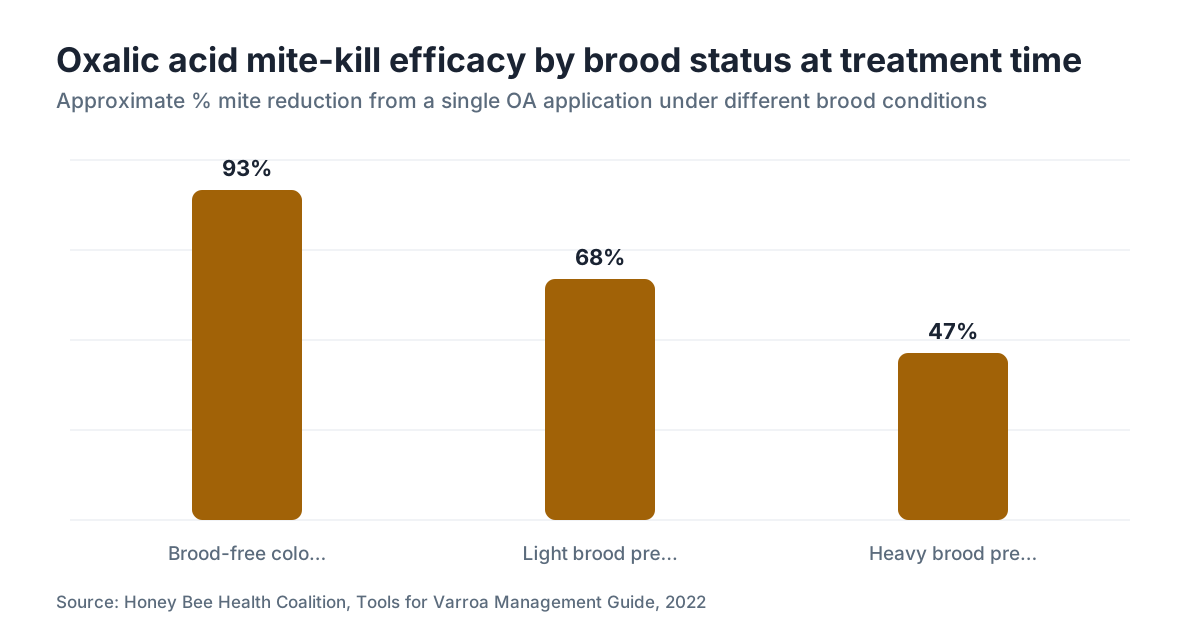
Oxalic acid, dribbled or vaporized, kills phoretic mites at rates usually cited above 90% in brood-free colonies [2]. Apply it with brood present and efficacy falls to 50% or lower, because the brood-dwelling mites never get touched. Timing is the whole game.
What mites survive a full Apivar treatment?
The survivors are mostly the ones that spent the entire treatment inside capped brood, plus any mites carrying genetic resistance to amitraz. A properly run 6-to-8-week Apivar course reduces mite loads by 90 to 95% from the starting count [3]. That sounds thorough. The math turns ugly when you start high.
Say your colony has 3,000 mites when the strips go in. At 93% efficacy, 210 mites are still alive. That leftover population is not scattered randomly. It's concentrated in the mites that rode out the treatment inside sealed cells, plus any survivors from a population that carries amitraz resistance, which is a real and growing problem in some regions [4].
The Honey Bee Health Coalition's Varroa management guide notes that amitraz resistance has been documented in the United States and recommends rotating treatment chemistry across seasons for exactly this reason [2]. Oxalic acid works by a different mechanism (direct contact toxicity to the mite), so it doesn't share amitraz's resistance liability. It kills amitraz-resistant mites as well as it kills susceptible ones.
So the mop-up does two jobs at once. It clears the remnant that hid in brood, and it puts a second mode of action against any resistant survivors.
How long after removing Apivar strips does the colony become brood-free?
Plan for 21 to 28 days after strip removal, then confirm brood-free status by opening the hive before you treat. There's no fixed number of days, and that's what trips up most beekeepers.
After you pull the strips, the queen keeps laying. Any egg laid that day takes 21 days to emerge as an adult (3 days egg, 6 days open larva, 12 days capped). But queens don't quit laying the moment strips come out. What you're really watching for is the last capped brood to emerge, which happens 12 days after the last cell was capped, and cells can be capped up to 9 days after the egg was laid.
Most beekeepers target 21 to 28 days post-strip-removal, then confirm with a direct inspection before applying OA [2]. Don't estimate. Open the hive and look. See any capped brood at all? Wait another week.
Some beekeepers speed this up by caging the queen for two weeks during the Apivar treatment, forcing a brood break so the colony goes brood-free while the strips are still working. That's more efficient, but it means handling the queen and carries its own tradeoffs. If you cage, you can often apply the OA dribble or vapor before the strips even come out, which maximizes total mite kill.
Standard no-cage protocol: pull strips, wait 21 to 28 days, confirm brood-free, apply oxalic acid.
What oxalic acid application method works best for a mop-up?
For a brood-free mop-up, dribble and vaporization both work, and both hit 90 to 97% mite kill [2]. Pick based on your setup, not on any efficacy gap. You have three registered options in the US: dribble (trickle), vaporization (sublimation), and extended-release glycerin-soaked shop towels under the Api-Bioxal label [5].
The registered dribble rate under the Api-Bioxal label is 50 mL of a 3.5% oxalic acid solution per 10-frame colony (roughly 5 mL per occupied seam of bees), applied once [5]. Vaporization uses 1 gram of oxalic acid crystals per brood box, applied as vapor with a sublimator.
Vaporization is faster per hive at scale and doesn't require opening the colony, which matters in cold weather. Dribble is cheaper to start (no vaporizer needed) and it's usually the practical pick for hobbyists treating a handful of hives.
The extended-release shop-towel method works differently. It gives slow ongoing release and is built to treat brood-present colonies over weeks. That's the opposite of a mop-up. Use dribble or vapor for targeted post-Apivar work.
Temperature matters for vaporization. The EPA-registered Api-Bioxal label specifies treatment when temperatures are above 50°F (10°C) [5]. Dribble handles slightly cooler days as long as the bees are clustered on combs where you can reach them.
You can find approved equipment at beekeeping supply companies or check whether any offer free shipping honey bee supply companies to cut startup costs.
How many OA treatments do you need for the mop-up?
One. That's the entire reason you wait for a brood-free window. Every mite is exposed, so a single well-timed application does the job.
The Api-Bioxal label allows one treatment per method per brood-free period, and in a truly brood-free colony, repeating within days adds no meaningful kill, because there's nothing left to hit after the first pass [5]. The common mistake is repeat applications without a brood-free window. Beekeepers vaporize three or four times with brood present and then wonder why the mites keep coming. The brood shield is the limiting factor, not the number of passes.
If your post-treatment mite wash still reads above 2% after the mop-up, one of two things happened. Either the colony wasn't fully brood-free when you treated, or you have a serious re-infestation event (mite drift or robbing from a collapsing neighbor). Both call for a different response, not more OA.
What mite count threshold should you see after the mop-up?
Aim for 1% or below after a well-timed mop-up. Test before and test after. The point is to drive mites under the level where they do measurable harm heading into the next season.
The Honey Bee Health Coalition recommends an action threshold of 2% mite infestation (roughly 2 mites per 100 bees in an alcohol wash or sugar roll) for most temperate-region colonies in late summer and early fall [2]. Some researchers and extension programs push for a stricter 1% before the winter bee population sets, because the long-lived winter bees reared in August and September carry the colony to spring, and heavy mite loads during their development wreck fat-body function [6].
Here's a clean number to remember: a single oxalic acid treatment in a brood-free colony kills over 90% of the mites present, while the same treatment with heavy brood present kills under 50% [2]. If your pre-mop-up count was 50 mites per 100 bees (5%) and you treated a brood-free colony with OA vapor, expect roughly 0.5 to 1 mite per 100 bees in a wash 72 hours later. Seeing 2% or more after the mop-up? Recount and check the brood.
For tracking these numbers across many hives over time, the free protocol templates at VarroaVault help you spot patterns a single count misses, which is handy if you're running 10 to 50 colonies.
When in the year does the mop-up strategy make the most sense?
Late summer into fall is where the mop-up earns its keep. Apivar strips commonly go in after the main honey flow to knock mites down before the colony rears its winter bees. In much of the northern US and Canada, strips go in around mid-August, come out 6 to 8 weeks later in late September or early October, and the OA mop-up lands in late October once the last brood has cleared.
That timing rides the colony's own biology. By late October in most temperate climates, colonies are often brood-free or close to it anyway, since egg-laying slows with shorter days and cooling temperatures. You're using the natural seasonal brood break as your treatment window.
Spring is a weaker target for this specific protocol. Colonies build brood hard in spring, and getting a brood-free window means caging the queen or waiting on a swarm-related pause.
In warm climates (Florida, Texas, coastal California), colonies may never go brood-free on their own. There the mop-up usually needs a deliberate brood break via queen caging, or you fall back on extended-release OA methods knowing efficacy will be lower.
Does a mop-up OA treatment harm bees or queens?
Applied at registered rates, oxalic acid has very low toxicity to adult bees and queens. Research generally shows no significant rise in adult bee mortality when OA is applied per label at recommended concentrations and volumes [7].
The main dribble risk is over-application. Too much liquid per seam chills bees and causes losses that have nothing to do with the OA. Follow the label: 5 mL per occupied seam, up to 50 mL total for a 10-frame colony. Don't eyeball it. Use a syringe or a calibrated applicator.
Vaporization safety is more about you than the bees. OA vapor is corrosive to human airways and eyes. Wear the respirator and eye protection the Api-Bioxal label specifies, seal the hive, and never inhale the vapor [5]. The bees seal the entrance themselves fast, and the vapor clears inside the hive within minutes.
Queens are the recurring worry. There's some anecdotal concern about queen loss after OA dribble, especially during peak laying, but controlled studies haven't consistently shown elevated queen loss at label rates [7]. The risk looks higher when colonies are stressed or when OA goes on in very cold weather and bees can't move freely. Treat on a mild day, above 45 to 50°F, and confirm the queen a week later.
Can you combine the mop-up with other treatments or do it stand-alone?
The OA mop-up is a stand-alone event. You've already run a full Apivar course. Piling on another synthetic acaricide at the same time adds chemical load without proportional benefit when the mop-up is timed right.
What some beekeepers run instead is a split protocol: Apivar in late summer as the primary treatment, an OA mop-up in October, then a mid-winter OA dribble or vaporization if the colony goes brood-free again in the cold months. This triple-window approach is aggressive but sensible in high-pressure mite regions. It keeps total synthetic acaricide use low while stacking up brood-free exposure chances.
Don't apply Apivar and OA at the same time. There's no registered combination protocol, and there's no good reason to try. Apivar already delivers high phoretic mite kill while the strips are in. The OA mop-up is built for after the strips come out and the brood is clear.
Formic acid (as MAQS or Formic Pro) is sometimes used as a brood-penetrating option that works with brood present, but that's a different strategy with its own temperature and queen-safety limits. For the classic post-Apivar mop-up, OA is the right tool.
What does the research actually say about this two-step strategy?
Honest answer: there's more field experience than controlled trial data on the exact Apivar-then-OA sequence. The component efficacy numbers are solid on their own, but randomized controlled trials comparing Apivar alone against Apivar plus OA mop-up across many colony-years aren't common in the published literature as of 2024.
What we do have is strong mechanistic support. A 2020 paper in PLOS ONE found that mite populations in residual brood at the end of a standard treatment period were the main source of within-colony re-infestation, more than mite drift from neighbors [8]. That directly supports clearing the residual population with a brood-free OA hit.
The Honey Bee Health Coalition's Varroa management guide (updated 2022) explicitly recommends an OA treatment timed to a brood-free period as a complement to any treatment that lacks brood penetration, which includes Apivar [2]. That guidance rests on a synthesis of available research and practitioner experience, not one single trial.
University extension programs, including Penn State Extension and the University of Minnesota Bee Lab, recommend the two-step approach in their seasonal management guidance [6][9].
Nobody has large randomized-trial data on colony survival across three winters comparing the two strategies head to head. The closest evidence is the mechanistic studies plus strong consensus among professional apiarists and extension researchers. Given the low cost and low risk of one well-timed OA treatment, the precautionary logic is strong even without a perfect trial.
For more on varroa biology, the varroa mite overview covers the reproductive cycle that makes this brood-free timing matter so much.
What are the most common mistakes beekeepers make with this protocol?
Treating too early is the most expensive mistake. Apply OA while even one frame of capped brood remains and you leave potentially thousands of mites untouched inside cells. They emerge within a week and re-infest the colony. Your wash looks great on day two, then creeps back up by day ten.
Not testing at all is the second most common failure. Beekeepers run the full Apivar course, do the OA mop-up, and assume it worked. If the mop-up was mistimed or the colony had undetected re-infestation, those colonies go into winter carrying loads that kill them by February. Test. Run an alcohol wash or sticky board count two to three days after the mop-up while mite mortality is still readable.
Using the wrong OA method is a quieter mistake. Extended-release glycerin pads aren't wrong exactly, but they're built for slow ongoing treatment with brood present, not a sharp one-time hit in a brood-free colony. Dribble or vapor gives a faster, more complete knockdown.
Ignoring re-infestation risk undoes everything. Even a perfect mop-up doesn't help if a collapsing neighbor colony sends mite-laden robbers into your hive two weeks later. Watch for robbing in fall, use entrance reducers, and test again 30 days post-mop-up in high-density beekeeping areas.
Frequently asked questions
Can I do the OA mop-up while Apivar strips are still in the hive?
Technically yes, but it defeats the purpose. The value of OA in a mop-up is hitting a brood-free colony after the strips come out. Applying it while strips are in and brood is present drops efficacy hard, because capped mites stay untouched. The one exception: if you deliberately caged your queen to force a brood break during the Apivar course, applying OA toward the end of that break makes sense.
How do I confirm my colony is brood-free before treating?
Open the hive and inspect every comb. Look for capped brood cells, which are tan to dark brown with a slightly convex surface. Open brood (eggs and larvae) is fine, since it will cap, but capped brood means wait. The inspection takes 10 to 15 minutes. Don't skip it. Natural brood breaks are hard to predict from the outside, so eyes on the frames is the only reliable confirmation.
What temperature is too cold for an OA mop-up treatment?
The Api-Bioxal label sets a floor of 50°F (10°C) for vaporization. For dribble, the concern below about 45°F is that chilling bees with cold liquid causes harm unrelated to the OA. A mild fall day, ideally 50 to 65°F, is the sweet spot for either method. Bees should be loosely clustered but still moving on combs. If they're tightly balled, dribble efficacy drops because you can't reach all the seams.
Does oxalic acid leave residues in honey or wax?
Oxalic acid occurs naturally in honey and beeswax. Research has not shown that OA treatment at label rates raises hive residues above natural background levels in honey to a meaningful degree. The Api-Bioxal label requires that treatment not be applied to colonies with honey supers in place intended for human consumption [5]. Remove supers before treating. Wax residue studies to date show no significant accumulation above naturally occurring oxalic acid levels in untreated wax.
How soon after the OA mop-up can I check whether it worked?
Run an alcohol wash 48 to 72 hours after treatment. Dead mites also drop onto a sticky board in the 24 to 72 hour window after OA vaporization, so a sticky board count right after treatment gives you a rough sense of scale even though the percentage still needs a bee sample. A wash three days out is your most accurate read. Aim for below 1% infestation heading into winter.
Can I use a generic oxalic acid product instead of Api-Bioxal?
No, not legally in the United States. Api-Bioxal is the only EPA-registered oxalic acid product approved for use in honey bee colonies in the US as of 2024 [5]. Using generic oxalic acid in a hive violates federal pesticide law under FIFRA whether or not the chemistry is identical. Some states add further restrictions. Buy registered Api-Bioxal and follow the label, which is the law [10].
Will mites develop resistance to oxalic acid the way they have with amitraz?
No documented resistance to oxalic acid has been observed in Varroa destructor as of 2024. The mechanism (contact toxicity to the mite) differs from amitraz, and resistance would require a very different set of genetic adaptations. This is one practical argument for using OA as a complement to synthetic treatments instead of leaning on a single mode of action year after year. Rotating and combining modes of action is standard resistance management.
Does the post-Apivar mop-up strategy work for nucs and splits?
Yes, and it can be easier with smaller units. A fresh split or nuc that hasn't had brood capped from the new queen is essentially brood-free for a window of roughly 9 to 12 days. That's a natural OA opportunity. For established nucs treated with Apivar, the same wait-for-brood-clear logic applies, just scaled to a smaller box. Adjust dribble volume to the actual number of occupied seams, not the maximum colony rate.
How does this protocol change in a two-queen or oversized colony?
More brood means a longer wait for the brood-free window and higher odds you miss some capped cells. Inspect more carefully and check every box. Two-queen colonies may desynchronize their brood cycles, so you need both queens to slow or stop laying before you can call the colony brood-free. The OA rate scales to occupied bee seams, so a large colony simply gets more total dribble volume or an extra vaporization pass across multiple boxes.
Should I do a mop-up even if my post-Apivar mite count looks low?
Generally yes, unless you tested truly low before the strips went in. A low count after Apivar might mean the strips worked well, or it might be a timing artifact where most mites were in brood during your wash and your sample underrepresents the real load. One OA application is cheap and low-risk. If you're at or below 0.5% on a post-Apivar wash, the mop-up is mostly prophylactic but still reasonable before winter.
What is the difference between a mop-up treatment and a winter OA treatment?
They're the same thing conceptually: OA applied to a brood-free colony. The difference is seasonal context. A post-Apivar mop-up targets the residual population left by an incomplete treatment course, typically in October. A winter OA treatment goes on mid-winter, often December or January, when the colony is naturally brood-free from cold and short days. Both exploit the same brood-free window and use the same method and rate.
How does mite re-infestation affect whether the mop-up works?
Re-infestation from collapsing neighbor colonies is the most common reason mop-ups don't hold. If a nearby hive is crashing under mite load in September or October, robber bees can deliver thousands of phoretic mites to your freshly treated colony within days. The mop-up itself works fine; the problem is external. Entrance reducers, no open feeding in fall, and monitoring 30 days out are the practical responses. Testing again a month later tells you whether it held.
Does Apivar resistance mean I should skip Apivar and rely only on OA?
Not yet, for most beekeepers. Documented amitraz resistance is real but not uniform across regions and populations. Skipping Apivar entirely over resistance risk leaves you fewer effective tools for brood-present conditions. Better: test your post-Apivar efficacy by comparing mite counts before and after treatment. Seeing less than 85 to 90% reduction is a signal to reconsider your chemistry rotation. The OA mop-up adds a non-cross-resistant tool to the sequence either way.
Sources
- USDA ARS Bee Research Laboratory, Varroa biology overview: Varroa reproductive cycle: roughly 11 to 12 days of development inside capped worker brood cells
- Honey Bee Health Coalition, Tools for Varroa Management Guide (2022): OA applied to brood-free colonies achieves 90%+ efficacy; action threshold of 2% mite infestation recommended; OA as complement to brood-impenetrant treatments; amitraz resistance documented in the US
- Elzen et al., Apidologie, 1999, amitraz efficacy field trial: Properly conducted Apivar (amitraz) treatment reduces mite loads by approximately 90 to 95% from starting count
- Kamler et al., Journal of Economic Entomology, 2016, amitraz resistance in Varroa: Amitraz resistance in Varroa destructor has been documented in US honey bee colonies
- EPA, Api-Bioxal (oxalic acid) pesticide label registration: Registered dribble rate 50 mL of 3.5% OA per 10-frame colony; treatment above 50°F; no supers for human consumption; one registered OA product for US honey bee use
- Penn State Extension, honey bee and varroa management resources: Stricter 1% mite threshold recommended before winter bee rearing; two-step Apivar plus OA mop-up recommended in seasonal management calendar
- Gregorc & Planinc, Apidologie, 2002, OA toxicity to adult bees and queens: Oxalic acid at registered rates shows no significant increase in adult bee or queen mortality in controlled studies
- Traynor et al., PLOS ONE, 2020, varroa mite population dynamics post-treatment: Mites in residual brood at end of Apivar treatment period are primary source of within-colony re-infestation after treatment
- University of Minnesota Extension, honey bee and varroa resources: University of Minnesota Extension recommends OA timed to brood-free period as complement to synthetic acaricide treatments including Apivar
- EPA FIFRA (Federal Insecticide, Fungicide, and Rodenticide Act), 7 U.S.C. § 136: Using unregistered pesticide products in a manner inconsistent with their label violates federal pesticide law
Last updated 2026-07-09