Sequential treatment: Apivar then oxalic acid timing explained
TL;DR
- Run Apivar strips for the full 56-day label period to collapse the brood cycle and drop capped-cell mite loads.
- Then, once the colony is broodless or nearly so at strip removal, apply oxalic acid vapor or dribble immediately to hit the remaining phoretic mites.
- The two treatments together routinely push efficacy above 95% where either alone falls short in high-mite colonies.
Why would you combine Apivar and oxalic acid at all?
Apivar (amitraz, 3.3% impregnated strips) is one of the most effective varroa treatments available to U.S. beekeepers, but it has a real ceiling. The EPA-registered label efficacy in clinical trials runs roughly 87-93% under field conditions, and in a heavily infested colony that still leaves hundreds of mites alive [1]. Apivar also does not kill mites inside capped brood cells as fast as it kills phoretic mites. The strips work by contact: bees pick up amitraz residue and spread it through the cluster, but it takes time for that residue to penetrate wax caps at levels that kill reproducing mites. A full 56-day treatment period gives the colony roughly two full brood cycles, which is why the label specifies that minimum duration [1].
Oxalic acid (OA) is the opposite in one key respect: it is highly effective against phoretic mites (mites riding on adult bees), and it has essentially zero effect on mites inside capped cells. The Honey Bee Health Coalition's Varroa Management Guide states directly that oxalic acid "is only effective against phoretic mites (those on adult bees, not in capped brood)" [2]. That single sentence explains the entire logic of sequential treatment.
So the strategy is: let Apivar run the full 56 days, suppressing mite reproduction across two brood cycles. At or near strip removal, the colony's brood population is low and a larger fraction of surviving mites are phoretic. That is the window where oxalic acid is disproportionately lethal. You are stacking a residual, reproduction-suppressing treatment against a fast-acting, contact-kill treatment at the moment it does the most damage.
This is not a novel idea. Extension apiculturists at Penn State and the University of Minnesota have both described the sequential approach in their management guides, and the Honey Bee Health Coalition explicitly includes it in their decision framework for high-infestation scenarios [2][3].
What does the Apivar label actually require before you add oxalic acid?
Before anything else, read the current EPA-registered label for Apivar. The label is the law under FIFRA, and deviating from it is a federal violation. As of the most recent registered label, the key constraints are:
- Treatment duration: 56 days minimum, no more than 2 strips per 5 frames of bees [1].
- Re-treatment: Do not treat more than twice per year.
- Honey supers: Remove honey supers before treatment and do not add them during treatment.
- Concurrent treatments: The label does not prohibit concurrent or sequential use of oxalic acid, because OA has its own separate EPA registration (Section 3 registration for oxalic acid dihydrate) [4]. They are not co-registered as a tank mix, though, so each must be used strictly according to its own label.
Oxalic acid's EPA label allows vaporization or dribble application to colonies regardless of brood presence, but it notes that efficacy drops when capped brood is present [4]. This is exactly why timing matters: applying OA at or after Apivar strip removal, when brood is at a seasonal or treatment-induced low, maximizes the share of mites you can actually reach.
One practical note: some beekeepers apply OA while Apivar strips are still in the hive, during a brief broodless window mid-treatment (common in late fall treatments in northern climates). The labels do not prohibit this, but the evidence base is thinner than the "remove strips, then apply OA" sequence. If you do it mid-treatment, you are still bound to finish the full 56-day Apivar period.
What is the ideal timing window for oxalic acid after Apivar strips come out?
The short answer: apply oxalic acid within a week of removing Apivar strips, ideally the same day or the day after, if you can confirm brood is low.
Here is the biology behind that window. A honey bee worker brood cycle runs 21 days. The queen, under normal conditions, starts laying again within days of mite pressure dropping. Once she lays, those eggs get capped around day 9 and mites start entering cells. From the moment you pull Apivar strips, you have roughly 9 days before a meaningful proportion of mites are locked away in capped brood again and oxalic acid loses its punch.
Run Apivar through a natural late-fall broodless period (a common tactic in USDA hardiness zones 5-7, where colonies go broodless from late October through December) and the OA window widens, sometimes 3-6 weeks, because the queen may not restart laying quickly [5]. In warmer climates (zones 8-10), queens rarely stop laying entirely, so your window after Apivar strip removal is tighter.
The Honey Bee Health Coalition recommends sampling mite levels (alcohol wash or sticky board) at or before strip removal to confirm the treatment worked and to decide whether OA follow-up is warranted [2]. If your post-Apivar mite count is already below 1-2 mites per 100 bees, you may not need OA. If it is 3 or higher, the sequential treatment is worth doing.
For oxalic acid vaporization specifically, one treatment at strip removal is the standard follow-up. Some practitioners do two vapor treatments 5-7 days apart to catch any mites that were in late-stage capped cells during the first application. The EPA label for OA allows up to three applications per treatment period when applied by vaporization [4], so this is within-label practice.
Does the sequence actually work better than Apivar alone?
The honest answer: yes, in high-mite-load situations, but the published data on the exact sequential protocol is thinner than you might hope.
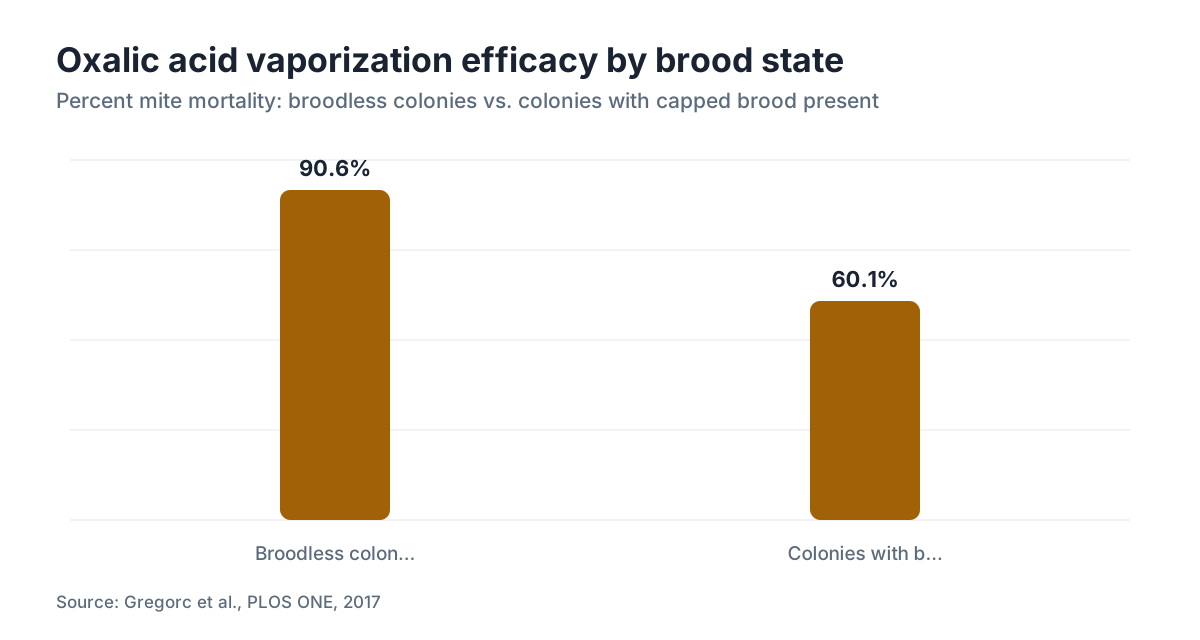
What we do have is solid data on each treatment's individual efficacy and clear mechanistic logic for why they complement each other. A 2017 study in PLOS ONE by Gregorc et al. found oxalic acid vaporization achieved 90.6% efficacy in broodless colonies and 60.1% in colonies with brood, confirming the brood-state dependency [6]. Apivar efficacy in the same literature runs 87-97% depending on colony size, mite load, and whether the full 56-day period is observed [1][3].
Simple multiplication of independent kill rates is not quite the right model (the same mites do not face both treatments equally), but as a rough frame: a colony starting at 2,000 mites treated with 90% efficacy Apivar has about 200 survivors. Apply OA at 90% efficacy to those phoretic survivors and you end up near 20 mites. That is a colony in good shape heading into winter.
The Honey Bee Health Coalition's Varroa Management Guide, which is the closest thing beekeeping has to a peer-reviewed clinical guideline, describes the sequential approach as appropriate when post-treatment mite counts stay elevated or when the beekeeper wants to maximize winter bee survival [2]. The guide is not a peer-reviewed study, but it synthesizes the available research and was developed with input from USDA-ARS researchers.
One real constraint: amitraz residues in wax build up over multiple treatment cycles, and there is ongoing research (including work from the USDA Beltsville lab) examining whether sub-lethal amitraz exposure affects brood development [7]. That is a reason not to run sequential treatments casually every cycle, but to use mite counts to decide when the extra step is actually needed.
Which oxalic acid delivery method works best in this sequence?
You have three EPA-registered options: vaporization (sublimation), dribble (oxalic acid in sugar syrup poured between frames), and extended-release sponge strips (sold as Api-Bioxal sponge pads in some markets). Each has trade-offs in this specific context.
Vaporization is the standard choice for the sequential follow-up. It distributes OA aerosol throughout the hive regardless of cluster configuration, it takes about 3 minutes per hive, and efficacy in low-brood conditions consistently comes in above 90% in published trials [6]. You need a vaporizer and proper respiratory protection (an OA-rated respirator, more than a dust mask). The EPA label for Api-Bioxal vaporization requires the applicator to wear specific PPE [4].
Dribble is the budget option and requires no vaporizer. You pour a 3.2% OA in 1:1 sugar syrup solution (about 5 mL per seam of bees, up to 50 mL total per colony) directly onto bees between frames [4]. Efficacy is comparable to vapor in true broodless conditions, but distribution is less even and it is harder on bees in cold weather. Dribble makes most sense if you are doing late-fall treatment in a cluster and do not own a vaporizer.
Extended-release strips (the Api-Bioxal glycerin-soaked cellulose pad format) are designed for use when brood is present because they release OA slowly over weeks. If you are pulling Apivar at the end of a low-brood window, extended-release strips are arguably the wrong tool, because the advantage of the broodless timing is immediate, concentrated contact kill. Save the strips for standalone treatment situations.
For the Apivar-then-OA sequence specifically, vaporization on the day of or day after strip removal is the cleanest protocol.
| OA Method | Efficacy (broodless) | Efficacy (brood present) | Requires equipment | Time per hive |
|---|---|---|---|---|
| Vaporization | ~90-95% [6] | ~60% [6] | Yes (vaporizer + PPE) | 3-5 min |
| Dribble | ~85-90% [4] | ~40-60% | No | 5-10 min |
| Extended-release strips | ~70-80% over 6 weeks | Works with brood | Minimal | 2 min |
Efficacy figures for dribble are from the Api-Bioxal label and supporting registrations; strip efficacy is from manufacturer trial data submitted to EPA [4].
How do you monitor mite levels to know if the sequential treatment worked?
Do an alcohol wash before you pull Apivar strips (or a sticky board count if that is your preference, though alcohol wash is more accurate). This tells you whether Apivar did its job and how many mites you are handing to the OA step.
The Honey Bee Health Coalition action threshold is 2 mites per 100 bees during the summer brood-rearing season and 1-2 mites per 100 bees going into winter [2]. If your count after 56 days of Apivar is already at or below 1 per 100, the OA follow-up is optional. If it is at 3 or above, apply OA.
Then do a follow-up wash 10-14 days after the OA application. At that point you should see counts well below 1 per 100 if the sequence worked. Still above 2 per 100 two weeks after the OA step? You have a problem worth investigating: possible amitraz resistance (rare in the U.S. but documented [7]), queen issues that kept brood present during treatment, or a reinfestation event from collapsing neighboring colonies.
Reinfestation is a real and underappreciated issue. Mite-laden foragers from a dying colony nearby can push your counts back up within weeks. No treatment protocol fully protects against that. The best mitigation is to do your follow-up count and treat again if needed, and to talk to neighboring beekeepers about their mite management. Tools like the varroa mite management guides at VarroaVault can help you build a monitoring calendar that catches reinfestation early.
For supply sourcing, including alcohol wash supplies and vaporizer equipment, check resources like beekeeping supply companies to compare options before buying.
What time of year makes the most sense for this sequential protocol?
Late summer and early fall is the sweet spot in most of North America. Here is why.
The bees that survive winter and build up the following spring are the so-called "winter bees" raised in August and September. These are the bees with higher fat body reserves and longer lifespans. Varroa mites suppress fat body development in pupae [3]. A high mite load in August means your winter bees are compromised before they are even capped. Getting mite counts down hard before August 15 (in northern states) or September 1 (in mid-Atlantic and transition zones) is the single most impactful thing you can do for colony survival.
A typical late-summer protocol:
- Start Apivar around August 1.
- Pull strips around September 26 (56 days later).
- Apply OA vapor immediately.
- Do a mite wash in mid-October to confirm success.
For fall treatment, this sequence also lines up well with the natural drop in brood that happens as day length shortens. By the time you pull strips in late September or October, many colonies in zones 5-6 already have reduced brood, which pushes OA efficacy higher still.
Spring treatment with this sequence is less common and less necessary if you treated hard in the fall. But if spring counts exceed 1-2 per 100 before supers go on, a spring Apivar treatment followed by OA at strip removal is within-label and appropriate. Just remember: honey supers cannot be on the hive during Apivar treatment [1], so spring timing must account for your local nectar flow.
The USDA's extension guidance through their Bee Informed Partnership has tracked colony loss rates by region and found that fall mite management is the single strongest predictor of overwinter survival in their survey data [8].
Can you use oxalic acid while Apivar strips are still in the hive?
Yes, technically, and some experienced beekeepers do this on purpose during a broodless window that falls mid-treatment. The labels for each product are independent, and neither prohibits the presence of the other.
The scenario usually looks like this: you start Apivar in early September in a northern climate. By late October, with strips still in and 10-20 days left on the treatment clock, the colony goes broodless due to cold and queen suppression. You vapor-treat with OA at that broodless moment, then finish the full 56-day Apivar period before pulling strips.
The argument for this approach is that you capture a natural broodless window that might not line up with strip removal. The argument against is that you are adding an extra stressor during Apivar treatment, and if OA vapor damages nurse bees, you may slow the colony's ability to spread amitraz through the cluster via grooming.
No published trial that I am aware of directly compares mid-treatment OA versus post-removal OA in terms of colony health outcomes. The closest guidance is the HBHC recommendation to apply OA "during a broodless period" without specifying whether Apivar must be out first [2]. Given that uncertainty, I would default to the post-removal sequence unless a clear natural broodless window shows up mid-treatment and you have good reason to take advantage of it.
Are there risks or downsides to this sequential approach?
A few worth knowing.
Amitraz residue accumulation. Wax is lipophilic and soaks up amitraz over time. Repeated Apivar treatments raise wax residue levels. A USDA study found amitraz and its metabolites in beeswax at levels that correlated with treatment frequency [7]. The current scientific consensus is that this does not cause acute colony harm at label-compliant treatment frequencies, but it is a reason to rotate treatment classes (formic acid, oxalic acid, thymol) across years rather than defaulting to Apivar every cycle.
Oxalic acid can kill bees if overdone. The dribble method at doses above the label maximum causes documented brood loss and adult bee mortality [4]. Vaporization at the label dose (2.0 g per brood box) is well-tolerated, but if you stack two vapor treatments 5-7 days apart, watch for any signs of unusual bee mortality on the landing board.
It does not protect against reinfestation. No matter how well you run this sequence, a collapsing apiary 500 meters away can re-infest your treated colony within weeks through robbing and drifting. Monitoring after treatment is not optional.
Cost. Apivar strips run roughly $30-$55 for a pack of 10 (treating up to 5 colonies), and Api-Bioxal runs $25-$40 for a 35-gram container that treats many colonies by vaporization. If you are managing a handful of hives, the combined cost per colony is manageable. For sideline operations of 50-100 hives, bulk Api-Bioxal sourcing matters. Beekeeping supply companies vary a lot on pricing.
None of these downsides outweigh the benefit in a high-mite situation. They are reasons to be thoughtful and count mites, not reasons to skip the protocol.
How does this protocol fit into a full-year varroa management plan?
The sequential Apivar-then-OA treatment is one tool in what should be a year-round monitoring and response system, not a once-and-done fix.
A reasonable annual framework for most of North America looks like this:
- Early spring (March-April): Alcohol wash after the colony starts building up. If above 1-2 mites per 100 bees, consider treatment before supers go on. Oxalic acid dribble or vapor can be used in the still-low-brood spring window without needing Apivar.
- Mid-summer (June-July): Wash at least once. Mite populations double roughly every 3 weeks during peak brood season [2]. A colony at 1% in June can be at 4-5% by August if left untreated.
- Late summer (August-September): This is the highest-stakes treatment window. Apivar strips go in by August 1 at the latest in most northern states. At strip removal around late September, do the OA follow-up described throughout this article.
- Late fall (November-December): If the colony goes broodless, this is an excellent standalone OA treatment window for any residual mites. Even if you nailed the fall sequence, run a wash in November to confirm.
VarroaVault's free protocol tools can help you map this calendar to your specific climate zone and flag when your mite counts cross the thresholds that warrant action. No single article replaces keeping records and responding to your own colony data.
For a broader picture of the parasites and pathogens affecting colony health, the varroa mite overview covers the biology in more depth.
What do beekeepers most often get wrong with this protocol?
After reading through extension guides, HBHC materials, and beekeeper forum discussions over years, the common mistakes cluster around a few themes.
Starting too late. Waiting until August 15 or later to start Apivar in a northern climate means strips do not come out until mid-October, the OA window is narrow, and the winter bees were already developing under high mite pressure. August 1 is the latest I would start in zones 5-6.
Pulling strips early. Forty-two days feels like enough. It is not. The 56-day minimum exists because it takes two full brood cycles to expose mites that were in capped cells at the start of treatment. Pulling at day 42 leaves a meaningful cohort of recently-emerged mites from late-cycle brood untouched by amitraz.
Skipping the mite wash. You cannot know whether the protocol worked without counting. This is the step most hobbyists skip and the reason many do not realize they are losing the fight until the colony collapses.
Treating without honey super removal. Amitraz residues in honey are not permitted under the Apivar label. Beyond the regulatory issue, residues in wax and honey are a real food safety concern. Always pull supers before starting strips [1].
Using dribble OA in the cold. Below about 50F, dribble OA can chill and kill bees, and the bees cannot redistribute the oxalic acid through a tight winter cluster. Vaporization is the right method in cold weather [4].
Get those five things right and this protocol will perform close to its theoretical ceiling.
Frequently asked questions
How long after removing Apivar strips should I wait before applying oxalic acid?
Do not wait at all if you can help it. Apply oxalic acid the same day you pull strips, or within a day or two at most. Once strips are out, the queen resumes normal laying quickly and mites begin entering capped cells within 9 days. The oxalic acid window shrinks fast. If you can confirm brood is already low at strip removal, that is your ideal moment for vaporization.
Can I apply oxalic acid while Apivar strips are still in the hive?
Yes. Neither product's label prohibits the other being present. Some beekeepers vapor-treat with OA during a natural mid-treatment broodless window without pulling strips first. This is within-label practice, but the evidence base for the mid-treatment timing is weaker than the post-removal sequence. If a clean broodless window opens up, it is reasonable to use it; otherwise wait until strips come out.
Does Apivar work on mites inside capped brood cells?
Yes, but slowly and incompletely compared to its effect on phoretic mites. Amitraz contact through wax caps takes time, which is exactly why the 56-day minimum treatment period is required. The first brood cycle exposes mites that were capped at the start of treatment; the second cycle catches the next reproductive generation. Shortening the treatment period meaningfully reduces efficacy against the capped-cell mite population.
What mite count after Apivar treatment tells me I need to follow up with oxalic acid?
The Honey Bee Health Coalition's threshold going into winter is 1-2 mites per 100 bees. If your alcohol wash at Apivar strip removal shows 3 or more mites per 100 bees, apply oxalic acid. If you are at 1 or below, the OA step is optional but still adds an insurance layer in high-risk situations like apiaries with known nearby colony collapse.
How many oxalic acid vaporizations should I do after pulling Apivar strips?
One treatment is standard for a low-brood or broodless colony. If you have any remaining capped brood at strip removal, two applications spaced 5-7 days apart will catch mites that were sealed in cells during the first vapor treatment. The EPA label for Api-Bioxal permits up to three vaporization applications per treatment period, so two is comfortably within-label practice.
Can I use formic acid instead of oxalic acid as the follow-up to Apivar?
Formic acid (MAQS or Formic Pro) does penetrate capped brood cells, so it works differently than OA in this context. But it cannot be used when ambient temperature is below about 50F (MAQS label), and it carries higher colony stress risk. As a post-Apivar follow-up in a low-brood late-season scenario, oxalic acid is generally the better choice. Formic acid makes more sense as a standalone mid-summer treatment.
Will this sequential treatment cause amitraz resistance in my mites?
Amitraz resistance in Varroa is documented but still relatively rare in North American populations as of the mid-2020s. Using Apivar at full label dose for the full 56-day period minimizes resistance selection compared to under-dosing or short-treating. Rotating treatment classes across years (Apivar one fall, formic acid or OA-only the next) is the recommended resistance management strategy according to the Honey Bee Health Coalition.
Do I need to remove honey supers before the oxalic acid step as well?
The Api-Bioxal label requires that honey supers intended for human consumption be removed before oxalic acid treatment. In practice, if you ran the full 56-day Apivar treatment (which requires super removal anyway), supers should already be off the hive. You would not add supers again until mite treatment is complete and the colony is in good health heading into winter.
What is the best time of year to run Apivar followed by oxalic acid?
Late summer is the highest-impact window, specifically starting Apivar by August 1 in USDA zones 5-6, so strips come out by late September. This protects the winter bees that carry the colony through to spring. The OA follow-up right at strip removal in late September, when brood is naturally declining, captures maximum mite efficacy. A secondary window exists in early spring before honey supers go on.
How do I know if the sequential treatment actually worked?
Do an alcohol wash 10-14 days after the oxalic acid application. You should see counts at or below 1 mite per 100 bees. If counts are still at 3 or higher, investigate: possible amitraz resistance, a brood-heavy colony that limited OA efficacy, or reinfestation from neighboring collapsing colonies. A single post-treatment count is not optional; it is the only way to confirm success.
Is the sequential Apivar-then-OA approach safe for the queen?
At label doses, both treatments are generally well-tolerated by queens. Oxalic acid vaporization at 2.0 g per brood box has not shown queen loss in controlled studies. Apivar strips occasionally cause queen loss when placed directly under the queen or in very small colonies, which is a placement issue rather than a chemical one. Keep strips away from the brood nest center and monitor the queen's laying pattern after treatment.
What equipment do I need to add oxalic acid vaporization to my treatment routine?
At minimum: an OA vaporizer (wand-style or pan-style), a NIOSH-approved respirator rated for oxalic acid aerosol (P100 filter with organic vapor cartridge), safety glasses, and gloves. Vaporizer prices range from about $30 for basic wand models to $200-plus for battery-powered units. Api-Bioxal (the only EPA-registered OA product for this use in the U.S.) must be used with all label-specified PPE.
Can I use the Apivar-then-OA sequence on nucleus colonies or splits?
Yes, with adjustments. Nucleus colonies often go broodless naturally after a split, which makes them excellent OA targets without needing Apivar at all. If a nuc has an established laying queen and rising mite counts, one Apivar strip per 5 frames of bees is the label rate. Follow with OA at strip removal just as you would for a full colony. Monitor closely since small colonies are more sensitive to treatment stress.
Sources
- EPA, Apivar (amitraz) registered pesticide label: Apivar requires a minimum 56-day treatment period, no more than 2 strips per 5 frames of bees, and removal of honey supers before treatment
- Honey Bee Health Coalition, Varroa Management Guide (honeybeehealth.org): Oxalic acid is only effective against phoretic mites; the HBHC action threshold going into winter is 1-2 mites per 100 bees; sequential treatment is described as appropriate for high-infestation scenarios
- Penn State Extension, Varroa Mite Management (extension.psu.edu): Apivar field efficacy runs 87-97% depending on treatment compliance; high mite loads in August suppress fat body development in winter bees
- EPA, Api-Bioxal (oxalic acid dihydrate) registered pesticide label: Api-Bioxal vaporization allows up to 3 applications per treatment period; dribble dose is 5 mL per seam up to 50 mL total; honey supers for human consumption must be removed; specific PPE required
- University of Minnesota Extension, Varroa Mite Management (extension.umn.edu): Colonies in USDA zones 5-7 can go broodless from late October through December, extending the effective OA treatment window
- Gregorc A et al., PLOS ONE 2017, oxalic acid vaporization efficacy trial: Oxalic acid vaporization achieved 90.6% mite mortality in broodless colonies and 60.1% in colonies with brood present
- USDA Agricultural Research Service, Beltsville Bee Lab, amitraz residue in beeswax research: Amitraz and its metabolites accumulate in beeswax at levels that correlate with treatment frequency; ongoing research on sub-lethal effects on brood
- Bee Informed Partnership / USDA National Agricultural Statistics Service, annual colony loss survey: Fall mite management is the single strongest predictor of overwinter colony survival in multi-year national survey data
- EPA, Federal Insecticide Fungicide and Rodenticide Act (FIFRA), 7 U.S.C. 136: Using a pesticide in a manner inconsistent with its label is a federal violation under FIFRA
- University of Florida IFAS Extension, Varroa Mite Biology and Management (ufl.edu): Mite populations can double roughly every 3 weeks during peak summer brood-rearing season; a colony at 1% in June can reach 4-5% by August
Last updated 2026-07-09