Randy Oliver's varroa treatment approach: what actually works
TL;DR
- Randy Oliver, a California commercial beekeeper and the researcher behind ScientificBeekeeping.com, runs an evidence-based varroa system built on monitoring, threshold-based decisions, and rotating between oxalic acid (OA) and formic acid.
- His most-cited work is the extended-release oxalic acid glycerin sponge: a low-cost, low-labor option for colonies that still have brood.
Who is Randy Oliver and why do beekeepers follow his work?
Randy Oliver is a California sideliner-turned-commercial beekeeper who runs roughly 1,000 colonies and publishes deeply researched, independently funded articles at ScientificBeekeeping.com. He is not an academic in the institutional sense. He runs his own replicated field trials, reads the primary literature, and writes it up in plain English. That combination is rare.
The beekeeping press covers him constantly. The American Bee Journal and Bee Culture have both published his work for over fifteen years [1]. He sits on the Honey Bee Health Coalition's Varroa management working group, the group behind the Tools for Varroa Management guide used widely by extension services [2].
Why do hobbyists and sideliners trust him? He shows his data. When a trial doesn't go the way he expected, he says so. When a treatment works only under specific conditions, he gives you those conditions. That kind of hedged honesty beats any marketing claim.
What is Randy Oliver's core varroa management philosophy?
You cannot manage what you don't measure. That premise runs under everything Oliver writes. Before any treatment decision, he insists on an alcohol wash or sugar roll to get a mite-per-hundred-bees count. He treats when infestation hits roughly 2 percent (2 mites per 100 bees) during the buildup season, and he argues that waiting for 3 percent in summer is acceptable if you monitor often. The specific threshold matters less than the habit of checking [2].
From there, his approach is what the Honey Bee Health Coalition calls Integrated Pest Management, or IPM. That means physical methods (drone brood removal, queen-right breaks) when mite loads are low, and chemical treatments when counts demand it. He does not recommend treating on a calendar schedule alone, though he grants that commercial outfits often do, because monitoring 500 hives takes real labor.
He is openly skeptical of treatments that are expensive, complicated, or that show inconsistent field efficacy. His published opinion on miticide strips that need precise temperature windows: the liability of a narrow application window makes them a poor fit for most hobbyists. He prefers treatments where the margin of error is wide enough that an average beekeeper can succeed.
What does Randy Oliver say about oxalic acid treatment?
Oxalic acid is the treatment Oliver has spent the most time on, and his extended-release sponge method is the project that brought him national attention. The concept is simple. Instead of a single dribble or vapor treatment that kills only phoretic (non-cell) mites, you put an oxalic acid-saturated glycerin sponge into the hive so mites are exposed over weeks. That extended contact covers multiple brood cycles, reaching mites that would otherwise sit protected inside capped cells.
His published trials showed mite reduction comparable to registered strip treatments when the sponge method was applied correctly, though he notes variability across colonies and seasons [1]. The key variables he identified were glycerin concentration (roughly 1:1 oxalic acid dihydrate to glycerin by weight), the number of sponges, and colony size. Two sponge pads placed on the top bars near the brood nest worked better than one.
One legal note matters here. As of this writing, oxalic acid is registered by the EPA for use in beehives under the label for products such as Api-Bioxal [3]. Oliver's specific sponge-pad formulation is not an EPA-registered application method under that label. He has advocated publicly for the EPA to evaluate and register it. Beekeepers who use the sponge method outside the registered label are using it off-label, which carries legal and liability implications you should understand before proceeding.
For the registered dribble method, Oliver's guidance follows the label exactly: 5 mL of 3.2 percent oxalic acid solution per seam of bees, no more than once per 14 days, applied when the colony is broodless or nearly so. In his experience, late fall treatment when brood is minimal gives the best kill rates [3].
For a deeper look at the biology of what you're fighting, the varroa mite article on this site is a good foundation.
How does Oliver's oxalic acid glycerin sponge method work in practice?
The recipe Oliver published uses oxalic acid dihydrate (the same chemical as in Api-Bioxal, sourced as a raw material) dissolved in glycerin. He has tested ratios from about 1:2 to 1:1 by weight and found that higher concentrations improve efficacy without much added bee mortality at reasonable exposure times. He soaks cellulose sponges (standard kitchen sponges cut to fit between frames) in the solution, lets them absorb fully, and places them directly on the top bars over the brood nest.
In his trials, a treatment window of 4 to 8 weeks produced the best results. He checks whether sponges need topping up with fresh glycerin solution every 2 to 3 weeks, since glycerin evaporates and bees chew the sponge material over time.
Temperature is less of a constraint than with formic acid. Oliver notes that the sponge method works across a wider temperature range, which matters if you live somewhere with unpredictable springs or falls. That flexibility is one of his main arguments for it.
Here is the mechanism. Bees contact the sponge, pick up oxalic acid on their bodies, and spread it through grooming. Mites feeding on the bees ingest it. The Honey Bee Health Coalition's Tools guide notes that oxalic acid is effective against phoretic mites but has limited direct penetration of wax cappings, which is why extended exposure and coverage of multiple brood cycles matter [2].
If you are sourcing equipment for this method, resources like beekeeping supply companies can help you find sponges, glycerin, and oxalic acid from reputable vendors.
What does Randy Oliver say about formic acid treatments?
Oliver respects formic acid for one reason above the rest: it kills mites inside capped brood cells, more than phoretic mites on adult bees. That is a real advantage during peak brood season when a large fraction of mites are protected. Products like Mite-Away Quick Strips (MAQS) and Formic Pro are the registered options in the US [4].
His criticism is practical. The effective dose sits close to the dose that stresses or kills bees, especially queens. Application temperature matters a lot. MAQS requires ambient temperatures between 50 and 85 degrees Fahrenheit for the full treatment period, and pushing the upper end risks queen loss and brood damage [4]. Oliver has written that he has seen real queen loss in his own apiaries during warm-weather formic treatments, and that he accounts for that risk in his management calendar.
Where formic acid is the chosen tool, his recommended approach is Formic Pro at lower temperatures (below 75 degrees F if possible) with strong ventilation and a reduced entrance. He treats for the full labeled duration, which is 14 days for a single-strip treatment or 20 days for the two-strip protocol under the Formic Pro label [4].
Bottom line from his own writing: formic acid is a tool he uses and recommends, but it needs more caution and tighter conditions than oxalic acid. If you are new to treating, he would push you toward oxalic acid first.
How does Randy Oliver view amitraz (Apivar) and other synthetic miticides?
Oliver is neither a cheerleader nor a strong critic of amitraz (sold as Apivar in the US). He views it as an effective tool with real risks attached, mainly resistance development when strips stay in too long and beekeepers use it every cycle without rotating [5].
His published guidance: use Apivar for 6 to 8 weeks (per label), pull the strips promptly, and rotate to a different mode of action for the next cycle. He points to documented amitraz resistance in European Varroa destructor populations as a warning of what happens when rotation gets neglected [5].
He is harder on coumaphos (CheckMite+) and tau-fluvalinate (Apistan). Both have documented resistance problems in US mite populations, and his public writing treats them as last resorts or monitoring tools rather than primary treatments.
Apivar does not work well below about 50 degrees F, so Oliver does not recommend it for late-fall or winter use. That is where oxalic acid dribble takes over in his seasonal calendar.
What does Randy Oliver's seasonal treatment calendar look like?
Oliver does not publish one universal calendar, because geography matters too much. A beekeeper in Minnesota has a true broodless period in January. A beekeeper in central California may never get one. The framework, though, stays consistent.
Spring buildup (population growing, mite load low): Monitor every 3 to 4 weeks. Treat if you hit the 2 percent threshold. Formic acid or Apivar work well when brood is present.
Summer peak (brood nest at maximum, mite load rising fast): This is the danger window, and Oliver treats aggressively. He favors formic acid when temperatures allow, or oxalic acid sponges if his extended-release approach is part of his protocol. He also uses drone comb removal as a supplement, since Varroa infests drone cells at a rate roughly 7 to 10 times higher than worker cells [2].
Fall wind-down (the window that decides winter): Oliver treats this as the most important treatment of the year. Winter bees raised under high mite loads die early, and losing them means losing the colony in February or March even if the cluster looks fine in December. He aims to knock mites below 1 percent before the main crop of winter bees is raised, usually 6 to 8 weeks before the first hard frost.
Late fall/winter (broodless or near-broodless): Oxalic acid dribble or vapor. This is the highest-efficacy window for OA, because nearly all mites are phoretic. Oliver treats twice here if mite counts justify it, with a 5 to 7 day gap between treatments to catch late-emerging mites.
| Season | Preferred Treatment | Threshold to Treat |
|---|---|---|
| Spring buildup | Formic acid or Apivar | 2% (2 mites/100 bees) |
| Summer peak | Formic acid, OA sponges, drone removal | 2% |
| Early fall | Apivar or formic acid | 1-2% |
| Late fall/winter (broodless) | OA dribble or vapor | Any detectable level |
What does the research say about Oliver's oxalic acid sponge efficacy?
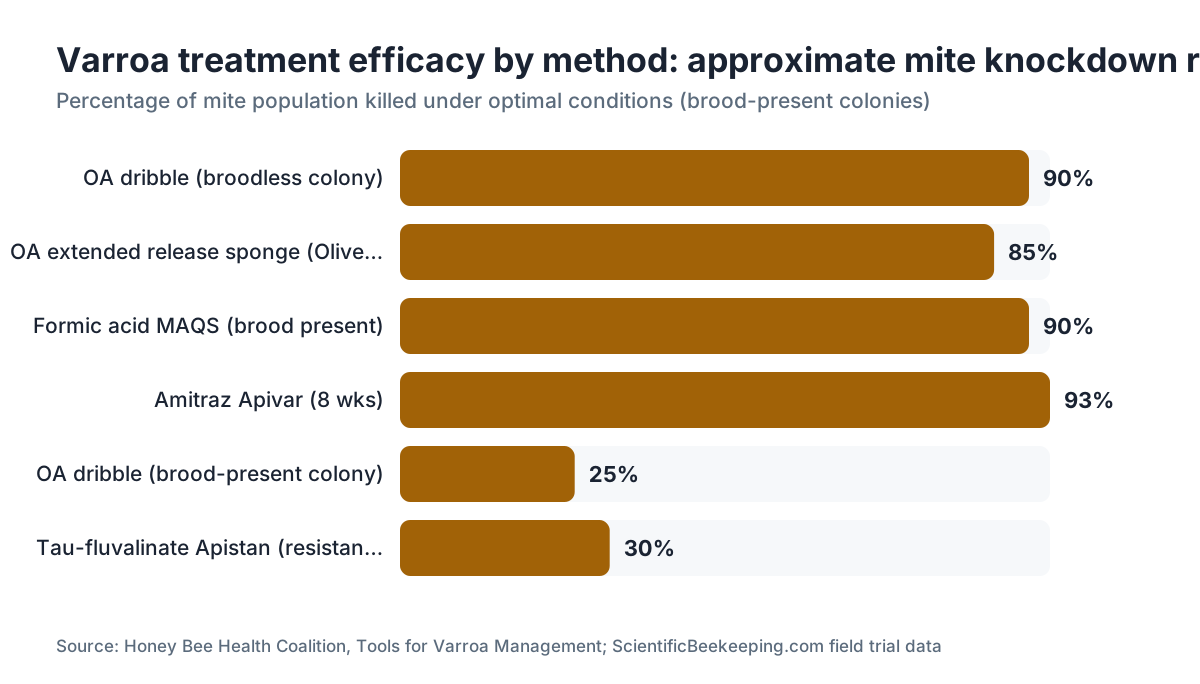
Oliver's own published trial data (on ScientificBeekeeping.com) showed mite knockdown in the 80 to 90 percent range over 4 to 6 week treatment periods with his higher-concentration sponge formulas. He is careful to note that his trials are not peer-reviewed in the traditional sense, though his methodology is transparent and his raw data is often published [9].
Independent work by university extension programs has generally confirmed that extended-release oxalic acid outperforms a single OA dribble in brood-present colonies, where the phoretic mite fraction may be only 20 to 30 percent of the total mite population [6]. A single dribble in a brood-heavy colony may kill only that phoretic fraction, leaving 70 to 80 percent of mites protected in cells.
The Honey Bee Health Coalition's Tools for Varroa Management guide states that "oxalic acid is only effective against phoretic mites," which is the reason Oliver built the extended-release concept in the first place: repeated low-dose exposure as mites emerge from cells turns a single-application failure into a sustained kill [2].
Nobody has great long-term resistance data on oxalic acid in Varroa yet. Oliver has written about this honestly. He notes that oxalic acid's mechanism (pH disruption and protein denaturation) makes resistance less likely than with synthetic acaricides, but nothing about that is guaranteed.
How does Randy Oliver recommend monitoring mite levels?
Alcohol wash beats sugar roll. Oliver has said the same thing across a decade of writing. Sugar rolls are gentler on bees but frequently undercount mites by 30 to 40 percent compared to alcohol wash [2]. For management decisions, especially in summer when you are trying to catch rising mite loads early, that undercount can cost you a colony.
His protocol: sample roughly 300 bees from the brood nest (not the entrance, not the top bars), wash in 70 percent isopropyl alcohol, and count the mites in the wash liquid. Express the result as mites per hundred bees. He does this every 3 to 4 weeks during active season, and calls monthly monitoring in late summer and early fall the bare minimum.
Sticky boards are not a replacement for alcohol wash in his view. They give you a relative trend, not a population estimate, and the relationship between natural mite drop and actual infestation shifts too much with temperature, colony size, and season to serve as a primary diagnostic.
The Varroa EasyCheck device (a commercial counting tool) and similar products make alcohol wash less messy, though Oliver notes that any jar with a tight lid and a screen works fine if you are willing to improvise.
What has Randy Oliver said about hygienic behavior and mite-resistant bees?
Oliver supports breeding for varroa-sensitive hygiene (VSH) and related traits, but he is honest that genetics alone is not enough for most beekeepers right now. The supply of reliably VSH-expressing queens is limited, queens open-mate and their daughters' behavior can drift, and the benefit takes years to show up at scale. He recommends buying from VSH-focused breeders when you can, but not treating VSH genetics as a substitute for monitoring and treatment.
He also writes about the Scandinavian "Gotland" experiments and related research on colonies left to adapt to Varroa over generations through natural selection. His take: promising at a population level, impractical for individual beekeepers who cannot absorb the colony losses that come during the adaptation period [1].
For hobbyists starting out, understanding the varroa mite biology is the prerequisite to understanding why any of Oliver's methods work.
How do Oliver's methods compare to other common varroa treatment approaches?
This is where his work earns its reputation. Rather than pushing a single product, he publishes comparative data across treatments. His most-cited comparisons pit OA sponge against Apivar and formic acid products in matched colony groups.
| Treatment | Effective Against Capped Brood Mites | Temperature Sensitivity | Residue Risk | Resistance Risk |
|---|---|---|---|---|
| OA dribble (Api-Bioxal) | No | Low | Very low | Low (theoretical) |
| OA extended release (sponge) | Partial (via extended exposure) | Low | Very low | Low |
| Formic acid (MAQS/Formic Pro) | Yes | High (50-85F window) | Low | Low |
| Amitraz (Apivar) | No (strips on frame only) | Moderate | Wax residue possible | Moderate (documented in EU) |
| Tau-fluvalinate (Apistan) | No | Low | High (wax residue) | High (widespread US resistance) |
His synthesis across articles: for a hobbyist with fewer than 25 hives, the practical sequence is alcohol wash monitoring, then OA extended release or formic acid in brood season, then OA dribble in the broodless window. Apivar is the backup when you need a sure knockdown after a missed treatment cycle and mites are high. Apistan he basically does not recommend anymore, given the resistance data.
For beekeepers building out a setup, the beekeeping supplies page has sourcing information relevant to getting monitoring and treatment equipment together.
Where can you actually find Randy Oliver's protocols and research?
The primary source is ScientificBeekeeping.com, which Oliver maintains himself. The site is free, dense, and not always organized for beginners, but the varroa section holds his full trial reports, his evolving thinking on OA glycerin methods, and his replies to reader questions that reveal his actual current practice. He updates it often.
The Honey Bee Health Coalition's Tools for Varroa Management guide, a free PDF from the coalition's website, matches the research behind Oliver's recommendations and carries endorsements from major US extension programs [2]. It is the closest thing the industry has to a consensus protocol document.
University extension programs at UC Davis, Penn State, University of Minnesota, and others have published varroa management guides that cite or track closely with Oliver's work [6]. These are useful for region-specific timing that his California-centric view may not cover.
VarroaVault's free varroa monitoring tools let you log alcohol wash counts, set threshold alerts, and track treatment timing across multiple hives. Use it alongside Oliver's protocols to actually watch your mite pressure over time instead of relying on memory.
The EPA product label for Api-Bioxal is the legal governing document for oxalic acid use in the US, and Oliver's protocols are only legal to the extent they match that label. Read it [3].
What are the most common mistakes beekeepers make with Randy Oliver's methods?
The biggest mistake is treating without monitoring first. Oliver is blunt about it: if you are guessing at mite levels, you will either over-treat (wasting money and stressing bees) or under-treat (losing the colony anyway). The alcohol wash takes fifteen minutes. There is no good argument for skipping it.
Second common mistake: using the OA sponge method when the registered dribble method is what the label requires. Oliver is clear that the sponge method is off-label under current EPA registration. Beekeepers who use it need to understand that. This isn't Oliver's failure, it's a regulatory lag, and he has advocated publicly for formal registration.
Third: treating in fall but too late. Wait until September to treat in a northern climate and your winter bees are already being raised under high mite loads. Oliver's data, and the extension literature, consistently show August as the treatment window that decides most northern colonies, not September or October [6].
Fourth: not rotating treatments. Using oxalic acid every cycle indefinitely may be fine given the low resistance risk, but relying on Apivar without rotating to a different mode of action every 1 to 2 years invites the resistance outcomes already documented in European apiaries [5].
Fifth: expecting perfection. Oliver writes that his methods work well on average across a large apiary, but individual colonies vary. A colony that still shows 3 percent mites after a full OA sponge treatment isn't proof the method failed. It may need a second treatment, a requeening, or a closer look at whether the sponge was placed correctly.
Track your treatment results over time and the pattern across your hives turns into useful data. VarroaVault's protocol tracker is one way to keep that history organized.
Frequently asked questions
Does Randy Oliver recommend treating varroa without chemicals?
Oliver supports non-chemical methods like drone comb removal and brood breaks as supplements, not primary treatments. He is direct that for most hobbyists in most climates, chemical treatments (oxalic acid or formic acid) are necessary to keep mite levels below damaging thresholds. He does not oppose chemical-free beekeeping as a philosophy, but his field data shows colonies relying solely on cultural controls typically reach dangerous mite loads.
Is Randy Oliver's oxalic acid glycerin sponge method legal in the US?
Not under the current EPA label for Api-Bioxal. The registered application methods are dribble and vaporization. Oliver's sponge method uses the same active ingredient in a delivery form not covered by the label. He has publicly pushed for EPA registration of extended-release OA formats. Until that happens, using sponges is technically off-label in the US, which beekeepers should understand before proceeding.
What mite count does Randy Oliver treat at?
Oliver's general threshold is 2 mites per 100 bees (2 percent) during spring and summer, measured by alcohol wash. In early fall he tightens this to 1 to 2 percent, given the importance of winter bee health. He treats at any detectable level during the broodless window in late fall, since OA dribble is highly effective then and the cost of leaving mites is high.
How often does Randy Oliver treat for varroa?
He treats on a threshold basis, not a fixed calendar. In a typical California season he may treat two to three times a year: once in spring if mite levels rise above threshold, once in late summer to protect winter bees, and once in the broodless window with oxalic acid dribble. High-pressure seasons or missed monitoring windows can mean more treatments. He does not recommend routine calendar treatments without a monitoring trigger.
What is Randy Oliver's opinion of Apivar (amitraz)?
He views Apivar as effective and appropriate when mite loads are high and OA or formic acid haven't been enough, but he stresses removing strips on time (8 weeks maximum) and rotating away from it every 1 to 2 cycles. He cites documented amitraz resistance in European Varroa populations as a warning against overuse. He does not recommend it for late-fall or winter use, given its reduced efficacy at low temperatures.
Can Randy Oliver's oxalic acid methods be used when there is brood present?
OA dribble has poor efficacy with brood present, because it kills only phoretic mites, which may be just 20 to 30 percent of the total in a full brood nest. OA vaporization has similarly limited brood penetration. Oliver's extended-release sponge method addresses this by keeping mites exposed over multiple brood cycles, but that method is off-label under current EPA registration. Formic acid stays the preferred registered option for brood-present colonies.
How does Randy Oliver make his glycerin oxalic acid sponge?
His published formula uses oxalic acid dihydrate dissolved in food-grade glycerin at roughly a 1:1 ratio by weight, soaked into cellulose sponges placed on top bars over the brood nest. He recommends two sponge pads per colony and a treatment window of 4 to 8 weeks, topping up with plain glycerin as needed. This is an off-label application under the current US EPA registration for Api-Bioxal.
Does Randy Oliver's research support VSH or mite-resistant bees?
Oliver supports breeding for varroa-sensitive hygiene and mite-resistant traits as a long-term strategy, but argues it is not a replacement for monitoring and treatment today. Queen supply from reliably VSH-expressing breeders is limited, open mating can dilute traits, and the benefit at an individual beekeeper level is slower than the research suggests at a population level. He recommends buying VSH genetics when available but treating regardless.
What monitoring method does Randy Oliver prefer for varroa counts?
Alcohol wash, consistently. He considers sugar rolls less accurate by roughly 30 to 40 percent compared to alcohol wash in head-to-head trials, and argues that undercount matters when your treatment threshold is 2 percent. His protocol is 300 bees sampled from the brood nest frames, washed in 70 percent isopropyl alcohol, results expressed as mites per 100 bees. Sticky boards are a trend indicator only, not a diagnostic tool.
What does Randy Oliver think about formic acid treatments like MAQS and Formic Pro?
He respects formic acid because it penetrates capped brood cells and kills mites inside, which oxalic acid does not reliably do in a single application. His practical concern is the narrow temperature window (50 to 85 degrees F for MAQS) and the real risk of queen loss at higher temperatures. He recommends Formic Pro with strong ventilation and temperatures below 75 degrees F when using formic acid, and accounts for queen loss risk in his management calendar.
How is Randy Oliver's work different from standard extension service recommendations?
Extension recommendations tend to be more conservative, sticking close to labeled applications and established products. Oliver publishes his own field trials, evaluates off-label and novel approaches (like OA glycerin sponges), and gives practitioners more nuanced cost-benefit analysis. Extension guides are more legally cautious; Oliver is more experimentally ambitious. Both are useful, and they agree far more than they disagree on core monitoring and threshold-based decision making.
Is Randy Oliver's approach suitable for new beekeepers?
His monitoring-first, threshold-based system suits new beekeepers because it teaches decision-making rather than product application by rote. The core skills needed are alcohol wash technique and reading a product label. His recommendation of oxalic acid dribble in the broodless window as a starting treatment fits beginners: low cost, simple application, and low risk of bee or queen damage when temperatures are right.
Where can I read Randy Oliver's actual research and protocols?
ScientificBeekeeping.com is the primary source, maintained by Oliver himself and free to read. His varroa section includes trial data, evolving sponge-method protocols, and detailed seasonal guidance. The Honey Bee Health Coalition's Tools for Varroa Management guide (free PDF) matches his approach and makes a good companion document. University extension programs at UC Davis, Penn State, and University of Minnesota publish regionally adapted guides consistent with his framework.
Sources
- American Bee Journal, Randy Oliver author archive: Randy Oliver has published varroa management research in the American Bee Journal for over fifteen years and operates ScientificBeekeeping.com.
- Honey Bee Health Coalition, Tools for Varroa Management Guide: The HBHC Tools for Varroa Management guide states that 'oxalic acid is only effective against phoretic mites' and recommends a 2 percent mite threshold for treatment decisions; Randy Oliver contributed to this working group.
- EPA, Api-Bioxal Oxalic Acid Product Registration: Api-Bioxal is EPA-registered for oxalic acid use in honey bee hives; registered application methods are dribble (5 mL of 3.2 percent solution per seam of bees) and vaporization; sponge-pad extended release is not a registered method under the current label.
- EPA, Mite-Away Quick Strips (MAQS) and Formic Pro Product Labels: MAQS requires ambient temperatures between 50 and 85 degrees Fahrenheit during the full application period; Formic Pro's two-strip protocol treatment duration is 20 days.
- USDA Agricultural Research Service, Honey Bee Research: Documented amitraz resistance in European Varroa destructor populations is a basis for recommending treatment rotation away from Apivar every one to two cycles.
- Penn State Extension, Varroa Management in Honey Bees: Penn State Extension recommends August as the critical treatment window in the northern US to protect winter bee production, and alcohol wash as the preferred monitoring method over sugar roll.
- UC Davis Department of Entomology, Honey Bee Research: UC Davis apiculture research supports threshold-based varroa management and extended oxalic acid exposure concepts for brood-present colonies.
- University of Minnesota Extension, Varroa Mite Management: University of Minnesota Extension recommends alcohol wash as more accurate than sugar roll, with natural mite drop on sticky boards described as a trend indicator only.
- ScientificBeekeeping.com, Randy Oliver, Oxalic Acid Extended Release Research: Oliver's published field trials showed mite knockdown rates in the 80 to 90 percent range over 4 to 6 week treatment periods with higher-concentration OA glycerin sponge formulas; raw trial data is published on the site.
- Honey Bee Health Coalition, Tools for Varroa Management Guide (drone comb data): Varroa preferentially infests drone cells at a rate roughly 7 to 10 times higher than worker cells, supporting drone comb removal as a supplemental mite management tactic.
Last updated 2026-07-09