How often should you repeat oxalic acid vaporization for varroa?

TL;DR
- The EPA-registered label for Api-Bvar (oxalic acid vaporization) allows treatment every 7 days, up to 3 applications per treatment period, during broodless or low-brood conditions.
- Most research and extension guidance points to three rounds spaced 5-7 days apart as the practical sweet spot for knocking mite loads below the damage threshold.
What does the EPA label actually say about vaporization intervals?
The registered label for Api-Bvar, the primary oxalic acid vaporization product in the U.S., specifies a maximum of three treatments per colony per year under the Varroa mite use pattern, with each treatment applied no more frequently than once every 7 days. [1] That 7-day floor is not arbitrary. Oxalic acid vapor only contacts phoretic mites, the ones riding adult bees. Mites capped inside brood cells are completely protected. The 7-day spacing is designed to catch newly emerged mites that were sealed in brood during the previous treatment before they disappear back under capped cells again.
The label language is straightforward: "Apply a maximum of three treatments, each treatment a minimum of 7 days apart." [1] Read that literally. Three treatments means three, not four. Seven days is a minimum, not a target. Going shorter than 7 days is an off-label use and could leave unnecessary acid residue in the hive without any extra mite kill.
Some beekeepers read "3 times per year" and assume they can spread those three applications across three separate seasons. Wrong read. The label describes a treatment series, not three isolated events. If you have a mite problem in August, you burn all three applications in August and you're done for the year under that label. Plan accordingly.
Why does the 7-day interval align with the varroa life cycle?
Varroa destructor takes about 12 days to complete a full reproductive cycle inside a capped worker brood cell, emerging with the bee on roughly day 12 post-capping. [2] After emergence, a mite spends time as a phoretic mite on adult bees before re-entering a cell to reproduce. That phoretic window varies. It averages somewhere between 4 and 11 days depending on the time of season and brood availability. [2]
Here's the problem. A single OAV treatment on day 0 kills phoretic mites and does nothing to mites sealed in cells. Some of those mites emerge on day 2, some on day 8, some on day 14. Wait 14 days for a second treatment and a portion of newly emerged mites will already have re-entered cells and be protected again. A 7-day interval catches the wave of emerging mites while most are still riding adult bees.
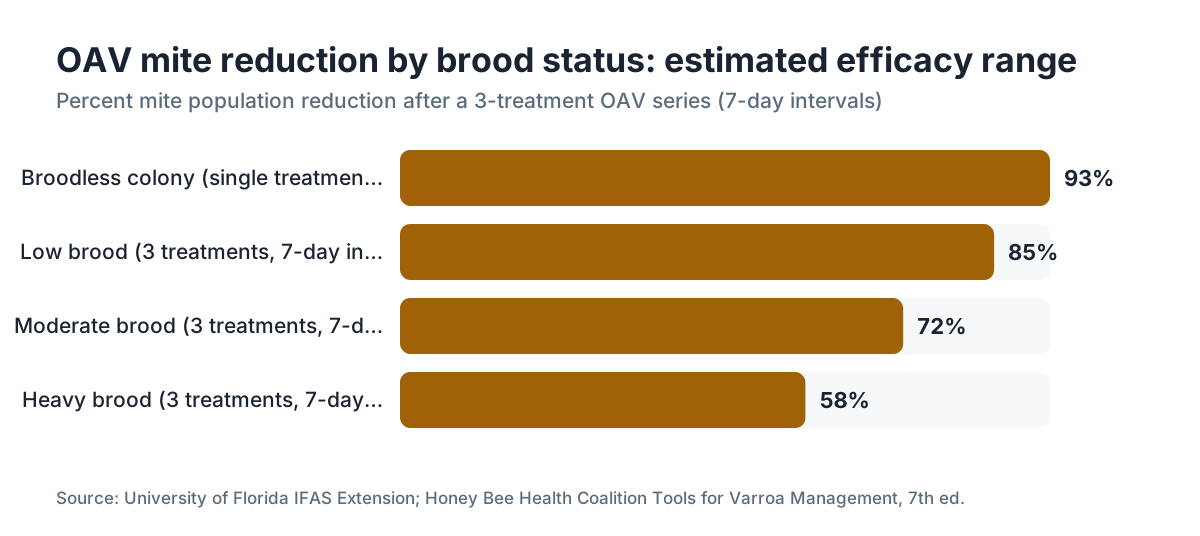
This is why a broodless colony (or a small winter cluster with almost no capped brood) responds far better to OAV than a colony in full summer production. With no brood to hide in, a single well-timed treatment can hit 90-95% of mites. Under heavy brood, you're always chasing the ones sealed away. [3] Three applications 7 days apart is roughly the minimum series needed to keep pace with mites cycling out of cells during a treatment window.
Is 7 days actually the best interval, or just the legal one?
Here's the honest version. The 7-day interval on the label came from the mite biology above and EPA's registration process, not from a dense network of field trials comparing 5-day vs. 7-day vs. 10-day intervals under identical conditions. Nobody has a clean head-to-head dataset here.
What research exists suggests that going slightly shorter, in the 4-7 day range, may improve efficacy during high-brood conditions because you catch a larger fraction of the emerging mite wave. A University of Florida IFAS study examining treatment timing found that colonies treated with multiple short-interval OAV applications during high-brood periods showed greater reductions in mite levels than single or widely spaced treatments. [3] That study was not designed as a regulatory trial, and going below 7 days is off-label in the U.S. regardless of what the biology suggests.
For most hobbyist situations, 7 days is close enough to optimal. In a broodless period the interval matters much less because there's no cell-hiding to worry about. Three treatments 7 days apart during a natural or induced broodless window will hammer mites as hard as any interval tweak would.
The Honey Bee Health Coalition's Varroa management guide notes that OAV "is most effective when colonies are broodless or have little capped brood" and that repeated treatments improve efficacy in colonies with brood present. [4] That's about as clean a summary of the situation as you'll find.
How many OAV treatments does it actually take to get mites under control?
One treatment almost never gets you there in a colony with brood. The math is simple. If roughly 80-90% of varroa mites in a colony with normal brood are sealed in cells at any given time, a single OAV treatment might kill only 10-20% of the total mite population even with high vapor efficiency. [2] Three treatments spaced 7 days apart stack those kills across multiple emergence waves.
Studies on OAV efficacy in colonies with brood have reported mite reduction rates ranging from about 55% to 95% across a 3-treatment series, depending on brood levels and treatment conditions. [3] In broodless colonies, a single treatment can achieve 90%+ reduction. That range matters. Treat three times during a full honey flow with substantial brood present and you might only cut your mite load by 60%. You could start with 2 mites per 100 bees and end with 0.8, which sounds fine but may still sit above the economic threshold heading into fall.
This is why counting mites before and after a treatment series is not optional. You need to know whether three applications actually brought you below roughly 2 mites per 100 bees (a commonly cited treatment threshold for most of the season) or just knocked the population down for a week. [4] If you're still above threshold after three OAV applications, it's time to consider a different treatment option or reassess colony conditions.
Does the interval change if the colony is broodless?
Yes, substantially. In a truly broodless colony, the logic of multiple treatments changes because you're not racing against a brood cell cycle. No mites hidden under caps means a single good OAV application can contact a very high percentage of the total mite population.
For winter broodless treatment, many extension programs recommend a single OAV application or a short series of two to three treatments even though brood is absent, simply because clustering bees don't all get equal vapor exposure in one pass. [5] Virginia Cooperative Extension recommends treating "2-3 times at 5-7 day intervals" even in winter, acknowledging that vapor distribution through a tight winter cluster can be uneven. [5]
During an induced broodless period, where you've caged the queen or pulled all brood frames, the recommendation is similar. Two to three treatments over 5-7 days ensures vapor reaches every corner of the colony and contacts any mite missed in a previous round. The EPA label's 7-day minimum still applies legally regardless of brood status.
So broodlessness doesn't mean one treatment is always enough. It means one treatment is a lot more effective than in a colony with heavy brood, and the series is shorter because you're not fighting the emergence wave.
What equipment and safety steps affect how well each vaporization works?
Interval recommendations assume each individual treatment actually works. A poorly sealed hive, an under-heated vaporizer, or an application that's cut short will waste a treatment slot. That stings, because you only get three per year.
Standard guidance is to seal all entrances and openings for at least 10 minutes post-application to let vapor distribute through the colony. [6] Most practitioners let colonies sit 10-15 minutes before reopening. Temperatures below about 50°F (10°C) can reduce mite mortality because cold bees cluster tightly and vapor penetration suffers. [5] On the flip side, very hot summer days can cause the acid to dissipate faster than it should.
Vaporizer wand placement matters too. The wand tip should reach into the brood box so vapor rises naturally through the colony. Block the bottom entrance with foam and seal the screened bottom board if one is present. [6]
Safety is not optional here. Oxalic acid vapor is a serious respiratory hazard. The EPA label requires a half-face respirator with an acid-gas cartridge, protective goggles, and chemical-resistant gloves at minimum. [1] Even with proper gear, you don't want to be in the vapor plume. Treat from the side, not directly over the entrance.
If you're building out your treatment kit, our beekeeping supplies resources can help you decide which vaporizer options and protective gear are worth the money.
Can you use OAV more than 3 times a year if mite counts are still high?
No, not legally. The Api-Bvar label limits use to three treatments per colony per year, and that limit is federal. [1] Using it more is an off-label application, which is illegal under FIFRA regardless of what the biology might support.
If mite levels sit above threshold after a complete 3-application OAV series, switch to a different approved treatment. Amitraz (Apivar strips), formic acid (Mite Away Quick Strips or Formic Pro), and thymol-based treatments (Apiguard) are all options depending on your temperature range and timing. The Honey Bee Health Coalition's Varroa management guide has a treatment decision matrix organized by season and brood status that's worth keeping bookmarked. [4]
Some beekeepers run OAV as one part of an integrated approach. They hit the brood-protected mite population first with formic acid or amitraz, then finish with OAV during a naturally broodless fall or winter period to clean up phoretic survivors. That's a legal and sensible sequence as long as each product's label requirements are followed and the OAV count doesn't exceed three.
How do you know if the OAV interval and number of treatments actually worked?
Count mites before and after. There's no other way to know.
The standard monitoring methods are an alcohol wash (most accurate) and a sugar roll (gentler but slightly less precise). An alcohol wash means sampling roughly 300 adult bees from the brood nest and counting the mites that fall off after agitation in alcohol. [9] You're after the count expressed as mites per 100 bees.
Most extension programs and the Honey Bee Health Coalition use a treatment threshold of approximately 2 mites per 100 bees during the brood-rearing season, with a lower threshold of about 1 mite per 100 bees recommended heading into August or September when the winter bee population is being produced. [4] These are the bees that need to be healthy going into winter. A colony that starts September with 3 mites per 100 bees is in serious trouble by November.
Count before your treatment series starts, then count again 7-14 days after the final application. If you haven't dropped below the relevant threshold, the treatment didn't do enough. That can happen even with a well-executed OAV series if brood levels were high during treatment, so check the conditions before you blame the protocol. Understanding varroa mite biology and monitoring basics is the context you need to read those post-treatment counts.
VarroaVault has a free mite counting and treatment timing tracker that logs pre- and post-treatment counts, calculates mites per 100 bees, and flags when you're approaching threshold again.
Does the interval recommendation differ between hobbyist and commercial operations?
The EPA label applies equally regardless of operation size. Three treatments, minimum 7 days apart, maximum three per year. Same for a backyard beekeeper with two hives and a commercial pollinator with 2,000. [1]
What differs in practice is feasibility. Hobbyists can often get into every colony every 7 days for three rounds. Commercial operations sometimes struggle with the labor math across hundreds of colonies, and the timing has to line up with pollination contracts and honey production windows. That's a management challenge, not a label modification.
Some large operations have moved toward induced broodless periods at scale, either through queen caging or splits, specifically to improve OAV efficacy in a single pass rather than committing to a three-treatment series. That's smart economics if you have the queen-handling capacity.
For sideliner operations running 25-150 colonies, the three-treatment OAV series during fall dearth stays the most common protocol and is well supported by extension guidance from states like Virginia, Pennsylvania, and North Carolina. [5] Pairing OAV with solid monitoring records is the difference between a program that works and one that just costs time and money.
What are the common mistakes beekeepers make with OAV timing and intervals?
Waiting too long to start is probably the most common. Beekeepers watch mite counts climb in late summer, decide to wait for the honey supers to come off, and then treat in October when the winter bees are already being damaged by virus-vectoring mites. The ideal OAV window for fall treatment is typically August through September in most of the northern U.S., while there's still enough warm weather for good vapor distribution and before the winter bee cohort is fully committed. [5]
The second mistake is treating once and assuming it worked. One OAV treatment in a colony with any appreciable brood is almost certainly not enough. Budget for all three applications upfront.
Third: skipping the post-treatment mite count. You can't manage what you don't measure. Treat in August, then count again in mid-September. If counts are still high, you have time to switch to another registered product before winter. Skip the count and you won't know until your colony is collapsing in January.
Fourth: poor hive sealing during treatment. A leaky hive lets vapor escape before it distributes. Take five minutes to foam the entrance and cover the screened bottom. It makes a measurable difference in how well the treatment works.
Fifth: ignoring temperature. Treating when ambient temperatures are below 50°F risks poor efficacy and stresses the cluster. This is a real consideration for beekeepers trying to squeeze in a late-fall or early-spring treatment. [5]
For help comparing treatment supplies and sourcing protective gear, our beekeeping supply companies roundups can point you to reliable sources without overpaying.
How does repeated OAV compare to other varroa treatments on the market?
Each approved treatment has a different profile depending on brood status, temperature window, and labor. The table below lays out the key parameters for the main registered options in the U.S.
| Treatment | Active Ingredient | Brood-penetrating? | Temp range (F) | Applications | Contact time |
|---|---|---|---|---|---|
| Api-Bvar (OAV) | Oxalic acid | No | >50°F recommended | Up to 3, 7 days apart | 10 min per hive |
| Apivar strips | Amitraz | Yes (slow) | 50-85°F | 2 strips, 6-8 weeks | 6-8 weeks |
| Mite Away Quick Strips | Formic acid | Yes | 50-79°F | 1-2 applications | 7 days |
| Formic Pro | Formic acid | Yes | 50-84°F | 1-2 applications | 14-21 days |
| Apiguard | Thymol | Partial | >60°F | 2 trays, 2 weeks apart | 2-4 weeks |
OAV wins on speed per hive (one person can treat a colony in under 5 minutes once set up) and cost per application (roughly $0.10-0.25 in oxalic acid per treatment, with the vaporizer itself running $100-300 depending on model). [7] The tradeoff is the brood limitation. Treat in the middle of summer with a full brood nest and amitraz strips or formic acid will reach brood-protected mites that OAV simply cannot touch.
Amitraz strips run a roughly 6-8 week contact window and do penetrate cell cappings to kill reproducing mites, which makes them the dominant fall treatment for many commercial beekeepers despite documented resistance concerns in some mite populations. [10] Formic acid is the only treatment that kills mites in capped brood and is approved for use while honey supers are on in some jurisdictions, though label terms vary by product. [10]
Frequently asked questions
Can I do more than 3 OAV treatments in a year if mites are still high?
No. The Api-Bvar EPA label caps use at three treatments per colony per year. That limit is federal and applies to everyone. If mite counts remain above threshold after three OAV applications, switch to a different registered product such as amitraz strips, formic acid, or thymol. Using OAV a fourth time in the same calendar year is an illegal off-label application under FIFRA.
What is the minimum number of days between oxalic acid vapor treatments?
The EPA-registered label requires a minimum of 7 days between OAV applications. Going shorter is an off-label use, which is illegal regardless of what mite biology might suggest about shorter intervals. Most extension guidance recommends treating on exactly 7-day spacing, though some research suggests 5-7 days may be slightly more effective during high-brood periods. The 7-day label minimum is the rule in practice.
Does OAV kill mites inside capped brood cells?
No. Oxalic acid vapor only contacts phoretic mites riding on adult bees. Mites sealed inside capped brood cells are completely protected from the vapor. This is why multiple treatments spaced 7 days apart are needed when brood is present, each round catching mites that emerged from cells since the previous application. OAV works best, often with a single treatment, when the colony is fully broodless.
How many OAV treatments does a broodless colony need?
A truly broodless colony may respond well to a single OAV treatment if vapor distribution through the cluster is thorough, but most extension programs still recommend two to three treatments at 5-7 day intervals even in winter. The reasoning is that vapor may not reach every bee in a tight winter cluster in one pass. Two treatments during a broodless window provides reasonable insurance without the full three-application cost.
What temperature is too cold for OAV to work effectively?
Most extension guidance recommends avoiding OAV treatment when ambient temperatures are below about 50°F (10°C). Cold bees cluster more tightly, which limits vapor penetration through the cluster. The oxalic acid vapor itself still forms at any temperature the vaporizer can generate, but mite kill is reduced when bees aren't distributed across frames. Virginia Cooperative Extension specifically notes 50°F as a lower effective threshold.
Is it legal to use OAV while honey supers are on the hive?
The Api-Bvar label does not allow use when honey supers intended for human consumption are on the hive. Remove honey supers before treating. This is a meaningful timing constraint for summer mite management during a honey flow. Formic acid products like Formic Pro have different label terms and are approved in some situations with supers on, making them a better choice for mid-season treatment if you can't pull supers.
What mite count should trigger a repeated OAV treatment series?
The Honey Bee Health Coalition and most university extension programs recommend treating when alcohol wash counts reach 2 mites per 100 bees during the main brood-rearing season. A lower threshold of roughly 1 mite per 100 bees is commonly recommended in August and September, when protecting the winter bee cohort is the priority. Count before starting any treatment series and again 7-14 days after the final application.
What respirator do I need to use an oxalic acid vaporizer?
The Api-Bvar EPA label requires a half-face respirator with an acid-gas cartridge (NIOSH-approved for oxalic acid), protective goggles, and chemical-resistant gloves. A dust mask or N95 is not sufficient protection against acid vapor. You should also position yourself to the side of the hive entrance rather than directly in front of the vapor plume, and avoid treating in enclosed spaces without significant ventilation.
How do I know if my OAV treatment series actually worked?
Count mites by alcohol wash before and after the treatment series. Sample roughly 300 bees from the brood nest, agitate in isopropyl alcohol, and count the mites that fall out. Express the result as mites per 100 bees. Take your post-treatment count 7-14 days after the final application. If you're still above the 2-per-100 threshold during the brood season, the treatment series wasn't sufficient and a different product should be considered.
Can I combine OAV with other mite treatments like amitraz or formic acid?
Sequencing different treatments is common and legitimate. A typical integrated approach runs amitraz strips or formic acid during summer when brood is heavy (since these penetrate capped cells), then follows with an OAV series during fall broodlessness to clean up remaining phoretic mites. Overlapping two treatments simultaneously in the same colony is generally not recommended due to additive stress and lack of safety data supporting combined residue levels.
Does OAV cause oxalic acid residues in honey?
Oxalic acid occurs naturally in honey at low levels (typically 8-40 mg/kg depending on floral source). Registered OAV treatments have not been shown to increase honey residues above naturally occurring background levels when used per label instructions, which include not treating with supers on. The EPA reviewed residue data during the Api-Bvar registration process. The label prohibition on treating with supers present is the practical safeguard in place.
What is the best time of year for a repeated OAV series?
Late summer and early fall, roughly August through September in most of the northern U.S., is widely considered the most important treatment window. Mite populations peak in late summer, winter bees are starting to develop, and temperatures are still warm enough for effective vapor distribution. A second common window is midwinter during natural broodlessness. Summer treatment during honey flows is legally constrained by the prohibition on treating with supers on the hive.
How long does each OAV treatment actually take per hive?
Once your vaporizer is up to temperature, each hive takes about 2-3 minutes of vaporization time plus 10-15 minutes of sealed dwell time. In practice, a beekeeper with one vaporizer can treat one hive, then move to the next while the first is dwell-timing. With efficient setup, experienced beekeepers treat 8-15 colonies per hour. The total time commitment for a three-treatment series across 10 hives is manageable in a single weekend morning each round.
Can OAV be used in a nucleus colony or package?
Yes, OAV can be used in nucleus colonies and new packages, and the label's three-treatment limit still applies. Small colony size actually improves vapor distribution since there's less volume for the acid to fill. Nucs established in spring often have periods of partial broodlessness that make OAV timing more straightforward. As with any colony, mite monitoring before and after treatment is the right way to confirm it worked.
Sources
- EPA - Api-Bvar Oxalic Acid Vaporizer Product Label (Regulation: EPA Reg. No. 92859-1): Api-Bvar label allows a maximum of three treatments per colony per year, each at least 7 days apart, and prohibits use when honey supers are on the hive
- USDA ARS - Varroa destructor biology and life cycle reference: Varroa mite completes its reproductive cycle inside a capped worker cell over approximately 12 days; phoretic period averages 4-11 days depending on season and brood availability
- University of Florida IFAS Extension - Honey Bee Diseases and Pests: Varroa Mites: Multiple short-interval OAV applications during high-brood periods show greater mite reductions than single or widely-spaced treatments; mite reduction rates in colonies with brood range from 55-95% across a 3-treatment OAV series
- Honey Bee Health Coalition - Tools for Varroa Management Guide (7th edition): OAV is most effective when colonies are broodless or have little capped brood; treatment threshold of approximately 2 mites per 100 bees during brood-rearing season; lower threshold of 1 mite per 100 bees recommended in August-September to protect winter bee cohort
- Virginia Cooperative Extension - Varroa Mite Management in Honey Bee Colonies: Extension recommends 2-3 OAV treatments at 5-7 day intervals even in broodless winter colonies; 50°F cited as effective lower temperature threshold; fall treatment window highlighted for August-September timing
- Pennsylvania State University Extension - Oxalic Acid Vaporization for Varroa Mite Control: Standard OAV practice requires sealing all hive entrances and openings for at least 10 minutes post-application to allow vapor distribution; proper vaporizer wand placement inside the brood box is recommended
- North Carolina State University Apiculture - Varroa Treatment Costs and Comparisons: OAV treatment costs approximately $0.10-0.25 in oxalic acid per treatment; vaporizer equipment ranges from $100-300 depending on model
- EPA - Pesticide Registration: Oxalic Acid for Varroa Mite Control (FIFRA basis): Using a registered pesticide at rates, frequencies, or applications beyond label instructions is illegal under FIFRA; off-label use includes treating more than three times per year or more frequently than every 7 days
- University of Minnesota Extension - Varroa Mite Monitoring and Management: Alcohol wash using approximately 300 bees from the brood nest is the most accurate monitoring method; results expressed as mites per 100 bees
- Honey Bee Health Coalition - Tools for Varroa Management: Treatment Comparison Table: Amitraz strips require 6-8 week contact time and do penetrate capped cells; amitraz resistance concerns documented in some mite populations; formic acid is approved for use with honey supers in some products
Last updated 2026-07-09