Rhubarb leaves for varroa treatment: what the science actually says
TL;DR
- Rhubarb leaves contain oxalic acid, the same compound in EPA-registered varroa treatments, but putting the raw leaves in a hive is illegal under U.S.
- pesticide law, unproven at effective concentrations, and probably toxic to bees.
- Use registered oxalic acid products instead.
- No published study shows rhubarb leaf application controls varroa at a brood-safe dose.
Why do beekeepers think rhubarb leaves could treat varroa?
The idea makes intuitive sense. Rhubarb leaves are loaded with oxalic acid, the same active ingredient in Api-Bioxal, the only EPA-registered oxalic acid product for varroa control in the United States [1]. Hobbyists have chased cheap, natural alternatives to commercial miticides for years, and "rhubarb is free from the garden" sounds great when a 35-gram packet of Api-Bioxal runs $25 to $40.
The logic goes like this. Oxalic acid kills mites. Rhubarb leaves have oxalic acid. So boil the leaves and pour the tea in, right?
That skips several steps that matter enormously in practice: concentration, formulation, residue behavior inside the hive, and legality.
This article works through each one honestly. Some of the chemistry is genuinely interesting. The conclusion is not a close call.
How much oxalic acid do rhubarb leaves actually contain?
Rhubarb leaves hold roughly 0.5 to 1.0 percent oxalate by fresh weight, with some samples measured as high as 1.25 percent [2]. That's high for a plant. It sounds like plenty until you line it up against what a registered product delivers.
A standard Api-Bioxal dribble mixes 3.5 grams of oxalic acid dihydrate into 35 mL of sugar syrup, giving a roughly 10 percent solution by weight [1]. The dose is tight and repeatable. A rhubarb leaf decoction would be far more dilute, and its strength would swing with leaf age, growing conditions, cooking time, and how much water you used. There's no standard preparation, so there's no reliable dose.
Concentration is the whole ballgame in miticide work. Too low and mites survive. Too high and you burn your bees. Api-Bioxal exists in a fixed formulation because the manufacturer ran efficacy and safety trials to find the narrow window where mite death is high and bee death is acceptable. Nobody has done that work for rhubarb leaf tea.
Oxalate also varies inside the plant. The petiole (the stalk people eat) is much lower in oxalate than the leaf blade. The leaves are the toxic part, which is why nobody eats them, and any hive application built from leaf material would concentrate the plant's most hazardous fraction.
Is it legal to use rhubarb leaves in a beehive in the United States?
No. Full stop.
Under the Federal Insecticide, Fungicide, and Rodenticide Act (FIFRA), any substance you apply to a hive to control a pest is a pesticide and must be registered with the EPA before use [3]. The oxalic acid registration covers Api-Bioxal only, as one specific formulated product with one specific label. Raw rhubarb leaves, a leaf extract, or any homemade oxalic acid brew is an unregistered pesticide use.
Applying an unregistered pesticide is a federal violation. For sideliners and commercial operators, it also opens liability if residues turn up in honey and a state apiarist catches them at inspection. For hobbyists, enforcement is rare, but the legal exposure is real and so is the risk of tainting your honey crop.
The label is the law. Api-Bioxal's label sets the formulation, the concentration, the application method (dribble, vaporization, or spray), and the timing limits. No label exists for rhubarb leaves. EPA guidance puts it plainly: "The label is the law," and using a pesticide inconsistent with its labeling violates FIFRA Section 12(a)(2)(G) [11].
Beekeepers in countries with looser pesticide rules have experimented with hardware-grade oxalic acid (wood bleach) or plant preparations. That's a different regulatory world. Borrowing those habits for American beekeeping is a mistake.
What does the research say about oxalic acid from plant sources versus registered products?
No peer-reviewed study has tested rhubarb leaf preparations for varroa control. That silence tells you something. Researchers have studied oxalic acid for varroa since the 1990s, and the compound is well described in the apiculture literature [4]. The field moved toward pure formulations, not plant extracts, because you can't reproduce results without controlling purity and concentration.
The Honey Bee Health Coalition's Varroa Management Guide, one of the most cited practitioner resources in North America, lists Api-Bioxal as the registered oxalic acid option and never mentions plant-derived preparations [5]. That reflects where the evidence sits.
A study by Gregorc and Planinc in Apidologie tested oxalic acid at controlled concentrations and found high mite mortality with acceptable bee losses when dose and timing were managed [4]. Note the phrase "controlled concentrations." Their work, like every reputable oxalic acid trial, used purified oxalic acid solutions, not plant decoctions.
One adjacent point. Some researchers have studied rhubarb (Rheum palmatum, the medicinal species) extracts for antimicrobial or antiparasitic activity in settings that have nothing to do with beehives. Killing something in a lab assay is not the same as treating 60,000 bees safely and legally.
For background on the mite itself and how it breeds inside capped brood, the varroa mite overview explains why treatment timing matters so much.
Could rhubarb leaves harm bees or contaminate honey?
Yes, on both counts.
At high concentrations, oxalic acid is corrosive to bee tissue. Api-Bioxal sits at a fixed concentration because the dose-response curve for bees is steep. A little past the right amount and bee mortality climbs fast. A rhubarb preparation with unknown oxalate content is a coin flip on overdose.
The leaves carry more than oxalic acid. They also contain anthraquinone glycosides. Nobody has mapped how those compounds affect honey bees, but the principle holds: a crude plant extract adds unknowns, and some of those unknowns could kill bees or lodge in wax and honey.
Honey contamination is a fair worry. Oxalic acid residues from Api-Bioxal use have been measured. The European Food Safety Authority set a maximum residue limit of 25 mg/kg for oxalic acid in honey and noted that naturally occurring levels typically run 13 to 40 mg/kg depending on floral source [6]. A rhubarb leaf treatment could add oxalate residues plus plant-specific secondary compounds that have no safety profile in honey at all.
If you sell honey, that risk is both unacceptable and impossible to quantify.
How does oxalic acid actually kill varroa mites?
Oxalic acid is a contact miticide. Bees walk through a dribbled solution or move through vaporized crystals and pick the compound up on their bodies. Mites feeding on those bees contact it and die, most likely from damage to their outer cuticle and disruption of basic metabolism [4].
The mechanism explains why rhubarb leaves would fail even at a perfect concentration. Oxalic acid works on phoretic mites, the ones riding adult bees. It has essentially zero effect on mites sealed inside capped brood [5]. That's why timing against the brood cycle is everything.
A rhubarb decoction as a wash or spray would need to coat bees at an even concentration across the whole cluster. Good luck. Vaporization, the method that reaches mites throughout the hive, needs a pure solid (oxalic acid dihydrate crystals) that sublimes cleanly at a set temperature. You cannot vaporize rhubarb leaves. The plant matrix would burn, not sublime, and you'd pump combustion products into the hive.
So the only workable route for a leaf preparation is a liquid dribble or spray. That's already the weakest of the three registered Api-Bioxal methods.
What are the registered oxalic acid treatment options that actually work?
Api-Bioxal is the only EPA-registered oxalic acid product for beehives in the U.S. as of 2025 [1]. You can apply it three ways, each with its own label rules:
| Method | When to use | Efficacy on phoretic mites | Brood required? |
|---|---|---|---|
| Dribble (syrup) | Broodless period | 90-95% in studies [4] | No brood preferred |
| Vaporization | Broodless or repeated treatments | 90-97% in some trials [5] | Works better broodless |
| Spray | Package bees, swarms | High on package bees | No brood |
The broodless requirement drives everything. Oxalic acid doesn't reach capped cells, so mites inside brood during treatment survive. Applied in winter after the queen stops laying, a single treatment can crush mite loads because nearly every mite is out riding a bee.
During the brood-rearing season, most beekeepers vaporize every 5 days for 3 rounds to catch mites as they emerge, instead of waiting for a true broodless window. The Api-Bioxal label caps dribble at 3 applications per year and gives separate guidance for vaporization, so read yours carefully [1].
On cost, a 35-gram packet treats about 10 colonies by dribble or 2 to 3 by vaporization depending on dose. At $25 to $40 a packet, the per-colony cost is small next to the price of a dead hive.
Are there other natural or organic varroa treatments that are actually approved?
Yes, several. The EPA-registered organic acid and essential oil options approved for organic production include oxalic acid (Api-Bioxal), formic acid (Mite Away Quick Strips and FormiVar), and thymol (Apilife VAR and Apiguard) [5]. Each has its own temperature window, efficacy range, and brood-safety catch.
Formic acid is the only registered treatment with real efficacy against mites inside capped brood, which makes it useful during the season. It's fussier to apply and hard on bees when temperatures climb, so the window matters. Apilife VAR and Apiguard run on thymol and work best between roughly 60 and 85 degrees F.
The Honey Bee Health Coalition's Varroa Management Guide puts every approved treatment, its temperature range, its timing, and its efficacy data in one free download [5]. Pair that document with a regular alcohol-wash monitoring routine and you have the foundation of a seasonal protocol.
VarroaVault has a free treatment timing calculator and protocol builder if you want to map which treatment to apply when, against your local brood cycle and current mite load. That kind of planning keeps you from grabbing something unproven because you weren't ready with something registered.
For sourcing registered treatments and monitoring gear, the beekeeping supply companies guide covers where to buy and how to compare price and shipping.
What should you do if your mite load is high and you're out of registered treatment?
Don't reach for the rhubarb. Order product tonight. Treat the day it lands.
In a real emergency with a colony sliding fast, the quickest legal move is an oxalic acid vaporization with Api-Bioxal if you have any on hand, or a formic acid strip if temperatures fall in range. Drone brood removal and a brood break (caging the queen) can slow mite reproduction while you wait for the mail.
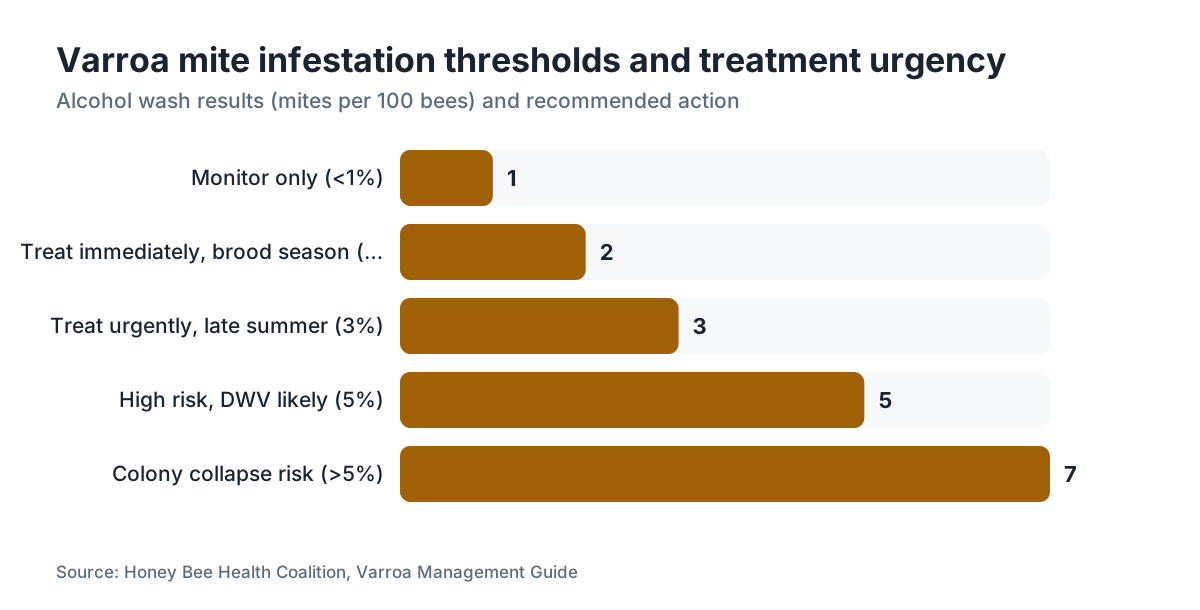
Nobody has clean data on exactly how many days a colony survives a heavy mite load before collapse turns irreversible. The window shuts fast in summer, when brood cycles are short and mite reproduction peaks. A colony reading 3 percent on an alcohol wash is already in trouble. At 5 percent or above, you're likely watching deformed wing virus show up in emerging bees.
To understand what's happening at the colony level, the varroa mite overview covers the reproductive biology and why mite loads snowball.
If you're new to monitoring and treatment planning, start with university extension resources. Penn State Extension's apiculture program and the University of Minnesota Bee Lab both publish free mite management guides kept current with product approvals [7][8].
Does anything in folk or traditional beekeeping have legitimate varroa-fighting potential?
It's an honest question, and it deserves an honest answer. Some traditional and plant-based approaches have real data behind them, even when they aren't EPA-registered here.
Thymol, pulled from thyme oil, is a traditional antimicrobial that researchers took seriously enough to run full efficacy trials. Now it's registered as Apilife VAR and Apiguard. That's what the road from folk remedy to approved treatment looks like: controlled trials, dose-response work, residue studies, regulatory review.
Anethole (from anise), formic acid (found naturally in ant secretions), and oxalic acid itself (present in many plants and in honey) walked the same road. Natural doesn't mean safe or effective at useful doses. It also doesn't rule a compound out.
Researchers have screened essential oils including oregano, wintergreen, and eucalyptus for acaricidal activity against Varroa destructor in lab assays. Results are mixed, and none are near U.S. registration [9]. The gap between "kills mites in a petri dish" and "can be applied to a colony at a dose that kills mites without harming bees, brood, or honey" is wide.
Rhubarb leaves haven't drawn serious research attention as a treatment. Not because researchers never heard of oxalic acid, but because raw plant material is a much harder problem than the purified compound that's already registered and works.
Respect the pipeline. If plant-based approaches interest you, follow the research, use what's registered, and monitor your mites so you actually know whether anything you try is working.
How do you actually monitor for varroa to know if any treatment is working?
Monitoring is the step most hobbyists skip, and it's why treatments fail. You can't tell whether a treatment worked if you never counted mites before and after.
The alcohol wash (or soapy water wash) is the standard. Take a roughly 300-bee sample off a brood frame, wash them in 70 percent isopropyl alcohol or a soapy water mix, and count the mites that drop. Mites per 100 bees is your infestation rate. The Honey Bee Health Coalition recommends treating at 2 mites per 100 bees (2 percent) during brood season [5].
Sticky boards are the other option. You count natural mite drop over 24 to 72 hours and apply a conversion factor to estimate the colony load. Less accurate than an alcohol wash, but it doesn't kill any bees.
Monitor before treatment. Monitor again 10 to 14 days after. If the load didn't fall much, either the treatment failed (timing, temperature, or application error) or mites are pouring in from a collapsing colony nearby (reinfestation). Both demand a response.
The Bee Informed Partnership's national management survey found that beekeepers who reported monitoring and treating on a threshold had lower winter losses than those who didn't monitor [10]. That's the clearest signal we have that monitoring-guided treatment beats treating on a calendar.
VarroaVault's free alcohol wash calculator turns your bee count and mite count into an infestation percentage with a treatment recommendation.
Frequently asked questions
Can I make a rhubarb leaf spray and use it on my bees?
No. A rhubarb leaf spray is an unregistered pesticide under FIFRA, and using it in a hive is a federal violation. Beyond the law, the oxalic acid concentration in a leaf decoction is unpredictable, and rhubarb leaves carry other compounds whose effects on bees and honey residues are unstudied. No research shows it works.
Are rhubarb leaves toxic to bees?
Potentially yes. At high concentrations, oxalic acid is corrosive to bee tissue. Rhubarb leaves also contain anthraquinone glycosides whose toxicity to bees isn't characterized. The risk isn't hypothetical: applying an unknown concentration of a corrosive acid plus uncharacterized plant compounds to a colony could cause real bee death with no proven mite control to show for it.
What is the oxalic acid content of rhubarb leaves?
Published analyses find total oxalates in rhubarb leaves at roughly 0.5 to 1.25 percent of fresh weight. That's high for a plant, but far below the concentration in an Api-Bioxal treatment. A leaf decoction varies with leaf maturity, growing conditions, and preparation, so hitting a reliable therapeutic dose with raw plant material isn't feasible.
Is oxalic acid from rhubarb the same as oxalic acid in Api-Bioxal?
Chemically, yes. Oxalic acid is oxalic acid. But Api-Bioxal is purified oxalic acid dihydrate at a precise concentration, formulated for consistent delivery. Rhubarb leaf preparations deliver oxalic acid alongside dozens of other plant compounds at an uncontrolled strength. Same molecule; completely different product quality, dose control, and legal status.
What varroa treatments are approved for organic beekeeping?
In the U.S., three treatment types are approved for organic production: oxalic acid (Api-Bioxal), formic acid (Mite Away Quick Strips, FormiVar), and thymol (Apilife VAR, Apiguard). All require following the EPA label. The Honey Bee Health Coalition's Varroa Management Guide lists every approved option with temperature ranges and application details. No plant-derived home preparation has approval.
How does varroa mite infestation rate affect colony survival?
The Honey Bee Health Coalition recommends treating at 2 mites per 100 bees during brood season and 2 to 3 percent in late summer before winter bees develop. Above 3 percent, deformed wing virus load usually climbs sharply. Above 5 percent, winter survival odds fall hard. These thresholds come from field data collected across North American monitoring programs.
Why can't I just use oxalic acid from the hardware store instead of Api-Bioxal?
Hardware-grade oxalic acid (sold as wood bleach or deck cleaner) is an unregistered pesticide when applied to a hive. It may also carry impurities absent from food or pharmaceutical grade material. Using it violates FIFRA the same way rhubarb leaves would. The cost gap versus Api-Bioxal is real, but so is the legal exposure and the residue risk in your honey.
Will rhubarb leaves work as a varroa treatment in a broodless hive?
No research shows rhubarb leaf preparations work in any hive condition. A broodless period is when oxalic acid treatments hit hardest because all mites are phoretic, but that only helps with a proper registered product at a known concentration. Being broodless doesn't fix the concentration, legality, or safety problems with raw leaf preparations.
Can I smoke rhubarb leaves in my smoker to treat varroa?
No. Burning rhubarb leaves produces combustion products, not vaporized oxalic acid. Vaporization with Api-Bioxal works because pure oxalic acid crystals sublime (go straight from solid to vapor) at controlled temperatures. Plant material combusts and produces a complex smoke of carbon compounds that don't deliver oxalic acid at any useful concentration and may harm bees.
What's the cheapest legal way to treat for varroa?
Oxalic acid dribble with Api-Bioxal during a broodless period runs about $2 to $4 per colony when a 35-gram packet treats 10 colonies. A one-time vaporizer purchase ($40 to $150 depending on model) drops per-treatment cost below $1 a colony. Formic acid strips and thymol products cost more per treatment but earn it with brood-season utility for active colonies.
How do I know if my varroa treatment actually worked?
Run an alcohol wash or soapy water wash before treatment to set your baseline. Repeat 10 to 14 days after. A correctly applied, well-timed treatment should drop mite load by at least 90 percent. If counts stay high, check your application method, the temperature during treatment, and whether reinfestation from neighboring colonies is undoing your work.
Are there any studies on plant-based varroa treatments besides thymol and oxalic acid?
Yes, but none have reached U.S. registration. Researchers have screened essential oils from oregano, eucalyptus, wintergreen, and others for acaricidal activity against Varroa destructor. Lab results are sometimes promising. Field efficacy at a dose safe for bees is a separate, harder question, and none of these preparations have finished the EPA registration path. The research continues; no product is close.
Could rhubarb leaves contaminate honey with oxalate residues?
Potentially yes, plus other plant compounds. Honey naturally holds oxalic acid at 13 to 40 mg/kg depending on floral source, and the European Food Safety Authority set a maximum residue limit of 25 mg/kg for treatment-derived oxalic acid. A rhubarb leaf application would add oxalates of unknown quantity plus plant secondary metabolites with no established residue limits or safety data in honey.
Sources
- EPA, Api-Bioxal Registration and Label: Api-Bioxal is the only EPA-registered oxalic acid product for varroa control in U.S. beehives, with specific formulation, concentration, and application method requirements on its label.
- USDA Agricultural Research Service, Oxalate Content of Foods: Total oxalate content in rhubarb leaves is approximately 0.5 to 1.25 percent of fresh weight in published analyses.
- EPA, FIFRA Overview and Pesticide Registration Requirements: Under FIFRA, any substance applied to a hive to control a pest is a pesticide and must be EPA-registered before use; using an unregistered pesticide violates FIFRA Section 12(a)(2)(G).
- Gregorc A, Planinc I. Acaricidal effect of oxalic acid in honeybee (Apis mellifera) colonies. Apidologie, 2001.: Controlled concentration oxalic acid treatments achieve 90-95 percent mite mortality with acceptable bee losses when concentration and timing are properly managed.
- Honey Bee Health Coalition, Varroa Management Guide: The HBHC Varroa Management Guide lists approved organic acid and thymol treatments, recommends treatment at 2 mites per 100 bees during brood season, and notes oxalic acid has essentially zero efficacy against mites in capped brood.
- European Food Safety Authority, Scientific Opinion on Oxalic Acid in Honey: EFSA set a maximum residue limit of 25 mg/kg for oxalic acid in honey from treatment; naturally occurring oxalic acid in honey ranges from 13 to 40 mg/kg depending on floral source.
- Penn State Extension, Varroa Mite Management: Penn State Extension publishes free mite management guides updated with current EPA-approved product information for hobbyist and commercial beekeepers.
- University of Minnesota Bee Lab, Varroa Resources: The University of Minnesota Bee Lab provides research-based varroa management guidance including alcohol wash protocols and approved treatment options.
- Imdorf A, Bogdanov S, Ochoa RI, Calderone NW. Use of essential oils for the control of Varroa jacobsoni Oud. in honey bee colonies. Apidologie, 1999.: Essential oil research including oregano, wintergreen, and eucalyptus shows variable lab results against Varroa destructor but none have completed EPA registration in the U.S.
- Bee Informed Partnership, National Management Survey: Colonies where owners reported using alcohol wash monitoring and threshold-based treatment had lower winter loss rates compared to colonies managed without monitoring.
- EPA, Label Is the Law - Pesticide Use: The EPA designates the pesticide label as a legal document; use inconsistent with label directions is a federal violation under FIFRA.
Last updated 2026-07-09