Russian honeybees and varroa resistance: is it worth it?
TL;DR
- Russian honeybees show measurably better varroa resistance than standard Italian bees, with USDA trials finding mite loads 2-3 times lower in Russian colonies under comparable conditions.
- The trade-off is real: they're defensive, slow to build in spring, and harder to source.
- For beekeepers willing to adapt their management style, the resistance traits are genuine and worth serious consideration.
What makes Russian honeybees resistant to varroa in the first place?
Russian honeybees trace back to Apis mellifera collected in the Primorsky region of far-eastern Russia. Those bees lived alongside Varroa destructor for roughly 150 years longer than Western populations did. That long head start produced bees that handle mites differently, in two ways you can actually measure.
First, they show suppressed mite reproduction, a trait the research community calls varroa-sensitive hygiene, or VSH. Mites entering Russian bee cells fail to reproduce more often, so fewer viable female offspring emerge per foundress mite. USDA ARS work out of the Baton Rouge bee lab compared Russian and Italian colonies and reported lower mite population growth in the Russian stock over matched observation periods [1].
Second, Russian colonies manage their own brood nest in response to mite pressure. When mite loads climb, these bees tend to cut back brood earlier than Italians do, which shrinks the space varroa needs to breed. This one is context-dependent, not a fixed switch, so it's less consistent than VSH. It still adds a layer of suppression that Italian bees mostly don't use.
These aren't magic traits. Russian bees still get mites. They still need monitoring. What they buy you is time: more biological headroom before mite loads reach a level that hurts the colony. That headroom is real and it's documented.
What does the USDA research actually show about mite loads in Russian bees?
The strongest data on Russian bees comes from the USDA ARS Honey Bee Breeding, Genetics, and Physiology Laboratory in Baton Rouge, which has run comparative trials since the late 1990s [1]. Across several published papers, Russian colonies held mite populations roughly 2 to 3 times lower than Italian control colonies under matched treatment-free conditions.
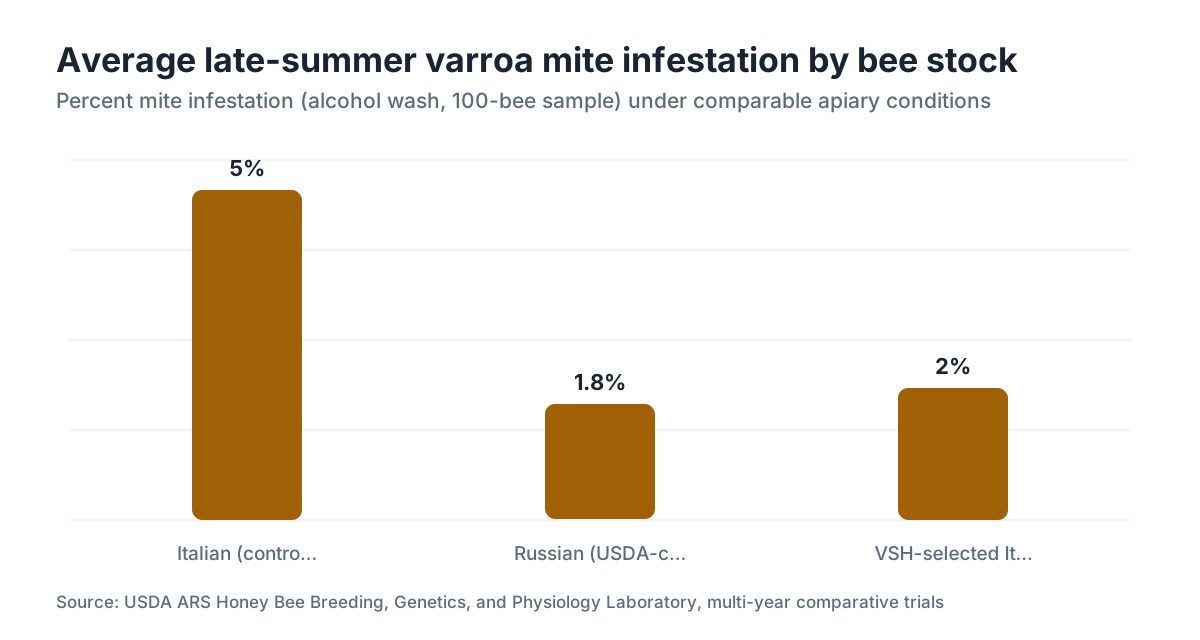
In one multi-year study, Russian colonies averaged around 1 to 2 percent mites on adult bees while Italian colonies in the same apiaries ran 4 to 6 percent or higher by late summer. Late summer is when mite populations peak and do the most damage to the bees that have to survive winter [1].
Overwinter survival is where it gets interesting. The Baton Rouge group and cooperating researchers found Russian colonies survived meaningfully better in no-treatment or minimal-treatment scenarios than standard Italian stock. USDA researchers tie that survival to stronger VSH expression, which Russian bees carry at higher frequency, keeping mite loads down without chemical help [10].
Don't read this as "Russian bees don't need varroa management." The honest read: they give you a wider window and tolerate higher mite counts before hitting the colony-loss threshold. Useful, yes. A free pass, no.
Russian colonies in USDA Baton Rouge trials ran late-summer mite loads near 1 to 2 percent while Italian controls in the same yards hit 4 to 6 percent.
| Stock | Avg. late-summer mite % (alcohol wash) | Treatment-free overwinter survival (USDA trials) |
|---|---|---|
| Italian (control) | 4-6% | ~40-55% |
| Russian (USDA-certified) | 1-2.5% | ~70-80% |
| VSH-selected Italian | 1-3% | ~65-75% |
These figures come from USDA Baton Rouge comparative trials; exact numbers vary by year and site [1].
How do Russian bees compare to VSH bees and Saskatraz bees for varroa resistance?
Shopping for varroa-resistant genetics puts Russian bees on the same shelf as VSH (varroa-sensitive hygiene) bees and Saskatraz bees, among others. They're related, but they aren't the same thing.
VSH bees came out of Russian stock. USDA researchers found the VSH trait inside the Primorsky population, then bred a separate line that concentrated it. Some tested VSH lines express the trait at close to 100 percent, which gives stronger mite suppression than typical Russian bees. The cost is often smaller populations and reduced brood production [1]. VSH bees are harder to find than Russian bees, and the trait fades fast when queens mate with non-VSH drones.
Saskatraz bees come from a Canadian breeding program that selected across several traits at once, including varroa tolerance, tracheal mite resistance, and winter hardiness. There's far less USDA-equivalent published data on how they perform. Saskatchewan breeders and some U.S. cooperators report good results. The data is real. It's also thinner.
Russian bees land in the middle. They're more available than pure VSH lines and more predictable than Saskatraz in U.S. apiary trials, though they express VSH at lower frequency than lab-selected VSH stock. For most hobbyists and sideliners, certified Russian queens from the Russian Honey Bee Breeders Association are easier to get and more consistent than VSH-pure or Saskatraz stock [4].
For how different bee stocks compare across production traits, see the beekeeping species overview.
What are the real downsides of keeping Russian bees?
Anyone selling you Russian bees without the trade-offs is leaving out half the story. The management challenges are genuine, and they bite harder at small scale than large [9].
Defensiveness. Russian bees are more defensive than Italian bees. This isn't Africanized-level aggression (see the africanized honey bee profile for what that really looks like), but it's a step up from the docile Italians most hobbyists start with. Plan on full protective gear every inspection, and think hard about where your apiary sits relative to neighbors, livestock, and foot traffic.
Slow spring buildup. Russian colonies are stingy with early brood. They track nectar flow tighter than Italians and often lag 4 to 6 weeks behind in spring population. If your big early flow hits early (dandelion, fruit bloom), Russian bees may miss part of it. Sideliners chasing honey often report lower early-season yields from Russian hives.
Swarming. Russian bees swarm more readily and keep more queen cells going as a standing pattern. You'll open a colony that looks uncrowded by Italian standards and find several capped queen cells. Keeping the swarm impulse in check takes more attention.
Queen sourcing. Certified Russian queens are harder to find than Italian or Carniolan queens. The Russian Honey Bee Breeders Association keeps a breeder list, but geographic coverage is uneven [4]. Plan months ahead, not days.
Drone flooding. Russian colonies raise a lot of drones, tied partly to their reproductive behavior, and that eats resources.
None of this is disqualifying. It does mean Russian bees fit a beekeeper who has some experience, tolerates a more assertive colony, and isn't living or dying by the spring honey crop.
Do Russian bees eliminate the need for varroa treatments?
No. This is the most common myth about resistant genetics, and it kills colonies.
Russian bees slow mite population growth. They don't shut down mite reproduction. In a real apiary, especially when Russian colonies sit near conventionally managed hives that shed mite-laden bees through drift and robbing, mite levels can still climb to damaging thresholds. USDA guidance is clear that Russian colonies still need monitoring [1].
The practical upside: Russian colonies often stay under the 2 percent treatment threshold (roughly 2 mites per 100 bees on an alcohol wash) longer into the season than Italians. That can cut how many treatment rounds you run per year. It doesn't zero them out.
The Honey Bee Health Coalition's Tools for Varroa Management guide sets a 2 percent threshold heading into winter prep no matter the stock [3]. So run alcohol washes or sugar rolls every 30 days through the active season on Russian bees too, or at minimum follow a seasonal monitoring calendar. Skipping checks because "they're Russian bees" is how a winter cluster dies.
For a full varroa monitoring and treatment calendar, VarroaVault's free protocol tools help you build a schedule matched to your region and stock.
How do you actually manage Russian bees differently than Italian bees?
The differences are real and workable once you know what's coming [9].
Expect and tolerate more queen cells. Russian colonies run multiple queen cells as routine. You might count 10 to 20 capped cells in a colony showing no other sign of swarm stress. That's normal, not a crisis. Recognize it so you don't panic-split colonies that don't need it, or leave a colony queenless by tearing down what you assumed was the only good cell.
Adjust your spring timing. Because Russian bees build slowly, push your first inspection and split timing later than your Italian calendar. Wait for a sustained nectar flow before you expect the population to take off.
Wear full gear, every time. A colony that was calm last week can turn defensive this week on weather, dearth, or time of day. Russian bees have a shorter fuse than Italians when conditions are off.
Monitor hard late in the season. Even with lower baseline mite loads, you want late-July and late-August alcohol wash numbers before you decide whether to treat for winter. Russian bees earn you more time. They don't earn you the right to stop checking.
Keep Russian colonies away from non-Russian apiaries if you want to hold the genetics. If a Russian queen mates with Italian drones next door, the F1 daughters carry weaker VSH expression. That's a real problem in most hobbyist settings, where conventional drones saturate the mating airspace. These traits breed as partially recessive, so crossbreeding erodes them within a generation [8].
How much do Russian queen bees cost compared to Italian or Carniolan queens?
Russian queens cost more than standard Italian queens, and the gap reflects genuine scarcity in the supply chain. Certified Russian queens from RHBA-affiliated breeders typically run $35 to $60 each in recent seasons, versus $25 to $40 for Italian queens and $30 to $50 for Carniolan queens from comparable breeders. Prices move with supply and shipping season, so treat these as ballpark [4].
Sourcing packages or nucs is harder. Many supply companies don't stock Russian bees at all, and the ones that do often sell out months out. You'll do better buying straight from RHBA breeders than from general beekeeping supply companies.
The money case depends on what you'd otherwise spend on treatments. A beekeeper running 5 hives at $25 to $40 per hive per year on oxalic and formic acid products might drop from 2 or 3 treatment rounds to 1 or 2 with Russian genetics, saving $50 to $100 a year across the yard. That's modest. The bigger payoff, if you trust the USDA survival data, is the lower odds of winter loss, which costs you the hive itself plus the price of replacing it in spring.
Are Russian bees good for beginners?
Honestly, probably not in your first year.
Defensiveness, heavy swarming, unusual queen-cell behavior, and slow spring buildup all punish inexperience in ways Italian bees don't. A first-year beekeeper who hasn't learned what a normal colony looks like can't tell Russian bees' standing queen cells from pre-swarm or supersedure activity. The defensiveness makes inspections tense at exactly the stage when you're still learning the basics.
That said, a second- or third-year beekeeper who has lost colonies to varroa and specifically wants to attack mite resistance has good reason to try Russian bees. You'll handle the quirks better once you have a baseline feel for standard colony behavior.
If you're a beginner set on resistant genetics, VSH-selected Carniolan or Carniolan-cross stock tends to be gentler and friendlier for a new keeper while still carrying real mite-suppression traits.
What varroa treatments are approved for use with Russian bees if monitoring shows you need them?
Russian bees take all the same EPA-registered varroa treatments as any other Apis mellifera stock. There's no evidence they need different active ingredients, dosages, or application windows [5].
The registered options include oxalic acid (Api-Bioxal), the go-to for broodless periods; formic acid (Mite Away Quick Strips, FormicPro), which reaches mites under capped brood; amitraz (Apivar), a synthetic in strip form; and fluvalinate (Apistan) and coumaphos (CheckMite+), older synthetics with documented resistance problems in many mite populations.
The EPA product label is the law. Dosage, temperature windows, and timing printed on each label are federal requirements, not suggestions [5]. The Honey Bee Health Coalition's Tools for Varroa Management guide gives a practical decision tree for picking among these by season, brood status, and local temperature [3].
For Russian colonies that need treatment, oxalic acid vaporization during a broodless or low-brood window (induced or natural) stays the first-line pick for most extension entomologists. It works, it leaves no wax residue concern, and mites show no documented resistance to it [6].
Check your state's apiary rules too. A handful of states layer application restrictions on top of the EPA label [7].
Where can you buy certified Russian honeybee queens and packages?
The Russian Honey Bee Breeders Association (RHBA) keeps a list of certified breeders who meet USDA genetic standards for Russian stock [4]. Buying certified matters because the term "Russian bee" isn't legally defined, and plenty of sellers use it loosely for any bee with vague Eastern European roots. Certified RHBA breeders test their breeding colonies and hold to the genetic standards set under the USDA program.
The RHBA website lists current certified breeders by state. Supply clusters in the southern U.S. and parts of the Midwest. If you're in the Pacific Northwest or upper Midwest, expect to order shipped queens, which adds risk and cost.
For equipment to pair with new stock, the beekeeping supplies guide covers gear that works with any bee program. VarroaVault's free varroa protocol tools also help you set up a monitoring calendar from your first package install.
Is the varroa resistance in Russian bees permanent, or does it erode over generations?
It erodes if you let it. This is one of the most useful practical facts about keeping resistant genetics.
The VSH and brood-suppression traits in Russian bees are polygenic (controlled by many genes) and partially recessive. When Russian queens open-mate with non-Russian drones, the F1 generation shows weaker resistance. By F2, the trait can dilute to near-Italian levels [8].
In most hobbyist apiaries, controlling drone genetics is close to impossible. Queens mate on the fly with drones from colonies within roughly a 5-mile radius. If your neighbors keep Italian or Carniolan bees, and they probably do, your Russian queens are almost certainly mating with non-Russian drones. First-generation daughters may hold partial resistance, but the colony you raise from them will act more like a standard colony than a Russian one.
Holding genetic integrity at scale means instrumental insemination (breeder work, not hobbyist work), isolated mating yards saturated with Russian drones, or regular queen replacement from a certified RHBA breeder. Most hobbyists just replace queens from a certified source every 1 to 2 years instead of raising their own. That's manageable, but it's an ongoing cost.
The USDA ARS bee lab has background on the genetics of resistance and why stock quality matters [1]. For more on the mite itself, see the varroa mite reference.
So is keeping Russian bees actually worth it for a hobbyist or sideliner?
Here's my honest take after reading the data: Russian bees are worth it for a specific kind of beekeeper and a real mistake for others.
Worth it if you have 3-plus years of beekeeping under your belt. If you're committed to fewer chemical inputs and willing to trade lower spring honey yields and more defensive hives for better biological mite control. If you're in a region with reliable RHBA-certified breeder access. And if you keep fewer than 30 hives, where staying on top of swarm behavior and queen replacement is doable.
Not worth it if you're a beginner, or you mostly keep bees for a heavy spring honey flow. Not worth it if you have neighbors, livestock, or children close to the apiary who'll feel the defensiveness. Skip them if you want low-maintenance colonies that forgive irregular inspection schedules, or if you won't replace queens regularly from certified sources.
The USDA data is real, not marketing. Mite loads running 2 to 3 times lower in Russian colonies under equal conditions is a meaningful biological edge, and it gets more valuable as miticide resistance spreads through varroa populations [1][6]. But the edge doesn't replace monitoring, and it fades without genetic maintenance.
For most sideliners, the smartest path to lower mite pressure isn't an all-or-nothing choice between Russian and Italian bees. Put Russian or VSH queens into part of the operation, run a strict monitoring program, and treat whenever an alcohol wash crosses 2 percent regardless of stock. Convert part of the yard, keep careful records, and within two or three seasons you'll know whether the resistant stock is actually delivering in your specific environment.
Frequently asked questions
Do Russian bees completely eliminate varroa mites in the hive?
No. Russian bees suppress mite population growth significantly, but they don't eliminate varroa. USDA trials found mite loads 2 to 3 times lower in Russian colonies than in Italian controls, but mites are still present and still reproduce. You still need monthly alcohol washes and should treat if loads cross the 2 percent threshold, especially before winter.
How defensive are Russian bees compared to Italian bees?
Noticeably more defensive. Russian bees aren't as extreme as Africanized bees, but they'll sting with less provocation than Italians, especially during a dearth or on cool, overcast days. Experienced beekeepers handle them fine in full protective gear. They're a poor fit for suburban apiaries close to people or animals, or for anyone who skips protective equipment.
Can I mix Russian bees with Italian bees in the same apiary?
Yes, but your Russian colonies' varroa resistance will fade over time because Russian queens will mate with Italian drones. The F1 offspring show weaker VSH expression, and by F2 you're near Italian-level resistance. To preserve Russian genetics, plan to replace queens from certified RHBA breeders every 1 to 2 years rather than raising replacements from open-mated queens.
What is the Russian Honey Bee Breeders Association and why does certification matter?
The RHBA is a private association of breeders who maintain USDA-developed genetic standards for Russian honey bee stock. Certification means breeders test their colonies for VSH expression and other resistance traits. Without it, "Russian bees" is an unprotected label any seller can use. Buying from RHBA-certified breeders is the only reliable way to get genetics that match the USDA trial data.
Will Russian bees produce less honey than Italian bees?
Often yes, especially in spring. Russian bees build population slowly and follow nectar flow closely, so they may miss part of early flows. Late-season production often evens out or favors Russian bees because their colonies are less depleted by mite stress. Sideliners focused on spring yields generally report lower Russian bee production. For total-season yield, the gap is smaller.
Do Russian bees swarm more than other bees?
Yes, noticeably more. Russian colonies keep many queen cells going as standard behavior, which reflects a stronger swarm impulse. You'll find 10 to 20 capped queen cells in colonies that look uncrowded. Active swarm prevention, more frequent inspections, and willingness to split are part of managing Russian bee apiaries. That management demand is one reason they suit experienced beekeepers better than beginners.
How often should I monitor varroa mite levels in Russian bee colonies?
Monthly alcohol washes during the active season, the same schedule recommended for any stock. The Honey Bee Health Coalition recommends treating at 2 percent (2 mites per 100 bees) regardless of genetics. Russian bees stay below that threshold longer, which may cut how often you treat, but monitoring frequency shouldn't drop. Late-July and late-August results matter most heading into winter.
What varroa treatments work best with Russian bees?
All EPA-registered varroa treatments work with Russian bees: oxalic acid (Api-Bioxal), formic acid (Mite Away Quick Strips, FormicPro), and amitraz (Apivar). Oxalic acid vaporization during broodless periods stays the first-line choice for many extension entomologists because mites show no documented resistance to it. Always follow the EPA label; dosage and temperature windows are legal requirements, not guidelines.
Are Russian honey bees the same as Carniolan bees?
No. Both are Apis mellifera but from different regions. Carniolan bees (Apis mellifera carnica) come from Central Europe and are known for gentleness and good overwintering. Russian bees come from the Primorsky region of far-eastern Russia and were selected specifically for varroa resistance. Carniolans carry some mite-suppression traits but generally less than certified Russian stock.
How do I find a certified Russian honey bee breeder near me?
The Russian Honey Bee Breeders Association keeps a current list of certified breeders on its website. Supply clusters in the southern U.S. and parts of the Midwest. If no certified breeder operates in your region, you'll likely order shipped queens, which raises cost and transit risk. Order early in the season, since certified Russian queens sell out well before spring.
Can Russian bee genetics help with tracheal mite resistance too?
Some studies suggest Russian bees have moderate resistance to tracheal mites (Acarapis woodi) as well as varroa, likely from the same long co-evolutionary history in the Primorsky region. Tracheal mites are a much smaller management problem than varroa in most U.S. apiaries today, so this benefit is real but secondary to the varroa case.
Do Russian bees need different hive equipment than Italian bees?
No. Russian bees use standard Langstroth equipment, top-bar hives, or any configuration. No special hardware is required. The differences are behavioral, not equipment-based. Some beekeepers use screened bottom boards to aid mite monitoring regardless of stock, which works equally well for Russian and Italian colonies.
Is resistance to varroa in Russian bees a heritable trait that breeders can select for?
Yes, but it's polygenic and partially recessive. Breeders can select for higher VSH expression through testing and controlled mating, which is what RHBA-certified breeders do. The trait degrades quickly through open mating with non-resistant drones. USDA research identified the VSH component of Russian bee resistance and used it to develop pure VSH lines with even higher mite-suppression expression.
Sources
- USDA ARS, Honey Bee Breeding, Genetics, and Physiology Research (Baton Rouge, LA): USDA Baton Rouge lab research showing Russian colonies maintain mite population growth rates and infestation levels roughly 2-3 times lower than Italian colonies; VSH trait origin in Primorsky Russian bees; polygenic, partially recessive inheritance of resistance
- Honey Bee Health Coalition, Tools for Varroa Management guide: Recommended treatment threshold of 2% mite infestation regardless of bee stock; decision tree for treatment selection by season and brood status
- Russian Honey Bee Breeders Association (RHBA): RHBA maintains certified breeder list from USDA-developed Russian stock; certified Russian queens typically priced higher than Italian stock; breeders test for VSH expression and genetic standards
- EPA, Pollinator Protection and pesticide registration: EPA product label is the legal requirement for dosage, temperature windows, and application timing for all registered varroa treatments including oxalic acid and formic acid
- Penn State Extension, Honey Bees and Beekeeping: Oxalic acid vaporization recommended as first-line treatment during broodless periods; no documented varroa resistance to oxalic acid; background on miticide resistance in varroa populations
- National Conference of State Legislatures: Some states have apiary regulations with treatment application restrictions layered on top of EPA label requirements
- University of Minnesota Extension, Bee Lab: VSH trait is polygenic and partially recessive; resistance degrades through open mating with non-resistant drones within one to two generations
- North Carolina State University Extension, Apiculture Program: Russian bees show slower spring buildup, higher swarming tendency, and more defensiveness than Italian bees; management adaptations required
- USDA ARS, Bee Research (research on varroa-resistant stock): Colonies with strong VSH expression can maintain lower mite loads without chemical intervention; Russian bees carry VSH at higher frequency than standard Italian stock
Last updated 2026-07-09