Safe oxalic acid vaporization frequency without harming bees

TL;DR
- The EPA-registered label for Api-Bioxal allows up to three oxalic acid vapor treatments per year, with individual treatments spaced no more than 17 days apart during a broodless or low-brood period.
- Most research and extension guidance points to three applications at 5-day intervals as the sweet spot: high efficacy, minimal bee harm, and staying within legal label limits.
What does the EPA-registered label actually say about treatment frequency?
The legal ceiling in the United States is set by the Api-Bioxal label, which is the only EPA-registered oxalic acid product for use in honey bee colonies. The label permits vaporization as a single treatment of up to three applications, with each application no more than 17 days apart. That three-application cycle may be repeated up to three times per year [1].
That last part trips people up. Three applications is one treatment cycle, not three separate single treatments. So your maximum legal annual exposure is nine individual vaporizations (three cycles of three), not three. Read the label carefully before you plan a season-long protocol.
The 17-day interval between applications in a cycle is not arbitrary. Varroa mite development inside a capped cell takes roughly 10 to 14 days, and the 17-day cap gives brood emerging between treatments a chance to be exposed before new capping seals mites away again. In a colony with active brood, hitting every 5 to 7 days is more effective than waiting the full 17, but the label permits any interval up to 17 days.
One thing the label does not explicitly restrict is the presence of a honey super intended for harvest, though best practice and most state extension guidance is to remove supers before treatment. Check your state apiarist's current guidance because some states have additional restrictions layered on top of the federal label.
How many oxalic acid vapor treatments actually kill varroa without hurting bees?
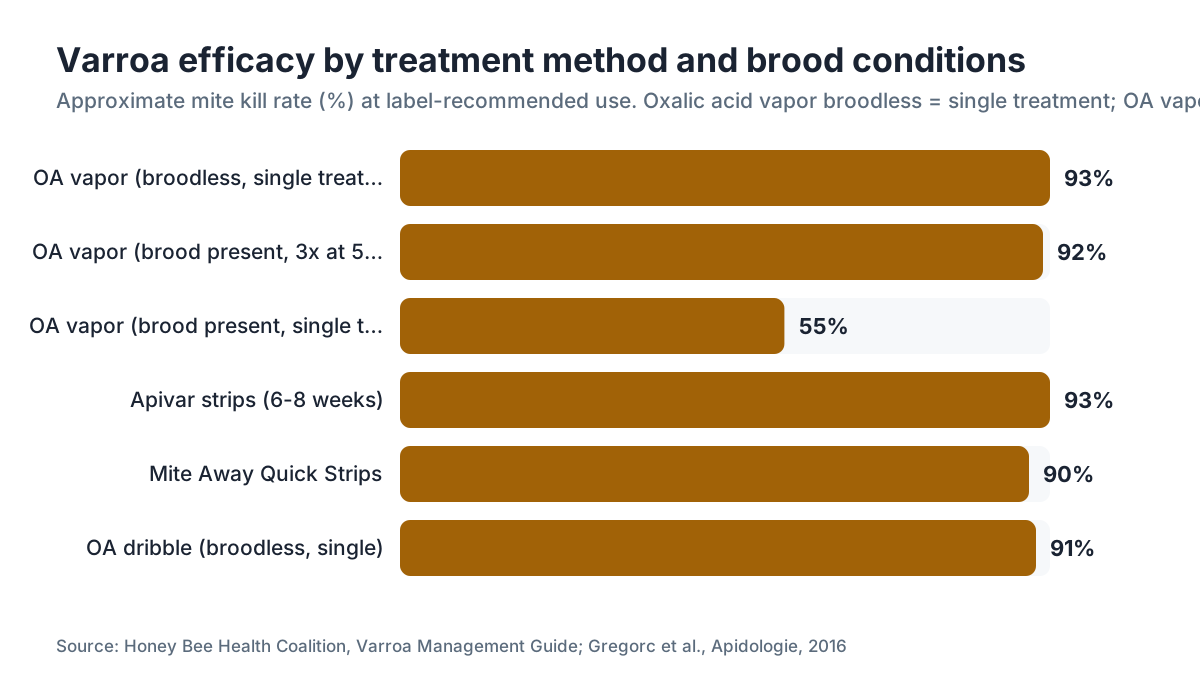
The most-cited evidence on this comes from work summarized by the Honey Bee Health Coalition's Varroa management guide, which describes oxalic acid vaporization as most effective during broodless periods but still useful when brood is present if treatments are repeated at short intervals [2]. A colony that is fully broodless (during a natural winter break or an induced broodless period) can knock varroa counts down more than 90 percent with a single vaporization, because there are no capped cells sheltering mites.
When brood is present, efficacy per treatment drops sharply. Studies from several European research programs, including work published by the journal Apidologie, found that repeated short-interval treatments (every 5 days, three times) under conditions with sealed brood achieved roughly 90 to 95 percent efficacy, comparable to a single treatment of a broodless colony [3]. The key is that repeated treatments catch mites as they emerge from cells before they can reproduce and re-enter new cells.
What about bee harm? At normal label-recommended doses (1 gram of oxalic acid dihydrate per brood chamber), research has not shown statistically significant increases in adult bee mortality when treatments are spaced 5 or more days apart [3]. Treating more frequently than every 5 days or using doses above label rates is where harm accumulates. Bees absorb oxalic acid through direct contact and also ingest residues on comb; at very high doses it damages the gut epithelium, so stacking treatments too close together compounds exposure before bees can clear it.
Does a broodless colony change how often you should vaporize?
Yes, dramatically. A single vaporization of a broodless colony can achieve efficacy above 90 percent because every mite in the hive is phoretic (riding on adult bees) and directly exposed to the vapor [2]. You do not need three treatments in a broodless hive. One good vaporization, confirmed by a wash or sticky board count three to five days later, is usually enough.
This is why winter is the best time to use oxalic acid for many beekeepers in temperate climates. The colony is naturally broodless from roughly November through January depending on your latitude, and a single well-executed treatment can drive mites to near-zero before the next season's brood explosion. The Honey Bee Health Coalition recommends this winter single-treatment approach as a core part of an integrated varroa management calendar [2].
If you are treating a broodless split or a queenless colony (while the beekeeper waits for a new queen to start laying), the same logic applies. One treatment handles it. Once a queen is laying and brood is capping again, the calculus shifts and you need either repeated short-interval treatments or a switch to a different treatment class that has capped-brood penetration.
What interval between vaporizations is safest for adult bees?
Five days is the interval most consistently supported by both efficacy data and bee-safety research. Treating every 5 days for three treatments (days 1, 6, and 11, roughly) keeps mite pressure down while giving adult bees enough time between exposures to metabolize and clear oxalic acid residues.
The label's outer limit of 17 days is a safety margin on the upper end, not a recommendation. Treating every 17 days when brood is present is actually less effective because mites have time to cap into new cells and reproduce between your treatments. The 17-day cap exists to bound the treatment cycle, not to prescribe the optimal interval.
If you are worried about bee health specifically, the relevant variable is cumulative dose, more than frequency. One gram per brood chamber per application is the label rate. Using 1.5 or 2 grams because you want faster results does not improve efficacy meaningfully and increases the toxicity burden on workers. Stick to label rates at a 5 to 7 day interval and you are in the well-studied safe zone.
There is also a seasonal bee-health concern. Treating heavily in late summer when colonies are raising winter bees (the long-lived fat bees that will carry the colony through winter) imposes stress at the worst possible time. Some beekeepers prefer to do a short-interval series in early August, then a second check and treatment if needed in October when brood is naturally declining, rather than treating continuously through the bee-raising window.
Is there a maximum number of total vaporizations per year before bee health suffers?
The label ceiling is nine individual vaporizations per year across three treatment cycles [1]. No published long-term chronic-exposure study I am aware of has tracked colonies receiving the full nine vaporizations season over season for multiple years, so the honest answer is that solid multi-year data does not yet exist at the population level. What we do know from residue studies is that oxalic acid does not accumulate in beeswax at toxicologically meaningful levels the way some synthetic acaricides do, which is part of why the EPA approved it [7].
Practically, most hobbyist and sideliner beekeepers in temperate climates do fine with one winter broodless treatment and one summer short-interval series (three applications), totaling four total vaporizations in a year. That keeps annual mite loads manageable without pushing toward the label ceiling.
The beekeepers most likely to approach the nine-treatment limit are those in warm climates with year-round brood, where there is no natural broodless period and varroa pressure is constant. In those situations, rotating treatment classes is smarter than stacking oxalic acid cycles. Continuous reliance on any single mode of action also raises resistance concerns over time, though oxalic acid's mechanism of action (contact toxicity, not a systemic metabolic pathway) makes resistance less likely than with synthetic miticides [9].
Does vaporization damage bees differently than dribble or spray methods?
The three application methods (vaporization, dribble, and extended-release spray) deliver oxalic acid through completely different routes, which matters for both efficacy and safety. Vaporization produces a fine aerosol that settles on bees throughout the hive, including in areas you cannot physically reach with a dribble. Dribble applies a water-sugar solution directly onto bees between frames, and extended-release shop towel methods provide slow-contact exposure over days to weeks.
For bee safety, the comparison is nuanced. Dribble at the label rate (50 mL of 3.2 percent solution per box) delivers a high immediate dose to bees it contacts directly but does not penetrate capped brood at all. Vaporization delivers lower per-bee concentrations but reaches more bees and reaches them repeatedly if you treat multiple times. At label doses, neither method has been shown to cause statistically significant short-term adult bee mortality in well-designed trials, but dribble during cold weather can chill and kill bees independent of the chemical itself.
Vaporization is generally preferred in winter because you do not have to open the hive or disturb the cluster. But it requires proper equipment, a sealed hive (tape all cracks and the screened bottom board), and personal protective equipment including an OA-rated respirator. The vapor is corrosive to respiratory tissue. This is non-negotiable.
What PPE and safety steps does the EPA require for oxalic acid vaporization?
The Api-Bioxal label requires: a NIOSH-approved respirator with an OV/P100 cartridge (not a dust mask), chemical-resistant gloves, protective eyewear, and a long-sleeved shirt [1]. The vaporizer itself must be powered off and allowed to cool completely before you remove it from the hive entrance. You should not reenter the hive for a minimum of ten minutes after treatment.
Many beekeepers underestimate the respiratory risk here. Oxalic acid vapor is heavier than air and can pool near the ground and at hive entrances. If you are crouching in front of several hives treating them in sequence, vapor exposure adds up. Treat in open air, not in an enclosed barn or shed.
A note on equipment: only vaporizers designed for this purpose and listed on the label are legal for use with Api-Bioxal in the US. The Varrox vaporizer is commonly referenced, but any commercial vaporizer that accepts the 1-gram dose and heats it to vaporization temperature is acceptable as long as it is used according to label directions. Homemade "wand" style vaporizers made from hardware store parts are not legal for use with Api-Bioxal under current EPA registration, even though they are widely used. I am not here to police anyone, but that is the legal reality.
For beekeepers who want to track treatment timing and dose as part of a structured protocol, VarroaVault's free management tools include a treatment log where you can record each vaporization date, dose, and colony response.
How do you know if vaporizations are working, and when should you stop or switch?
Monitoring before and after treatment is the only way to know if your protocol is working. The standard method is an alcohol wash or sugar roll of roughly 300 bees (about half a cup) from the brood nest. A mite count above 2 mites per 100 bees (2 percent infestation rate) is the widely accepted treatment threshold used by most university extension programs and the Honey Bee Health Coalition [2].
Treat, then recheck 3 to 5 days after your last vaporization. If the count has dropped below 1 per 100 and the colony looks healthy, you are done for that cycle. If the count is still above 2 per 100, either your sealing was poor (vapor escaped rather than saturating the cluster), your dose was too low, or you have a high-brood colony where the phoretic fraction is small and a short three-treatment series was not enough.
If counts stay high after two complete three-treatment cycles, switch to a different treatment class. Amitraz (Apivar strips) or a formic acid product (Mite Away Quick Strips, or Formic Pro) works on mites inside capped cells, which vaporization does not [10]. Rotating modes of action is good practice even when counts are under control, not only as a resistance-management tool but because different treatments work better at different times of year [9].
A quick primer on varroa mites themselves is worth reading before you finalize your protocol. The varroa mite article on this site covers the mite's reproductive cycle in detail, which directly informs why treatment timing and interval matter so much.
Can you vaporize when honey supers are on?
This is one of the most common questions, and the answer from the label is: Api-Bioxal is not approved for use when honey supers intended for human consumption are present [1]. That is a hard label restriction. You must remove supers before treatment.
The concern is residue in harvestable honey. Oxalic acid does occur naturally in honey at low levels, but adding more through treatment when supers are present can push residues above background. The EPA and USDA have not set a Maximum Residue Limit (MRL) for oxalic acid in honey in the US as of the last label revision, but the label prohibition on super-on treatment is unambiguous.
If your main honey flow ends in late July and you want to treat in August, pull the supers, extract, then treat. Most colonies in the northern US go into a natural nectar dearth in August anyway, which makes it a practical time to treat before the fall brood-rearing push that produces winter bees.
Does vaporizing multiple hives in the same apiary spread varroa or disease?
Vaporization itself does not spread varroa between colonies. The real concern is treatment timing and robbing behavior, not the oxalic acid. If you treat one colony that becomes weak post-treatment while leaving strong untreated colonies nearby, robbing can spread mites from the weakened hive back to the treated ones. That is an argument for treating all colonies in an apiary at roughly the same time, which most extension programs recommend anyway.
The other apiary-level concern is entrance leakage during treatment. If you tape entrances and block the screened bottom but vapor still escapes through cracks, bees from adjacent hives can drift into it. Proper sealing protects your bees and your neighbors' in a multi-hive apiary.
For beekeepers who also supply their operations with equipment from various sources, checking our notes on beekeeping supplies and beekeeping supply companies can help identify vaporizers and PPE from reputable sources.
How does vaporization frequency compare to other varroa treatment methods?
Here is a direct comparison of the main EPA-registered treatment options and how their application frequency and brood-penetration characteristics differ:
| Treatment | Active Ingredient | Applications Per Cycle | Penetrates Capped Brood | Legal Supers Off Req. |
|---|---|---|---|---|
| Api-Bioxal vapor | Oxalic acid | Up to 3 (17-day max interval) | No | Yes |
| Apivar strips | Amitraz | 1 placement, 6-8 weeks | Yes (indirect) | Yes |
| Mite Away Quick Strips | Formic acid | 1-2 pads, 7 days each | Yes | Yes |
| Formic Pro | Formic acid | 1-2 pads, 14 days each | Yes | Yes |
| Apiguard | Thymol | 2 trays, 2 weeks each | Partial | Yes |
| HopGuard 3 | Hop beta acids | 1-2 strips per cycle | No | No (allowed with supers) |
Oxalic acid vaporization has the shortest individual application time (about 2 minutes per hive once setup is done) and the lowest per-treatment cost, typically under a dollar per colony for the oxalic acid itself [4]. The tradeoff is that it requires more return visits than a 6-week Apivar placement and it does not penetrate capped brood.
For a hobbyist managing fewer than 10 hives, the time cost of three return trips every 5 to 7 days is manageable. At 50 or more colonies, Apivar strips become more practical purely because of labor, even if oxalic acid is cheaper per colony.
No treatment is perfect. The Honey Bee Health Coalition's guide puts it plainly: "The goal of varroa management is not to eliminate varroa but to keep mite populations at levels that do not cause colony damage," and it recommends an integrated approach using monitoring data to guide treatment decisions rather than calendar-based treatment alone [2].
What are the most common mistakes beekeepers make with oxalic acid vaporization?
Poor sealing is the most common cause of treatment failure. If vapor escapes through cracks in the bottom board, gaps around the landing board, or an unblocked screened insert, the hive never reaches an effective vapor concentration. Use painter's tape on every gap and a solid board or tape over the screened bottom. You want to hear bees reacting to the vapor (a brief roaring sound) within 30 to 60 seconds of the vaporizer heating up.
Underdosing happens when beekeepers get nervous about harming bees and use half a gram instead of a full gram. Label rate is 1 gram per brood chamber, with an additional 0.5 grams per super (when supers are present for non-harvest purposes in the rare cases where that is allowed). Underdosing cuts efficacy without meaningfully cutting bee exposure because the bees still absorb the vapor; you just kill fewer mites.
Treating once and assuming the job is done when brood is present is another common mistake. A single vaporization when brood is capped knocks phoretic mites down but leaves reproductive mites untouched inside cells. Those mites emerge with the next generation of bees and start reproducing immediately. You need the follow-up treatments.
Skipping the post-treatment mite wash is the last big one. Treating without confirmation is flying blind. A $10 jar of isopropyl alcohol and a few minutes per hive gives you real data. The Honey Bee Health Coalition offers a free downloadable mite management calendar that pairs treatment events with monitoring checkpoints [2], and VarroaVault's protocol tools can help you track counts across colonies over time.
Frequently asked questions
How many times a year can I vaporize oxalic acid legally in the US?
Under the Api-Bioxal label, you can run up to three treatment cycles per year, with each cycle consisting of up to three individual vaporizations spaced no more than 17 days apart. That is a maximum of nine individual vaporizations per year. Most beekeepers in temperate climates do four to six total and get good control without approaching that ceiling.
Can I vaporize oxalic acid every 5 days and is that safe for bees?
Yes, every 5 days is within label limits and is the interval most supported by efficacy research. Three treatments on days 1, 6, and 11 at the label dose of 1 gram per brood chamber has not shown statistically significant adult bee mortality in published studies. It is more effective than waiting longer between treatments when brood is present in the hive.
Do I need to remove honey supers before oxalic acid vaporization?
Yes. The Api-Bioxal label prohibits vaporization when honey supers intended for human consumption are present. This is a legal requirement, not a suggestion. Remove supers, extract, and then treat. Most beekeepers time summer treatments to coincide with the post-main-flow dearth in late July or August when supers are off anyway.
Does oxalic acid vaporization work when there is brood in the hive?
It works but requires repeated treatments because oxalic acid vapor does not penetrate capped brood cells. Mites reproducing inside cells are protected. Three treatments spaced 5 days apart can achieve 90 to 95 percent efficacy by catching mites as they emerge between treatments. A single treatment when heavy brood is present will only knock down phoretic mites.
What respirator do I need for oxalic acid vaporization?
The Api-Bioxal label requires a NIOSH-approved respirator with an OV/P100 cartridge. A dust mask or surgical mask is not sufficient. Oxalic acid vapor is corrosive to respiratory tissue. Pair it with chemical-resistant gloves and protective eyewear. Treat outdoors or in well-ventilated areas, never in an enclosed space.
How do I know if my oxalic acid vaporization actually worked?
Do an alcohol wash of about 300 bees from the brood nest 3 to 5 days after your last treatment. Count the mites per 100 bees. A count below 1 percent means the treatment worked well. A count still above 2 percent means something went wrong, typically poor hive sealing, underdosing, or a very high brood-to-phoretic-mite ratio requiring more treatment cycles.
Is oxalic acid vaporization safe for queen bees?
At label doses, research has not shown oxalic acid vaporization to cause significantly higher queen loss rates than untreated hives. Anecdotally, some beekeepers report queen losses after treatment, especially if the queen is in a small nucleus colony or exposed to higher-than-label doses. Stick to label rates, seal the hive properly, and your risk of queen harm is low.
Can I vaporize oxalic acid in winter when bees are clustered?
Yes, and this is one of the best times to treat. A broodless winter cluster means all mites are phoretic on adult bees, so a single vaporization can achieve more than 90 percent mite kill. You do not need to open the hive; insert the vaporizer through the entrance, seal it, run the treatment, and wait ten minutes before removing. Keep treatments to one in a broodless winter window.
Does oxalic acid vaporization leave residues in honey or wax?
Oxalic acid does occur naturally in honey at background levels. Research shows that oxalic acid does not accumulate in beeswax at toxicologically significant levels the way synthetic miticides do, which contributed to its EPA registration. Residue levels in honey after properly timed treatments (supers off) remain within naturally occurring ranges. This is one reason it is approved for organic operations.
Can varroa mites become resistant to oxalic acid?
No documented cases of varroa resistance to oxalic acid exist as of current research. Its mechanism is contact toxicity rather than a metabolic pathway mites can evolve around, which makes resistance much less likely than with synthetic acaricides like amitraz or pyrethroids. That said, relying on any single treatment class indefinitely is not best practice, and rotating methods remains recommended.
How long should I wait after vaporizing before I open the hive?
The Api-Bioxal label states a minimum of ten minutes before re-entry. Practically, most beekeepers wait 15 to 20 minutes to make sure the vapor has dispersed. Keep your respirator on when you first crack the lid. Avoid leaning your face directly over the open hive immediately after treatment even if it has been ten minutes, especially in calm, windless conditions.
How does vaporization frequency change for a small nucleus colony vs. a full hive?
A nuc colony with a small population of bees has fewer total mites and a higher proportion of phoretic mites if there is less capped brood. One or two vaporizations at a lower dose (some beekeepers use 0.5 grams for a 5-frame nuc) may be sufficient. Always monitor with a wash before and after to confirm. The 1-gram-per-brood-chamber rate on the label is the safe starting point even for nucs.
What is the difference between oxalic acid dribble and vaporization for treatment frequency?
Dribble is a one-time treatment approved only for broodless colonies; the label does not allow repeated dribble treatments in a single cycle the way vaporization allows three. Vaporization is more flexible and more effective when some brood is present because it reaches bees throughout the hive. In a broodless hive, a single dribble and a single vaporization have comparable efficacy, roughly above 90 percent.
Sources
- EPA, Api-Bioxal Product Label (EPA Reg. No. 92155-1): Api-Bioxal vaporization is permitted for up to three applications per treatment cycle, no more than 17 days apart, for up to three cycles per year; supers for human consumption must be removed; OV/P100 respirator required
- Honey Bee Health Coalition, Varroa Management Guide (latest edition): Single oxalic acid vaporization of broodless colonies achieves over 90 percent efficacy; treatment threshold is 2 mites per 100 bees; integrated monitoring-guided approach recommended
- Gregorc A. et al., Apidologie, 2016, repeated oxalic acid vaporization study: Three vaporizations at 5-day intervals during sealed brood conditions achieved 90 to 95 percent efficacy with no statistically significant increase in adult bee mortality at label doses
- Penn State Extension, Beekeeping: Varroa Mite Management: Oxalic acid vaporization is among the lowest-cost per-colony varroa treatments available; cost of oxalic acid crystals is typically under one dollar per colony per application
- University of Minnesota Extension, Honey Bees: Varroa Mite Management: Oxalic acid vaporization is effective and approved for use in colonies with or without brood; repeated short-interval treatments recommended when brood is present
- Cornell University College of Agriculture and Life Sciences, Honey Bee Disease and Pest Management: Winter broodless treatment with oxalic acid is recommended as a core annual varroa management practice; single vaporization sufficient for broodless colonies
- USDA Agricultural Research Service, Oxalic Acid for Varroa Control: Oxalic acid does not accumulate in beeswax at toxicologically significant levels; no documented varroa resistance to oxalic acid has been identified
- Oregon State University Extension, Integrated Pest Management for Honey Bees: Rotating treatment classes is recommended to reduce mite population pressure and minimize resistance risk; oxalic acid rotation with amitraz or formic acid products described
- Honey Bee Health Coalition, Varroa Management Guide, treatment comparison table: Apivar (amitraz) is placed once for 6 to 8 weeks; Mite Away Quick Strips and Formic Pro penetrate capped brood; HopGuard 3 is permitted with honey supers on
Last updated 2026-07-09