Saving apivar strips: what's safe, what's risky, and what to do
TL;DR
- Apivar (amitraz 3.3%) strips are labeled for single-use treatments of 6 to 10 weeks.
- The EPA label does not permit reuse.
- A strip off-gasses amitraz as it works, so a partially used strip has unknown residual efficacy.
- Sealed, cool storage keeps unopened strips potent through their 2-to-3-year shelf life.
- Reusing strips risks treatment failure and amitraz resistance.
What does the Apivar label actually say about saving or reusing strips?
The Apivar label is a legal document, not a suggestion. Using a pesticide in a way the label doesn't allow is a federal violation under FIFRA (7 U.S.C. § 136j) [1]. The current Apivar label says strips stay in the colony for a minimum of 6 weeks and a maximum of 10 weeks, then come out and go to disposal. It says nothing about reusing them between colonies or between rounds [2].
That silence is deliberate. Amitraz off-gasses continuously from the plastic matrix, so after 6 to 10 weeks in a hive the strip has given up most of its active ingredient. A used strip looks almost exactly like a new one. You cannot tell by looking, touching, or smelling whether 10% or 80% of the amitraz is gone.
Saving a strip that's already done a hive stint and putting it back for a second treatment is off-label. That makes it illegal. It also makes it unreliable. If you're fighting to keep a colony alive, unreliable is the one thing you can't build a plan around.
What is the shelf life of unopened Apivar strips?
Unopened, properly stored Apivar strips carry a shelf life set by the manufacturer, Veto-Pharma. Current production runs are stamped with a 2-to-3-year expiration from the manufacture date [3]. The amitraz sits inside a polymer strip, and as long as the strip stays sealed in its foil at the labeled storage range (roughly 41°F to 77°F, or 5°C to 25°C), breakdown is slow.
Heat is the enemy. A package left in a hot truck, a July barn, or anywhere that regularly climbs past 77°F will lose amitraz faster even before you open it. I can't point you to a published decay curve for heat-stressed unopened strips, but the chemistry isn't a mystery: amitraz is an imine that hydrolyzes faster in heat and moisture [4].
Bought strips at the end of last season? If they've been cool, dry, and sealed in foil, they're almost certainly fine for this year. Read the expiration date on the package. In date, use them.
How much amitraz does a strip actually lose during a treatment cycle?
This is where the data gets interesting, and where the "just save the strips" instinct starts to fall apart.
Work on amitraz release from strips, including residue studies by Bogdanov and colleagues published in Apidologie, shows the active ingredient comes off in a roughly exponential decline, with the heaviest release in the first 2 to 4 weeks [4]. A strip that's been in a colony for 6 to 8 weeks has released somewhere between 50% and 80% of its amitraz load, depending on colony temperature, how much the bees contact it, and humidity.
So a strip pulled after a full cycle may hold 20% to 50% of its original amitraz. Sounds worth saving. The catch is you have no way to measure it in your apiary, and that leftover amitraz is spread unevenly through the matrix. It won't off-gas at the same rate a fresh strip would.
The Honey Bee Health Coalition's Varroa Management Guide ties efficacy directly to keeping acaricide concentrations high through the whole brood cycle, because varroa breed inside capped cells [5]. A partially depleted strip may not hold the killing concentration long enough to catch mites emerging from late-capped brood.
That's the real failure mode. It isn't that a used strip does nothing. It's that it might do just enough to knock mites back without killing them, which is precisely the pressure that breeds amitraz-tolerant varroa.
Does reusing Apivar strips contribute to amitraz resistance?
Yes, and this is the part that should stop any thoughtful beekeeper cold.
Amitraz resistance in Varroa destructor is documented in commercial operations across the United States, Europe, and South America [6]. The mechanism isn't fully worked out, but it follows the pattern of other acaricides: mites that survive a weak dose pass on whatever let them survive. A depleted strip delivers exactly that weak dose.
The Honey Bee Health Coalition names rotating chemistries and finishing full, label-compliant treatments as two main ways to slow resistance [5]. Reused strips fail both. You're applying the same chemistry at a reduced dose. That's the textbook recipe for resistance.
For a beekeeper with five hives, this can feel like somebody else's problem. But amitraz is one of maybe three practical chemical tools a hobbyist has. Losing it to resistance would be a genuine mess with no clean replacement. Skipping a few dollars of savings per round is cheap insurance.
Want the biology behind the pest itself? Start with our overview of the varroa mite.
What's the right way to store Apivar strips before you open them?
Keep sealed packages at room temperature, out of direct sun, away from heat and moisture. The label range is roughly 41°F to 77°F [2]. A basement shelf, a climate-controlled room, or a household refrigerator (not freezer) all work. In hot climates the fridge is a solid choice, as long as strips sit in a sealed container so condensation doesn't form on the packaging when you pull them out.
Don't store strips next to other pesticides, solvents, or fuels. Amitraz reacts poorly with alkaline materials, and while the foil packet is fairly protective, there's no reason to test it.
Buying in bulk at season's end for the price break? Keep the packages sealed until treatment day. Opening the foil starts the off-gassing clock before the strips ever reach a hive. There's thin data on how fast a strip loses amitraz sitting open on a shelf versus inside a colony, but the safe answer is simple: don't leave them open.
For seasonal planning, most reputable beekeeping supply companies carry Apivar year-round, though stock thins in early spring when demand spikes.
Can you store partially used (opened but unused) strips between treatments?
This is a different question from reusing strips that have already been in a hive, and the answer has more shades to it.
Say you open a package for three hives and it holds more strips than you need right now. The unused strips that never touched a hive still carry their full amitraz load. The question is whether you can hold them and use them later.
The label doesn't address mid-package storage, which is a real gap. Veto-Pharma's guidance, in line with standard pesticide practice, is to follow label directions and avoid storing open packages. In plain terms: strips out of their foil are off-gassing. At room temperature, outside a warm hive, that off-gassing runs far slower than at 95°F colony heat. But it isn't zero.
If you end up with leftovers from an open package, reseal them as tightly as you can (a vacuum sealer is ideal, or at minimum press out the air and clip it shut) and store them cool and dark. Use them at your next treatment, not 12 months out. And treat them as slightly depleted, not factory-fresh.
Honestly, the cleaner fix is buying quantities that match your hive count. Odd number of hives per package? Split a purchase with a neighbor.
What are the signs that Apivar strips have gone bad or lost potency?
Looking at the strip tells you nothing reliable. A degraded Apivar strip looks like a fresh one. Color, texture, even smell won't reveal potency (amitraz has a faint odor, but weak smell doesn't mean weak strip).
The real signs of failure show up in your mite counts, not the strip. Do a wash (alcohol wash or sugar roll) at the start of treatment and again 6 to 8 weeks in. If mite levels haven't dropped much, degraded strips or resistance is one explanation. Others include reinfestation from neighboring colonies, bad strip placement, or too short a treatment window [5].
Many experienced beekeepers use this rule of thumb: a full Apivar treatment should cut mite loads by at least 90% to 95%. That exact figure isn't from a single published study, but it lines up with the efficacy Veto-Pharma reports in trial data (greater than 93% under label conditions) [3].
Monitor after treatment. An alcohol wash of 300 bees is the standard. If your post-treatment count still sits above 2 mites per 100 bees (a widely cited fall action threshold in the Northern Hemisphere), don't assume the strips worked and walk away.
How much money are you actually trying to save, and is it worth the risk?
Let's be blunt about the economics, because that's usually what's behind the question.
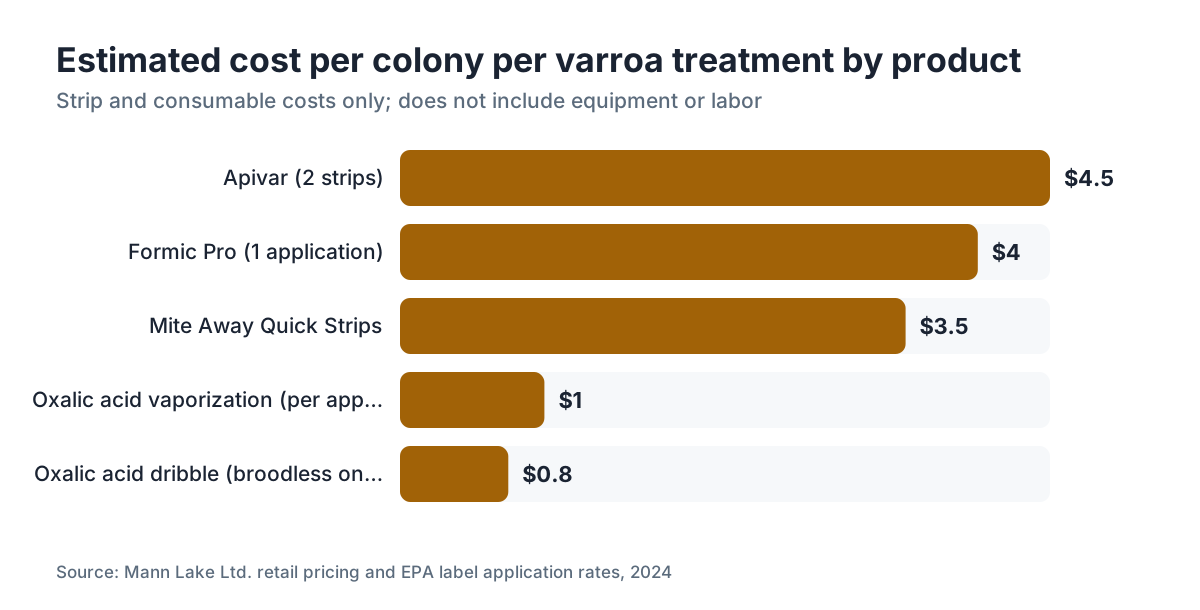
Apivar strips retail around $1.50 to $3.00 each depending on pack size and supplier, running roughly $25 to $45 for a 10-strip pack and $90 to $160 for a 50-strip pack (prices move; check current suppliers) [7]. A standard treatment uses 2 strips per hive. So one round costs about $3 to $6 in strip cost per colony.
Saving a used strip to skip buying a new one means gambling your colony's health on $1.50 to $3.00. Colony loss costs far more. A replacement package of bees runs $150 to $200. A nucleus colony is $200 to $300 or more. Even ignoring the value of your time, the math doesn't favor reuse.
The picture shifts a little for sideliners running 50-plus colonies, where aggregate strip cost starts to bite. Even there, the resistance and failure risk make reuse a bad bet. The better lever for sideliners is bulk buying, which drops per-strip cost in a real way.
For planning purchases and tracking treatment timing and costs, VarroaVault's free protocol tools make it easier to buy efficiently instead of squeezing extra life out of used strips.
How should you dispose of used Apivar strips properly?
Pull used strips from the hive at the end of the treatment window (no more than 10 weeks per the label) [2]. After removal, disposal follows standard pesticide guidelines.
EPA guidance for small quantities of pesticide waste is to wrap used strips in paper, seal them in a plastic bag, and put them in household trash, unless your local jurisdiction has specific hazardous waste rules [12]. Don't burn strips. Amitraz combustion produces toxic byproducts. Don't leave them exposed in the apiary where animals, livestock, or children could reach them.
Many areas hold household hazardous waste collection events that take small quantities of pesticide materials. That's the cleanest route if you have access to it.
Write down when strips went in and when you pulled them. This tracks efficacy, and it also documents your label compliance if an inspection or a colony-loss dispute with an insurer ever comes up.
Are there situations where an experienced beekeeper might legitimately extend a treatment?
The label allows up to 10 weeks in the hive. So if you put strips in and then hit a bad weather stretch or couldn't get back to the yard, strips sitting for 9 weeks are still label-compliant. That's not reuse. That's the top of the legal window.
Past 10 weeks, the label is clear: pull them. Extra time adds no real efficacy (the strip is mostly spent) and it does add resistance pressure on the mites that lived.
Some beekeepers ask about a fresh set of strips right after pulling the first, as a double treatment. The label doesn't describe that as a protocol, so it's off-label in that sense. There's no explicit ban on treating a colony more than once per season, but back-to-back rounds of the same chemistry build exactly the selection environment you want to dodge. If mites survived round one, they're your most amitraz-tolerant individuals, and you're about to breed from them.
When a first Apivar treatment looks like it failed, confirm it with a mite wash, switch to a different mode of action (oxalic acid, say), and work out why the first round underperformed before you reach for more Apivar.
What does the Honey Bee Health Coalition say about treatment protocols and strip management?
The Honey Bee Health Coalition (HBHC) is the closest thing U.S. beekeeping has to a consensus body on varroa. Their Varroa Management Guide, currently in its 4th edition as of 2022, is a free download and the reference most university extension programs send beekeepers to [5].
The HBHC guide tells beekeepers to monitor mite loads before and after treatment with a quantitative method (alcohol wash or CO2 wash), apply treatments per label directions, rotate chemistries to slow resistance, and keep records of treatment dates and post-treatment counts.
On strip reuse specifically, the guide doesn't say "don't reuse strips" because it works at the protocol level, not the product level. But its push for full, effective treatments can't be squared with reuse. A treatment that starts with a depleted strip isn't a complete treatment.
The University of Minnesota Bee Lab, one of the most-cited varroa research programs in North America, makes the same point: treatment success depends on holding acaricide pressure through the brood cycle, which takes strips with adequate active ingredient from start to finish [8].
To structure your seasonal treatments from spring through fall, VarroaVault's free varroa management tools help you map treatment windows to your local brood cycle calendar.
What are the real alternatives if Apivar is too expensive or unavailable?
If cost is the real driver here, there are legal, effective alternatives to Apivar worth a hard look.
Oxalic acid (OA) in vaporized, dribble, or extended-release forms is EPA-registered for varroa and runs a lot cheaper per treatment than amitraz strips. The Api-Bioxal label covers all three methods [9]. Dribble works best in broodless conditions. Vaporization can be used with brood present but takes multiple applications to catch mites coming out of capped cells. Extended-release OA products are newer and worth watching as the registration picture shifts.
HopGuard 3 (hop beta acids) is another EPA-registered option with a different mode of action, though its efficacy data is more mixed, especially in colonies carrying lots of capped brood [10].
Formic acid products (Mite Away Quick Strips, Formic Pro) work and penetrate capped brood, which is a big advantage. They need temperature windows (above 50°F but below about 85°F for most products) that rule them out in midsummer heat and deep fall [11].
None of these are free. All of them beat a failed Apivar course on cost. Rotating among them also manages resistance better than running Apivar every cycle.
For a full comparison of treatment supplies and prices, current listings from beekeeping supply companies with live pricing beat any number I can print here.
Frequently asked questions
Can I reuse Apivar strips in a second hive after pulling them from the first?
No. Moving used strips between hives is off-label under FIFRA and can spread disease between colonies while delivering a sub-therapeutic amitraz dose. A strip that finished a treatment cycle has released 50% to 80% of its amitraz. It won't give the second colony a real treatment, and it can select for resistance in both mite populations.
How long do Apivar strips last if I never open the package?
Unopened Apivar strips stored at 41°F to 77°F typically last 2 to 3 years from manufacture, per the expiration date Veto-Pharma prints on the package. Heat breaks down amitraz even in sealed packaging, so don't leave strips in a hot vehicle or unventilated shed. Check the expiration date before every treatment season.
Is it legal to save and reuse Apivar strips?
Reusing a strip that already finished a treatment cycle is off-label use of a registered pesticide, a federal violation under the Federal Insecticide, Fungicide, and Rodenticide Act (FIFRA, 7 U.S.C. § 136j). The Apivar label calls for removal and disposal after the treatment window. Off-label use can also void legal protections if a colony is harmed.
What happens if I leave Apivar strips in the hive longer than 10 weeks?
The label caps in-hive time at 10 weeks. Leaving strips past that adds no efficacy (the strip is largely spent) but keeps exposing surviving mites to amitraz, raising selection pressure for resistance. It can also push amitraz residues into wax and honey. Pull strips on time.
Can I store opened Apivar strips until my next treatment round?
Strips that never went in a hive but whose foil is opened will off-gas amitraz at room temperature, much slower than inside a warm colony. If you have leftovers from an open package, reseal them tightly, store cool and dark, and use them in your next round (same season if you can). Don't plan on holding open packages across multiple years.
Do Apivar strips lose potency in cold storage?
Cold storage (refrigerator temperatures around 35°F to 40°F) slows amitraz off-gassing and beats warm storage. Freezing isn't recommended because it can affect the polymer matrix. If you refrigerate strips, let them warm back to room temperature before opening the package to prevent condensation. The labeled storage range is 41°F to 77°F.
How do I know if my Apivar treatment worked?
You need a mite count. Do an alcohol wash on a 300-bee sample before treatment and again 6 to 8 weeks in. Under label conditions, Apivar should cut mite loads by more than 93% per Veto-Pharma trial data. A post-treatment count above 2 mites per 100 bees in late summer or fall signals a failure: degraded strips, resistance, or reinfestation.
What should I do with used Apivar strips after pulling them?
Wrap used strips in paper, seal them in a plastic bag, and dispose of them in household trash unless your local jurisdiction says otherwise. Don't burn them. Amitraz combustion produces harmful byproducts. Don't compost them or leave them exposed in the apiary. Many areas hold hazardous waste collection events that accept small quantities of pesticide waste.
Can I use Apivar strips a second time in the same colony in one season?
The label doesn't explicitly ban treating the same colony twice in a season, but back-to-back amitraz treatments are poor resistance management. Mites surviving a first round are your most tolerant individuals. A second Apivar round selects even harder for resistance. If the first treatment fails, switch to a different mode of action, diagnose why it underperformed, and reassess.
How do Apivar strips compare to oxalic acid for cost per treatment?
Apivar runs about $3 to $6 per colony per treatment (2 strips at $1.50 to $3.00 each). Oxalic acid vaporization costs roughly $0.50 to $1.50 per treatment per colony in consumables, though it needs multiple applications in colonies with brood. For broodless colonies, a single OA dribble or vapor treatment is the lowest-cost effective option available.
Does amitraz resistance from saved or misused strips affect all beekeepers?
Yes. Amitraz resistance is a community-level problem. Resistant mite genotypes spread between apiaries through natural bee movement and robbing. A single beekeeper repeatedly applying sub-lethal amitraz doses doesn't only risk their own colonies. They can seed the local mite population with more tolerant individuals that neighboring beekeepers' treatments then have to overcome.
Where should I put Apivar strips inside the hive for best efficacy?
Place strips vertically in the brood nest, between frames where bees cluster densely. The label specifies 2 strips per colony regardless of size, positioned in the center of the brood area. Good bee contact is how amitraz transfers through the colony. Strips hung in empty space or in honey supers away from brood will underperform.
Can I use Apivar when honey supers are on?
No. The label explicitly prohibits use when honey supers meant for human consumption are present or when a honey flow that could trigger super placement is imminent. Remove supers before treatment and don't add supers during the treatment window. This is a label requirement and a food safety issue, since amitraz can accumulate in honey.
Sources
- U.S. EPA, Pesticide Registration overview (FIFRA, 7 U.S.C. § 136j): Using a pesticide inconsistent with its labeling is a federal violation under FIFRA (7 U.S.C. § 136j)
- U.S. EPA, Pesticide Product and Label System (Apivar, EPA Reg. No. 84922-6): Apivar strips must remain in the colony 6-10 weeks, then be removed and disposed of; no reuse is described
- Veto-Pharma, Apivar product information and efficacy data: Apivar reports greater than 93% efficacy under label conditions; shelf life is 2-3 years from manufacture
- Bogdanov, S. et al., Residues of amitraz and its metabolites in beeswax, Apidologie: Amitraz-impregnated strips release active ingredient in a declining curve, with heaviest release in the first 2-4 weeks; amitraz hydrolysis increases with temperature and moisture
- Honey Bee Health Coalition, Varroa Management Guide 4th edition (2022): HBHC recommends label-compliant treatments, pre- and post-treatment monitoring, and acaricide rotation to slow resistance; efficacy depends on maintaining adequate concentration throughout the brood cycle
- Milani, N., The resistance of Varroa jacobsoni to acaricides, Apidologie (1999): Amitraz resistance in Varroa destructor has been documented in commercial operations in the United States, Europe, and South America
- Mann Lake Ltd., Apivar retail pricing reference: Apivar strips retail at approximately $25-$45 for a 10-strip pack and $90-$160 for a 50-strip pack depending on supplier and pack size
- University of Minnesota Bee Lab, Varroa management resources: Treatment success depends on maintaining acaricide pressure throughout the brood cycle, requiring strips with adequate active ingredient from start to finish
- U.S. EPA, Pesticide Labels (Api-Bioxal oxalic acid, EPA Reg. No. 69727-3): Api-Bioxal (oxalic acid) is EPA-registered for varroa treatment via dribble, vaporization, and extended-release methods
- University of Minnesota Bee Lab, Varroa treatment options overview: HopGuard 3 (hop beta acids) is EPA-registered with more mixed efficacy data, particularly in colonies with substantial capped brood
- Honey Bee Health Coalition, Varroa Management Guide (formic acid section): Formic acid products penetrate capped brood and require temperature windows above 50°F and below approximately 85°F for safe use
- U.S. EPA, Household Hazardous Waste (HHW) guidance: EPA recommends wrapping small quantities of used pesticide materials in paper, sealing in plastic, and disposing in household trash or at hazardous waste collection events
Last updated 2026-07-09