Small cell foundation and varroa resistance: fact or myth?
TL;DR
- Small cell foundation (4.9 mm cell size) has been sold since the 1990s as a way to suppress varroa by shortening the capped-brood window.
- Every controlled, replicated study through 2024 found no significant drop in mite levels versus standard foundation.
- The claim is a myth as a standalone varroa tool.
- It does not appear to harm colonies, but it will not replace monitoring and treatment.
What is the small cell foundation claim, and where did it come from?
The idea sounds tidy. Raise bees on foundation with smaller cells, around 4.9 mm across, and the bees come out slightly smaller with a capped-brood phase shortened by a day or two. Varroa destructor reproduces inside that capped cell, so a shorter window should mean fewer mite offspring reaching maturity per cycle. Scale that across a whole colony and mite loads should fall over time.
That is the theory. It never survived contact with a controlled trial.
The claim traces to Ed and Dee Lusby in Arizona during the late 1980s and 1990s, spread first through beekeeping newsletters and later through online forums. Supporters also leaned on natural comb measurements arguing that modern commercial foundation had inflated cell sizes above what bees prefer on their own. The pitch caught on fast. It offered a chemical-free, low-cost path to varroa control at a moment when beekeepers were running out of options.
For a broader picture of what varroa is and how it reproduces, see our article on the varroa mite.
By the early 2000s small cell had become a movement with devoted practitioners who insisted it worked for them. That confidence ran straight into what researchers found when they ran the numbers under controlled conditions.
What does the actual research say about small cell and varroa levels?
Every well-designed, replicated study has failed to show that small cell foundation reduces varroa infestation rates. That is the whole answer, and it has not changed in over a decade.
The study people cite most is Coffey et al. (2010) in the Journal of Economic Entomology. The team ran a two-year trial across multiple sites using 4.9 mm small cell comb, standard 5.4 mm foundation, and naturally drawn comb as a third treatment. They measured mites repeatedly with alcohol wash and sticky board counts. Their stated finding: "small cell comb did not reduce Varroa mite levels relative to standard comb" [1]. No statistically significant difference showed up between any of the three comb types.
Ellis et al. (2009), also in the Journal of Economic Entomology, ran a similar trial earlier and landed in the same place [2]. No difference in mite loads. That team added a detail worth holding onto: bees raised on small cell foundation did not reliably come out smaller as adults, which cuts the legs out from under the biological mechanism the claim depends on.
Here is the part proponents rarely address. The whole premise needs bees to build and occupy consistently smaller cells. Multiple research teams measured what bees actually drew on small cell foundation and found wide variation, often creeping back toward the bees' preferred size no matter what was stamped on the sheet. If the cells are not smaller, the mechanism cannot fire.
No peer-reviewed study has shown small cell foundation cutting varroa to a meaningful degree against a proper control group under equivalent management. None.
Is there any biological reason small cell could theoretically work?
There is a plausible mechanism, which is exactly why the claim refuses to die. Varroa enter brood cells just before capping, reproduce during the capped phase, and ride out with the emerging adult. The reproductive window in worker brood runs roughly 12 days of capping. Shorten that window and fewer mite offspring reach maturity per cycle.
The math is the problem. A one-day cut in capping time would have to happen consistently, and it would only suppress mites if it stopped a foundress from finishing at least one reproductive cycle. Varroa reproduction does not run on such a thin margin that a small time reduction reliably breaks the mite without other pressures acting on it.
Then there is the question of whether smaller-celled bees actually develop faster. The controlled studies found no consistent link. Ellis and colleagues flatly noted they did not get reliably smaller adult bees from small cell combs, and smaller bees are the prerequisite for the timing argument to work at all.
The Honey Bee Health Coalition's Varroa Management Guide is the most widely used consensus reference for practicing beekeepers in North America. It does not list small cell foundation as a recommended varroa control method [3]. That omission tracks the science as of the guide's latest edition.
Why do some beekeepers swear it works for them?
This is the honest part of the conversation, and it deserves a real answer instead of a shrug.
Some beekeepers who switched to small cell in the 2000s reported big drops in mite loads and colony losses. A few have kept bees for decades and watch their hives closely. They are not making it up.
Several things explain the pattern without crediting the cell size. Beekeepers who adopt small cell are usually highly motivated people who also ramped up monitoring, tightened their inspections, and often changed their queen stock around the same time, moving toward local or hygienic genetics. Any one of those changes can lower mite pressure on its own. Change five variables at once and you cannot say which one did the work.
Survivor selection is real too. Small cell programs often stop treating entirely, so colonies with poor varroa-sensitive hygiene or weak grooming behavior die, and the survivors carry better genetics. Over several years that pressure can produce genuinely more mite-tolerant stock. The credit belongs to genetics and selection, not the wax.
Confirmation bias finishes the job. Believe hard in a method and you remember the wins and explain away the losses.
None of this makes those beekeepers wrong about their results. It means the cell size is almost certainly not the cause of them.
How does small cell compare to methods that actually work?
If small cell foundation does not move mite counts, what does? Plenty, and it is worth putting the options side by side.
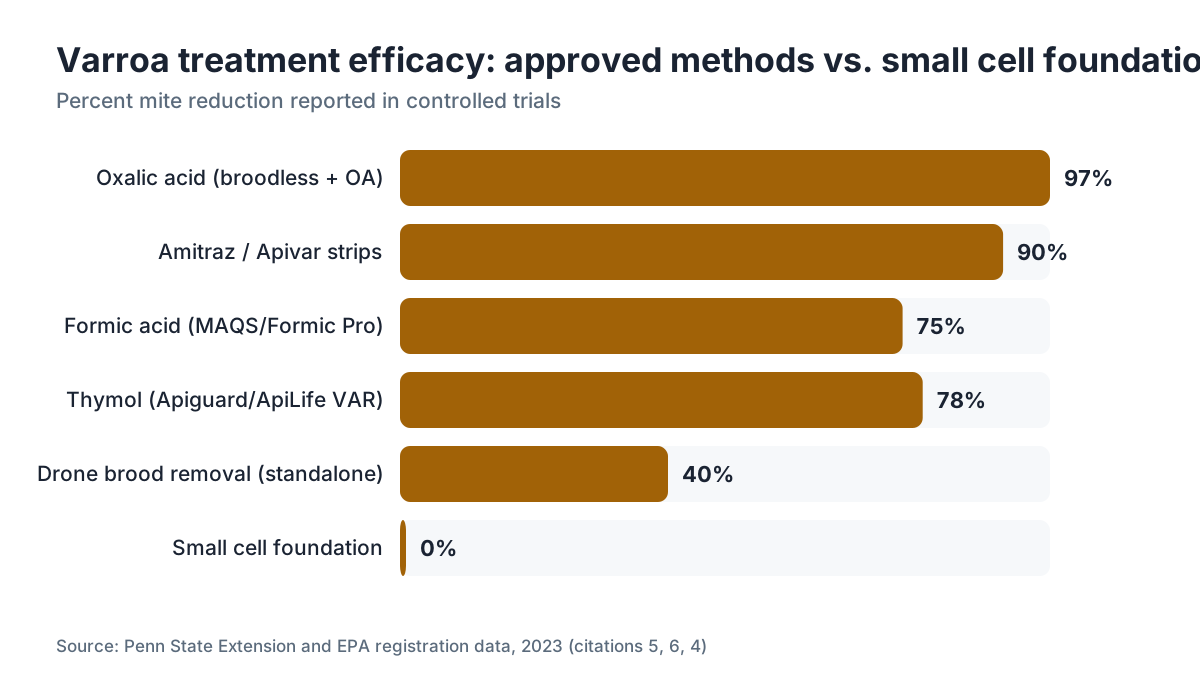
Treatments with documented efficacy split into two groups: chemical products registered with the EPA for hive use, and mechanical or biological methods backed by field evidence. The table lays out the main choices.
| Method | Evidence level | Approximate efficacy | Notes |
|---|---|---|---|
| Oxalic acid (dribble or vaporization) | High, multiple trials | 90-99% in broodless colonies [4] | EPA registered; timing is everything |
| Amitraz (Apivar strips) | High | 85-95% in trials [5] | Needs a full brood cycle; resistance emerging in some regions |
| Formic acid (MAQS, Formic Pro) | High | 60-90% depending on temp [5] | Can treat with honey supers on |
| Thymol (ApiLife VAR, Apiguard) | Moderate-high | 65-90% with temp compliance [5] | Temperature-dependent; not below 60°F |
| Drone brood removal | Moderate | 30-50% as a standalone [6] | Useful supplement, not enough alone |
| Brood break + oxalic acid | High | >95% combined [4] | Best during winter cluster or an induced break |
| Small cell foundation | No evidence | No significant difference vs. control [1][2] | Not recommended by HBHC [3] |
Oxalic acid during a broodless window is the single most reliable knockdown available to hobbyists, hitting 90 to 99 percent in trials [4]. Small cell foundation returns no measurable mite benefit against a control [1][2]. That is the gap in one line.
The Honey Bee Health Coalition Varroa Management Guide has free, printable treatment decision trees sorted by season, colony condition, and product availability. Cooperative Extension programs at land-grant universities, including Penn State, UC Davis, and North Carolina State, publish state-specific treatment calendars built around local climate [7][8][9].
Want a structured way to track mite loads and time treatments to your local brood cycle? VarroaVault's free tools handle the monitoring math so you catch the moment a colony crosses the 2% action threshold, well before it turns into a crisis.
Does cell size affect bee health in any other way?
Fair question, and it deserves a straight answer kept separate from the varroa claim.
Some researchers have asked whether modern commercial foundation, which settled at roughly 5.4 mm in the early 20th century, is an artificial enlargement over what bees build on their own. The evidence is mixed. Bees in different geographic populations and subspecies show different natural cell preferences. Wild European Apis mellifera colonies tend to build in the 5.1 to 5.4 mm range. Africanized honey bees, which show stronger varroa resistance partly from behavior, do build somewhat smaller cells, but that correlation does not prove cell size causes the resistance.
You can read more about the behavioral and genetic differences in Africanized populations in our overview of the africanized honey bee.
Set varroa aside and some natural comb advocates argue that bees on plastic or heavily embossed wax may build less evenly, burn more energy fixing cells, or regulate brood temperature a touch differently. None of those claims has strong numbers behind it. They are not crazy. They are just not proven. If your goal is varroa control specifically, the evidence says cell size is not the lever to pull.
What did the scientific community conclude from the small cell trials?
The verdict is settled and it is not close. Coffey et al. 2010 wrote it plainly: "We found no evidence that small cell comb reduces Varroa infestation rates" [1]. Ellis et al. 2009 said the same, reporting that "neither small cell nor large cell foundation significantly affected mite infestation levels" against natural comb controls [2].
Reviewers of both papers pointed out that the earlier positive reports were all anecdotal, lacking control groups, consistent mite measurement, and blinding. Without those pieces you cannot tell what is actually doing the work.
The consensus, reflected by the Honey Bee Health Coalition, Penn State Extension, and North Carolina State University Extension, is that small cell foundation is not a recommended varroa strategy [3][7][9]. Future research could change that, but as of 2024 no peer-reviewed trial has reversed it.
One thing the studies did not find: harm. Small cell foundation does not appear to hurt colonies. If a beekeeper wants natural or smaller-cell comb for other reasons, the downside looks low. The real danger sits in believing it replaces monitoring and treatment, because that belief has cost people their bees.
Should I buy small cell foundation for my hives?
Depends entirely on what you expect it to do.
Want to experiment with natural comb building, cut your reliance on plastic foundation, or try something different for philosophical reasons? The evidence does not suggest small cell foundation will hurt your bees. Go ahead.
Buying it because you think it lowers mite counts and lets you skip treatment cycles? Stop there. Colonies run on the belief that small cell controls varroa, without regular alcohol wash monitoring, can crash fast. Varroa populations roughly double every 4 to 6 weeks during peak brood season [6]. A colony that looks fine in May can be collapsing by August if mite loads have been climbing the whole time unchecked.
The supplies market has no shortage of products claiming varroa benefits with no evidence behind them. Small cell foundation is one of the oldest of those claims. For where to source legitimate gear without stepping in a marketing trap, our piece on beekeeping supply companies is a good start.
Here is the bottom line. Small cell foundation costs more than standard, takes colonies longer to draw out, and delivers no documented varroa benefit. For most hobbyists on a budget, that money does more good on an oxalic acid vaporizer or a quality mite-resistant queen.
What actually reduces varroa without chemicals, if anything?
A few non-chemical methods have real evidence behind them, even though none of them match the best chemical treatments used alone.
Hygienic behavior and varroa-sensitive hygiene (VSH) genetics are probably the strongest non-chemical lever a hobbyist has right now. Queens selected for VSH produce workers that find and pull mite-infested pupae out of capped cells at much higher rates. USDA Baton Rouge Bee Lab research shows high-VSH colonies can hold mite populations below the economic threshold without chemical intervention under certain conditions [10]. That is a real finding from real research, unlike small cell.
Brood breaks work too. A natural swarm-prep pause or a queen caged for a week or two interrupts the mite's reproductive cycle. Pair a brood break with oxalic acid during the broodless window and efficacy climbs above 95% across multiple studies [4].
Drone brood trapping is the hands-on option. Add a drone comb frame, let the bees fill and cap it, then freeze and remove it. Done consistently across a season it cuts mite populations 30 to 50% [6]. It is labor-heavy and completely chemical-free.
Trap combs, frequent monitoring, and queen genetics all pull in the same direction. No single non-chemical method carries a colony alone in most climates. Anyone telling you otherwise, whether they are selling small cell foundation, essential oil blends, or frequency generators, is leaving something out.
For tracking mite levels through the season, VarroaVault's monitoring tools give you the calculation framework and treatment timing around your local climate and brood cycle, at no cost.
How should I monitor for varroa instead of relying on small cell?
The alcohol wash is the most accurate mite monitoring method there is. Scoop about 300 bees (roughly half a cup) from the brood nest, wash them in isopropyl alcohol or windshield washer fluid, and count the mites that drop out. Divide mites by bees, multiply by 100, and you have your infestation percentage [3][7].
The action threshold most beekeepers use in North America is 2% during the brood season, meaning 2 mites per 100 bees [3]. Penn State Extension holds that 2% line from April through August and pushes for a lower threshold heading into fall, when it matters most for winter bee health [7]. Some researchers argue for 1% in August and September specifically, because colonies raising winter bees cannot absorb the virus load that comes with high mite counts.
Sticky boards and CO2 washes are the alternatives, each with tradeoffs. Sticky boards need a 24-hour count and run more variable. CO2 washes are faster but need equipment. The Honey Bee Health Coalition's free Varroa Management Guide walks through all three with photographs and calculation tables [3].
The habit is what matters. Monitor on a schedule, more than when something looks off. Infested colonies usually look completely normal until they are past easy recovery. Monthly checks during the active season are the floor. Every three weeks from July through September is better.
Frequently asked questions
Has any study ever found small cell foundation reduces varroa mites?
No peer-reviewed, replicated, controlled study has found that small cell foundation (4.9 mm) significantly reduces varroa infestation rates. The two most rigorous trials, Coffey et al. 2010 and Ellis et al. 2009, both in the Journal of Economic Entomology, found no statistically significant difference in mite levels between small cell, standard, and natural comb treatments.
What size is small cell foundation and how does it differ from standard?
Small cell foundation is typically stamped at 4.9 mm across the cell. Standard commercial foundation ranges from 5.1 to 5.4 mm by manufacturer. Advocates claim 4.9 mm is closer to a natural, pre-industrial cell size. Research teams measuring what bees actually build on small cell foundation have found wide variation, with cells often drawing out larger than intended.
Why do beekeepers who use small cell say their mite counts dropped?
The likely cause is confounding variables. Beekeepers who adopt small cell programs often improve monitoring, change queen genetics, and tighten management at the same time. Letting untreated colonies die and breeding only from survivors also selects for varroa-tolerant genetics over years. The cell size itself is almost certainly not the causal factor in any drop they observe.
Does the Honey Bee Health Coalition recommend small cell foundation for varroa control?
No. The Honey Bee Health Coalition's Varroa Management Guide, the leading consensus reference for North American beekeepers, does not list small cell foundation as a recommended varroa method. The guide centers on alcohol wash monitoring, EPA-registered treatments, and genetic approaches like VSH queens.
Is natural comb the same as small cell foundation?
They overlap but are not identical. Natural comb is built freely by bees with no embossed foundation guiding cell size. Small cell foundation is a manufactured product with a specific 4.9 mm cell size stamped in. Coffey et al. 2010 tested both alongside standard foundation and found neither reduced varroa relative to the other.
Can small cell foundation harm my bees?
The studies show no evidence of harm from small cell foundation itself. The danger is the false confidence it creates. Beekeepers who believe small cell is controlling their mites may skip monitoring and delay treatment, letting varroa populations reach colony-collapsing levels before they notice a problem.
What is the varroa treatment with the highest efficacy?
Oxalic acid applied during a broodless period, by dribble or vaporization, shows 90 to 99% efficacy across multiple studies. Pairing a brood break with oxalic acid vaporization produces the highest single-application results. Apivar (amitraz) strips show 85 to 95% efficacy and are reliable for colonies with active brood when a full treatment cycle is completed.
At what mite percentage should I treat my colony?
The standard action threshold across most North American extension programs is 2 mites per 100 bees (2%) during the brood season. Some researchers recommend dropping to 1% in August and September, when colonies raise the long-lived winter bees. Penn State Extension and the Honey Bee Health Coalition both use the 2% benchmark as the treatment trigger.
Do Africanized honey bees have smaller cells and is that why they resist varroa?
Africanized bees build slightly smaller cells on average, but researchers credit their higher varroa tolerance mainly to behavior: faster brood development, higher rates of hygienic behavior, and more aggressive grooming. Cell size alone does not explain their resistance, and the link between Africanized genetics and mite tolerance is more complex than any single physical factor.
How often should I do an alcohol wash to monitor varroa?
Monthly monitoring during active brood season (roughly April through October in most of the continental US) is the minimum most extension programs recommend. During the high-risk late summer window of July through September, testing every three weeks gives better resolution. One wash takes about 10 minutes once you have the process down, and it is the only reliable way to know your actual mite load.
Is small cell foundation worth the extra cost compared to standard foundation?
For varroa management, no. Small cell foundation costs more per sheet, takes colonies longer to draw out (bees often resist a cell size that differs from their preference), and provides no documented mite benefit. On a limited budget, that money does more work on an oxalic acid vaporizer or a VSH-tested queen.
Are there any non-chemical varroa management methods with real evidence?
Yes. VSH (varroa-sensitive hygiene) genetics, brood breaks combined with oxalic acid, and consistent drone brood removal all have peer-reviewed support. None match the best chemical treatments used alone, and most researchers and the Honey Bee Health Coalition treat non-chemical methods as supplements to a monitoring-and-treatment program, not replacements for it.
Did Africanized bees develop varroa resistance because of cell size or behavior?
Behavior is the primary driver. Africanized colonies show higher rates of hygienic behavior, more frequent grooming, and faster brood development that compresses the mite's reproductive window. Their average cell size runs slightly smaller than European strains, but controlled experiments have not established cell size as a significant independent factor in their mite tolerance.
Where can I find free varroa management resources from reputable sources?
The Honey Bee Health Coalition publishes a free downloadable Varroa Management Guide at honeybeehealthcoalition.org. Penn State Extension, UC Davis, and North Carolina State University Extension all maintain free online varroa resources with regional treatment calendars. The EPA's pesticide registration site lists all currently approved varroa treatments with label requirements.
Sources
- Journal of Economic Entomology, Coffey et al. 2010, 'Evaluation of Small Cell Foundation': Small cell comb did not reduce Varroa mite levels relative to standard comb in a two-year replicated trial
- Journal of Economic Entomology, Ellis et al. 2009, 'The Effects of Small Cell Comb on Varroa Mite Populations': Neither small cell nor large cell foundation significantly affected mite infestation levels compared to natural comb
- Honey Bee Health Coalition, Varroa Management Guide: HBHC does not list small cell foundation as a recommended varroa management method; 2% action threshold is standard
- EPA, Pesticides program (oxalic acid registration and efficacy): Oxalic acid shows 90-99% efficacy in broodless colonies and is EPA registered for use in honey bee hives
- Penn State Extension, Varroa Treatment Efficacy Comparison: Apivar (amitraz) shows 85-95% efficacy; formic acid 60-90% depending on temperature; thymol 65-90% with temperature compliance
- Penn State Extension, Varroa Mite Monitoring and Management: Varroa populations can double every 4 to 6 weeks during peak brood season; drone brood removal reduces mite populations 30-50% as a standalone
- Penn State Extension, Varroa Management Action Thresholds: Penn State recommends 2% mite infestation threshold April through August and a lower threshold approaching fall
- UC Agriculture and Natural Resources (UC Davis), Varroa Resources: UC extension publishes regionally specific varroa treatment calendars for California beekeepers
- NC State University Extension, Apiculture Program: NC State extension lists recommended varroa management methods consistent with HBHC guidance; small cell is not among them
- USDA ARS, Baton Rouge Bee Lab VSH Research: High-VSH colonies can maintain mite populations below economic thresholds under certain conditions without chemical intervention
- EPA, Pesticides program (Apivar/amitraz label): Apivar strips are EPA registered for varroa control in honey bee colonies with a full brood cycle treatment window
- EPA, Pesticides program (Formic Pro and MAQS labels): Formic acid products are EPA registered for varroa treatment and approved for use with honey supers on
Last updated 2026-07-09