Spray application oxalic acid: does it actually work on varroa?
TL;DR
- Oxalic acid spray kills phoretic varroa riding on adult bees, but it usually hits only 40-60% efficacy because it can't touch mites sealed inside capped brood.
- The EPA registered it in 2015, and it's legal in all 50 states.
- Most beekeepers get better results from vaporization or amitraz strips.
- Spray earns its keep as a broodless-period treatment when nothing else is on hand.
What is oxalic acid spray and how is it supposed to work?
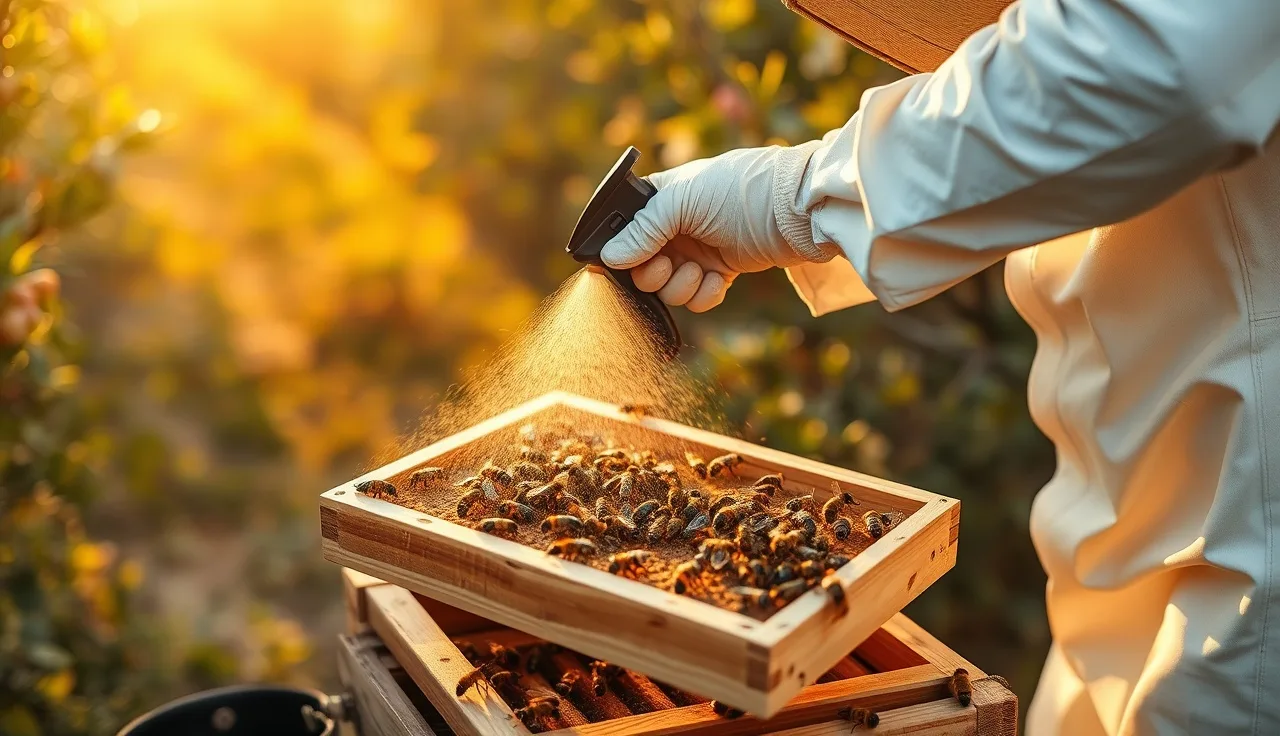
Oxalic acid is an organic acid that shows up naturally in rhubarb, spinach, and plenty of other plants. Against Varroa destructor it works by direct contact. The acid kills phoretic mites, the ones riding on adult bees, when it touches them. Spray application means dissolving oxalic acid dihydrate crystals in sugar syrup and misting or drizzling that solution onto the bees in the frame gaps.
The action is physical and chemical, not systemic. Oxalic acid doesn't circulate through a bee's hemolymph or soak into wax the way some synthetic miticides do. A mite has to actually touch treated bee surface to die. Simple enough, but it creates an immediate problem. During a normal brood-rearing season, roughly 80-90% of a colony's varroa live sealed inside capped brood cells [1]. Spray reaches none of them.
The spray method came out of European research in the 1990s, before vaporizers were common. Beekeepers who couldn't get a vaporizer would dissolve oxalic acid in 1:1 sugar syrup and mist the bees between frames with a handheld sprayer. It worked, within limits. Those limits are the whole story.
Is oxalic acid spray legal to use in the United States?
Yes. The EPA registered oxalic acid dihydrate for use in honey bee colonies in 2015, and Api-Bioxal is the only commercial product currently registered [2]. The label covers three application methods: dribble (trickle), vaporization, and extended-release sponge strips. Spray isn't listed as its own method; the label handles "direct application" and spraying under the dribble-equivalent use pattern, and the exact wording depends on the label version.
Here's the legal part that trips people up. In the United States you must use a registered product (Api-Bioxal or a state-registered equivalent) according to its label. The label is the law under FIFRA, the Federal Insecticide, Fungicide, and Rodenticide Act [3]. Buying oxalic acid dihydrate as wood bleach and dosing your hives with it is off-label use and not legal, even though the chemistry is identical.
The Honey Bee Health Coalition's Tools for Varroa Management guide notes that Api-Bioxal is approved for use in hives with or without honey supers, which is one of its real advantages over many synthetic miticides [4]. Read the current label before you treat. The language has changed since the 2015 registration.
What efficacy does oxalic acid spray actually achieve against varroa?
Here's where the honesty starts. Published efficacy for oxalic acid spray swings widely depending on brood status, technique, and how researchers counted the dead mites.
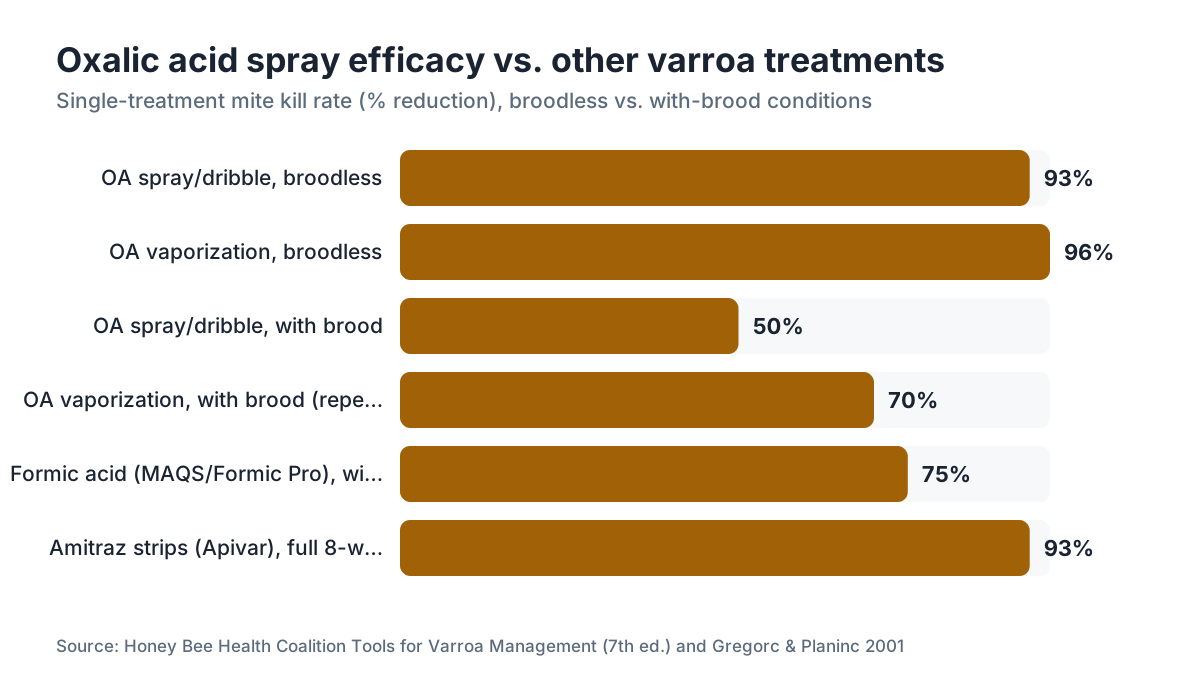
In broodless colonies, a single oxalic acid dribble or spray can reach 90-97% mite knockdown [5]. That number gets quoted constantly. It's real, but it only holds in the broodless condition. Add brood and single-treatment efficacy drops to 40-60%, because the capped cells shield most of the mite population from any contact treatment [1].
A 2001 study by Gregorc and Planinc in Apidologie measured oxalic acid across colonies with different brood levels and found mite fall was significantly tied to the proportion of open brood. More brood, lower kill for any contact method [1]. Repeated sprays about a week apart can catch newly emerged mites before they slip back into cells and push efficacy higher, but you're racing the brood cycle and stressing bees with repeated handling.
So the practical rule: if your colony has capped brood, which is most of the year in most climates, spray or dribble is a backup tool, not a primary control.
| Method | Broodless efficacy | With brood (single tx) | Brood penetration |
|---|---|---|---|
| OA spray/dribble | 90-97% | 40-60% | None |
| OA vaporization | 90-99% | 60-80% (repeated) | None |
| Formic acid (MAQS/Formic Pro) | 60-90% | 60-90% | Partial |
| Amitraz strips (Apivar) | N/A | 90-97% (8 wk) | Indirect via bee contact |
Sources: Honey Bee Health Coalition Tools for Varroa Management [4], EPA Api-Bioxal label [2].
How does spray compare to vaporization and dribble?
All three oxalic acid methods share one hard limit. They kill only phoretic mites, and none of them reach into capped cells. The differences are coverage, bee stress, and how much liquid you leave behind.
Vaporization (sublimation) turns oxalic acid crystals into vapor that spreads through the hive and coats bees and comb. Research generally shows it reaches slightly higher kill rates per application than dribble or spray, and it drops far less liquid into the hive, which matters for winter moisture [6]. Vaporizing every 5 days across 3 to 5 cycles can cut mite loads hard even with brood present, because you keep catching newly emerged mites before they re-infest cells.
The dribble method, where you run a measured volume of oxalic syrup along each frame seam, works about as well as spray but doses more precisely per bee. The Api-Bioxal label calls for 5 mL of prepared solution per seam of bees for dribble [2]. Spraying is harder to dose evenly.
For a hobbyist with a few hives, the money looks like this. A vaporizer runs $150-300 up front and lasts years. An Api-Bioxal packet costs about $15-25 and treats several hives. Spray needs almost no equipment and gives the least consistent results. If you're buying gear anyway, the varroa mite literature broadly favors vaporization for winter and broodless work and a slow-release miticide like Apivar for in-season control.
When does oxalic acid spray make sense to use?
There are real situations where spray is the right call, or at least the best call you've got.
Broodless periods are the prime window. Late fall after the queen quits laying, or after a deliberate brood break (caging the queen for 24 days to let all capped brood emerge), leaves your mite population almost entirely phoretic. One clean dribble or spray then can knock out more than 90% of your mites going into winter [4]. This is probably the highest-value single treatment in all of beekeeping, and it's cheap.
Package bees and splits fit well too. A newly hived package has no capped brood for several days after installation. A treatment a few days in, before the first eggs cap, hits nearly the whole mite population.
Emergencies count. No vaporizer, a colony with a climbing mite count, and something has to happen now. Spray won't be your best outcome, but knocking mites down 40-60% beats standing around waiting for equipment.
What spray is bad for: mid-summer treatment of a full production colony carrying frames of brood. That job needs an amitraz strip (Apivar), a formic acid product (Formic Pro), or repeated vaporization. Leaning on spray as your main summer miticide is how beekeepers lose colonies in August.
What concentration and mixing ratio should you use for oxalic acid spray?
The Api-Bioxal label sets the prepared dribble solution at 3.5% oxalic acid dihydrate in 1:1 sugar syrup (sugar to water by weight) [2]. That works out to roughly 35 grams of Api-Bioxal per liter of 1:1 syrup. Don't go higher. Stronger solutions kill more mites, sure, and they also kill more bees, cost you queens, and damage brood.
For spray, use the same concentration. Dissolve the crystals in warm syrup until fully clear, cool it to room temperature, load a hand sprayer, and mist a light coat onto the bees you can see in each frame gap. You want the bees lightly coated, not soaked. Wet bees chill, and chilled bees in October is not a situation you want to create.
A few mixing details that matter. Use warm water, not boiling, because oxalic acid dissolves faster in warm liquid. Stir until the solution runs clear; undissolved crystals clog sprayers and dose unevenly. Wear nitrile gloves and eye protection. At working concentration, oxalic acid irritates skin and will genuinely damage your eyes.
If you're sorting out gear, the beekeeping supplies lineup at most vendors includes small hand sprayers rated for acidic solutions. Garden sprayers with brass fittings corrode over time from the acid.
Does spray application harm bees or queens?
At label-rate concentration, oxalic acid spray causes measurable but generally acceptable bee mortality when you use it right. Studies show a modest bump in adult bee deaths in the days after treatment, especially with heavy application or cold weather [7]. Bees grooming themselves after a light coat swallow some oxalic acid, and at label concentration that doesn't appear to cause meaningful gut damage in healthy adults.
Queen loss is the risk people fret over, and it's real but manageable. Queens hate disruption, and soaking one directly with oxalic solution can kill her. The guidance is to avoid spraying straight into the cluster center where the queen usually sits, especially in cold weather when the bees are packed tight and you can't spot her. Some beekeepers cage or clip the queen out before treatment. That's cautious, and probably worth it for a queen you value.
Brood damage is possible if the solution hits open larvae directly. One more reason the broodless period is the safest window.
The Honey Bee Health Coalition guide says oxalic acid "is one of the safest miticides available in terms of honey and wax residues," and that residues in honey are indistinguishable from the oxalic acid already present naturally [4]. That's a solid reassurance for hobbyists worried about their harvest.
How many times can you spray in one season, and how often?
The Api-Bioxal label allows a maximum of two dribble/spray applications per year, at least 24 days apart [2]. That's a hard regulatory limit, not a suggestion. Two applications isn't enough repetition to beat the brood-protection problem if your colony carries significant brood.
Vaporization under the current label allows more frequent dosing (the label lays out regimens of 3 treatments 5 days apart), which is part of why vaporization is more flexible for in-season use.
If you're using spray as a broodless treatment, two applications 24 days apart is plenty. One good application during the broodless window clears the phoretic population, and a follow-up 3 to 4 weeks later catches mites that emerged from cells you assumed were already empty. In practice, most beekeepers doing a proper fall broodless treatment run one application, get excellent results, and keep the second allowance in reserve.
Can you spray oxalic acid when honey supers are on?
Yes, and this is one of the genuine advantages of oxalic acid over most other miticides. The Api-Bioxal label doesn't restrict use to when supers are off [2]. Synthetic miticides like Apivar (amitraz) and Apistan (fluvalinate) require you to pull supers first because of wax absorption and honey contamination concerns.
Still, treating with supers on during a honey flow is mostly pointless on efficacy, even if it's fine on legality. During peak flow your colony has wall-to-wall capped brood. A spray at 40% efficacy on a colony carrying a 3% mite load won't save it. You'll get marginal knockdown, burn one of your two annual applications, and still finish summer with a mite problem.
The super-on permission matters most for spring splits and late-fall treatments, where you'd rather not fuss with pulling partially filled supers.
What do university and extension researchers actually recommend?
The short version of what the research community says: oxalic acid spray is a legitimate tool with a narrow use case, not a general-purpose varroa fix.
The University of Minnesota Bee Lab, Penn State Extension, and the Honey Bee Health Coalition all include oxalic acid dribble and spray in their recommended rotations, and all attach the same caveat, that efficacy hangs on brood status [4][8]. The HBHC guide specifically recommends oxalic acid in fall when colonies are broodless or near it, as part of a full-season integrated pest management plan.
Penn State's varroa management publication treats timing relative to the brood cycle as "the most important factor affecting treatment success" for any contact miticide, oxalic acid included [8].
No major research institution recommends spray or dribble as a standalone mid-summer strategy. The field has shifted toward vaporization for its flexibility and toward Apivar strips for reliable in-season control. Spray fills a niche: cheap, low-equipment, broodless-period application. Inside that niche, it works well.
If you want a protocol built around your local brood cycle and your own mite counts instead of a generic calendar, the free tools at VarroaVault help you put one together.
What are the biggest mistakes beekeepers make with oxalic acid spray?
The most common mistake is treating a colony full of brood and expecting spray to solve a mite crisis. It won't. Monitor in July, find a 3%+ infestation with frames of brood, and spray isn't your answer. That situation needs Apivar, Formic Pro, or a committed vaporization regimen.
Second mistake: under-dosing because you're scared of hurting the bees. A light mist that barely wets them doesn't cover enough of the mite-bee interface to kill reliably. Lightly coated, not drenched.
Third: treating in cold weather without thinking about what that does to bees. Below about 50 degrees F (10 C), the cluster is tight, metabolism slows, and getting wet adds real cold stress. Doing a fall treatment? Pick a mild day when bees are loosely clustered or still moving.
Fourth: skipping mite counts before and after. Spray is cheap, which tempts people to use it as a preventive no matter the actual mite level. Monitoring tells you whether you needed to treat and whether it worked. An alcohol wash or sugar roll before treatment and again 30 days after is the only way to know. The varroa mite monitoring guides at major extension programs all hammer this point.
Fifth: not reading the label. Home-brew concentrations or unapproved carriers (honey instead of sugar syrup, say) are both illegal and unpredictable for bee safety.
Is oxalic acid spray worth it, or should you just get a vaporizer?
If you run more than 2 or 3 hives and you're serious about keeping them alive, buy a vaporizer. The $150-300 up front pays for itself inside a season or two in reduced losses, and vaporization gives you more treatment flexibility across the year [6]. That's my honest opinion.
For a first-year beekeeper with one hive, a tight budget, and a fall package that just went broodless, spray is a perfectly legitimate treatment. It costs almost nothing if you already own a hand sprayer. One proper fall treatment in a broodless colony genuinely protects it going into winter.
The spray-versus-vaporizer either/or is a little artificial anyway. Plenty of experienced beekeepers run a vaporizer as their main tool and keep an Api-Bioxal packet around for dribble or spray when the vaporizer doesn't fit, like inside an established structure, or on a small nuc when you haven't set up full protective gear.
For sourcing and comparing, established beekeeping supply companies usually beat Amazon for products that ship with real label documentation. Once you find a good vendor, check whether they run free shipping honey bee supply companies deals, since Api-Bioxal packets are light but vaporizers are not.
So: spray works within its limits. Know the limits, stay inside them, count your mites.
Frequently asked questions
Can I make my own oxalic acid spray at home instead of buying Api-Bioxal?
Legally, no. Under FIFRA you must use an EPA-registered product applied according to its label. Api-Bioxal is currently the only registered oxalic acid product for honey bee colonies in the US. Using industrial oxalic acid (wood bleach) in your hives is off-label pesticide use, even though the chemistry is the same. The cost difference is small enough that the legal and safety risk isn't worth it.
How do I know if my oxalic acid spray treatment actually worked?
Run an alcohol wash or sticky board count before treatment and again 30 days after. Mite levels should drop measurably. During a broodless period you should see a 90%+ drop. With brood present, expect 40-60%. No drop at all can mean the solution was too dilute, the application too light, or mites from nearby colonies are re-infesting your hive.
How long does oxalic acid remain active in the hive after spraying?
Oxalic acid spray has no residual activity the way a strip miticide does. Once the solution dries or gets groomed off the bees, the killing stops. That's why timing against the brood cycle matters so much. There's no extended kill period to catch mites emerging from cells after treatment.
Will oxalic acid spray affect my honey?
No meaningful contamination at label rates. Oxalic acid is naturally present in honey at 8-40 mg/kg depending on floral source. Treatment at label concentration leaves residues indistinguishable from those natural background levels, according to the Honey Bee Health Coalition Tools for Varroa Management guide. That's why Api-Bioxal is approved for use even with honey supers in place.
How many mites does oxalic acid spray kill compared to Apivar?
Apivar (amitraz) strips left in for the full 8-week course reach 90-97% efficacy across the whole mite population, including mites emerging from brood. Oxalic acid spray in a colony with brood reaches 40-60% in a single treatment and is capped at two applications per year. For mid-season treatment of an active colony, Apivar is far more effective. Oxalic acid spray matches or beats Apivar only during broodless periods.
Can I spray oxalic acid on a nuc or split?
Yes, and it works well. A fresh split or newly hived nuc often has little or no capped brood for several days, putting you in or near the broodless window where spray efficacy is highest. Treat 3 to 5 days after the split, before the first eggs cap, for best results. Use the label concentration: 3.5% oxalic acid dihydrate in 1:1 sugar syrup.
Is it safe to spray oxalic acid when bees are clustering for winter?
A light cluster treatment is one of the most valuable applications, but temperature matters. Treat on a day above 40-50 degrees F so the cluster is slightly loose and bees can spread the solution by moving. In a tight winter cluster below 40 F, you risk chilling bees with cold liquid. The broodless state of a winter cluster is exactly the high-efficacy scenario where this treatment pays off most.
Does spraying stress the bees or reduce the colony population?
At label concentration, researchers have seen a modest short-term rise in adult bee mortality in the days after treatment. For a healthy colony that effect is small next to the benefit of knocking mites down. The real risk comes from treating in cold weather, soaking bees instead of lightly coating them, or applying too often. Follow label rates and temperature guidance and the stress stays manageable.
Can varroa mites develop resistance to oxalic acid?
No resistance to oxalic acid has been documented in field populations of Varroa destructor in current published literature. The physical acid-contact mechanism makes resistance harder to develop than with pyrethroids or amitraz. This is one reason oxalic acid has stayed reliably effective since its introduction, and why resistance-management rotation advice focuses on cycling synthetic miticides, not oxalic acid.
What protective gear do I need to apply oxalic acid spray?
At minimum, nitrile gloves and safety glasses or goggles. The working solution (3.5% in syrup) irritates skin and can seriously damage eyes on direct contact. A dust mask isn't needed for the prepared liquid spray, but it's essential if you ever handle raw oxalic acid crystals in dry form, which irritate the respiratory tract. Standard beekeeper protective clothing covers the bee-handling part of the job.
How does the number of bees in the hive affect how much spray I use?
Coverage matters more than a fixed volume. You want a light, even mist on all the bees visible in each frame gap. The Api-Bioxal label guidance for dribble is 5 mL per seam of bees; for spray, apply enough to visibly coat the bees without soaking them. A strong colony with 8 seams needs more solution than a small nuc with 3 seams. Don't over-apply trying to compensate for bees you can't see.
Is there any point spraying oxalic acid in summer when brood is present?
Only as an emergency partial measure. If your summer mite count hits 3-4% and you have no strips or vaporizer, a spray buys you some reduction (maybe 40-50%) while you get proper supplies. It's no substitute for a real summer treatment like Apivar or Formic Pro. Using spray as your primary summer strategy is one of the fastest routes to a mite-crashed colony by September.
Sources
- Gregorc A, Planinc I. Acaricidal effect of oxalic acid in honeybee colonies. Apidologie, 2001: 80-90% of varroa population is inside capped brood during brood-rearing season; contact treatments miss mites in sealed cells
- EPA, Api-Bioxal Oxalic Acid Dihydrate label (EPA Reg. No. 89459-1): Api-Bioxal label specifies 3.5% oxalic acid dihydrate in 1:1 sugar syrup, 5 mL per seam for dribble, max two applications per year at 24-day minimum interval, approved with honey supers
- EPA, Federal Insecticide Fungicide and Rodenticide Act (FIFRA): Under FIFRA, pesticide labels are legally binding; use must conform to label directions
- Honey Bee Health Coalition, Tools for Varroa Management Guide (7th edition): Oxalic acid approved with honey supers; one of safest miticides for honey and wax residues; recommended for broodless fall treatment; residues indistinguishable from naturally occurring levels
- Gregorc A, Planinc I. Acaricidal effect of oxalic acid in honeybee colonies. Apidologie, 2001: Single oxalic acid dribble or spray reaches 90-97% knockdown in broodless colonies; mite fall significantly correlated with proportion of open brood
- Underwood R, Currie R. The effects of temperature and dose of oxalic acid on treatment efficacy and queen survival. Apidologie, 2004: Vaporization deposits less liquid into the hive and achieves efficacy comparable to or exceeding dribble; temperature affects queen survival post-treatment
- Higes M et al. Negative long-term effects of oxalic acid in Apis mellifera iberiensis. Journal of Apicultural Research, 2020: Oxalic acid treatment at working concentrations causes modest short-term increase in adult bee mortality; effect is small in healthy colonies at label rates
- Penn State Extension, Varroa Mite Management in Pennsylvania: Treatment timing relative to brood cycle is the most important factor affecting treatment success for contact miticides including oxalic acid
- USDA AMS National Organic Program, allowed substances list for oxalic acid: Oxalic acid is allowed for use in certified organic bee operations as a miticide
- University of Minnesota Bee Lab, Varroa mite management: OA dribble and spray included in recommended treatment rotations with caveat that efficacy depends on brood status; vaporization preferred for flexibility
Last updated 2026-07-10