Oxalic acid vaporization in cold weather: does it still work?
TL;DR
- Oxalic acid vaporization works in cold weather, including at or just below freezing, as long as the colony is broodless.
- Efficacy against phoretic mites stays high (90% or more) no matter the ambient temperature.
- The real limits are cluster behavior, vaporizer performance, and applicator safety in cold air.
- Most beekeepers treat down to 32°F (0°C).
What temperature does oxalic acid vaporization actually need?
No minimum ambient temperature appears on the EPA-registered label for Api-Bioxal, the only oxalic acid product approved for use in the United States. The Véto-pharma label lists a broodless condition as the key requirement for high efficacy, not a temperature threshold [1]. That matters, because a lot of beekeepers assume "cold means don't treat." That's backwards. Cold weather is often when colonies are most broodless, which makes winter one of the best treatment windows of the year.
Most experienced beekeepers treat down to about 32°F (0°C). Some push below that. The limit is not chemical. Oxalic acid sublimes (converts from solid to vapor) at around 157°C (315°F) at the vaporizer plate, and that process does not care about 40-degree outdoor air. What changes in cold weather is the bee cluster. Bees cluster tightly below about 57°F (14°C), and a dense cluster can slow the vapor's spread across every bee on the outer shell of a very large colony [2].
The University of Minnesota Extension notes that oxalic acid vaporization can be done any time bees are not flying, which covers most of the northern winter [2]. That's the practical green light from a source you can trust.
Does cold weather reduce how well the vapor kills mites?
No, not in any direct chemical sense. Oxalic acid kills Varroa destructor by contact, not by absorption or ingestion. A 2012 study in Apidologie found oxalic acid efficacy against phoretic mites (mites riding adult bees, not sealed inside brood cells) consistently above 90% when used during broodless periods, regardless of season [3]. Cold does not degrade the acid or make it less lethal on contact.
The indirect effect of cold is on vapor distribution. When bees cluster, they press into a dense ball, roughly the size of a cantaloupe in a small colony or a basketball in a strong one. Vapor pumped into the bottom of a hive still reaches most bees because it rises and disperses through the cluster, but a very tight, large cluster can leave distribution slightly uneven. Studies have not pinned this down as a major efficacy driver. The Honey Bee Health Coalition's Varroa Management Guide puts single-treatment efficacy at 90 to 99% for broodless colonies, with brood presence being the main variable, not temperature [4].
Here's a real cold-weather bonus. Bees won't break cluster to escape the vapor the way they might in warm conditions, so any irritant effect stays contained. That's an argument for treating in the cold. Bees sit still, vapor saturates the cluster, mites die.
What happens to the vaporizer itself in cold weather?
This is where cold weather genuinely matters. Most battery-powered oxalic acid vaporizers (the Varomor, Varrocleaner, and similar designs) use a heated metal pan or cup to sublimate oxalic acid dihydrate crystals. The heating element itself is not temperature-sensitive. The battery powering it is.
Lithium-ion and sealed lead-acid batteries lose capacity in cold. A 12V car battery or deep-cycle battery sitting in 20°F (-7°C) air delivers much less current than its rated capacity. If your vaporizer needs 12V at a specific amperage to reach sublimation temperature fast, a cold-drained battery heats the pan more slowly, and that can leave some oxalic acid partially volatilized rather than fully sublimated. Partially volatilized acid drops crystals inside the hive entrance and on bees instead of reaching the cluster as fine vapor.
The fix is simple. Keep your battery warm. Store it indoors until just before you treat, or wrap it in a battery blanket. A fully charged, warm battery performs the same in January as in October. Check your manufacturer's specs for minimum operating current. Most units need at least 8 to 10 amps at 12V for proper sublimation.
Propane-powered wand vaporizers (like the Provap 110) sidestep battery issues, though ambient cold cools the metal wand faster between hives. Give the wand a few extra seconds to reheat between colonies in sub-40°F conditions.
Does the hive need to be broodless for cold-weather vaporization to work?
Yes. This is the single most important factor in oxalic acid efficacy, ahead of temperature, time of year, or equipment. Oxalic acid vapor does not penetrate capped brood cells. Any mites sealed inside cells when you treat survive and re-infest bees as soon as those cells uncap [4].
Across most of the northern United States, natural broodlessness runs from late November through January, though exact timing shifts by region and by how mild the fall was. In USDA hardiness zones 5 and below, colonies are often broodless from early December to mid-February [5]. That window is your prime vaporization opportunity, and cold weather is part of what creates it.
In warm climates (zones 8 to 10), colonies may never go fully broodless. For those beekeepers, vaporization still cuts mite loads but takes multiple treatments (typically three rounds spaced 5 days apart) to catch mites as they emerge from cells. The Honey Bee Health Coalition recommends that multi-treatment approach when brood is present [4].
Not sure whether your colony is broodless? Pull a frame from the middle of the cluster on a day that climbs above 50°F. No capped cells with the dark, domed look of brood means you're clear to treat.
How should you apply oxalic acid vapor when it's cold outside?
The basic protocol barely changes, but a few cold-weather adjustments earn their keep.
Seal the hive well. In warm weather, some vapor escapes through small gaps and you lose a bit of treatment. In cold weather the cluster sits toward the center of the hive, away from the entrance, so you want vapor to fill the entire box before it dissipates. Push the entrance reducer to its smallest opening (or close it completely for the 2 to 3 minutes of treatment), and cover the top ventilation if you run screened inner covers.
Extend dwell time a little. Standard guidance from the Api-Bioxal label is roughly 2 to 3 minutes of vapor followed by a sealed period. In cold weather I let it sit sealed for 3 to 4 minutes before reopening. There's no evidence of harm to bees from slightly longer exposure at labeled doses, and you want the vapor deep into the cluster interior.
Dose stays the same. The Api-Bioxal label specifies 1 gram of oxalic acid dihydrate per brood box for vaporization [1]. More does not improve efficacy in any meaningful way and can irritate bees. Less underdoses. Cold weather does not change this math.
Work fast. Set your own comfort aside. Every second a hive is open in sub-40°F weather chills the cluster. Have your vaporizer loaded and hot before you open anything. Insert, dose, seal, move on. A practiced beekeeper can treat a hive in under 90 seconds from opening to sealed.
What personal protective equipment do you need for cold-weather vaporization?
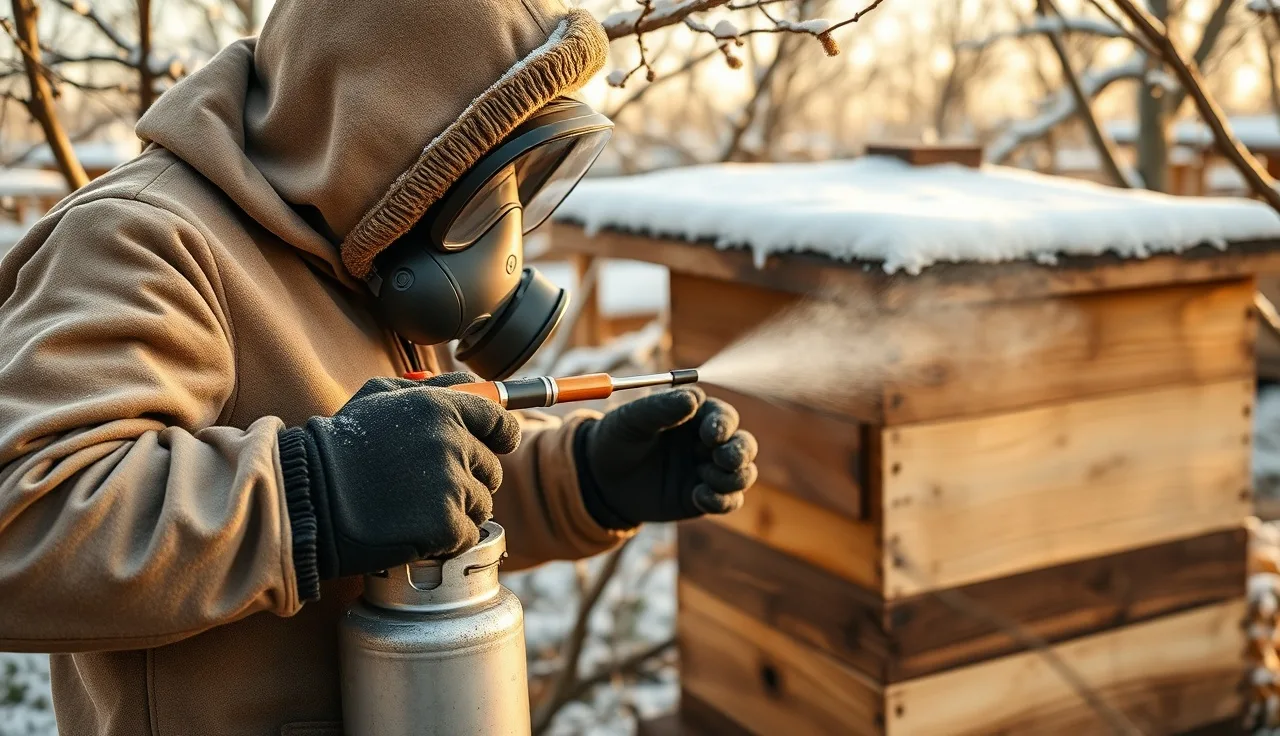
Oxalic acid vapor is a serious respiratory and eye irritant. The Api-Bioxal label requires a respirator rated at minimum N95 or P100 for particulate protection, plus goggles or a face shield [1]. The EPA registration for Api-Bioxal (EPA Reg. No. 84436-1) spells these out. They are not optional.
Cold adds a wrinkle: glasses and goggles fog. Wearing a respirator in cold air makes it worse, because warm exhaled air has nowhere to go. Anti-fog-coated goggles help. So does rubbing a thin film of dish soap onto the lens interiors and letting it dry, an old diver's trick. Some beekeepers switch to full-face respirators that seal better and fog less.
Gloves should already be part of your normal vaporization kit, because the vaporizer wand gets very hot. In cold weather you're probably already wearing insulated gloves, and those protect against accidental contact far better than summer nitrile would.
Do not treat in wind. This is a year-round rule that bites harder in winter, because bulkier PPE is slower to adjust. Wind scatters vapor unpredictably and can push it toward your face even behind a respirator. Wait for a calm day. Winter has plenty of them.
How many treatments do you need in winter?
If the colony is genuinely broodless, one oxalic acid vaporization hits 90 to 99% efficacy against phoretic mites [4]. One treatment. That's the advantage of the winter broodless window. You're not chasing a recurring source of new mites emerging from cells.
The catch is confirming broodlessness, and then confirming your mite load justified treatment in the first place. The Honey Bee Health Coalition recommends treating when mite counts reach 2% of the adult bee population (roughly 2 mites per 100 bees on an alcohol wash), though some beekeepers and researchers use a 3% threshold [4]. In late fall, if you skipped summer treatment and your mites are high, a single winter treatment can still save a colony that would otherwise die by March.
If you treated in fall and mite loads stayed low, one confirmatory winter treatment is reasonable insurance. If your colony still has some brood (common in zone 7 and warmer), plan on three rounds spaced 5 days apart to cover the full brood emergence cycle.
To track mite loads before and after treatment, an alcohol wash kit and a spreadsheet cover it. VarroaVault has free protocol sheets and a mite count tracker if you want records across seasons.
Can you vaporize when it's below freezing?
Yes, and many beekeepers do. Temperatures below 32°F (0°C) are not a chemical barrier to oxalic acid vaporization. The vaporizer plate temperature (157°C and up) is unaffected by ambient cold. The bees are clustered and not flying, which means no drift, no bees returning to the wrong hive, and no bees wandering outside to die on the landing board.
The practical floor most beekeepers report is around 20 to 25°F (-6 to -4°C), and even that is more about equipment and personal comfort than chemistry. Below that, battery performance drops off unless you've kept the battery warm. Propane units treat at any temperature above the point where condensation or ice inside the entrance would block vapor flow, which in practice isn't a concern until you're well below 0°F (-18°C).
Here's the point most people miss. Treating at 25°F in January on a broodless colony often beats treating at 55°F in October on a colony that still holds a patch of brood. Temperature is the wrong variable to fixate on. Broodlessness is the right one.
For more on the varroa mite itself and why mite loads spike in fall, see our overview of varroa mite biology and seasonal cycles.
What does the Api-Bioxal label actually say about temperature?
The EPA-registered Api-Bioxal label, available through the National Pesticide Information Center and the EPA's pesticide product database, sets no minimum ambient temperature for vaporization [1]. That matters, because the label is the law. If a temperature restriction were required, it would be printed there.
What the label does specify: the dose (1 gram oxalic acid dihydrate per brood box), the application method (sublimation, or vaporization), the PPE requirements (N95 minimum, goggles), the maximum number of treatments per year (three per colony), and the recommendation to treat broodless colonies for best results [1].
The Honey Bee Health Coalition's Varroa Management Guide, the closest thing U.S. beekeeping has to a clinical practice guideline, mirrors this. It describes oxalic acid vaporization as usable when temperatures are at or above 0°C (32°F) as a practical guideline, with broodlessness as the efficacy driver [4]. That 32°F figure turns up in multiple extension guides too, not as a label requirement but as a commonly cited practical threshold.
The University of California Agriculture and Natural Resources program describes oxalic acid as effective during the winter broodless period without naming a temperature minimum, which lines up with the label's silence on the question [6].
How does cold-weather vaporization compare to other winter mite treatments?
The main alternatives for winter mite management are oxalic acid dribble (the trickle method), formic acid products like MAQS and Formic Pro, thymol products like Api-Life Var, and no treatment at all.
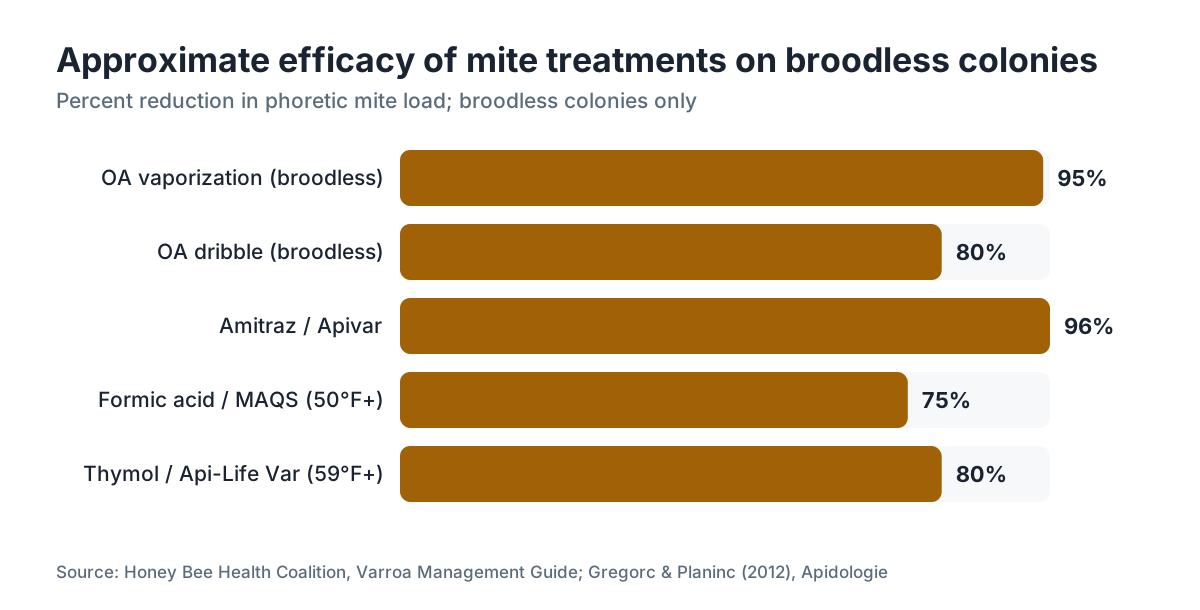
Oxalic acid dribble is also approved for winter use and carries no temperature restriction on its label, but it requires opening the cluster to apply 3.5% oxalic acid syrup directly onto bees between frames. Research generally shows vaporization beats dribble (typically 90 to 99% versus 70 to 90% for dribble) on the same broodless colonies [3]. Dribble also adds moisture to the hive at a time of year when moisture management already matters.
Formic acid products (MAQS, Formic Pro) carry explicit temperature limits. The MAQS label specifies treatment temperatures between 50°F and 85°F (10 to 29°C), which rules out most winter use in northern climates [7]. Formic acid is also more volatile in swinging temperatures, with higher toxicity risk to bees when it's warm.
Thymol-based products (Api-Life Var) generally need temperatures above 59 to 65°F (15 to 18°C) to volatilize and work, making them poor winter choices [8]. Note that Apivar is amitraz, not thymol.
So in cold weather, oxalic acid vaporization is more than effective. It's the only EPA-registered treatment with no temperature floor, which makes it the default choice for winter mite management in North American beekeeping.
| Treatment | Winter usable? | Temp minimum | Brood penetration | Approx. efficacy (broodless) |
|---|---|---|---|---|
| OA vaporization | Yes | None specified (32°F practical) | No | 90-99% |
| OA dribble | Yes | None specified | No | 70-90% |
| Formic acid (MAQS) | No | 50°F | Partial | 60-90% |
| Thymol (Api-Life Var) | No | 59-65°F | Partial | 70-90% |
| Amitraz (Apivar) | Limited | 50°F recommended | No | 93-99% |
What are the signs a cold-weather treatment worked?
You won't see a pile of dead mites on the sticky board the way you might after a high-load summer treatment, because a broodless winter colony usually carries far fewer mites. A good winter treatment on a colony with a 1 to 2% mite load going in might drop only 50 to 200 mites total, spread across several days on the board. Don't use mite drop as your main success metric in winter.
The better read: do a baseline alcohol wash in late October or early November before treating, then a follow-up wash in February or March as bees begin rearing spring brood. If your mite rate stays below 1 to 2% into early spring, the treatment worked. If mites explode in April or May, either your winter treatment fell short or re-infestation crept in from a neighboring colony through late-winter robbing or early spring drift.
Colony behavior is a proxy too. A colony that came through winter with a strong cluster, normal early spring buildup, and a clean brood pattern probably wasn't crushed by varroa. One that's unusually small in March, with spotty brood and deformed wings on early bees, likely had mite levels that overwhelmed even a solid treatment.
Where can you get oxalic acid and the right equipment?
Api-Bioxal is sold through most major beekeeping supply retailers. It comes in 175g and 35g packages. The 175g package runs roughly $25 to $35 at retail and holds enough material for many colonies over multiple seasons, since you use only 1 gram per box per treatment.
Vaporizers range from about $75 for basic battery-powered models to $250 to $400 for propane wand units like the Provap 110. The difference shows up once you're treating more than 5 to 10 colonies at a time. For hobbyist beekeepers with 1 to 5 hives, a battery-powered model is fine as long as you keep the battery warm. Sideliners running 20 to 50 colonies will likely find a propane unit pays for itself in time saved.
For a broader look at where to source beekeeping supplies, including PPE and vaporizers, see our guide to beekeeping supply companies. If free shipping matters to your budget, we also have a roundup of free shipping honey bee supply companies.
VarroaVault's free treatment protocol cards include a cold-weather vaporization checklist you can print and keep in your bee bag. No email required.
Frequently asked questions
What is the minimum temperature for oxalic acid vaporization?
The Api-Bioxal label sets no minimum ambient temperature for vaporization. In practice, most beekeepers treat successfully down to 32°F (0°C), and some go lower. Below about 25°F, battery-powered vaporizers may underperform unless the battery was kept warm. Broodlessness matters far more than temperature for efficacy.
Will oxalic acid vaporization work when bees are in a cluster?
Yes. Oxalic acid vapor rises through the hive and penetrates a clustered colony well enough to contact the vast majority of bees and the mites riding them. A very large, extremely tight cluster might get slightly less even distribution, but studies still show 90 to 99% efficacy on phoretic mites in clustered broodless winter colonies.
How many oxalic acid vapor treatments does a colony need in winter?
If the colony is fully broodless, one treatment reaches 90 to 99% efficacy against phoretic mites. You don't repeat treatments in a broodless colony because no capped cells are re-releasing mites. If your colony still has brood (common in warmer climates), plan three treatments spaced 5 days apart to cover the full cell capping cycle.
Can I use oxalic acid vaporization below freezing?
Yes. Many beekeepers treat at 20 to 25°F without problems. The chemistry is unaffected by cold. The main risk is battery performance: a cold battery may not deliver enough current to sublimate oxalic acid fully. Keep the battery warm until just before treating. Propane-powered vaporizers perform well at any reasonable winter temperature.
Does oxalic acid vapor hurt bees in cold weather?
At the labeled dose of 1 gram per brood box, oxalic acid vapor does not cause measurable bee mortality in healthy colonies. Cold weather means bees can't leave the hive to escape irritation, but at proper doses that isn't a problem. Overdosing is more dangerous in confined cold conditions, so stick strictly to the label rate.
How do I know if my colony is broodless before treating?
On a day when temperatures climb above 50°F, pull a central frame from the cluster and look for capped cells with the dark, slightly domed look of capped brood. Honey and pollen cells have flat or slightly convex wax cappings in a lighter color. No capped brood means you're clear to treat. In most northern U.S. zones, natural broodlessness runs December through January.
What PPE do I need for oxalic acid vaporization in winter?
The Api-Bioxal label requires a minimum N95 respirator (P100 is better) plus goggles or a face shield at all times during application. These requirements don't change in winter. Cold weather can fog goggle lenses; use anti-fog coated lenses or apply a thin dried film of dish soap to the inside surface. Never treat without respiratory protection.
How does oxalic acid vaporization compare to dribble method in winter?
Vaporization consistently outperforms dribble on broodless colonies, with efficacy of 90 to 99% versus roughly 70 to 90% for dribble. Dribble also introduces moisture into the hive during winter, which can worsen condensation problems. For winter treatment, vaporization is the better choice if you have the equipment. Dribble is acceptable if you don't.
Can formic acid or thymol products be used in cold weather instead?
No, not effectively. MAQS (formic acid) has a label minimum of 50°F (10°C). Thymol products like Api-Life Var need temperatures of 59 to 65°F to volatilize properly. Both are labeled for warmer months. Oxalic acid vaporization is the only EPA-registered mite treatment with no temperature floor, which makes it the correct choice for winter mite management.
How do I check if my winter oxalic acid treatment worked?
Do an alcohol wash baseline before treating in fall, then a follow-up wash in February or March. If mite levels stay below 2% into early spring buildup, the treatment worked. Mite drop counts on a sticky board are less reliable in winter because total mite loads are lower. A strong, healthy spring buildup with a clean brood pattern is also a good indicator.
How often can I vaporize with oxalic acid per year?
The Api-Bioxal label allows a maximum of three treatments per colony per year. For a winter broodless treatment, most beekeepers use one application. If you treat in fall (multiple rounds for a colony with brood) and again in winter, track your total applications. Exceeding three per year is not permitted under the EPA registration.
What vaporizer works best for cold-weather treatments?
Propane-powered wand vaporizers like the Provap 110 are the most reliable in cold weather because they don't depend on battery performance. Battery-powered models work fine if you keep the 12V battery warm before use. Either way, confirm the vaporizer reaches full sublimation temperature (the oxalic acid should disappear cleanly, not leave residue in the pan) before inserting it into the hive.
Is oxalic acid vaporization legal to use on colonies with honey supers?
No. The Api-Bioxal label prohibits vaporization when honey supers intended for human consumption are present. In winter this is almost never an issue since supers are typically removed, but confirm your hive configuration before treating. If honey supers are on the hive for any reason, remove them before applying oxalic acid.
Does cold storage or cold weather affect oxalic acid dihydrate crystals?
Oxalic acid dihydrate crystals are stable at cold temperatures. Freezing doesn't degrade the product. The bigger concern is moisture: if crystals absorb humidity, they can clump and fail to sublimate evenly. Store Api-Bioxal in a sealed container in a cool, dry place. Inspect crystals before loading the vaporizer; they should be dry and free-flowing.
Sources
- EPA, Api-Bioxal Product Label (EPA Reg. No. 84436-1): Api-Bioxal label specifies 1 gram oxalic acid dihydrate per brood box for vaporization, maximum three treatments per year, PPE requirements including N95 respirator and goggles, and no minimum ambient temperature for vaporization use
- University of Minnesota Extension, Bee Lab, Oxalic Acid for Varroa Control: Oxalic acid vaporization can be performed any time bees are not flying; colonies cluster below approximately 57°F (14°C)
- Gregorc & Planinc (2012), Apidologie, Efficacy of oxalic acid treatments against Varroa destructor: Oxalic acid efficacy against phoretic mites consistently above 90% during broodless periods regardless of season; vaporization generally outperforms dribble method
- Honey Bee Health Coalition, Varroa Management Guide (current edition): Single vaporization treatment achieves 90-99% efficacy on broodless colonies; recommends treatment threshold of approximately 2% mite infestation rate; brood presence is the primary efficacy variable; multi-treatment protocol (3 rounds, 5 days apart) recommended when brood is present
- USDA Agricultural Research Service, Bee Research Laboratory: In USDA hardiness zones 5 and below, colonies are typically broodless from early December to mid-February
- University of California Agriculture and Natural Resources, Statewide Integrated Pest Management Program, Varroa Mite Management: Oxalic acid is effective during the winter broodless period; no minimum temperature specified for vaporization efficacy
- EPA, MAQS (Mite-Away Quick Strips) Label, Formic Acid: MAQS label specifies treatment temperature range of 50°F to 85°F (10°C to 29°C), precluding most winter use in northern climates
- Penn State Extension, Varroa Mite Management in Honey Bee Colonies: Thymol-based products including Api-Life Var require ambient temperatures of 59-65°F for proper volatilization and efficacy; not suitable for winter use
- National Pesticide Information Center, Oxalic Acid General Fact Sheet: Oxalic acid is a contact toxicant; effectiveness against mites depends on direct contact and is not diminished by cold ambient temperatures
- Oregon State University Extension Service, Managing Varroa Mites in Honey Bee Colonies: Winter vaporization of oxalic acid during the broodless period described as an effective and practical mite management strategy for Pacific Northwest beekeepers
- Honey Bee Health Coalition, Tools for Varroa Management (7th edition): Oxalic acid dribble efficacy estimated at 70-90% on broodless colonies; dribble introduces moisture into the hive and is generally less effective than vaporization
Last updated 2026-07-09